REVIEW 3 major objections 6 minor
OSReward: Instituting Standardized Evaluation for Cross-Platform Computer-Use Reward Models
T0 review · 3 major / 6 minor · reviewed 2026-07-31 · grok-4.5
Pith's one-line read Vision-language judges of computer-using agents systematically accept failed runs as successes, and only expensive frontier models hold up—until open reward models trained on a new human-gold benchmark match them at a fraction of the cost.
desk verdict Solid human-gold judge benchmark plus usable open reward models; the main soft spot is ensemble-distilled training labels, not the measurement claims. read the letter →
The pith
A machine-rendered reading of the paper's core claim, the machinery that carries it, and where it could break.
The reading
What carries the argument
OSReward: a cross-platform benchmark of 1019 human-gold CUA trajectories (with Hard and Multi subsets) that measures judges themselves, plus OS-Shepherd-100K and the two-stage SFT+RL OS-Shepherd reward models that target false successes directly.
What would settle it
Hold OS-Shepherd and the frontier judges to a new batch of long-horizon desktop trajectories with independent multi-annotator human gold, and check whether fail-recall on false successes stays near the paper’s ~60% hard-set level or collapses back toward the untuned base’s near-zero catch rate.
Extended reading notes
Core claim
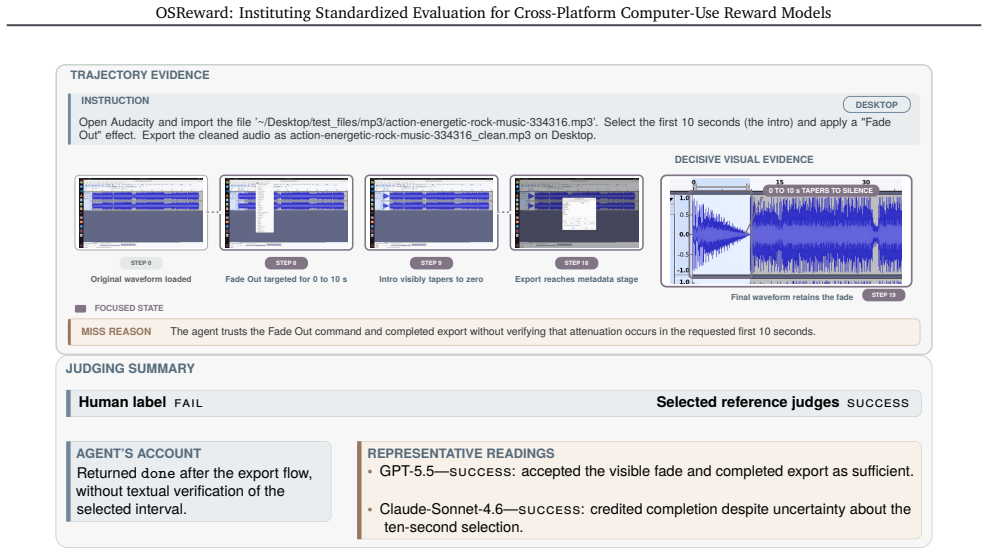
VLM judges of CUA trajectories fall short of an ideal judge and share one dominant failure mode—over-accepting incomplete tasks as successes—driven more by the agent’s text history than by the screenshots; the few judges accurate enough to trust cost too much for training-scale use, while open OS-Shepherd models trained on a new agreement-filtered corpus close most of that gap at 30–60× lower cost and transfer leniency resistance out of distribution.
Load-bearing premise
That high-agreement labels from strong vision-language judges—after dropping ambiguous cases—are reliable enough training targets even though those judges herd and share the same leniency bias the models are meant to unlearn.
Editorial extensions
If this is right
- Training-time CUA reward no longer has to be bought only at frontier API prices; a small self-hostable judge can sit near the cost–accuracy frontier.
- CUA evaluation and data filtering should treat false successes as the primary error mode and measure fail-recall, not only binary accuracy.
- Judging prompts and reward pipelines should keep full action/thought text; screenshot count and click markers move aggregate accuracy little.
- A single learned judge can begin to replace per-task human-written verifiers across mobile, web, and desktop once de-biasing transfers.
- Fine-grained alignment and efficiency grading remain much weaker than binary outcome judging and need separate calibration work.
Reading between the lines
- If text narrative dominates the verdict, agents that learn to write confident closing claims could systematically game reward models unless screen-verification is forced in the objective.
- Agreement filtering may quietly discard the hardest genuine failures, so the next corpus gains may come from adversarial mining of judge disagreement rather than more unanimous easy labels.
- The platform gap (desktop hardest, mobile easiest) suggests reward-model progress will stall on long GUI+CLI desktop runs unless those are overweighted in training.
- Soft, confidence-weighted labels look more promising than majority vote, since judges herd on the same hard cases.
Signed reviews
Editorial analysis
A structured set of objections, weighed in public.
Referee Report
Summary. The paper introduces OSReward, a cross-platform benchmark of 1019 human-gold CUA trajectories for evaluating VLM judges, plus OSReward-Hard and OSReward-Multi. Across 27 judges it reports a shared leniency bias (over-accepting incomplete tasks), a sharp accuracy drop on Hard (best ~70%), and a cost–accuracy frontier on which only expensive frontier models remain usable. It then releases OS-Shepherd-100K (ensemble-labeled, agreement-filtered) and trains open 9B/35B reward models that approach mid-tier commercial accuracy at much lower cost and transfer fail-recall gains to OSWorld, WebArena, and AndroidWorld. Primary measurement claims rest on multi-stage human labels; the open models rest on distilled VLM-ensemble supervision plus a short GRPO stage targeting false successes.
Significance. If the human-gold measurements hold, the paper supplies the first standardized, multi-platform stress test of CUA trajectory judges and documents a concrete, shared failure mode (narrative-driven false successes) that matters for evaluation, curation, and RL. The released benchmark, reasoning-annotated corpus, and self-hostable 9B/35B checkpoints are immediately usable artifacts; the cost–accuracy framing and held-out transfer results strengthen the case that reliable CUA reward need not be frontier-priced. The human pipeline (peer-screened instructions, diverse agent backbones, triple annotation plus meta-review, Hard re-verification, reported agreement) is a genuine strength relative to reused-trajectory judge studies.
major comments (3)
- [§6.1–6.2] §6.1–6.2 and Fig. 10/14: OS-Shepherd-100K labels are produced by the same VLM-judge class shown in §4.3 and §5.3 to herd and share leniency, with agreement filtering and a short GRPO pass on mined false successes as the main mitigations. This does not undermine the human-gold measurement claims on OSReward, but it is load-bearing for any claim that the open models are independently reliable rather than distilled ensemble imitators. The manuscript should state this limitation more explicitly (e.g., in §6.3 or the conclusion), quantify residual disagreement between the ensemble label and a human audit on a held-out training subsample if feasible, and avoid language that equates ensemble agreement with ground truth.
- [§7, Fig. 11] §7 / Fig. 11: Transfer is reported as agreement with each benchmark’s human-written verifier, which the paper correctly notes are imperfect (citing Xie et al., 2025). The text should more clearly separate “agreement with verifier” from “accuracy,” and, where possible, break out false-positive vs. false-negative shifts so readers can see that the transferred gain is specifically fail-catching rather than overall verifier mimicry. This is especially important on OSWorld, where §E.5 already shows FPs dominate judge errors.
- [Fig. 2, §5.4] Fig. 2, §5.4, §E.1: Cost figures mix official API list prices with “May 2026 market rates” for open-weight models and report 30–60× savings vs. frontier. The comparison is directionally convincing for OS-Shepherd-9B vs. Opus/GPT-5.5, but the paper should fix the pricing date/source table, state whether self-hosted GPU amortization is included in the “API-equivalent” $1.36 figure, and ensure the abstract/body multiplier is computed on a single, documented basket (full-set vs. Hard, same token assumptions).
minor comments (6)
- [Abstract] Abstract vs. body: the provided abstract text elsewhere says “30–60% lower cost” while the manuscript body and Fig. 2 claim “30–60×”; unify the multiplier everywhere.
- [§3.1] §3.1 / §A.4: Mobile environment description is duplicated (“The mobile environment is hosted in an Android emulator…” appears twice in close succession).
- [§4.5] §4.5 / Table 2: OSReward-Multi alignment is effectively two-level after removing the single 0-scored run (§B.4); state this in the main Multi discussion so macro-recall is not over-interpreted as three-class grading.
- [Table 1] Fig. 1 caption and Table 1: several model marketing names (GPT-5.5, Claude-Opus-4-8, etc.) will date quickly; keep API identifiers from Table 9 adjacent in the main results for reproducibility.
- [§5.2] §5.2 takeaway claims actions carry “roughly more signal” than CoT; the −1.8pp vs −7.2pp ablations support text>vision more cleanly than actions>CoT—soften the wording.
- [§3.4] Minor typos/style: “with detailed definitions in with detailed definitions in §B.4” (§3.4); “envel⌢pe” artifacts in the author block; ensure Hard-set N=284 platform counts in Fig. 8 match the released metadata.
Circularity Check
No significant circularity: primary claims rest on held-out multi-stage human-gold labels and external verifiers, not on quantities defined by the training ensemble.
full rationale
OSReward is an empirical measurement and systems paper, not a first-principles derivation. The load-bearing reliability claims (frontier judges share leniency; accuracy collapses on OSReward-Hard; OS-Shepherd matches commercial judges at much lower cost and transfers de-biasing) are scored against 1019 trajectories with multi-annotator human gold plus meta-review, fully disjoint from OS-Shepherd-100K. Training labels are agreement-filtered VLM ensemble judgments—a standard distillation setup with a known shared-bias risk—but the paper does not redefine success by those labels, does not fit a parameter on the evaluation set and call it a prediction, and does not import a self-authored uniqueness theorem to force the result. Held-out agreement with OSWorld/WebArena/AndroidWorld human-written verifiers and the reported base→SFT→RL fail-recall shift on human-gold Hard further separate measured performance from training-label construction. Self-citations (OS-Genesis, OpenMobile, infrastructure papers) supply data-collection methods and reused open trajectories, not the gold verdicts or the accuracy numbers. No step reduces a claimed prediction to its inputs by construction.
Assumptions & free parameters
free parameters (4)
- N trailing screenshots (default 5) =
5
- Ensemble agreement filter threshold =
~85% of judged trajectories retained
- GRPO RL hyperparameters =
lr=1e-6, KL=0.001, ~150 steps
- API/market unit prices for cost frontier =
e.g. OS-Shepherd-9B ~$1.36 per full-set pass
assumptions (4)
- domain assumption Multi-stage human annotation (3-way + meta-review) yields ground-truth success/fail for CUA trajectories.
- domain assumption A trajectory is FAIL if the agent did not obtain/verify the answer through the environment, even if the answer is factually correct.
- ad hoc to paper High-agreement votes among strong VLM judges are sufficiently clean training labels after dropping the ambiguous middle.
- domain assumption Standard supervised fine-tuning plus GRPO improves judge calibration without needing new human labels.
invented entities (2)
-
OSReward / OSReward-Hard / OSReward-Multi
independent evidence
-
OS-Shepherd-100K and OS-Shepherd 9B/35B
independent evidence
Cite this review
Pith. "Pith review of OSReward: Instituting Standardized Evaluation for Cross-Platform Computer-Use Reward Models." pith.science (2026). https://pith.science/paper/GU67LITU
@misc{pith2026260728609,
  author       = {Pith},
  title        = {Pith review of: OSReward: Instituting Standardized Evaluation for Cross-Platform Computer-Use Reward Models},
  year         = {2026},
  howpublished = {\url{https://pith.science/paper/GU67LITU}},
  note         = {Machine review of arXiv:2607.28609}
}
read the original abstract
Computer-using agents (CUAs) are advancing rapidly across the digital world. A CUA trajectory records the agent's actions, states, and reasoning. Verifying whether it fulfilled the task instruction is central to CUA evaluation, data curation, and reinforcement learning. Neither human-written verifiers nor human annotators can provide such verification at scale, so the field increasingly turns to vision-language models (VLMs) as judges of CUA trajectories. But a fundamental question has long gone unexamined: are these VLM judges reliable enough? To study it systematically, we introduce OSReward, a realistic, high-quality benchmark that evaluates VLM judges on CUA trajectories. The trajectories come from diverse agent backbones executing human-verified instructions across platforms, and are then rigorously labeled with ground-truth verdicts through multi-stage human annotation. Building on it, we derive OSReward-Hard, a challenge set concentrating genuinely hard cases, and OSReward-Multi for fine-grained efficiency and alignment scoring. The most comprehensive evaluation of VLM judges to date finds even state-of-the-art models fall short of an ideal judge, sharing a systematic leniency bias that mislabels failed runs as successes. The few reliable enough to trust are too expensive to run at scale, while affordable open models trail far behind. To close this gap, we construct and release OS-Shepherd-100K, an open corpus of reasoning-annotated trajectory judgments for the CUA community. On it, we train OS-Shepherd (9B and 35B), open reward models that supply low-cost, stable, and reliable reward signals, matching commercial judges at 30-60x lower cost than the frontier. Extensive analyses further inform the design of reliable CUA reward at scale. Our code, benchmark, dataset, and model checkpoints are available at https://os-copilot.github.io/OSReward-Home/.
Figures


Figures from the paper (25 more)




Reviewed July 31, 2026 · model on record in the stance chip above.
Discussion (0). Continue with ORCID to comment.