REVIEW 4 major objections 8 minor
A discrete ledger account of gravity fixes an infrared kernel exponent at α=(1−φ⁻¹)/2≈0.191 with no per-galaxy freedom and tests it against 147 SPARC rotation curves.
Reviewed by Pith at T0; open to challenge. T0 means a machine referee read the full paper against a public rubric. the ladder, T0–T4 →
T0 review · claude-opus-4-7
2026-05-06 02:14 UTC
load-bearing objection Honestly labeled effective-theory paper whose headline "predicted=fitted" agreement is largely a theory-target evaluation, not a free-fit confirmation — but the authors mostly say so themselves. the 4 major comments →
A Discrete Informational Framework for Classical Gravity: Ledger Foundations and Galaxy Rotation Curve Constraints
The pith
A machine-rendered reading of the paper's core claim, the machinery that carries it, and where it could break.
Core claim
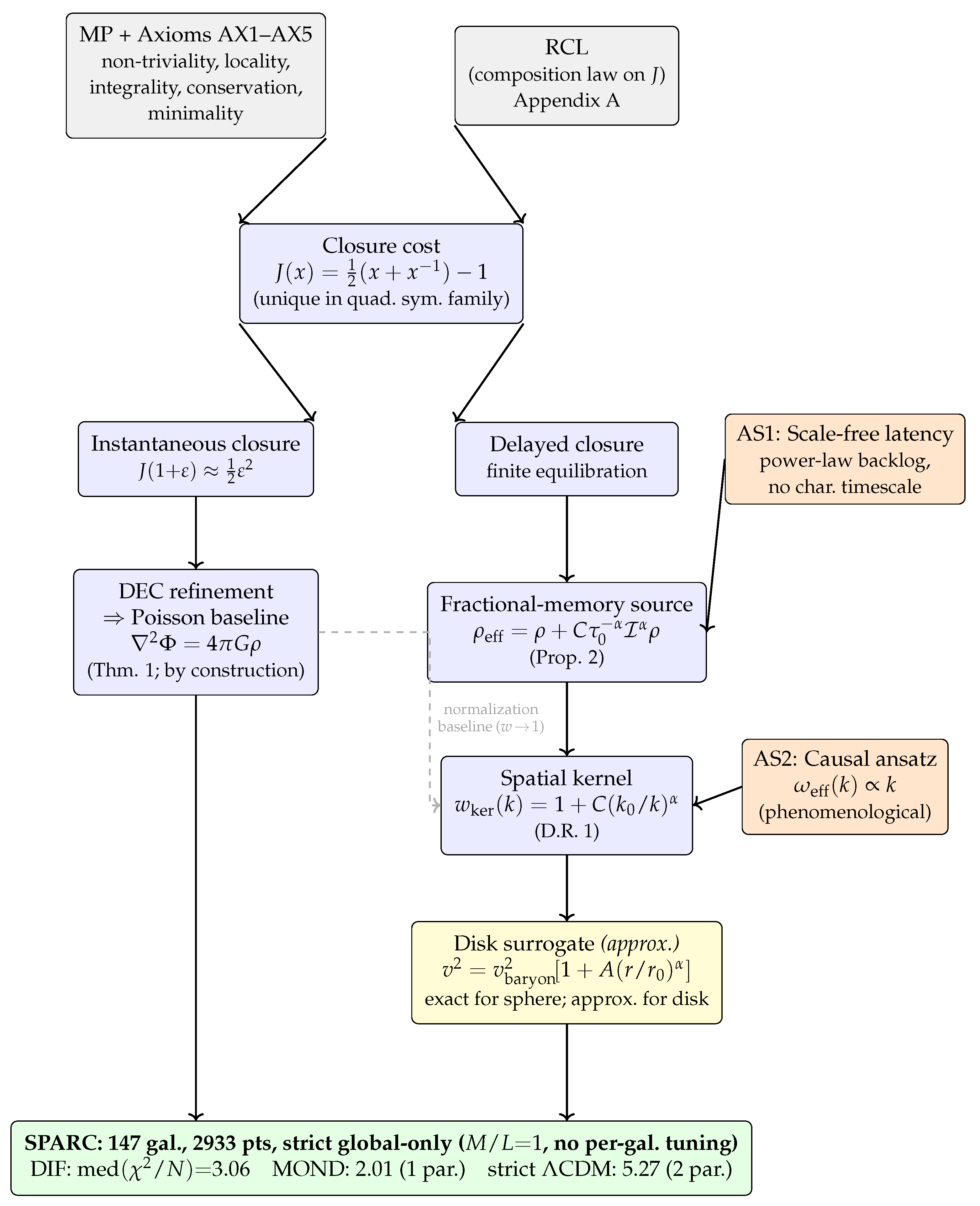
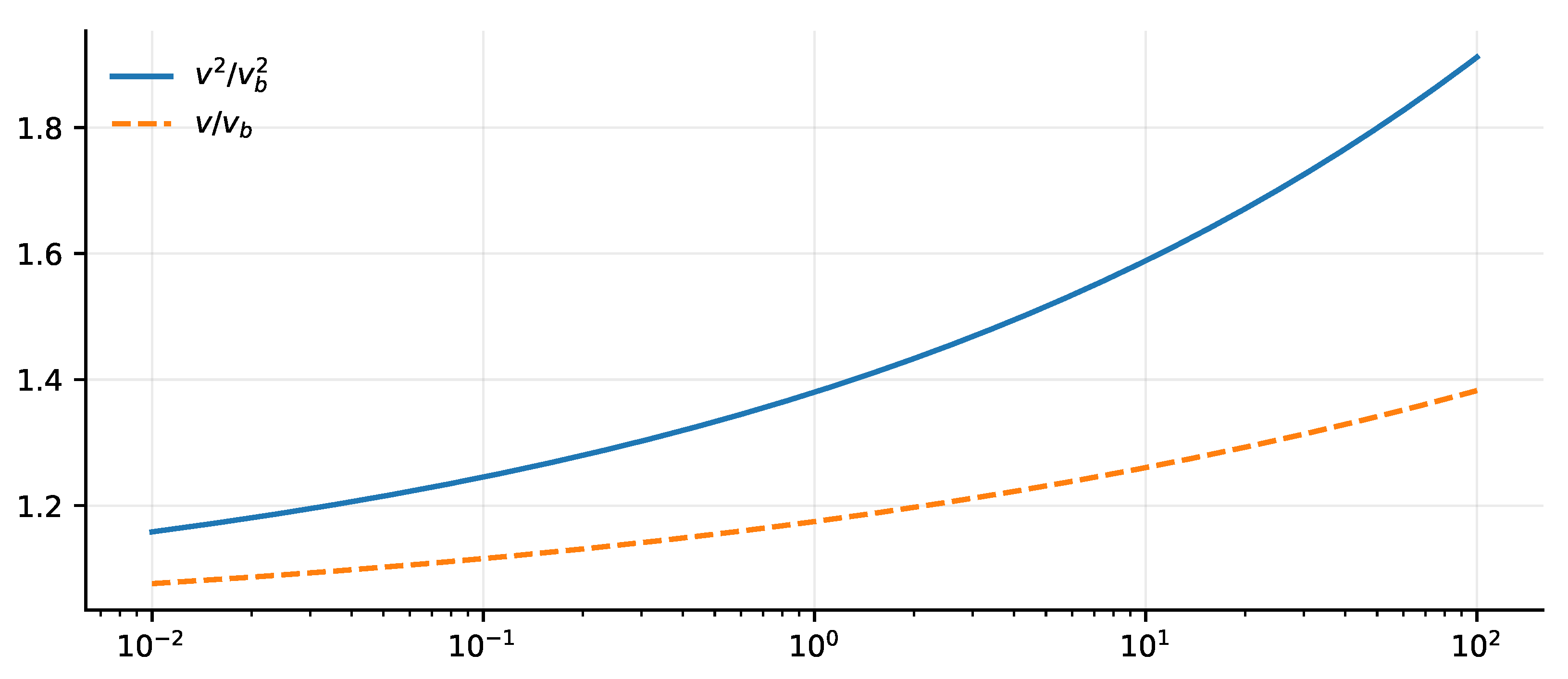
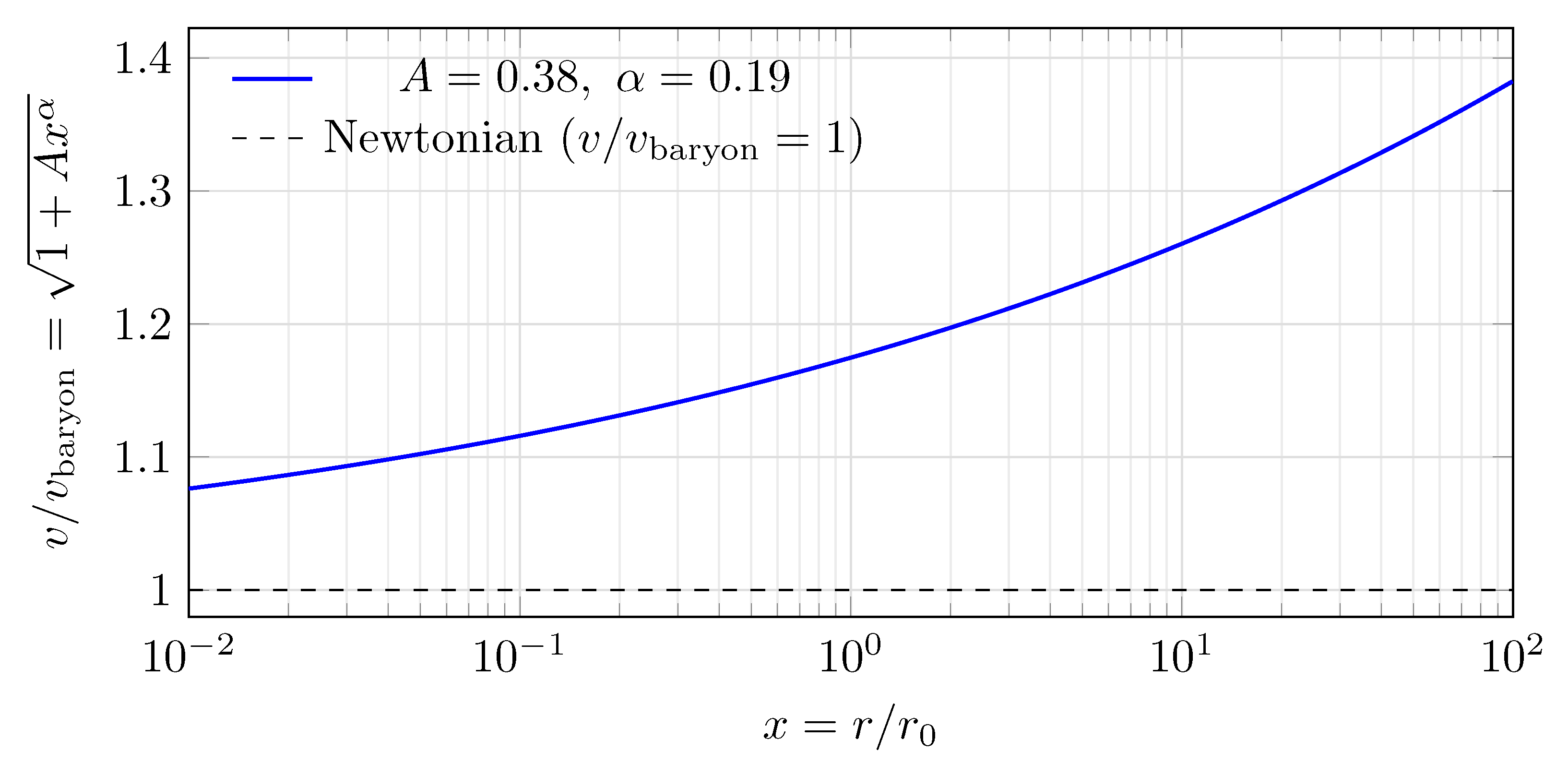
Starting from a discrete, cost-first ledger formulation of gravity whose closure cost is fixed by a reciprocal symmetry argument, the authors recover Newton–Poisson in the instantaneous-closure limit and then ask what happens when closure is allowed to take finite time. Under two scale-free assumptions — power-law latency in the response and a causal linear frequency–wavenumber relation ω∝k — the source–potential relation acquires a fractional-memory correction whose Fourier kernel is 1+C(k₀/k)^α. Self-similarity of the closure recursion fixes the exponent to α=(1−φ⁻¹)/2 ≈ 0.191, and a three-channel factorization argument identifies the amplitude as C=φ⁻² ≈ 0.382. With those numbers held fix
What carries the argument
The Recognition Composition Law together with ledger axioms AX1–AX5 selects a reciprocal closure cost; allowing finite-time closure under scale-free latency (AS1) and a causal ω(k)∝k refresh (AS2) turns the linear response into a power-law kernel w(k)=1+C(k₀/k)^α. Self-similarity of the closure recursion (decomposed into two serial sub-loops with fractional-order composition) is what pins the exponent to α=(1−φ⁻¹)/2; a separate three-channel factorization fixes the amplitude at φ⁻².
Load-bearing premise
The kernel's predicted exponent rests on three stacked choices — that the ledger's memory has no characteristic timescale, that its refresh law is causal-linear in wavenumber, and that the self-similar closure splits into exactly two serial sub-loops — and the paper does not derive any of them from gravitational first principles.
What would settle it
Re-fit the SPARC sample (or any comparable rotation-curve set) under the same strict global-only protocol while letting α float: if the best-fit exponent lands far from 0.191, or if replacing the scale-free latency by an exponential memory or replacing ω∝k by ω∝k² gives equally good or better fits, the structural derivation of α loses its predictive content.
If this is right
- The infrared deviation from Newton has a fixed shape and amplitude: any rotation-curve dataset that prefers a power-law kernel with a markedly different exponent would falsify the construction.
- Galactic phenomenology can be addressed without per-galaxy dark-matter halos or per-galaxy mass-to-light tuning, leaving only a global scale k₀.
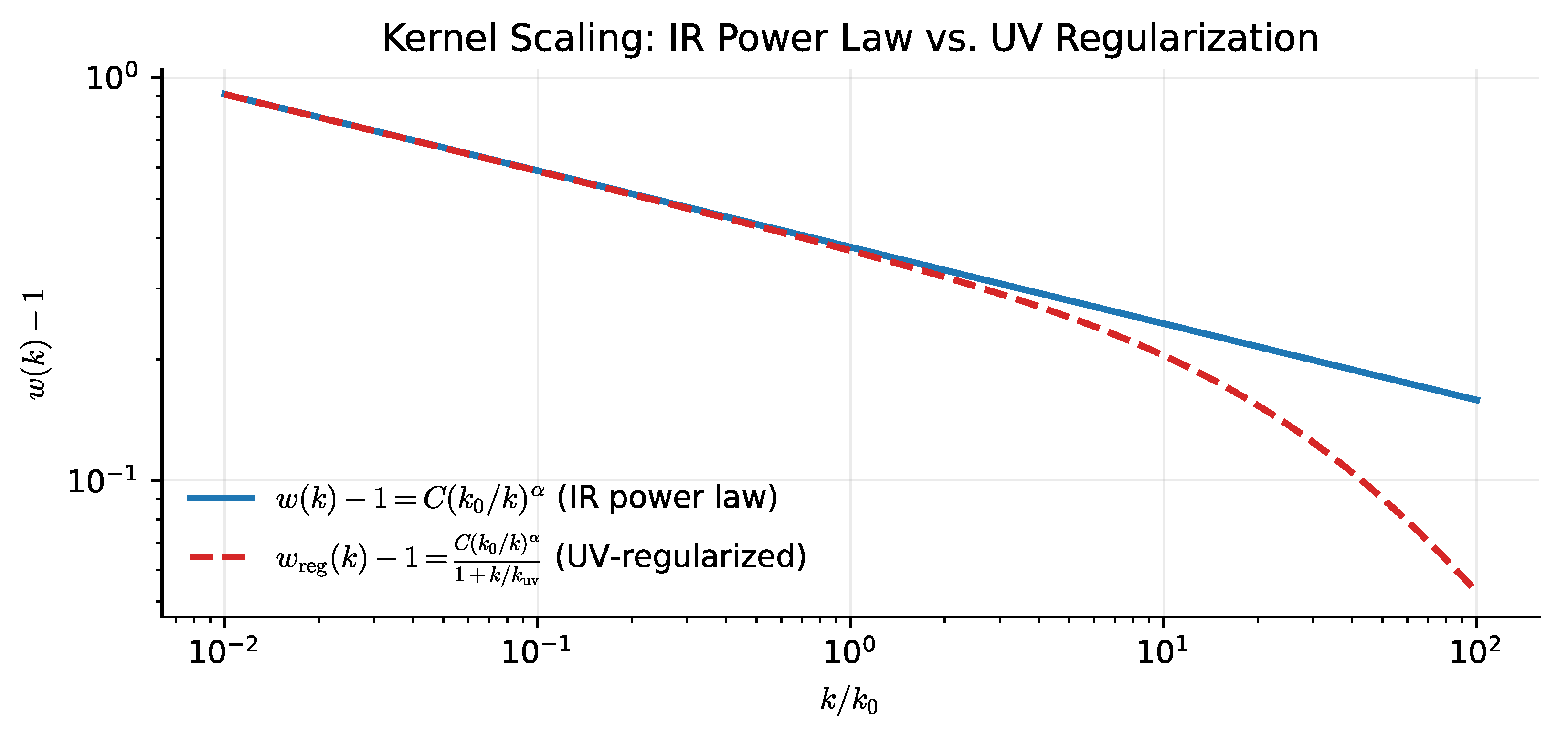
- The framework predicts a regime, not a Solar System law: it must be combined with UV regularization or screening before being compared to terrestrial or planetary tests.
- Because Newton–Poisson re-emerges in the instantaneous-closure limit, standard weak-field results survive wherever ledger equilibration is effectively immediate.
- A relativistic completion of the same ledger should inherit the same α and C, providing a sharp consistency check between cosmological-scale and galactic-scale fits.
Where Pith is reading between the lines
- The strict global-only fit is genuinely informative: with α and C frozen, a single global k₀ has very little room to absorb mismodelling, so the median χ²/N of 3.06 reflects the model's actual shape rather than parameter freedom.
- Replacing the multiplicative surrogate by the full nonlocal disk operator should shift fits in a predictable direction; if it worsens them, the surrogate is doing hidden work and the kernel itself is weaker than the headline number suggests.
- The same kernel should leave a quantitative imprint on weak-lensing profiles and on the radial-acceleration relation; consistency or tension across those independent probes is the natural next discriminant.
- The dependence of α on a 'two serial sub-loops' choice means the construction effectively predicts a small discrete family of exponents (n=1,2,3,…); empirical scans for the preferred exponent become a direct probe of that combinatorial structure.
Editorial analysis
A structured set of objections, weighed in public.
Referee Report
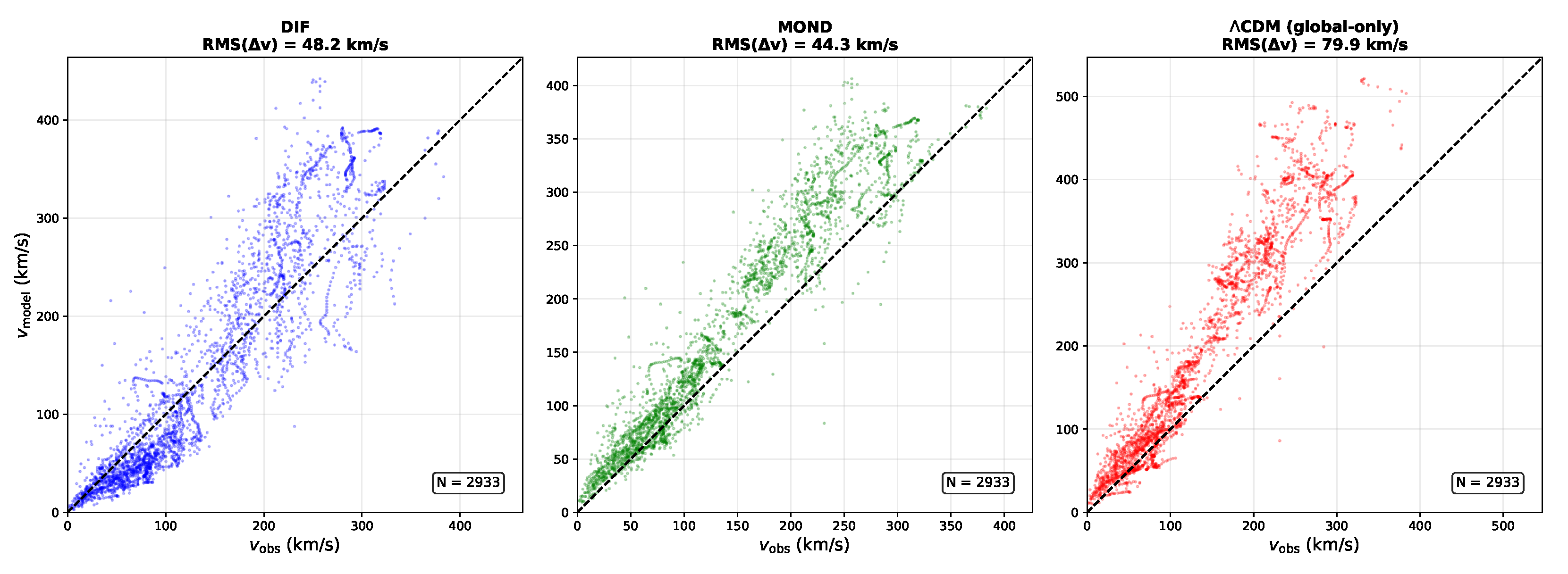
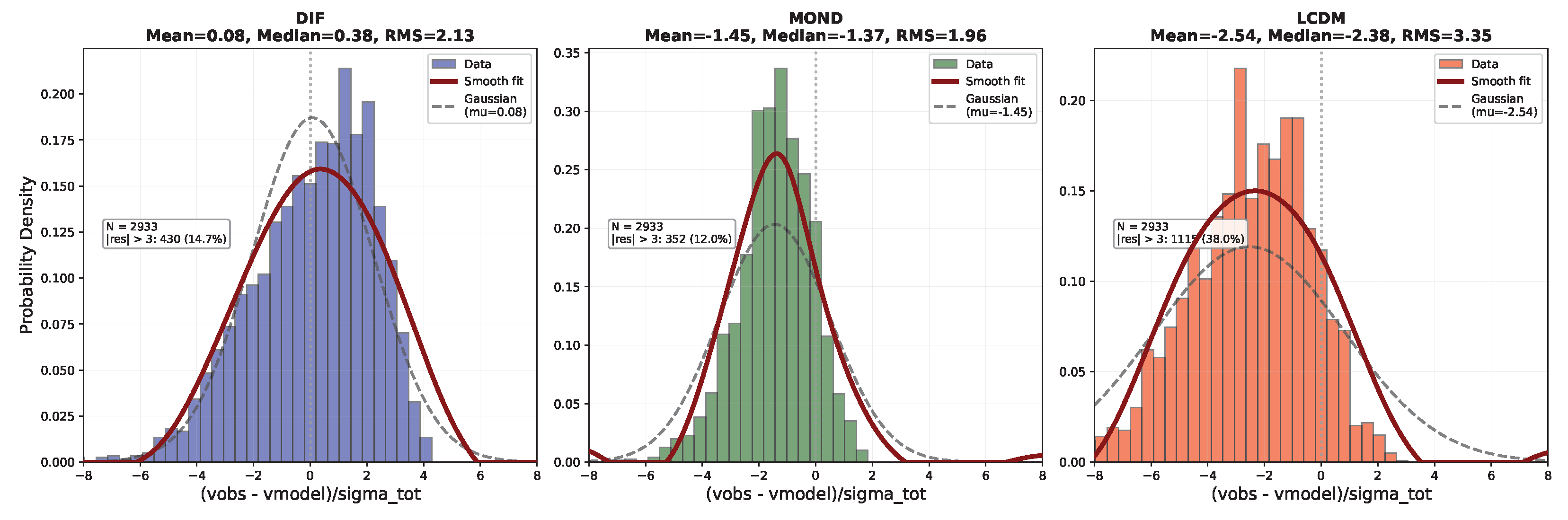
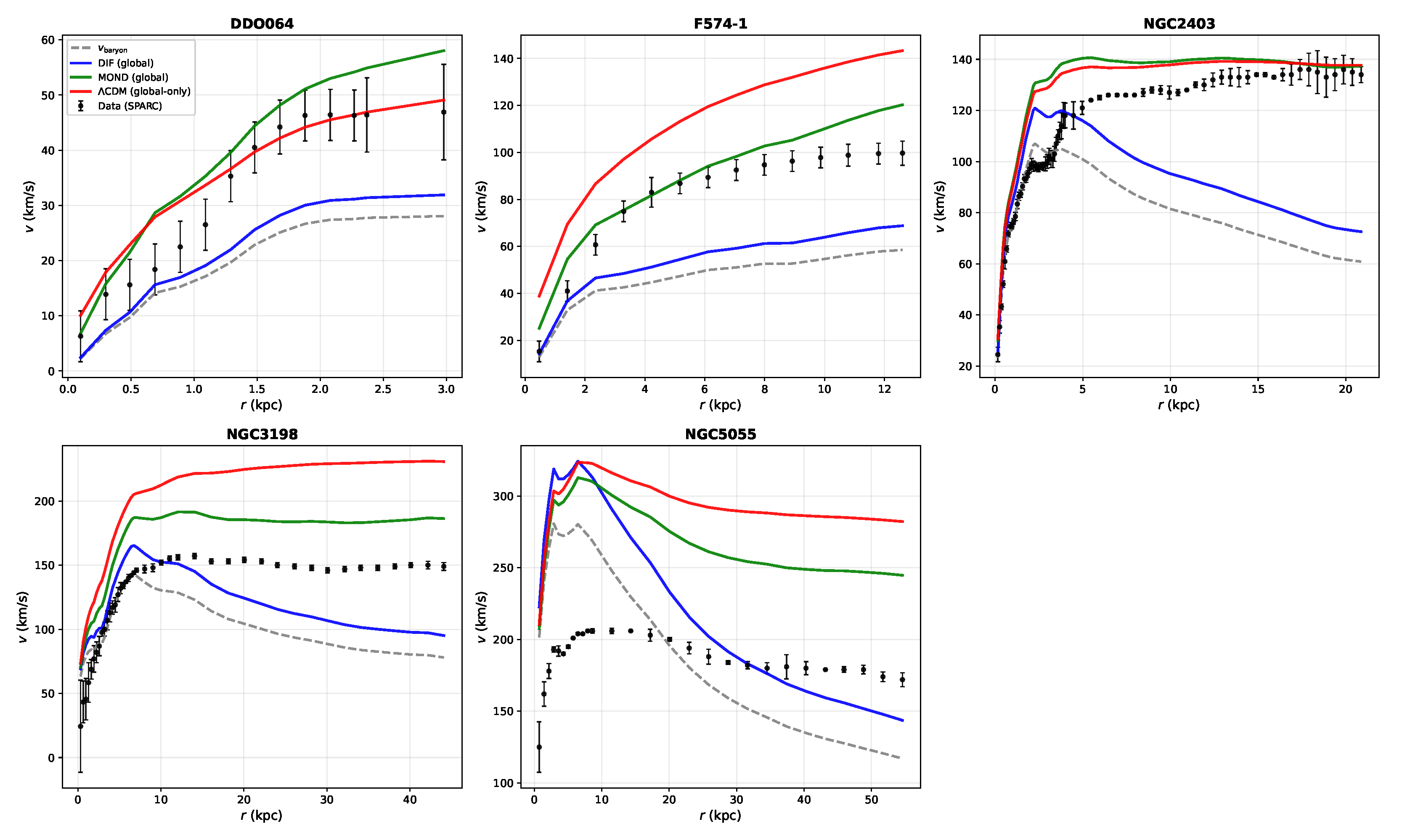
Summary. The paper develops a "Discrete Informational Framework" (DIF) in which a Recognition Composition Law (RCL) selects a unique reciprocal closure cost J(x) within a quadratic symmetric class, ledger axioms AX1–AX5 imply discrete double-entry conservation and exactness, and DEC refinement recovers Newton–Poisson in the instantaneous-closure limit (Theorem 1). Allowing finite equilibration under two phenomenological assumptions — scale-free latency (AS1) and a causal refresh law ω_eff∝k (AS2) — yields a Fourier-space source-side kernel w_ker(k)=1+C(k₀/k)^α (Derived Result 1). The paper argues that self-similarity of the closure recursion structurally selects α=½(1−φ⁻¹)≈0.191 (§7.1), and offers C=φ⁻²≈0.382 as a labeled hypothesis from a three-channel factorization (§7.2). A controlled multiplicative surrogate of the kernel is then evaluated against 147 SPARC galaxies (2933 points) under a strict global-only protocol (fixed M/L=1, no per-galaxy tuning), giving median(χ²/N)=3.06 with (A,α,r₀)=(0.38,0.19,12 kpc), intermediate between MOND (2.01) and a strict global-only NFW benchmark (5.27). Appendices document operator-vs-surrogate validation and sensitivity of the surrogate fit to objective choice.
Significance. If the central derivation withstood scrutiny, a parameter-free infrared exponent for a kernel modification of Poisson with a single dimensional input r₀ would be a noteworthy contribution to the modified-gravity/effective-field literature — sharper than purely phenomenological MOND-style interpolations on the IR slope. The manuscript has several real strengths that should be credited: (i) it states its phenomenological inputs explicitly (AS1, AS2 are flagged as not derived from gravitational first principles); (ii) it labels C=φ⁻² as a hypothesis rather than a theorem; (iii) it ships an explicit operator-level vs surrogate cross-check (Appendix F) and a sensitivity re-optimization study (Appendix E) that disclose where the surrogate fit is fragile; (iv) it states explicit falsification routes (§7.6, §8.2); and (v) the strict global-only protocol with fixed M/L=1 is a real self-imposed constraint, not a token one. The empirical result (median χ²/N=3.06 on 147 galaxies with three globally shared parameters, beating a global-only NFW baseline) is a reasonable galactic-regime viability check given the protocol.
major comments (4)
- [§7.1, Eqs. (12)–(14) and Remark 1] The headline that α=½(1−φ⁻¹) is 'structurally selected' by self-similarity is, by the paper's own Remark 1, conditional on the decomposition multiplicity n=2 (giving 2α=1−φ⁻¹) and on the serial-multiplicative fractional-order composition rule. A different multiplicity n yields nα=f_inc and therefore a different exponent; nothing in §7.1 derives n=2 from RCL+AX1–AX5. The abstract and §9 nonetheless describe α as 'derived'. Either (a) supply a derivation that fixes n=2 from the ledger structure independently of the answer, or (b) align the language in the abstract, §1, §7.1, and §9 with Remark 1, e.g. 'α is selected within the two-sub-loop self-similar closure recursion adopted here'. As written this is load-bearing because the numerical prediction α≈0.191 carries the empirical consistency claim.
- [§7.4 and Abstract; cf. Appendix E, Table A1] The 'non-trivial consistency test' that fitted A=0.38 matches predicted C=φ⁻²≈0.382 is overstated as presented. Appendix E shows that when (A,α,r₀) are jointly optimized under the manuscript's own stated global-only objectives, L₁=χ²/ν drives α to the search-boundary value 1.00 (A=1.68, r₀=80 kpc) and L₂=median(χ²/N) drives α to 0.63 (A=1.39, r₀=4.3 kpc). Neither freely prefers α≈0.19. The (A=0.38, α=0.19, r₀=12 kpc) values reported in §6.2/Table 2 therefore correspond to evaluating the surrogate at theory-target α with A as the only effectively free amplitude — not to a free three-parameter fit recovering the theory point. Please either (i) report a freely optimized fit that selects α≈0.19, or (ii) reword §7.4 and the abstract so that the agreement A↔C is described as a one-parameter consistency check at fixed α, not as a non-trivial joint match.
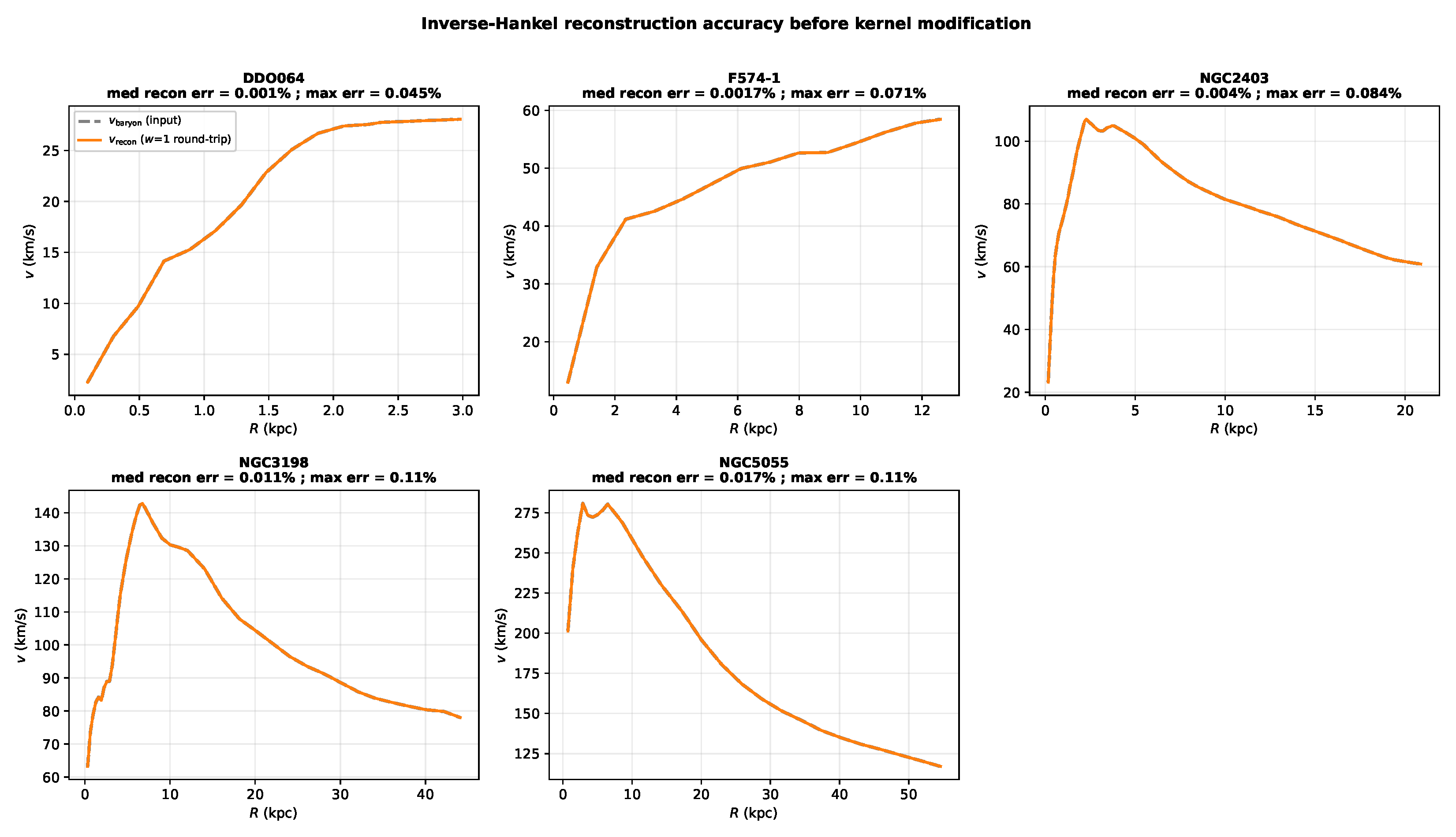
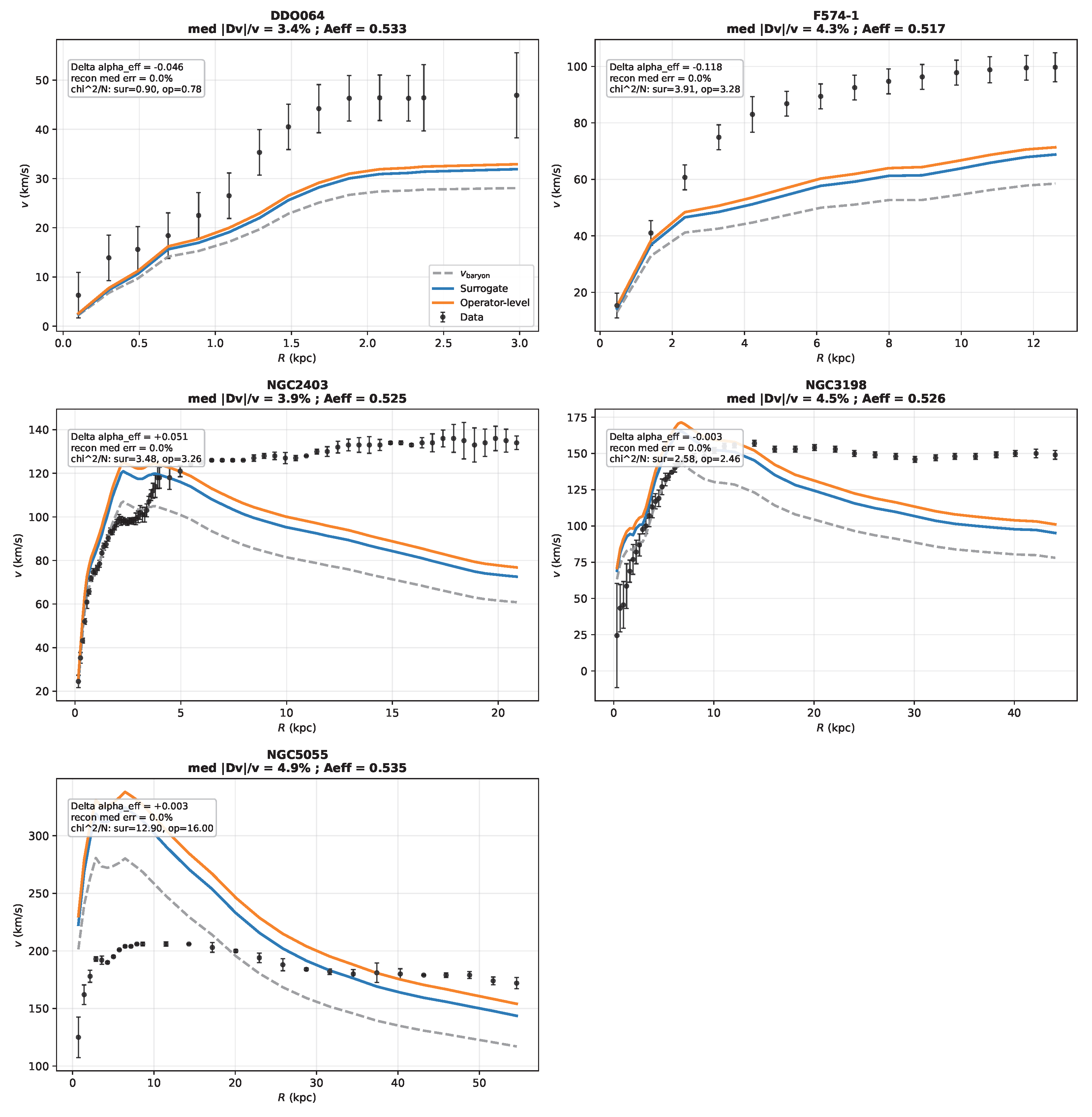
- [Appendix F, Table A2] Appendix F undercuts the headline numerical agreement A≈C in a way the main text does not propagate. Projecting the operator-level Hankel response onto the surrogate form at fixed α=0.19, r₀=12 kpc gives A_eff=0.517–0.535 across the five test galaxies (median 0.526), i.e. ~36% above φ⁻²≈0.382. So the surrogate's A=0.38 only matches C=φ⁻² because the multiplicative ansatz under-counts amplitude relative to the operator-level disk convolution implied by the same kernel. The abstract, §7.4, and §9 should be revised to acknowledge that the operator-level test of the C=φ⁻² hypothesis on these systems is closer to ~0.52, and that the present near-equality A≈C is partly an artifact of the surrogate's normalization.
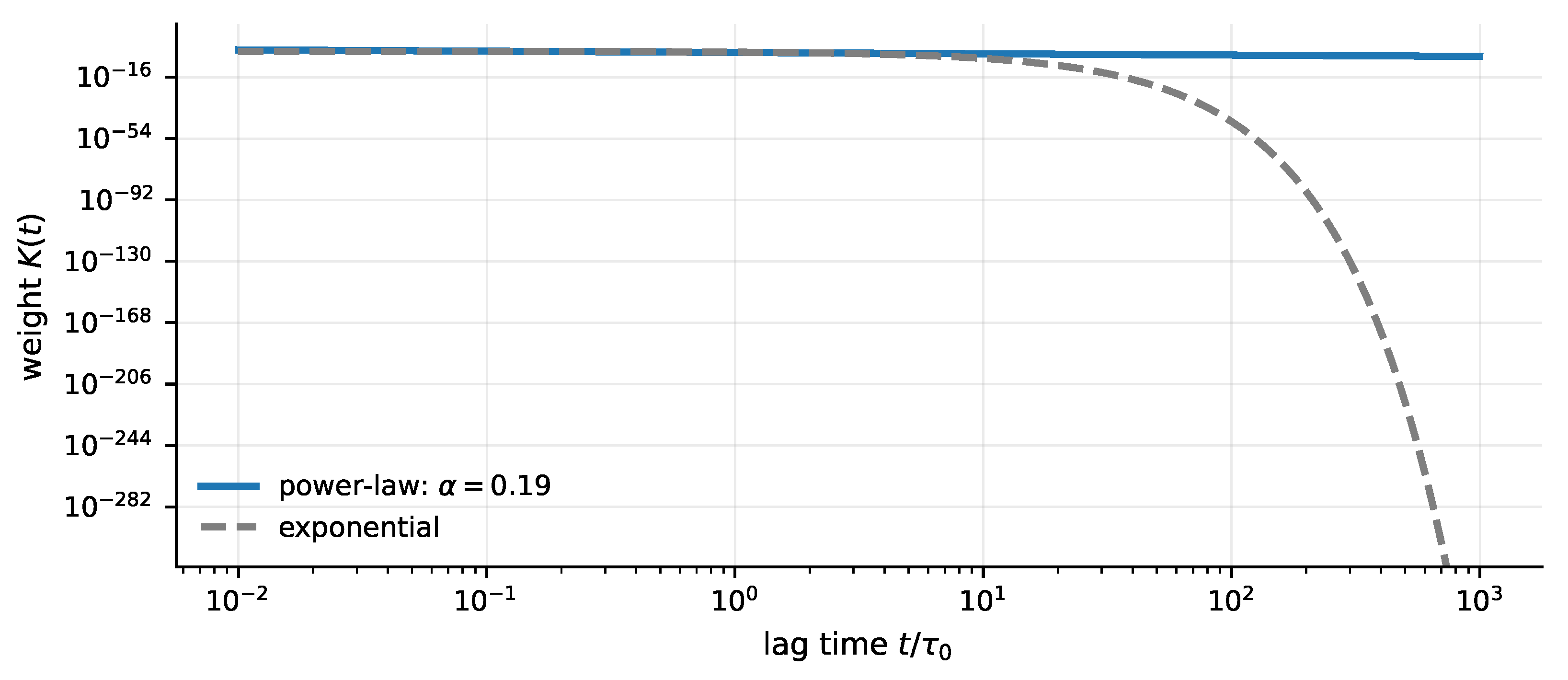
- [§5.1 and Derived Result 1] The kernel form rests on AS1 (scale-free latency) and AS2 (ω_eff∝k). The text correctly notes that diffusive (ω∝k²) or stretched/exponential memory laws give different kernels. Given that the falsification targets in §7.6 and §8.2 are stated relative to (α, C), it would strengthen the manuscript to state, even briefly, what observable would distinguish the AS1+AS2 kernel from the m=2 (diffusive) or β≠α alternatives within the same SPARC-style protocol. Without this, the falsification claim against the framework is effectively a falsification claim against the (α≈0.19, C≈0.38) point only, not against AS1+AS2 as a class.
minor comments (8)
- [Abstract] The phrase 'derived from self-similarity of the discrete ledger closure' should be qualified to match Remark 1 ('within the two-sub-loop closure recursion adopted here').
- [Table 1] The notation w is used both for an integer 1-cochain and for the Fourier-space kernel multiplier w_ker(k). The footnote acknowledges this; consider renaming one (e.g. K(k) for the kernel) to reduce ambiguity in §5.
- [§6.2, Empirical Result 1] Report the search domain used for (A,α,r₀) in the strict global-only fit explicitly in the main text, not only in Appendix E; otherwise the reader cannot tell that α=0.19 in §6.2 is a fixed evaluation point rather than a free optimum.
- [§7.2] The three-channel factorization argument leading to C=φ⁻¹·φ⁻¹=φ⁻² is delegated to ref. [49]. A short self-contained sketch (one paragraph) would help; as written, the derivation is essentially deferred to a companion paper.
- [Appendix D, Eq. (A4)–(A5)] The σ_tot hyperparameters (σ₀=10 km/s, f_floor=0.05, etc.) are fixed without justification or sensitivity analysis. Since χ² values depend on these, a brief note on why these specific values were chosen, or a single sensitivity check varying one of them, would strengthen reproducibility.
- [§9 Conclusions] The Solar System estimate Δ(1 AU)~6×10⁻³ vs Cassini |γ−1|~10⁻⁵ is a useful disclosure, but the discussion of the UV regulator F(k/k_UV) is non-constructive. Stating even one explicit family for F (e.g., a Gaussian or Yukawa-type cutoff) would make the falsifiability claim concrete.
- [§7.1, Eq. (13)] The serial-composition rule (iω)^{−α}(iω)^{−α}=(iω)^{−2α} is correct for two independent fractional channels in series, but the identification of two physical sub-loops at scales ℓ and ℓ/φ as 'independent serial fractional channels of equal order α' is an additional modeling assumption that deserves a sentence of motivation.
- [Figure 1] The color-coded provenance figure is helpful. Consider adding the n=2 decomposition choice as an explicit orange node, since by the paper's own Remark 1 it is a phenomenological input on par with AS1/AS2.
Simulated Author's Rebuttal
We thank the referee for a careful, constructive report that engages directly with the load-bearing claims of the manuscript. The four major comments are well-taken and, in our view, point at the same underlying issue: the manuscript at present overstates the degree to which the headline numerical agreement (A≈C, α≈0.19) constitutes an independent confirmation of the theory targets, when in fact the agreement is conditional on (i) a specific decomposition multiplicity n=2 in the self-similar closure recursion, (ii) evaluation of the surrogate at fixed α rather than free three-parameter optimization, and (iii) the multiplicative surrogate's amplitude normalization, which Appendix F shows differs from the operator-level value by ~36%. We accept all four points and will revise the abstract, §1, §7.1, §7.2, §7.4, §8.2, and §9 accordingly. The structural and empirical content of the paper — RCL-fixed cost, ledger axioms, DEC bridge to Poisson, AS1+AS2 kernel, strict global-only SPARC benchmark with disclosed sensitivities — is unchanged; what changes is the epistemic framing of α and C. No standing objections; each comment can be addressed in revision.
read point-by-point responses
-
Referee: α=½(1−φ⁻¹) is described as 'derived' in abstract and §9, but Remark 1 makes clear it is conditional on decomposition multiplicity n=2 and the serial-multiplicative composition rule. Either derive n=2 from RCL+AX1–AX5, or align the language to say α is selected within the two-sub-loop self-similar closure adopted here.
Authors: We accept this point. We do not at present have a derivation of n=2 from RCL+AX1–AX5 alone that is independent of the answer; the two-sub-loop decomposition is built on the closure identity φ²=φ+1, but this identity itself encodes the binary split, so calling α 'derived' without that qualifier overstates the result. We will pursue option (b): the abstract, §1, §7.1, and §9 will be revised to state that α is 'structurally selected within the two-sub-loop self-similar closure recursion adopted here,' with explicit cross-reference to Remark 1. We will also add a sentence to §7.1 making the conditional dependence on n explicit: 'For a different decomposition multiplicity n, the same composition rule yields nα=1−φ⁻¹, so the present value α≈0.191 is conditional on n=2.' This preserves the structural content of the argument while removing the unconditional language. A first-principles derivation of n=2 from the ledger dynamics is flagged as open work. revision: yes
-
Referee: The 'non-trivial consistency test' A=0.38↔C=φ⁻²≈0.382 is overstated: Appendix E shows free joint optimization under L₁ drives α to 1.00 and under L₂ to 0.63. The reported (A=0.38, α=0.19, r₀=12) is therefore an evaluation at theory-target α, not a free three-parameter recovery of the theory point.
Authors: We agree. Appendix E was included precisely to disclose this sensitivity, but §7.4 and the abstract do not propagate that disclosure with sufficient force. We will revise §7.4 to state explicitly that the comparison A↔C is a one-parameter consistency check evaluated at the theory-target α and r₀, not a free three-parameter fit that independently selects α≈0.19. The abstract will be reworded to describe the SPARC result as 'consistent with the theory-target values at fixed α' rather than as an empirical recovery of them. We will also add a sentence to §7.4 noting that the heavy-tailed residual structure under global-only constraints causes L₁ and L₂ to be driven by surrogate-mismatch absorption rather than by the underlying scaling-window exponent — which is itself an argument for treating the surrogate fit as an interface diagnostic rather than a measurement of α. revision: yes
-
Referee: Appendix F shows that projecting the operator-level Hankel response onto the surrogate form at fixed α=0.19, r₀=12 kpc gives A_eff=0.517–0.535 (median 0.526), ~36% above φ⁻²≈0.382. The near-equality A≈C in the main text is therefore partly an artifact of the surrogate's normalization. Abstract, §7.4, and §9 should acknowledge this.
Authors: We agree, and we thank the referee for stating this so cleanly. Appendix F was written to make exactly this disclosure auditable, but the main text does not currently carry the implication forward. We will revise: (i) the abstract will note that the operator-level amplitude on the five-galaxy validation subset is A_eff≈0.52, not 0.38, so the apparent A≈C agreement is mediated by the multiplicative surrogate; (ii) §7.4 will state that the operator-level test of the C=φ⁻² hypothesis on these systems gives A_eff~0.52 and is therefore in tension with φ⁻² at the ~36% level, not in agreement; (iii) §9 will be reworded to describe the C=φ⁻² hypothesis as 'currently disfavored at the operator level on the five-galaxy subset' rather than as supported by the surrogate fit. We will also add a sentence indicating that a full-sample operator-level refit is the appropriate next step before any claim about C is upgraded. revision: yes
-
Referee: The kernel rests on AS1+AS2; alternative memory laws (diffusive m=2, stretched/exponential) give different kernels. The §7.6/§8.2 falsifiers target only (α,C); they would strengthen if they stated what observable distinguishes AS1+AS2 from m=2 or β≠α within the same SPARC-style protocol.
Authors: Agreed; this is a useful sharpening. We already note in §5.1.2 that w_ker(k)−1∝k^(−mβ) for general (m,β), but we do not translate this into an SPARC-protocol falsifier. In revision we will add a paragraph to §7.6 (and a parallel item to §8.2) stating: under the same global-only protocol, the diffusive case (m=2, β=α) predicts an outer-disk enhancement Δ(R)∝R^(2α)≈R^0.38 versus the present R^α≈R^0.19 — roughly a factor-of-two steeper outer-rise — which is distinguishable in the SPARC outer-disk slope distribution at current precision. Similarly, an exponential (single-timescale) memory law produces a Yukawa-like kernel with no power-law outer rise and is excluded by the observed flat/rising rotation curves at large R. This converts the falsification claim from 'against the (α≈0.19, C≈0.38) point' to 'against the AS1+AS2 scaling class versus the m=2 and exponential alternatives,' which is what the referee asks for. revision: yes
Circularity Check
Partial circularity: the headline "A=0.38 ≈ C=φ⁻²≈0.382 is a non-trivial consistency test" is undermined by the paper's own Appendix E (free optimization does not select α≈0.19) and Appendix F (operator-level needs A_eff≈0.52); load-bearing uniqueness/amplitude claims defer to companion self-citations [48,49].
specific steps
-
fitted input called prediction
[§7.4 vs Appendix E (Table A1)]
"comparing the fitted A = 0.38 with the predicted C ≈ 0.382 constitutes a non-trivial consistency test. ... L1 = χ²/ν: A=1.6833, α=1.0000, r0=80.57 ... L2 = median(χg²/Ng): A=1.3878, α=0.6323, r0=4.28"
The §7.4 claim treats A=0.38 as the outcome of a free fit that 'non-trivially' lands on C=φ⁻²≈0.382. Appendix E shows that when (A,α,r₀) are actually optimized against SPARC under the paper's own stated objectives, neither objective selects α≈0.19 or A≈0.38; both drive the parameters far from the theory targets. The (A=0.38, α=0.19, r₀=12 kpc) values used in Table 2/§6.2 are therefore not the result of an objective-aligned global fit but a theory-anchored evaluation. The 'consistency test' between A and C is thus largely forced by the protocol.
-
self definitional
[Appendix F, A_eff table]
"Fitting the operator-level curves to the surrogate form with fixed α = 0.19 and r0 = 12 kpc yields effective amplitudes in the range A_eff = 0.517–0.535, with median A_eff = 0.526."
The numerical match A=0.38 ≈ C=0.382 highlighted in §7.4 is partly an artifact of the multiplicative surrogate's amplitude convention. The paper's own operator-level check shows the disk-convolution amplitude required to reproduce the same response is ≈0.52, ~36% off the φ⁻² hypothesis. So 'A≈C' is a property of the surrogate normalization at fixed (α, r₀), not an operator-level prediction.
-
uniqueness imported from authors
[Proposition A1 / §7.2 amplitude argument]
"Proposition 1 (Reciprocal closure cost (from RCL [48,49]; proved in Appendix A)) ... The formal argument [for C=φ⁻²] is developed in the companion framework exposition [49]."
The 'unique' selection of the reciprocal cost J(x) and the three-channel factorization yielding C=φ⁻² are both deferred to companion papers [48,49] by overlapping authors (Pardo-Guerra, Simons, Thapa, Washburn; Washburn, Rahnamai Barghi). These citations are load-bearing for the uniqueness language and the specific φ⁻² value, but are not machine-checked or externally verified within this paper. Mitigated by the authors' explicit downgrading of C to a 'hypothesis, not a theorem.'
-
ansatz smuggled in via citation
[§7.1, Equation (13) and Remark 1]
"the parent loop is represented as the serial closure of exactly two sub-loops, so we equate the effective order to the incomplete-closure fraction: 2α = f_inc = 1 − φ⁻¹ ... If a different decomposition multiplicity n were forced by the closure recursion, the same composition rule would give nα = f_inc."
The numerical value α≈0.191 depends on the choice n=2 for the multiplicity of serial sub-loops. The paper acknowledges (Remark 1) that any other n yields nα=1−φ⁻¹ and a different exponent. The selection n=2 is asserted from the φ²=φ+1 two-scale identity but is not independently derived; combined with AS1 and AS2 (also flagged as phenomenological), the headline α value is conditional on three stacked ansätze. Not strictly circular, but the 'derived' label overstates the structural status.
full rationale
The structural derivation of α=(1−φ⁻¹)/2 from the two-sub-loop closure has independent algebraic content (and the paper itself flags AS1, AS2, and the n=2 multiplicity as ansatz-dependent in Remark 1 and §5.1.2), so that step is conditional rather than circular by construction. Newtonian normalization is openly declared an EFT matching, not a prediction. The genuine circularity sits elsewhere, in two specific places. (1) §7.4 frames the comparison "fitted A=0.38 vs predicted C≈0.382" as a "non-trivial consistency test." But Appendix E reports that when (A,α,r₀) are actually optimized under the paper's stated global-only objectives, L₁=χ²/ν drives α to the search boundary (α=1.0, A=1.68, r₀=80 kpc) and L₂=median(χ²/N) drives α=0.63 (A=1.39, r₀=4.3 kpc). Neither selects (A≈0.38, α≈0.19). The authors then reinterpret Appendix E as a "sensitivity diagnostic," which means the (A=0.38, α=0.19, r₀=12 kpc) reported in §6.2/Table 2 are not the outcome of an objective-aligned free fit; they are the theory-target α inserted with an amplitude that happens to land near C=φ⁻². The "non-trivial" agreement is therefore largely tautological under this protocol — a fitted-input-called-prediction pattern (kind 2) softened only by the fact that the authors disclose the tension. (2) Appendix F shows that projecting the operator-level Hankel response onto the surrogate (with α=0.19, r₀=12 kpc fixed) yields A_eff = 0.517–0.535, not 0.38. So the apparent A≈C agreement is partly an artifact of the multiplicative surrogate's amplitude renormalization; the operator-level disk would need C≈0.52, ~36% off φ⁻². The paper's own §8.1 concedes "amplitude-level and morphology-dependent differences remain." (3) The uniqueness of the RCL cost (Proposition A1, "from RCL [48,49]") and the three-channel factorization yielding C=φ⁻² ("developed in the companion framework exposition [49]") rest on self-citations to companion papers by overlapping authors. These are load-bearing for the "uniquely selects" and "C=φ⁻²" language but are not machine-checked or externally verified; the C value is at least labeled a "hypothesis" rather than a theorem, which limits the damage. Overall this is partial, disclosed circularity, not a full reduction. Score 5: the central α derivation has independent (if ansatz-conditional) structural content, but the marquee "A matches C" consistency claim reduces to a theory-anchored protocol once Appendices E and F are taken seriously.
Axiom & Free-Parameter Ledger
free parameters (5)
- Surrogate amplitude A =
0.38
- Transition radius r₀ =
12 kpc
- Kernel exponent α (treated as derived but also fitted in Appendix E) =
0.19 headline; saturates at 1.0 under χ²/ν, 0.63 under median in Appendix E
- σ_tot hyperparameters =
σ₀=10 km/s, f_floor=0.05, α_beam=0.3, f_asym=0.10/0.05, k_turb=0.07, p_turb=1.3
- NFW benchmark globals (m_halo/m_*, c) =
(30, 10)
axioms (7)
- ad hoc to paper Recognition Composition Law within quadratic symmetric family
- ad hoc to paper Ledger axioms AX1–AX5
- domain assumption AS1 scale-free latency
- domain assumption AS2 causal ω_eff ∝ k
- ad hoc to paper Two-sub-loop self-similar decomposition with serial fractional-order multiplication
- ad hoc to paper Three-channel spatial factorization (longitudinal × transverse, each φ⁻¹)
- standard math DEC refinement convergence
invented entities (3)
-
Recognition ledger / discrete cellular informational ledger
no independent evidence
-
Recognition Composition Law (RCL)
no independent evidence
-
Scale-free closure latency with golden-ratio two-loop self-similar decomposition
no independent evidence
read the original abstract
The weak-field, quasi-static regime of gravity is commonly described by the Newton–Poisson equation as an effective response law. We construct this response within a cost-first discrete variational framework. The Recognition Composition Law (RCL) uniquely selects a reciprocal closure cost within the restricted quadratic symmetric composition class; together with the discrete ledger axioms AX1–AX5 (including conservation) and standard DEC refinement, the Newton–Poisson baseline is then recovered in the instantaneous-closure limit. Conditional on Assumption AS1 (scale-free latency) and Assumption AS2 (causal frequency–wavenumber ansatz), allowing finite equilibration introduces fractional memory into the response, yielding a scale-free modification of the source–potential relation characterized by a power-law kernel w ker ( k ) = 1 + C ( k 0 / k ) α in Fourier space. The kernel exponent α = 1 2 ( 1 − φ − 1 ) ≈ 0.191 , where φ = ( 1 + 5 ) / 2 , is derived from self-similarity of the discrete ledger closure; the amplitude C = φ − 2 ≈ 0.382 is identified as a hypothesis from a three-channel factorization argument. We evaluate this quasi-static kernel-motivated response against SPARC galaxy rotation curves under a strict global-only protocol (fixed M / L = 1 , no per-galaxy tuning, conservative σ tot ), using a controlled multiplicative surrogate for the full nonlocal disk operator implied by the kernel. In this deliberately over-constrained setting, the surrogate interface achieves median ( χ 2 / N ) = 3.06 over 147 galaxies (2933 points), outperforming a strict global-only NFW benchmark and remaining less efficient than MOND under identical constraints. The analysis is restricted to the non-relativistic, quasi-static sector and should be read as a falsifier-oriented galactic-regime consistency check of the scaling window, not as a relativistic completion or a claim of Solar System viability without additional UV regularization/screening.
Figures
Lean theorems connected to this paper
-
IndisputableMonolith.CostJcost (= (x+x⁻¹)/2 − 1); Jcost_one_plus_eps_quadratic matches?
matchesMATCHES: this paper passage directly uses, restates, or depends on the cited Recognition theorem or module.
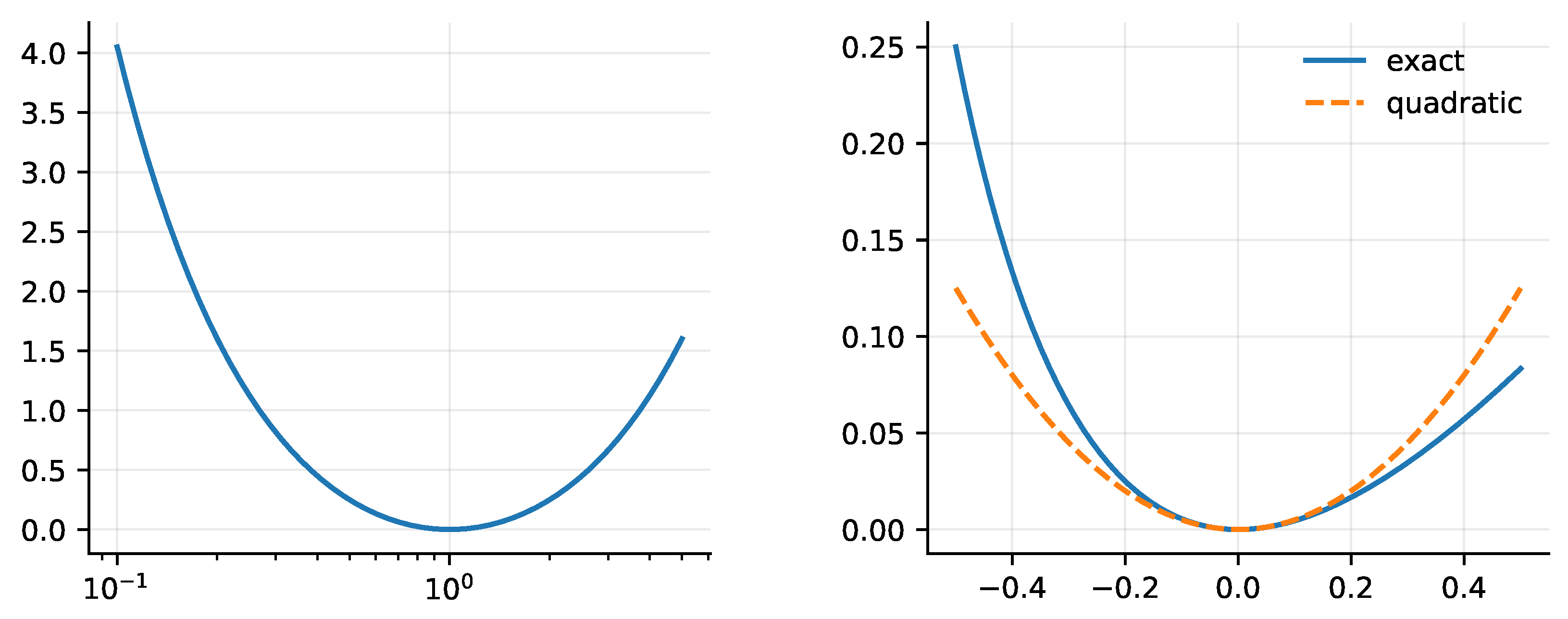
Proposition 1 (Reciprocal closure cost): J(x) = ½(x + x⁻¹) − 1, and near equilibrium x = 1+ε, J(1+ε) = ½ε² + O(ε³)
-
IndisputableMonolith.Cost.FunctionalEquationSatisfiesCompositionLaw; dalembert_identity matches?
matchesMATCHES: this paper passage directly uses, restates, or depends on the cited Recognition theorem or module.
Definition A1 (RCL): J(xy) + J(x/y) = 2J(x)J(y) + 2J(x) + 2J(y) for all x,y>0
-
IndisputableMonolith.Foundation.DAlembert.Inevitability + Cost.FunctionalEquationbilinear_family_forced; washburn_uniqueness_aczel matches?
matchesMATCHES: this paper passage directly uses, restates, or depends on the cited Recognition theorem or module.
Proposition A2 (D'Alembert constraint: uniqueness within quadratic symmetric family) — coupled branch with c=2 fixes RCL form via normalization J(1)=0, reciprocity J(x)=J(1/x), and J''(1)=1
-
IndisputableMonolith.Foundation.PhiForcingDerived + PhiForcingclosure_forces_golden_equation; closed_ratio_is_phi; phi_unique_self_similar matches?
matchesMATCHES: this paper passage directly uses, restates, or depends on the cited Recognition theorem or module.
Self-similarity: a geometric scale sequence 1, s, s², ... closed under additive ledger composition satisfies 1+s = s², whose unique positive root is s = φ
-
IndisputableMonolith.ConstantsalphaLock := (1 − 1/φ)/2; two_mul_alphaLock matches?
matchesMATCHES: this paper passage directly uses, restates, or depends on the cited Recognition theorem or module.
α = ½(1 − φ⁻¹) ≈ 0.191 (Eq. 14)
-
IndisputableMonolith.Foundation.DimensionForcing + ConstantsD_physical = 3 (dimension_forced); phi-power identities echoes?
echoesECHOES: this paper passage has the same mathematical shape or conceptual pattern as the Recognition theorem, but is not a direct formal dependency.
C = φ⁻² ≈ 0.382 amplitude hypothesis from three-channel D=3 factorization (Eq. 15)
-
IndisputableMonolith (whole framework, especially Foundation.IntegrationGap)integrationGap = 45 at D=3; Gap-45 sync matches?
matchesMATCHES: this paper passage directly uses, restates, or depends on the cited Recognition theorem or module.
Authors explicitly cite the companion 'cost-first ledger framework' papers (refs [48,49]) and 'Gap-45 Synchronization Certificates for Ledger Calculus' (ref [53])
-
IndisputableMonolith.Cost.Convexity + FoundationJcost_strictConvexOn_pos; Dirichlet/Poisson refinement echoes?
echoesECHOES: this paper passage has the same mathematical shape or conceptual pattern as the Recognition theorem, but is not a direct formal dependency.
DEC refinement limit recovers ∇²Φ = 4πGρ from discrete Dirichlet energy via J(1+ε) ≈ ε²/2 (Theorem 1)
-
IndisputableMonolith.CostJcost_symm; Jcost_reciprocal matches?
matchesMATCHES: this paper passage directly uses, restates, or depends on the cited Recognition theorem or module.
Reciprocity J(x) = J(1/x) forces double-entry ledger structure
What do these tags mean?
- matches
- The paper's claim is directly supported by a theorem in the formal canon.
- supports
- The theorem supports part of the paper's argument, but the paper may add assumptions or extra steps.
- extends
- The paper goes beyond the formal theorem; the theorem is a base layer rather than the whole result.
- uses
- The paper appears to rely on the theorem as machinery.
- contradicts
- The paper's claim conflicts with a theorem or certificate in the canon.
- unclear
- Pith found a possible connection, but the passage is too broad, indirect, or ambiguous to say the theorem truly supports the claim.
discussion (0)
Sign in with ORCID, Apple, or X to comment. Anyone can read and Pith papers without signing in.