Investigating Dark Matter and MOND Models with Galactic Rotation Curve Data: Analysing the Gas-Dominated Galaxies
Pith reviewed 2026-05-25 17:38 UTC · model grok-4.3
The pith
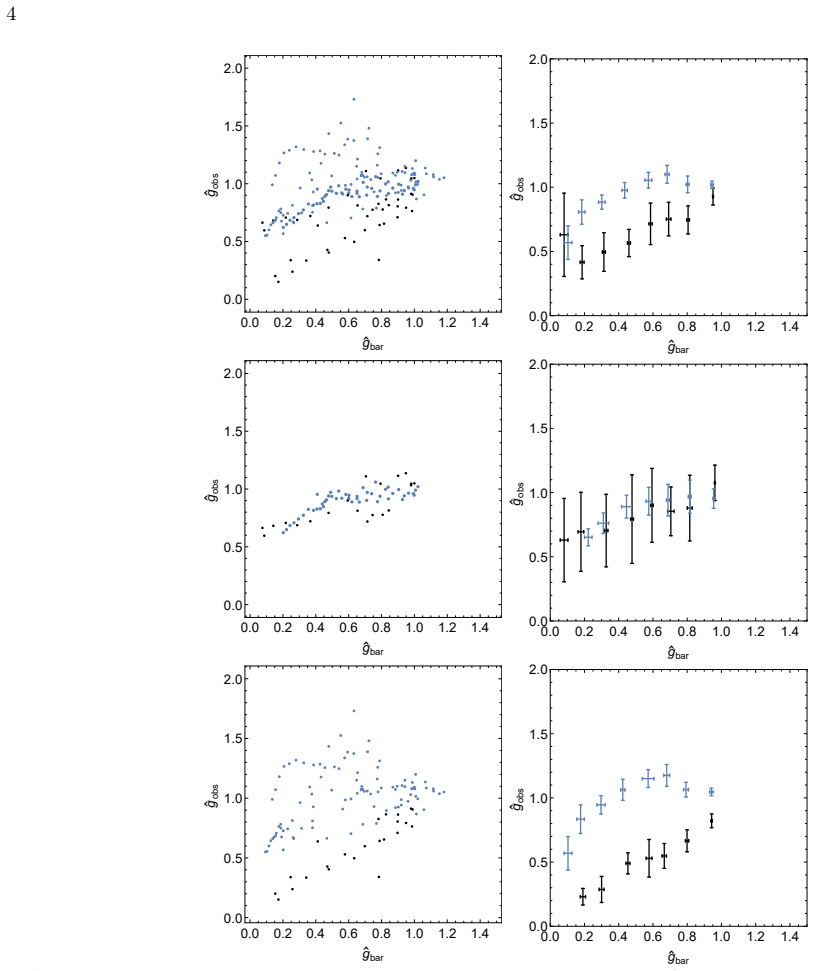
Gas-dominated galaxies show rightward curving geometry in normalized g2-space with r_obs exceeding r_bar.
A machine-rendered reading of the paper's core claim, the machinery that carries it, and where it could break.
Core claim
The overall geometry of the gas dominated galaxies in SPARC is consistent with a rightward curving geometry in the normalized g2-space (characterized by r_obs > r_bar), in contrast to the geometry of all galaxies which approximates a curve nowhere (r_obs = r_bar) with slight rightward inclination. The gas-dominated subset therefore supplies the mass-to-light-ratio-independent geometry that can be used to infer properties of the missing-mass solution, while the difference between the two samples indicates the radial dependence of the disk mass-to-light ratio.
What carries the argument
Normalized g2-space of (g_bar, g_obs) with r_bar and r_obs defined as the radii of maximum baryonic and observed accelerations; the normalization reduces random and systematic errors and permits direct geometric comparison across galaxies.
If this is right
- Any viable model of galactic dynamics must reproduce a rightward-curving locus once mass-to-light-ratio effects are removed.
- The offset between the gas-dominated geometry and the full-sample geometry directly encodes the radial run of disk mass-to-light ratio.
- The mass-to-light-independent geometry supplies a sharper test for proposed solutions to the missing-mass problem.
Where Pith is reading between the lines
- Models that predict different curvature directions or no curvature at all in this normalized space can be ruled out by the gas-dominated subset alone.
- Extending the same geometric test to additional gas-rich systems at higher redshift would check whether the rightward curvature is universal or evolves.
Load-bearing premise
Restricting the sample to gas-dominated galaxies suppresses the impact of mass-to-light ratios to leading order so that the measured geometry directly reflects the true dynamics.
What would settle it
A statistically significant fraction of additional gas-dominated galaxies showing r_obs less than or equal to r_bar would contradict the reported rightward-curving geometry.
Figures


read the original abstract
In this study the geometry of gas dominated galaxies in the SPARC database is analyzed in a normalized $(g_{bar},g_{obs})$-space ($g2$-space), where $g_{obs}$ is the observed centripetal acceleration and $g_{bar}$ is the centripetal acceleration as obtained from the observed baryonic matter via Newtonian dynamics. The normalization of $g2$-space significantly reduce the effect of both random and systematic uncertainties as well as enable a comparison of the geometries of different galaxies. Analyzing the gas-dominated galaxies (as opposed to other galaxies) further suppress the impact of the mass to light ratios. It is found that the overall geometry of the gas dominated galaxies in SPARC is consistent with a rightward curving geometry in the normalized $g2$-space (characterized by $r_{obs}>r_{bar}$, where $r_{bar}=\arg \max_r[g_{bar}(r)]$ and $r_{obs}=\arg \max_r[g_{obs}(r)]$). This is in contrast to the overall geometry of all galaxies in SPARC which best approximates a geometry curing nowhere in normalized $g2$-space (characterized by $r_{obs}=r_{bar}$) with a slight inclination toward a rightward curving geometry. The geometry of the gas dominated galaxies not only indicate the true (independent of mass to light ratios to leading order) geometry of data in $g2$-space (which can be used to infer properties on the solution to the missing mass problem) but also - when compared to the geometry of all galaxies - indicate the underlying radial dependence of the disk mass to light ratio.
Editorial analysis
A structured set of objections, weighed in public.
Referee Report
Summary. The manuscript analyzes the geometry of gas-dominated galaxies from the SPARC database in a normalized (g_bar, g_obs) g2-space. It reports that these galaxies exhibit an overall rightward-curving geometry (r_obs > r_bar, where r_bar and r_obs are the radii of maximum g_bar and g_obs) in contrast to the full SPARC sample, which approximates a geometry with no curving (r_obs = r_bar) and only a slight rightward tendency. The normalization and gas-dominated selection are presented as suppressing uncertainties from mass-to-light ratios, allowing inference on the underlying dynamics and radial M/L dependence relevant to the missing-mass problem.
Significance. If the reported geometric distinction holds under quantitative scrutiny, the result supplies an observational constraint on acceleration-space geometry that is less sensitive to stellar M/L uncertainties than the full sample. The use of publicly available SPARC data and the explicit normalization procedure that reduces both random and systematic effects are strengths that facilitate direct comparison across galaxies.
major comments (2)
- [Abstract, §3] Abstract and §3 (data selection): the criteria used to define the gas-dominated subsample (e.g., explicit gas-fraction threshold or HI-mass dominance condition) are not stated quantitatively, preventing assessment of whether the reported contrast with the full sample is robust to alternative cuts or post-hoc selection.
- [Abstract, Results] Results and abstract: the claim of consistency with rightward-curving geometry (r_obs > r_bar) is presented without reported uncertainties, error propagation on the arg-max locations, or bootstrap/robustness tests on the subsample, so the statistical significance of the difference from the full-sample geometry cannot be evaluated from the given information.
minor comments (2)
- [Abstract] Abstract: 'curing' appears to be a typographical error for 'curving' in two places.
- [Abstract, Methods] Notation: the definition r_bar = arg max_r [g_bar(r)] is clear but would benefit from an explicit statement of how the maximum is located (e.g., spline fit, discrete sampling) to ensure reproducibility.
Simulated Author's Rebuttal
We thank the referee for the constructive comments and the recommendation for minor revision. We address each major comment below and will revise the manuscript to incorporate the requested details and statistical elements.
read point-by-point responses
-
Referee: [Abstract, §3] Abstract and §3 (data selection): the criteria used to define the gas-dominated subsample (e.g., explicit gas-fraction threshold or HI-mass dominance condition) are not stated quantitatively, preventing assessment of whether the reported contrast with the full sample is robust to alternative cuts or post-hoc selection.
Authors: We agree that the quantitative selection criteria for the gas-dominated subsample were not stated explicitly. In the revised manuscript we will add the precise definition (including any gas-fraction threshold or HI-mass dominance condition) to both the abstract and §3, together with a short robustness check against plausible alternative cuts. revision: yes
-
Referee: [Abstract, Results] Results and abstract: the claim of consistency with rightward-curving geometry (r_obs > r_bar) is presented without reported uncertainties, error propagation on the arg-max locations, or bootstrap/robustness tests on the subsample, so the statistical significance of the difference from the full-sample geometry cannot be evaluated from the given information.
Authors: We acknowledge that the manuscript does not report uncertainties on the arg-max locations or statistical tests. In the revision we will include error propagation for r_bar and r_obs and add bootstrap or equivalent robustness tests on the subsample so that the statistical significance of the geometric distinction can be assessed. revision: yes
Circularity Check
No significant circularity; observational geometry from public data
full rationale
The paper reports a direct observational comparison of normalized g2-space geometries (r_obs vs r_bar) between the gas-dominated SPARC subsample and the full sample. No equations, fitted parameters, or model derivations are presented that reduce the reported geometry to an input by construction. The selection criterion (gas dominance) is justified by the baryonic mass budget and does not create a self-referential loop. No self-citation chains, ansatzes, or uniqueness theorems are invoked as load-bearing premises. The result is an empirical description of existing rotation-curve data and therefore carries no circularity burden under the enumerated patterns.
Axiom & Free-Parameter Ledger
axioms (2)
- domain assumption Gas-dominated selection suppresses mass-to-light ratio impact to leading order.
- domain assumption Normalization in g2-space reduces both random and systematic uncertainties.
Reference graph
Works this paper leans on
-
[1]
To be clear; this difference is caused by the galaxies considered in the two analysis’
(and reproduced in the left panel of figure 2) which is largely consistent with a nowhere geometry (using ˜Υd i = 0.5 and ˜Υb i = 0.7). To be clear; this difference is caused by the galaxies considered in the two analysis’. The overall geometry in normalized g2-space progres- sively approach a nowhere geometry, as found in [29], as the constraint on the gal...
-
[2]
to my attention. I thank Federico Lelli for com- ments on the draft and discussions of difficulties in mea- suring data points at small radii. Lastly I acknowledge the partial funding from The Council For Independent Research, grant number DFF 6108-00623. The CP3-Origins center is partially funded by the Danish National Research Foundation, grant number DNR...
-
[3]
V. C. Rubin, N. Thonnard, and W. K. Ford, Jr., As- trophys. J. 238, 471 (1980)
work page 1980
-
[4]
T. S. van Albada, J. N. Bahcall, K. Begeman, and R. Sancisi, 295, 305 (1985)
work page 1985
-
[5]
A. Bosma, The distribution and kinematics of neu- tral hydrogen in spiral galaxies of various morphologi- cal types, Ph.D. thesis, PhD Thesis, Groningen Univ., (1978) (1978)
work page 1978
-
[6]
F. Zwicky, Helv. Phys. Acta 6, 110 (1933), [Gen. Rel. Grav.41,207(2009)]
work page 1933
-
[7]
A direct empirical proof of the existence of dark matter
D. Clowe, M. Bradac, A. H. Gonzalez, M. Markevitch, S. W. Randall, C. Jones, and D. Zaritsky, Astrophys. J. 648, L109 (2006), arXiv:astro-ph/0608407 [astro-ph]
work page internal anchor Pith review Pith/arXiv arXiv 2006
-
[8]
P. A. R. Ade et al. (Planck), Astron. Astrophys. 594, A13 (2016), arXiv:1502.01589 [astro-ph.CO]
work page internal anchor Pith review Pith/arXiv arXiv 2016
- [9]
-
[10]
R. A. Flores and J. R. Primack, Astrophys. J. 427, L1 (1994)
work page 1994
-
[11]
Dark Matter Substructure in Galactic Halos
B. Moore, S. Ghigna, F. Governato, G. Lake, T. R. Quinn, J. Stadel, and P. Tozzi, Astrophys. J. 524, L19 (1999), arXiv:astro-ph/9907411 [astro-ph]
work page internal anchor Pith review Pith/arXiv arXiv 1999
-
[12]
Too big to fail? The puzzling darkness of massive Milky Way subhaloes
M. Boylan-Kolchin, J. S. Bullock, and M. Kapling- hat, Mon. Not. Roy. Astron. Soc. 415, L40 (2011), arXiv:1103.0007 [astro-ph.CO]. 10
work page internal anchor Pith review Pith/arXiv arXiv 2011
-
[13]
R. B. Tully and J. R. Fisher, Astron. Astrophys. 54, 661 (1977)
work page 1977
-
[14]
S. M. Faber and R. E. Jackson, Astrophys. J. 204, 668 (1976)
work page 1976
-
[15]
S. S. McGaugh, J. M. Schombert, G. D. Bothun, and W. J. G. de Blok, Astrophys. J. 533, L99 (2000), arXiv:astro-ph/0003001 [astro-ph]
work page internal anchor Pith review Pith/arXiv arXiv 2000
-
[16]
The Radial Acceleration Relation in Rotationally Supported Galaxies
S. McGaugh, F. Lelli, and J. Schombert, Phys. Rev. Lett. 117, 201101 (2016), arXiv:1609.05917 [astro- ph.GA]
work page internal anchor Pith review Pith/arXiv arXiv 2016
-
[17]
One Law To Rule Them All: The Radial Acceleration Relation of Galaxies
F. Lelli, S. S. McGaugh, J. M. Schombert, and M. S. Pawlowski, Astrophys. J. 836, 152 (2017), arXiv:1610.08981 [astro-ph.GA]
work page internal anchor Pith review Pith/arXiv arXiv 2017
- [18]
-
[19]
R. H. Sanders, Mon. Not. Roy. Astron. Soc. 342, 901 (2003), arXiv:astro-ph/0212293 [astro-ph]
work page internal anchor Pith review Pith/arXiv arXiv 2003
-
[20]
C. Skordis, D. F. Mota, P. G. Ferreira, and C. Boehm, Phys. Rev. Lett. 96, 011301 (2006), arXiv:astro- ph/0505519 [astro-ph]
-
[21]
Can Cosmic Structure form without Dark Matter?
S. Dodelson and M. Liguori, Phys. Rev. Lett.97, 231301 (2006), arXiv:astro-ph/0608602 [astro-ph]
work page internal anchor Pith review Pith/arXiv arXiv 2006
-
[22]
S. Dodelson, Int. J. Mod. Phys. D20, 2749 (2011), arXiv:1112.1320 [astro-ph.CO]
work page internal anchor Pith review Pith/arXiv arXiv 2011
-
[23]
SPARC: Mass Models for 175 Disk Galaxies with Spitzer Photometry and Accurate Rotation Curves
F. Lelli, S. S. McGaugh, and J. M. Schombert, Astron. J. 152, 157 (2016), arXiv:1606.09251 [astro-ph.GA]
work page internal anchor Pith review Pith/arXiv arXiv 2016
-
[24]
O. Chashchina, R. Foot, and Z. Silagadze, Phys. Rev. D95, 023009 (2017)
work page 2017
-
[25]
Modified Dark Matter: Relating Dark Energy, Dark Matter and Baryonic Matter
D. Edmonds, D. Farrah, D. Minic, Y. J. Ng, and T. Takeuchi, Int. J. Mod. Phys. D27, 1830001 (2017), arXiv:1709.04388 [astro-ph.CO]
work page internal anchor Pith review Pith/arXiv arXiv 2017
-
[26]
Can $\Lambda$CDM model reproduce MOND-like behavior?
D.-C. Dai and C. Lu, Phys. Rev. D96, 124016 (2017), arXiv:1712.01654 [gr-qc]
work page internal anchor Pith review Pith/arXiv arXiv 2017
-
[27]
Gravitational wave as probe of superfluid dark matter
R.-G. Cai, T.-B. Liu, and S.-J. Wang, Phys. Rev. D97, 023027 (2018), arXiv:1710.02425 [hep-ph]
work page internal anchor Pith review Pith/arXiv arXiv 2018
-
[28]
Phenomenological consequences of superfluid dark matter with baryon-phonon coupling
L. Berezhiani, B. Famaey, and J. Khoury, JCAP 1809, 021 (2018), arXiv:1711.05748 [astro-ph.CO]
work page internal anchor Pith review Pith/arXiv arXiv 2018
-
[29]
J. Petersen and M. T. Frandsen, (2017), arXiv:1710.03096 [astro-ph.GA]
-
[30]
P. Li, F. Lelli, S. McGaugh, and J. Schombert, Astron. Astrophys. 615, A3 (2018), arXiv:1803.00022 [astro- ph.GA]
work page internal anchor Pith review Pith/arXiv arXiv 2018
-
[31]
M. T. Frandsen and J. Petersen, (2018), arXiv:1805.10706 [astro-ph.GA]
work page internal anchor Pith review Pith/arXiv arXiv 2018
-
[32]
S. Mcgaugh and J. Schombert, The Astronomical Jour- nal 148 (2014), 10.1088/0004-6256/148/5/77
- [33]
-
[34]
P. Salucci, (2016), arXiv:1612.08857 [astro-ph.GA]
work page internal anchor Pith review Pith/arXiv arXiv 2016
discussion (0)
Sign in with ORCID, Apple, or X to comment. Anyone can read and Pith papers without signing in.