Space-variant Generalized Gaussian Regularization for Image Restoration
Pith reviewed 2026-05-25 18:35 UTC · model grok-4.3
The pith
A space-variant regularizer based on local half-Generalized Gaussian gradient distributions enables high-quality restorations for varied images and noise types.
A machine-rendered reading of the paper's core claim, the machinery that carries it, and where it could break.
Core claim
Modeling the local gradient magnitudes of the target image with a half-Generalized Gaussian distribution yields a space-variant regularizer with two automatically estimated per-pixel parameters; when this regularizer is combined with L2 or L1 data-fidelity terms and minimized via ADMM, the method produces high-quality restorations for a wide range of target images and the noise types examined.
What carries the argument
Space-variant generalized Gaussian regularizer whose two per-pixel parameters are estimated from the observed image.
If this is right
- The same regularizer framework handles additive white Gaussian noise through the L2 term and impulsive noises through the L1 term.
- Automatic per-pixel parameter estimation removes the need for manual selection of regularization weights.
- Local adaptation allows the model to accommodate different gradient distributions within one image.
- The ADMM scheme supplies a practical iterative solver for the non-smooth optimization problem.
Where Pith is reading between the lines
- The per-pixel adaptivity may reduce over-smoothing in mixed smooth and textured regions relative to global regularizers.
- The modeling choice could be tested by applying the regularizer to other linear inverse problems such as deblurring.
- Failure cases on strongly non-half-GGD gradient fields would clarify the boundaries of the modeling assumption.
Load-bearing premise
The gradient magnitudes of the target image distribute locally according to a half-Generalized Gaussian distribution.
What would settle it
Restoration experiments on an image whose local gradient magnitudes deviate markedly from a half-Generalized Gaussian distribution would show whether the method still yields high-quality output.
Figures





read the original abstract
We propose a new space-variant regularization term for variational image restoration based on the assumption that the gradient magnitudes of the target image distribute locally according to a half-Generalized Gaussian distribution. This leads to a highly flexible regularizer characterized by two per-pixel free parameters, which are automatically estimated from the observed image. The proposed regularizer is coupled with either the $L_2$ or the $L_1$ fidelity terms, in order to effectively deal with additive white Gaussian noise or impulsive noises such as, e.g, additive white Laplace and salt and pepper noise. The restored image is efficiently computed by means of an iterative numerical algorithm based on the alternating direction method of multipliers. Numerical examples indicate that the proposed regularizer holds the potential for achieving high quality restorations for a wide range of target images characterized by different gradient distributions and for the different types of noise considered.
Editorial analysis
A structured set of objections, weighed in public.
Referee Report
Summary. The manuscript proposes a space-variant regularization term for variational image restoration based on the assumption that gradient magnitudes of the target image distribute locally according to a half-Generalized Gaussian distribution. This yields a flexible regularizer with two per-pixel parameters (shape and scale) estimated automatically from the observed noisy image. The regularizer is paired with either an L2 or L1 fidelity term to address additive white Gaussian noise or impulsive noises (e.g., Laplace or salt-and-pepper), and the resulting problem is solved via an ADMM-based iterative algorithm. Numerical examples are claimed to indicate potential for high-quality restorations across varied gradient distributions and noise types.
Significance. If the half-GGD modeling assumption is valid for typical images and the per-pixel parameter estimation proves robust to noise, the method could deliver a more adaptive regularization framework than fixed-norm approaches such as total variation, with the automatic estimation reducing manual tuning. The ADMM solver and explicit handling of multiple noise models are practical strengths that would support broader applicability if the claims are substantiated with quantitative evidence.
major comments (3)
- [Abstract] Abstract: the assertion that 'numerical examples indicate that the proposed regularizer holds the potential for achieving high quality restorations' supplies no quantitative metrics (e.g., PSNR, SSIM), no baseline comparisons, and no derivation details, so the central empirical claim cannot be evaluated.
- [Abstract] Abstract: the two per-pixel parameters are estimated from the observed (noisy) image itself; this data dependence is load-bearing for the claimed flexibility and robustness across noise types, yet no analysis of estimation bias or stability under noise is provided.
- [Abstract] Abstract: the modeling assumption that local gradient magnitudes follow a half-Generalized Gaussian distribution is presented without any supporting validation on image statistics or sensitivity analysis, which directly underpins the derivation of the space-variant regularizer.
minor comments (1)
- [Abstract] The abstract lists specific noise examples but does not clarify whether the L1 fidelity is used uniformly for all impulsive noises or differentiated by type.
Simulated Author's Rebuttal
We thank the referee for the constructive comments on the abstract. We address each point below and will revise the manuscript to improve clarity and provide additional supporting material where needed.
read point-by-point responses
-
Referee: [Abstract] Abstract: the assertion that 'numerical examples indicate that the proposed regularizer holds the potential for achieving high quality restorations' supplies no quantitative metrics (e.g., PSNR, SSIM), no baseline comparisons, and no derivation details, so the central empirical claim cannot be evaluated.
Authors: The abstract is a concise summary; the full quantitative results (PSNR/SSIM tables, baseline comparisons to TV and other methods) appear in Section 5, with derivations in Sections 2-3. We will revise the abstract to briefly reference the observed quantitative gains and point to the experimental section for evaluation. revision: yes
-
Referee: [Abstract] Abstract: the two per-pixel parameters are estimated from the observed (noisy) image itself; this data dependence is load-bearing for the claimed flexibility and robustness across noise types, yet no analysis of estimation bias or stability under noise is provided.
Authors: The estimation procedure (moment matching on local noisy gradients) is given in Section 3.2. While experiments demonstrate performance across noise types, we agree a dedicated bias/stability study is valuable and will add it (e.g., synthetic-data bias plots and noise-variance sweeps) in a new subsection. revision: yes
-
Referee: [Abstract] Abstract: the modeling assumption that local gradient magnitudes follow a half-Generalized Gaussian distribution is presented without any supporting validation on image statistics or sensitivity analysis, which directly underpins the derivation of the space-variant regularizer.
Authors: The half-GGD modeling choice is introduced in Section 2 with references to natural-image gradient statistics and used to derive the regularizer in Section 3. We will add explicit validation (histogram fits on sample images) and a sensitivity study showing restoration impact under controlled deviations from the assumption. revision: yes
Circularity Check
No circularity: modeling assumption and data-driven parameter estimation are independent of the target result
full rationale
The paper explicitly states its modeling assumption (local half-GGD on gradient magnitudes of the target image) and derives the space-variant regularizer from it, then describes a separate practical step of estimating the two per-pixel parameters from the observed noisy image. This is a standard adaptive regularization workflow and does not constitute self-definitional reduction, fitted-input-called-prediction, or any of the enumerated circular patterns. No load-bearing self-citations appear in the abstract or derivation description. The numerical examples serve as external validation rather than internal forcing. The method remains self-contained against benchmarks and does not reduce its claimed flexibility to its own inputs by construction.
Axiom & Free-Parameter Ledger
free parameters (1)
- two per-pixel parameters (shape and scale)
axioms (1)
- domain assumption gradient magnitudes of the target image distribute locally according to a half-Generalized Gaussian distribution
Reference graph
Works this paper leans on
-
[1]
Abramowitz M, and Stegun IA. 1970. Handbook of Mathematical Functions. New York
work page 1970
-
[2]
Bioucas-Dias J and Figueredo M. 2010. Fast image Recovery Using Variable Splitting and Con- strained Optimization. IEEE Trans Image Proc 19: 2345–2356
work page 2010
-
[3]
Bovik A.C. 2010. Handbook of Image and Video Processing. Academic press
work page 2010
-
[4]
Boyd S, Parikh N, Chu E, Peleato B and Eckstein J. 2011. Distributed Optimization and Statistical Learning via the Alternating Direction Method of Multipliers Foundations and Trends in Machine Learning 3: 1–122
work page 2011
-
[5]
Cai JF, Chan RH and Nikolova M. 2010. Fast two-phase image deblurring under impulse noise. Journ Math Imaging Vision 36: 46–53
work page 2010
-
[6]
He C, Hu C, Zhang W and Shi B. 2014. A Fast Adaptive Parameter Estimation for Total Variation Image Restoration. IEEE Trans Image Proc 23: 4954–4967
work page 2014
-
[7]
Kai-Sheng S(2006) A globally convergent and consistent method for estimating the shape parameter of a generalized Gaussian distribution. IEEE Trans Infor 52: 510–527. 13
work page 2006
-
[8]
Karnran S and Leon-Garcia A. 1995. Estimation of shape parameter for generalized Gaussian distri- butions in subband decompositions of video. IEEE Trans Circuits and Systems for Video Technology 5: 52–56
work page 1995
-
[9]
Lanza A, Morigi S and Sgallari F. 2016. ConstrainedTVp-ℓ2 Model for Image Restoration, Journ. Scientific Computing, 68: 64–91
work page 2016
-
[10]
Lanza A, Morigi S and Sgallari F. 2016. Convex Image Denoising via Non-convex Regularization with Parameter Selection. Journ Math Imag Vision 56: 195–220
work page 2016
-
[11]
Lazzaro D, Morigi S, Melpignano P, Loli Piccolomini E and Benini L. 2017. Image enhancement variational methods for Enabling Strong Cost Reduction in OLED-based Point-of-Care Immunofluo- rescent Diagnostic Systems. International Journal for Numerical Methods in Biomedical Engineering 34(3), e2932
work page 2017
-
[12]
Min T, Yang J and He B. 2009. Alternating direction algorithms for total variation deconvolution in image reconstruction. TR0918, Dept Math, Nanjing University
work page 2009
-
[13]
1992: Nonlinear total variation based noise removal algorithms
Rudin LI, Osher S and Fatemi E. 1992: Nonlinear total variation based noise removal algorithms. Physics D, 60: 259–268
work page 1992
-
[14]
Wen Y and Chan RH. 2012. Parameter Selection for Total Variation Based Image Restoration Using Discrepancy Principle. IEEE Trans Image Proc. 21: 1770–1781
work page 2012
-
[15]
Tao M, Yang J. 2009. Alternating Direction Algorithm for Total Variation Deconvolution in Image Reconstruction, Department of Mathematics. Nanjing University, Tech. Rep. TR0918
work page 2009
-
[16]
Lanza A, Morigi S, Pragliola M, Sgallari F. 2018. Space-variant TV regularization for image restora- tion. Lecture Notes in Computational Vision and Biomechanics
work page 2018
-
[17]
Hong M, Luo Z, Razaviyayn M. 2014. Convergence Analysis of Alternating Direction Method of Multipliers for a Family of Nonconvex Problems. Preprint, arXiv:1410.1390
work page internal anchor Pith review Pith/arXiv arXiv 2014
-
[18]
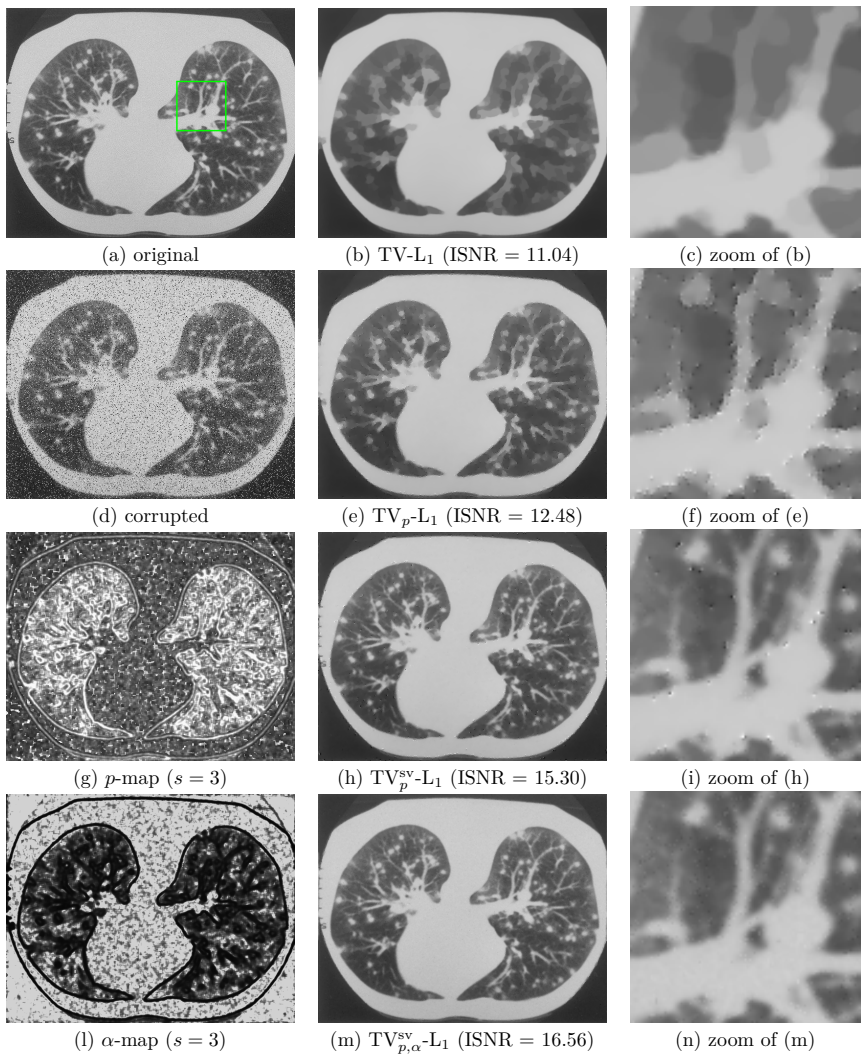
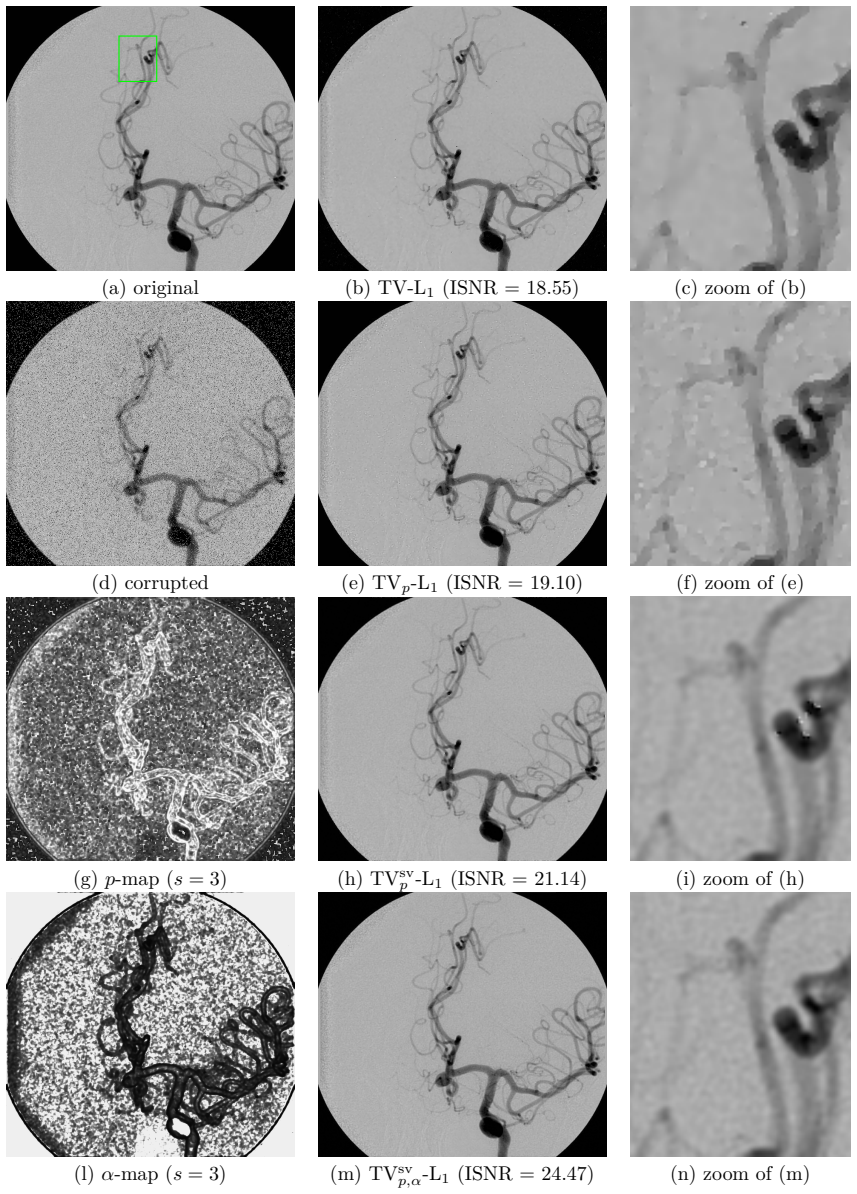
He B, Yuan X. 2012. On the O(1/n) convergence rate of the Douglas-Rachford alternating direction method. SIAM Journal on Numerical Analysis, vol. 50, no. 2, pp. 700–709. 14 (a) original (b) TV-L 1 (ISNR = 11.04) (c) zoom of (b) (d) corrupted (e) TV p-L1 (ISNR = 12.48) (f) zoom of (e) (g) p-map (s = 3) (h) TV sv p -L1 (ISNR = 15.30) (i) zoom of (h) (l) α-m...
work page 2012
discussion (0)
Sign in with ORCID, Apple, or X to comment. Anyone can read and Pith papers without signing in.