Data-driven prediction of vortex-induced vibration response of marine risers subjected to three-dimensional current
Pith reviewed 2026-05-25 17:08 UTC · model grok-4.3
The pith
Clustering 3D current experiment data groups riser VIV responses by flow direction and trains a random forest to predict them.
A machine-rendered reading of the paper's core claim, the machinery that carries it, and where it could break.
Core claim
By clustering the experimental 3D flow data, measurable parameters that influence VIV responses can be identified; the riser responses group according to their statistical characteristics, which relate to the direction of the flow; and a random forest regression model fitted to the measured responses allows direct performance comparison with existing VIV prediction tools such as VIVANA-FD.
What carries the argument
Data clustering algorithm applied to experimental 3D flow profiles, followed by random forest regression trained on the resulting grouped VIV response statistics.
If this is right
- Riser responses can be grouped by statistical characteristics that relate directly to current direction throughout the water column.
- A random forest regression model can be trained on measured VIV data to produce predictions under three-dimensional flow conditions.
- The data-driven predictions can be compared in performance against conventional tools that rely on two-dimensional flow assumptions.
- The identified measurable parameters from clustering offer an alternative route to incorporating 3D current effects without first reducing profiles to two dimensions.
Where Pith is reading between the lines
- If additional 3D-current experiments become available, the same clustering step could reveal whether the same direction-related parameters remain dominant.
- The approach could be tested on other slender marine structures such as mooring lines or pipelines that experience similar 3D flow conditions.
- Design workflows might eventually accept measured 3D current profiles directly rather than requiring manual conversion to equivalent 2D cases.
Load-bearing premise
The single available 3D-current experiment supplies a representative sample of the parameter space that governs VIV response under varying current directions.
What would settle it
Running the identical clustering-plus-random-forest procedure on data from a second, independent 3D-current riser experiment and finding that the model predictions no longer align with the measured responses or with VIVANA-FD outputs.
Figures



read the original abstract
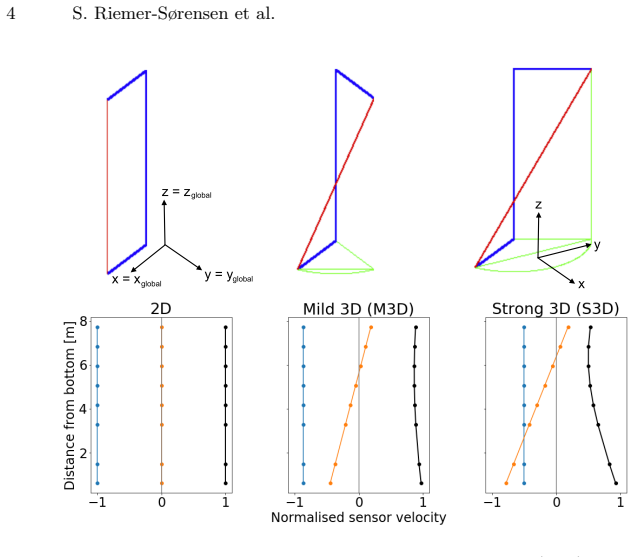
Slender marine structures such as deep-water marine risers are subjected to currents and will normally experience Vortex Induced Vibrations (VIV), which can cause fast accumulation of fatigue damage. The ocean current is often three-dimensional (3D), i.e., the direction and magnitude of the current vary throughout the water column. Today, semi-empirical tools are used by the industry to predict VIV induced fatigue on risers. The load model and hydrodynamic parameters in present VIV prediction tools are developed based on two-dimensional (2D) flow conditions, as it is challenging to consider the effect of 3D flow along the risers. Accordingly, the current profiles must be purposely made 2D during the design process, which leads to significant uncertainty in the prediction results. Further, due to the limitations in the laboratory, VIV model tests are mostly carried out under 2D flow conditions and thus little experimental data exist to document VIV response of riser subjected to varying directions of the current. However, a few experiments have been conducted with 3D current. We have used results from one of these experiments to investigate how well 1) traditional and 2) an alternative method based on a data driven prediction can describe VIV in 3D currents. Data driven modelling is particularly suited for complicated problems with many parameters and non-linear relationships. We have applied a data clustering algorithm to the experimental 3D flow data in order to identify measurable parameters that can influence responses. The riser responses are grouped based on their statistical characteristics, which relate to the direction of the flow. Furthermore we fit a random forest regression model to the measured VIV response and compare its performance with the predictions of existing VIV prediction tools (VIVANA-FD).
Editorial analysis
A structured set of objections, weighed in public.
Referee Report
Summary. The manuscript proposes a data-driven method for predicting vortex-induced vibration (VIV) responses of marine risers in three-dimensional (3D) currents. It uses experimental data from one 3D current test to apply clustering to identify influential measurable parameters, groups responses by statistical characteristics linked to flow direction, fits a random forest regression model to the VIV data, and compares its performance to the existing tool VIVANA-FD.
Significance. Should the approach prove robust, it would offer an alternative to semi-empirical VIV tools that are limited by their 2D flow assumptions, potentially improving fatigue predictions for risers in realistic ocean conditions. The integration of clustering and random forest regression demonstrates a practical application of machine learning to a complex hydrodynamic problem with nonlinear dependencies.
major comments (2)
- [Abstract] The abstract supplies no performance metrics, cross-validation details, data volume, or error bars; without these the claim that the data-driven method 'describes' 3D VIV cannot be evaluated against the stated comparison to VIVANA-FD.
- The single available 3D-current experiment supplies the entire dataset for both clustering and random-forest training, so extracted parameters and model performance may reflect test-specific artifacts rather than general VIV drivers. This undermines the claim that the identified parameters are general measurable drivers of VIV response.
minor comments (2)
- Clarify the specific clustering algorithm used and the criteria for grouping responses.
- Provide details on the input features and target variables for the random forest model.
Simulated Author's Rebuttal
We thank the referee for the constructive comments on the abstract and data limitations. We address each major comment below and will make revisions to strengthen the manuscript.
read point-by-point responses
-
Referee: [Abstract] The abstract supplies no performance metrics, cross-validation details, data volume, or error bars; without these the claim that the data-driven method 'describes' 3D VIV cannot be evaluated against the stated comparison to VIVANA-FD.
Authors: We agree that the abstract should include quantitative details to support the claims. In the revised version, we will add specific performance metrics (such as R-squared values and mean absolute errors for the random forest predictions), cross-validation procedure (e.g., 5-fold cross-validation details), data volume (number of samples and features from the experiment), and error bars or uncertainty estimates. These additions will allow direct evaluation against VIVANA-FD results. revision: yes
-
Referee: The single available 3D-current experiment supplies the entire dataset for both clustering and random-forest training, so extracted parameters and model performance may reflect test-specific artifacts rather than general VIV drivers. This undermines the claim that the identified parameters are general measurable drivers of VIV response.
Authors: We acknowledge the validity of this concern. The analysis relies on data from a single 3D-current experiment because few such datasets exist. This introduces the risk that identified parameters and model performance are specific to the test conditions rather than broadly generalizable. We will revise the manuscript to explicitly discuss this limitation in a dedicated section, qualify the claims about the parameters being 'general measurable drivers,' and frame the work as a demonstration of the data-driven approach on available 3D VIV data, with a call for additional experiments to assess broader applicability. revision: partial
Circularity Check
No significant circularity; derivation relies on external experimental data and independent benchmark.
full rationale
The paper describes applying a data clustering algorithm to 3D flow measurements from one experiment, grouping responses by statistical characteristics, fitting a random forest regression to the measured VIV responses, and comparing performance against the existing VIVANA-FD tool. No equations, self-citations, or steps reduce any claimed prediction or result to quantities defined by the model's own parameters or inputs by construction. The central result is a supervised fit evaluated on held-out experimental points against an external benchmark, satisfying the criteria for a self-contained derivation against external benchmarks.
Axiom & Free-Parameter Ledger
axioms (1)
- domain assumption The statistical properties of the measured 3D current profiles are sufficient to cluster and predict VIV response statistics.
Reference graph
Works this paper leans on
-
[1]
Machine Learning 45(1), 5–32 (Oct 2001)
Breiman, L.: Random forests. Machine Learning 45(1), 5–32 (Oct 2001). https://doi.org/10.1023/A:1010933404324
-
[2]
In: Pei, J., Tseng, V.S., Cao, L., Motoda, H., Xu, G
Campello, R.J.G.B., Moulavi, D., Sander, J.: Density-based clustering based on hierarchical density estimates. In: Pei, J., Tseng, V.S., Cao, L., Motoda, H., Xu, G. (eds.) Advances in Knowledge Discovery and Data Mining. pp. 160–172. Springer Berlin Heidelberg, Berlin, Heidelberg (2013)
work page 2013
-
[3]
Springer series in statistics, Springer (2009), http://www.worldcat.org/oclc/300478243
Hastie, T., Tibshirani, R., Friedman, J.H.: The elements of statistical learning: data mining, inference, and prediction, 2nd Edition. Springer series in statistics, Springer (2009), http://www.worldcat.org/oclc/300478243
-
[4]
Lie, H., Braaten, H., Jhingran, V., Sequeiros, O.E., Vandiver, K.: Comprehen- sive riser viv model tests in uniform and sheared flow. vol. 5. ASME 2012 31st International Conference on Ocean, Offshore and Arctic Engineering (2012). https://doi.org/10.1115/OMAE2012-84055
-
[5]
Offshore Technology Conference, OTC-8700-MS, Houston, Texas (1998)
Lie, H., Mo, K., Vandiver, J.: Viv model test of a bare- and a staggered buoyancy riser in a rotating rig. Offshore Technology Conference, OTC-8700-MS, Houston, Texas (1998). https://doi.org/10.4043/8700-MS
-
[6]
The Journal of Open Source Software 2(11) (mar 2017)
McInnes, L., Healy, J., Astels, S.: hdbscan: Hierarchical density based clustering. The Journal of Open Source Software 2(11) (mar 2017). https://doi.org/10.21105/joss.00205
-
[7]
Passano, E., Larsen, C., Lie, H., , Wu, J.: VIVANA - Theory Manual Version 4.4 (2014)
work page 2014
-
[8]
Journal of Offshore Mechanics and Arctic Engineering 131 (2009)
Srivilairit, T., Manuel, L.: Vortex-induced vibration and coincident current velocity profiles for a deepwater drilling riser. Journal of Offshore Mechanics and Arctic Engineering 131 (2009). https://doi.org/10.1115/1.3058684
-
[10]
Marine Structures 51, 134 – 151 (2017)
Thorsen, M., Sævik, S., Larsen, C.: Non-linear time domain analysis of cross-flow vortex-induced vibrations. Marine Structures 51, 134 – 151 (2017). https://doi.org/10.1016/j.marstruc.2016.10.007
-
[11]
Offshore Technology Conference, OTC-10931-MS, Houston, Texas (1999)
Triantafyllou, M., Triantafyllou, G., Tein, Y.D., Ambrose, B.D.: Pragmatic riser viv analysis. Offshore Technology Conference, OTC-10931-MS, Houston, Texas (1999). https://doi.org/10.4043/10931-MS
-
[12]
Journal of Fluids and Structures 21(3), 335 – 361 (2005)
Trim, A., Braaten, H., Lie, H., Tognarelli, M.: Experimental investigation of vortex- induced vibration of long marine risers. Journal of Fluids and Structures 21(3), 335 – 361 (2005). https://doi.org/10.1016/j.jfluidstructs.2005.07.014, marine and Aeronautical Fluid-Structure Interactions
work page doi:10.1016/j.j 2005
-
[13]
Flow-Induced Vibration Conference, Lucerne, Switzerland (2000)
Vandiver, J.: Predicting lock-in on drilling risers in sheared flows. Flow-Induced Vibration Conference, Lucerne, Switzerland (2000)
work page 2000
-
[14]
Vandiver, J., Li, L.: Shear7 v4.5 Program Theoretical Manual (2007)
work page 2007
-
[15]
Vandiver, J.K., Swithenbank, S.B., Jaiswal, V., Jhingran, V.: Fatigue damage from high mode number vortex-induced vibration. vol. 4. ASME 2006 25th International Conference on Ocean, Offshore and Arctic Engineering (2006). https://doi.org/10.1115/OMAE2006-92409
-
[16]
Westfall, P.H.: Kurtosis as peakedness, 1905 - 2014. r.i.p. American Statistician 68(3), 191–195 (aug 2014). https://doi.org/10.1080/00031305.2014.917055
work page internal anchor Pith review Pith/arXiv arXiv doi:10.1080/00031305.2014.917055 1905
discussion (0)
Sign in with ORCID, Apple, or X to comment. Anyone can read and Pith papers without signing in.