Variable dust emission by WC type Wolf-Rayet stars observed in the NEOWISE-R survey
Pith reviewed 2026-05-25 14:35 UTC · model grok-4.3
The pith
NEOWISE-R infrared photometry identifies ten new dust-making WC Wolf-Rayet stars and eleven with variable dust emission.
A machine-rendered reading of the paper's core claim, the machinery that carries it, and where it could break.
Core claim
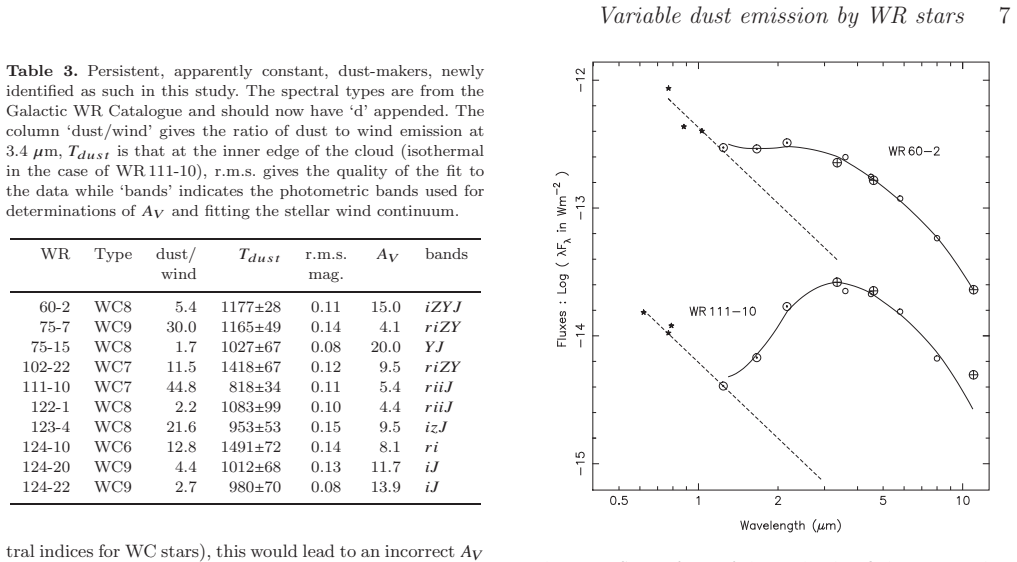
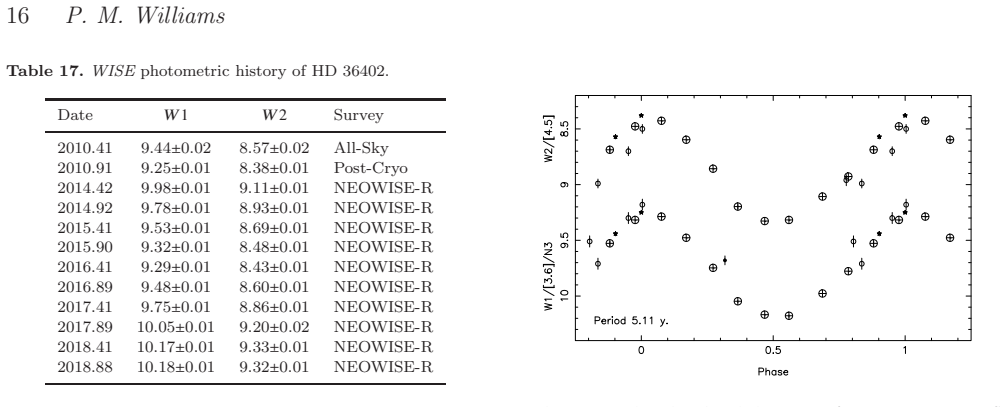
From their SEDs, ten apparently non-variable stars were newly identified as dust makers, including three, WR 102-22, WR 110-10 and WR 124-10, having subtype earlier than WC8-9, the first such stars to show this phenomenon. The 11 stars found to show variable dust emission include six new episodic dust-makers. Of previously known dust makers, NEOWISE-R photometry captured the rise of WR 19 in 2018 confirming its 10.1-year period, the start of a new episode for WR 125 suggesting a period near 28.3 years, and nearly a full cycle for HD 36402 revising its period to 5.1 years.
What carries the argument
Infrared spectral energy distributions (SEDs) constructed from NEOWISE-R 3.4 and 4.6 micron photometry combined with archival optical data to isolate circumstellar dust emission above stellar wind levels.
If this is right
- Early-subtype WC stars can form dust despite their higher temperatures.
- Episodic dust formation occurs in a larger fraction of WC stars than previously catalogued.
- Long-term infrared monitoring can determine or revise dust-formation periods for known makers.
- Dust production is observed in both Galactic and LMC WC populations.
Where Pith is reading between the lines
- Binary interactions may trigger dust formation in more WC stars than single-star models predict.
- Updated dust-maker statistics could revise estimates of the contribution of Wolf-Rayet stars to galactic dust budgets.
- Similar infrared surveys of other massive-star classes might reveal additional hidden dust episodes.
Load-bearing premise
The observed infrared excesses and their variations are produced by circumstellar dust rather than free-free wind emission, background sources, or other contaminants.
What would settle it
Higher-resolution mid-infrared imaging or spectroscopy that shows the excesses match pure wind models without dust spectral features would falsify the dust-maker identifications.
Figures







read the original abstract
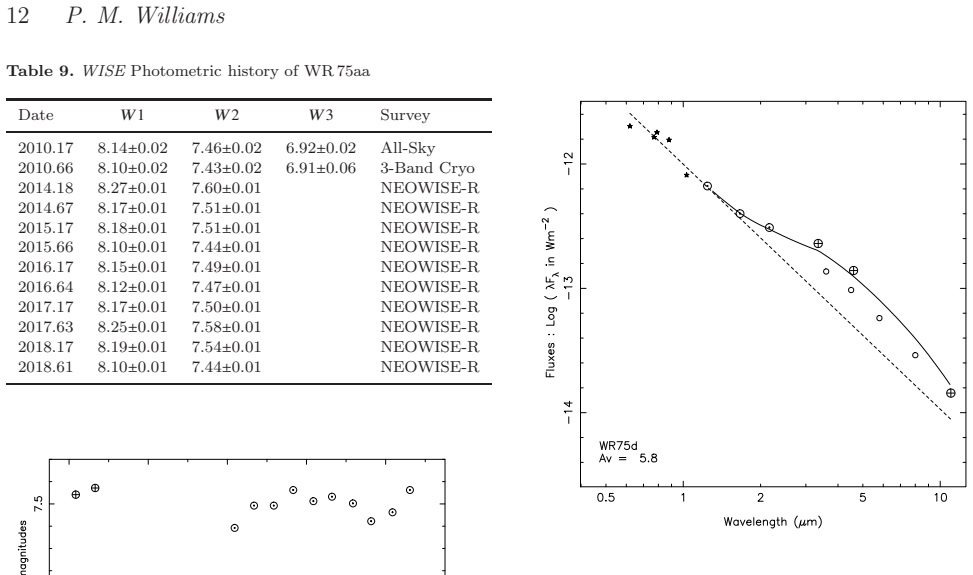
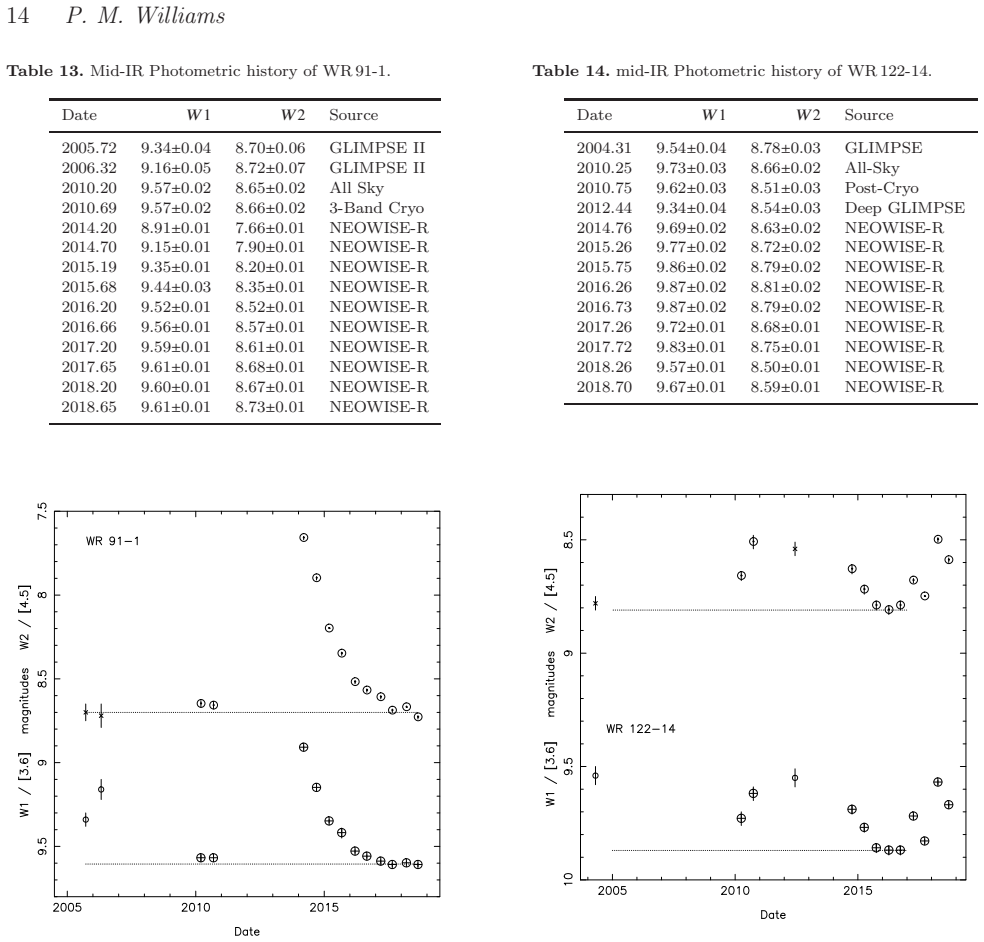
Photometry at 3.4 and 4.6 micron of 128 Population~I WC type Wolf-Rayet stars in the Galaxy and 12 in the Large Magellanic Cloud (LMC) observed in the WISE NEOWISE-R survey was searched for evidence of circumstellar dust emission and its variation. Infrared spectral energy distributions (SEDs) were assembled, making use of archival r, i, Z and Y photometry to determine reddening and stellar wind levels for the WC stars found in recent IR surveys and lacking optical photometry. From their SEDs, ten apparently non-variable stars were newly identified as dust makers, including three, WR 102-22, WR 110-10 and WR 124-10, having subtype earlier than WC8-9, the first such stars to show this phenomenon. The 11 stars found to show variable dust emission include six new episodic dust-makers, WR 47c, WR 75-11, WR 91-1, WR 122-14 and WR 125-1 in the Galaxy and HD 38030 in the LMC. Of previously known dust makers, NEOWISE-R photometry of WR 19 captured its rise to maximum in 2018, confirming the 10.1-y period, that of WR 125 the beginning of a new episode of dust formation suggesting a period near 28.3~y., while that of HD 36402 covered almost a whole period and forced revision of it to 5.1~y.
Editorial analysis
A structured set of objections, weighed in public.
Referee Report
Summary. The paper analyzes NEOWISE-R 3.4 and 4.6 μm photometry for 128 Galactic and 12 LMC WC Wolf-Rayet stars, assembling SEDs from archival r, i, Z, Y photometry to determine reddening and wind levels. It identifies ten new apparently non-variable dust makers (including three with subtypes earlier than WC8-9: WR 102-22, WR 110-10, WR 124-10), eleven variables (six new episodic: WR 47c, WR 75-11, WR 91-1, WR 122-14, WR 125-1, HD 38030), and updates periods for known variables (WR 19 at 10.1 y, WR 125 near 28.3 y, HD 36402 at 5.1 y).
Significance. If the SED-based dust identifications hold, the work expands the known population of dust-producing WC stars and provides the first examples of dust formation in subtypes earlier than WC8-9, with direct implications for wind physics and episodic dust production. The use of public all-sky survey data and the period revisions for three known systems constitute reproducible observational constraints that can be tested with future monitoring.
major comments (2)
- [SED analysis and new dust-maker identifications] Section describing SED construction and dust identification (near the paragraph on assembling SEDs from archival photometry): the assignment of W1/W2 excess to circumstellar dust for the three early-subtype stars (WR 102-22, WR 110-10, WR 124-10) rests on extrapolation of the stellar-wind continuum level; an uncertainty of even 0.1–0.2 mag in the normalized wind contribution would remove the claimed excess, yet no quantitative error budget, comparison to non-dust WC control stars, or independent mass-loss diagnostics (e.g., radio fluxes) is supplied to bound this systematic.
- [Variable dust emission results] Section on variable dust emission (paragraph listing the 11 variables): the classification of six stars as new episodic dust-makers relies on the same SED separation; without an explicit variability threshold (e.g., amplitude relative to photometric uncertainty or wind-flux scatter) or exclusion criteria for background contamination, the distinction between episodic dust and other sources of mid-IR variation remains difficult to verify from the reported photometry alone.
minor comments (2)
- [Abstract and §4] The abstract and results section should explicitly state the number of stars with sufficient epochs for variability detection versus those classified as non-variable due to sparse sampling.
- [Results tables] Table or figure presenting the 10 new non-variable dust makers should include the measured W1–W2 color excess and its uncertainty for each object.
Simulated Author's Rebuttal
We thank the referee for their careful reading of the manuscript and for highlighting areas where additional detail would improve clarity. We respond to each major comment below.
read point-by-point responses
-
Referee: Section describing SED construction and dust identification (near the paragraph on assembling SEDs from archival photometry): the assignment of W1/W2 excess to circumstellar dust for the three early-subtype stars (WR 102-22, WR 110-10, WR 124-10) rests on extrapolation of the stellar-wind continuum level; an uncertainty of even 0.1–0.2 mag in the normalized wind contribution would remove the claimed excess, yet no quantitative error budget, comparison to non-dust WC control stars, or independent mass-loss diagnostics (e.g., radio fluxes) is supplied to bound this systematic.
Authors: We agree that an explicit quantitative error budget for the wind-continuum normalization would strengthen the dust identifications for the three early-subtype stars. The SEDs were constructed by fitting optical r, i, Z, Y photometry to constrain reddening and the free-free wind level before extrapolating to W1/W2; the reported excesses for WR 102-22, WR 110-10 and WR 124-10 are 0.35–0.55 mag, which exceeds the 0.1–0.2 mag uncertainty range noted by the referee. In the revised manuscript we will add a dedicated paragraph that (i) propagates the observed scatter in the optical-to-mid-IR normalization across the non-dust WC control stars in our sample and (ii) tabulates the W1–W2 excess relative to that scatter for the three objects. Radio fluxes are unavailable for these specific stars in the literature, so we will note this limitation while emphasizing that the method is applied uniformly to the full 140-star sample. revision: yes
-
Referee: Section on variable dust emission (paragraph listing the 11 variables): the classification of six stars as new episodic dust-makers relies on the same SED separation; without an explicit variability threshold (e.g., amplitude relative to photometric uncertainty or wind-flux scatter) or exclusion criteria for background contamination, the distinction between episodic dust and other sources of mid-IR variation remains difficult to verify from the reported photometry alone.
Authors: The six new episodic dust-makers were identified from NEOWISE-R light curves that show coherent, multi-epoch brightening correlated with an SED excess above the wind continuum. We acknowledge that the original text does not state an explicit variability threshold or background-exclusion protocol. In revision we will insert a methods paragraph defining the adopted criterion (peak-to-peak amplitude >3× the per-epoch photometric uncertainty and >2× the rms scatter measured for non-dust WC stars) and describing the visual inspection of WISE images plus catalog quality flags used to reject obvious background contamination. These additions will allow readers to reproduce the classification directly from the photometry. revision: yes
Circularity Check
No circularity in observational photometry and SED identification
full rationale
The paper reports direct NEOWISE-R photometry at 3.4/4.6 μm for WC stars, assembles SEDs using archival optical/near-IR data to normalize wind levels and reddening, and identifies dust excesses by inspection. No equations, model fits, predictions, or self-citations are described that reduce any claim to its inputs by construction. The central results (new dust makers including early subtypes, variable episodes) are empirical reports of measured excesses and timing, self-contained against external benchmarks with no load-bearing self-referential steps.
Axiom & Free-Parameter Ledger
free parameters (1)
- dust formation periods =
various (e.g. 5.1 y for HD 36402)
axioms (1)
- domain assumption Mid-infrared excess at 3.4 and 4.6 microns traces circumstellar dust emission in WC star winds
Reference graph
Works this paper leans on
-
[1]
Allen D. A., Swings J. P., Harvey P. M., 1972, , http://ukads.nottingham.ac.uk/abs/1972A
work page 1972
-
[2]
Barentsen G., et al., 2014, @doi [ ] 10.1093/mnras/stu1651 , http://ukads.nottingham.ac.uk/abs/2014MNRAS.444.3230B 444, 3230
-
[3]
Bartzakos P., Moffat A. F. J., Niemela V. S., 2001, @doi [ ] 10.1046/j.1365-8711.2001.04126.x , https://ui.adsabs.harvard.edu/#abs/2001MNRAS.324...18B 324, 18
-
[4]
Benjamin R. A., et al., 2003, @doi [ ] 10.1086/376696 , http://ukads.nottingham.ac.uk/abs/2003PASP..115..953B 115, 953
-
[5]
Bonanos A. Z., et al., 2009, @doi [ ] 10.1088/0004-6256/138/4/1003 , https://ui.adsabs.harvard.edu/abs/2009AJ....138.1003B 138, 1003
-
[6]
Breysacher J., Azzopardi M., Testor G., 1999, @doi [ ] 10.1051/aas:1999240 , http://ukads.nottingham.ac.uk/abs/1999A
-
[7]
Churchwell E., et al., 2009, @doi [ ] 10.1086/597811 , http://adsabs.harvard.edu/abs/2009PASP..121..213C 121, 213
-
[8]
Cioni M. R. L., et al., 2011, @doi [ ] 10.1051/0004-6361/201016137 , https://ui.adsabs.harvard.edu/abs/2011A&A...527A.116C 527, A116
- [9]
-
[10]
Cohen M., Barlow M. J., Kuhi L. V., 1975, , http://ukads.nottingham.ac.uk/abs/1975A
work page 1975
-
[11]
Colangeli L., Mennella V., Palumbo P., Rotundi A., Bussoletti E., 1995, , http://ukads.nottingham.ac.uk/abs/1995A
work page 1995
-
[12]
Cross N. J. G., et al., 2012, @doi [ ] 10.1051/0004-6361/201219505 , http://ukads.nottingham.ac.uk/abs/2012A
-
[13]
Crowther P. A., De Marco O., Barlow M. J., 1998, @doi [ ] 10.1046/j.1365-8711.1998.01360.x , http://ukads.nottingham.ac.uk/abs/1998MNRAS.296..367C 296, 367
-
[14]
Cutri R. M., et al., 2012, VizieR Online Data Catalog, https://ui.adsabs.harvard.edu/abs/2012yCat.2281....0C p. II/281
work page 2012
-
[15]
Damineli A., Almeida L. A., Blum R. D., Damineli D. S. C., Navarete F., Rubinho M. S., Teodoro M., 2016, @doi [ ] 10.1093/mnras/stw2122 , http://ukads.nottingham.ac.uk/abs/2016MNRAS.463.2653D 463, 2653
-
[16]
Dougherty S. M., Beasley A. J., Claussen M. J., Zauderer B. A., Bolingbroke N. J., 2005, @doi [ ] 10.1086/428494 , http://ukads.nottingham.ac.uk/abs/2005ApJ...623..447D 623, 447
-
[17]
Drew J. E., et al., 2005, @doi [ ] 10.1111/j.1365-2966.2005.09330.x , http://ukads.nottingham.ac.uk/abs/2005MNRAS.362..753D 362, 753
-
[18]
Drew J. E., et al., 2014, @doi [ ] 10.1093/mnras/stu394 , http://ukads.nottingham.ac.uk/abs/2014MNRAS.440.2036D 440, 2036
-
[19]
Epchtein N., et al., 1999, , http://ukads.nottingham.ac.uk/abs/1999A
work page 1999
-
[20]
Fahed R., et al., 2011, @doi [ ] 10.1111/j.1365-2966.2011.19035.x , http://ukads.nottingham.ac.uk/abs/2011MNRAS.418....2F 418, 2
-
[21]
Gaia Collaboration et al., 2018, @doi [ ] 10.1051/0004-6361/201833051 , http://adsabs.harvard.edu/abs/2018A
work page internal anchor Pith review doi:10.1051/0004-6361/201833051 2018
-
[22]
Gehrz R. D., Hackwell J. A., 1974, @doi [ ] 10.1086/153281 , http://ukads.nottingham.ac.uk/abs/1974ApJ...194..619G 194, 619
-
[23]
A., Chu Y.-H., 2008, @doi [ ] 10.1086/587059 , 177, 216
Guerrero M. A., Chu Y.-H., 2008, @doi [ ] 10.1086/587059 , 177, 216
-
[24]
Hackwell J. A., Gehrz R. D., Smith J. R., Strecker D. W., 1976, @doi [ ] 10.1086/154811 , http://ukads.nottingham.ac.uk/abs/1976ApJ...210..137H 210, 137
-
[25]
Hackwell J. A., Gehrz R. D., Grasdalen G. L., 1979, @doi [ ] 10.1086/157479 , http://ukads.nottingham.ac.uk/abs/1979ApJ...234..133H 234, 133
-
[26]
Hadfield L. J., van Dyk S. D., Morris P. W., Smith J. D., Marston A. P., Peterson D. E., 2007, @doi [ ] 10.1111/j.1365-2966.2007.11424.x , http://ukads.nottingham.ac.uk/abs/2007MNRAS.376..248H 376, 248
-
[27]
Homeier N. L., Blum R. D., Conti P. S., Damineli A., 2003, @doi [ ] 10.1051/0004-6361:20021569 , http://ukads.nottingham.ac.uk/abs/2003A
-
[28]
Hopewell E. C., et al., 2005, @doi [ ] 10.1111/j.1365-2966.2005.09487.x , http://ukads.nottingham.ac.uk/abs/2005MNRAS.363..857H 363, 857
-
[29]
D., Schmutz W., 1992, , http://ukads.nottingham.ac.uk/abs/1992A
Howarth I. D., Schmutz W., 1992, , http://ukads.nottingham.ac.uk/abs/1992A
work page 1992
-
[30]
Jarrett T. H., et al., 2011, @doi [ ] 10.1088/0004-637X/735/2/112 , http://ukads.nottingham.ac.uk/abs/2011ApJ...735..112J 735, 112
-
[31]
Kanarek G., Shara M., Faherty J., Zurek D., Moffat A., 2015, @doi [ ] 10.1093/mnras/stv1342 , http://ukads.nottingham.ac.uk/abs/2015MNRAS.452.2858K 452, 2858
-
[32]
Kato D., et al., 2007, @doi [ ] 10.1093/pasj/59.3.615 , https://ui.adsabs.harvard.edu/abs/2007PASJ...59..615K 59, 615
-
[33]
D., 1965, @doi [ ] 10.1086/190116 , http://ukads.nottingham.ac.uk/abs/1965ApJS...11..216L 11, 216
Lafler J., Kinman T. D., 1965, @doi [ ] 10.1086/190116 , http://ukads.nottingham.ac.uk/abs/1965ApJS...11..216L 11, 216
-
[34]
Lamontagne R., Moffat A. F. J., Drissen L., Robert C., Matthews J. M., 1996, @doi [ ] 10.1086/118175 , http://adsabs.harvard.edu/abs/1996AJ....112.2227L 112, 2227
-
[35]
Lau R. M., Hankins M. J., Sch \"o del R., Sanchez-Bermudez J., Moffat A. F. J., Ressler M. E., 2017, @doi [ ] 10.3847/2041-8213/835/2/L31 , http://ukads.nottingham.ac.uk/abs/2017ApJ...835L..31L 835, L31
-
[36]
Lawrence A., et al., 2007, @doi [ ] 10.1111/j.1365-2966.2007.12040.x , http://adsabs.harvard.edu/abs/2007MNRAS.379.1599L 379, 1599
-
[37]
Lef \`e vre L., et al., 2005, @doi [ ] 10.1111/j.1365-2966.2005.09017.x , http://cdsads.u-strasbg.fr/abs/2005MNRAS.360..141L 360, 141
-
[38]
M., Koribalski B., 1997, , http://ukads.nottingham.ac.uk/abs/1997ApJ...481..898L 481, 898
Leitherer C., Chapman J. M., Koribalski B., 1997, , http://ukads.nottingham.ac.uk/abs/1997ApJ...481..898L 481, 898
work page 1997
-
[39]
Lucas P. W., et al., 2008, @doi [ ] 10.1111/j.1365-2966.2008.13924.x , http://adsabs.harvard.edu/abs/2008MNRAS.391..136L 391, 136
-
[40]
Mainzer A., et al., 2011, @doi [ ] 10.1088/0004-637X/731/1/53 , http://adsabs.harvard.edu/abs/2011ApJ...731...53M 731, 53
-
[41]
Mainzer A., et al., 2014, @doi [ ] 10.1088/0004-637X/792/1/30 , http://ukads.nottingham.ac.uk/abs/2014ApJ...792...30M 792, 30
-
[42]
Dust Formation in Massive WR+O Binaries: Recent Results
Marchenko S. V., Moffat A. F. J., 2007, in St.-Louis N., Moffat A. F. J., eds, Astronomical Society of the Pacific Conference Series Vol. 367, Massive Stars in Interactive Binaries. p. 213 ( @eprint astro-ph/0610531 )
work page internal anchor Pith review Pith/arXiv arXiv 2007
-
[43]
Marchenko S. V., Moffat A. F. J., Vacca W. D., C \^o t \'e S., Doyon R., 2002, @doi [ ] 10.1086/339138 , http://cdsads.u-strasbg.fr/abs/2002ApJ...565L..59M 565, L59
-
[44]
Mathis J. S., Cassinelli J. P., van der Hucht K. A., Prusti T., Wesselius P. R., Williams P. M., 1992, @doi [ ] 10.1086/170863 , http://ukads.nottingham.ac.uk/abs/1992ApJ...384..197M 384, 197
-
[45]
Mauerhan J. C., Van Dyk S. D., Morris P. W., 2009, @doi [ ] 10.1086/603544 , http://ukads.nottingham.ac.uk/abs/2009PASP..121..591M 121, 591
-
[46]
Mauerhan J. C., Van Dyk S. D., Morris P. W., 2011, @doi [ ] 10.1088/0004-6256/142/2/40 , http://ukads.nottingham.ac.uk/abs/2011AJ....142...40M 142, 40
-
[47]
Midooka T., Sugawara Y., Ebisawa K., 2019, @doi [ ] 10.1093/mnras/sty3488 , http://adsabs.harvard.edu/abs/2019MNRAS.484.2229M 484, 2229
-
[48]
Minniti D., et al., 2010, @doi [ ] 10.1016/j.newast.2009.12.002 , http://ukads.nottingham.ac.uk/abs/2010NewA...15..433M 15, 433
-
[49]
Miszalski B., Miko ajewska J., 2014, @doi [ ] 10.1093/mnras/stu292 , http://ukads.nottingham.ac.uk/abs/2014MNRAS.440.1410M 440, 1410
-
[50]
Moffat A. F. J., Niemela V. S., Marraco H. G., 1990, @doi [ ] 10.1086/168232 , http://ukads.nottingham.ac.uk/abs/1990ApJ...348..232M 348, 232
-
[51]
Monnier J. D., Tuthill P. G., Danchi W. C., 1999, @doi [ ] 10.1086/312352 , http://ukads.nottingham.ac.uk/abs/1999ApJ...525L..97M 525, L97
-
[52]
Monnier J. D., et al., 2011, @doi [ ] 10.1088/2041-8205/742/1/L1 , http://ukads.nottingham.ac.uk/abs/2011ApJ...742L...1M 742, L1
-
[53]
Morris P. W., Brownsberger K. R., Conti P. S., Massey P., Vacca W. D., 1993, @doi [ ] 10.1086/172923 , http://ukads.nottingham.ac.uk/abs/1993ApJ...412..324M 412, 324
-
[54]
Niemela V. S., 1995, in van der Hucht K. A., Williams P. M., eds, IAU Symposium Vol. 163, Wolf-Rayet Stars: Binaries; Colliding Winds; Evolution. p. 223
work page 1995
-
[55]
Rosslowe C. K., Crowther P. A., 2015, @doi [ ] 10.1093/mnras/stu2525 , http://ukads.nottingham.ac.uk/abs/2015MNRAS.447.2322R 447, 2322
-
[56]
Sander A. A. C., Hamann W.-R., Todt H., Hainich R., Shenar T., Ramachandran V., Oskinova L. M., 2019, @doi [ ] 10.1051/0004-6361/201833712 , http://ukads.nottingham.ac.uk/abs/2019A
-
[57]
Shara M. M., Moffat A. F. J., Smith L. F., Niemela V. S., Potter M., Lamontagne R., 1999, @doi [ ] 10.1086/300908 , http://ukads.nottingham.ac.uk/abs/1999AJ....118..390S 118, 390
-
[58]
Shara M. M., et al., 2009, @doi [ ] 10.1088/0004-6256/138/2/402 , http://ukads.nottingham.ac.uk/abs/2009AJ....138..402S 138, 402
-
[59]
Shara M. M., Faherty J. K., Zurek D., Moffat A. F. J., Gerke J., Doyon R., Artigau E., Drissen L., 2012, @doi [ ] 10.1088/0004-6256/143/6/149 , http://ukads.nottingham.ac.uk/abs/2012AJ....143..149S 143, 149
-
[60]
Skrutskie M. F., et al., 2006, @doi [ ] 10.1086/498708 , http://ukads.nottingham.ac.uk/abs/2006AJ....131.1163S 131, 1163
-
[61]
Smith L. F., 1968a, @doi [ ] 10.1093/mnras/138.1.109 , https://ui.adsabs.harvard.edu/#abs/1968MNRAS.138..109S 138, 109
-
[62]
Smith L. F., 1968b, @doi [ ] 10.1093/mnras/140.4.409 , http://ukads.nottingham.ac.uk/abs/1968MNRAS.140..409S 140, 409
-
[63]
Sugawara Y., et al., 2015, @doi [ ] 10.1093/pasj/psv099 , http://ukads.nottingham.ac.uk/abs/2015PASJ...67..121S 67, 121
-
[64]
Sugawara Y., Maeda Y., Tsuboi Y., 2017, in Ness J.-U., Migliari S., eds, The X-ray Universe 2017. p. 215
work page 2017
-
[65]
Taranova O. G., Shenavrin V. I., 2011, @doi [Astronomy Letters] 10.1134/S1063773710091014 , http://ukads.nottingham.ac.uk/abs/2011AstL...37...30T 37, 30
-
[66]
Tuthill P. G., Monnier J. D., Danchi W. C., 1999, @doi [ ] 10.1038/19033 , http://ukads.nottingham.ac.uk/abs/1999Natur.398..487T 398, 487
-
[67]
Tuthill P. G., Monnier J. D., Lawrance N., Danchi W. C., Owocki S. P., Gayley K. G., 2008, @doi [ ] 10.1086/527286 , http://ukads.nottingham.ac.uk/abs/2008ApJ...675..698T 675, 698
-
[68]
Usov V. V., 1991, @doi [ ] 10.1093/mnras/252.1.49 , http://ukads.nottingham.ac.uk/abs/1991MNRAS.252...49U 252, 49
-
[69]
Varricatt W. P., Ashok N. M., 2006, @doi [ ] 10.1111/j.1365-2966.2005.09693.x , http://adsabs.harvard.edu/abs/2006MNRAS.365..127V 365, 127
-
[70]
Veen P. M., van der Hucht K. A., Williams P. M., Catchpole R. M., Duijsens M. F. J., Glass I. S., Setia Gunawan D. Y. A., 1998, , http://ukads.nottingham.ac.uk/abs/1998A
work page 1998
-
[71]
M., 1999, in Wolf B., Stahl O., Fullerton A
Williams P. M., 1999, in Wolf B., Stahl O., Fullerton A. W., eds, Lecture Notes in Physics, Berlin Springer Verlag Vol. 523, IAU Colloq. 169: Variable and Non-spherical Stellar Winds in Luminous Hot Stars. p. 275, @doi 10.1007/BFb0106391
-
[72]
M., 2019, @doi [Research Notes of the AAS ] 10.3847/2515-5172/ab1f75 , 3, 71
Williams P. M., 2019, @doi [Research Notes of the AAS ] 10.3847/2515-5172/ab1f75 , 3, 71
-
[73]
Williams P. M., Eenens P. R. J., 1989, @doi [ ] 10.1093/mnras/240.2.445 , http://ukads.nottingham.ac.uk/abs/1989MNRAS.240..445W 240, 445
-
[74]
Williams M., van der Hucht K. A., 1992, in Drissen L., Leitherer C., Nota A., eds, Astronomical Society of the Pacific Conference Series Vol. 22, Nonisotropic and Variable Outflows from Stars. p. 269
work page 1992
-
[75]
The colliding-wind WC9+OB system WR 65 and dust formation by WR stars
Williams P. M., van der Hucht K. A., 2015, in Hamann W.-R., Sander A., Todt H., eds, Wolf-Rayet Stars: Proceedings of an International Workshop held in Potsdam, Germany, 1-5 June 2015. Universit \"a tsverlag Potsdam, 2015. pp 275--278 ( @eprint arXiv 1508.00724 )
work page internal anchor Pith review Pith/arXiv arXiv 2015
-
[76]
Williams P. M., Beattie D. H., Lee T. J., Stewart J. M., Antonopoulou E., 1978, @doi [ ] 10.1093/mnras/185.3.467 , http://ukads.nottingham.ac.uk/abs/1978MNRAS.185..467W 185, 467
-
[77]
Williams P. M., Longmore A. J., van der Hucht K. A., Talevera A., Wamsteker W. M., Abbott D. C., Telesco C. M., 1985, @doi [ ] 10.1093/mnras/215.1.23P , http://ukads.nottingham.ac.uk/abs/1985MNRAS.215P..23W 215, 23P
-
[78]
Williams P. M., van der Hucht K. A., Th\'e P. S., 1987, , http://ukads.nottingham.ac.uk/abs/1987A
work page 1987
-
[79]
Williams P. M., van der Hucht K. A., Pollock A. M. T., Florkowski D. R., van der Woerd H., Wamsteker W. M., 1990a, , http://ukads.nottingham.ac.uk/abs/1990MNRAS.243..662W 243, 662
-
[80]
Williams P. M., van der Hucht K. A., Th\'e P. S., Bouchet P., 1990b, , http://ukads.nottingham.ac.uk/abs/1990MNRAS.247P..18W 247, 18P
discussion (0)
Sign in with ORCID, Apple, or X to comment. Anyone can read and Pith papers without signing in.