On Reducing Negative Jacobian Determinant of the Deformation Predicted by Deep Registration Networks
Pith reviewed 2026-05-25 13:23 UTC · model grok-4.3
The pith
Two training mechanisms reduce folding in deformations from deep registration networks without architecture or hyperparameter changes.
A machine-rendered reading of the paper's core claim, the machinery that carries it, and where it could break.
Core claim
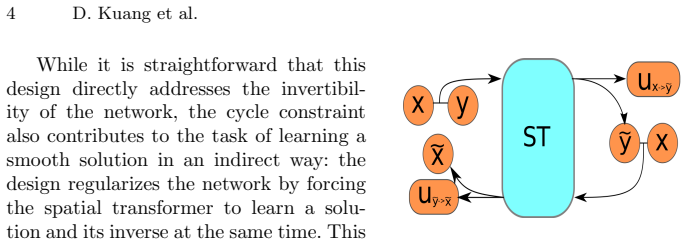
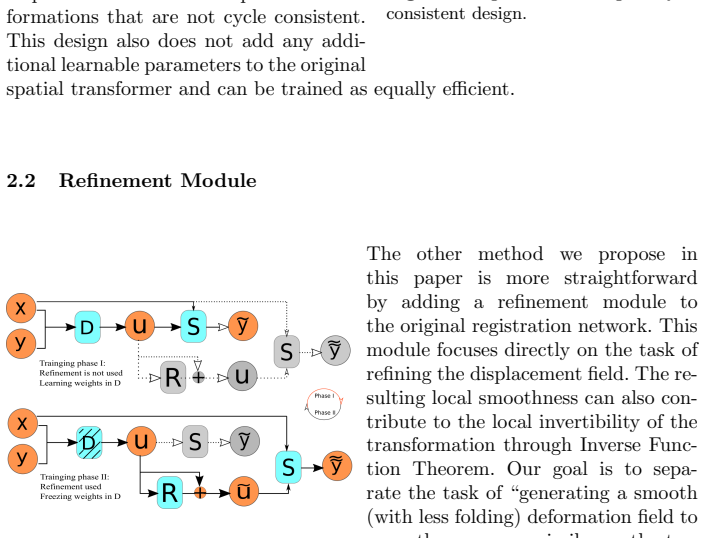
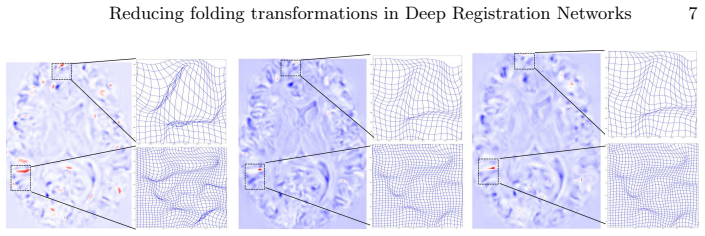
The paper shows that two independent training mechanisms, introduced without altering the baseline loss terms, hyperparameters, or network architecture, substantially lower the number of voxels where the Jacobian determinant of the predicted deformation is negative.
What carries the argument
Two independent training mechanisms that encourage avoidance of negative Jacobian determinants during optimization of the registration network.
If this is right
- Fewer voxels exhibit non-invertible folding in the output deformation fields.
- The mechanisms integrate directly with existing unsupervised registration losses.
- No retuning of regularization weights or network design is required.
- Smoother deformations are obtained on typical medical image pairs.
Where Pith is reading between the lines
- The same mechanisms could be tested on non-medical registration problems such as satellite or microscopy alignment.
- They might permit weaker spatial smoothness penalties while still controlling folds.
- Post-processing steps that repair folds could become less necessary.
Load-bearing premise
The mechanisms can be added independently of existing losses and will reduce negative Jacobians on medical datasets without creating new failure modes or requiring per-dataset tuning.
What would settle it
Running the baseline registration network with either mechanism on a representative medical dataset and finding no measurable drop in the count of negative Jacobian locations.
Figures


read the original abstract
Image registration is a fundamental step in medical image analysis. Ideally, the transformation that registers one image to another should be a diffeomorphism that is both invertible and smooth. Traditional methods like geodesic shooting approach the problem via differential geometry, with theoretical guarantees that the resulting transformation will be smooth and invertible. Most previous research using unsupervised deep neural networks for registration have used a local smoothness constraint (typically, a spatial variation loss) to address the smoothness issue. These networks usually produce non-invertible transformations with ``folding'' in multiple voxel locations, indicated by a negative determinant of the Jacobian matrix of the transformation. While using a loss function that specifically penalizes the folding is a straightforward solution, this usually requires carefully tuning the regularization strength, especially when there are also other losses. In this paper we address this problem from a different angle, by investigating possible training mechanisms that will help the network avoid negative Jacobians and produce smoother deformations. We contribute two independent ideas in this direction. Both ideas greatly reduce the number of folding locations in the predicted deformation, without making changes to the hyperparameters or the architecture used in the existing baseline registration network.
Editorial analysis
A structured set of objections, weighed in public.
Referee Report
Summary. The paper proposes two independent training mechanisms for unsupervised deep registration networks to reduce the number of locations with negative Jacobian determinants (folding) in the predicted deformation fields. The central claim is that these mechanisms achieve substantial reductions in folding while requiring no changes to the hyperparameters or architecture of a baseline registration network that uses standard similarity and smoothness losses.
Significance. If the mechanisms can be shown to deliver the claimed reductions on standard medical datasets while truly preserving baseline hyperparameters, the work would address a practical barrier to deploying deep registration models in settings that require diffeomorphic transformations. This could reduce reliance on post-hoc folding corrections or extensive loss-weight tuning.
major comments (1)
- [Abstract] Abstract: The assertion that the two ideas reduce folding 'without making changes to the hyperparameters or the architecture used in the existing baseline registration network' is load-bearing for the contribution. Any new training mechanism (auxiliary loss, sampling strategy, or regularizer) must be combined with the existing similarity + smoothness losses; the relative weighting coefficients are hyperparameters. The manuscript supplies no evidence that these coefficients remain fixed at their baseline values, remain optimal, or are unnecessary once the new mechanisms are present.
minor comments (1)
- [Abstract] Abstract: The two proposed ideas are not named or described, preventing assessment of whether they are genuinely independent of the baseline losses or architecture.
Simulated Author's Rebuttal
We thank the referee for the detailed review and the opportunity to clarify the central claim in the abstract. We address the major comment below.
read point-by-point responses
-
Referee: [Abstract] Abstract: The assertion that the two ideas reduce folding 'without making changes to the hyperparameters or the architecture used in the existing baseline registration network' is load-bearing for the contribution. Any new training mechanism (auxiliary loss, sampling strategy, or regularizer) must be combined with the existing similarity + smoothness losses; the relative weighting coefficients are hyperparameters. The manuscript supplies no evidence that these coefficients remain fixed at their baseline values, remain optimal, or are unnecessary once the new mechanisms are present.
Authors: We confirm that the two proposed training mechanisms were added while keeping the similarity and smoothness loss weights exactly equal to the values used for the baseline network (i.e., no retuning or re-optimization of those coefficients was performed). The mechanisms are therefore compatible with the standard loss combination at its original hyperparameter settings. To address the lack of explicit evidence, the revised manuscript will include a dedicated paragraph and table that lists the precise loss weights employed for both the baseline and the augmented training runs, confirming they are identical. revision: yes
Circularity Check
No circularity: empirical mechanisms proposed without self-referential derivation
full rationale
The paper proposes two training mechanisms to reduce negative Jacobian determinants in deep registration networks. The abstract states these ideas are independent, reduce folding locations, and require no changes to baseline hyperparameters or architecture. No equations, fitted parameters renamed as predictions, self-citations as load-bearing premises, or ansatzes smuggled via prior work are present in the provided text. The central claims rest on empirical outcomes on medical datasets rather than any derivation that reduces to its own inputs by construction. This is the expected non-finding for a methods paper focused on practical training adjustments.
Axiom & Free-Parameter Ledger
Forward citations
Cited by 1 Pith paper
-
MorphSeek: Fine-grained Latent Representation-Level Policy Optimization for Deformable Image Registration
MorphSeek advances a latent representation-level policy optimization approach for deformable image registration that reports Dice gains on brain MRI, liver CT, and MR-CT benchmarks with high label efficiency.
Reference graph
Works this paper leans on
-
[1]
Neuroimage 54(3), 2033–2044 (2011)
Avants, B.B., Tustison, N.J., Song, G., Cook, P.A., Klein, A., Gee, J.C.: A repro- ducible evaluation of ants similarity metric performance in brain image registration. Neuroimage 54(3), 2033–2044 (2011)
work page 2033
-
[2]
In: Proceedings of the IEEE Conference on Computer Vision and Pattern Recognition
Balakrishnan, G., Zhao, A., Sabuncu, M.R., Guttag, J., Dalca, A.V.: An unsuper- vised learning model for deformable medical image registration. In: Proceedings of the IEEE Conference on Computer Vision and Pattern Recognition. pp. 9252–9260 (2018) 8 D. Kuang et al
work page 2018
-
[3]
In: Advances in neural information processing systems
Goodfellow, I., Pouget-Abadie, J., Mirza, M., Xu, B., Warde-Farley, D., Ozair, S., Courville, A., Bengio, Y.: Generative adversarial nets. In: Advances in neural information processing systems. pp. 2672–2680 (2014)
work page 2014
-
[4]
In: Advances in neural information processing systems
Jaderberg, M., Simonyan, K., Zisserman, A., et al.: Spatial transformer networks. In: Advances in neural information processing systems. pp. 2017–2025 (2015)
work page 2017
-
[5]
Adam: A Method for Stochastic Optimization
Kingma, D.P., Ba, J.: Adam: A method for stochastic optimization. arXiv preprint arXiv:1412.6980 (2014)
work page internal anchor Pith review Pith/arXiv arXiv 2014
-
[6]
Frontiers in neuroscience 6, 171 (2012)
Klein, A., Tourville, J.: 101 labeled brain images and a consistent human cortical labeling protocol. Frontiers in neuroscience 6, 171 (2012)
work page 2012
-
[7]
Non-rigid image registration using fully convolutional networks with deep self-supervision
Li, H., Fan, Y.: Non-rigid image registration using fully convolutional networks with deep self-supervision. arXiv preprint arXiv:1709.00799 (2017)
work page internal anchor Pith review Pith/arXiv arXiv 2017
-
[8]
In: International Conference on Medical Image Computing and Computer-Assisted Intervention
Roh´ e, M.M., Datar, M., Heimann, T., Sermesant, M., Pennec, X.: Svf-net: Learning deformable image registration using shape matching. In: International Conference on Medical Image Computing and Computer-Assisted Intervention. pp. 266–274. Springer (2017)
work page 2017
-
[9]
In: International Conference on Medical image computing and computer-assisted intervention
Ronneberger, O., Fischer, P., Brox, T.: U-net: Convolutional networks for biomedi- cal image segmentation. In: International Conference on Medical image computing and computer-assisted intervention. pp. 234–241. Springer (2015)
work page 2015
-
[10]
Unsupervised End-to-end Learning for Deformable Medical Image Registration
Shan, S., Guo, X., Yan, W., Chang, E.I., Fan, Y., Xu, Y., et al.: Unsupervised end-to-end learning for deformable medical image registration. arXiv preprint arXiv:1711.08608 (2017)
work page internal anchor Pith review Pith/arXiv arXiv 2017
-
[11]
In: International Conference on Medical Image Computing and Computer-Assisted Intervention
Sokooti, H., de Vos, B., Berendsen, F., Lelieveldt, B.P., Iˇ sgum, I., Staring, M.: Nonrigid image registration using multi-scale 3d convolutional neural networks. In: International Conference on Medical Image Computing and Computer-Assisted Intervention. pp. 232–239. Springer (2017)
work page 2017
-
[12]
In: Deep Learning for Medical Image Analysis, pp
Wang, S., Kim, M., Wu, G., Shen, D.: Scalable high performance image registra- tion framework by unsupervised deep feature representations learning. In: Deep Learning for Medical Image Analysis, pp. 245–269. Elsevier (2017)
work page 2017
-
[13]
Empirical Evaluation of Rectified Activations in Convolutional Network
Xu, B., Wang, N., Chen, T., Li, M.: Empirical evaluation of rectified activations in convolutional network. arXiv preprint arXiv:1505.00853 (2015)
work page internal anchor Pith review Pith/arXiv arXiv 2015
-
[14]
NeuroImage 158, 378–396 (2017)
Yang, X., Kwitt, R., Styner, M., Niethammer, M.: Quicksilver: Fast predictive image registration–a deep learning approach. NeuroImage 158, 378–396 (2017)
work page 2017
-
[15]
Yoo, I., Hildebrand, D.G., Tobin, W.F., Lee, W.C.A., Jeong, W.K.: ssemnet: Serial- section electron microscopy image registration using a spatial transformer network with learned features. In: Deep Learning in Medical Image Analysis and Multi- modal Learning for Clinical Decision Support, pp. 249–257. Springer (2017)
work page 2017
-
[16]
Inverse-Consistent Deep Networks for Unsupervised Deformable Image Registration
Zhang, J.: Inverse-consistent deep networks for unsupervised deformable image registration. arXiv preprint arXiv:1809.03443 (2018)
work page internal anchor Pith review Pith/arXiv arXiv 2018
-
[17]
Zhu, J.Y., Park, T., Isola, P., Efros, A.A.: Unpaired image-to-image translation using cycle-consistent adversarial networks. arXiv preprint (2017)
work page 2017
discussion (0)
Sign in with ORCID, Apple, or X to comment. Anyone can read and Pith papers without signing in.