Kazhdan-Lusztig R-polynomials for pircons
Pith reviewed 2026-05-25 11:50 UTC · model grok-4.3
The pith
Introduces pircons as a unifying combinatorial structure for parabolic, zircon, and fixed-point-free-involution versions of Kazhdan-Lusztig R-polynomials.
A machine-rendered reading of the paper's core claim, the machinery that carries it, and where it could break.
Core claim
Pircons provide a common combinatorial framework for parabolic Kazhdan-Lusztig R-polynomials, Kazhdan-Lusztig R-polynomials of zircons, and Kazhdan-Lusztig-Vogan polynomials for fixed point free involutions.
Load-bearing premise
That the recursive relations and positivity properties that define the R-polynomials on the earlier structures continue to hold verbatim once the ambient poset is replaced by a pircon.
Figures


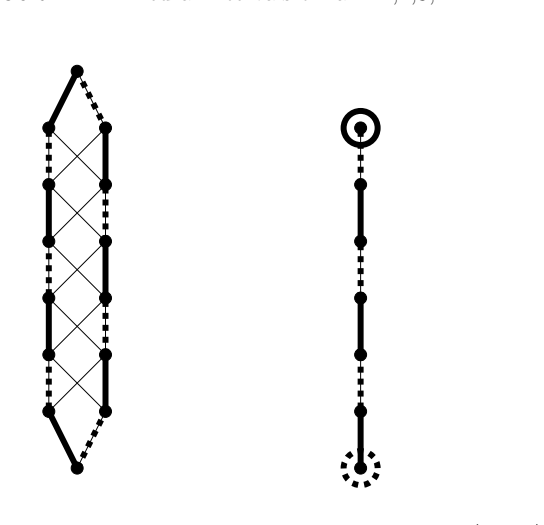
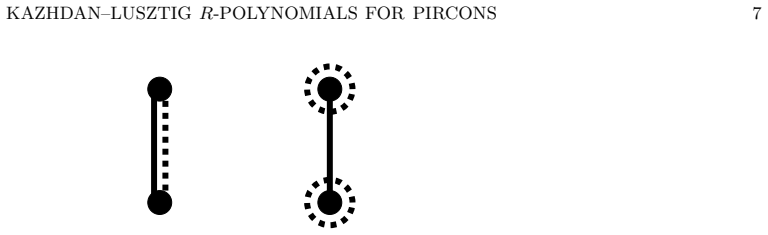


read the original abstract
The purpose of this work is to provide a common combinatorial framework for some of the analogues and generalizations of Kazhdan-Lusztig R-polynomials that have appeared since the introduction of these remarkable polynomials (e.g., parabolic Kazhdan-Lusztig R-polynomials, Kazhdan-Lusztig R-polynomials of zircons, and Kazhdan-Lusztig-Vogan polynomials for fixed point free involutions).
Editorial analysis
A structured set of objections, weighed in public.
Referee Report
Summary. The manuscript introduces the class of pircons (a poset generalization encompassing zircons and certain parabolic quotients) and defines Kazhdan-Lusztig R-polynomials on them via a recursion that is asserted to recover the parabolic R-polynomials, the R-polynomials of zircons, and the Kazhdan-Lusztig-Vogan polynomials attached to fixed-point-free involutions.
Significance. If the claimed recovery holds, the construction supplies a single combinatorial setting in which several existing generalizations of R-polynomials can be compared and potentially extended; the paper supplies the necessary poset axioms and the recursive definition.
major comments (2)
- [§2] §2 (Definition of pircon and the R-polynomial recursion): the listed pircon axioms do not visibly guarantee the unique maximal chains or the length-parity constraints that are required for the classical recursion (sum over covering relations with the usual degree condition) to be well-defined; without an explicit lemma showing these properties follow from the axioms, it is unclear that the recursion is unambiguous on an arbitrary pircon.
- [§4] §4 (Recovery statements): the claims that the pircon R-polynomials coincide with the parabolic, zircon, and Vogan cases are stated but no explicit isomorphism or restriction argument is supplied that preserves the covering relations and the base case at the identity element; this verification is load-bearing for the unification claim.
minor comments (1)
- Notation for the rank function and the length function on the pircon should be distinguished from the standard Coxeter length to avoid confusion when specializing to the classical cases.
Simulated Author's Rebuttal
We thank the referee for the careful reading and the constructive major comments. We address each point below and indicate the revisions we will make.
read point-by-point responses
-
Referee: [§2] §2 (Definition of pircon and the R-polynomial recursion): the listed pircon axioms do not visibly guarantee the unique maximal chains or the length-parity constraints that are required for the classical recursion (sum over covering relations with the usual degree condition) to be well-defined; without an explicit lemma showing these properties follow from the axioms, it is unclear that the recursion is unambiguous on an arbitrary pircon.
Authors: We agree that the well-definedness of the recursion requires explicit verification. The pircon axioms were chosen precisely to ensure unique maximal chains between comparable elements and the necessary length-parity conditions, but we acknowledge that this is not stated as a separate lemma. In the revised manuscript we will insert a short lemma in §2 proving these properties directly from the axioms, thereby confirming that the recursion is unambiguous. revision: yes
-
Referee: [§4] §4 (Recovery statements): the claims that the pircon R-polynomials coincide with the parabolic, zircon, and Vogan cases are stated but no explicit isomorphism or restriction argument is supplied that preserves the covering relations and the base case at the identity element; this verification is load-bearing for the unification claim.
Authors: The referee is correct that the recovery statements are central to the paper’s contribution and that the current text only asserts the coincidences without supplying the detailed arguments. We will expand §4 with three short subsections, each exhibiting the explicit restriction (or isomorphism) of a pircon to the corresponding classical poset while verifying that covering relations and the base case at the identity are preserved. revision: yes
Axiom & Free-Parameter Ledger
invented entities (1)
-
pircons
no independent evidence
Lean theorems connected to this paper
-
IndisputableMonolith/Cost/FunctionalEquationwashburn_uniqueness_aczel unclear?
unclearRelation between the paper passage and the cited Recognition theorem.
Definition 5.1 and recursion (5.1) for Rx-polynomials on refined pircons via special partial matchings Mv
-
IndisputableMonolith/Foundation/RealityFromDistinctionreality_from_one_distinction unclear?
unclearRelation between the paper passage and the cited Recognition theorem.
Theorem 2.5 on order complexes of intervals in pircons being PL balls/spheres
What do these tags mean?
- matches
- The paper's claim is directly supported by a theorem in the formal canon.
- supports
- The theorem supports part of the paper's argument, but the paper may add assumptions or extra steps.
- extends
- The paper goes beyond the formal theorem; the theorem is a base layer rather than the whole result.
- uses
- The paper appears to rely on the theorem as machinery.
- contradicts
- The paper's claim conflicts with a theorem or certificate in the canon.
- unclear
- Pith found a possible connection, but the passage is too broad, indirect, or ambiguous to say the theorem truly supports the claim.
Reference graph
Works this paper leans on
-
[1]
N. Abdallah, M. Hansson, A. Hultman, Topology of posets with special partial matchings , Advances in Math. 348 (2019), 255-276
work page 2019
-
[2]
N. Abdallah, A. Hultman, Combinatorial invariance of KazhdanLusztigVogan polynom ials for fixed point free involutions, J. Algebr. Comb. 47 (2018), 543-560
work page 2018
-
[3]
A. Bj¨ orner, F. Brenti, Combinatorics of Coxeter Groups , Graduate Texts in Mathematics 231, Springer-Verlag, New York, 2005
work page 2005
-
[4]
Brenti, P -kernels, IC bases and Kazhdan–Lusztig polynomials , J
F. Brenti, P -kernels, IC bases and Kazhdan–Lusztig polynomials , J. Algebra 259 (2003), 613-627
work page 2003
- [5]
- [6]
-
[7]
F. Caselli, M. Marietti, Special matchings in Coxeter groups , Europ. J. Combin. 61 (2017), 151-166
work page 2017
-
[8]
F. Caselli, M. Marietti, A simple characterization of special matchings in lower Bru hat intervals , Discrete Math. 341 (2018), 851-862
work page 2018
-
[9]
V. V. Deodhar, Some characterizations of Bruhat ordering on a Coxeter grou p and determination of the relative M¨ obius function, Invent. Math., 39 (1977), 187-198
work page 1977
-
[10]
Deodhar, On some geometric aspects of Bruhat orderings
V. Deodhar, On some geometric aspects of Bruhat orderings. II. The parab olic analogue of Kazhdan–Lusztig polynomials, J. Algebra, 111 (1987), 483-506
work page 1987
-
[11]
M. J. Dyer, Hecke algebras and reflections in Coxeter groups , Ph. D. Thesis, University of Sydney, 1987
work page 1987
-
[12]
Hultman, Criteria for rational smoothness of some symmetric orbit cl osures, Adv
A. Hultman, Criteria for rational smoothness of some symmetric orbit cl osures, Adv. in Math. 229 (2012), 183-200
work page 2012
-
[13]
Hultman, Fixed Points of Zircon Automorphisms , Order 25 (2008), 85-90
A. Hultman, Fixed Points of Zircon Automorphisms , Order 25 (2008), 85-90
work page 2008
-
[14]
J.E. Humphreys, Reflection Groups and Coxeter Groups , Cambridge Studies in Advanced Mathematics, no.29, Cambridge Univ. Press, Cambridge, 1990
work page 1990
-
[15]
D. Kazhdan, G. Lusztig, Representations of Coxeter groups and Hecke algebras , Invent. Math. 53 (1979), 165-184
work page 1979
-
[16]
Marietti, Algebraic and combinatorial properties of zircons , J
M. Marietti, Algebraic and combinatorial properties of zircons , J. Algebraic Combin., 26 (2007), 363-382
work page 2007
-
[17]
Marietti, Special matchings and parabolic Kazhdan–Lusztig polynomi als, Trans
M. Marietti, Special matchings and parabolic Kazhdan–Lusztig polynomi als, Trans. Amer. Math. Soc. 368 (2016), no. 7, 5247-5269
work page 2016
-
[18]
M. Marietti, The combinatorial invariance conjecture for parabolic Kaz hdan–Lusztig polynomials of lower inter- vals, Advances in Math. 335 (2018), 180-210
work page 2018
-
[19]
Stanley, Enumerative Combinatorics , vol.1, Wadsworth and Brooks/Cole, Monterey, CA, 1986
R.P. Stanley, Enumerative Combinatorics , vol.1, Wadsworth and Brooks/Cole, Monterey, CA, 1986
work page 1986
-
[20]
Stanley, Subdivisions and local h-vectors, J
R.P. Stanley, Subdivisions and local h-vectors, J. Amer. Math. Soc. 5 (1992), 805851. Dipartimento di Ingegneria Industriale e Scienze Matemati che, Universit `a Politecnica delle Marche, Via Brecce Bianche, 60131 Ancona, Italy E-mail address : m.marietti@univpm.it
work page 1992
discussion (0)
Sign in with ORCID, Apple, or X to comment. Anyone can read and Pith papers without signing in.