Revisiting the impact of stellar magnetic activity on the detectability of solar-like oscillations by Kepler
Pith reviewed 2026-05-25 10:40 UTC · model grok-4.3
The pith
Stars with a photometric activity index above 2,000 ppm have a 98.3 percent probability of showing no detectable solar-like oscillations.
A machine-rendered reading of the paper's core claim, the machinery that carries it, and where it could break.
Core claim
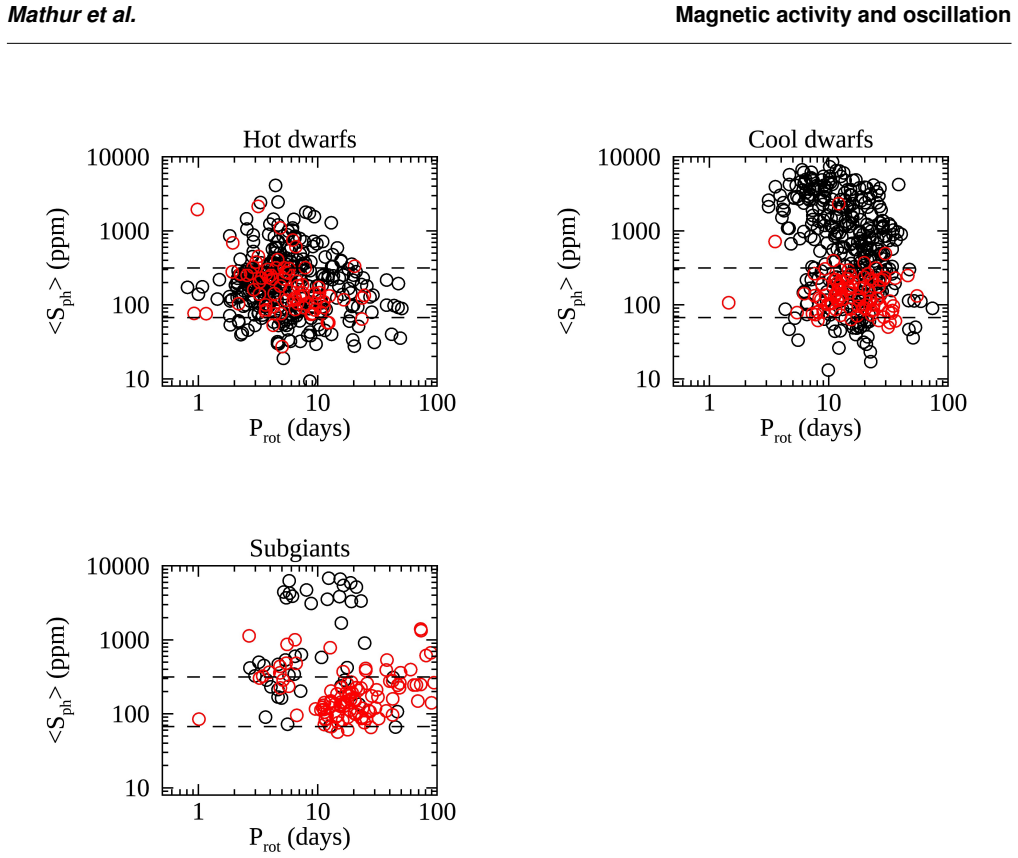
In the cleaned sample, stars whose predicted mode amplitudes exceed the detection threshold show an amplitude-to-noise ratio above 0.94 when oscillations are seen. Of the 323 such stars with reliable rotation periods, 32 percent have activity levels exceeding solar maximum and therefore lack detectable p-modes. Magnetic activity cannot account for the non-detections in the other 68 percent. Spectroscopic checks on a subsample suggest low metallicity may reduce mode amplitudes. Stars whose photometric activity index exceeds 2,000 ppm have a 98.3 percent probability of non-detection.
What carries the argument
The photometric magnetic activity index, derived from measured rotation periods and light-curve variability, used to test correlation with predicted versus observed mode amplitudes.
If this is right
- Magnetic activity above solar maximum accounts for non-detections in 32 percent of the 323 stars where modes were predicted to be visible.
- A photometric activity index below 20-30 ppm marks the practical limit at which rotation and magnetic activity become undetectable in the light curves.
- Low metallicity emerges as a candidate explanation for suppressed modes in the 68 percent of cases not explained by activity.
- No systematic correlation appears between mode non-detection and either binary status or stellar inclination angle.
Where Pith is reading between the lines
- Surveys could apply an activity-index threshold to deprioritize targets unlikely to yield oscillation detections.
- The unexplained 68 percent of cases motivates refined models of how metallicity affects mode excitation or damping.
- If low metallicity systematically reduces amplitudes, oscillation-based interior probes may be biased toward higher-metallicity solar analogs.
Load-bearing premise
The predicted mode amplitudes correctly identify the 323 stars in which oscillations should have been detectable without systematic bias from the amplitude formula or from how the main-sequence solar-like sample was defined.
What would settle it
Detection of solar-like oscillations in a statistically significant fraction of stars whose photometric activity index exceeds 2,000 ppm would falsify the claimed 98.3 percent non-detection probability.
Figures




read the original abstract
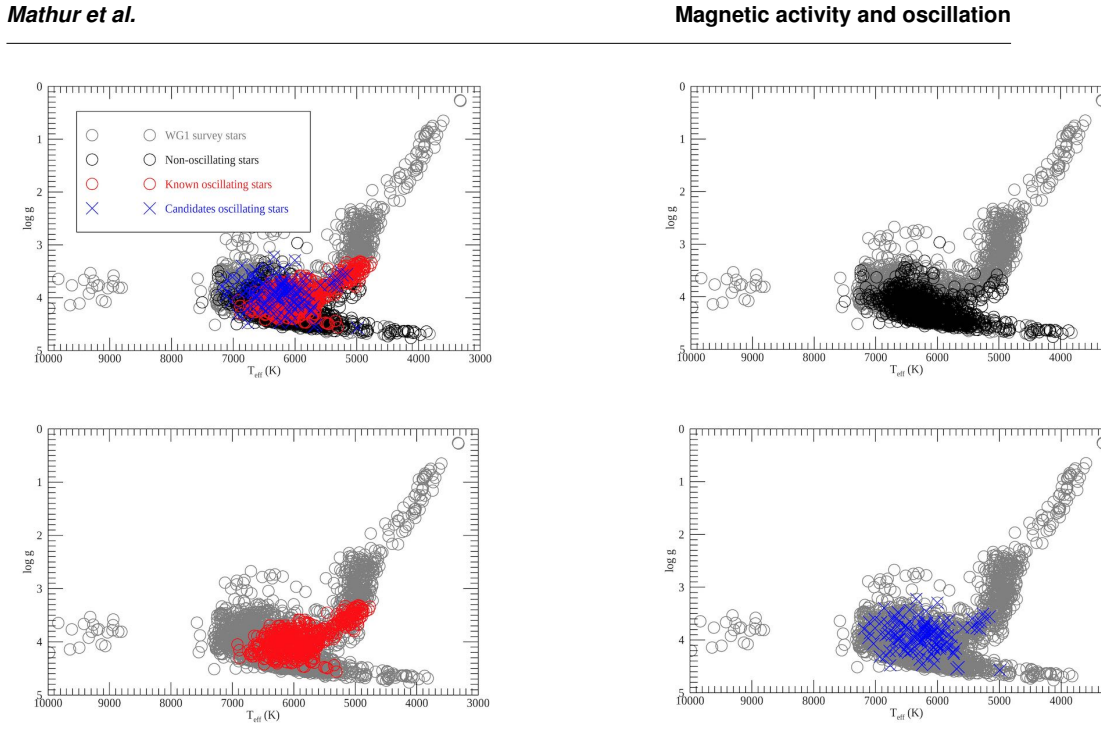
Over 2,000 stars were observed for one month with a high enough cadence in order to look for acoustic modes during the survey phase of the Kepler mission. Solar-like oscillations have been detected in about 540 stars. The question of why no oscillations were detected in the remaining stars is still open. Previous works explained the non-detection of modes with the high level of magnetic activity. However, the studied stars contained some classical pulsators and red giants that could have biased the results. In this work, we revisit this analysis on a cleaner sample of 1,014 main-sequence solar-like stars. First we compute the predicted amplitude of the modes. We find that the stars with detected modes have an amplitude to noise ratio larger than 0.94. We measure reliable rotation periods and the associated photometric magnetic index for 684 stars and in particular for 323 stars where the mode amplitude is predicted to be high enough to be detected. We find that among these 323 stars 32% have a magnetic activity level larger than the Sun at maximum activity, explaining the non-detection of p modes. Interestingly, magnetic activity cannot be the primary reason responsible for the absence of detectable modes in the remaining 68% of the stars without p modes detected and with reliable rotation periods. Thus, we investigate metallicity, inclination angle, and binarity as possible causes of low mode amplitudes. Using spectroscopic observations for a subsample, we find that a low metallicity could be the reason for suppressed modes. No clear correlation with binarity nor inclination is found. We also derive the lower limit for our photometric activity index (of 20-30 ppm) below which rotation and magnetic activity are not detected. Finally with our analysis we conclude that stars with a photometric activity index larger than 2,000 ppm have 98.3% probability of not having oscillations detected.
Editorial analysis
A structured set of objections, weighed in public.
Referee Report
Summary. The paper analyzes Kepler survey-phase observations of over 2000 stars to explain the non-detection of solar-like oscillations in the majority of cases. Using a cleaned sample of 1014 main-sequence solar-like stars, the authors compute predicted mode amplitudes via scaling relations, establish an empirical detection threshold of amplitude-to-noise ratio >0.94, derive rotation periods and a photometric magnetic activity index for 684 stars (including 323 with predicted detectable amplitudes), and conclude that activity levels exceeding the Sun at maximum (photometric index >2000 ppm) account for non-detections in 32% of the 323 stars while reporting a 98.3% probability of non-detection for stars above this activity threshold; the remaining 68% are attributed to factors such as low metallicity based on a spectroscopic subsample, with no clear role for inclination or binarity.
Significance. If the amplitude predictions hold without systematic bias, the work delivers a quantitative empirical constraint on activity suppression of p-modes that is directly useful for asteroseismic target selection and for interpreting non-detections in large surveys. The adoption of a strictly main-sequence solar-like sample removes contamination from classical pulsators and red giants that affected earlier studies, and the direct count yielding the 98.3% probability constitutes a falsifiable, parameter-light result.
major comments (2)
- [section computing predicted mode amplitudes and selection of the 323 stars] The attribution of non-detections to magnetic activity in 32% of the 323 stars (and the associated 98.3% probability statement) rests on the assumption that the predicted amplitudes correctly flag these stars as detectable in the absence of activity. The scaling relations for mode amplitudes and the definition of the main-sequence solar-like sample are not shown to be free of systematic offsets with metallicity or evolutionary state; a sensitivity test or comparison against an independent amplitude estimator is required to confirm that the high-activity subset is not preferentially misclassified.
- [section on measurement of rotation periods and photometric magnetic index] The photometric magnetic activity index threshold of 2000 ppm is presented as corresponding to the Sun at maximum activity, yet the precise calibration of this index against solar values, its uncertainty, and any post-selection cuts applied to the 684 stars with measured rotation periods are not detailed; this directly affects the robustness of the 98.3% probability quoted in the abstract and conclusion.
minor comments (2)
- [final analysis section] The lower limit of 20-30 ppm for the photometric activity index below which rotation and activity are undetectable should be shown with an explicit figure or table relating it to the noise properties of the Kepler light curves.
- [conclusions] Clarify whether the 98.3% probability is computed over the full 1014-star sample or restricted to the 323 stars with predicted detectable amplitudes, and state the exact denominator and numerator.
Simulated Author's Rebuttal
We thank the referee for their thorough and constructive review. The comments highlight important points regarding the robustness of our conclusions, and we address each major comment below. We will revise the manuscript to incorporate additional details and tests as outlined.
read point-by-point responses
-
Referee: [section computing predicted mode amplitudes and selection of the 323 stars] The attribution of non-detections to magnetic activity in 32% of the 323 stars (and the associated 98.3% probability statement) rests on the assumption that the predicted amplitudes correctly flag these stars as detectable in the absence of activity. The scaling relations for mode amplitudes and the definition of the main-sequence solar-like sample are not shown to be free of systematic offsets with metallicity or evolutionary state; a sensitivity test or comparison against an independent amplitude estimator is required to confirm that the high-activity subset is not preferentially misclassified.
Authors: We agree that explicit validation against potential systematics in the amplitude scaling relations would strengthen the attribution of the 32% fraction and the associated probability. In the revised manuscript we will add a sensitivity analysis in which the predicted amplitudes are perturbed by amounts representative of known uncertainties arising from metallicity and evolutionary state (drawing on published assessments of the scaling relations). We will also perform a limited comparison against an independent amplitude estimator for the spectroscopic subsample. These additions will confirm that the high-activity subset is not preferentially misclassified and will support the robustness of the quoted statistics. revision: yes
-
Referee: [section on measurement of rotation periods and photometric magnetic index] The photometric magnetic activity index threshold of 2000 ppm is presented as corresponding to the Sun at maximum activity, yet the precise calibration of this index against solar values, its uncertainty, and any post-selection cuts applied to the 684 stars with measured rotation periods are not detailed; this directly affects the robustness of the 98.3% probability quoted in the abstract and conclusion.
Authors: We thank the referee for noting the need for greater transparency on the activity-index calibration. The 2000 ppm value is obtained by applying the identical photometric index definition to solar observations at activity maximum. In the revised manuscript we will expand the relevant methods section to describe the solar calibration data set, the resulting uncertainty on the threshold, and the precise post-selection criteria applied to the 684 stars (including the 20-30 ppm lower limit for reliable rotation detection already mentioned in the text). This expanded description will directly underpin the robustness of the 98.3% probability. revision: yes
Circularity Check
No significant circularity; empirical counts after independent threshold
full rationale
The paper computes predicted mode amplitudes via scaling relations, determines an amplitude-to-noise threshold of 0.94 as the minimum observed among detected stars, and applies it to identify the 323-star subset. The central claim (98.3% non-detection probability for activity index >2000 ppm) is a direct empirical count over stars with measured rotation periods and activity indices versus detection status. No equation or step reduces this probability to a fitted parameter defined from the same data by construction, nor does any self-citation chain or ansatz make the result tautological. The derivation remains self-contained against the observed sample.
Axiom & Free-Parameter Ledger
free parameters (2)
- amplitude-to-noise detection threshold =
0.94
- photometric activity index threshold =
2000 ppm
axioms (1)
- domain assumption Predicted mode amplitudes computed from stellar parameters accurately forecast detectability in main-sequence solar-like stars.
Reference graph
Works this paper leans on
-
[1]
Aigrain, S., Llama, J., Ceillier, T., Chagas, M. L. d., Davenport, J. R. A., Garc´ıa, R. A., et al. (2015). Testing the recovery of stellar rotation signals from Kepler light curves using a blind hare-and-hounds exercise. MNRAS 450, 3211–3226. doi:10.1093/mnras/stv853
-
[2]
Basri, G., Walkowicz, L. M., Batalha, N., Gilliland, R. L., Jenkins, J., Borucki, W. J., et al. (2010). Photometric Variability in Kepler Target Stars: The Sun Among Stars-a First Look. ApJL 713, L155–L159. doi:10.1088/2041-8205/713/2/L155
-
[3]
Basri, G., Walkowicz, L. M., Batalha, N., Gilliland, R. L., Jenkins, J., Borucki, W. J., et al. (2011). Photometric Variability in Kepler Target Stars. II. An Overview of Amplitude, Periodicity, and Rotation in First Quarter Data. AJ 141, 20. doi:10.1088/0004-6256/141/1/20
-
[4]
G., Allende Prieto, C., Van Reeth, T., Tkachenko, A., Raskin, G., van Winckel, H., et al
Beck, P. G., Allende Prieto, C., Van Reeth, T., Tkachenko, A., Raskin, G., van Winckel, H., et al. (2016). The HERMES solar atlas and the spectroscopic analysis of the seismic solar analogue KIC 3241581. A&A 589, A27. doi:10.1051/0004-6361/201425423
-
[5]
G., do Nascimento, J.-D., Jr., Duarte, T., Salabert, D., Tkachenko, A., Mathis, S., et al
Beck, P. G., do Nascimento, J.-D., Jr., Duarte, T., Salabert, D., Tkachenko, A., Mathis, S., et al. (2017). Lithium abundance and rotation of seismic solar analogues. Solar and stellar connection from Kepler and Hermes observations. A&A 602, A63. doi:10.1051/0004-6361/201629820
-
[6]
A., Huber, D., Gaidos, E., and van Saders, J
Berger, T. A., Huber, D., Gaidos, E., and van Saders, J. L. (2018). Revised Radii of Kepler Stars and Planets Using Gaia Data Release 2. ApJ 866, 99. doi:10.3847/1538-4357/aada83
-
[7]
Bonanno, A., Corsaro, E., and Karoff, C. (2014). Asteroseismic stellar activity relations. A&A 571, A35. doi:10.1051/0004-6361/201424632
-
[8]
Braun, D. C., Duvall, T. L., Jr., and Labonte, B. J. (1987). Acoustic absorption by sunspots. ApJL 319, L27–L31. doi:10.1086/184949
-
[9]
Brown, T. M. (1991). The source of solar high-frequency acoustic modes - Theoretical expectations. ApJ 371, 396–401. doi:10.1086/169900
-
[10]
Brun, A. S. and Browning, M. K. (2017). Magnetism, dynamo action and the solar-stellar connection. Living Reviews in Solar Physics 14, 4. doi:10.1007/s41116-017-0007-8
-
[11]
Bugnet, L., Garc´ıa, R. A., Davies, G. R., Mathur, S., Corsaro, E., Hall, O. J., et al. (2018). FliPer: A global measure of power density to estimate surface gravities of main-sequence solar-like stars and red giants. A&A 620, A38. doi:10.1051/0004-6361/201833106
-
[12]
Bugnet, L., Garc ´ıa, R. A., Mathur, S., Davies, G. R., Hall, O. J., Lund, M. N., et al. (2019). FliPerClass: In search of solar-like pulsators among TESS targets. A&A 624, A79. doi:10.1051/ 0004-6361/201834780
work page 2019
-
[13]
Campante, T. L., Chaplin, W. J., Lund, M. N., Huber, D., Hekker, S., Garc ´ıa, R. A., et al. (2014). Limits on Surface Gravities of Kepler Planet-candidate Host Stars from Non-detection of Solar-like Oscillations. ApJ 783, 123. doi:10.1088/0004-637X/783/2/123 Frontiers 13 Mathur et al. Magnetic activity and oscillation
-
[14]
L., Schofield, M., Kuszlewicz, J
Campante, T. L., Schofield, M., Kuszlewicz, J. S., Bouma, L., Chaplin, W. J., Huber, D., et al. (2016). The Asteroseismic Potential of TESS: Exoplanet-host Stars. ApJ 830, 138. doi:10.3847/0004-637X/ 830/2/138
-
[15]
Ceillier, T., Tayar, J., Mathur, S., Salabert, D., Garc´ıa, R. A., Stello, D., et al. (2017). Surface rotation of Kepler red giant stars. A&A 605, A111. doi:10.1051/0004-6361/201629884
-
[16]
Ceillier, T., van Saders, J., Garc ´ıa, R. A., Metcalfe, T. S., Creevey, O., Mathis, S., et al. (2016). Rotation periods and seismic ages of KOIs - comparison with stars without detected planets from Kepler observations. MNRAS 456, 119–125. doi:10.1093/mnras/stv2622
-
[17]
Chaplin, W. J., Bedding, T. R., Bonanno, A., Broomhall, A.-M., Garc ´ıa, R. A., Hekker, S., et al. (2011). Evidence for the Impact of Stellar Activity on the Detectability of Solar-like Oscillations Observed by Kepler. ApJL 732, L5. doi:10.1088/2041-8205/732/1/L5
-
[18]
Chaplin, W. J., Elsworth, Y ., Isaak, G. R., Miller, B. A., and New, R. (2000). Variations in the excitation and damping of low-l solar p modes over the solar activity cycle∗. MNRAS 313, 32–42. doi:10.1046/j.1365-8711.2000.03176.x
-
[19]
Chaplin, W. J., Kjeldsen, H., Bedding, T. R., Christensen-Dalsgaard, J., Gilliland, R. L., Kawaler, S. D., et al. (2011). Predicting the Detectability of Oscillations in Solar-type Stars Observed by Kepler. ApJ 732, 54–+. doi:10.1088/0004-637X/732/1/54
-
[20]
J., Kjeldsen , H., Christensen-Dalsgaard , J
Chaplin, W. J., Kjeldsen, H., Christensen-Dalsgaard, J., Basu, S., Miglio, A., Appourchaux, T., et al. (2011). Ensemble Asteroseismology of Solar-Type Stars with the NASA Kepler Mission. Science 332, 213–. doi:10.1126/science.1201827
-
[21]
Properties of 42 Solar-type Kepler Targets from the Asteroseismic Modeling Portal
De Cat, P., Fu, J. N., Ren, A. B., Yang, X. H., Shi, J. R., Luo, A. L., et al. (2015). Lamost Observations in the Kepler Field. I. Database of Low-resolution Spectra. ApJS 220, 19. doi:10.1088/0067-0049/ 220/1/19
-
[22]
Duncan, D. K., Vaughan, A. H., Wilson, O. C., Preston, G. W., Frazer, J., Lanning, H., et al. (1991). CA II H and K measurements made at Mount Wilson Observatory, 1966-1983. ApJS 76, 383–430. doi:10.1086/191572
-
[23]
Elsworth, Y ., Howe, R., Isaak, G. R., McLeod, C. P., and New, R. (1990). Variation of low-order acoustic solar oscillations over the solar cycle. Nature 345, 322–324. doi:10.1038/345322a0
-
[24]
Fr¨ohlich, C., Romero, J., Roth, H., Wehrli, C., Andersen, B. N., Appourchaux, T., et al. (1995). VIRGO: Experiment for Helioseismology and Solar Irradiance Monitoring. Sol. Phys. 162, 101–128. doi:10.1007/BF00733428
-
[25]
Furlan, E., Ciardi, D. R., Cochran, W. D., Everett, M. E., Latham, D. W., Marcy, G. W., et al. (2018). The Kepler Follow-up Observation Program. II. Stellar Parameters from Medium- and High-resolution Spectroscopy. ApJ 861, 149. doi:10.3847/1538-4357/aaca34
-
[26]
A., Ceillier, T., Mathur, S., and Salabert, D
Garc´ıa, R. A., Ceillier, T., Mathur, S., and Salabert, D. (2013). Measuring Reliable Surface Rotation Rates from Kepler Photometric Observations. In Astronomical Society of the PacificConference Series, eds. H. Shibahashi and A. E. Lynas-Gray. vol. 479 of Astronomical Society of the Pacific Conference Series, 129
work page 2013
-
[27]
Rotation and magnetism of Kepler pulsating solar-like stars
Garc´ıa, R. A., Ceillier, T., Salabert, D., Mathur, S., van Saders, J. L., Pinsonneault, M., et al. (2014). Rotation and magnetism of Kepler pulsating solar-like stars. Towards asteroseismically calibrated age-rotation relations. A&A 572, A34. doi:10.1051/0004-6361/201423888
-
[28]
A., Hekker, S., Stello, D., Guti ´errez-Soto, J., Handberg, R., Huber, D., et al
Garc´ıa, R. A., Hekker, S., Stello, D., Guti ´errez-Soto, J., Handberg, R., Huber, D., et al. (2011). Preparation of Kepler light curves for asteroseismic analyses. MNRAS 414, L6–L10. doi:10.1111/j. 1745-3933.2011.01042.x This is a provisional file, not the final typeset article 14 Mathur et al. Magnetic activity and oscillation
work page doi:10.1111/j 2011
-
[30]
A., Mathur, S., Salabert, D., Ballot, J., R´egulo, C., Metcalfe, T
Garc´ıa, R. A., Mathur, S., Salabert, D., Ballot, J., R´egulo, C., Metcalfe, T. S., et al. (2010). CoRoT Reveals a Magnetic Activity Cycle in a Sun-Like Star. Science 329, 1032–. doi:10.1126/science. 1191064
-
[31]
Gaulme, P., Jackiewicz, J., Appourchaux, T., and Mosser, B. (2014). Surface Activity and Oscillation Amplitudes of Red Giants in Eclipsing Binaries. ApJ 785, 5. doi:10.1088/0004-637X/785/1/5
-
[32]
Goldreich, P. and Keeley, D. A. (1977). Solar seismology. II - The stochastic excitation of the solar p-modes by turbulent convection. ApJ 212, 243–251. doi:10.1086/155043
-
[33]
A., Hasselquist, S., Shetrone, M., Cunha, K., Allende Prieto, C., Anguiano, B., et al
Holtzman, J. A., Hasselquist, S., Shetrone, M., Cunha, K., Allende Prieto, C., Anguiano, B., et al. (2018). APOGEE Data Releases 13 and 14: Data and Analysis. AJ 156, 125. doi:10.3847/1538-3881/ aad4f9
-
[34]
Hon, M., Stello, D., and Yu, J. (2018). Deep learning classification in asteroseismology using an improved neural network: results on 15 000 Kepler red giants and applications to K2 and TESS data. MNRAS 476, 3233–3244. doi:10.1093/mnras/sty483
-
[35]
Howe, R., Davies, G. R., Chaplin, W. J., Elsworth, Y . P., and Hale, S. J. (2015). Validation of solar-cycle changes in low-degree helioseismic parameters from the Birmingham Solar-Oscillations Network. MNRAS 454, 4120–4141. doi:10.1093/mnras/stv2210
-
[36]
Jain, R. and Haber, D. (2002). Solar p-modes and surface magnetic fields: Is there an acoustic emission?. MDI/SOHO observations. A&A 387, 1092–1099. doi:10.1051/0004-6361:20020310
-
[37]
Karoff, C., Metcalfe, T. S., Santos, ˆA. R. G., Montet, B. T., Isaacson, H., Witzke, V ., et al. (2018). The Influence of Metallicity on Stellar Differential Rotation and Magnetic Activity. ApJ 852, 46. doi:10.3847/1538-4357/aaa026
-
[38]
Kiefer, R., Komm, R., Hill, F., Broomhall, A.-M., and Roth, M. (2018). GONG p-Mode Parameters Through Two Solar Cycles. Sol. Phys. 293, 151. doi:10.1007/s11207-018-1370-x
-
[39]
Kiefer, R., Schad, A., Davies, G., and Roth, M. (2017). Stellar magnetic activity and variability of oscillation parameters: An investigation of 24 solar-like stars observed by Kepler. A&A 598, A77. doi:10.1051/0004-6361/201628469
-
[40]
Kjeldsen, H. and Bedding, T. R. (1995). Amplitudes of stellar oscillations: the implications for asteroseismology. A&A 293, 87–106
work page 1995
-
[41]
Komm, R. W., Howe, R., and Hill, F. (2000). Solar-Cycle Changes in Gong P-Mode Widths and Amplitudes 1995-1998. ApJ 531, 1094–1108. doi:10.1086/308518
-
[42]
Kraft, R. P. (1967). Studies of Stellar Rotation. V . The Dependence of Rotation on Age among Solar-Type Stars. ApJ 150, 551. doi:10.1086/149359
-
[43]
Luo, A.-L., Zhao, Y .-H., Zhao, G., Deng, L.-C., Liu, X.-W., Jing, Y .-P., et al. (2016). VizieR Online Data Catalog: LAMOST DR2 catalogs (Luo+, 2016). VizieR Online Data Catalog 5149
work page 2016
-
[44]
Majewski, S. R., Schiavon, R. P., Frinchaboy, P. M., Allende Prieto, C., Barkhouser, R., Bizyaev, D., et al. (2017). The Apache Point Observatory Galactic Evolution Experiment (APOGEE). AJ 154, 94. doi:10.3847/1538-3881/aa784d
-
[45]
Mathur, S., Bruntt, H., Catala, C., Benomar, O., Davies, G. R., Garc´ıa, R. A., et al. (2013). Study of HD 169392A observed by CoRoT and HARPS. A&A 549, A12. doi:10.1051/0004-6361/201219678
-
[46]
A., Ballot, J., Ceillier, T., Salabert, D., Metcalfe, T
Mathur, S., Garc´ıa, R. A., Ballot, J., Ceillier, T., Salabert, D., Metcalfe, T. S., et al. (2014). Magnetic activity of F stars observed by Kepler. A&A 562, A124. doi:10.1051/0004-6361/201322707 Frontiers 15 Mathur et al. Magnetic activity and oscillation
-
[47]
A., Catala, C., Bruntt, H., Mosser, B., Appourchaux, T., et al
Mathur, S., Garc ´ıa, R. A., Catala, C., Bruntt, H., Mosser, B., Appourchaux, T., et al. (2010). The solar-like CoRoT target HD 170987: spectroscopic and seismic observations. A&A 518, A53. doi:10.1051/0004-6361/201014103
-
[48]
A., Huber, D., Regulo, C., Stello, D., Beck, P
Mathur, S., Garc´ıa, R. A., Huber, D., Regulo, C., Stello, D., Beck, P. G., et al. (2016). Probing the Deep End of the Milky Way with Kepler: Asteroseismic Analysis of 854 Faint Red Giants Misclassified as Cool Dwarfs. ApJ 827, 50. doi:10.3847/0004-637X/827/1/50
-
[49]
Mathur, S., Garc´ıa, R. A., R´egulo, C., Creevey, O. L., Ballot, J., Salabert, D., et al. (2010). Determining global parameters of the oscillations of solar-like stars. A&A 511, A46. doi:10.1051/0004-6361/ 200913266
-
[50]
Mathur, S., Huber, D., Batalha, N. M., Ciardi, D. R., Bastien, F. A., Bieryla, A., et al. (2017). Revised Stellar Properties of Kepler Targets for the Q1-17 (DR25) Transit Detection Run. ApJS 229, 30. doi:10.3847/1538-4365/229/2/30
-
[51]
Mathur, S., Salabert, D., Garc´ıa, R. A., and Ceillier, T. (2014). Photometric magnetic-activity metrics tested with the Sun: application to Kepler M dwarfs. Journal of Space Weather and Space Climate 4, A15. doi:10.1051/swsc/2014011
-
[52]
McQuillan, A., Mazeh, T., and Aigrain, S. (2014). Rotation Periods of 34,030 Kepler Main-sequence Stars: The Full Autocorrelation Sample. ApJS 211, 24. doi:10.1088/0067-0049/211/2/24
-
[53]
B., Gizon, L., Schunker, H., and Karoff, C
Nielsen, M. B., Gizon, L., Schunker, H., and Karoff, C. (2013). Rotation periods of 12 000 main- sequence Kepler stars: Dependence on stellar spectral type and comparison with v sin i observations. A&A 557, L10. doi:10.1051/0004-6361/201321912
-
[54]
A., Ballot, J., Stello, D., and Sato, K
Pires, S., Mathur, S., Garc ´ıa, R. A., Ballot, J., Stello, D., and Sato, K. (2015). Gap interpolation by inpainting methods: Application to ground and space-based asteroseismic data. A&A 574, A18. doi:10.1051/0004-6361/201322361
-
[55]
Raskin, G. (2011). Hermes, a fibre-fed high-resolution spectrograph for the Mercator Telescope. Ph.D. thesis, Institute of Astronomy, Katholieke Universiteit Leuven, Belgium
work page 2011
-
[56]
Raskin, G., van Winckel, H., Hensberge, H., Jorissen, A., Lehmann, H., Waelkens, C., et al. (2011). HERMES: a high-resolution fibre-fed spectrograph for the Mercator telescope. A&A 526, A69. doi:10.1051/0004-6361/201015435
-
[57]
Rauer, H., Catala, C., Aerts, C., Appourchaux, T., Benz, W., Brandeker, A., et al. (2014). The PLATO 2.0 mission. Experimental Astronomy 38, 249–330. doi:10.1007/s10686-014-9383-4
-
[58]
Reinhold, T., Reiners, A., and Basri, G. (2013). Rotation and differential rotation of active Kepler stars. A&A 560, A4. doi:10.1051/0004-6361/201321970
-
[59]
Ricker, G. R., Winn, J. N., Vanderspek, R., Latham, D. W., Bakos, G. ´A., Bean, J. L., et al. (2015). Transiting Exoplanet Survey Satellite (TESS). Journal of Astronomical Telescopes, Instruments, and Systems 1, 014003. doi:10.1117/1.JATIS.1.1.014003
work page internal anchor Pith review doi:10.1117/1.jatis.1.1.014003 2015
-
[60]
Salabert, D., Garc´ıa, R. A., Beck, P. G., Egeland, R., Pall´e, P. L., Mathur, S., et al. (2016). Photospheric and chromospheric magnetic activity of seismic solar analogs. Observational inputs on the solar-stellar connection from Kepler and Hermes. A&A 596, A31. doi:10.1051/0004-6361/201628583
-
[61]
A., Jim´enez, A., Bertello, L., Corsaro, E., and Pall´e, P
Salabert, D., Garc´ıa, R. A., Jim´enez, A., Bertello, L., Corsaro, E., and Pall´e, P. L. (2017). Photospheric activity of the Sun with VIRGO and GOLF. Comparison with standard activity proxies. A&A 608, A87. doi:10.1051/0004-6361/201731560
-
[62]
Magnetic variability in the young solar analog KIC 10644253
Salabert, D., R´egulo, C., Garc´ıa, R. A., Beck, P. G., Ballot, J., Creevey, O. L., et al. (2016). Magnetic variability in the young solar analog KIC 10644253. Observations from the Kepler satellite and the HERMES spectrograph. A&A 589, A118. doi:10.1051/0004-6361/201527978 This is a provisional file, not the final typeset article 16 Mathur et al. Magnetic ...
-
[63]
Salabert, D., R´egulo, C., P´erez Hern´andez, F., and Garc´ıa, R. A. (2018). Frequency dependence of p-mode frequency shifts induced by magnetic activity in Kepler solar-like stars. A&A 611, A84. doi:10.1051/0004-6361/201731714
-
[64]
Samadi, R., Ludwig, H.-G., Belkacem, K., Goupil, M. J., and Dupret, M.-A. (2010). The CoRoT target HD 49933 . I. Effect of the metal abundance on the mode excitation rates. A&A 509, A15. doi:10.1051/0004-6361/200911867
-
[65]
Santos, A. R. G., Campante, T. L., Chaplin, W. J., Cunha, M. S., Lund, M. N., Kiefer, R., et al. (2018). Signatures of Magnetic Activity in the Seismic Data of Solar-type Stars Observed by Kepler. ApJS 237, 17. doi:10.3847/1538-4365/aac9b6
-
[66]
Schonhut-Stasik, J., Huber, D., Baranec, C., Lamman, C., Salama, M., Jensen-Clem, R., et al. (2019). Robo-ao kepler asteroseismic survey. ii. do stellar companions inhibit stellar oscillations? ApJ, submitted
work page 2019
-
[67]
Smith, J. C., Stumpe, M. C., Van Cleve, J. E., Jenkins, J. M., Barclay, T. S., Fanelli, M. N., et al. (2012). Kepler Presearch Data Conditioning II - A Bayesian Approach to Systematic Error Correction. PASP 124, 1000–1014. doi:10.1086/667697
-
[68]
R., Benomar, O., Bildsten, L., Elsworth, Y
Stello, D., Huber, D., Bedding, T. R., Benomar, O., Bildsten, L., Elsworth, Y . P., et al. (2013). Asteroseismic Classification of Stellar Populations among 13,000 Red Giants Observed by Kepler. ApJL 765, L41. doi:10.1088/2041-8205/765/2/L41
-
[69]
Stumpe, M. C., Smith, J. C., Van Cleve, J. E., Twicken, J. D., Barclay, T. S., Fanelli, M. N., et al. (2012). Kepler Presearch Data Conditioning I - Architecture and Algorithms for Error Correction in Kepler Light Curves. PASP 124, 985–999. doi:10.1086/667698
-
[70]
Thompson, S. E., Christiansen, J. L., Jenkins, J. M., Caldwell, D. A., Barclay, T., Bryson, S. T., et al. (2013). Kepler Data Release 21 Notes (KSCI-19061-001). Kepler mission
work page 2013
-
[71]
Torrence, C. and Compo, G. P. (1998). A Practical Guide to Wavelet Analysis. Bulletin of the American Meteorological Society 79, 61–78. doi:10.1175/1520-0477(1998)079
-
[72]
Woodard, M. F. and Noyes, R. W. (1985). Change of solar oscillation eigenfrequencies with the solar cycle. Nature 318, 449–450. doi:10.1038/318449a0
-
[73]
R., Stello, D., Hon, M., Murphy, S
Yu, J., Huber, D., Bedding, T. R., Stello, D., Hon, M., Murphy, S. J., et al. (2018). Asteroseismology of 16,000 Kepler Red Giants: Global Oscillation Parameters, Masses, and Radii. ApJS 236, 42. doi:10.3847/1538-4365/aaaf74
-
[74]
M., Baranec, C., Riddle, R., Duev, D
Ziegler, C., Law, N. M., Baranec, C., Riddle, R., Duev, D. A., Howard, W., et al. (2018). Robo-AO Kepler Survey. IV . The Effect of Nearby Stars on 3857 Planetary Candidate Systems.AJ 155, 161. doi:10.3847/1538-3881/aab042 FUNDING This paper includes data collected by the Kepler mission. Funding for the Kepler mission is provided by the NASA Science Missi...
discussion (0)
Sign in with ORCID, Apple, or X to comment. Anyone can read and Pith papers without signing in.