Extragalactic astrophysics with next-generation CMB experiments
Pith reviewed 2026-05-24 22:57 UTC · model grok-4.3
The pith
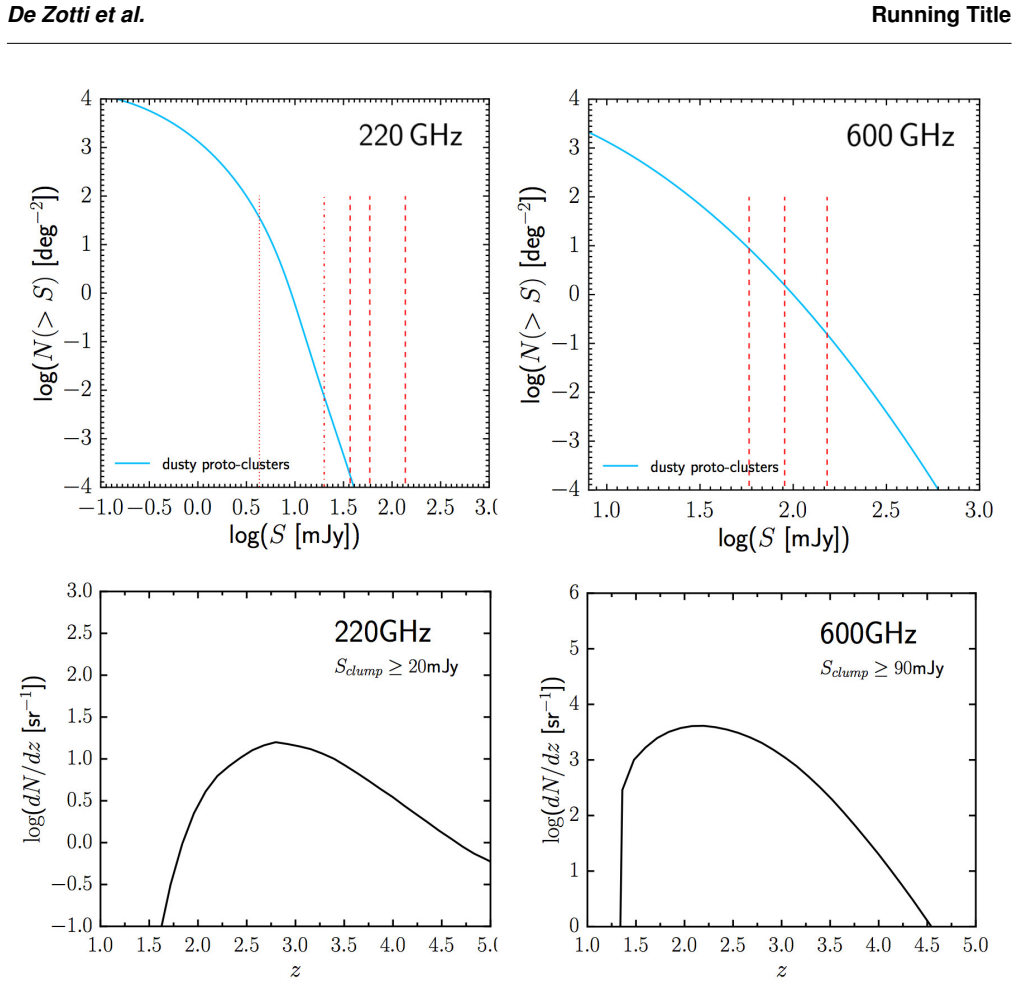
Next-generation CMB experiments will detect thousands of strongly lensed galaxies out to redshift 6 and proto-clusters in their main star-forming phase.
A machine-rendered reading of the paper's core claim, the machinery that carries it, and where it could break.
Core claim
The central claim is that instruments such as PICO, CORE, CMB-Bharat, Simons Observatory and CMB-S4 will discover several thousands of strongly lensed galaxies out to z~6 or more, along with galaxy proto-clusters at the epoch when their member galaxies formed most of their stars. They will also detect tens of thousands of local dusty galaxies and thousands of radio sources up to z~5, and measure polarized emission from thousands of sources at mm/sub-mm wavelengths.
What carries the argument
Strong gravitational lensing by foreground galaxies that boosts flux and stretches images, combined with the high sensitivity of next-generation CMB surveys to mm/sub-mm emission from dusty galaxies.
If this is right
- Investigation of galaxy internal structure at z~3 with ~60 pc resolution becomes routine for many objects.
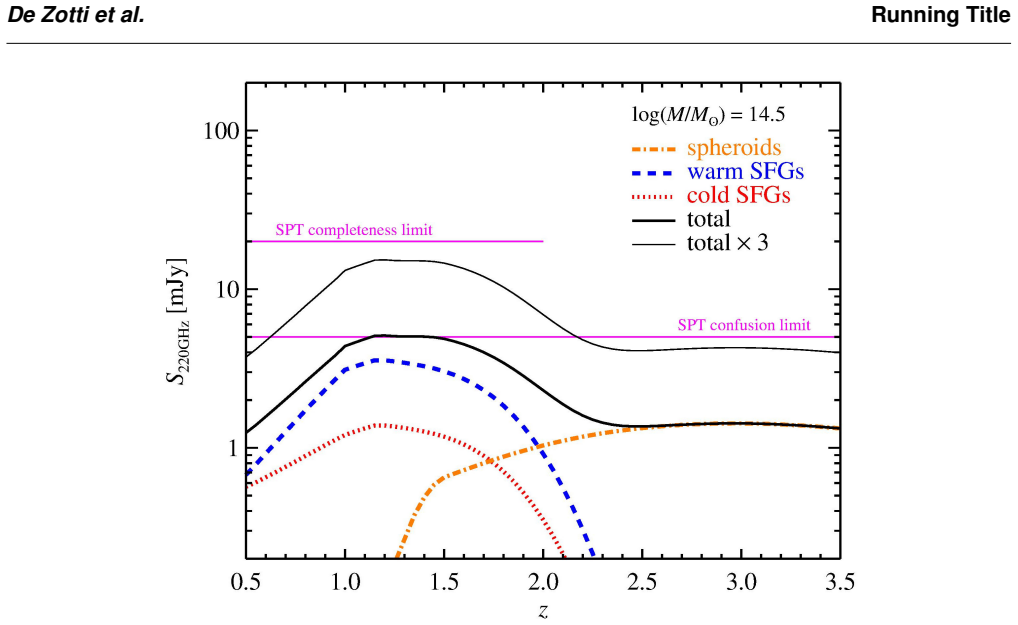
- Proto-clusters can be identified before they develop detectable hot gas via X-rays or SZ effect.
- Large samples of polarized radio sources and dusty galaxies will be available for statistical studies.
- Number counts of high-z sources can be measured to much fainter levels than today.
Where Pith is reading between the lines
- These detections could tighten constraints on the star formation rate density at z>3 by providing large, uniformly selected samples.
- Cross-correlations with optical or near-IR surveys might reveal the dark matter halos hosting these proto-clusters.
- Failure to find the predicted numbers would indicate either lower lensing optical depths or different evolution in the sub-mm luminosity function than assumed.
Load-bearing premise
That the number counts of dusty galaxies and the statistics of strong lensing at faint flux levels and high redshifts can be reliably extrapolated from existing shallower surveys.
What would settle it
Running the next-generation surveys and counting far fewer than several thousand strongly lensed galaxies or proto-clusters would falsify the yield predictions.
Figures


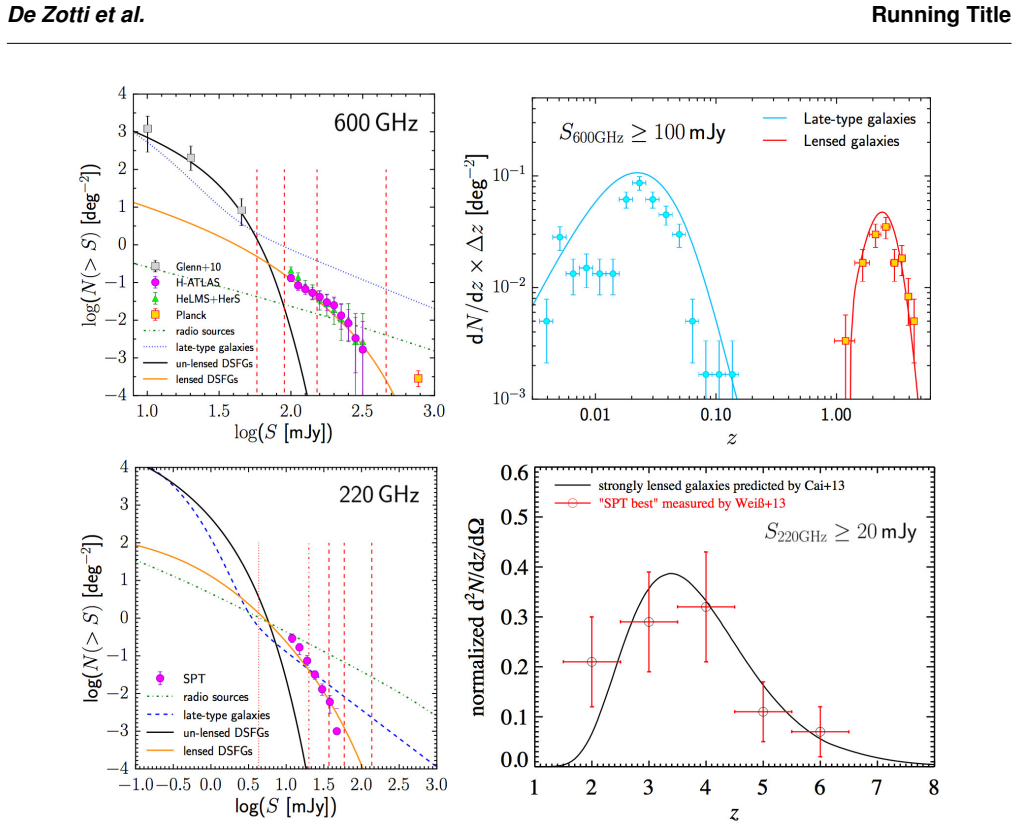
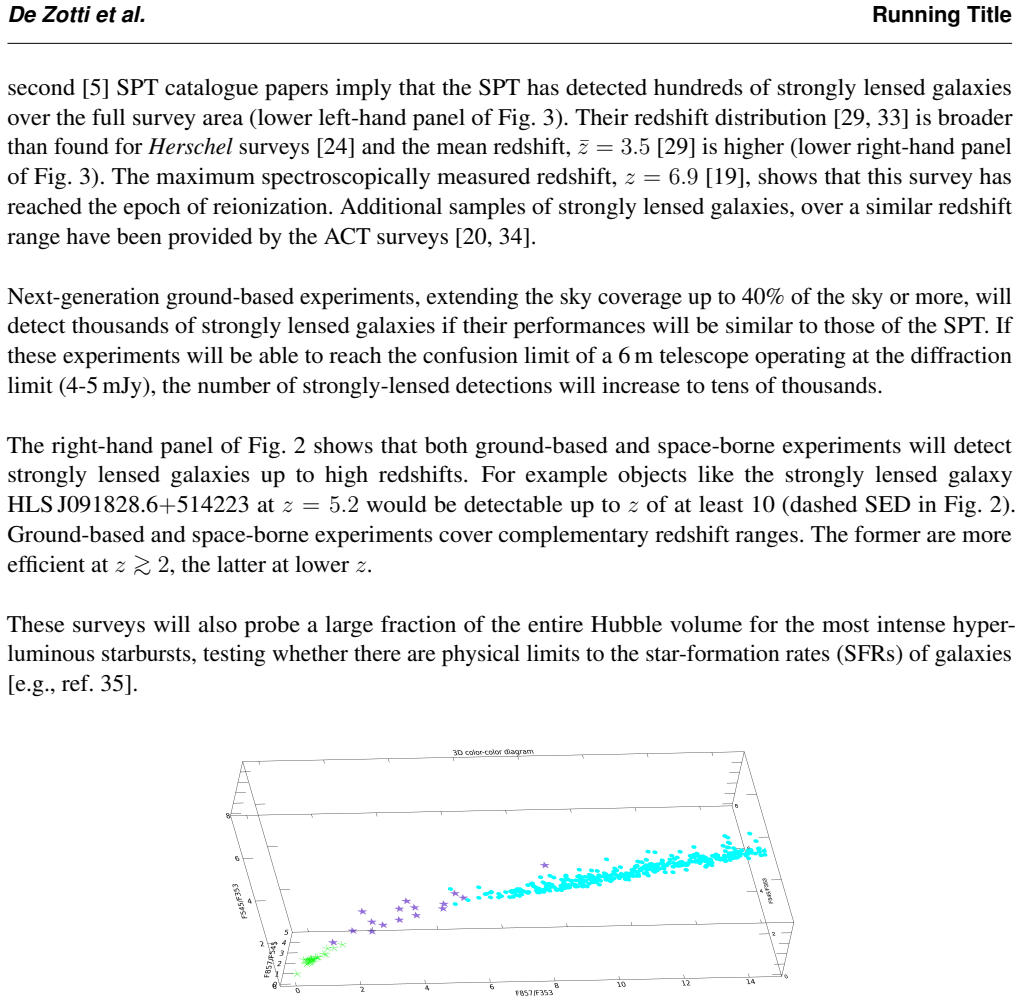
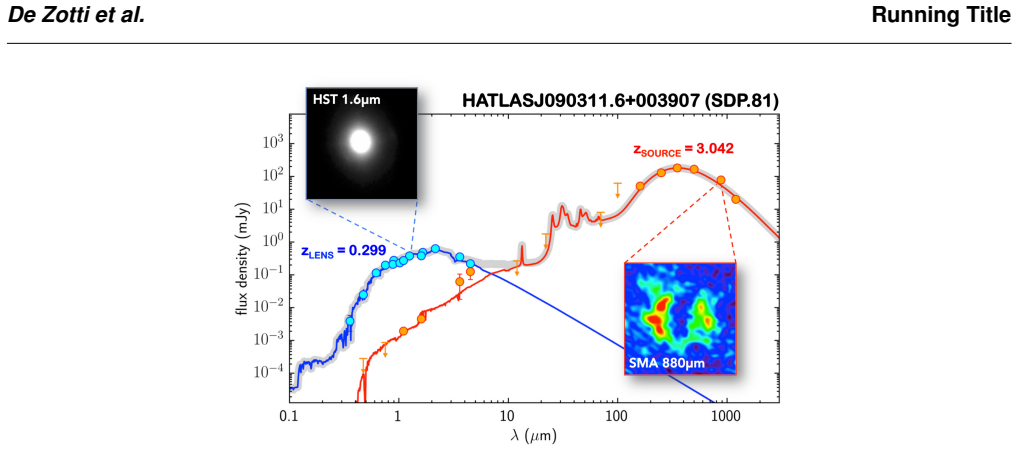
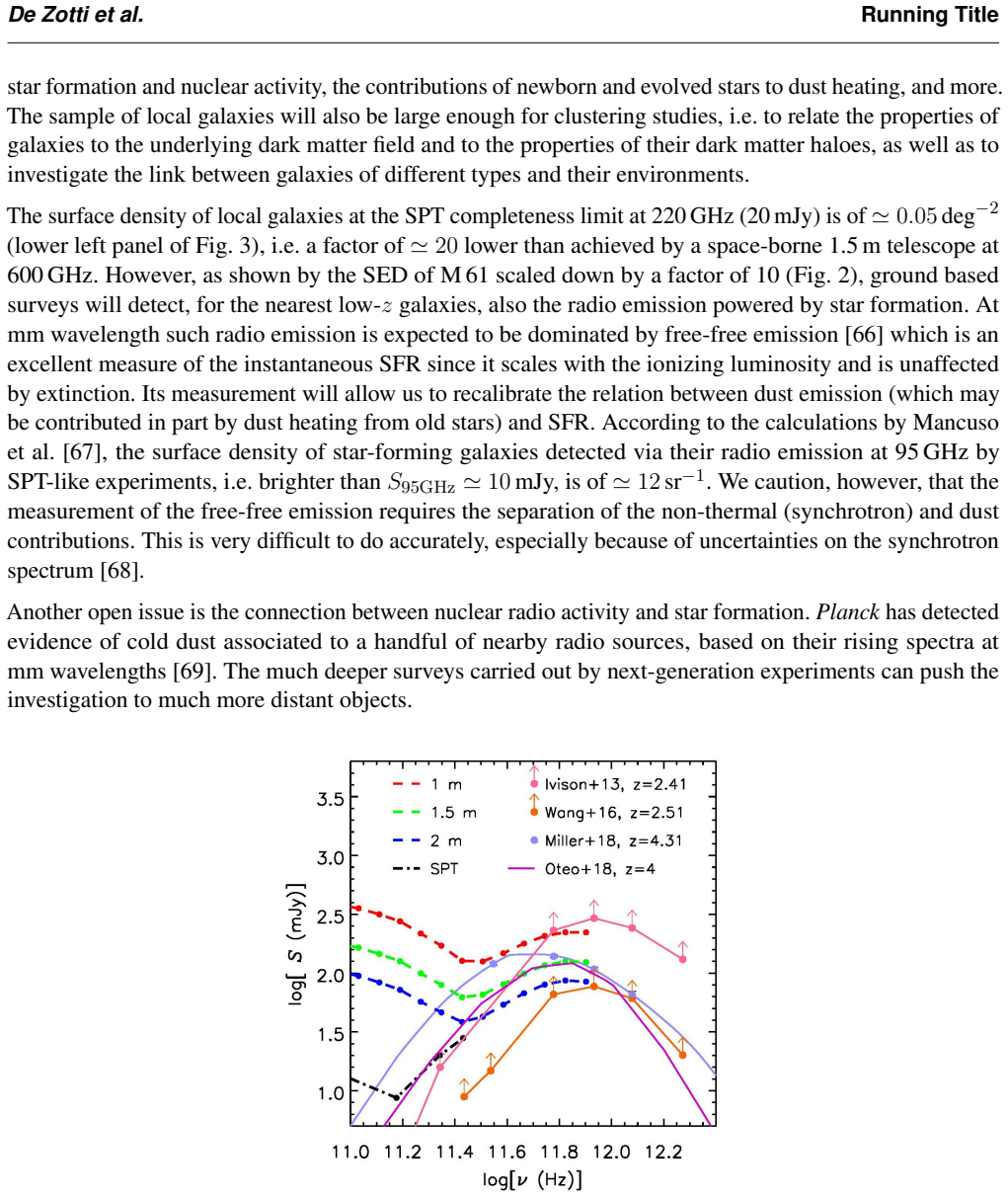


read the original abstract
Planck, SPT and ACT surveys have clearly demonstrated that Cosmic Microwave Background (CMB) experiments, while optimised for cosmological measurements, have made important contributions to the field of extragalactic astrophysics in the last decade. Future CMB experiments have the potential to make even greater contributions. One example is the detection of high-z galaxies with extreme gravitational amplifications. The combination of flux boosting and of stretching of the images has allowed the investigation of the structure of galaxies at z ~3 with the astounding spatial resolution of about 60 pc. Another example is the detection of proto-clusters of dusty galaxies at high z when they may not yet possess the hot intergalactic medium allowing their detection in X-rays or via the Sunyaev-Zeldovich effect. Next generation CMB experiments, like PICO, CORE, CMB-Bharat from space and Simons Observatory and CMB-S4 from the ground, will discover several thousands of strongly lensed galaxies out to z~6 or more and of galaxy proto-clusters caught in the phase when their member galaxies where forming the bulk of their {stars. They will also detect tens of thousands of local dusty galaxies and thousands of radio sources at least up to z~5. Moreover they will measure the polarized emission of thousands of radio sources and of dusty galaxies at mm/sub-mm wavelengths.
Editorial analysis
A structured set of objections, weighed in public.
Referee Report
Summary. The manuscript reviews the extragalactic science potential of next-generation CMB experiments (PICO, CORE, CMB-Bharat from space; Simons Observatory and CMB-S4 from the ground). Building on results from Planck, SPT and ACT, it argues that these instruments will detect several thousand strongly lensed galaxies out to z ≳ 6, proto-clusters of dusty galaxies during their peak star-formation epoch, tens of thousands of local dusty galaxies, and thousands of radio sources to z ~ 5, while also measuring polarized emission from thousands of sources at mm/sub-mm wavelengths.
Significance. If the yield forecasts are robust, the work correctly identifies a high-impact, multi-purpose science case for future CMB facilities: the combination of wide area, high sensitivity and multi-frequency coverage will enable statistical samples of strongly lensed high-z galaxies (with ~60 pc resolution) and proto-clusters that are difficult to obtain at other wavelengths. The emphasis on the complementarity with X-ray and SZ searches is a useful framing.
major comments (2)
- [Abstract] Abstract: the quantitative forecasts ('several thousands of strongly lensed galaxies out to z~6 or more' and 'galaxy proto-clusters') are presented as firm expectations without any error budget, explicit sensitivity analysis, or reference to the specific number-count models and lensing optical-depth calculations on which they rest. Because these numbers constitute the central claim of the paper, the absence of even a brief derivation or citation to the underlying extrapolation assumptions is a load-bearing omission.
- [Abstract] Abstract (and implied main-text discussion of yields): the extrapolation implicitly assumes that the Euclidean-normalized differential counts dN/dS and the lensing probability continue with the same faint-end slope and redshift distribution below the current ~10–30 mJy limits and beyond z ~ 4. No test of the stability of these assumptions against plausible changes in the high-z population or magnification bias is provided; if either assumption fails, the predicted yields shift by factors of several, directly affecting the claimed discovery potential.
minor comments (2)
- [Abstract] Abstract: typographical error 'where' should read 'were' ('when their member galaxies where forming').
- [Abstract] Abstract: stray '{' character before 'stars'.
Simulated Author's Rebuttal
We thank the referee for the constructive comments and for recognizing the potential impact of the science case. We address each major comment below.
read point-by-point responses
-
Referee: [Abstract] Abstract: the quantitative forecasts ('several thousands of strongly lensed galaxies out to z~6 or more' and 'galaxy proto-clusters') are presented as firm expectations without any error budget, explicit sensitivity analysis, or reference to the specific number-count models and lensing optical-depth calculations on which they rest. Because these numbers constitute the central claim of the paper, the absence of even a brief derivation or citation to the underlying extrapolation assumptions is a load-bearing omission.
Authors: We agree that the abstract would be strengthened by explicit references to the underlying models. The quoted yields are extrapolations from the number counts and lensing optical depths already presented in the main text (drawing on Planck, SPT and ACT results). We will revise the abstract to include citations to the relevant number-count models and lensing calculations, together with a short parenthetical note on the extrapolation assumptions. revision: yes
-
Referee: [Abstract] Abstract (and implied main-text discussion of yields): the extrapolation implicitly assumes that the Euclidean-normalized differential counts dN/dS and the lensing probability continue with the same faint-end slope and redshift distribution below the current ~10–30 mJy limits and beyond z ~ 4. No test of the stability of these assumptions against plausible changes in the high-z population or magnification bias is provided; if either assumption fails, the predicted yields shift by factors of several, directly affecting the claimed discovery potential.
Authors: We acknowledge that a quantitative test of the stability of the faint-end slope and redshift distribution would be valuable. The main text already notes the reliance on current survey results, but we will add a brief sensitivity discussion (or reference to existing robustness checks in the cited literature) to address possible variations in the high-z population and magnification bias. revision: yes
Circularity Check
No circularity in forward-looking yield forecasts
full rationale
The paper presents observational forecasts for next-generation CMB experiments based on scaling existing Planck/SPT/ACT number counts and lensing optical depths. No derivations, equations, fitted parameters, or self-citations are shown that reduce any claimed yield to quantities defined by the authors' own prior work. The central claims are extrapolations relying on external literature, making the analysis self-contained against benchmarks outside the present manuscript.
Axiom & Free-Parameter Ledger
Reference graph
Works this paper leans on
-
[1]
Exploring cosmic origins with CORE: Survey requirements and mission design
Delabrouille J, de Bernardis P, Bouchet FR, Ach ´ucarro A, Ade PAR, Allison R, et al. Exploring cosmic origins with CORE: Survey requirements and mission design. JCAP 4 (2018) 014. doi:10. 1088/1475-7516/2018/04/014
work page 2018
-
[2]
PICO: Probe of Inflation and Cosmic Origins
Hanany S, Alvarez M, Artis E, Ashton P, Aumont J, Aurlien R, et al. PICO: Probe of Inflation and Cosmic Origins. arXiv e-prints (2019)
work page 2019
-
[3]
Extragalactic sources in Cosmic Microwave Background maps
De Zotti G, Castex G, Gonz´alez-Nuevo J, Lopez-Caniego M, Negrello M, Cai ZY , et al. Extragalactic sources in Cosmic Microwave Background maps. JCAP 6 (2015) 018. doi:10.1088/1475-7516/2015/ 06/018
-
[4]
Planck Collaboration III. Planck 2018 results. III. High Frequency Instrument data processing and frequency maps. arXiv e-prints (2018)
work page 2018
-
[5]
Mocanu LM, Crawford TM, Vieira JD, Aird KA, Aravena M, Austermann JE, et al. Extragalactic Millimeter-wave Point-source Catalog, Number Counts and Statistics from 771 deg2 of the SPT-SZ Survey. ApJ 779 (2013) 61. doi:10.1088/0004-637X/779/1/61
-
[6]
The pre-launch Planck Sky Model: a model of sky emission at submillimetre to centimetre wavelengths
Delabrouille J, Betoule M, Melin JB, Miville-Desch ˆenes MA, Gonzalez-Nuevo J, Le Jeune M, et al. The pre-launch Planck Sky Model: a model of sky emission at submillimetre to centimetre wavelengths. A&A 553 (2013) A96. doi:10.1051/0004-6361/201220019
-
[7]
Maps of the Southern Millimeter-wave Sky from Combined 2500 deg2 SPT-SZ and Planck Temperature Data
Chown R, Omori Y , Aylor K, Benson BA, Bleem LE, Carlstrom JE, et al. Maps of the Southern Millimeter-wave Sky from Combined 2500 deg2 SPT-SZ and Planck Temperature Data. ApJS 239 (2018) 10. doi:10.3847/1538-4365/aae694
-
[8]
Gonz´alez-Nuevo J, Arg¨ueso F, L´opez-Caniego M, Toffolatti L, Sanz JL, Vielva P, et al. The Mexican hat wavelet family: application to point-source detection in cosmic microwave background maps. MNRAS 369 (2006) 1603–1610. doi:10.1111/j.1365-2966.2006.10442.x
-
[9]
L´opez-Caniego M, Herranz D, Gonz´alez-Nuevo J, Sanz JL, Barreiro RB, Vielva P, et al. Comparison of filters for the detection of point sources in Planck simulations.MNRAS 370 (2006) 2047–2063. doi:10.1111/j.1365-2966.2006.10639.x
-
[10]
Planck Collaboration XXVI. Planck 2015 results. XXVI. The Second Planck Catalogue of Compact Sources. A&A 594 (2016) A26. doi:10.1051/0004-6361/201526914
-
[11]
Exploring cosmic origins with CORE: Extragalactic sources in cosmic microwave background maps
De Zotti G, Gonz´alez-Nuevo J, Lopez-Caniego M, Negrello M, Greenslade J, Hern´andez-Monteagudo C, et al. Exploring cosmic origins with CORE: Extragalactic sources in cosmic microwave background maps. JCAP 4 (2018) 020. doi:10.1088/1475-7516/2018/04/020
-
[12]
Planck Collaboration XVIII. Planck early results. XVIII. The power spectrum of cosmic infrared background anisotropies. A&A 536 (2011) A18. doi:10.1051/0004-6361/201116461
-
[13]
Planck Collaboration XXX. Planck 2013 results. XXX. Cosmic infrared background measurements and implications for star formation. A&A 571 (2014) A30. doi:10.1051/0004-6361/201322093. This is a provisional file, not the final typeset article 22 De Zotti et al. Running Title
-
[14]
HerMES: Cosmic Infrared Background Anisotropies and the Clustering of Dusty Star-forming Galaxies
Viero MP, Wang L, Zemcov M, Addison G, Amblard A, Arumugam V , et al. HerMES: Cosmic Infrared Background Anisotropies and the Clustering of Dusty Star-forming Galaxies. ApJ 772 (2013) 77. doi:10.1088/0004-637X/772/1/77
-
[15]
The Detection of a Population of Submillimeter-Bright, Strongly Lensed Galaxies
Negrello M, Hopwood R, De Zotti Gea. The Detection of a Population of Submillimeter-Bright, Strongly Lensed Galaxies. Science 330 (2010) 800–. doi:10.1126/science.1193420
-
[16]
Intense star formation within resolved compact regions in a galaxy at z = 2.3
Swinbank AM, Smail I, Longmore S, Harris AI, Baker AJ, De Breuck C, et al. Intense star formation within resolved compact regions in a galaxy at z = 2.3. Nature 464 (2010) 733–736. doi:10.1038/nature08880
-
[17]
A bright z = 5.2 lensed submillimeter galaxy in the field of Abell 773
Combes F, Rex M, Rawle TD, Egami E, Boone F, Smail I, et al. A bright z = 5.2 lensed submillimeter galaxy in the field of Abell 773. HLSJ091828.6+514223. A&A 538 (2012) L4. doi:10.1051/ 0004-6361/201118750
work page 2012
-
[18]
A dusty star-forming galaxy at z = 6 revealed by strong gravitational lensing
Zavala JA, Monta˜na A, Hughes DH, Yun MS, Ivison RJ, Valiante E, et al. A dusty star-forming galaxy at z = 6 revealed by strong gravitational lensing. Nature Astronomy 2 (2018) 56–62. doi:10. 1038/s41550-017-0297-8
work page 2018
-
[19]
ISM Properties of a Massive Dusty Star-forming Galaxy Discovered at z∼ 7
Strandet ML, Weiss A, De Breuck C, Marrone DP, Vieira JD, Aravena M, et al. ISM Properties of a Massive Dusty Star-forming Galaxy Discovered at z∼ 7. ApJL 842 (2017) L15. doi:10.3847/ 2041-8213/aa74b0
work page 2017
-
[20]
Marsden D, Gralla M, Marriage TA, Switzer ER, Partridge B, Massardi M, et al. The Atacama Cosmology Telescope: dusty star-forming galaxies and active galactic nuclei in the Southern survey. MNRAS 439 (2014) 1556–1574. doi:10.1093/mnras/stu001
-
[21]
CMB-S4 Science Book, First Edition
Abazajian KN, Adshead P, Ahmed Z, Allen SW, Alonso D, Arnold KS, et al. CMB-S4 Science Book, First Edition. arXiv e-prints (2016)
work page 2016
-
[22]
The Simons Observatory: science goals and forecasts
Ade P, Aguirre J, Ahmed Z, Aiola S, Ali A, Alonso D, et al. The Simons Observatory: science goals and forecasts. JCAP 2 (2019) 056. doi:10.1088/1475-7516/2019/02/056
-
[23]
Planck Collaboration VI. Planck 2018 results. VI. Cosmological parameters. arXiv e-prints (2018)
work page 2018
-
[24]
The Herschel-ATLAS: a sample of 500µm-selected lensed galaxies over 600 deg2
Negrello M, Amber S, Amvrosiadis Aea. The Herschel-ATLAS: a sample of 500µm-selected lensed galaxies over 600 deg2. MNRAS 465 (2017) 3558–3580. doi:10.1093/mnras/stw2911
-
[25]
A Hybrid Model for the Evolution of Galaxies and Active Galactic Nuclei in the Infrared
Cai ZY , Lapi A, Xia ea J-Q. A Hybrid Model for the Evolution of Galaxies and Active Galactic Nuclei in the Infrared. ApJ 768 (2013) 21. doi:10.1088/0004-637X/768/1/21
-
[26]
Glenn J, Conley A, B´ethermin M, Altieri B, Amblard A, Arumugam V , et al. HerMES: deep galaxy number counts from a P(D) fluctuation analysis of SPIRE Science Demonstration Phase observations. MNRAS 409 (2010) 109–121. doi:10.1111/j.1365-2966.2010.17781.x
-
[28]
Vieira JD, Crawford TM, Switzer ER, Ade PAR, Aird KA, Ashby MLN, et al. Extragalactic Millimeter-wave Sources in South Pole Telescope Survey Data: Source Counts, Catalog, and Statistics for an 87 Square-degree Field. ApJ 719 (2010) 763–783. doi:10.1088/0004-637X/719/1/763
-
[29]
Weiß A, De Breuck C, Marrone DP, Vieira JD, Aguirre JE, Aird KA, et al. ALMA Redshifts of Millimeter-selected Galaxies from the SPT Survey: The Redshift Distribution of Dusty Star-forming Galaxies. ApJ 767 (2013) 88. doi:10.1088/0004-637X/767/1/88
-
[30]
Ca˜nameras R, Nesvadba NPH, Guery ea D. Planck’s dusty GEMS: The brightest gravitationally lensed galaxies discovered with the Planck all-sky survey. A&A 581 (2015) A105. doi:10.1051/ 0004-6361/201425128. Frontiers 23 De Zotti et al. Running Title
work page 2015
-
[31]
Herschel-ATLAS: Toward a Sample of ˜1000 Strongly Lensed Galaxies.ApJ 749 (2012) 65
Gonz´alez-Nuevo J, Lapi A, Fleuren S, Bressan S, Danese L, De Zotti G, et al. Herschel-ATLAS: Toward a Sample of ˜1000 Strongly Lensed Galaxies.ApJ 749 (2012) 65. doi:10.1088/0004-637X/ 749/1/65
-
[32]
SHALOS: Statistical Herschel-ATLAS Lensed Objects Selection
Gonz´alez-Nuevo J, Su´arez G´omez SL, Bonavera L, S´anchez-Lasheras F, Arg¨ueso F, Toffolatti L, et al. SHALOS: Statistical Herschel-ATLAS Lensed Objects Selection. arXiv e-prints (2019)
work page 2019
-
[33]
Dusty starburst galaxies in the early Universe as revealed by gravitational lensing
Vieira JD, Marrone DP, Chapman SC, De Breuck C, Hezaveh YD, Weiβ A, et al. Dusty starburst galaxies in the early Universe as revealed by gravitational lensing. Nature 495 (2013) 344–347. doi:10.1038/nature12001
-
[35]
The maximum flux of star-forming galaxies
Crocker RM, Krumholz MR, Thompson TA, Clutterbuck J. The maximum flux of star-forming galaxies. MNRAS 478 (2018) 81–94. doi:10.1093/mnras/sty989
-
[36]
Eales S, Dunne L, Clements D, Cooray A, De Zotti G, Dye S, et al. The Herschel ATLAS. PASP 122 (2010) 499. doi:10.1086/653086
-
[37]
Herschel *-ATLAS: deep HST/WFC3 imaging of strongly lensed submillimetre galaxies
Negrello M, Hopwood R, Dye S, da Cunha E, Serjeant S, Fritz J, et al. Herschel *-ATLAS: deep HST/WFC3 imaging of strongly lensed submillimetre galaxies. MNRAS 440 (2014) 1999–2012. doi:10.1093/mnras/stu413
-
[38]
Candidate Gravitationally Lensed Dusty Star-forming Galaxies in the Herschel Wide Area Surveys
Nayyeri H, Keele M, Cooray A, Riechers DA, Ivison RJ, Harris AI, et al. Candidate Gravitationally Lensed Dusty Star-forming Galaxies in the Herschel Wide Area Surveys. ApJ 823 (2016) 17. doi:10.3847/0004-637X/823/1/17
-
[39]
Galaxy counts and contributions to the background radiation from 1µm to 1000 mim
Franceschini A, Toffolatti L, Mazzei P, Danese L, de Zotti G. Galaxy counts and contributions to the background radiation from 1µm to 1000 mim. A&A Supp. 89 (1991) 285–310
work page 1991
-
[40]
Blain AW, Longair MS. Submillimetre cosmology. MNRAS 264 (1993) 509–521. doi:10.1093/ mnras/264.2.509
work page 1993
-
[41]
De Lucia, G., Kauffmann, G., and White, S
York T, Jackson N, Browne IWA, Koopmans LVE, McKean JP, Norbury MA, et al. CLASS B0631+519: last of the Cosmic Lens All-Sky Survey lenses. MNRAS 361 (2005) 259–271. doi:10. 1111/j.1365-2966.2005.09170.x
-
[42]
Jackson N. Gravitational lenses and lens candidates identified from the COSMOS field.MNRAS 389 (2008) 1311–1318. doi:10.1111/j.1365-2966.2008.13629.x
-
[43]
Treu T. Strong Lensing by Galaxies. ARA&A 48 (2010) 87–125. doi:10.1146/ annurev-astro-081309-130924
work page 2010
-
[44]
Negrello M, Perrotta F, Gonz´alez-Nuevo Jea. Astrophysical and cosmological information from large-scale submillimetre surveys of extragalactic sources. MNRAS 377 (2007) 1557–1568. doi:10. 1111/j.1365-2966.2007.11708.x
-
[45]
Finding high- redshift strong lenses in DES using convolutional neural networks
Jacobs C, Collett T, Glazebrook K, McCarthy C, Qin AK, Abbott TMC, et al. Finding high- redshift strong lenses in DES using convolutional neural networks. MNRAS 484 (2019) 5330–5349. doi:10.1093/mnras/stz272
-
[46]
Serjeant S. Strong Gravitational Lenses and Multi-Wavelength Galaxy Surveys with Akari, Herschel, SPICA and EUCLID. Publication of Korean Astronomical Society 32 (2017) 251–255. doi:10.5303/ PKAS.2017.32.1.251
work page 2017
-
[47]
The current status of galaxy formation
Silk J, Mamon GA. The current status of galaxy formation. Research in Astronomy and Astrophysics 12 (2012) 917–946. doi:10.1088/1674-4527/12/8/004
-
[48]
Somerville RS, Dav ´e R. Physical Models of Galaxy Formation in a Cosmological Framework. ARA&A 53 (2015) 51–113. doi:10.1146/annurev-astro-082812-140951. This is a provisional file, not the final typeset article 24 De Zotti et al. Running Title
work page internal anchor Pith review doi:10.1146/annurev-astro-082812-140951 2015
-
[49]
Fujimoto S, Ouchi M, Kohno Kea. ALMA 26 Arcmin 2 Survey of GOODS-S at One Millimeter (ASAGAO): Average Morphology of High-z Dusty Star-forming Galaxies in an Exponential Disk (n≃ 1). ApJ 861 (2018) 7. doi:10.3847/1538-4357/aac6c4
-
[50]
The Herschel-ATLAS: magnifications and physical sizes of 500-µm-selected strongly lensed galaxies
Enia A, Negrello M, Gurwell M, Dye S, Rodighiero G, Massardi M, et al. The Herschel-ATLAS: magnifications and physical sizes of 500-µm-selected strongly lensed galaxies. MNRAS 475 (2018) 3467–3484. doi:10.1093/mnras/sty021
-
[51]
Ca˜nameras R, Nesvadba N, Kneissl Rea. Planck’s dusty GEMS. IV . Star formation and feedback in a maximum starburst at z = 3 seen at 60-pc resolution. A&A 604 (2017) A117. doi:10.1051/ 0004-6361/201630186
work page 2017
-
[52]
Powerful Outflows and Feedback from Active Galactic Nuclei
King A, Pounds K. Powerful Outflows and Feedback from Active Galactic Nuclei. ARA&A 53 (2015) 115–154. doi:10.1146/annurev-astro-082214-122316
work page Pith review doi:10.1146/annurev-astro-082214-122316 2015
-
[53]
Very extended cold gas, star formation and outflows in the halo of a bright quasar at z >6
Cicone C, Maiolino R, Gallerani S, Neri R, Ferrara A, Sturm E, et al. Very extended cold gas, star formation and outflows in the halo of a bright quasar at z >6. A&A 574 (2015) A14. doi:10.1051/ 0004-6361/201424980
work page 2015
-
[54]
Observing positive and negative AGN feedback
Cresci G, Maiolino R. Observing positive and negative AGN feedback. Nature Astronomy 2 (2018) 179–180. doi:10.1038/s41550-018-0404-5
-
[55]
Fast molecular outflow from a dusty star-forming galaxy in the early Universe
Spilker JS, Aravena M, B´ethermin Mea. Fast molecular outflow from a dusty star-forming galaxy in the early Universe. Science 361 (2018) 1016–1019. doi:10.1126/science.aap8900
-
[56]
Ca˜nameras R, Nesvadba NPH, Limousin M, Dole H, Kneissl R, Koenig S, et al. Planck’s dusty GEMS. V . Molecular wind and clump stability in a strongly lensed star-forming galaxy at z = 2.2. A&A 620 (2018) A60. doi:10.1051/0004-6361/201833679
-
[57]
Characterizing Feedback Through Molecular Outflows Across Cosmic Time
Spilker J, Nyland K. Characterizing Feedback Through Molecular Outflows Across Cosmic Time. Murphy E, editor, Science with a Next Generation Very Large Array(2018), Astronomical Society of the Pacific Conference Series, vol. 517, 657
work page 2018
-
[58]
The Origins Space Telescope: mission concept overview
Leisawitz D, Amatucci E, Carter R, DiPirro M, Flores A, Staguhn J, et al. The Origins Space Telescope: mission concept overview. Space Telescopes and Instrumentation 2018: Optical, Infrared, and Millimeter Wave (2018), Society of Photo-Optical Instrumentation Engineers (SPIE) Conference Series, vol. 10698, 1069815. doi:10.1117/12.2313823
-
[59]
Origins Space Telescope: Predictions for far-IR spectroscopic surveys
Bonato M, De Zotti G, Leisawitz D, Negrello M, Massardi M, Baronchelli I, et al. Origins Space Telescope: Predictions for far-IR spectroscopic surveys. PASA 36 (2019) e017. doi:10.1017/pasa. 2019.8
-
[60]
Natarajan P, Sigurdsson S. Sunyaev–Zeldovich decrements with no clusters? MNRAS 302 (1999) 288–292. doi:10.1046/j.1365-8711.1999.02116.x
-
[61]
Platania P, Burigana C, De Zotti G, Lazzaro E, Bersanelli M. Sunyaev-Zel’dovich effect from quasar-driven blast waves. MNRAS 337 (2002) 242–246. doi:10.1046/j.1365-8711.2002.05907.x
-
[62]
The asteroseismic surface effect from a grid of 3D convection simulations - I
Lacy M, Mason B, Sarazin C, Chatterjee S, Nyland K, Kimball A, et al. Direct detection of quasar feedback via the Sunyaev-Zeldovich effect. MNRAS 483 (2019) L22–L27. doi:10.1093/mnrasl/ sly215
-
[63]
Ca˜nameras R, Nesvadba NPH, Kneissl Rea. Planck’s dusty GEMS. III. A massive lensing galaxy with a bottom-heavy stellar initial mass function at z = 1.5. A&A 600 (2017) L3. doi:10.1051/ 0004-6361/201630359
work page 2017
-
[65]
Constraints on the identity of the dark matter from strong gravitational lenses
Li R, Frenk CS, Cole S, Gao L, Bose S, Hellwing W A. Constraints on the identity of the dark matter from strong gravitational lenses. MNRAS 460 (2016) 363–372. doi:10.1093/mnras/stw939. Frontiers 25 De Zotti et al. Running Title
-
[66]
The spectral energy distribution of powerful starburst galaxies - I
Galvin TJ, Seymour N, Marvil J, Filipovi´c MD, Tothill NFH, McDermid RM, et al. The spectral energy distribution of powerful starburst galaxies - I. Modelling the radio continuum. MNRAS 474 (2018) 779–799. doi:10.1093/mnras/stx2613
-
[67]
Predictions for Ultra-deep Radio Counts of Star-forming Galaxies
Mancuso C, Lapi A, Cai ZY , Negrello M, De Zotti G, Bressan A, et al. Predictions for Ultra-deep Radio Counts of Star-forming Galaxies. ApJ 810 (2015) 72. doi:10.1088/0004-637X/810/1/72
-
[68]
Large gas reservoirs and free-free emission in two lensed star-forming galaxies at z = 2.7
Aravena M, Murphy EJ, Aguirre JE, Ashby MLN, Benson BA, Bothwell M, et al. Large gas reservoirs and free-free emission in two lensed star-forming galaxies at z = 2.7. MNRAS 433 (2013) 498–505. doi:10.1093/mnras/stt741
-
[69]
Planck Collaboration XLV. Planck intermediate results. XLV . Radio spectra of northern extragalactic radio sources. A&A 596 (2016) A106. doi:10.1051/0004-6361/201527780
-
[70]
Herschel-ATLAS: A Binary HyLIRG Pinpointing a Cluster of Starbursting Protoellipticals
Ivison RJ, Swinbank AM, Smail I, Harris AI, Bussmann RS, Cooray A, et al. Herschel-ATLAS: A Binary HyLIRG Pinpointing a Cluster of Starbursting Protoellipticals. ApJ 772 (2013) 137. doi:10.1088/0004-637X/772/2/137
-
[71]
Discovery of a Galaxy Cluster with a Violently Starbursting Core at z = 2.506
Wang T, Elbaz D, Daddi E, Finoguenov A, Liu D, Schreiber C, et al. Discovery of a Galaxy Cluster with a Violently Starbursting Core at z = 2.506. ApJ 828 (2016) 56. doi:10.3847/0004-637X/828/1/ 56
-
[72]
A massive core for a cluster of galaxies at a redshift of 4.3
Miller TB, Chapman SC, Aravena M, Ashby MLN, Hayward CC, Vieira JD, et al. A massive core for a cluster of galaxies at a redshift of 4.3. Nature 556 (2018) 469–472. doi:10.1038/ s41586-018-0025-2
work page 2018
-
[73]
The Astrophysical Journal879(2), 82 (2019) https://doi.org/10.3847/1538-4357/ ab22b8
Oteo I, Ivison RJ, Dunne L, Manilla-Robles A, Maddox S, Lewis AJR, et al. An Extreme Protocluster of Luminous Dusty Starbursts in the Early Universe. ApJ 856 (2018) 72. doi:10.3847/1538-4357/ aaa1f1
-
[74]
On the statistics of proto-cluster candidates detected in the Planck all-sky survey
Negrello M, Gonzalez-Nuevo J, De Zotti Gea. On the statistics of proto-cluster candidates detected in the Planck all-sky survey. MNRAS 470 (2017) 2253–2261. doi:10.1093/mnras/stx1367
-
[75]
Bocquet S, Dietrich JP, Schrabback T, Bleem LE, Klein M, Allen SW, et al. Cluster Cosmology Constraints from the 2500 deg2 SPT-SZ Survey: Inclusion of Weak Gravitational Lensing Data from Magellan and the Hubble Space Telescope. arXiv e-prints (2018)
work page 2018
-
[76]
The realm of the galaxy protoclusters
Overzier RA. The realm of the galaxy protoclusters. A review. A&A Rev. 24 (2016) 14. doi:10.1007/ s00159-016-0100-3
work page 2016
-
[77]
Mehrtens N, Romer AK, Hilton M, Lloyd-Davies EJ, Miller CJ, Stanford SA, et al. The XMM Cluster Survey: optical analysis methodology and the first data release. MNRAS 423 (2012) 1024–1052. doi:10.1111/j.1365-2966.2012.20931.x
-
[78]
Distant galaxy clusters in the XMM Large Scale Structure survey
Willis JP, Clerc N, Bremer MN, Pierre M, Adami C, Ilbert O, et al. Distant galaxy clusters in the XMM Large Scale Structure survey. MNRAS 430 (2013) 134–156. doi:10.1093/mnras/sts540
-
[79]
Sunyaev RA, Zeldovich YB. The Observations of Relic Radiation as a Test of the Nature of X-Ray Radiation from the Clusters of Galaxies. Comments on Astrophysics and Space Physics 4 (1972) 173
work page 1972
-
[80]
Bleem LE, Stalder B, de Haan T, Aird KA, Allen SW, Applegate DE, et al. Galaxy Clusters Discovered via the Sunyaev-Zel’dovich Effect in the 2500-Square-Degree SPT-SZ Survey.ApJS 216 (2015) 27. doi:10.1088/0067-0049/216/2/27
-
[81]
Planck Collaboration XXVII. Planck 2015 results. XXVII. The second Planck catalogue of Sunyaev- Zeldovich sources. A&A 594 (2016) A27. doi:10.1051/0004-6361/201525823
-
[82]
Hilton M, Hasselfield M, Sif´on C, Battaglia N, Aiola S, Bharadwaj V , et al. The Atacama Cosmology Telescope: The Two-season ACTPol Sunyaev-Zeldovich Effect Selected Cluster Catalog.ApJS 235 (2018) 20. doi:10.3847/1538-4365/aaa6cb. This is a provisional file, not the final typeset article 26 De Zotti et al. Running Title
-
[83]
The RedMaPPer Galaxy Cluster Catalog From DES Science Verification Data
Rykoff ES, Rozo E, Hollowood D, Bermeo-Hernandez A, Jeltema T, Mayers J, et al. The RedMaPPer Galaxy Cluster Catalog From DES Science Verification Data. ApJS 224 (2016) 1. doi:10.3847/ 0067-0049/224/1/1
work page 2016
discussion (0)
Sign in with ORCID, Apple, or X to comment. Anyone can read and Pith papers without signing in.