Stellar atmospheric parameters for 754 spectra from the X-shooter Spectral Library
Pith reviewed 2026-05-24 21:25 UTC · model grok-4.3
The pith
A uniform set of effective temperatures, surface gravities and iron abundances is provided for 754 X-shooter spectra.
A machine-rendered reading of the paper's core claim, the machinery that carries it, and where it could break.
Core claim
We present a uniform set of stellar atmospheric parameters, effective temperatures, surface gravities, and iron abundances for 754 spectra of 616 XSL stars. We used the full-spectrum fitting package ULySS with the empirical MILES library as reference to fit the ultraviolet-blue (UVB) and visible (VIS) spectra. The stars cover a range of effective temperature 2900 < Teff < 38 000 K, surface gravity 0 < log g < 5.7, and iron abundance -2.5 < [Fe/H] < +1.0, with a couple of stars extending down to [Fe/H] = -3.9. The precisions of the measurements for the G- and K-type stars are 0.9%, 0.14, and 0.06 in Teff, log g, and [Fe/H], respectively.
What carries the argument
Full-spectrum fitting of UVB and VIS segments with ULySS, using the empirical MILES library as the reference set of spectra and parameters.
If this is right
- The parameters cover the stated ranges in Teff, log g and [Fe/H] and are accompanied by type-specific precision estimates.
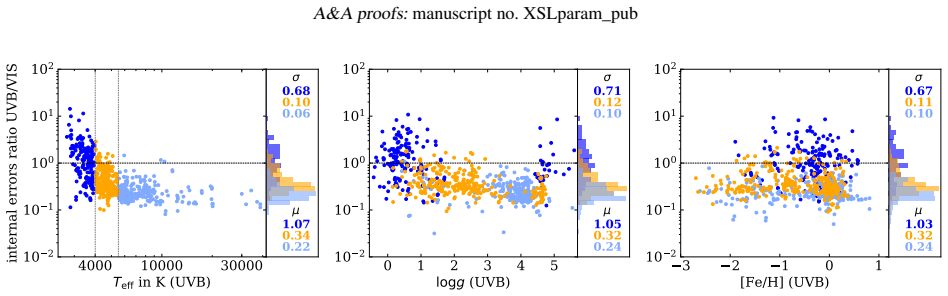
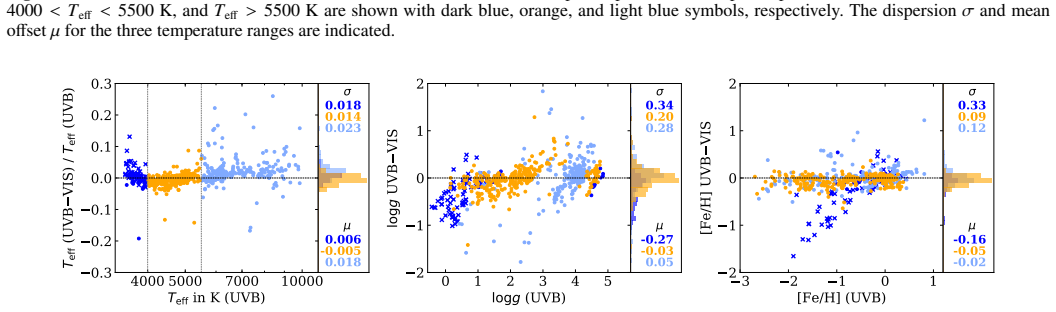
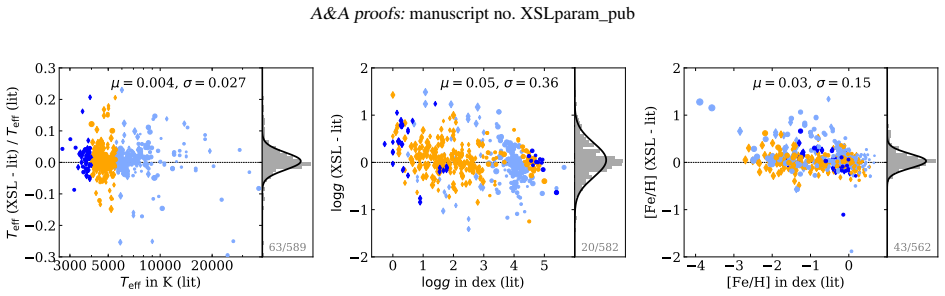
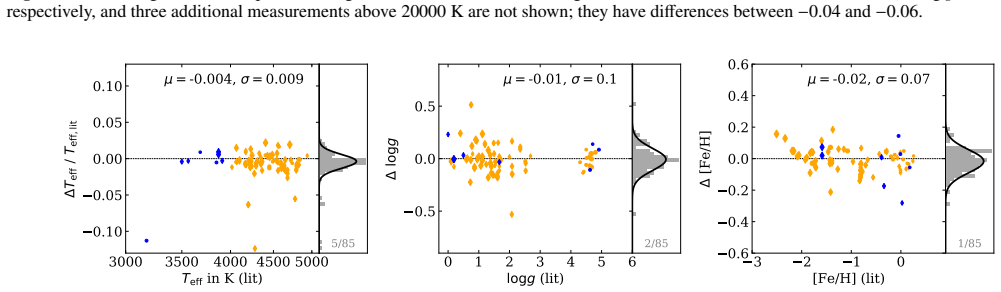
- Internal consistency of the fits was tested and the results were compared with literature compilations.
- The catalog supplies a consistent reference set intended for stellar population work.
- Separate precisions are quoted for G/K stars, cool giants, other cool stars, and stars hotter than 6500 K.
Where Pith is reading between the lines
- The catalog could be used to test whether population-synthesis models reproduce observed spectra when fed these parameters.
- Applying the same fitting procedure to the near-infrared arm of the XSL spectra would allow a check on wavelength-dependent consistency.
- The derived parameters could serve as an anchor for recalibrating other medium-resolution libraries that overlap with XSL.
Load-bearing premise
The MILES library supplies reference spectra and parameters accurate enough to serve as the basis for fitting across the full range of stellar types and metallicities present in the XSL sample.
What would settle it
A set of independent high-resolution spectroscopic parameters for a subset of the same stars that differ from the fitted values by more than the stated type-dependent precisions.
Figures







read the original abstract
The X-shooter Spectral Library (XSL) is an empirical stellar library at medium spectral resolution covering the wavelength range from 3000 \AA to 24 800 \AA. This library aims to provide a benchmark for stellar population studies. In this work, we present a uniform set of stellar atmospheric parameters, effective temperatures, surface gravities, and iron abundances for 754 spectra of 616 XSL stars. We used the full-spectrum fitting package ULySS with the empirical MILES library as reference to fit the ultraviolet-blue (UVB) and visible (VIS) spectra. We tested the internal consistency and we compared our results with compilations from the literature. The stars cover a range of effective temperature 2900 < Teff < 38 000 K, surface gravity 0 < log g < 5.7, and iron abundance -2.5 < [Fe/H] < +1.0, with a couple of stars extending down to [Fe/H] = -3.9. The precisions of the measurements for the G- and K-type stars are 0.9%, 0.14, and 0.06 in Teff, log g, and [Fe/H], respectively. For the cool giants with log g < 1, the precisions are 2.1%, 0.21, and 0.22, and for the other cool stars these values are 1%, 0.14, and 0.10. For the hotter stars (Teff > 6500 K), these values are 2.6%, 0.20, and 0.10 for the three parameters.
Editorial analysis
A structured set of objections, weighed in public.
Referee Report
Summary. The manuscript presents a uniform set of stellar atmospheric parameters (effective temperature Teff, surface gravity log g, and iron abundance [Fe/H]) for 754 spectra of 616 stars from the X-shooter Spectral Library (XSL). Parameters are derived via full-spectrum fitting of the UVB and VIS arms using the ULySS package with the empirical MILES library as reference. Internal consistency is tested and results are compared to literature compilations. The sample spans 2900 < Teff < 38000 K, 0 < log g < 5.7, and -3.9 < [Fe/H] < +1.0, with type-dependent precisions reported (e.g., 0.9% in Teff, 0.14 dex in log g, 0.06 dex in [Fe/H] for G/K stars).
Significance. If the results hold, this provides a valuable homogeneous parameter catalog for a large empirical stellar library spanning a wide wavelength range (3000–24800 Å), supporting its use as a benchmark for stellar population studies. The full-spectrum fitting method is standard, and the internal consistency tests plus literature comparisons offer moderate grounding, though the empirical tie to MILES limits independence at parameter extremes.
major comments (2)
- [Abstract] Abstract: The quoted precisions (0.9–2.6% in Teff, 0.14–0.22 dex in log g, 0.06–0.22 dex in [Fe/H] by stellar type) are presented without details on fitting residuals, covariance from ULySS, or post-fit adjustments; this is load-bearing for the central claim that these precisions are reliable across the full range including extremes.
- [Abstract] Abstract and results: Internal consistency tests and literature comparisons are described but not indicated to be stratified by the extreme subsets (e.g., [Fe/H] < -2.5, Teff > 20000 K, or log g < 1 cool giants), where MILES coverage is known to be sparse; this directly affects validation of uniformity for the full XSL sample.
minor comments (1)
- [Abstract] Abstract: The stated [Fe/H] range is -2.5 < [Fe/H] < +1.0 with a couple of stars to -3.9; clarify whether the quoted precisions apply to these outliers or if they are treated separately.
Simulated Author's Rebuttal
We thank the referee for the constructive feedback on our presentation of precision estimates and validation across the parameter range. We respond to each major comment below and agree that clarifications and additions will strengthen the manuscript.
read point-by-point responses
-
Referee: [Abstract] Abstract: The quoted precisions (0.9–2.6% in Teff, 0.14–0.22 dex in log g, 0.06–0.22 dex in [Fe/H] by stellar type) are presented without details on fitting residuals, covariance from ULySS, or post-fit adjustments; this is load-bearing for the central claim that these precisions are reliable across the full range including extremes.
Authors: The quoted precisions are the standard deviations obtained directly from our internal consistency tests (repeat observations of the same stars), as described in the results section. The methods section details the ULySS fitting procedure, including the use of the covariance matrix for formal errors and typical residual levels after fitting. No post-fit adjustments were applied. Due to abstract length constraints we did not repeat these details there, but we will revise the abstract to include a short clause stating that the precisions derive from internal consistency tests on repeat spectra. We agree this improves transparency for the full range, including extremes where MILES coverage is limited. revision: yes
-
Referee: [Abstract] Abstract and results: Internal consistency tests and literature comparisons are described but not indicated to be stratified by the extreme subsets (e.g., [Fe/H] < -2.5, Teff > 20000 K, or log g < 1 cool giants), where MILES coverage is known to be sparse; this directly affects validation of uniformity for the full XSL sample.
Authors: We agree that explicit stratification by the most extreme subsets is not shown. The number of stars in these regimes is small (only a couple with [Fe/H] < -2.5, limited hot stars above 20 000 K, and a modest number of cool giants with log g < 1), which restricts the utility of formal stratification. Nevertheless, the internal consistency tests encompass these objects, and the literature comparisons for the available extreme stars remain consistent with the quoted type-dependent precisions. In revision we will add a dedicated paragraph in the results section that separately discusses performance and limitations for the extreme subsets, explicitly noting the sparse MILES coverage at the boundaries. revision: yes
Circularity Check
No significant circularity; parameters derived from external reference library with literature validation
full rationale
The paper derives Teff, log g and [Fe/H] for XSL spectra by applying the ULySS full-spectrum fitting code to the independent MILES empirical library (explicitly stated in the abstract and methods). It reports internal consistency tests plus direct comparisons to external literature compilations. No self-definitional equations, no fitted inputs relabeled as predictions, and no load-bearing self-citations or uniqueness theorems appear in the derivation chain. Reliance on MILES is a standard empirical calibration step whose accuracy is externally checkable; the paper does not reduce its central claim to its own inputs by construction.
Axiom & Free-Parameter Ledger
axioms (1)
- domain assumption The MILES library provides reliable reference spectra and parameters for full-spectrum fitting across the stellar parameter space covered by XSL.
Reference graph
Works this paper leans on
-
[1]
Bensby, T., Feltzing, S., & Oey, M. S. 2014, A&A, 562, A71
work page 2014
-
[2]
Cenarro, A. J., Peletier, R. F., Sánchez-Blázquez, P., et al. 2007, MNRAS, 374, 664
work page 2007
- [3]
-
[4]
Chen, Y .-P., Trager, S. C., Peletier, R. F., et al. 2014, A&A, 565, A117
work page 2014
-
[5]
Coelho, P. R. T. 2014, MNRAS, 440, 1027
work page 2014
-
[6]
2013, ApJ, 767, 3 Falcón-Barroso, J., Sánchez-Blázquez, P., Vazdekis, A., et al
Davies, B., Kudritzki, R.-P., Plez, B., et al. 2013, ApJ, 767, 3 Falcón-Barroso, J., Sánchez-Blázquez, P., Vazdekis, A., et al. 2011, A&A, 532, A95
work page 2013
- [7]
- [8]
-
[9]
Ho, A. Y . Q., Ness, M. K., Hogg, D. W., et al. 2017, ApJ, 836, 5
work page 2017
-
[10]
Katz, D., Soubiran, C., Cayrel, R., Adda, M., & Cautain, R. 1998, A&A, 338, 151
work page 1998
-
[11]
Koleva, M., Prugniel, P., Bouchard, A., & Wu, Y . 2009, A&A, 501, 1269
work page 2009
-
[12]
Koleva, M., Prugniel, P., Ocvirk, P., et al. 2007, in IAU Symposium, V ol. 241, Stellar Populations as Building Blocks of Galaxies, ed. A. Vazdekis & R. Peletier, 183–184
work page 2007
- [13]
-
[14]
Kurucz, R. L. 2017, ATLAS9: Model atmosphere program with opacity distri- bution functions, Astrophysics Source Code Library
work page 2017
-
[15]
Luck, R. E. & Bond, H. E. 1989, ApJS, 71, 559
work page 1989
-
[16]
Luck, R. E. & Lambert, D. L. 1992, ApJS, 79, 303
work page 1992
-
[17]
Makarov, D., Prugniel, P., Terekhova, N., Courtois, H., & Vauglin, I. 2014, A&A, 570, A13
work page 2014
-
[18]
Martins, L. P. & Coelho, P. 2007, MNRAS, 381, 1329
work page 2007
-
[19]
Percival, S. M. & Salaris, M. 2009, ApJ, 703, 1123
work page 2009
- [20]
- [21]
-
[22]
2006, MNRAS, 370, 141 Sánchez-Blázquez, P., Peletier, R
Recio-Blanco, A., Bijaoui, A., & de Laverny, P. 2006, MNRAS, 370, 141 Sánchez-Blázquez, P., Peletier, R. F., Jiménez-Vicente, J., et al. 2006, MNRAS, 371, 703
work page 2006
-
[23]
Sharma, K., Prugniel, P., & Singh, H. P. 2016, A&A, 585, A64
work page 2016
-
[24]
Smiljanic, R., Korn, A. J., Bergemann, M., et al. 2014, A&A, 570, A122
work page 2014
- [25]
-
[26]
2016, A&A, 591, A118 Article number, page 13 of 15 A&A proofs: manuscript no
Soubiran, C., Le Campion, J.-F., Brouillet, N., & Chemin, L. 2016, A&A, 591, A118 Article number, page 13 of 15 A&A proofs: manuscript no. XSLparam_pub
work page 2016
-
[27]
Vazdekis, A., Koleva, M., Ricciardelli, E., Röck, B., & Falcón-Barroso, J. 2016, MNRAS, 463, 3409
work page 2016
-
[28]
Vernet, J., Dekker, H., D’Odorico, S., et al. 2011, A&A, 536, A105
work page 2011
-
[29]
Villaume, A., Conroy, C., Johnson, B., et al. 2017, ApJS, 230, 23
work page 2017
- [30]
-
[31]
Xiang, M. S., Liu, X. W., Yuan, H. B., et al. 2015, MNRAS, 448, 822 Article number, page 14 of 15 Anke Arentsen et al.: Stellar atmospheric parameters for 754 spectra from the X-shooter Spectral Library , Appendix A: Tables with derived and literature stellar parameters Table A.1. Derived atmospheric parameters of the XSL stars Name Obs a UVB solution VIS...
work page 2015
discussion (0)
Sign in with ORCID, Apple, or X to comment. Anyone can read and Pith papers without signing in.