A three-dimensional map of the hot Local Bubble using diffuse interstellar bands
Pith reviewed 2026-05-24 20:41 UTC · model grok-4.3
The pith
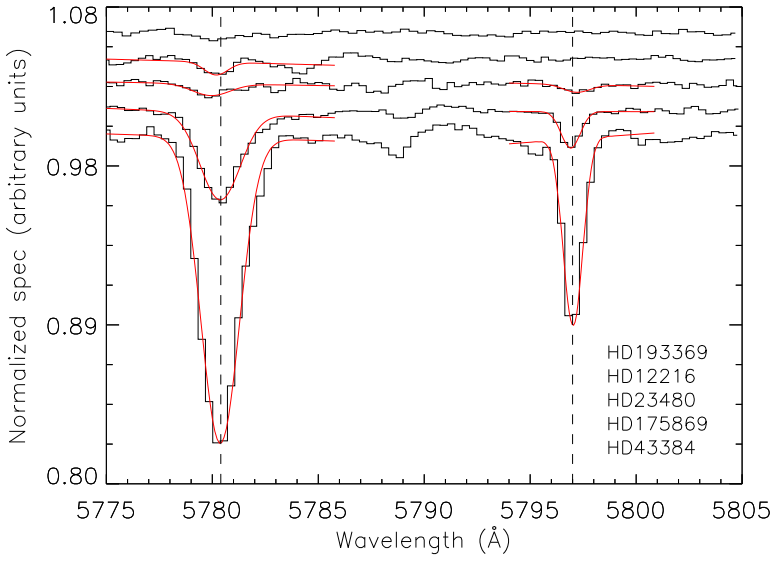
The λ5780 DIB carrier survives the hot X-ray gas inside the Local Bubble while the λ5797 carrier does not.
A machine-rendered reading of the paper's core claim, the machinery that carries it, and where it could break.
Core claim
The three-dimensional structure of the Local Bubble is mapped using the λ5780 and λ5797 DIB tracers, revealing that DIB carriers are present inside the Bubble. The map shows low ratios of λ5797/λ5780 inside the Bubble compared to the outside. This proves that the carrier of the λ5780 DIB can withstand X-ray photo-dissociation and sputtering by fast ions, where the carrier of the λ5797 DIB succumbs. This would mean that DIB carriers can be more stable than hitherto thought and that the carrier of the λ5780 DIB must be larger than that of the λ5797 DIB. Alternatively, small-scale denser structures that shield some of the DIB carriers must be prevalent within the Bubble.
What carries the argument
The λ5797/λ5780 equivalent-width ratio, which serves as a diagnostic of differential destruction inside the hot X-ray gas of the Local Bubble.
If this is right
- The λ5780 carrier is larger and more resistant to X-ray and ion processing than the λ5797 carrier.
- DIB carriers in general can survive the interior conditions of supernova-driven bubbles.
- Small-scale denser and cooler structures that shield DIB carriers are likely common inside such bubbles.
- The 3D DIB map provides a direct view of the low-density cavity surrounding the Solar System.
Where Pith is reading between the lines
- Stability differences between the two carriers could be used to test candidate molecules or grains proposed for DIBs.
- The same ratio diagnostic could be applied to other local hot bubbles or to bubbles in external galaxies.
- High-resolution observations might detect small-scale ratio variations that would confirm the presence of shielded clumps inside the Bubble.
Load-bearing premise
The observed drop in the λ5797/λ5780 ratio inside the Bubble is produced by selective destruction of the λ5797 carrier by the hot gas rather than by line-of-sight effects or other unrelated environmental differences.
What would settle it
A large sample of stars with confirmed sightlines through the Bubble interior that shows the same λ5797/λ5780 ratio as stars outside the Bubble would falsify the claim of differential carrier destruction.
Figures


read the original abstract
The Solar System is located within a low-density cavity, known as the Local Bubble, which appears to be filled with an X-ray emitting gas at a temperature of 10$^6$ K. Such conditions are too harsh for typical interstellar atoms and molecules to survive. There exists an enigmatic tracer of interstellar gas, known as Diffuse Interstellar Bands (DIB), which often appears as absorption features in stellar spectra. The carriers of these bands remain largely unidentified. Here we report the three-dimensional structure of the Local Bubble using two different DIB tracers ($\lambda$5780 and $\lambda$5797), which reveals that DIB carriers are present within the Bubble. The map shows low ratios of $\lambda$5797/$\lambda$5780 inside the Bubble compared to the outside. This finding proves that the carrier of the $\lambda$5780 DIB can withstand X-ray photo-dissociation and sputtering by fast ions, where the carrier of the $\lambda$5797 DIB succumbs. This would mean that DIB carriers can be more stable than hitherto thought and that the carrier of the $\lambda$5780 DIB must be larger than that of the $\lambda$5797 DIB. Alternatively, small-scale denser (and cooler) structures that shield some of the DIB carriers must be prevalent within the Bubble, implying that such structures may be an intrinsic feature of supernova-driven bubbles.
Editorial analysis
A structured set of objections, weighed in public.
Referee Report
Summary. The manuscript constructs a three-dimensional map of the Local Bubble from measurements of the λ5780 and λ5797 diffuse interstellar bands toward stars with known distances. It reports the presence of DIB carriers inside the hot X-ray gas and a lower λ5797/λ5780 ratio inside the Bubble relative to outside. The authors interpret the ratio difference as proving that the λ5780 carrier withstands X-ray photo-dissociation and ion sputtering while the λ5797 carrier does not, implying greater stability and larger size for the former carrier; an alternative of prevalent dense substructures is noted.
Significance. If the ratio gradient is shown to arise specifically from differential processing inside the Bubble, the result would constrain DIB carrier properties and the internal structure of supernova-driven cavities. The 3D mapping technique using multiple DIB tracers is a potentially useful addition to existing methods for probing the Local Bubble.
major comments (2)
- [Abstract] Abstract: the assertion that the ratio difference 'proves' differential survival supplies no information on sample selection, distance determinations, error bars, or how line-of-sight effects, varying radiation fields, or other environmental factors were ruled out. This interpretation is load-bearing for the claims about carrier stability and size.
- [Abstract] Abstract: the 3D reconstruction is built from the same DIB data used to measure the ratio gradient, yet the text does not demonstrate that interior sightlines are isolated from mixed or exterior paths sufficiently to exclude geometric or small-scale shielding effects as the cause of the observed ratio drop.
Simulated Author's Rebuttal
We thank the referee for the constructive report. We address each major comment below, noting that the manuscript already presents the dense-substructure alternative in the abstract and discussion. Revisions will be made to improve clarity without altering the core results.
read point-by-point responses
-
Referee: [Abstract] Abstract: the assertion that the ratio difference 'proves' differential survival supplies no information on sample selection, distance determinations, error bars, or how line-of-sight effects, varying radiation fields, or other environmental factors were ruled out. This interpretation is load-bearing for the claims about carrier stability and size.
Authors: The abstract is space-limited, but the full text details the Gaia-based distance sample, equivalent-width measurements with uncertainties, and the tomographic 3D reconstruction. Line-of-sight integration and radiation-field variations are discussed via the two-tracer comparison and the explicit alternative of small-scale dense structures. We will revise the abstract to replace 'proves' with 'indicates' and add a brief clause on sample and error considerations to avoid overstatement. revision: yes
-
Referee: [Abstract] Abstract: the 3D reconstruction is built from the same DIB data used to measure the ratio gradient, yet the text does not demonstrate that interior sightlines are isolated from mixed or exterior paths sufficiently to exclude geometric or small-scale shielding effects as the cause of the observed ratio drop.
Authors: The 3D map assigns DIB ratios to volume elements using stars whose distances place them inside versus outside the Bubble boundary; mixed sightlines are mitigated by the differential behavior of the two DIBs. We acknowledge the abstract does not explicitly show example interior sightline isolation. We will add a short methods paragraph and a supplementary figure illustrating representative interior versus exterior sightlines to demonstrate that geometric mixing does not drive the ratio gradient. revision: partial
Circularity Check
No significant circularity; derivation is observational comparison
full rationale
The paper builds a 3D map directly from measured DIB equivalent widths along sightlines and reports the observed λ5797/λ5780 ratio difference between Bubble-interior and exterior paths. No equations, fitted parameters, or self-citations are invoked to derive the ratio or the stability conclusion; the central claim is an interpretation of the raw observational contrast rather than a reduction of outputs to inputs by construction. The alternative explanation (dense substructures) is explicitly noted, confirming the result is not forced by any internal definition or self-referential step.
Axiom & Free-Parameter Ledger
axioms (1)
- domain assumption DIB features measured in stellar spectra can be attributed to specific carriers located in the interstellar medium along the line of sight.
Reference graph
Works this paper leans on
-
[1]
Cox, D. P. & Reynolds, R. J. The local interstellar medium. Annu. Rev. Astron. Astrophys. 25, 303–344 (1987)
work page 1987
-
[2]
Y ., Lallement, R., Vergely, J.-L
Welsh, B. Y ., Lallement, R., Vergely, J.-L. & Raimond, S. New 3D gas density maps of NaI and CaII interstellar absorption within 300 pc. Astron. Astrophys. 510, A54 (2010). 0912. 3040
work page 2010
-
[3]
Lallement, R. et al. 3D maps of the local ISM from inversion of individual color excess measurements. Astron. Astrophys. 561, A91 (2014). 1309.6100
work page internal anchor Pith review Pith/arXiv arXiv 2014
-
[4]
Galeazzi, M. et al. The origin of the local 1/4-keV X-ray flux in both charge exchange and a hot bubble. Nature 512, 171–173 (2014). 1407.7539
work page internal anchor Pith review Pith/arXiv arXiv 2014
-
[5]
Heckman, T. M. & Lehnert, M. D. The Detection of the Diffuse Interstellar Bands in Dusty Starburst Galaxies. Astrophys. J. 537, 690–696 (2000). astro-ph/0002399
work page internal anchor Pith review Pith/arXiv arXiv 2000
-
[6]
Phillips, M. M. et al. On the Source of the Dust Extinction in Type Ia Supernovae and the Discovery of Anomalously Strong Na I Absorption. Astrophys. J. 779, 38 (2013). 1311. 0147
work page 2013
-
[7]
Monreal-Ibero, A. et al. Towards DIB mapping in galaxies beyond 100 Mpc. A radial profile of theλ5780.5 diffuse interstellar band in AM 1353-272 B.Astron. Astrophys. 576, L3 (2015). 1502.06548
work page internal anchor Pith review Pith/arXiv arXiv 2015
-
[8]
Sarre, P. J. The diffuse interstellar bands: A major problem in astronomical spectroscopy. J. Mol. Spectrosc. 238, 1–10 (2006). astro-ph/0608113. 9
work page internal anchor Pith review Pith/arXiv arXiv 2006
-
[9]
Bailey, M. et al. Probing the Local Bubble with diffuse interstellar bands. I. Project overview and southern hemisphere survey. Astron. Astrophys. 585, A12 (2016). 1509.08025
work page internal anchor Pith review Pith/arXiv arXiv 2016
-
[10]
Farhang, A. et al. Probing the Local Bubble with Diffuse Interstellar Bands. II. The DIB Properties in the Northern Hemisphere. Astrophys. J. 800, 64 (2015). 1412.0044
work page internal anchor Pith review Pith/arXiv arXiv 2015
-
[11]
Farhang, A., Khosroshahi, H. G., Javadi, A. & van Loon, J. T. Probing the Local Bubble with Diffuse Interstellar Bands. III. The Northern Hemisphere Data and Catalog. Astrophys. J. Supplements 216, 33 (2015). 1412.4277
work page internal anchor Pith review Pith/arXiv arXiv 2015
-
[12]
Polycyclic aromatic hydrocarbon processing in a hot gas
Micelotta, E. R., Jones, A. P. & Tielens, A. G. G. M. Polycyclic aromatic hydrocarbon pro- cessing in a hot gas. Astron. Astrophys. 510, A37 (2010). 0912.1595
work page internal anchor Pith review Pith/arXiv arXiv 2010
-
[13]
The search for the origin of the Local Bubble redivivus
Fuchs, B., Breitschwerdt, D., de Avillez, M. A., Dettbarn, C. & Flynn, C. The search for the origin of the Local Bubble redivivus. Mon. Not. R. Astron. Soc. 373, 993–1003 (2006). astro-ph/0609227
work page internal anchor Pith review Pith/arXiv arXiv 2006
-
[14]
Holberg, J. B., Barstow, M. A., Bruhweiler, F. C., Hubeny, I. & Green, E. M. Far-Ultraviolet Space Telescope Imaging Spectrograph Spectra of the White Dwarf REJ 1032+532. II. Stellar Spectrum. Astrophys. J. 517, 850–858 (1999)
work page 1999
-
[15]
Fulara, J., Jakobi, M. & Maier, J. P. Electronic and infrared spectra of C +60 and C−60 in neon and argon matrices. Chem. Phys. Lett. 211, 227–234 (1993)
work page 1993
-
[16]
Sneden, C., Woszczyk, A. & Krelowski, J. Diffuse-Band Observations Related to the Inter- stellar Extinction Law. Publ. Astron. Soc. Pac. 103, 1005 (1991). 10
work page 1991
-
[17]
V os, D. A. I., Cox, N. L. J., Kaper, L., Spaans, M. & Ehrenfreund, P. Diffuse interstellar bands in Upper Scorpius: probing variations in the DIB spectrum due to changing environmental conditions. Astron. Astrophys. 533, A129 (2011). 1108.1083
work page internal anchor Pith review Pith/arXiv arXiv 2011
-
[18]
Three-dimensional mapping of the local interstellar medium with composite data
Capitanio, L., Lallement, R., Vergely, J. L., Elyajouri, M. & Monreal-Ibero, A. Three- dimensional mapping of the local interstellar medium with composite data. Astron. Astrophys. 606, A65 (2017). 1706.07711
work page internal anchor Pith review Pith/arXiv arXiv 2017
-
[19]
Lallement, R. et al. Gaia-2MASS 3D maps of Galactic interstellar dust within 3 kpc. arXiv e-prints arXiv:1902.04116 (2019). 1902.04116
work page internal anchor Pith review Pith/arXiv arXiv 1902
-
[20]
Kos, J. et al. Pseudo-three-dimensional maps of the diffuse interstellar band at 862 nm.Science 345, 791–795 (2014). 1408.4120
work page internal anchor Pith review Pith/arXiv arXiv 2014
-
[21]
Cox, N. L. J., Kaper, L., Foing, B. H. & Ehrenfreund, P. Diffuse interstellar bands of un- precedented strength in the line of sight towards high-mass X-ray binary 4U 1907+09.Astron. Astrophys. 438, 187–199 (2005)
work page 1907
-
[22]
Welsh, B. Y ., Sfeir, D. M., Sirk, M. M. & Lallement, R. EUV mapping of the local interstellar medium: the Local Chimney revealed? Astron. Astrophys. 352, 308–316 (1999)
work page 1999
-
[23]
Distance to the northern high-latitude HI shells
Puspitarini, L. & Lallement, R. Distance to northern high-latitude HI shells.Astron. Astrophys. 545, A21 (2012). 1207.5353
work page internal anchor Pith review Pith/arXiv arXiv 2012
-
[24]
Weilbacher, P. M. et al. A MUSE map of the central Orion Nebula (M 42). Astron. Astrophys. 582, A114 (2015). 1507.00006. 11
work page internal anchor Pith review Pith/arXiv arXiv 2015
-
[25]
A deep X-ray observation of M82 with XMM-Newton
Ranalli, P., Comastri, A., Origlia, L. & Maiolino, R. A deep X-ray observation of M82 with XMM-Newton. Mon. Not. R. Astron. Soc. 386, 1464–1480 (2008). 0802.2943
work page internal anchor Pith review Pith/arXiv arXiv 2008
-
[26]
Micelotta, E. R. et al. The Formation of Cosmic Fullerenes from Arophatic Clusters. Astro- phys. J. 761, 35 (2012). 1207.5817
work page internal anchor Pith review Pith/arXiv arXiv 2012
-
[27]
The History and Future of the Local and Loop I Bubbles
Breitschwerdt, D. & de Avillez, M. A. The history and future of the Local and Loop I bubbles. Astron. Astrophys. 452, L1–L5 (2006). astro-ph/0604162
work page internal anchor Pith review Pith/arXiv arXiv 2006
-
[28]
Pittard, J. M. Self-sealing shells: blowouts and blisters on the surfaces of leaky wind-blown bubbles and supernova remnants. Mon. Not. R. Astron. Soc. 435, 3600–3613 (2013). 1308. 3392
work page 2013
-
[29]
Gatto, A. et al. Modelling the supernova-driven ISM in different environments. Mon. Not. R. Astron. Soc. 449, 1057–1075 (2015). 1411.0009
work page internal anchor Pith review Pith/arXiv arXiv 2015
-
[30]
Wallner, A. et al. Recent near-Earth supernovae probed by global deposition of interstellar radioactive 60Fe. Nature 532, 69–72 (2016)
work page 2016
-
[31]
van Loon, J. T. et al. Detailed maps of interstellar clouds in front of ωCentauri: small-scale structures in the Galactic disc-halo interface. Mon. Not. R. Astron. Soc. 399, 195–208 (2009). 0905.3654
work page internal anchor Pith review Pith/arXiv arXiv 2009
-
[32]
Herbig, G. H. The diffuse interstellar bands. IV - The region 4400-6850 A. Astrophys. J. 196, 129–160 (1975). 12
work page 1975
-
[33]
Properties of Diffuse Interstellar Bands at Different Physical Conditions of the ISM
Kos, J. & Zwitter, T. Properties of Diffuse Interstellar Bands at Different Physical Conditions of the Interstellar Medium. Astrophys. J. 774, 72 (2013). 1306.5788
work page internal anchor Pith review Pith/arXiv arXiv 2013
-
[34]
Gaia Data Release 2: Observational Hertzsprung-Russell diagrams
Gaia Collaboration et al. Gaia Data Release 2. Observational Hertzsprung-Russell diagrams. Astron. Astrophys. 616, A10 (2018). 1804.09378
work page internal anchor Pith review Pith/arXiv arXiv 2018
-
[35]
Gaia Data Release 2. Summary of the contents and survey properties
Gaia Collaboration et al. Gaia Data Release 2. Summary of the contents and survey properties. Astron. Astrophys. 616, A1 (2018). 1804.09365
work page internal anchor Pith review Pith/arXiv arXiv 2018
-
[36]
Bailer-Jones, C. A. L., Rybizki, J., Fouesneau, M., Mantelet, G. & Andrae, R. Estimating Distance from Parallaxes. IV . Distances to 1.33 Billion Stars in Gaia Data Release 2. Astron. J. 156, 58 (2018). 1804.10121
work page internal anchor Pith review Pith/arXiv arXiv 2018
-
[37]
Tarantola, A. & Valette, B. Generalized Nonlinear Inverse Problems Solved Using the Least Squares Criterion (Paper 1R1855). Rev. Geophys. Space Phys. 20, 219 (1982)
work page 1982
-
[38]
Tarantola, A. & Nercessian, A. Three-dimensional inversion without blocks. Geophys. J. 76, 299–306 (1984)
work page 1984
-
[39]
Childs, H. et al. VisIt: An End-User Tool For Visualizing and Analyzing Very Large Data. High Performance Visualization 357-372 (2012). 13 Correspondence Correspondence and requests for materials should be addressed to A. Farhang (email: a.farhang@ipm.ir) Acknowlegdements We wish to thank the Iranian National Observatory (INO) and School of Astonomy at IP...
work page 2012
discussion (0)
Sign in with ORCID, Apple, or X to comment. Anyone can read and Pith papers without signing in.