Investigation of high-temperature bulk transport characteristics and skew scattering in samarium hexaboride
Pith reviewed 2026-05-24 17:42 UTC · model grok-4.3
The pith
Anomalous Hall sign changes in SmB6 at 65 K and 305 K are due to temperature-dependent skew scattering from f-d electron resonance.
A machine-rendered reading of the paper's core claim, the machinery that carries it, and where it could break.
Core claim
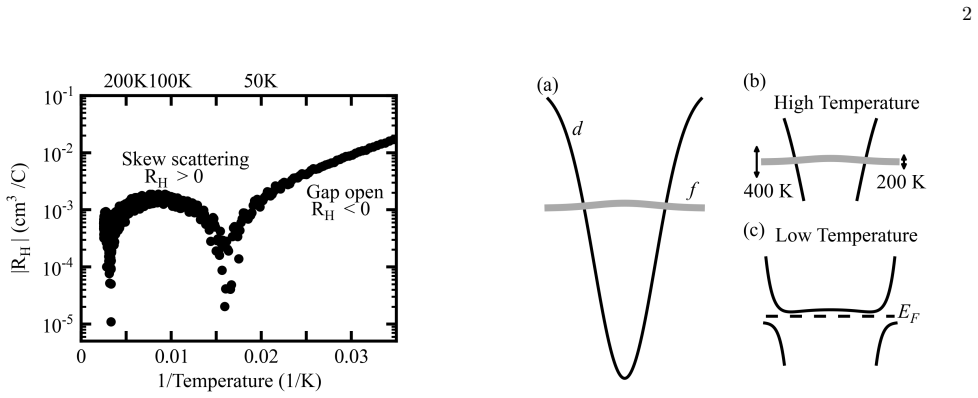
We interpret the anomalous sign of the Hall coefficient in the context of skew scattering arising from the strong correlations between the f and d electrons. At energy scales where the gap is closed, the number of d electrons in resonance with the f electrons at the Fermi energy varies. When a large proportion of d and f electrons are in resonance, skew scattering is dominant, leading to the observation of the positive sign, but when fewer are in resonance, conventional scattering mechanisms dominate instead.
What carries the argument
skew scattering arising from strong correlations between the f and d electrons, with the proportion of resonant electrons at the Fermi energy varying with temperature
If this is right
- The positive Hall sign between 65 K and 305 K indicates dominance of skew scattering rather than a change in carrier type.
- Skew scattering becomes dominant when a large proportion of d electrons are in resonance with f electrons.
- Conventional scattering mechanisms dominate when fewer electrons are in resonance, restoring the negative Hall sign.
- The temperature points of 65 K and 305 K mark scales where the resonance proportion changes significantly.
Where Pith is reading between the lines
- Similar sign changes might be observable in other Kondo insulators with f-d hybridization.
- Temperature-dependent calculations of the skew scattering amplitude could test the resonance model quantitatively.
- This view implies high-temperature bulk transport is dominated by correlation effects rather than topological surface states.
- Hall measurements under varying magnetic fields could further isolate the skew scattering contribution.
Load-bearing premise
The assumption that skew scattering dominates the Hall response when a large proportion of d and f electrons are in resonance, varying with temperature to cause the observed sign changes at 65 K and 305 K.
What would settle it
Microscopic calculation of the temperature-dependent skew scattering contribution failing to reproduce the double sign change at 65 K and 305 K.
Figures


read the original abstract
A well-known feature in transport data of the topological Kondo insulator SmB$_6$ is the sign change in the Hall coefficient at 65 K. Carriers in SmB$_6$ are known to be negative, but above 65 K, the Hall sign suggests that the carriers are positive. Here, we extend Hall measurements up to 400 K and observe that the Hall coefficient changes back to the correct (negative) sign at about 305 K. We interpret the anomalous sign of the Hall coefficient in the context of skew scattering arising from the strong correlations between the $f$ and $d$ electrons. At energy scales where the gap is closed, the number of $d$ electrons in resonance with the $f$ electrons at the Fermi energy varies. When a large proportion of $d$ and $f$ electrons are in resonance, skew scattering is dominant, leading to the observation of the positive sign, but when fewer are in resonance, conventional scattering mechanisms dominate instead.
Editorial analysis
A structured set of objections, weighed in public.
Referee Report
Summary. The manuscript reports Hall coefficient measurements on the topological Kondo insulator SmB6 extended to 400 K. It identifies a sign change from negative to positive at 65 K and a reversal back to negative at ~305 K. The authors interpret the anomalous positive sign in the intermediate range as arising from skew scattering due to strong f-d electron correlations; specifically, at energy scales where the hybridization gap is closed, the number of resonant d electrons at the Fermi energy varies with temperature such that skew scattering dominates (producing positive Hall sign) only when a large proportion of d and f electrons are in resonance.
Significance. If the interpretation holds, the work would link high-temperature bulk transport anomalies in SmB6 to skew scattering from f-d correlations, extending understanding of correlated topological materials beyond the low-T regime. The experimental extension of Hall data to 400 K is a concrete contribution, but the absence of a quantitative model or falsifiable prediction reduces the potential impact.
major comments (2)
- [Abstract] Abstract: The central claim that skew scattering dominates (yielding positive Hall sign) between 65 K and 305 K because 'a large proportion of d and f electrons are in resonance' is presented without any derivation or explicit model for the temperature-dependent resonant fraction n_res(T) obtained from the known hybridization gap, nor a skew-scattering Hall formula that reproduces the two observed crossover temperatures from that fraction.
- [Abstract] Abstract: No quantitative fitting, error analysis, or parameter-independent prediction is supplied for the Hall coefficient data or the proposed mechanism, so the interpretation remains consistent with the data by construction rather than uniquely explaining the sign changes at the specific temperatures 65 K and 305 K.
minor comments (2)
- The manuscript would benefit from explicit statements of the sample characteristics (e.g., stoichiometry, residual resistivity) and measurement geometry to allow direct comparison with prior SmB6 Hall studies.
- Notation for the Hall coefficient (sign convention and units) should be clarified in the figure captions or methods section for readers unfamiliar with the high-T regime.
Simulated Author's Rebuttal
We thank the referee for their careful reading of the manuscript and for highlighting the need for greater clarity on the proposed mechanism. We respond to each major comment below.
read point-by-point responses
-
Referee: [Abstract] Abstract: The central claim that skew scattering dominates (yielding positive Hall sign) between 65 K and 305 K because 'a large proportion of d and f electrons are in resonance' is presented without any derivation or explicit model for the temperature-dependent resonant fraction n_res(T) obtained from the known hybridization gap, nor a skew-scattering Hall formula that reproduces the two observed crossover temperatures from that fraction.
Authors: We agree that the interpretation in the abstract is qualitative. The manuscript links the observed sign reversals to the known temperature evolution of the f-d hybridization gap in SmB6 (closing near 50-100 K) and the resulting resonance condition that favors skew scattering when a substantial fraction of d and f states overlap at the Fermi level. No explicit functional form for n_res(T) or a closed-form skew-scattering Hall expression is derived because constructing such a model would require a full microscopic treatment of the scattering amplitudes (e.g., via many-body perturbation theory), which lies outside the scope of this primarily experimental report focused on extending Hall data to 400 K. The crossover temperatures are noted to be consistent with the hybridization energy scale (~few meV). We will revise the abstract and discussion to state explicitly that the argument is qualitative and to reference the relevant energy scales more precisely. revision: partial
-
Referee: [Abstract] Abstract: No quantitative fitting, error analysis, or parameter-independent prediction is supplied for the Hall coefficient data or the proposed mechanism, so the interpretation remains consistent with the data by construction rather than uniquely explaining the sign changes at the specific temperatures 65 K and 305 K.
Authors: The central experimental contribution is the observation of the second sign reversal at ~305 K, which had not been reported previously. The proposed mechanism draws on established skew-scattering phenomenology in correlated f-electron systems and on the independently measured hybridization gap of SmB6. While no numerical fitting or error propagation on a model is performed, the temperatures of the two sign changes align with the gap-closing scale at low T and the thermal suppression of resonant scattering at high T. We acknowledge that a parameter-free prediction would strengthen uniqueness; however, the present work is intended to document the high-temperature anomaly and to offer a physically motivated interpretation rather than to deliver a complete quantitative theory. We do not plan to add fitting in revision but can expand the discussion to compare the observed temperatures with literature values for the hybridization gap. revision: no
Circularity Check
No circularity: qualitative interpretation of observed sign changes
full rationale
The manuscript reports Hall measurements extending to 400 K and notes sign reversals at the observed temperatures of 65 K and 305 K. It then supplies a qualitative regime argument linking resonance fraction to dominance of skew versus conventional scattering. No equations, fitted parameters, or first-principles derivation are presented whose output is forced by the input data or by self-citation. The temperatures are measured quantities, not outputs of a model that is then called a prediction. No load-bearing self-citation, ansatz smuggling, or self-definitional step appears in the supplied text. The central claim is therefore an interpretive hypothesis whose validity can be assessed against external data or calculations without internal reduction.
Axiom & Free-Parameter Ledger
axioms (1)
- domain assumption Skew scattering from f-d electron correlations can lead to positive Hall coefficient when resonance is high.
Reference graph
Works this paper leans on
-
[1]
Past research led to the classification of SmB 6 as a rare-earth mixed valence compound [2–4] as well as a Kondo insulator, [5, 6] where strong interactions be- tween f and d electrons lead to the opening of a small hybridization gap at the Fermi energy below about 100 K. In transport, the gap opening is observed as a resis- tance rise below about 50 K, te...
work page internal anchor Pith review Pith/arXiv arXiv 1907
-
[2]
3(c), there are not enough electrons left at the Fermi level to partic- ipate in resonance
When the gap is open, as shown in Fig. 3(c), there are not enough electrons left at the Fermi level to partic- ipate in resonance. Here, the skew scattering mechanism is destroyed and the Hall coefficient is again measured with the correct sign down to lowest temperatures. Since the Hall coefficient is often used to extract carrier density and mobility, the e...
- [3]
-
[4]
N. F. Mott, Philosophical Magazine 30, 403 (1974)
work page 1974
-
[5]
R. M. Martin and J. W. Allen, Journal of Applied Physics 50, 7561 (1979)
work page 1979
-
[6]
J. W. Allen and R. M. Martin, J. Phys. Colloq. 6, 171 (1980)
work page 1980
- [7]
-
[8]
P. S. Riseborough, Advances in Physics 49, 257 (2000)
work page 2000
-
[9]
J. W. Allen, B. Batlogg, and P. Wachter, Physical Re- view B 20, 4807 (1979)
work page 1979
-
[10]
J. C. Nickerson, R. M. White, K. N. Lee, R. Bachmann, T. H. Geballe, and G. W. Hull, Jr., Physical Review B 3, 2030 (1971)
work page 2030
- [11]
-
[12]
R. Takahashi and S. Murakami, Journal of the Physical Society of Japan 80, 123710 (2011)
work page 2011
- [13]
-
[14]
S. Wolgast, C ¸ . Kurdak, K. Sun, J. W. Allen, D.-J. Kim, and Z. Fisk, Physical Review B 88, 180405(R) (2013)
work page 2013
-
[15]
D. J. Kim, S. Thomas, T. Grant, J. Botimer, Z. Fisk, and J. Xia, Scientific Reports 3, 3150 (2013)
work page 2013
-
[16]
D. J. Kim, J. Xia, and Z. Fisk, Scientific Reports 13, 466 (2014)
work page 2014
-
[17]
S. Wolgast, Y. S. Eo, T. Ozturk, G. Li, Z. Xiang, C. Tins- man, T. Asaba, B. Lawson, F. Yu, J. W. Allen, K. Sun, L. Li, C ¸ . Kurdak, D.-J. Kim, and Z. Fisk, Physical Re- view B 92, 180405(R) (2015)
work page 2015
- [18]
-
[19]
M. Neupane, N. Alidoust, S.-Y. Xu, T. Kondo, Y. Ishida, D. J. Kim, C. Liu, I. Belopolski, Y. J. Jo, T.-R. Chang, H.-T. Jeng, T. Durakiewicz, L. Balicas, H. Lin, A. Bansil, S. Shin, Z. Fisk, and M. Z. Hasan, Nature Communica- tions 4, 2991 (2013)
work page 2013
- [20]
-
[21]
N. Xu, P. K. Biswas, J. H. Dil, R. S. Dhaka, G. Landolt, S. Muff, C. E. Matt, X. Shi, N. C. Plumb, M. Radovic, E. Pomjakushina, K. Conder, A. Amato, S. V. Borisenko, R. Yu, H.-M. Weng, Z. Fang, X. Dai, J. Mesot, H. Ding, and M. Shi, Nature Communications 5, 4566 (2014)
work page 2014
-
[22]
E. Frantzeskakis, N. de Jong, B. Zwartsenberg, Y. K. Huang, Y. Pan, X. Zhang, J. X. Zhang, F. X. Zhang, L. H. Bao, O. Tegus, A. Varykhalov, A. de Visser, and M. S. Golden, Physical Review X 3, 041024 (2013)
work page 2013
-
[23]
J. D. Denlinger, J. W. Allen, J.-S. Kang, K. Sun, J.-W. Kim, J. H. Shim, B. I. Min, D.-J. Kim, and Z. Fisk, (2014), arXiv:1312.6637 [cond-mat.str-el]
work page internal anchor Pith review Pith/arXiv arXiv 2014
-
[24]
G. Li, Z. Xiang, F. Yu, T. Asaba, B. Lawson, P. Cai, C. Tinsman, A. Berkley, S. Wolgast, Y. S. Eo, D.-J. Kim, C. Kurdak, J. W. Allen, K. Sun, X. H. Cheng, Y. Y. Wang, Z. Fisk, and L. Li, Science 346, 1208 (2014)
work page 2014
- [25]
-
[26]
S. R¨ oßler, L. Jiao, D.-J. Kim, S. Seiro, K. Rasim, F. Steglich, L. H. Tjeng, Z. Fisk, and S. Wirth, Philo- sophical Magazine 96, 3262 (2016)
work page 2016
- [27]
-
[28]
Y. S. Eo, A. Rakoski, J. Lucien, D. Mihaliov, C ¸ . Kurdak, P. F. S. Rosa, and Z. Fisk, Proceedings of the National Academy of Sciences 116, 12638 (2019)
work page 2019
-
[29]
A. Rakoski, Y. S. Eo, K. Sun, and C ¸ . Kurdak, Physical Review B 95, 195133 (2017)
work page 2017
-
[30]
J. Bardeen, L. N. Cooper, and J. Schreiffer, Physical Review 108, 1175 (1957)
work page 1957
-
[31]
M. A. Woolf and F. Reif, Physical Review 137, 557 (1965)
work page 1965
-
[32]
B. S. Tan, Y.-T. Hsu, B. Zeng, M. Ciomaga Hatnean, N. Harrison, Z. Zhu, M. Hartstein, M. Kiourlappou, A. Srivastava, M. D. Johannes, T. P. Murphy, J.-H. Park, L. Balicas, G. G. Lonzarich, G. Balakrishnan, and S. E. Sebastian, Science 349, 6245 (2015)
work page 2015
-
[33]
M. Hartstein, W. H. Toews, Y.-T. Hsu, B.Zeng, X. Chen, M. C. Hatnean, Q. R. Zhang, S. Nakamura, A. S. Padgett, G. Rodway-Gant, J. Berk, M. K. Kingston, G. H. Zhang, M. K. Chan, S. Yamashita, T. Sakakibara, Y. Tanako, J.-H. Park, L. Balicas, N. Harrison, N. Shit- sevalova, G. Balakrishnan, G. G. Lonzarich, R. W. Hill, M. Sutherland, and S. E. Sebastian, Na...
work page 2017
-
[34]
S. von Molnar, T. Theis, A. Benoit, A. Briggs, J. Flou- quet, J. Ravex, and Z. Fisk, in Valence Fluctuations , edited by P. Wachter and H. Boppart (North-Holland Publishing Company, 1982)
work page 1982
-
[35]
P. Coleman, P. W. Anderson, and T. V. Ramakrishnan, Physical Review Letters 55, 414 (1985)
work page 1985
-
[36]
J. D. Denlinger, J. W. Allen, J.-S. Kang, K. Sun, B. I. Min, D.-J. Kim, and Z. Fisk, in Proceedings of the In- ternational Conference on Strongly Correlated Electron Systems, Vol. 3 (2014)
work page 2014
discussion (0)
Sign in with ORCID, Apple, or X to comment. Anyone can read and Pith papers without signing in.