Convergence of the perfectly matched layer method for transient acoustic-elastic interaction above an unbounded rough surface
Pith reviewed 2026-05-24 17:37 UTC · model grok-4.3
The pith
The perfectly matched layer converges exponentially to the original acoustic-elastic problem via an error bound on their Dirichlet-to-Neumann operators.
A machine-rendered reading of the paper's core claim, the machinery that carries it, and where it could break.
Core claim
The solution of the PML-truncated acoustic-elastic problem converges exponentially to the solution of the original unbounded problem as the PML thickness grows or the absorption parameter is tuned, with the rate controlled by the difference between the Dirichlet-to-Neumann maps of the two formulations.
What carries the argument
Error estimate between the Dirichlet-to-Neumann operators of the original problem and the PML problem
If this is right
- The PML problem in the finite strip is well-posed and inherits stability bounds from the original formulation.
- The original problem itself is well-posed and stable in the Laplace domain and after inversion.
- Truncation error decays exponentially in both the layer thickness and the PML absorption strength.
- The method applies to any bounded elastic body immersed above an unbounded rough surface.
Where Pith is reading between the lines
- The same DtN-comparison strategy may transfer to other time-dependent wave problems that require artificial truncation.
- Numerical schemes built on this PML truncation could achieve high accuracy with modest layer sizes once the exponential rate is calibrated.
- The approach supplies a rigorous justification for using PML in scattering simulations involving fluid-solid interfaces with irregular topography.
Load-bearing premise
The original acoustic-elastic problem possesses a stable solution whose Dirichlet-to-Neumann operator can be compared directly to the corresponding operator of the truncated PML problem.
What would settle it
A concrete counter-example in which the difference between the original and PML solutions fails to decay exponentially when the PML thickness is increased while the absorption parameter is held fixed.
Figures
read the original abstract
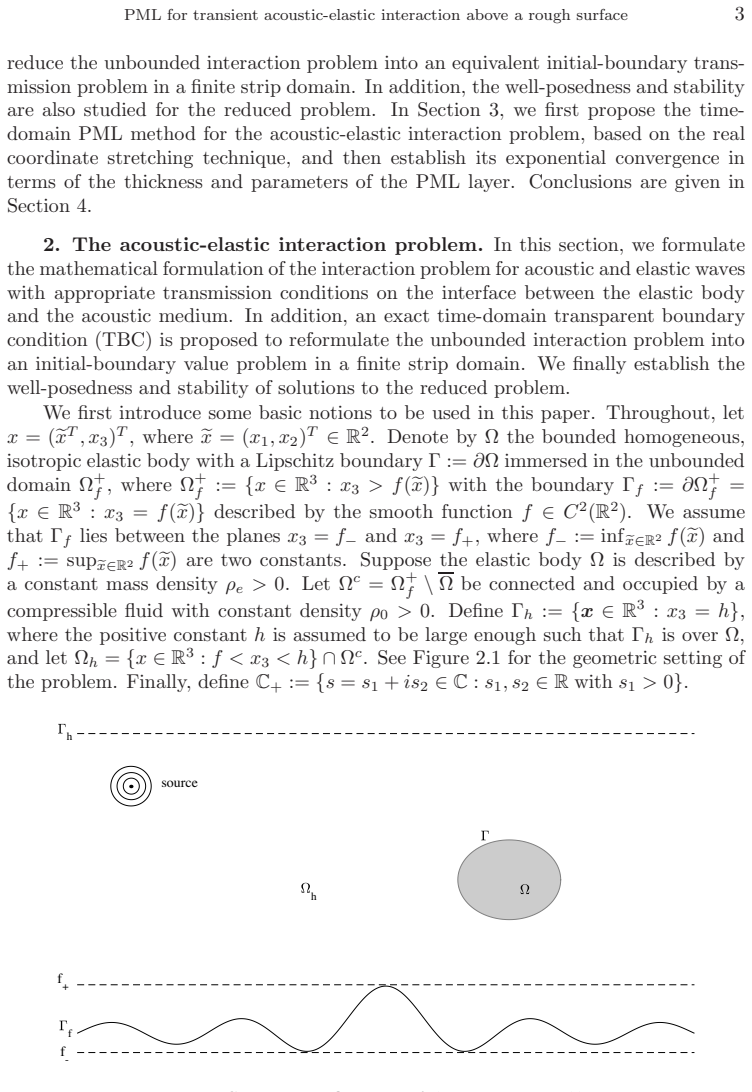
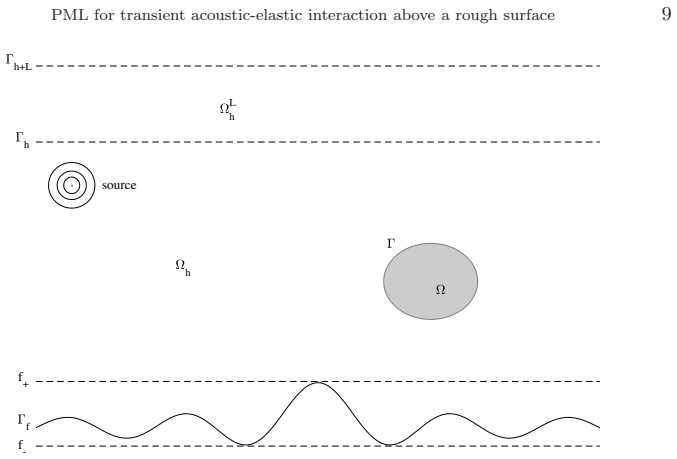
This paper is concerned with the time-dependent acoustic-elastic interaction problem associated with a bounded elastic body immersed in a homogeneous air or fluid above an unbounded rough surface. The well-posedness and stability of the problem are first established by using the Laplace transform and the energy method. A perfectly matched layer (PML) is then introduced to truncate the interaction problem above a finite layer containing the elastic body, leading to a PML problem in a finite strip domain. We further establish the existence, uniqueness and stability estimate of solutions to the PML problem. Finally, we prove the exponential convergence of the PML problem in terms of the thickness and parameter of the PML layer, based on establishing an error estimate between the DtN operators of the original problem and the PML problem.
Editorial analysis
A structured set of objections, weighed in public.
Referee Report
Summary. The paper establishes well-posedness and stability of the time-dependent acoustic-elastic interaction problem above an unbounded rough surface via the Laplace transform and energy methods. It introduces a PML truncation above a finite strip containing the elastic body, proves existence, uniqueness, and stability estimates for the resulting PML problem, and demonstrates exponential convergence of the PML solution with respect to layer thickness and absorption parameter by deriving an explicit error estimate between the Dirichlet-to-Neumann operators of the original and truncated problems.
Significance. If the central claims hold, the work supplies a rigorous justification for PML truncation in transient acoustic-elastic simulations involving rough surfaces, a setting arising in geophysics and underwater acoustics. The explicit derivation of the DtN error estimate after well-posedness, yielding parameter-free exponential decay, is a clear technical strength that supports reliable a-priori error control without auxiliary fitting.
Simulated Author's Rebuttal
We thank the referee for the positive review and recommendation to accept the manuscript. The summary accurately captures the main contributions regarding well-posedness via Laplace transform and energy methods, as well as the exponential convergence of the PML truncation through the DtN error estimate.
Circularity Check
No significant circularity
full rationale
The paper's derivation chain is self-contained: it starts from the time-dependent acoustic-elastic problem, establishes well-posedness and stability via Laplace transform plus energy estimates, introduces the PML truncation, proves well-posedness of the truncated problem, and obtains exponential convergence from an explicit error bound between the two DtN operators. No step reduces by definition to its own inputs, no fitted parameters are relabeled as predictions, and no load-bearing uniqueness claim rests on a self-citation chain. The argument relies on standard transform and energy techniques applied to the given PDE system.
Axiom & Free-Parameter Ledger
axioms (2)
- domain assumption The Laplace transform converts the time-dependent problem into a frequency-domain problem for which well-posedness can be established before inversion.
- domain assumption An error estimate between the original and PML Dirichlet-to-Neumann operators implies exponential convergence of the truncated solution.
Reference graph
Works this paper leans on
-
[1]
G. Bao, Y. Gao and P. Li, Time-domain analysis of an acoust ic-elastic interaction problem, Arch. Rational Mech. Anal. 229 (2018), 835-884
work page 2018
- [2]
-
[3]
B´ erenger, A perfectly matched layer for the absorp tion of electromagnetic waves, J
J.P. B´ erenger, A perfectly matched layer for the absorp tion of electromagnetic waves, J. Com- put. Phys. 114 (1994), 185-200
work page 1994
-
[4]
J.H. Bramble and J.E. Pasciak, Analysis of a finite PML app roximation for the three dimen- sional time-harmonic Maxwell and acoustic scattering prob lems, Math. Comp. 76 (2007), 597-614
work page 2007
-
[5]
S.N. Chandler-Wilde, E. Heinemeyer and R. Potthast, A we ll-posed integral equation formula- tion for three-dimensional rough surface scattering, Proc. Roy. Soc. London A 462 (2006), 3683-3705
work page 2006
-
[6]
S.N. Chandler-Wilde and P. Monk, Existence, uniqueness , and variational methods for scatter- ing by unbounded rough surfaces, SIAM J. Math. Anal. 37 (2005), 598-618
work page 2005
-
[7]
S.N. Chandler-Wilde and P. Monk, The PML for rough surfac e scattering, Appl. Numer. Math. 59 (2009), 2131-2154
work page 2009
-
[8]
S.N. Chandler-Wilde, C.R. Ross and B. Zhang, Scattering by infinite one-dimensional rough surfaces, Proc. Roy. Soc. London A 455 (1999), 3767-3787. PML for transient acoustic-elastic interaction above a rou gh surface 19
work page 1999
-
[9]
S.N. Chandler-Widle and B. Zhang, A uniqueness result fo r scattering by infinite rough surfaces, SIAM J. Appl. Math. 58 (1998), 1774-1790
work page 1998
-
[10]
Q. Chen and P. Monk, Discretization of the time domain CF IE for acoustic scattering problems using convolution quadrature, SIAM J. Math. Anal. 46 (2014), 3107-3130
work page 2014
-
[11]
Z. Chen, Convergence of the time-domain perfectly matc hed layer method for acoustic scatter- ing problems, Int. J. Numer. Anal. Model 6 (2009), 124-146
work page 2009
-
[12]
Z. Chen and J.C. N´ ed´ elec, On Maxwell equations with th e transparent boundary condition, J. Comput. Math. 26 (2008), 284-296
work page 2008
-
[13]
Z. Chen and H. W u, An adaptive finite element method with p erfectly matched absorbing layers for the wave scattering by periodic structures, SIAM J. Numer. Anal. 41 (2003), 799-826
work page 2003
-
[14]
Z. Chen and X. W u, An adaptive uniaxial perfectly matche d layer method for time-harmonic scattering problems, Numer. Math. Theor. Meth. Appl. 1 (2005), 113-137
work page 2005
-
[15]
Z. Chen and X. W u, Long-time stability and convergence o f the uniaxial perfectly matched layer method for time-domain acoustic scattering problems , SIAM J. Numer. Anal. 50 (2012), 2632-2655
work page 2012
-
[16]
Z. Chen and W. Zheng, Convergence of the uniaxial perfec tly matched layer method for time- harmonic scattering problems in two-layered media, SIAM J. Numer. Anal. 48 (2010), 2158-2185
work page 2010
-
[17]
Cohen, Numerical Methods for Laplace Transform Inversion , Springer, 2007
A.M. Cohen, Numerical Methods for Laplace Transform Inversion , Springer, 2007
work page 2007
-
[18]
F. Collino and P. Monk, The perfectly matched layer in cu rvilinear coordinates, SIAM J. Sci. Comput. 19 (1998), 2061-2090
work page 1998
- [19]
- [20]
-
[21]
Y. Gao, P. Li and B. Zhang, Analysis of transient acousti c-elastic interaction in an unbounded structure, SIAM J. Math. Anal. 49 (2017), 3951-3972
work page 2017
- [22]
-
[23]
G.C. Hsiao, On the boundary-field equation methods for fl uid-structure interactions, in: Problems and Methods in Mathematical Physics (ed. L. Jentsch and F. Tr¨ oltzsch), Vieweg+Teubner Verlag, 1994, pp. 79-88
work page 1994
-
[24]
G.C. Hsiao, R.E. Kleinman and G.F. Roach, W eak solution s of fluid-solid interaction problems, Math. Nachr. 218 (2000), 139-163
work page 2000
-
[25]
G.C. Hsiao, R.E. Kleinman and L.S. Schuetz, On variatio nal formulations of boundary value problems for fluid-solid interactions, in: Elastic Wave Propagation (ed. M.F. McCarthy and M.A. Hayes), 1989, pp. 321-326
work page 1989
-
[26]
G.C. Hsiao, F.-J. Sayas and R.J. W einacht, Time-depend ent fluid-structure interaction, Math. Methods Appl. Sci. 40 (2017), 486-500
work page 2017
-
[27]
M. Lassas and E. Somersalo, On the existence and converg ence of the solution of PML equations, Computing. 60 (1998), 229-241
work page 1998
- [28]
-
[29]
P. Li, L. W ang and A. W ood, Analysis of transient electro magnetic scattering from a three- dimensional open cavity, SIAM J. Appl. Math. 75 (2015), 1675-1699
work page 2015
-
[30]
C.J. Luke and P.A. Martin, Fluid-solid interaction: Ac oustic scattering by a smooth elastic obstacle, SIAM J. Appl. Math. 55 (1995), 904-922
work page 1995
-
[31]
Mclean, Strongly elliptic systems and boundary integral equations , Cambridge University Press, 2000
W. Mclean, Strongly elliptic systems and boundary integral equations , Cambridge University Press, 2000
work page 2000
-
[32]
H.J.-P. Morand and R. Ohayon, Fluid Structure Interaction , J. Wiley, Chichester, UK, 1995
work page 1995
-
[33]
F.L. Teixeira and W.C. Chew, Advances in the theory of pe rfectly matched layers, in: Fast and Efficient Algorithms in Computational Electromagnetics (ed. W. C. Chew et al.), Artech House, Boston, 2001, pp. 283-346
work page 2001
-
[34]
Tr` eves, Basic Linear Partial Differential Equations , Academic Press, New York, 1975
F. Tr` eves, Basic Linear Partial Differential Equations , Academic Press, New York, 1975
work page 1975
-
[35]
E. Turkel and A. Yefet, Absorbing PML boundary layers fo r wave-like equations, Appl.Numer. Math. 27 (1998), 533-557
work page 1998
-
[36]
B. W ang and L. W ang, On L2-stability analysis of time-domain acoustic scattering pr oblems with exact nonreflecting boundary conditions, J. Math. Study 1 (2014), 65-84
work page 2014
- [37]
-
[38]
C. W ei and J. Yang, Analysis of a time-dependent fluid-so lid interaction problem above a local rough surface, Sci. China Math. 62 (2019), https://doi.org/10.1007/s11425-017-9364-3
-
[39]
C. W ei, J. Yang and B. Zhang, Convergence analysis of the PML method for time-domain electromagnetic scattering problems, submitted, 2019
work page 2019
discussion (0)
Sign in with ORCID, Apple, or X to comment. Anyone can read and Pith papers without signing in.