New Beta Cephei stars with KELT
Pith reviewed 2026-05-24 15:15 UTC · model grok-4.3
The pith
KELT light-curve analysis identifies 86 new Beta Cephei stars and raises the known total by 70 percent.
A machine-rendered reading of the paper's core claim, the machinery that carries it, and where it could break.
Core claim
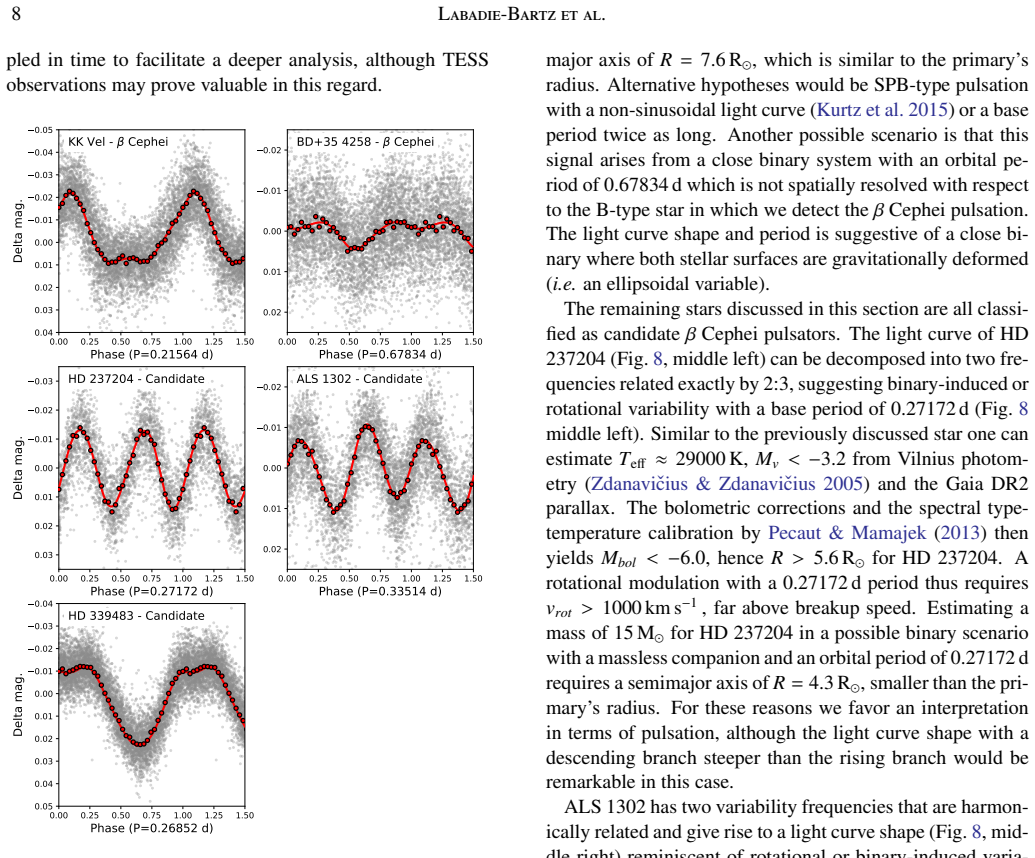
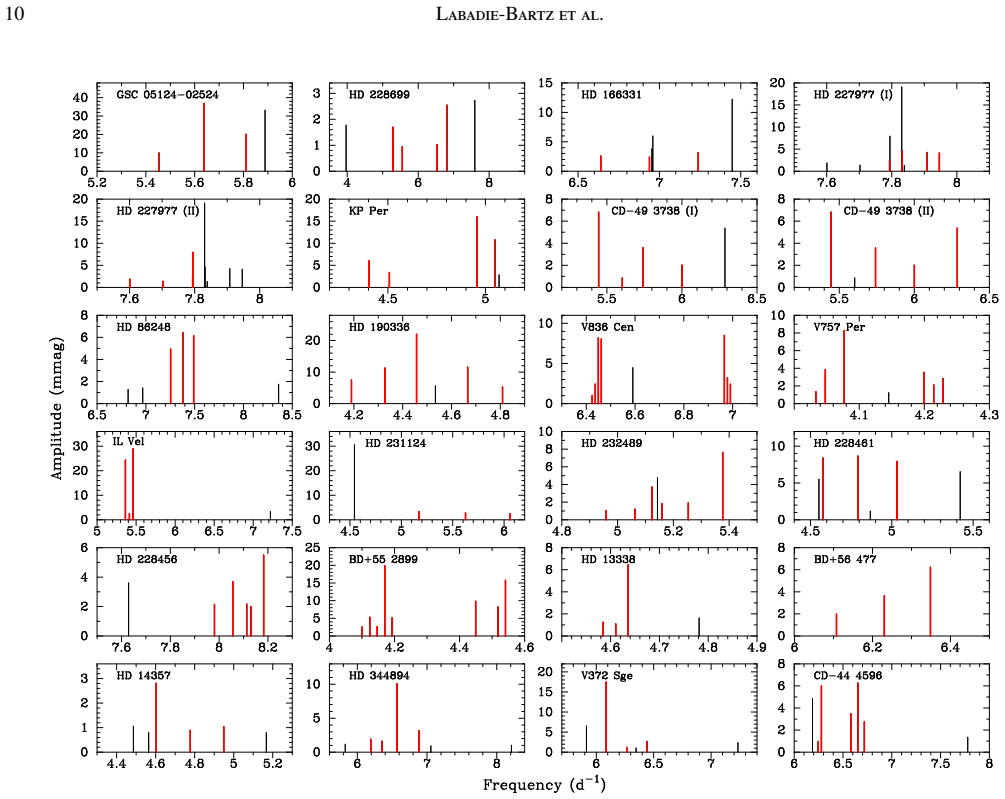
We present the results of a search for Galactic Beta Cephei stars by performing a frequency analysis on the optical light curves of known O- and B-type stars with data from the KELT exoplanet survey. We identify 113 Beta Cephei stars, of which 86 are new discoveries, which altogether represents a ~70% increase in the number presently known. An additional 96 candidates are identified. Among our targets, we find five new eclipsing binaries and 22 stars with equal frequency spacings suggestive of rotational splitting of nonradial pulsation modes.
What carries the argument
Frequency analysis of KELT light curves applied to O- and B-type stars to isolate the characteristic pulsation frequencies of Beta Cephei variables.
If this is right
- The known population of Beta Cephei stars increases by approximately 70 percent.
- Most of the new and known Beta Cephei stars will receive high-quality TESS light curves suitable for detailed asteroseismology.
- Five new eclipsing binaries are added to the sample of O- and B-type systems.
- Twenty-two stars exhibit frequency spacings consistent with rotational splitting of nonradial modes.
- The larger sample supports improved statistical studies of massive-star interiors and evolution.
Where Pith is reading between the lines
- The same wide-field survey approach could be applied to other photometric archives to locate additional Beta Cephei stars beyond the KELT footprint.
- TESS data on this expanded set may tighten constraints on the size of convective cores in massive stars.
- Runaway-star candidates among the sample offer a route to test formation and ejection mechanisms for high-mass objects.
- Statistical properties derived from the full 113-star list could be compared directly with stellar-evolution models that include pulsation physics.
Load-bearing premise
The detected periodic signals in the KELT data are Beta Cephei pulsations rather than other forms of stellar variability.
What would settle it
Higher-precision photometry or spectroscopy that reclassifies a large fraction of the 86 new objects as non-pulsators or different variable types would falsify the count.
Figures




read the original abstract
We present the results of a search for Galactic Beta Cephei stars, which are massive pulsating stars with both pressure modes and mixed modes. Thus, these stars can serve as benchmarks for seismological studies of the interiors of massive stars. We conducted the search by performing a frequency analysis on the optical light curves of known O- and B-type stars with data from the KELT exoplanet survey. We identify 113 Beta Cephei stars, of which 86 are new discoveries, which altogether represents a ~70% increase in the number presently known. An additional 96 candidates are identified. Among our targets, we find five new eclipsing binaries and 22 stars with equal frequency spacings suggestive of rotational splitting of nonradial pulsation modes. Candidates for runaway stars among our targets and a number of interesting individual objects are discussed. Most of the known and newly discovered Beta Cephei stars will be observed by the TESS mission, providing by far the most comprehensive observational data set of massive main sequence pulsating stars of sufficient quality for detailed asteroseismic studies. Future analysis of these light curves has the potential to dramatically increase our understanding of the structure of stellar interiors and the physical processes taking place therein.
Editorial analysis
A structured set of objections, weighed in public.
Referee Report
Summary. The manuscript reports a search for Galactic Beta Cephei stars via frequency analysis of KELT light curves for known O- and B-type stars. It identifies 113 Beta Cephei stars (86 new discoveries, a ~70% increase in the known sample), plus 96 additional candidates, 5 new eclipsing binaries, and 22 stars showing equal frequency spacings suggestive of rotational splitting. Many targets are noted as suitable for TESS asteroseismology.
Significance. If the classifications hold, the expanded sample would provide a substantially larger set of massive pulsators for detailed seismic modeling of stellar interiors, especially once TESS light curves become available. The work is primarily observational and adds to the catalog of known Beta Cephei stars without introducing new theoretical derivations or parameter-free predictions.
major comments (2)
- [Methods (frequency analysis and classification)] The central claim of 113 secure Beta Cephei identifications (including the net ~70% increase) rests on the frequency-analysis pipeline in the methods section. The frequency window (typically 3–20 d⁻¹) and amplitude cuts used to isolate p-modes are not shown to have quantified overlap with SPB g-modes, daily aliases, or rotational signals; without explicit false-positive rates or cross-validation against known contaminants, the purity of the sample cannot be assessed.
- [Results (sample table)] Table or figure presenting the final sample (likely Table 1 or equivalent) lists the 113 stars but supplies no per-object validation metrics (e.g., number of independent modes, signal-to-noise thresholds, or comparison to literature classifications) that would allow readers to evaluate the reliability of the new discoveries versus the 96 candidates.
minor comments (2)
- [Abstract] The abstract states the discovery numbers but does not mention the total number of O/B stars initially searched or the selection function; adding this context would clarify the completeness of the search.
- [Methods] Notation for frequencies (e.g., d⁻¹ units) and amplitude thresholds should be defined consistently in the first methods subsection where they appear.
Simulated Author's Rebuttal
We thank the referee for the careful and constructive review. The two major comments identify areas where additional detail on validation and sample purity would strengthen the manuscript. We address each point below and will revise accordingly.
read point-by-point responses
-
Referee: [Methods (frequency analysis and classification)] The central claim of 113 secure Beta Cephei identifications (including the net ~70% increase) rests on the frequency-analysis pipeline in the methods section. The frequency window (typically 3–20 d⁻¹) and amplitude cuts used to isolate p-modes are not shown to have quantified overlap with SPB g-modes, daily aliases, or rotational signals; without explicit false-positive rates or cross-validation against known contaminants, the purity of the sample cannot be assessed.
Authors: The referee correctly notes that the methods section does not include a quantitative false-positive analysis or explicit overlap estimates with SPB stars, aliases, or rotational modulation. The 3–20 d⁻¹ window and amplitude thresholds follow conventions from prior β Cephei surveys to target p-modes, and we performed literature cross-checks on the 27 previously known β Cephei stars recovered in our input list. However, we did not compute simulated false-positive rates or formal purity metrics. We will revise the methods section to add a dedicated paragraph discussing potential contaminants, the rationale for the frequency window, and an estimate of sample purity derived from the recovery rate of known objects plus a simple Monte Carlo assessment of aliasing and noise properties in the KELT data. revision: yes
-
Referee: [Results (sample table)] Table or figure presenting the final sample (likely Table 1 or equivalent) lists the 113 stars but supplies no per-object validation metrics (e.g., number of independent modes, signal-to-noise thresholds, or comparison to literature classifications) that would allow readers to evaluate the reliability of the new discoveries versus the 96 candidates.
Authors: We agree that the current Table 1 (or equivalent) lacks per-star metrics that would let readers judge classification reliability. The table reports only basic identifiers, coordinates, and a binary flag for new versus known. In the revised manuscript we will expand the table (or add a supplementary table) to include, for each star: the number of independent frequencies detected above the chosen S/N threshold, the highest S/N value, and a brief literature-comparison note. This will allow direct comparison between the 113 secure identifications and the 96 candidates. revision: yes
Circularity Check
Observational discovery report with no derivation chain or self-referential elements
full rationale
The paper performs a frequency analysis on KELT light curves of known O/B stars to identify Beta Cephei candidates using established frequency ranges (typically 3-20 d^{-1} for p-modes) and amplitude criteria. No equations, fitted parameters, predictions, or self-citations are load-bearing for the central count of 113 stars (86 new). Classification applies external definitions of Beta Cephei variability to new photometry; the result does not reduce to its inputs by construction and is self-contained against catalog benchmarks.
Axiom & Free-Parameter Ledger
axioms (1)
- domain assumption Beta Cephei stars are massive pulsating stars with both pressure modes and mixed modes.
Lean theorems connected to this paper
-
IndisputableMonolith/Foundation/RealityFromDistinction.leanreality_from_one_distinction unclear?
unclearRelation between the paper passage and the cited Recognition theorem.
For each of the 5840 light curves ... a Fourier periodogram was computed in the range of 0 – 20 d−1. ... strongest peak in the range of known β Cephei star pulsation frequencies (f ≳ 3 d−1)
-
IndisputableMonolith/Cost/FunctionalEquation.leanwashburn_uniqueness_aczel unclear?
unclearRelation between the paper passage and the cited Recognition theorem.
Objects pre-classified as β Cephei stars either showed periodic variability at a single frequency between 4 – 14 d−1 ... or showed periodic variability at multiple frequencies in the range 4 – 14 d−1
What do these tags mean?
- matches
- The paper's claim is directly supported by a theorem in the formal canon.
- supports
- The theorem supports part of the paper's argument, but the paper may add assumptions or extra steps.
- extends
- The paper goes beyond the formal theorem; the theorem is a base layer rather than the whole result.
- uses
- The paper appears to rely on the theorem as machinery.
- contradicts
- The paper's claim conflicts with a theorem or certificate in the canon.
- unclear
- Pith found a possible connection, but the passage is too broad, indirect, or ambiguous to say the theorem truly supports the claim.
Forward citations
Cited by 1 Pith paper
-
TESS Observations of Stochastic Low-frequency Variability in Extreme Helium Stars
TESS data show stochastic low-frequency variability dominates in most extreme helium stars, with characteristic timescales of 0.5-10 days correlating to stellar parameters and matching subsurface convection predictions.
Reference graph
Works this paper leans on
-
[1]
2011, A&A, 534, A98, doi: 10.1051/0004-6361/201117629
Aerts, C., Briquet, M., Degroote, P., Thoul, A., & van Hoolst, T. 2011, A&A, 534, A98, doi: 10.1051/0004-6361/201117629
-
[2]
2003, Science, 300, 1926, doi: 10.1126/science.1084993
Aerts, C., Thoul, A., Daszy´nska, J., et al. 2003, Science, 300, 1926, doi: 10.1126/science.1084993
-
[3]
2017, ApJL, 847, L7, doi: 10.3847/2041-8213/aa8a62
Aerts, C., Van Reeth, T., & Tkachenko, A. 2017, ApJL, 847, L7, doi: 10.3847/2041-8213/aa8a62
- [4]
-
[5]
2004, A&A, 415, 241, doi: 10.1051/0004-6361:20034142
Aerts, C., Waelkens, C., Daszy´nska-Daszkiewicz, J., et al. 2004, A&A, 415, 241, doi: 10.1051/0004-6361:20034142
-
[6]
Aerts, C., Marchenko, S. V ., Matthews, J. M., et al. 2006, ApJ, 642, 470, doi: 10.1086/500800 Astropy Collaboration, Robitaille, T. P., Tollerud, E. J., et al. 2013, A&A, 558, A33, doi: 10.1051/0004-6361/201322068
-
[7]
Barnsley, R. M., & Steele, I. A. 2013, A&A, 556, A81, doi: 10.1051/0004-6361/201220419 Braganc ¸a, G. A., Daflon, S., Cunha, K., et al. 2012, AJ, 144, 130, doi: 10.1088/0004-6256/144/5/130
- [8]
-
[9]
Briquet, M., Neiner, C., Aerts, C., et al. 2012, MNRAS, 427, 483, doi: 10.1111/j.1365-2966.2012.21933.x
-
[10]
Cargile, P. A., James, D. J., Pepper, J., et al. 2014, ApJ, 782, 29, doi: 10.1088/0004-637X/782/1/29
-
[11]
Chen, B., Vergely, J. L., Valette, B., & Carraro, G. 1998, A&A, 336, 137
work page 1998
-
[12]
Chini, R., Hoffmeister, V . H., Nasseri, A., Stahl, O., & Zinnecker, H. 2012, MNRAS, 424, 1925, doi: 10.1111/j.1365-2966.2012.21317.x
-
[13]
Clark, J. S., & Steele, I. A. 2000, Astronomy and Astrophysics Supplement Series, 141, 65, doi: 10.1051/aas:2000310
-
[14]
Cousins, A. W. J. 1982, Information Bulletin on Variable Stars, 2158
work page 1982
-
[15]
Crawford, D. L. 1978, AJ, 83, 48, doi: 10.1086/112176 Daflon, S., Cunha, K., de Ara ´ujo, F. X., Wolff, S., & Przybilla, N. 2007, AJ, 134, 1570, doi: 10.1086/521707 Daszy´nska-Daszkiewicz, J., Ostrowski, J., & Pamyatnykh, A. A. 2013, MNRAS, 432, 3153, doi: 10.1093/mnras/stt670 De Cat, P. 2002, in Astronomical Society of the Pacific Conference
-
[16]
Series, V ol. 259, IAU Colloq. 185: Radial and Nonradial Pulsationsn as Probes of Stellar Physics, ed. C. Aerts, T. R. Bedding, & J. Christensen-Dalsgaard, 196 De Cat, P., & Aerts, C. 2002, A&A, 393, 965, doi: 10.1051/0004-6361:20021068 De Cat, P., Briquet, M., Aerts, C., et al. 2007, A&A, 463, 243, doi: 10.1051/0004-6361:20066202
-
[17]
2009, A&A, 506, 111, doi: 10.1051/0004-6361/200911782
Degroote, P., Briquet, M., Catala, C., et al. 2009, A&A, 506, 111, doi: 10.1051/0004-6361/200911782
-
[18]
Deupree, R. G., & Beslin, W. 2010, ApJ, 721, 1900, doi: 10.1088/0004-637X/721/2/1900
-
[19]
2004, A&A, 415, 251, doi: 10.1051/0004-6361:20034143
Dupret, M.-A., Thoul, A., Scuflaire, R., et al. 2004, A&A, 415, 251, doi: 10.1051/0004-6361:20034143
-
[20]
Dziembowski, W. A., & Goode, P. R. 1992, ApJ, 394, 670, doi: 10.1086/171621
-
[21]
A., Moskalik, P., & Pamyatnykh, A
Dziembowski, W. A., Moskalik, P., & Pamyatnykh, A. A. 1993, MNRAS, 265, 588, doi: 10.1093/mnras/265.3.588
-
[22]
Dziembowski, W. A., & Pamyatnykh, A. A. 2008, MNRAS, 385, 2061, doi: 10.1111/j.1365-2966.2008.12964.x
-
[23]
2004, A&A, 426, 687, doi: 10.1051/0004-6361:20040418 Gaia Collaboration, Prusti, T., de Bruijne, J
Fokin, A., Mathias, P., Chapellier, E., Gillet, D., & Nardetto, N. 2004, A&A, 426, 687, doi: 10.1051/0004-6361:20040418 Gaia Collaboration, Prusti, T., de Bruijne, J. H. J., et al. 2016, A&A, 595, A1, doi: 10.1051/0004-6361/201629272 Gaia Collaboration, Brown, A. G. A., Vallenari, A., et al. 2018, A&A, 616, A1, doi: 10.1051/0004-6361/201833051
-
[24]
Garrison, R. F., Hiltner, W. A., & Schild, R. E. 1977, ApJS, 35, 111, doi: 10.1086/190468
-
[25]
Groote, D., Kaufmann, J. P., & Lange, A. 1982, Astronomy and Astrophysics Supplement Series, 50, 77
work page 1982
-
[26]
Guetter, H. H. 1979, AJ, 84, 1846, doi: 10.1086/112616
-
[27]
Handler, G. 2005, Information Bulletin on Variable Stars, 5667 —. 2009, MNRAS, 398, 1339, doi: 10.1111/j.1365-2966.2009.15005.x
-
[28]
2011, A&A, 533, A70, doi: 10.1051/0004-6361/201116874
Handler, G., & Meingast, S. 2011, A&A, 533, A70, doi: 10.1051/0004-6361/201116874
-
[29]
Handler, G., Shobbrook, R. R., Vuthela, F. F., et al. 2003, MNRAS, 341, 1005, doi: 10.1046/j.1365-8711.2003.06487.x New Beta Cephei stars with KELT 39
-
[30]
Handler, G., Balona, L. A., Shobbrook, R. R., et al. 2002, MNRAS, 333, 262, doi: 10.1046/j.1365-8711.2002.05295.x
-
[31]
Handler, G., Jerzykiewicz, M., Rodr´ıguez, E., et al. 2006, MNRAS, 365, 327, doi: 10.1111/j.1365-2966.2005.09728.x
-
[32]
2019, ApJL, 873, L4, doi: 10.3847/2041-8213/ab095f
Handler, G., Pigulski, A., Daszy´nska-Daszkiewicz, J., et al. 2019, ApJL, 873, L4, doi: 10.3847/2041-8213/ab095f
-
[33]
Hartkopf, W. I., & Mason, B. D. 2009, AJ, 138, 813, doi: 10.1088/0004-6256/138/3/813
-
[34]
1956, Astronomische Nachrichten, 283, 109, doi: 10.1002/asna.19562830211
Heckmann, O., Dieckvoss, W., & Kox, H. 1956, Astronomische Nachrichten, 283, 109, doi: 10.1002/asna.19562830211
- [35]
-
[36]
1999, Michigan Spectral Survey, 5, 0
Houk, N., & Swift, C. 1999, Michigan Spectral Survey, 5, 0
work page 1999
-
[37]
Huang, W., Gies, D. R., & McSwain, M. V . 2010, ApJ, 722, 605, doi: 10.1088/0004-637X/722/1/605
-
[38]
2009, A&A, 506, 95, doi: 10.1051/0004-6361/200911928
Huat, A.-L., Hubert, A.-M., Baudin, F., et al. 2009, A&A, 506, 95, doi: 10.1051/0004-6361/200911928
-
[39]
Jaschek, M., & Egret, D. 1982, in IAU Symposium, V ol. 98, Be Stars, ed. M. Jaschek & H.-G. Groth, 261 Jeffery, C. S. 2014, in IAU Symposium, V ol. 301, Precision Asteroseismology, ed. J. A. Guzik, W. J. Chaplin, G. Handler, & A. Pigulski, 297–304, doi: 10.1017/S1743921313014488 Jeffery, C. S., & Ramsay, G. 2018, MNRAS, 475, L122, doi: 10.1093/mnrasl/sly015
-
[40]
2009, Information Bulletin on Variable Stars, 5881 Kahraman Alic ¸avus ¸, F
Jurcsik, J., Sodor, A., & Hajdu, G. 2009, Information Bulletin on Variable Stars, 5881 Kahraman Alic ¸avus ¸, F. 2016, personal communication
work page 2009
-
[41]
1972, Astronomy and Astrophysics Supplement Series, 7, 35
Karlsson, B. 1972, Astronomy and Astrophysics Supplement Series, 7, 35
work page 1972
-
[42]
Kawka, A., Vennes, S., N´emeth, P., Kraus, M., & Kub´at, J. 2010, MNRAS, 408, 992, doi: 10.1111/j.1365-2966.2010.17165.x
-
[43]
Kazarovets, E. V ., Samus, N. N., Durlevich, O. V ., et al. 1999, Information Bulletin on Variable Stars, 4659, 1
work page 1999
-
[44]
Kelly, B. D., & Kilkenny, D. 1986, South African Astronomical Observatory Circular, 10, 27
work page 1986
-
[45]
Kilkenny, D., Crause, L. A., & van Wyk, F. 2005, MNRAS, 361, 559, doi: 10.1111/j.1365-2966.2005.09188.x
-
[46]
Kilkenny, D., Koen, C., Jeffery, C. S., Hill, N. C., & O’Donoghue, D. 1999, MNRAS, 310, 1119, doi: 10.1046/j.1365-8711.1999.03012.x
-
[47]
Koen, C., & Eyer, L. 2002, MNRAS, 331, 45, doi: 10.1046/j.1365-8711.2002.05150.x
-
[48]
Kunzli, M., North, P., Kurucz, R. L., & Nicolet, B. 1997, A&AS, 122, 51, doi: 10.1051/aas:1997291
-
[49]
Bowman, D. M. 2015, MNRAS, 450, 3015, doi: 10.1093/mnras/stv868
-
[50]
Labadie-Bartz, J., Pepper, J., McSwain, M. V ., et al. 2017, AJ, 153, 252, doi: 10.3847/1538-3881/aa6396
-
[51]
Communications in Asteroseismology , year = 2005, month = jun, volume =
Lenz, P., & Breger, M. 2005, Communications in Asteroseismology, 146, 53, doi: 10.1553/cia146s53
-
[52]
1975, Publications of the Astronomical Society of the Pacific, 87, 173, doi: 10.1086/129741
Levato, H., & Malaroda, S. 1975, Publications of the Astronomical Society of the Pacific, 87, 173, doi: 10.1086/129741
-
[53]
Luri, X., Brown, A. G. A., Sarro, L. M., et al. 2018, A&A, 616, A9, doi: 10.1051/0004-6361/201832964
- [54]
-
[55]
Martin, J. C. 2006, AJ, 131, 3047, doi: 10.1086/504079
-
[56]
2013, A&A, 560, A16, doi: 10.1051/0004-6361/201322480
Martins, F., & Palacios, A. 2013, A&A, 560, A16, doi: 10.1051/0004-6361/201322480
-
[57]
Mathias, P., Gillet, D., Fokin, A. B., & Cambon, T. 1998, A&A, 339, 525
work page 1998
-
[58]
2006, A&A, 459, 589, doi: 10.1051/0004-6361:20064980
Mazumdar, A., Briquet, M., Desmet, M., & Aerts, C. 2006, A&A, 459, 589, doi: 10.1051/0004-6361:20064980
-
[59]
1997, A&AS, 124, 349, doi: 10.1051/aas:1997197
Mermilliod, J.-C., Mermilliod, M., & Hauck, B. 1997, A&AS, 124, 349, doi: 10.1051/aas:1997197
-
[60]
2015, ApJ, 801, 113, doi: 10.1088/0004-637X/801/2/113
Moe, M., & Di Stefano, R. 2015, ApJ, 801, 113, doi: 10.1088/0004-637X/801/2/113
-
[61]
Montgomery, M. H., & O’Donoghue, D. 1999, Delta Scuti Star Newsletter, 13, 28
work page 1999
-
[62]
Moskalik, P., & Dziembowski, W. A. 1992, A&A, 256, L5
work page 1992
- [63]
-
[64]
Napiwotzki, R., Schoenberner, D., & Wenske, V . 1993, A&A, 268, 653
work page 1993
-
[65]
Netopil, M., Paunzen, E., Maitzen, H. M., North, P., & Hubrig, S. 2008, A&A, 491, 545, doi: 10.1051/0004-6361:200810325
-
[66]
Pamyatnykh, A. A., Handler, G., & Dziembowski, W. A. 2004, MNRAS, 350, 1022, doi: 10.1111/j.1365-2966.2004.07721.x
-
[67]
2015, A&A, 580, A23, doi: 10.1051/0004-6361/201526413
Paunzen, E. 2015, A&A, 580, A23, doi: 10.1051/0004-6361/201526413
-
[68]
Pecaut, M. J., & Mamajek, E. E. 2013, ApJS, 208, 9, doi: 10.1088/0067-0049/208/1/9
work page internal anchor Pith review doi:10.1088/0067-0049/208/1/9 2013
-
[69]
B., Siverd, R., James, D., & Stassun, K
Pepper, J., Kuhn, R. B., Siverd, R., James, D., & Stassun, K. 2012, PASP, 124, 230, doi: 10.1086/665044
-
[70]
Pepper, J., Pogge, R. W., DePoy, D. L., et al. 2007, PASP, 119, 923, doi: 10.1086/521836
-
[71]
2008, A&A, 477, 917, doi: 10.1051/0004-6361:20078581
Pigulski, A., & Pojma´nski, G. 2008, A&A, 477, 917, doi: 10.1051/0004-6361:20078581
-
[72]
2016, A&A, 588, A55, doi: 10.1051/0004-6361/201527872
Pigulski, A., Cugier, H., Popowicz, A., et al. 2016, A&A, 588, A55, doi: 10.1051/0004-6361/201527872
-
[73]
1967, Boletin de los Observatorios Tonantzintla y Tacubaya, 4, 86
Poveda, A., Ruiz, J., & Allen, C. 1967, Boletin de los Observatorios Tonantzintla y Tacubaya, 4, 86
work page 1967
-
[74]
Transiting Exoplanet Survey Satellite (TESS)
Ricker, G. R., Winn, J. N., Vanderspek, R., et al. 2014, in Proc. SPIE, V ol. 9143, Space Telescopes and Instrumentation 2014: Optical, Infrared, and Millimeter Wave, 914320, doi: 10.1117/12.2063489
-
[75]
Rivinius, T., Baade, D., & Carciofi, A. C. 2016, A&A, 593, A106, doi: 10.1051/0004-6361/201628411
-
[76]
C., Martayan C., 2013, @doi [ ] 10.1007/s00159-013-0069-0 , http://adsabs.harvard.edu/abs/2013A
Rivinius, T., Carciofi, A. C., & Martayan, C. 2013, A&A Rv, 21, 69, doi: 10.1007/s00159-013-0069-0
-
[77]
2013, AJ, 146, 102, doi: 10.1088/0004-6256/146/4/102 40 L abadie-Bartz et al
Saesen, S., Briquet, M., Aerts, C., Miglio, A., & Carrier, F. 2013, AJ, 146, 102, doi: 10.1088/0004-6256/146/4/102 40 L abadie-Bartz et al
-
[78]
2014, A&A, 569, A18, doi: 10.1051/0004-6361/201323259 Skiff, B
Eggenberger, P. 2014, A&A, 569, A18, doi: 10.1051/0004-6361/201323259 Skiff, B. A. 2014, VizieR Online Data Catalog, 1
-
[79]
Stankov, A., & Handler, G. 2005, ApJS, 158, 193, doi: 10.1086/429408
-
[80]
Stassun, K. G., Oelkers, R. J., Pepper, J., et al. 2018, AJ, 156, 102, doi: 10.3847/1538-3881/aad050
discussion (0)
Sign in with ORCID, Apple, or X to comment. Anyone can read and Pith papers without signing in.