REVIEW 4 major objections 5 minor 75 references
A Brief Review on Particle Acceleration in Multi-island Magnetic Reconnection
T0 review · 4 major / 5 minor · reviewed 2026-08-14 · deepseek-v4-flash
Pith's one-line read Multi-island magnetic reconnection, as currently simulated, cannot produce the steep power-law spectra of solar energetic particles.
desk verdict A useful but thin review of the theory-simulation mismatch in multi-island reconnection; the negative conclusion in the abstract is stated more strongly than the cited PIC runs support. read the letter →
The pith
A machine-rendered reading of the paper's core claim, the machinery that carries it, and where it could break.
The reading
What carries the argument
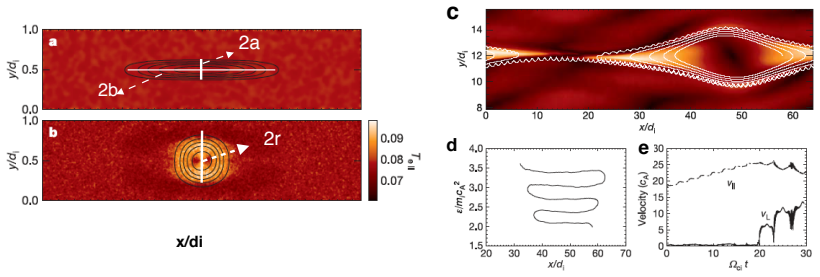
The mechanism is first-order Fermi acceleration driven by the contraction and merging of magnetic islands. The central object is the island perimeter: as an island contracts, its perimeter $l$ shrinks at rate $V_l$, and the parallel and perpendicular energies of trapped particles grow according to $dW/dt \propto (V_l/c)(1/\tau_c)W$, with $\tau_c = l/c$, so each contraction is a first-order Fermi step. Merging of two islands into one also shortens the perimeter and releases magnetic energy because the total flux is the larger of the two initial fluxes rather than their sum. The transport model in [53] expands the 6D Liouville equation and yields a power-law index controlled by the ratio of contraction time to diffusion time, so that longer particle diffusion produces a harder spectrum. The PIC simulations test this machinery, and the mismatch between simulated and observed spectra is the paper's central finding.
What would settle it
A particle-in-cell simulation of mildly relativistic multi-island reconnection with a domain large enough, or with transport enhanced, so that each electron interacts with many dozens of islands would settle the issue: if a power-law with an index near −5 emerges, the paper's central negative claim is wrong; if no power-law appears even with abundant island interactions, the injection problem is physical. Observationally, the claim would be contradicted by a solar flare electron spectrum above the break with an index near −1.3, matching the hard slopes seen in highly relativistic simulations.
Extended reading notes
Core claim
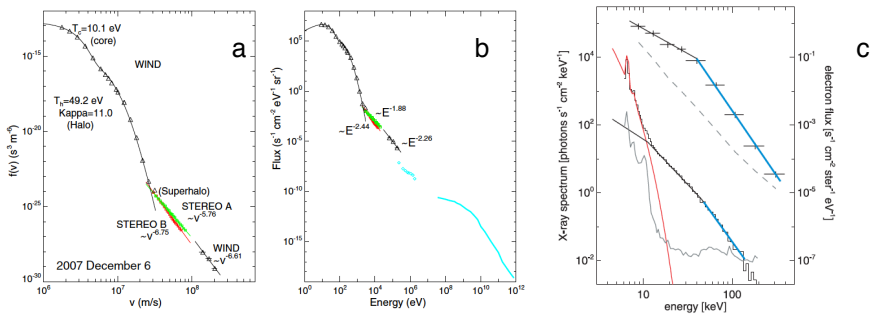
The central assessment is that the first-order Fermi mechanism in multi-island magnetic reconnection is theoretically capable of generating a power-law energy distribution, yet current particle-in-cell simulations do not confirm this in the mildly relativistic regime that matters for solar physics. In those simulations, electrons remain confined in a magnetic island for about $30\,\Omega_i^{-1}$ and interact with only about seven islands over the whole run, too few for the stochastic transport that the power-law requires. In highly relativistic simulations a power-law does form, but its index is about −1 to −2, far harder than the broken power-laws with indices around −3.9 ± 0.9 above the break observed in flare electrons, and harder than the steep superhalo spectra in the solar wind. The paper also notes that kinetic instabilities in 3D reconnection heat the plasma and can thermalize the accelerated particles, making the power-law even harder to produce. The overall conclusion is that multi-island reconnection, as it now stands, cannot reproduce the observed energetic particle spectra.
Load-bearing premise
The negative conclusion for mildly relativistic reconnection rests on the premise that current PIC simulations are representative; in particular, if the limited number of island interactions per electron is a numerical artifact of domain size or resolution, the missing power-law would be a numerical effect rather than a physical injection problem.
Editorial extensions
If this is right
- If the paper's assessment is correct, multi-island reconnection alone cannot account for the steep electron power-laws observed in solar flares and the solar wind; some additional source of stochasticity or a separate injection mechanism is required.
- The hard simulated power-laws in highly relativistic reconnection indicate long particle diffusion times, so matching the soft observed spectra would require fast transport and short diffusion times among islands.
- Plasma heating from kinetic instabilities in 3D reconnection is a further obstacle; a successful model must either suppress those instabilities or show that the power-law is established before thermalization occurs.
- The multi-island mechanism may still apply to highly relativistic environments such as pulsar nebulae and gamma-ray bursts, where the harder simulated spectra could be appropriate, even though it fails for the mildly relativistic solar context.
Reading between the lines
- If the roughly seven island interactions per electron are the bottleneck, then a larger simulation domain or longer run that gives each electron many more island encounters should restore a power-law in mildly relativistic reconnection; that is a numerical test the paper does not carry out.
- The injection problem described here parallels the classic injection problem of diffusive shock acceleration, suggesting that multi-island reconnection may need a pre-existing seed population rather than acting on the thermal pool.
- The review's analytical-versus-simulation gap could be closed by simulations that add explicit pitch-angle scattering or background turbulence, since the analytical power-law requires randomized motion; this is an extension the paper leaves implicit.
- If 3D kinetic instabilities indeed thermalize the accelerated particles, then the observed steep superhalo spectra may require acceleration sites where instability growth is weak, such as very thin current sheets, which could be tested in high-resolution 3D runs.
Editorial analysis
A structured set of objections, weighed in public.
Referee Report
Summary. The paper is a brief review of the theory and PIC simulation literature on particle acceleration in multi-island magnetic reconnection. It introduces the mechanisms of island contraction and merging, presents the transport-theory solution of Zank et al. (2014) in Eq. (7), and then argues that PIC simulations of mildly relativistic reconnection do not produce power-law spectra, while highly relativistic reconnection simulations produce power-laws that are too hard (index ~ -1.3) to match observed solar wind and flare spectra (index ~ -3 to -5). It suggests that long diffusion times in the theoretical model explain hard spectra and that kinetic instabilities in 3D reconnection may further thermalize power-law particles.
Significance. The review is useful as a concise entry point to an active debate and correctly identifies that the theoretical promise of first-order Fermi acceleration in multi-island reconnection has not been fully confirmed by simulations in the parameter regime relevant to flares and the solar wind. It gives explicit credit to key works and reproduces the main analytical formulas, and it draws attention to a real discrepancy between theoretical expectations and simulation outcomes. However, its central negative conclusion is stated more strongly than the evidence supports: the cited mildly relativistic PIC runs have only about seven island interactions per particle, and the comparison of spectral indices across different groups and setups is not controlled. If the conclusion is retained, it should be framed as an open numerical and physical question rather than as a demonstrated inability of the mechanism.
major comments (4)
- [Section 3, paragraph on why mildly relativistic PIC simulations fail] The paper itself states that in the Drake et al. [47] simulation an electron is confined in an island for about 30 Ω_i^-1, the usable simulation time is about 200 Ω_i^-1, and the mean number of island interactions is only about 7, which the authors call 'too small to randomize the electron population.' This admission makes the non-power-law outcome in mildly relativistic runs as plausibly a finite-domain and statistics artifact as a genuine absence of first-order Fermi acceleration. The abstract's claim that simulations 'seem to suggest that the first-order Fermi acceleration mechanism is unable to produce a power-law particle energy distribution function in mildly relativistic multi-island magnetic reconnections' is therefore stronger than the cited evidence supports. The manuscript should either soften this conclusion or provide convergence tests showing that the result persists with larger domains and longer simulation durations.
- [Section 3, comparison of spectral indices] The conclusion that highly relativistic simulations produce 'too hard' spectra (index ~ -1.3) relative to observations (index ~ -3.9±0.9 above the break, and ~ -3 for superhalo electrons) is based on comparing simulations by different groups that differ in dimensionality (2D vs 3D), magnetization, domain size, and in the definition and energy range of the fitted index (e.g., p in Guo et al. [55] versus α used elsewhere in the paper). Because these are not controlled parameter scans, the apparent discrepancy may be partly a numerical selection effect. The paper would be considerably strengthened by a table listing the key parameters of each simulation (σ, domain size, dimensionality, index definition) so that the comparisons are transparent and restricted to runs that differ only in the physical parameter of interest.
- [Section 2.3, Eq. (7)] The interpretation that a long diffusion time τ_diff produces hard power-laws, and that the observed soft spectra imply short τ_diff, relies entirely on the transport-theory solution of Zank et al. (2014), which is the authors' own framework, and this same framework is then used to explain the absence of power-laws in the PIC simulations. This is self-referential unless τ_diff/τ_c is directly measured in the simulations or the theory is validated against an independent simulation set. In addition, the index α in Eq. (7) is a velocity-distribution index, while the paper later compares it to observed energy spectral indices; the conversion between the two is not given, which can mislead the quantitative comparison with observations.
- [Section 3, citation [67]] Sironi and Spitkovsky (2014, ApJL 783, L21) is a study of particle acceleration at relativistic collisionless shocks, not a PIC simulation of magnetic reconnection. Listing it among simulations [67, 55, 68, 57, 69] 'that have successfully produced power-law energy spectra' in the context of multi-island reconnection is an accuracy error in a review article and should be corrected or removed.
minor comments (5)
- [Section 2.1] The text repeatedly says 'eclipse' where 'ellipse' is meant (e.g., 'the perimeter l of an eclipse approximately is l≈ π(a+b)...' and 'evolves from eclipse to round').
- [Figure 6] The right panel is reproduced from Dahlin et al. 2017 [46] but the caption does not identify the source per panel; please provide explicit citations for the left and right panels and state the relevant parameters (e.g., σ, domain size) in the caption.
- [Sections 2.3 and 3] The symbol α is used both for the velocity power-law index in the theoretical solution (Eq. (7) and the subsequent text) and for the energy spectral index in the abstract and Section 3; introducing distinct symbols (e.g., α_v and α_E) would remove ambiguity.
- [Section 3] In the sentence 'This index can not match the observed energy spectrum of superhalo electrons in the solar wind with a index ∼ −3', 'a index' should be 'an index', and the text should clarify whether the superhalo index is a phase-space density index or a flux index.
- [Figure 5] The middle panel compares 'theoretical (dashed) and observational (solid) particle flux' but the figure is low-resolution and the axes are not clearly labeled; please improve the reproduction and labeling of the figure.
Circularity Check
No circular reduction found; central claim rests on independent PIC simulations, with only minor self-referential interpretation.
full rationale
The paper's main assessment—that mildly relativistic multi-island reconnection PIC simulations do not produce observed soft power-law spectra, while highly relativistic runs give harder spectra—is supported by external simulation results (Dahlin et al. 2014, 2016, 2017; Pritchett 2008; Oka 2010; Guo et al. 2014) and by observed spectral indices, not by fitting a parameter and renaming it a prediction. The theoretical section derives the contraction/merging acceleration from standard adiabatic invariants; Eq. (7) is presented as the steady-state solution of Zank et al. (2014), and it is used interpretively (e.g., 'the hard power-law is likely a result of long diffusion time') rather than as the source of the central negative result. The self-citations to Zank et al. [53] and Zhao et al. [65] provide the interpretive framework and are not machine-checked or externally falsified within this review, but they do not force the abstract's conclusion: the failure of mildly relativistic PIC runs to produce power laws is an external numerical observation, and the paper itself notes the caveat that only ~7 island interactions occur in the Drake et al. simulation, which may be a finite-domain artifact. No equation in the paper is equivalent by construction to a fitted input, and no uniqueness theorem from the authors is invoked to exclude alternatives. Thus there is minor self-citation but no circular reduction; the central claim retains independent content.
Assumptions & free parameters
assumptions (5)
- domain assumption The magnetic flux ψ is approximately conserved during island contraction (B_{x,a} a ≈ B_{x,b} r).
- domain assumption The plasma is incompressible during island contraction (πab = πr²).
- domain assumption The first and second adiabatic invariants and the magnetic flux are approximately conserved during island merging.
- domain assumption The pitch-angle scattering operator has the simplest form, ∂/∂μ [(1/τ_s)(1-μ²) ∂f/∂μ].
- domain assumption The convective flow velocity dominates the advective Alfvénic velocity in the transport equation.
Cite this review
Pith. "Pith review of A Brief Review on Particle Acceleration in Multi-island Magnetic Reconnection." pith.science (2026). https://pith.science/paper/I66JNXXU
@misc{pith2026190809155,
  author       = {Pith},
  title        = {Pith review of: A Brief Review on Particle Acceleration in Multi-island Magnetic Reconnection},
  year         = {2026},
  howpublished = {\url{https://pith.science/paper/I66JNXXU}},
  note         = {Machine review of arXiv:1908.09155}
}
abstract
The basic physics and recent progresses in theoretical and particle-in-cell (PIC) simulation studies of particle acceleration in multi-island magnetic reconnection are briefly reviewed. Particle acceleration in multi-island magnetic reconnection is considered a plausible mechanism for the acceleration of energetic particles in solar flares and the solar wind. Theoretical studies have demonstrated that such a mechanism can produce the observed power-law energy distribution of energetic particles if the particle motion is sufficiently randomized in the reconnection event. However, PIC simulations seem to suggest that the first-order Fermi acceleration mechanism is unable to produce a power-law particle energy distribution function in mildly relativistic multi-island magnetic reconnections. On the other hand, while simulations of highly relativistic reconnections appear to be able to produce a power-law energy spectrum, the spectral indices obtained are generally harder than the soft power-law spectra with indices $\sim -5$ commonly observed in the solar wind and solar flare events. In addition, the plasma heating due to kinetic instabilities in 3D magnetic reconnection may "thermalize" the power-law particles, making it even more difficult for multi-island reconnections to generate a power-law spectrum. We discuss the possible reasons that may lead to these problems.
Figures


Figures from the paper (5 more)


Reference graph
Works this paper leans on
-
[47]
Drake J F, Swisdak M, Che H and Shay M A 2006 Nature 443 553–556
work page 2006
-
[55]
Guo F, Li H, Daughton W and Liu Y H 2014 Physical Review Letters 113 155005
work page 2014
-
[1]
Dungey J W 1961 Physical Review Letters 6 47–48
work page 1961
-
[2]
Baker D N, Pulkkinen T I, Angelopoulos V, Baumjohann W and McPherron R L 1996 Journal of Geophysical Research: Space Physics 101 12975–13010 URL https://agupubs.onlinelibrary.wiley.com/doi/abs/10.1029/95JA03753
-
[3]
Zelenyi L M, Artemyev A V, Malova K V, Petrukovich A A and Nakamura R 2010 Physics Uspekhi 53 933–941
work page 2010
-
[4]
Lin R P 2011 Space Sci. Rev. 159 421–445 (Preprint 1110.1805)
work page Pith review arXiv 2011
-
[5]
Khabarova O V, Zank G P, Malandraki O E, Li G, le Roux J A and Webb G M 2017 Sun and Geosphere 12 23–30
work page 2017
-
[6]
Priest E and Forbes T 2000 Magnetic Reconnection (Magnetic Reconnection, by Eric Priest and Terry Forbes, pp. 612. ISBN 0521481791. Cambridge, UK: Cambridge University Press, June 2000.)
work page 2000
Show all 75 references
-
[7]
Dennis B R, Emslie A G and Hudson H S 2011 Space Sci. Rev. 159 3–17
2011
-
[8]
Benz A O 2017 Living Reviews in Solar Physics 14 2
2017
-
[9]
Gloeckler G, Zurbuchen T H and Geiss J 2003 J. Geophys. Res. 108 1158
2003
-
[10]
Fisk L A 2003 J. Geophys. Res. 108 1157
2003
-
[11]
B¨ uhler R and Blandford R 2014 Reports on Progress in Physics 77 066901
2014
-
[12]
Blandford R, Yuan Y, Hoshino M and Sironi L 2017 Space Sci. Rev. 207 291–317
2017
-
[13]
Kouveliotou C, Wijers R A M J and Woosley S 2012 Gamma-ray Bursts
2012
-
[14]
Treumann R A and Baumjohann W 2015 The Astronomy and Astrophysics Review 23 4
2015
-
[15]
Oka M, Birn J, Battaglia M, Chaston C C, Hatch S M, Livadiotis G, Imada S, Miyoshi Y, Kuhar M, Effenberger F, Eriksson E, Khotyaintsev Y V and Retin` o A 2018 Space Sci. Rev. 214 82 ( Preprint 1805.09278)
2018 arXiv
-
[16]
Fermi E 1949 Physical Review 75 1169–1174
1949
-
[17]
Axford W I 1977 The three-dimensional structure of the interplanetary medium Study of Travelling Interplanetary Phenomena (Astrophysics and Space Science Library vol 71) ed Shea M A, Smart D F and Wu S T pp 145–163
1977
-
[18]
Bell A R 1978 Monthly Notices of the Royal Astronomical Society 182 147–156
1978
-
[19]
Bell A R 1978 Monthly Notices of the Royal Astronomical Society 182 443–455
1978
-
[20]
Blandford R D and Ostriker J P 1978 The Astrophysical Journal Letters 221 L29–L32
1978
-
[21]
Krymskii G F 1977 Akademiia Nauk SSSR Doklady 234 1306–1308
1977
-
[22]
Øieroset M, Lin R P, Phan T D, Larson D E and Bale S D 2002 Phys. Rev. Lett. 89 195001–+
2002
-
[23]
Biskamp D 1993 Nonlinear magnetohydrodynamics (Cambridge Monographs on Plasma Physics, Cambridge [England]; New York, NY: Cambridge University Press, —c1993)
1993
-
[24]
Aschwanden M J 2002 Space Sci. Rev. 101 1–227
2002
-
[25]
Goldman M V, Newman D L and Lapenta G 2016 Space Sci. Rev. 199 651–688
2016
-
[26]
Plasma 23 102109
Le A, Egedal J and Daughton W 2016 Phys. Plasma 23 102109
2016
-
[27]
Speiser T W 1965 J. Geophys. Res. 70 4219–+
1965
-
[28]
Birn J and Hesse M 2009 Annales Geophysicae 27 1067–1078 URL https://www.ann-geophys.net/27/1067/2009/
2009
-
[29]
Egedal J, Daughton W and Le A 2012 Nature Physics 8 321–324
2012
-
[30]
Khotyaintsev Y V, Graham D B, Norgren C, Eriksson E, Li W, Johlander A, Vaivads A, Andr´ e M, Pritchett P L, Retin` o A, Phan T D, Ergun R E, Goodrich K, Lindqvist P A, Marklund G T, Le Contel O, Plaschke F, Magnes W, Strangeway R J, Russell C T, Vaith H, Argall M R, Kletzing ...
2016
-
[31]
Pritchett P L 2008 Physics of Plasmas 15 102105
2008
-
[32]
Li X, Guo F, Li H and Li G 2017 The Astrophysical Journal 843 21
2017
-
[33]
Mu˜ noz P A and B¨ uchner J 2018 The Astrophysical Journal864 92 (Preprint 1705.01066)
2018 arXiv
-
[34]
Che H, Drake J F, Swisdak M and Yoon P H 2010 Geophys. Res. Lett. 37 11105–+
2010
-
[35]
Che H, Drake J F and Swisdak M 2011 Nature 474 184
2011
-
[36]
Daughton W, Roytershteyn V, Karimabadi H, Yin L, Albright B J, Bergen B and Bowers K J 2011 Nature Physics 7 539–542
2011
-
[37]
Moser A L and Bellan P M 2012 Nature 482 379–381
2012
-
[38]
Eyink G, Vishniac E, Lalescu C, Aluie H, Kanov K, B¨ urger K, Burns R, Meneveau C and Szalay A 2013 Nature 497 466–469
2013
-
[39]
Phan T D, Eastwood J P, Cassak P A, Øieroset M, Gosling J T, Gershman D J, Mozer F S, Shay M A, Fujimoto M, Daughton W, Drake J F, Burch J L, Torbert R B, Ergun R E, Chen L J, Wang S, Pollock C, Dorelli J C, Lavraud B, Giles B L, Moore T E, Saito Y, Avanov L A, Paterson W, Str...
2016
-
[40]
Galeev A A, Kuznetsova M M and Zelenyi L M 1986 Space Sci. Rev. 44 1–41
1986
-
[41]
Drake J F, Shay M A, Thongthai W and Swisdak M 2005 Phys. Rev. Lett. 94 095001–+
2005
-
[42]
Plasma 18 052109
Che H, Goldman M V and Newman D L 2011 Phys. Plasma 18 052109
2011
-
[43]
Plasma 21 062305
Che H 2014 Phys. Plasma 21 062305
2014
-
[44]
Dahlin J T, Drake J F and Swisdak M 2014 Physics of Plasmas 21 092304 (Preprint 1406.0831)
2014 arXiv
-
[45]
Dahlin J T, Drake J F and Swisdak M 2016 Physics of Plasmas 23 120704
2016
-
[46]
Dahlin J T, Drake J F and Swisdak M 2017 Physics of Plasmas 24 092110
2017
-
[48]
Coppi B, Laval G and Pellat R 1966 Phys. Rev. Lett. 16 1207–1210
1966
-
[49]
Kaw P K, Valeo E J and Rutherford P H 1979 Phys. Rev. Lett. 43(19) 1398–1401 URL http://link.aps.org/doi/10.1103/PhysRevLett.43.1398
1979 doi
-
[50]
Pritchett P L and Wu C C 1979 Physics of Fluids 22 2140–2146
1979
-
[51]
Tajima T and Sakai J I 1986 IEEE Transactions on Plasma Science 14 929–933
1986
-
[52]
Schumacher J and Kliem B 1997 Physics of Plasmas 4 3533–3543
1997
-
[53]
Zank G P, le Roux J A, Webb G M, Dosch A and Khabarova O 2014 The Astrophysical Journal 797 28
2014
-
[54]
le Roux J A, Zank G P and Khabarova O V 2018 The Astrophysical Journal 864 158
2018
-
[56]
Guo F, Li H, Daughton W, Li X and Liu Y H 2016 Physics of Plasmas 23 055708 (Preprint 1604.02924)
2016 arXiv
-
[57]
Guo F, Li X, Li H, Daughton W, Zhang B, Lloyd-Ronning N, Liu Y H, Zhang H and Deng W 2016 The Astrophysical Journal Letters 818 L9 (Preprint 1511.01434)
2016 arXiv
-
[58]
Borovikov D, Tenishev V, Gombosi T I, Guidoni S E, DeVore C R, Karpen J T and Antiochos S K 2017 The Astrophysical Journal 835 48
2017
-
[59]
Oka M, Phan T D, Krucker S, Fujimoto M and Shinohara I 2010 The Astrophysical Journal 714 915–926 (Preprint 1004.1154)
2010 arXiv
-
[60]
Bian N H and Kontar E P 2013 Physical Review Letters 110 151101 (Preprint 1302.6090)
2013 arXiv
-
[61]
Zank G P, Hunana P, Mostafavi P, Le Roux J A, Li G, Webb G M, Khabarova O, Cummings A, Stone E and Decker R 2015 The Astrophysical Journal 814 137
2015
-
[62]
le Roux J A, Zank G P, Webb G M and Khabarova O 2015 The Astrophysical Journal 801 112
2015
-
[63]
le Roux J A, Zank G P, Webb G M and Khabarova O V 2016 The Astrophysical Journal 827 47
2016
-
[64]
Fermo R L, Drake J F and Swisdak M 2010 Physics of Plasmas 17 010702
2010
-
[65]
Zhao L L, Zank G P, Khabarova O, Du S, Chen Y, Adhikari L and Hu Q 2018 The Astrophysical Journal 864 L34
2018
-
[66]
Drake J F, Swisdak M and Fermo R 2013 The Astrophysical Journal Letters 763 L5
2013
-
[67]
Sironi L and Spitkovsky A 2014 The Astrophysical Journal Letters 783 L21 URL http://stacks.iop.org/2041-8205/783/i=1/a=L21
2014
-
[68]
Li X, Guo F, Li H and Li G 2015 The Astrophysical Journal Letters 811 L24
2015
-
[69]
Werner G R, Uzdensky D A, Cerutti B, Nalewajko K and Begelman M C 2016 The Astrophysical Journal Letters 816 L8 URL http://stacks.iop.org/2041-8205/816/i=1/a=L8
2016
-
[70]
Holman G D, Sui L, Schwartz R A and Emslie A G 2003 The Astrophysical Journal Letters 595 L97–L101
2003
-
[71]
Krucker S, Kontar E P, Christe S and Lin R P 2007 The Astrophysical Journal Letters 663 L109–L112
2007
-
[72]
Krucker S, Oakley P H and Lin R P 2009 The Astrophysical Journal 691 806–810
2009
-
[73]
James T, Subramanian P and Kontar E P 2017 Monthly Notices of the Royal Astronomical Society 471 89–99 URL + http://dx.doi.org/10.1093/mnras/stx1460
2017 doi
-
[74]
Mu˜ noz P A, B¨ uchner J and Kilian P 2017Physics of Plasmas 24 022104
-
[75]
Wang L, Lin R P, Salem C, Pulupa M, Larson D E, Yoon P H and Luhmann J G 2012 The Astrophysical Journal Letters 753 L23
2012
Reviewed August 14, 2026 · model on record in the stance chip above.
Discussion (0). Continue with ORCID to comment.