REVIEW 3 major objections 5 minor 14 references
DeepBbox: Accelerating Precise Ground Truth Generation for Autonomous Driving Datasets
T0 review · 3 major / 5 minor · reviewed 2026-08-14 · deepseek-v4-flash
Pith's one-line read This paper claims that a small network, DeepBbox, corrects rough detector boxes so precisely that 50% more bounding-box edges fall within 1% error and can skip human correction.
desk verdict The edge-level gain is real, but the paper's practical claim that this meaningfully cuts annotation time does not survive the per-edge/per-box gap. read the letter →
The pith
A machine-rendered reading of the paper's core claim, the machinery that carries it, and where it could break.
The reading
What carries the argument
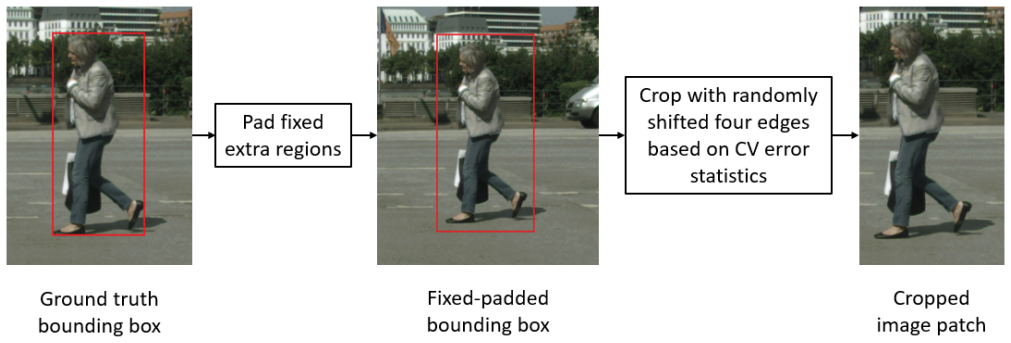
The engine of the method is a synthetic training procedure that turns ground-truth boxes into realistic loose patches. For each fully visible object, DeepBbox expands the true box, perturbs each edge independently with a Gaussian whose variances are fitted to Faster-RCNN's observed error ratios ($\mathcal{N}(0, 0.0064)$ for vertical edges and $\mathcal{N}(0, 0.0196)$ for horizontal edges), crops the patch, scales it to 256x256 while preserving aspect ratio and padding with zeros, and feeds it to a convolutional feature extractor followed by three fully connected layers that regress the two opposite corners. Huber loss replaces pure L1 to keep optimization smooth. Because the perturbation distribution, not any particular detector, defines the task, the same trained model can be applied to different detectors and trackers.
What would settle it
Measure the actual edge-error distribution of several object detectors and trackers across driving datasets and compare it with the independent Gaussian assumption; if a common detector shows biased or strongly correlated edge errors, retrain DeepBbox on the true distribution and check whether the percentage of edges within 1% error still beats the raw pre-labels. If that improvement disappears, the synthetic-error premise is what carried the result.
Extended reading notes
Core claim
In the paper's account, the central discovery is that a comparatively simple regression network, trained on synthetically perturbed crops, can make loose bounding boxes tight enough that 50% more edges meet a 1% precision tolerance than the raw pre-labels do. On the Cityscapes pedestrian test set, the share of edges within 1% of the longest edge rises from 25.1% for Faster-RCNN pre-labels to 37.7% with DeepBbox using a MobileNet feature extractor, while mean absolute edge error relative to the longest edge falls from 4.25% to 3.34%; a VGG16 variant gives 35.5% and a similar error drop. The paper frames this as an annotation-cost result: more pre-labels would pass review untouched, and the network needs only about 7.6 thousand boxes to be fine-tuned to a new dataset such as BDD, where it still improves on raw Faster-RCNN pre-labels.
Load-bearing premise
The load-bearing premise is that synthetic training patches, made by expanding true boxes and shifting each edge by random amounts chosen to mimic Faster-RCNN's typical error sizes, resemble the real loose boxes DeepBbox will be asked to fix.
Editorial extensions
If this is right
- At the reported 1% tolerance, roughly half again as many bounding-box edges survive without human correction, so the per-box review workload drops for the same precision standard.
- Because about 7.6 thousand annotated boxes suffice to fine-tune the network to a new dataset, DeepBbox can be inserted early in an annotation pipeline rather than after the dataset is already labeled.
- The method's relative insensitivity to a 30% mismatch in the assumed error size suggests one model can serve multiple detectors or trackers whose error scales differ.
- Making key-frame and intermediate-frame pre-labels tighter before human review means fewer boxes need to be re-drawn, which translates directly into saved annotation time.
Reading between the lines
- If the per-edge Gaussian error model were replaced by a distribution that also captures correlations among edges, such as systematic detector bias shared by vertical edges, the same training procedure might handle detector families the current setup does not test; the paper does not investigate correlated errors.
- The 1%-edge metric is an edge-level statistic, so a direct claim about saved annotator hours would require an annotator study that converts edge-level pass rates into per-box review time; this paper does not include such a study.
- The same regression target could be redefined for rotated boxes or polygon outlines by changing the four-coordinate output to other corner or vertex coordinates, though the paper's experiments stop at axis-aligned boxes on pedestrians.
Signed reviews
Editorial analysis
A structured set of objections, weighed in public.
Referee Report
Summary. The paper proposes DeepBbox, a convolutional network that takes an image patch cropped around a pre-labeled bounding box and regresses the four edges of a tight bounding box for the main object. The network is trained on Cityscapes by expanding ground-truth boxes and perturbing their edges with Gaussian noise that is fitted to Faster-RCNN edge-error statistics, and it is evaluated on real Faster-RCNN pre-labels on Cityscapes test data, on a transfer setting on BDD, and on a few tracker examples from Caltech. The headline result is that the percentage of bounding-box edges falling within 1% of the longest edge rises from 25.1% to 37.7% after DeepBbox correction, which the paper interprets as a 50% increase in edges that need no human correction and hence a reduction in annotation time.
Significance. If the reported improvement is robust, the method is a useful component for semi-automatic annotation pipelines: it is evaluated on real detector pre-labels rather than only simulated ones, it compares three feature extractors, and it reports a low-data fine-tuning experiment (Fig. 5) that supports early adoption during annotation. The paper also honestly states known limitations, including occlusion, and discusses alternative correction methods. However, the central practical claim that the edge-level gain translates into a meaningful reduction in manual annotation effort is not directly established, which limits the significance until that link is quantified.
major comments (3)
- [Section IV-B, Table III] The headline improvement is per-edge, but human annotation correction is performed at the box level: a box with any out-of-tolerance edge still requires a human pass. If the four edges were independent, the all-edges-within-1% box rate would rise from roughly 0.25^4 = 0.4% to roughly 0.38^4 = 2.0%, leaving about 98% of boxes needing correction. The paper reports no box-level no-correction rate and no measured annotation time, so the abstract and conclusion statement that 50% more edges 'do not have to go through human correction' and that this reduces manual annotation time is not supported as stated. Please report the fraction of boxes whose four edges are all within tolerance before and after correction, and, if possible, annotator time for a small user study.
- [Section III-B, Section IV-B] Training patches are synthesized by expanding ground-truth boxes and shifting edges with Gaussian noise whose variances are fitted to Faster-RCNN on Cityscapes train, and the main test set is real Faster-RCNN pre-labels from the same distribution. This is a favorable setting. The mismatch experiments only scale the same fitted Gaussian by plus or minus 30%, which does not test systematic bias, correlated edge errors, class-dependent errors, or a different detector/tracker distribution. The claim that DeepBbox 'can be applied to various video annotation pipelines' is therefore only weakly supported. Please report the actual error statistics of the corrected pre-labels (e.g., per-edge bias and correlation), and evaluate on at least one distinct source of pre-labels or on a synthetic distribution with correlated or biased edge shifts.
- [Section IV-B, Tables II and III] All numeric results appear to come from a single training run, with no variance across initializations, no confidence intervals, and no significance tests. The differences among VGG16, MobileNet, and ResNet50 are within about two percentage points at the 1% tolerance, so the reported architecture ranking may not be robust. Please report means and standard deviations over at least three to five runs or use bootstrap resampling over test objects.
minor comments (5)
- [Abstract and Section IV-A] The abstract says 'within 1% error' but the precise definition is that the absolute error is within 1% of the true bounding box's longest edge; Section IV-A also says vertical and horizontal edge errors are normalized by width and height respectively. Please make the normalization used in Table III explicit and consistent.
- [Throughout] There are recurring typos, including 'pre-lables' instead of 'pre-labels' in several places and 'ground through bounding boxes' in Section IV-A. Please proofread the manuscript.
- [Section IV-A] The description of the BDD masks is confusing: the text says BDD contains fine-grained object segmentation masks but 'does not contain object instance segmentation.' Please clarify what the masks contain and how connected pedestrian pixels were converted to instance-level tight boxes without instance IDs.
- [Section III-B, Fig. 3] The fixed expansion ratio used to enlarge the ground-truth boxes is not given numerically. Please report the value used in the experiments.
- [Section IV-B, Fig. 5] In Fig. 5, it is unclear whether the x-axis is the fraction of images or the fraction of bounding boxes used for fine-tuning. Please clarify the axis and the training protocol.
Circularity Check
No significant circularity: DeepBbox's correction gain is an empirical result on held-out pre-labels, not a reduction to its training inputs.
full rationale
The paper's claimed derivation chain is: (1) collect Faster-RCNN bounding-box edge error statistics on Cityscapes train; (2) generate synthetic training patches by perturbing ground-truth boxes with a Gaussian fit to those statistics; (3) train DeepBbox to regress tight boxes from such patches; (4) evaluate the trained model on Cityscapes test and on BDD, reporting per-edge error tolerance improvements. None of these steps defines the output in terms of the input by construction. The Gaussian noise is an augmentation distribution, not the predicted quantity; the network must still learn to map image content to the true box. The main evaluation is compared against actual Faster-RCNN pre-labels, and the mismatch experiments in Table II (trained with 30% more or 30% less error) and the BDD transfer test provide external checks that the result is not merely a re-display of the fitted error statistics. The paper contains no load-bearing self-citations, no imported uniqueness theorem, and no renamed known result. The skeptic's concern about per-edge versus per-box metrics is an evaluation-granularity issue, not a circularity issue, and does not affect this score.
Assumptions & free parameters
free parameters (4)
- Gaussian vertical edge error variance =
0.0064
- Gaussian horizontal edge error variance =
0.0196
- Patch expansion ratio =
not specified
- Edge tolerance for precise labels =
1% of longest edge
assumptions (3)
- domain assumption Cityscapes fine-grained segmentation masks provide accurate ground truth bounding boxes.
- domain assumption Edge error of Faster-RCNN pre-labels is approximately Gaussian.
- domain assumption Pre-labels with IoU at least 0.5 against ground truth are representative of annotation pipeline inputs.
Cite this review
Pith. "Pith review of DeepBbox: Accelerating Precise Ground Truth Generation for Autonomous Driving Datasets." pith.science (2026). https://pith.science/paper/N6X3YISP
@misc{pith2026190905620,
  author       = {Pith},
  title        = {Pith review of: DeepBbox: Accelerating Precise Ground Truth Generation for Autonomous Driving Datasets},
  year         = {2026},
  howpublished = {\url{https://pith.science/paper/N6X3YISP}},
  note         = {Machine review of arXiv:1909.05620}
}
read the original abstract
Autonomous driving requires various computer vision algorithms, such as object detection and tracking.Precisely-labeled datasets (i.e., objects are fully contained in bounding boxes with only a few extra pixels) are preferred for training such algorithms, so that the algorithms can detect exact locations of the objects. However, it is very time-consuming and hence expensive to generate precise labels for image sequences at scale. In this paper, we propose DeepBbox, an algorithm that corrects loose object labels into right bounding boxes to reduce human annotation efforts. We use Cityscapes dataset to show annotation efficiency and accuracy improvement using DeepBbox. Experimental results show that, with DeepBbox,we can increase the number of object edges that are labeled automatically (within 1\% error) by 50% to reduce manual annotation time.
Figures


Figures from the paper (3 more)


Reference graph
Works this paper leans on
-
[1]
The cityscapes dataset for semantic urban scene understanding
Marius Cordts, Mohamed Omran, Sebastian Ramos, Timo Rehfeld, Markus Enzweiler, Rodrigo Benenson, Uwe Franke, Stefan Roth, and Bernt Schiele. The cityscapes dataset for semantic urban scene understanding. In Proceedings of the IEEE conference on computer vision and pattern recognition , pages 3213–3223, 2016
2016
-
[2]
A new per- formance measure and evaluation benchmark for road detection al- gorithms
Jannik Fritsch, Tobias Kuehnl, and Andreas Geiger. A new per- formance measure and evaluation benchmark for road detection al- gorithms. In International Conference on Intelligent Transportation Systems (ITSC) , 2013
work page 2013
-
[3]
Bdd100k: A diverse driving video database with scalable annotation tooling
Fisher Yu, Wenqi Xian, Yingying Chen, Fangchen Liu, Mike Liao, Vashisht Madhavan, and Trevor Darrell. Bdd100k: A diverse driving video database with scalable annotation tooling. arXiv preprint arXiv:1805.04687, 2018
arXiv 2018
-
[4]
Extreme clicking for efficient object annotation
Dim P Papadopoulos, Jasper RR Uijlings, Frank Keller, and Vittorio Ferrari. Extreme clicking for efficient object annotation. In Proceed- ings of the IEEE International Conference on Computer Vision , pages 4930–4939, 2017
work page 2017
-
[5]
M. Everingham, S. M. A. Eslami, L. Van Gool, C. K. I. Williams, J. Winn, and A. Zisserman. The pascal visual object classes challenge: A retrospective. International Journal of Computer Vision , 111(1):98– 136, January 2015
work page 2015
-
[6]
Training object class detectors with click supervision
Dim P Papadopoulos, Jasper RR Uijlings, Frank Keller, and Vittorio Ferrari. Training object class detectors with click supervision. In Proceedings of the IEEE Conference on Computer Vision and Pattern Recognition, pages 6374–6383, 2017
work page 2017
-
[7]
Spot on: Action localization from pointly-supervised proposals
Pascal Mettes, Jan C Van Gemert, and Cees GM Snoek. Spot on: Action localization from pointly-supervised proposals. In European conference on computer vision , pages 437–453. Springer, 2016
work page 2016
-
[8]
Whats the point: Semantic segmentation with point supervision
Amy Bearman, Olga Russakovsky, Vittorio Ferrari, and Li Fei-Fei. Whats the point: Semantic segmentation with point supervision. In European conference on computer vision , pages 549–565. Springer, 2016
work page 2016
Show all 14 references
-
[9]
Very deep convolu- tional networks for large-scale image recognition
Karen Simonyan and Andrew Zisserman. Very deep convolu- tional networks for large-scale image recognition. arXiv preprint arXiv:1409.1556, 2014
2014 arXiv
-
[10]
Deep residual learning for image recognition
Kaiming He, Xiangyu Zhang, Shaoqing Ren, and Jian Sun. Deep residual learning for image recognition. In Proceedings of the IEEE conference on computer vision and pattern recognition , pages 770– 778, 2016
2016
-
[11]
Mobilenets: Efficient convolutional neural networks for mobile vision applications
Andrew G Howard, Menglong Zhu, Bo Chen, Dmitry Kalenichenko, Weijun Wang, Tobias Weyand, Marco Andreetto, and Hartwig Adam. Mobilenets: Efficient convolutional neural networks for mobile vision applications. arXiv preprint arXiv:1704.04861 , 2017
2017 arXiv
-
[12]
Geodesic active contours
Vicent Caselles, Ron Kimmel, and Guillermo Sapiro. Geodesic active contours. International journal of computer vision , 22(1):61–79, 1997
1997
-
[13]
Fast r-cnn
Ross Girshick. Fast r-cnn. In Proceedings of the IEEE international conference on computer vision , pages 1440–1448, 2015
2015
-
[14]
Pedestrian detection: A benchmark
Piotr Doll ´ar, Christian Wojek, Bernt Schiele, and Pietro Perona. Pedestrian detection: A benchmark. 2009
2009
Reviewed August 14, 2026 · model on record in the stance chip above.
Discussion (0). Continue with ORCID to comment.