Terahertz imaging system with on-chip superconducting Josephson plasma emitters for nondestructive testing
Pith reviewed 2026-05-24 09:06 UTC · model grok-4.3
The pith
Reports experimental demonstration of THz imaging using superconducting Josephson plasma emitters for nondestructive testing of metallic and biological objects.
A machine-rendered reading of the paper's core claim, the machinery that carries it, and where it could break.
Core claim
The quality of the images, exhibiting high-contrast differentiation between metallic and non-metallic parts, making different features of objects visible, and targeting different powders, demonstrates the viability of this THz imaging system for nondestructive, contactless, quick, and accurate environmental monitoring, security, medicine, materials, and quantum science and technology applications.
Load-bearing premise
That the Josephson plasma emitters deliver adequate power, coherence, and tunability under the imaging conditions used, such that the observed image contrast is attributable to the source properties rather than to post-processing or favorable sample choices (abstract provides no quantitative power, noise, or resolution metrics).
Figures
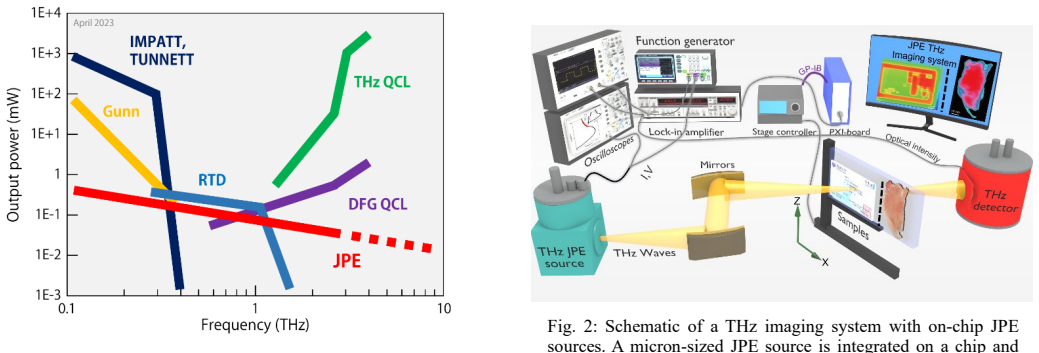


read the original abstract
Compared with adjacent microwaves and infrared frequencies, terahertz (THz) frequency offers numerous advantages for imaging applications. The unique THz spectral signatures of chemicals allow the development of THz imaging systems for nondestructive tests and the evaluation of biological objects, materials, components, circuits, and systems, which are especially useful in the security, medical, material, pharmaceutical, aeronautical, and electronics industries. However, technological advancements have been hindered owing to the lack of power-efficient and compact THz sources. Here, we use high-temperature superconducting monolithic sources known as Josephson plasma emitters (JPEs)-which are compact, chip-integrated coherent and monochromatic sources of broadly tunable THz waves-and report the art of non-destructive imaging of concealed metallic surgical blades, floppy disks, dandelion leaves, and slices of pork meat in the THz spectral range. The quality of the images, exhibiting high-contrast differentiation between metallic and non-metallic parts, making different features of objects visible, and targeting different powders, demonstrates the viability of this THz imaging system for nondestructive, contactless, quick, and accurate environmental monitoring, security, medicine, materials, and quantum science and technology applications.
Editorial analysis
A structured set of objections, weighed in public.
Referee Report
Summary. The manuscript reports the use of compact, chip-integrated high-temperature superconducting Josephson plasma emitters (JPEs) as coherent and tunable THz sources in a nondestructive imaging system. It presents qualitative THz images of concealed metallic blades, floppy disks, dandelion leaves, pork meat slices, and various powders, asserting high-contrast differentiation between metallic and non-metallic features that demonstrates viability for applications in security, medicine, materials, and quantum technologies.
Significance. If the JPE sources deliver sufficient coherent power and tunability under imaging conditions, the work would address a key technological bottleneck in THz imaging by providing a monolithic, compact alternative to existing sources. The experimental approach with real-world samples is a positive aspect, but the absence of quantitative benchmarks prevents evaluation of whether the claimed advantages over conventional THz systems are realized.
major comments (2)
- [Abstract and Results] Abstract and Results section: The central claim that the observed high-contrast images demonstrate viability for multiple applications rests on qualitative images alone; no measured output power, emission linewidth, tunability range under load, spatial resolution, dynamic range, or noise-equivalent power are reported, preventing attribution of contrast to JPE source properties rather than detector response, optics, or sample selection.
- [Methods] Methods/Experimental setup: No details are provided on JPE operating conditions during imaging (bias current, temperature stability, or emitted power under the actual optical geometry), nor on any calibration or baseline measurements against known THz sources or detectors.
minor comments (2)
- [Figures] Figure captions should specify imaging wavelength or frequency, scale bars, acquisition parameters, and any post-processing steps applied to the images.
- [Discussion] The manuscript would benefit from explicit comparison to prior THz imaging demonstrations using other sources (e.g., quantum cascade lasers or photoconductive antennas) to contextualize the JPE performance.
Simulated Author's Rebuttal
We thank the referee for the constructive comments on our manuscript. We address each major point below with clarifications on the scope of the work, which is a practical demonstration of imaging rather than a full source characterization study. Revisions are indicated where we can strengthen the presentation without new experiments.
read point-by-point responses
-
Referee: [Abstract and Results] Abstract and Results section: The central claim that the observed high-contrast images demonstrate viability for multiple applications rests on qualitative images alone; no measured output power, emission linewidth, tunability range under load, spatial resolution, dynamic range, or noise-equivalent power are reported, preventing attribution of contrast to JPE source properties rather than detector response, optics, or sample selection.
Authors: The manuscript is a demonstration that a compact JPE-based system can produce usable THz images of real-world objects with visible contrast between metallic and non-metallic features. This directly supports viability for the listed applications without requiring full quantitative benchmarking in the same paper. Prior publications on JPE devices have reported power, linewidth, and tunability; we have added citations to those works in the revised manuscript to allow readers to connect the imaging results to the source properties. The consistent appearance of expected features across chemically and structurally different samples (metal blades, leaves, meat, powders) indicates that contrast arises from sample THz transmission rather than detector or optics artifacts. We have clarified this attribution in the Results section. revision: partial
-
Referee: [Methods] Methods/Experimental setup: No details are provided on JPE operating conditions during imaging (bias current, temperature stability, or emitted power under the actual optical geometry), nor on any calibration or baseline measurements against known THz sources or detectors.
Authors: We have expanded the Methods section in the revised manuscript to specify the bias currents, temperature, and stability conditions used for each imaging run. Emitted power under the imaging geometry was not separately calibrated because the monolithic source was operated as part of the complete system; the fact that clear, high-contrast images were obtained with the chosen samples serves as functional validation. No baseline comparison to other THz sources was performed, as the goal was to show the integrated JPE approach rather than a metrology study. revision: yes
- Quantitative values for output power, linewidth, spatial resolution, dynamic range, or noise-equivalent power measured under the exact imaging optical geometry and load conditions are not available from the present experiments and cannot be added without additional dedicated measurements.
Circularity Check
No circularity: experimental imaging report with no derivations or fitted predictions
full rationale
The paper is an experimental report describing THz images obtained with Josephson plasma emitters. No derivation chain, equations, or predictions appear in the abstract or described full text. The central claim rests on qualitative image contrast observations rather than any mathematical reduction to inputs, fitted parameters renamed as predictions, or self-citation load-bearing steps. Self-citations (if present for prior JPE development) are not invoked to justify a uniqueness theorem or ansatz that forces the result. The work is self-contained against external benchmarks as an observation of image quality.
Axiom & Free-Parameter Ledger
axioms (1)
- domain assumption Josephson plasma emission in high-temperature superconductors produces coherent, tunable THz radiation when biased appropriately
Reference graph
Works this paper leans on
- [1]
-
[2]
J. F. Federici, B. Schulkin, F. Huang, D. Gary, R. Barat, F. Oliveira, and D. Zimdars, THz Imaging and Sensing for Security Applications — Explosives, Weapons and Drugs, Semicond Sci Technol 20, S266 (2005)
work page 2005
-
[3]
D. M. Mittleman, Twenty Years of Terahertz Imaging [Invited], Opt Express 26, 9417 (2018)
work page 2018
-
[4]
A. Redo -Sanchez, N. Laman, B. Schulkin, and T . Tongue, Review of Terahertz Technology Readiness Assessment and Applications , J Infrared Millim Terahertz Waves 34, 500 (2013)
work page 2013
-
[5]
X. C. Zhang, A. Shkurinov, and Y . Zhang, Extreme Terahertz Science, Nat Photonics 11, 16 (2017)
work page 2017
-
[6]
S. G. Pavlov, H.- W. H übers, H. Riemann, R. K. Zhukavin, E. E. Orlova, and V . N. Shastin, Terahertz Optically Pumped Si:Sb Laser , J Appl Phys 92, 5632 (2002)
work page 2002
-
[7]
Q. Wang, L. Xie, and Y . Ying, Overview of Imaging Methods Based on Terahertz Time -Domain Spectroscopy, Appl Spectrosc Rev 57, 249 (2022)
work page 2022
-
[8]
Ozyuzer et al., Emission of Coherent THz Radiation from Superconductors, Science 318, 1291 (2007)
L. Ozyuzer et al., Emission of Coherent THz Radiation from Superconductors, Science 318, 1291 (2007)
work page 2007
-
[9]
U. Welp, K. Kadowaki, and R. Kleiner, Superconducting Emitters of THz Radiation, Nat Photonics 7, 702 (2013)
work page 2013
-
[10]
I. Kakeya and H. Wang, Terahertz-Wave Emission from Bi2212 Intrinsic Josephson Junctions: A Review on Recent Progress, Supercond Sci Technol 29, 073001 (2016)
work page 2016
-
[11]
T. Kashiwagi et al., The Present Status of High -T c Superconducting Terahertz Emitters , Supe rcond Sci Technol 30, 074008 (2017)
work page 2017
-
[12]
K. Delfanazari, R. A. Klemm, H. J. Joyce, D. A. Ritchie, and K. Kadowaki, Integrated, Portable, Tunable, and Coherent Terahertz Sources and Sensitive Detectors Based on Layered Superconductors, Proceedings of the IEEE 108, 721 (2020)
work page 2020
-
[13]
R. Kleiner, F. Steinmeyer, G. Kunkel, and P. M ̈ uller, Intrinsic Josephson Effects in Bi 2Sr2CaCu2O8 Single Crystals, Phys Rev Lett 68, 2394 (1992)
work page 1992
-
[14]
M. Tsujimoto et al., Broadly Tunable Sub- Terahertz Emission from Internal Current-Voltage Characteristic Branches Generated from Bi2Sr2CaCu2O8+δ, Phys Rev Lett 108, 107006 (2012)
work page 2012
-
[15]
T. Kashiwagi et al., A High -Tc Intrinsic Josephson Junction Emitter Tunable from 0.5 to 2.4 Terahertz , Appl Phys Lett 107, 082601 (2015)
work page 2015
-
[16]
E. A. Borodianskyi and V . M. Krasnov, Josephson Emission with Frequency Span 1 –11 THz from Small Bi2Sr2CaCu2O8+δ Mesa Structures , Nat Commun 8 , 1742 (2017)
work page 2017
-
[17]
H. Sun et al., Compact High- Tc Superconducting Terahertz Emitter with Tunable Frequency from 0.15 to 1 THz, Applied Sciences 13, 3469 (2023)
work page 2023
-
[18]
M. Li et al., Linewidth Dependence of Coherent Terahertz Emission from Bi 2Sr2CaCu2O8 Intrinsic Josephson Junction Stacks in the Hot -Spot Regime , Phys Rev B Condens Matter Mater Phys 86, 060505 (2012)
work page 2012
-
[19]
L. Y . Hao et al., Compact Superconducting Terahertz Source Operating in Liquid Nitrogen, Phys Rev Appl 3, 024006 (2015)
work page 2015
-
[20]
K. J. Kihlstrom et al., Powerful Terahertz Emission from a Bi 2Sr2CaCu2O8+δ Mesa Operating Above 77 K , Phys Rev Appl 19, 034055 (2023)
work page 2023
- [21]
- [22]
-
[23]
R. Kleiner and H. Wang, Terahertz Emission from Bi2Sr2CaCu2O8+x Intrinsic Josephson Junction Stacks , J Appl Phys 126, 171101 (2019)
work page 2019
-
[24]
M. Tsujimoto, H. Minami, K. Delfanazari, M. Sawamura, R. Nakayama, T. Kitamura, T. Yamamoto, T. Kashiwagi, T. Hattori, and K. Kadowaki, Terahertz Imaging System Using High- Tc Superconducting Oscillation Devices, J Appl Phys 111, 123111 (2012)
work page 2012
-
[25]
T. Kash iwagi et al., Computed Tomography Image Using Sub-Terahertz Waves Generated from a High-Tc Superconducting Intrinsic Josephson Junction Oscillator, Appl Phys Lett 104, 082603 (2014)
work page 2014
-
[26]
T. Kashiwagi et al., Reflection Type of Terahertz Imaging System Usi ng a High- Tc Superconducting Oscillator, Appl Phys Lett 104, 022601 (2014)
work page 2014
- [27]
-
[28]
A. P. Zhuravel, A. V Ustinov, D. Abraimov, and S. M. Anlage, Imaging Local Sources of Intermodulation in Superconducting Microwave Devices , IEEE Transactions on Applied Superconductivity 13, 340 (2003)
work page 2003
-
[29]
A. P. Zhuravel, S. M. Anlage, and A. V Ustinov, Imaging of Microscopic Sources of Resistive and Reactive Nonlinearities in Superconducting Microwave Devices, IEEE Transactions on Applied Superconductivity 17, 902 (2007)
work page 2007
-
[30]
M. Tsujimoto, T. Kashiwagi, H. Minami, and K. Kadowaki, Broadly Tunable CW Terahertz Sources Using Intrinsic Josephson Junction Stacks in High‐ Temperature Superconductors, Terahertz Spectroscopy - A Cutting Edge Technology , Chapter 10, pp. 192 (2017), IntechOpen, London, UK
work page 2017
-
[31]
M. Tsujimoto, K. Yamaki, K. Deguchi, T. Yamamoto, T. Kashiwagi, H. Minami, M. Tachiki, K. Kadowaki, and R. A. Klemm, Geometrical Resonance Conditions for THz Radiation from the Intrinsic Jose phson Junctions in Bi 2Sr2CaCu2O8+δ, Phys Rev Lett 105, 037005 (2010)
work page 2010
-
[32]
K. Delfanazari et al., Tunable Terahertz Emission from the Intrinsic Josephson Junctions in Acute Isosceles Triangular Bi2Sr2CaCu2O8+δ Mesas, Opt Express 21, 2171 (2013)
work page 2013
-
[33]
K. Delfanazari et al., Study of Coherent and Continuous Terahertz Wave Emission in Equilateral Triangular Mesas of Superconducting Bi 2Sr2CaCu2O8+δ Intrinsic Josephson Junctions , Physica C Supercond 491, 16 (2013)
work page 2013
-
[34]
K. Delfanazari, H. Asai, M. Tsujimoto, T. Kashiwagi, T. Kitamura, T. Yamamoto, W. Wilson, R. A. Klemm, T. Hattori, and K. Kadowaki, Effect of Bias Electrode Position on Terahertz Radiation from Pentagonal Mesas of Superconducting Bi2Sr2CaCu2O8+δ, IEEE Transactions on Terahertz Science and Technology 5 , 505 (2015)
work page 2015
-
[35]
M. Tsujimoto, I. Kakeya, T. Kashiwagi, H. Minami, and K. Kadowaki, Cavity Mode Identification for Coherent Terahertz Emission from High- Tc Superconductors, Opt Express 24, 4591 (2016)
work page 2016
-
[36]
T. Kashiwagi et al., Improved Excitation Mode Selectivity of High -Tc superconducting Terahertz Emitters, J Appl Phys 124, 033901 (2018)
work page 2018
-
[37]
M. Tsujimoto et al., Design and Characterization of Microstrip Patch Antennas for High- T c Superconducting Terahertz Emitters , Opt Express 29, 16980 (2021)
work page 2021
-
[38]
G. Kuwano et al., Experimental Validation of a Microstrip Antenna Model for High- Tc Superconducting Terahertz Emitters, J Appl Phys 129, 223905 (2021)
work page 2021
-
[39]
N. V . Chernomyrdin, A. O. Schadko, S. P. Lebedev, V . L. Tolstoguzov, V . N. Kurlov, I. V . Reshetov, I. E. Spektor, M. Skorobogatiy, S. O. Yurchenko, and K. I. Zaytsev, Solid Immersion Terahertz Imaging with Sub- Wavelength Resolution , Appl Phys Lett 110 , 221109 (2017)
work page 2017
-
[40]
J. F. Federici, D. Gary, B. Schulkin, F. Huang, H. Altan, R. Barat, and D. Zimdars, Terahertz Imaging Using an Interferometric Array, Appl Phys Lett 83, 2477 (2003)
work page 2003
- [41]
- [42]
-
[43]
M. Gezimati and G. Singh, Terahertz Imaging and Sensing for Healthcare: Current Status and Future Perspectives, IEEE Access 11, 18590 (2023)
work page 2023
-
[44]
X. B. Huang, D. B. Hou, P. J. Huang, Y . H. Ma, X. Li, and G. X. Zhang, The Meat Freshness Detection Based on Terahertz Wave , in Selected Papers of the Photoelectronic Technology Committee Conferences , edited by S. Liu, S. Zhuang, M. I. Petelin, and L. Xiang, Vol. 9795 (SPIE, 2015), p. 97953D
work page 2015
-
[45]
T. Löffler, T. Bauer, K. J. Siebert, H. G. Roskos, A. Fitzgerald, and S. Czasch, Terahertz Dark -Field Imaging of Biomedical Tissue , Opt Express 9 , 616 (2001)
work page 2001
-
[46]
A. J. Fitzgerald, E. Berry, N. N. Zinovev, G. C. Walker, M. A. Smith, and J. M. Chamberlain, An Introduction to Medical Imaging with Coherent Terahertz Frequency Radiation, Phys Med Biol 47, R67 (2002)
work page 2002
discussion (0)
Sign in with ORCID, Apple, or X to comment. Anyone can read and Pith papers without signing in.