Relation between broadcast domination and multipacking numbers on chordal and other hyperbolic graphs
Pith reviewed 2026-05-24 05:14 UTC · model grok-4.3
The pith
Connected chordal graphs satisfy γ_b(G) ≤ ⌈(3/2) mp(G)⌉, with constructions showing the ratio can reach 10/9.
A machine-rendered reading of the paper's core claim, the machinery that carries it, and where it could break.
Core claim
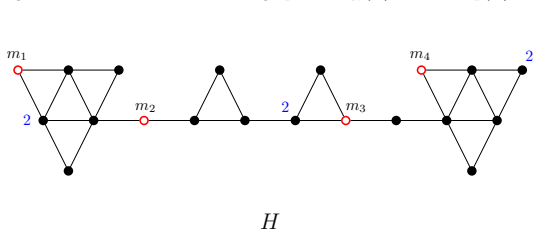
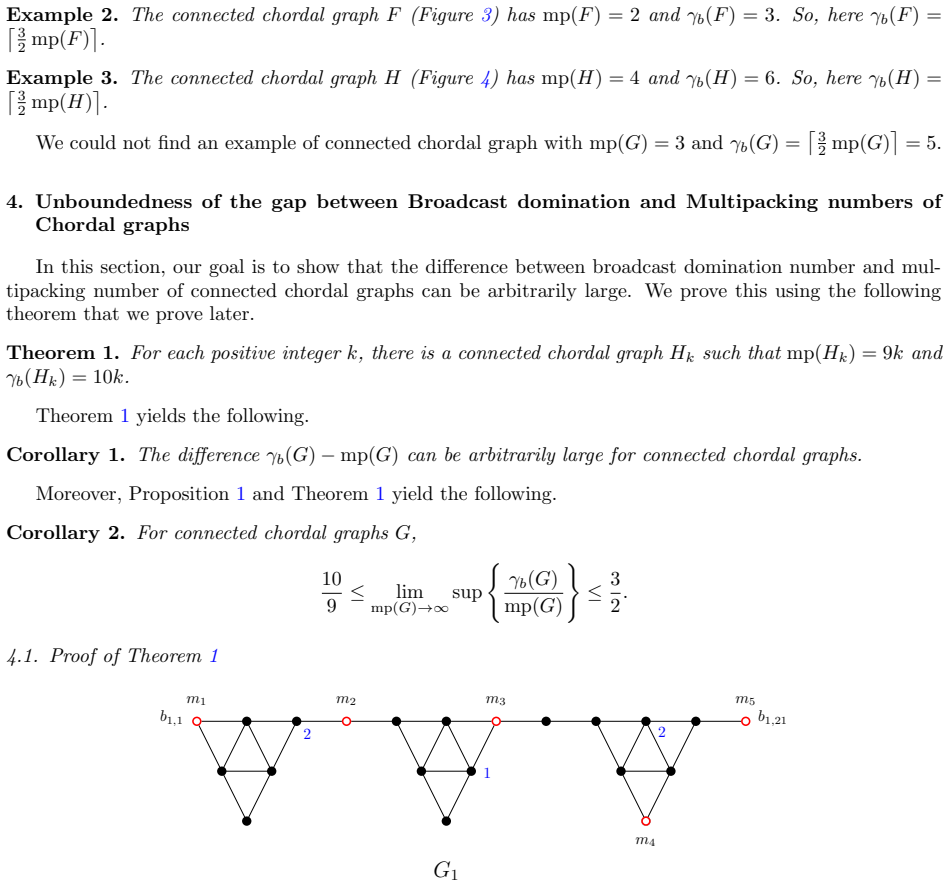
For any connected chordal graph G, γ_b(G) ≤ ⌈(3/2) mp(G)⌉. An infinite family of connected chordal graphs exists with γ_b(G)/mp(G) = 10/9 and mp(G) arbitrarily large, so that γ_b(G) − mp(G) is unbounded. For every δ-hyperbolic graph the inequality γ_b(G) ≤ ⌊(3/2) mp(G) + 2δ⌋ holds. In addition a polynomial-time algorithm produces a multipacking of size at least ⌈(2 mp(G) − 4δ)/3⌉ in any δ-hyperbolic graph.
What carries the argument
The direct comparison of the minimum dominating-broadcast cost γ_b(G) with the maximum multipacking cardinality mp(G), using chordal elimination orderings or negative-curvature bounds to control ball overlaps.
If this is right
- In chordal graphs one parameter can be used to bound the other without computing both.
- The ratio 10/9 is achievable and the absolute gap grows without limit even inside the chordal class.
- Hyperbolic graphs admit the same style of bound with a correction linear in the hyperbolicity constant δ.
- A guaranteed-size multipacking can be constructed in polynomial time for any δ-hyperbolic graph.
Where Pith is reading between the lines
- Similar ratio bounds may hold in other classes closed under certain elimination schemes, such as graphs of bounded treewidth.
- The algorithmic construction for multipackings could be adapted to produce approximate broadcast solutions in hyperbolic networks.
- Empirical checks on large random chordal graphs could reveal whether the 3/2 factor or the 10/9 ratio is typical in practice.
Load-bearing premise
The structural restrictions of chordal graphs and bounded-hyperbolicity graphs suffice to derive the stated multiplicative and additive relations between broadcast cost and multipacking size.
What would settle it
A single connected chordal graph G for which γ_b(G) > ⌈(3/2) mp(G)⌉ would refute the main chordal-graph inequality.
Figures




read the original abstract
For a graph $ G = (V, E) $ with a vertex set $ V $ and an edge set $ E $, a function $ f : V \rightarrow \{0, 1, 2, . . . , diam(G)\} $ is called a \emph{broadcast} on $ G $. For each vertex $ u \in V $, if there exists a vertex $ v $ in $ G $ (possibly, $ u = v $) such that $ f (v) > 0 $ and $ d(u, v) \leq f (v) $, then $ f $ is called a dominating broadcast on $ G $. The cost of the dominating broadcast $f$ is the quantity $ \sum_{v\in V}f(v) $. The minimum cost of a dominating broadcast is the broadcast domination number of $G$, denoted by $ \gamma_{b}(G) $. A multipacking is a set $ S \subseteq V $ in a graph $ G = (V, E) $ such that for every vertex $ v \in V $ and for every integer $ r \geq 1 $, the ball of radius $ r $ around $ v $ contains at most $ r $ vertices of $ S $, that is, there are at most $ r $ vertices in $ S $ at a distance at most $ r $ from $ v $ in $ G $. The multipacking number of $ G $ is the maximum cardinality of a multipacking of $ G $ and is denoted by $ mp(G) $. We show that, for any connected chordal graph $G$, $\gamma_{b}(G)\leq \big\lceil{\frac{3}{2} mp(G)\big\rceil}$. We also show that $\gamma_b(G)-mp(G)$ can be arbitrarily large for connected chordal graphs by constructing an infinite family of connected chordal graphs such that the ratio $\gamma_b(G)/mp(G)=10/9$, with $mp(G)$ arbitrarily large. Moreover, we show that $\gamma_{b}(G)\leq \big\lfloor{\frac{3}{2} mp(G)+2\delta\big\rfloor} $ holds for all $\delta$-hyperbolic graphs. In addition, we provide a polynomial-time algorithm to construct a multipacking of a $\delta$-hyperbolic graph $G$ of size at least $ \big\lceil{\frac{2mp(G)-4\delta}{3} \big\rceil} $.
Editorial analysis
A structured set of objections, weighed in public.
Referee Report
Summary. The paper establishes relations between the broadcast domination number γ_b(G) and the multipacking number mp(G). For connected chordal graphs, it proves γ_b(G) ≤ ⌈(3/2) mp(G)⌉. It constructs an infinite family of connected chordal graphs where γ_b(G)/mp(G) = 10/9 with mp(G) arbitrarily large. For δ-hyperbolic graphs, it proves γ_b(G) ≤ ⌊(3/2) mp(G) + 2δ⌋ and gives a polynomial-time algorithm to construct a multipacking of size at least ⌈(2mp(G) - 4δ)/3⌉.
Significance. If the results hold, they provide meaningful bounds relating domination and packing in graphs with special structure. The chordal graph result and the explicit construction showing a ratio of 10/9 are particularly useful for understanding the parameters. The extension to hyperbolic graphs and the algorithmic contribution add value. The paper ships explicit constructions and an algorithm, which are strengths.
major comments (2)
- Section 3, Theorem 3.1: the proof of γ_b(G) ≤ ⌈(3/2) mp(G)⌉ for chordal graphs relies on induction along a perfect elimination ordering, but the extension step from a multipacking in G-v to one in G does not explicitly verify that the r-ball condition is preserved for all r when adding back the simplicial vertex v.
- Section 4: the infinite family construction achieving ratio exactly 10/9 is load-bearing for the claim that γ_b - mp can be arbitrarily large; the general-member calculation of both mp(G) and γ_b(G) must be supplied in full to confirm the ratio is not smaller than 10/9.
minor comments (2)
- Abstract: the floor/ceiling expressions in the three displayed bounds use inconsistent spacing around the symbols; standardize the notation.
- The running-time analysis of the polynomial-time multipacking algorithm in the hyperbolic case should cite the specific data structures used for distance queries.
Simulated Author's Rebuttal
We thank the referee for the careful reading and constructive comments. We address the major comments point by point below and will revise the manuscript to incorporate the requested clarifications.
read point-by-point responses
-
Referee: Section 3, Theorem 3.1: the proof of γ_b(G) ≤ ⌈(3/2) mp(G)⌉ for chordal graphs relies on induction along a perfect elimination ordering, but the extension step from a multipacking in G-v to one in G does not explicitly verify that the r-ball condition is preserved for all r when adding back the simplicial vertex v.
Authors: We thank the referee for identifying this point. The chordal property and the fact that v is simplicial ensure that any ball intersecting the neighborhood of v behaves like a clique, so the r-ball counts cannot increase beyond the bound when v is added (either the multipacking set remains unchanged or v is not added if it would violate a local condition). However, we acknowledge that an explicit case analysis for arbitrary r was not written out. In the revision we will add a dedicated paragraph in the proof of Theorem 3.1 that verifies the r-ball condition for every r ≥ 1 after re-inserting v. revision: yes
-
Referee: Section 4: the infinite family construction achieving ratio exactly 10/9 is load-bearing for the claim that γ_b - mp can be arbitrarily large; the general-member calculation of both mp(G) and γ_b(G) must be supplied in full to confirm the ratio is not smaller than 10/9.
Authors: We agree that the general-member verification is necessary for completeness. The construction is defined by a recursive attachment of 9-vertex blocks to a path-like backbone; for the k-th member we have mp(G_k) = 9k and γ_b(G_k) = 10k. In the revised Section 4 we will include the full inductive argument establishing both equalities for arbitrary k, together with the explicit multipacking and broadcast functions that achieve these values. revision: yes
Circularity Check
No significant circularity identified
full rationale
The paper states direct inequalities γ_b(G) ≤ ⌈(3/2) mp(G)⌉ for chordal graphs and γ_b(G) ≤ ⌊(3/2) mp(G) + 2δ⌋ for δ-hyperbolic graphs, plus an explicit infinite family construction achieving ratio 10/9. These follow from standard structural properties (perfect elimination orderings for chordal graphs; thin-triangle property for hyperbolic graphs) that are externally known and not defined in terms of the target parameters. No fitted inputs are relabeled as predictions, no self-citations are load-bearing for the central claims, and no ansatz or renaming reduces the result to its inputs by construction. The derivation chain is self-contained against the graph-class definitions.
Axiom & Free-Parameter Ledger
axioms (2)
- domain assumption Graphs are finite, undirected, and connected.
- domain assumption Chordal graphs admit perfect elimination orderings and δ-hyperbolic graphs satisfy the δ-hyperbolicity inequality on distances.
Reference graph
Works this paper leans on
-
[1]
S. Das, F. Foucaud, S. S. Islam, J. Mukherjee, Relation between broadcast domination and multipack- ing numbers on chordal graphs, in: A. Bagchi, R. Muthu (Eds.), Algorithms and Discrete Applied Mathematics - 9th International Conference, CALDAM 2023, Gandhinagar, India, February 9-11, 2023, Proceedings, Vol. 13947 of Lecture Notes in Computer Science, Sp...
work page 2023
-
[2]
Cornu´ ejols, Combinatorial optimization: Packing and covering, SIAM, 2001
G. Cornu´ ejols, Combinatorial optimization: Packing and covering, SIAM, 2001
work page 2001
-
[3]
J. E. Dunbar, D. J. Erwin, T. W. Haynes, S. M. Hedetniemi, S. T. Hedetniemi, Broadcasts in graphs, Discrete Applied Mathematics 154 (1) (2006) 59–75
work page 2006
-
[4]
D. J. Erwin, Dominating broadcasts in graphs, Bull. Inst. Combin. Appl 42 (89) (2004) 105. 12
work page 2004
-
[5]
D. J. Erwin, Cost domination in graphs, Western Michigan University, 2001
work page 2001
-
[6]
L. E. Teshima, Broadcasts and multipackings in graphs, Master’s thesis, University of Victoria (2012)
work page 2012
-
[7]
L. Beaudou, R. C. Brewster, On the multipacking number of grid graphs, Discrete Mathematics & Theoretical Computer Science 21 (Graph Theory) (2019)
work page 2019
-
[8]
A. Meir, J. Moon, Relations between packing and covering numbers of a tree, Pacific Journal of Math- ematics 61 (1) (1975) 225–233
work page 1975
-
[9]
P. Heggernes, D. Lokshtanov, Optimal broadcast domination in polynomial time, Discrete Mathematics 306 (24) (2006) 3267–3280
work page 2006
-
[10]
R. C. Brewster, G. MacGillivray, F. Yang, Broadcast domination and multipacking in strongly chordal graphs, Discrete Applied Mathematics 261 (2019) 108–118
work page 2019
-
[11]
F. Foucaud, B. Gras, A. Perez, F. Sikora, On the complexity of broadcast domination and multipacking in digraphs, Algorithmica 83 (9) (2021) 2651–2677
work page 2021
-
[12]
R. C. Brewster, C. M. Mynhardt, L. E. Teshima, New bounds for the broadcast domination number of a graph, Central European Journal of Mathematics 11 (2013) 1334–1343
work page 2013
-
[13]
L. Beaudou, R. C. Brewster, F. Foucaud, Broadcast domination and multipacking: bounds and the integrality gap, The Australasian Journal of Combinatorics 74 (1) (2019) 86–97
work page 2019
-
[14]
B. L. Hartnell, C. M. Mynhardt, On the difference between broadcast and multipacking numbers of graphs, Utilitas Mathematica 94 (2014) 19–29
work page 2014
-
[15]
Gromov, Hyperbolic groups, in: Essays in group theory, Springer, 1987, pp
M. Gromov, Hyperbolic groups, in: Essays in group theory, Springer, 1987, pp. 75–263
work page 1987
-
[16]
G. Brinkmann, J. H. Koolen, V. Moulton, On the hyperbolicity of chordal graphs, Annals of Combina- torics 5 (1) (2001) 61–69
work page 2001
-
[17]
D. G. Corneil, B. Dalton, M. Habib, Ldfs-based certifying algorithm for the minimum path cover problem on cocomparability graphs, SIAM Journal on Computing 42 (3) (2013) 792–807
work page 2013
-
[18]
D. G. Corneil, S. Olariu, L. Stewart, Asteroidal triple-free graphs, SIAM Journal on Discrete Mathe- matics 10 (3) (1997) 399–430
work page 1997
-
[19]
M. C. Golumbic, Algorithmic graph theory and perfect graphs, Elsevier, 2004
work page 2004
- [20]
-
[21]
J. M. Keil, J. S. Mitchell, D. Pradhan, M. Vatshelle, An algorithm for the maximum weight independent set problem on outerstring graphs, Computational Geometry 60 (2017) 19–25
work page 2017
-
[22]
Y. Shavitt, T. Tankel, On the curvature of the internet and its usage for overlay construction and distance estimation, in: IEEE INFOCOM 2004, Vol. 1, IEEE, 2004, p. 384
work page 2004
-
[23]
J. A. Walter, H. Ritter, On interactive visualization of high-dimensional data using the hyperbolic plane, in: Proceedings of the eighth ACM SIGKDD international conference on Knowledge discovery and data mining, 2002, pp. 123–132
work page 2002
-
[24]
R. Brewster, L. Duchesne, Broadcast domination and fractional multipackings, manuscript (2013)
work page 2013
-
[25]
Y. Wu, C. Zhang, Hyperbolicity and chordality of a graph, The Electronic Journal of Combinatorics 18 (1) (2011) P43. 13
work page 2011
-
[26]
Y. Dourisboure, C. Gavoille, Tree-decompositions with bags of small diameter, Discrete Mathematics 307 (16) (2007) 2008–2029
work page 2007
- [27]
-
[28]
L. E. Teshima, Multipackings in graphs, arXiv preprint arXiv:1409.8057 (2014). 14
work page internal anchor Pith review Pith/arXiv arXiv 2014
discussion (0)
Sign in with ORCID, Apple, or X to comment. Anyone can read and Pith papers without signing in.