A Jet from a Nearly Dormant Black Hole
Pith reviewed 2026-06-27 08:58 UTC · model grok-4.3
The pith
Observations detect a two-sided jet from the supermassive black hole in M60 despite an Eddington ratio of 10^{-8}.
A machine-rendered reading of the paper's core claim, the machinery that carries it, and where it could break.
Core claim
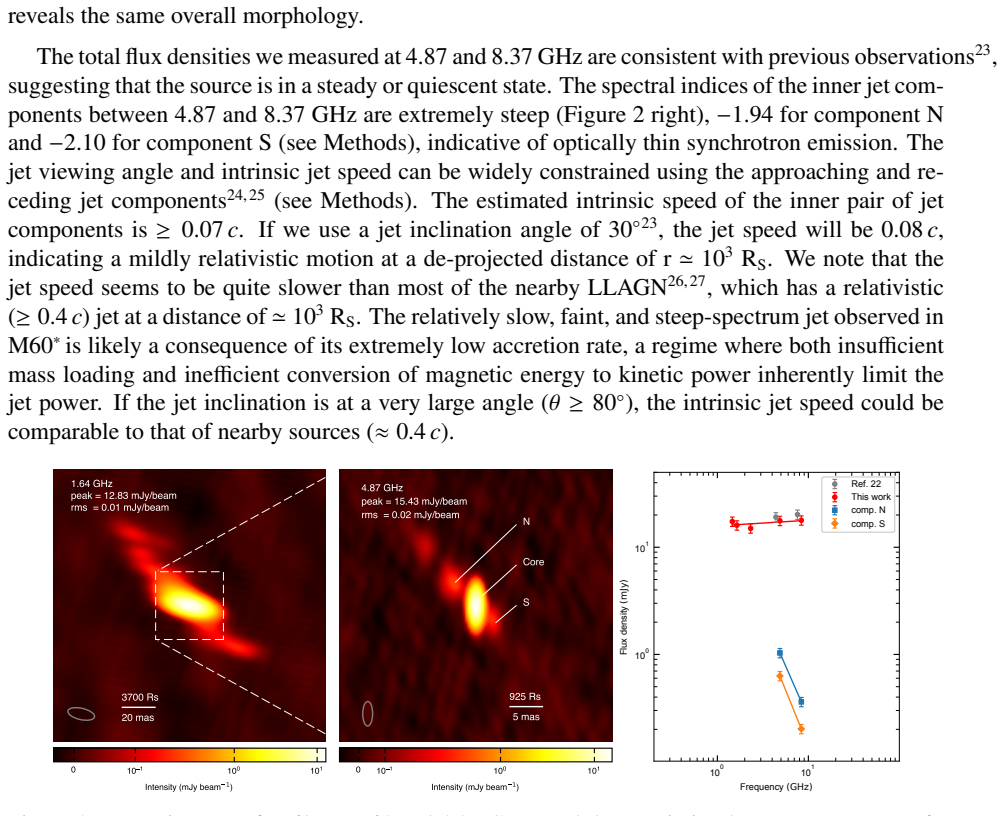
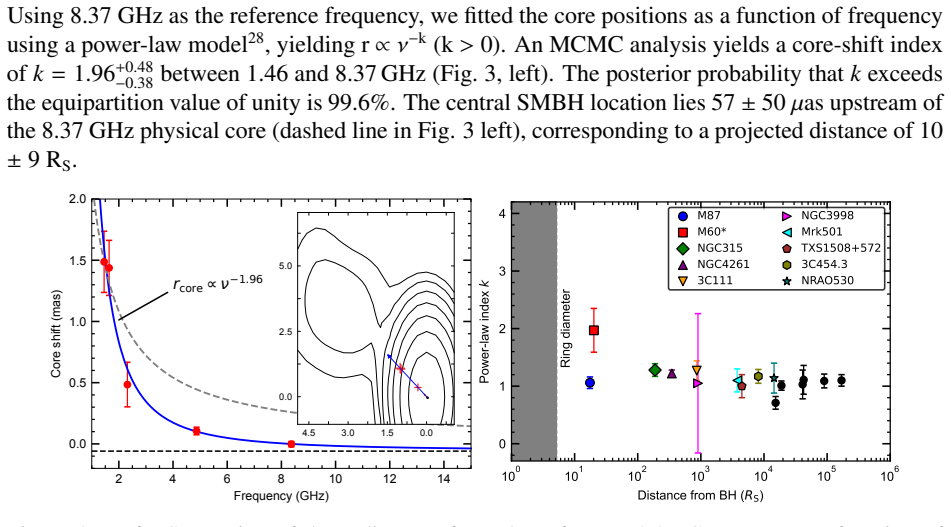
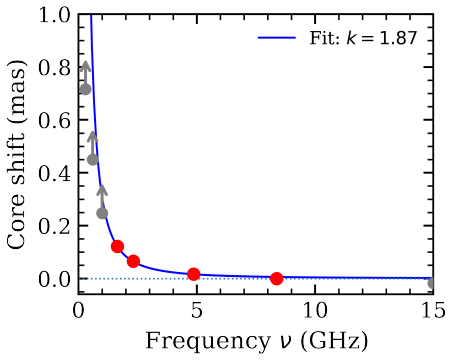
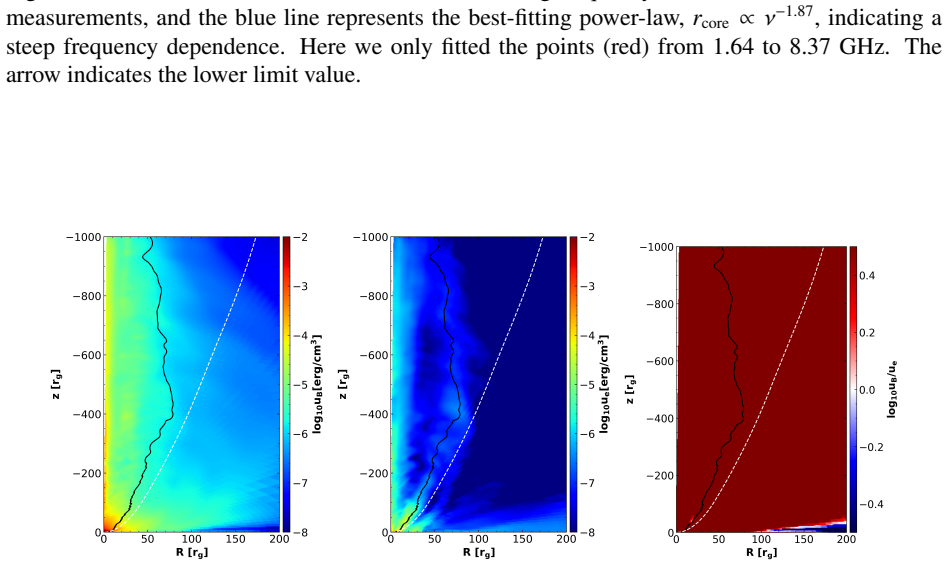
Multi-frequency very long baseline interferometric observations detect a compact two-sided jet with an unusually steep synchrotron spectrum in NGC 4649. The apparent radio core exhibits an unprecedentedly steep frequency-dependent position shift toward the SMBH, locating the central engine only about 57 microarcseconds (projected distance of about 10 Schwarzschild radii) upstream of the 8.37 GHz core. General relativistic magnetohydrodynamic and radiative-transfer simulations reproduce the observed jet morphology and core-shift behaviour, indicating a magnetically dominated, non-equipartition jet-launching region.
What carries the argument
The steep frequency-dependent core shift together with GRMHD simulations that require magnetic dominance to match the data.
If this is right
- Collimated outflows can be sustained at accretion rates as low as 10^{-8} of the Eddington limit.
- The jet-launching region lies within roughly 10 Schwarzschild radii of the event horizon.
- Standard conical equipartition models fail; magnetic dominance is required to explain the observations.
- M60 becomes a laboratory for studying jet formation on event-horizon scales in the lowest-accretion regime.
Where Pith is reading between the lines
- Similar faint jets may exist around Sgr A* and the M31 nucleus but remain undetected with current resolution.
- Jet persistence at such low accretion rates could alter estimates of black-hole feedback in quiescent galaxies.
- The required magnetic dominance supplies a lower bound on the field strength needed for collimation near dormant black holes.
Load-bearing premise
The detected compact radio structure and its frequency-dependent position shift are produced by a jet launched by the central black hole rather than by unrelated emission or instrumental effects.
What would settle it
Multi-frequency imaging that shows the same radio component at all frequencies with no measurable position shift or with a flat spectrum instead of the reported steep spectrum.
Figures



read the original abstract
Most galaxies host supermassive black holes (SMBHs) that remain weakly accreting or dormant for much of their lifetimes. At the lowest accretion rates, these systems may represent the transition between active nuclei and dormant black holes, but whether they can still launch collimated jets remains unclear. The nuclei in our Galaxy (\sgra) and M31 are key examples of this regime, although no clear jet structure has yet been detected in either source. Here we report multi-frequency very long baseline interferometric observations of \Msixty\ (NGC~4649), a nearby elliptical galaxy hosting a nearly dormant SMBH with an Eddington ratio of $\sim10^{-8}$. We detect a compact two-sided jet with an unusually steep synchrotron spectrum, demonstrating that collimated outflows can persist even under nearly dormant accretion conditions. The apparent radio core exhibits an unprecedentedly steep frequency-dependent position shift toward the SMBH, locating the central engine only $\sim57\,\mu$as, corresponding to a projected distance of $\sim10$ Schwarzschild radii, upstream of the 8.37-GHz core. The observed jet morphology and steep core-shift behaviour are reproduced by general relativistic magnetohydrodynamic and radiative-transfer simulations, indicating a magnetically dominated, non-equipartition jet-launching region that departs from the standard conical equipartition picture. These results provide direct observational evidence that jet production can survive near the dormant SMBHs and establish \Msixty\ as a unique laboratory for probing jet formation on event-horizon scales in the lowest-accretion SMBH regime.
Editorial analysis
A structured set of objections, weighed in public.
Referee Report
Summary. The paper reports multi-frequency VLBI observations of NGC 4649 (M60) detecting a compact two-sided jet with steep synchrotron spectrum from its SMBH at ~10^{-8} Eddington ratio. It measures an unusually steep frequency-dependent core position shift of ~57 μas, locating the central engine ~10 Schwarzschild radii upstream of the 8.37 GHz core, and shows that GRMHD plus radiative-transfer simulations reproduce both the jet morphology and the core-shift behavior, indicating a magnetically dominated non-equipartition launch region.
Significance. If the jet identification and core-shift interpretation are robust, the result would provide direct evidence that collimated outflows can persist at extremely low accretion rates, extending our understanding of jet production near dormant SMBHs and establishing M60 as a laboratory for horizon-scale studies. The multi-frequency VLBI dataset combined with simulation comparison is a methodological strength.
major comments (3)
- [§4] §4 (Core position measurements): The reported ~57 μas frequency-dependent shift and its attribution to synchrotron self-absorption in a non-equipartition flow requires an explicit quantitative error budget addressing refractive interstellar effects and residual phase-calibration systematics at the micro-arcsecond level; without such a test (e.g., closure-phase consistency across bands), the placement of the engine at ~10 Rs remains vulnerable to alternative explanations.
- [§5] §5 (Simulation comparison): The claim that GRMHD+RT runs reproduce the observed morphology and steep core-shift without post-hoc parameter adjustment is central to the non-equipartition interpretation, yet the manuscript does not appear to present the explored parameter space or a quantitative goodness-of-fit metric demonstrating that the match is not forced by tuning of magnetic field or electron distribution parameters.
- [§3] §3 (Jet detection): The two-sided compact structure is interpreted as an SMBH-launched jet rather than unrelated emission or calibration artifacts, but the paper lacks reported multi-epoch proper-motion limits or additional tests that would independently exclude refractive or instrumental origins at the claimed precision.
minor comments (2)
- [Abstract] The abstract states the spectrum is 'unusually steep'; adding a direct numerical comparison to core-shift indices in other LLAGN would clarify the 'unprecedented' claim.
- [Figures] Figure captions for the VLBI images should include the exact restoring beam sizes and contour levels used at each frequency to allow independent assessment of the two-sided structure.
Simulated Author's Rebuttal
We thank the referee for their thorough review and valuable comments on our manuscript. We address each of the major comments below and indicate where revisions will be made to the manuscript.
read point-by-point responses
-
Referee: [§4] §4 (Core position measurements): The reported ~57 μas frequency-dependent shift and its attribution to synchrotron self-absorption in a non-equipartition flow requires an explicit quantitative error budget addressing refractive interstellar effects and residual phase-calibration systematics at the micro-arcsecond level; without such a test (e.g., closure-phase consistency across bands), the placement of the engine at ~10 Rs remains vulnerable to alternative explanations.
Authors: We concur that an explicit quantitative error budget is necessary to robustly support the core-shift measurement. In the revised manuscript, we will expand §4 to include a detailed error analysis quantifying the potential contributions from refractive interstellar scintillation and residual phase-calibration errors at the μas level. Additionally, we will report closure-phase consistency tests performed across the observed frequency bands to confirm that the measured shift is intrinsic rather than due to systematics. revision: yes
-
Referee: [§5] §5 (Simulation comparison): The claim that GRMHD+RT runs reproduce the observed morphology and steep core-shift without post-hoc parameter adjustment is central to the non-equipartition interpretation, yet the manuscript does not appear to present the explored parameter space or a quantitative goodness-of-fit metric demonstrating that the match is not forced by tuning of magnetic field or electron distribution parameters.
Authors: The simulations presented were conducted using GRMHD models with magnetic field strengths and electron distributions appropriate for the low accretion rate regime of M60, without post-hoc tuning to match the specific core-shift value. To provide greater transparency, the revised manuscript will include a description of the parameter ranges explored in the GRMHD and radiative transfer calculations, along with a quantitative goodness-of-fit assessment (e.g., via structural similarity or chi-squared metrics) between the simulated and observed images and core positions. revision: yes
-
Referee: [§3] §3 (Jet detection): The two-sided compact structure is interpreted as an SMBH-launched jet rather than unrelated emission or calibration artifacts, but the paper lacks reported multi-epoch proper-motion limits or additional tests that would independently exclude refractive or instrumental origins at the claimed precision.
Authors: The jet identification relies on the detection of a symmetric two-sided structure with a steep synchrotron spectrum that is consistent across multiple frequencies, features that are difficult to attribute to calibration artifacts or refractive interstellar effects, which typically do not produce such frequency-dependent but morphologically consistent emission. We note that our dataset consists of single-epoch observations, so multi-epoch proper-motion measurements are not available. revision: partial
- Absence of multi-epoch VLBI observations, which precludes reporting proper-motion limits to further rule out alternative explanations for the detected structure.
Circularity Check
No significant circularity; result is direct observational detection
full rationale
The paper reports multi-frequency VLBI detections of a two-sided compact structure and frequency-dependent core shift in M60, with the central claim resting on these empirical measurements rather than any derivation that reduces to fitted parameters or self-citations by construction. GRMHD+RT simulations are invoked only for post-observation interpretation and morphological matching, without the observed jet or shift being defined in terms of the simulation outputs. No self-definitional, fitted-input-as-prediction, or load-bearing self-citation steps appear in the abstract or described chain; the work is self-contained against external VLBI data.
Axiom & Free-Parameter Ledger
Reference graph
Works this paper leans on
-
[1]
Previous core-shift measurements in nearby AGNs have typically yielded power-law indices kclose to unity 7, 21, 29, consistent with this expectation 20. Notable exceptions include NGC 315, which exhibits a modest deviation from equipartition withk=1.28±0.11 30, and 3C 454.3, where temporal variations inkfrom∼0.6 to∼2.2 have been reported 31. However, in t...
2024
-
[2]
Ho, L. C. Nuclear activity in nearby galaxies.ARA&A46, 475–539 (2008).0803.2268
Pith/arXiv arXiv 2008
-
[3]
Yu, Q. & Tremaine, S. Observational constraints on growth of massive black holes.MNRAS 335, 965–976 (2002).astro-ph/0203082
Pith/arXiv arXiv 2002
-
[4]
Yuan, F. & Narayan, R. Hot Accretion Flows Around Black Holes.ARA&A52, 529–588 (2014).1401.0586
Pith/arXiv arXiv 2014
-
[5]
Inayoshi, K., Ichikawa, K. & Ho, L. C. Universal Transition Diagram from Dormant to Actively Accreting Supermassive Black Holes.ApJ894, 141 (2020).2001.11032
arXiv 2020
-
[6]
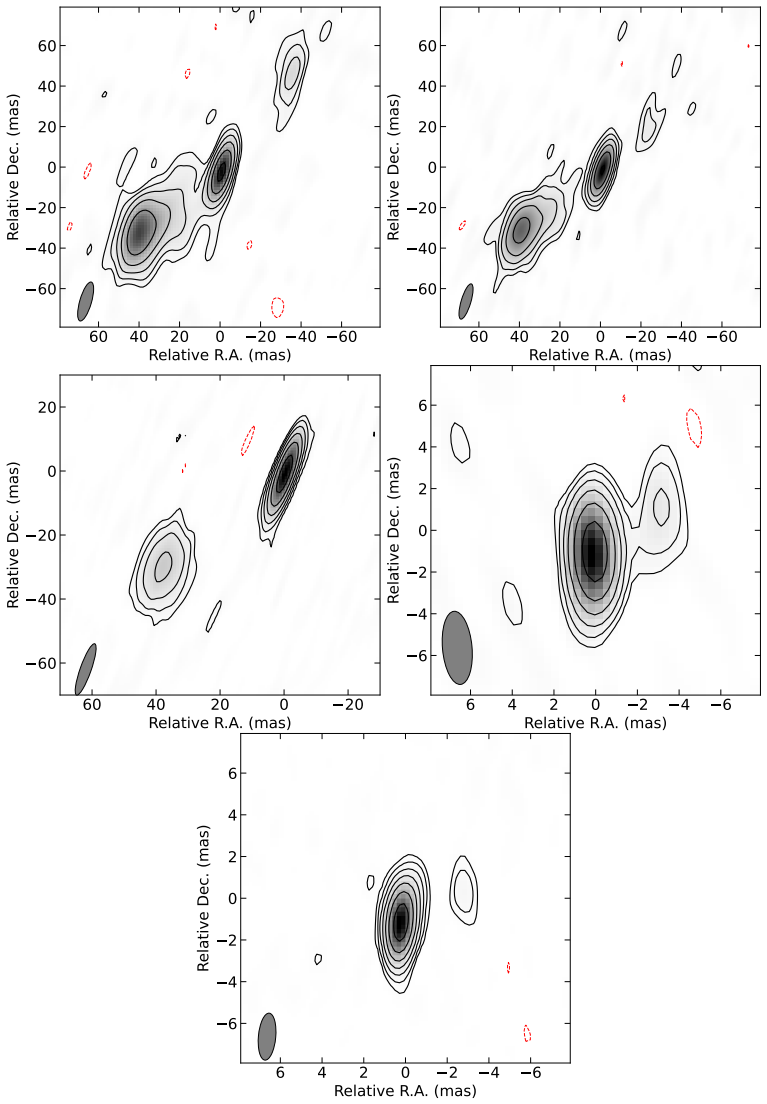
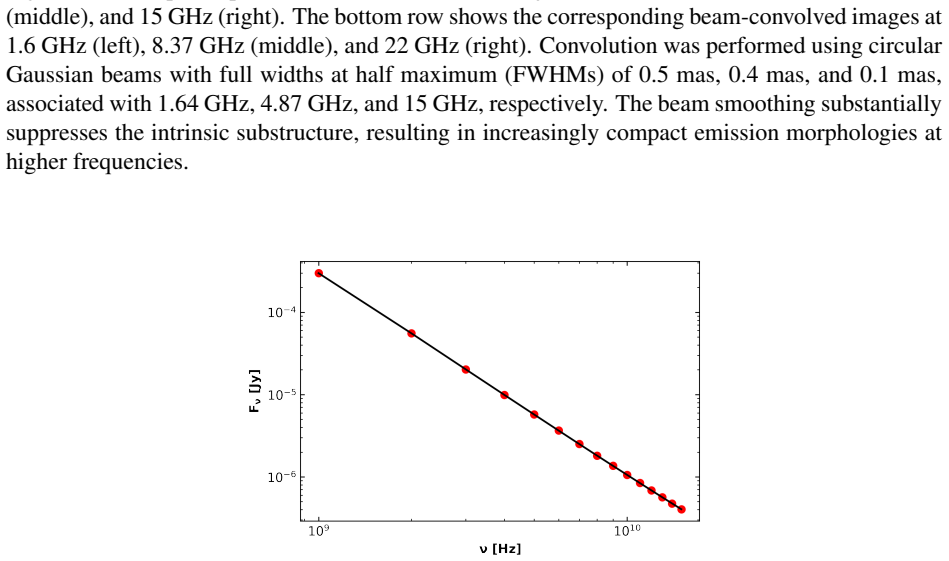
Boccardi, B., Krichbaum, T. P., Ros, E. & Zensus, J. A. Radio observations of active galactic nuclei with mm-VLBI.A&A Rev.25, 4 (2017).1711.07548. 19 Figure 6: The top row presents the intrinsic simulated jet emission at 1.64 GHz (left), 4.87 GHz (middle), and 15 GHz (right). The bottom row shows the corresponding beam-convolved images at 1.6 GHz (left), ...
Pith/arXiv arXiv 2017
-
[7]
Gu, Q. S., Huang, J. S., Wilson, G. & Fazio, G. G. Direct Evidence from Spitzer for a Low- Luminosity AGN at the Center of the Elliptical Galaxy NGC 315.ApJ671, L105–L108 (2007).0711.0051
Pith/arXiv arXiv 2007
-
[8]
Nature477, 185–187 (2011)
Hada, K.et al.An origin of the radio jet in M87 at the location of the central black hole. Nature477, 185–187 (2011)
2011
-
[9]
Plambeck, R. L.et al.Probing the Parsec-scale Accretion Flow of 3C 84 with Millimeter Wavelength Polarimetry.ApJ797, 66 (2014).1410.5887
Pith/arXiv arXiv 2014
-
[10]
Blandford, R. D. & Znajek, R. L. Electromagnetic extraction of energy from Kerr black holes.MNRAS179, 433–456 (1977)
1977
- [12]
-
[14]
Inayoshi, K., Ostriker, J. P., Haiman, Z. & Kuiper, R. Low-density, radiatively inefficient rotating-accretion flow on to a black hole.MNRAS476, 1412–1426 (2018).1709.07452
Pith/arXiv arXiv 2018
-
[15]
Event Horizon Telescope Collaborationet al.First Sagittarius A* Event Horizon Telescope Results. V . Testing Astrophysical Models of the Galactic Center Black Hole.ApJ930, L16 (2022)
2022
-
[16]
Ben Zineb, Y ., Ozel, F. & Psaltis, D. Advancing Black Hole Imaging with Space-Based Interferometry.arXiv e-printsarXiv:2412.01904 (2024).2412.01904
arXiv 2024
-
[17]
Lee, M. G. & Jang, I. S. Resolving the Discrepancy of Distance to M60, a Giant Elliptical Galaxy in Virgo.ApJ841, 23 (2017).1705.02389
Pith/arXiv arXiv 2017
-
[18]
A., Pushkarev, A
Koryukova, T. A., Pushkarev, A. B., Plavin, A. V . & Kovalev, Y . Y . Tracing Milky Way scattering by compact extragalactic radio sources.MNRAS515, 1736–1750 (2022).2201. 04359
2022
-
[20]
A., Ratner, M
Bartel, N., Herring, T. A., Ratner, M. I., Shapiro, I. I. & Corey, B. E. VLBI limits on the proper motion of the ‘core’ of the superluminal quasar 3C345.Nature319, 733–738 (1986)
1986
-
[21]
Lobanov, A. P. Ultracompact jets in active galactic nuclei.A&A330, 79–89 (1998). astro-ph/9712132. 22
Pith/arXiv arXiv 1998
-
[22]
O’Sullivan, S. P. & Gabuzda, D. C. Magnetic field strength and spectral distribution of six parsec-scale active galactic nuclei jets.MNRAS400, 26–42 (2009).0907.5211
Pith/arXiv arXiv 2009
-
[23]
Fraga-Encinas, R., Mo ´scibrodzka, M. & Falcke, H. The core-shift of Sagittarius A* as a discriminant between disk and jet emission models with millimeter very long baseline inter- ferometry.A&A706, A151 (2026).2312.12951
arXiv 2026
-
[24]
Li, X.et al.A Centiparsec-scale Compact Radio Core in the Nearby Galaxy M60.ApJ960, 1 (2024).2311.06126
arXiv 2024
-
[25]
Boettcher, M., Harris, D. E. & Krawczynski, H.Relativistic Jets from Active Galactic Nuclei (John Wiley & Sons, Ltd, 2012)
2012
-
[26]
Cheng, X.et al.Toward Microarcsecond Astrometry for the Innermost Wobbling Jet of the BL Lacertae Object OJ 287.ApJ955, L30 (2023).2309.03635
arXiv 2023
-
[27]
Park, J.et al.Kinematics of the M87 Jet in the Collimation Zone: Gradual Acceleration and Velocity Stratification.ApJ887, 147 (2019).1911.02279
arXiv 2019
-
[28]
Park, J.et al.Jet Collimation and Acceleration in the Giant Radio Galaxy NGC 315.ApJ 909, 76 (2021).2012.14154
arXiv 2021
-
[29]
Relativistic jets as X-ray and gamma-ray sources.ApJ243, 700–709 (1981)
Konigl, A. Relativistic jets as X-ray and gamma-ray sources.ApJ243, 700–709 (1981)
1981
-
[30]
Sokolovsky, K. V ., Kovalev, Y . Y ., Pushkarev, A. B. & Lobanov, A. P. A VLBA survey of the core shift effect in AGN jets. I. Evidence of dominating synchrotron opacity.A&A532, A38 (2011).1103.6032
Pith/arXiv arXiv 2011
-
[31]
Ricci, L.et al.Spectral and magnetic properties of the jet base in NGC 315.A&A693, A172 (2025).2411.19126
arXiv 2025
-
[32]
Chamani, W.et al.Time variability of the core-shift effect in the blazar 3C 454.3.A&A672, A130 (2023).2209.13301
arXiv 2023
-
[33]
Bower, G. C.et al.The Proper Motion of the Galactic Center Pulsar Relative to Sagittarius A*.ApJ798, 120 (2015).1411.0399
Pith/arXiv arXiv 2015
-
[34]
Event Horizon Telescope Collaborationet al.First M87 Event Horizon Telescope Results. VIII. Magnetic Field Structure near The Event Horizon.ApJ910, L13 (2021).2105.01173
arXiv 2021
-
[35]
Ro, H.et al.Spectral analysis of a parsec-scale jet in M 87: Observational constraint on the magnetic field strengths in the jet.A&A673, A159 (2023).2303.01014
arXiv 2023
-
[36]
C.et al.ALMA Observations of the Terahertz Spectrum of Sagittarius A*.ApJ 881, L2 (2019).1907.08319
Bower, G. C.et al.ALMA Observations of the Terahertz Spectrum of Sagittarius A*.ApJ 881, L2 (2019).1907.08319
arXiv 2019
-
[37]
Event Horizon Telescope Collaborationet al.First Sagittarius A* Event Horizon Telescope Results. VIII. Physical Interpretation of the Polarized Ring.ApJ964, L26 (2024). 23
2024
-
[38]
Chavez, E.et al.Prospects of Detecting a Jet in Sagittarius A* with Very-long-baseline Interferometry.ApJ974, 116 (2024).2405.06029
arXiv 2024
-
[39]
Deller, A. T., Tingay, S. J., Bailes, M. & West, C. DiFX: A Software Correlator for Very Long Baseline Interferometry Using Multiprocessor Computing Environments.PASP119, 318–336 (2007).astro-ph/0702141
Pith/arXiv arXiv 2007
-
[40]
Deller, A. T.et al.DiFX-2: A More Flexible, Efficient, Robust, and Powerful Software Correlator.PASP123, 275 (2011).1101.0885
arXiv 2011
-
[41]
Greisen, E. W. AIPS, the VLA, and the VLBA. In Heck, A. (ed.)Information Handling in Astronomy - Historical Vistas, vol. 285 ofAstrophysics and Space Science Library, 109 (2003)
2003
-
[42]
Keimpema, A.et al.The SFXC software correlator for very long baseline interferometry: algorithms and implementation.Experimental Astronomy39, 259–279 (2015).1502.00467
Pith/arXiv arXiv 2015
-
[43]
Salafia, O. S.et al.Multiwavelength View of the Close-by GRB 190829A Sheds Light on Gamma-Ray Burst Physics.ApJ931, L19 (2022).2106.07169
arXiv 2022
-
[44]
Cheng, X., An, T., Sohn, B. W., Hong, X. & Wang, A. Parsec-scale properties of eight Fanaroff-Riley type 0 radio galaxies.MNRAS506, 1609–1622 (2021).2105.05396
arXiv 2021
-
[45]
Shen, J. & Gebhardt, K. The Supermassive Black Hole and Dark Matter Halo of NGC 4649 (M60).ApJ711, 484–494 (2010).0910.4168
Pith/arXiv arXiv 2010
-
[46]
Woo, J.-H.et al.Do Quiescent and Active Galaxies Have Different M BH-σ∗ Relations?ApJ 772, 49 (2013).1305.2946
Pith/arXiv arXiv 2013
-
[47]
Paggi, A.et al.Active Galactic Nucleus Feedback in the Hot Halo of NGC 4649.ApJ787, 134 (2014)
2014
-
[48]
Paggi, A.et al.Constraining the Physical State of the Hot Gas Halos in NGC 4649 and NGC 5846.ApJ844, 5 (2017).1706.02303
Pith/arXiv arXiv 2017
-
[49]
Duras, F.et al.Universal bolometric corrections for active galactic nuclei over seven lumi- nosity decades.A&A636, A73 (2020).2001.09984
arXiv 2020
-
[50]
White, C. J., Stone, J. M. & Gammie, C. F. An Extension of the Athena++Code Frame- work for GRMHD Based on Advanced Riemann Solvers and Staggered-mesh Constrained Transport.ApJS225, 22 (2016).1511.00943
Pith/arXiv arXiv 2016
-
[51]
Stone, J. M., Tomida, K., White, C. J. & Felker, K. G. The Athena++Adaptive Mesh Refinement Framework: Design and Magnetohydrodynamic Solvers.ApJS249, 4 (2020). 2005.06651
arXiv 2020
-
[52]
Fishbone, L. G. & Moncrief, V . Relativistic fluid disks in orbit around Kerr black holes.ApJ 207, 962–976 (1976). 24
1976
-
[53]
Penna, R. F., Kulkarni, A. & Narayan, R. A new equilibrium torus solution and GRMHD initial conditions.AAP559, A116 (2013).1309.3680
Pith/arXiv arXiv 2013
-
[54]
Narayan, R., Igumenshchev, I. V . & Abramowicz, M. A. Magnetically Arrested Disk: an Energetically Efficient Accretion Flow.PASJ55, L69–L72 (2003).astro-ph/0305029
Pith/arXiv arXiv 2003
-
[55]
Tchekhovskoy, A., Narayan, R. & McKinney, J. C. Efficient generation of jets from mag- netically arrested accretion on a rapidly spinning black hole.MNRAS418, L79–L83 (2011). 1108.0412
Pith/arXiv arXiv 2011
-
[56]
Yang, H.et al.Modeling the inner part of the jet in M87: Confronting jet morphology with theory.Science Advances10, eadn3544 (2024).2403.15950
arXiv 2024
-
[57]
Mo ´scibrodzka, M., Falcke, H. & Shiokawa, H. General relativistic magnetohydrodynamical simulations of the jet in M 87.A&A586, A38 (2016).1510.07243
Pith/arXiv arXiv 2016
-
[58]
& Gammie, C
Petersen, E. & Gammie, C. Non-thermal models for infrared flares from Sgr A*.MNRAS 494, 5923–5935 (2020)
2020
-
[59]
Blandford, R. D. & K ¨onigl, A. Relativistic jets as compact radio sources.ApJ232, 34–48 (1979)
1979
-
[60]
Ball, D., ¨Ozel, F., Psaltis, D., Chan, C.-K. & Sironi, L. The Properties of Reconnection Current Sheets in GRMHD Simulations of Radiatively Inefficient Accretion Flows.ApJ853, 184 (2018).1705.06293
Pith/arXiv arXiv 2018
-
[61]
Mo ´scibrodzka, M. & Gammie, C. F. IPOLE - semi-analytic scheme for relativistic polarized radiative transport.MNRAS475, 43–54 (2018).1712.03057
Pith/arXiv arXiv 2018
-
[62]
Yuan, F., Quataert, E. & Narayan, R. Nonthermal Electrons in Radiatively Inefficient Accre- tion Flow Models of Sagittarius A*.ApJ598, 301–312 (2003).astro-ph/0304125
Pith/arXiv arXiv 2003
-
[63]
GRA VITY Collaborationet al.A geometric distance measurement to the Galactic center black hole with 0.3% uncertainty.A&A625, L10 (2019).1904.05721
arXiv 2019
-
[64]
Ghez, A. M.et al.Measuring Distance and Properties of the Milky Way’s Central Supermas- sive Black Hole with Stellar Orbits.ApJ689, 1044–1062 (2008).0808.2870
Pith/arXiv arXiv 2008
-
[65]
Event Horizon Telescope Collaborationet al.First Sagittarius A* Event Horizon Telescope Results. VI. Testing the Black Hole Metric.ApJ930, L17 (2022)
2022
-
[66]
Lo, K. Y ., Shen, Z.-Q., Zhao, J.-H. & Ho, P. T. P. Intrinsic Size of Sagittarius A*: 72 Schwarzschild Radii.ApJ508, L61–L64 (1998).astro-ph/9809222
Pith/arXiv arXiv 1998
-
[67]
Event Horizon Telescope Collaborationet al.First M87 Event Horizon Telescope Results. I. The Shadow of the Supermassive Black Hole.ApJ875, L1 (2019).1906.11238. 25
Pith/arXiv arXiv 2019
-
[68]
Gonz ´alez-Mart´ın, O., Masegosa, J., M´arquez, I., Guainazzi, M. & Jim´enez-Bail´on, E. An X- ray view of 82 LINERs with Chandra and XMM-Newton data.A&A506, 1107–1121 (2009). 0905.2973
Pith/arXiv arXiv 2009
-
[69]
B.et al.The VSOP 5 GHz Continuum Survey: The Prelaunch VLBA Obser- vations.ApJS131, 95–183 (2000)
Fomalont, E. B.et al.The VSOP 5 GHz Continuum Survey: The Prelaunch VLBA Obser- vations.ApJS131, 95–183 (2000)
2000
-
[70]
Veale, M.et al.The MASSIVE Survey - V . Spatially resolved stellar angular momentum, velocity dispersion, and higher moments of the 41 most massive local early-type galaxies. MNRAS464, 356–384 (2017).1609.00391
Pith/arXiv arXiv 2017
-
[71]
Nature532, 340–342 (2016).1604.01400
Thomas, J.et al.A 17-billion-solar-mass black hole in a group galaxy with a diffuse core. Nature532, 340–342 (2016).1604.01400
Pith/arXiv arXiv 2016
-
[72]
& Bender, R
Beuing, J., Dobereiner, S., Bohringer, H. & Bender, R. X-ray luminosities for a magnitude- limited sample of early-type galaxies from the ROSAT All-Sky Survey.MNRAS302, 209– 221 (1999)
1999
-
[73]
Brown, M. J. I., Jannuzi, B. T., Floyd, D. J. E. & Mould, J. R. The Ubiquitous Radio Continuum Emission from the Most Massive Early-type Galaxies.ApJ731, L41 (2011). 1103.2828
Pith/arXiv arXiv 2011
-
[74]
A., Trujillo, I., Leaman, R
Beasley, M. A., Trujillo, I., Leaman, R. & Montes, M. A single population of red globular clusters around the massive compact galaxy NGC 1277.Nature555, 483–486 (2018).1803. 04893
2018
-
[75]
van den Bosch, R. C. E.et al.An over-massive black hole in the compact lenticular galaxy NGC 1277.Nature491, 729–731 (2012).1211.6429
Pith/arXiv arXiv 2012
-
[76]
Scharw ¨achter, J., Combes, F., Salom´e, P., Sun, M. & Krips, M. The overmassive black hole in NGC 1277: new constraints from molecular gas kinematics.MNRAS457, 4272–4284 (2016).1507.02292
Pith/arXiv arXiv 2016
-
[77]
Park, S., Yang, J., Oonk, J. B. R. & Paragi, Z. Discovery of five low-luminosity active galactic nuclei at the centre of the Perseus cluster.MNRAS465, 3943–3948 (2017).1611.05986
Pith/arXiv arXiv 2017
-
[78]
McConnell, N. J.et al.Dynamical Measurements of Black Hole Masses in Four Brightest Cluster Galaxies at 100 Mpc.ApJ756, 179 (2012).1203.1620
Pith/arXiv arXiv 2012
-
[79]
S.et al.The X-ray coronae of the two brightest galaxies in the Coma cluster
Sanders, J. S.et al.The X-ray coronae of the two brightest galaxies in the Coma cluster. MNRAS439, 1182–1192 (2014).1401.3131
Pith/arXiv arXiv 2014
-
[80]
Breuval, L.et al.A 1.3% Distance to M33 from Hubble Space Telescope Cepheid Photom- etry.ApJ951, 118 (2023).2304.00037
arXiv 2023
-
[81]
Bender, R.et al.HST STIS Spectroscopy of the Triple Nucleus of M31: Two Nested Disks in Keplerian Rotation around a Supermassive Black Hole.ApJ631, 280–300 (2005). astro-ph/0509839. 26
Pith/arXiv arXiv 2005
-
[82]
Garcia, M. R.et al.X-ray and Radio Variability of M31*, The Andromeda Galaxy Nuclear Supermassive Black Hole.ApJ710, 755–763 (2010).0907.4977
Pith/arXiv arXiv 2010
-
[83]
Peng, S.et al.Searching for Radio Outflows from M31* with VLBI Observations.ApJ953, 12 (2023).2306.07189
arXiv 2023
discussion (0)
Sign in with ORCID, Apple, or X to comment. Anyone can read and Pith papers without signing in.