Compact dose delivery of laser-accelerated high-energy electron beams towards radiotherapy applications
Pith reviewed 2026-05-24 04:24 UTC · model grok-4.3
The pith
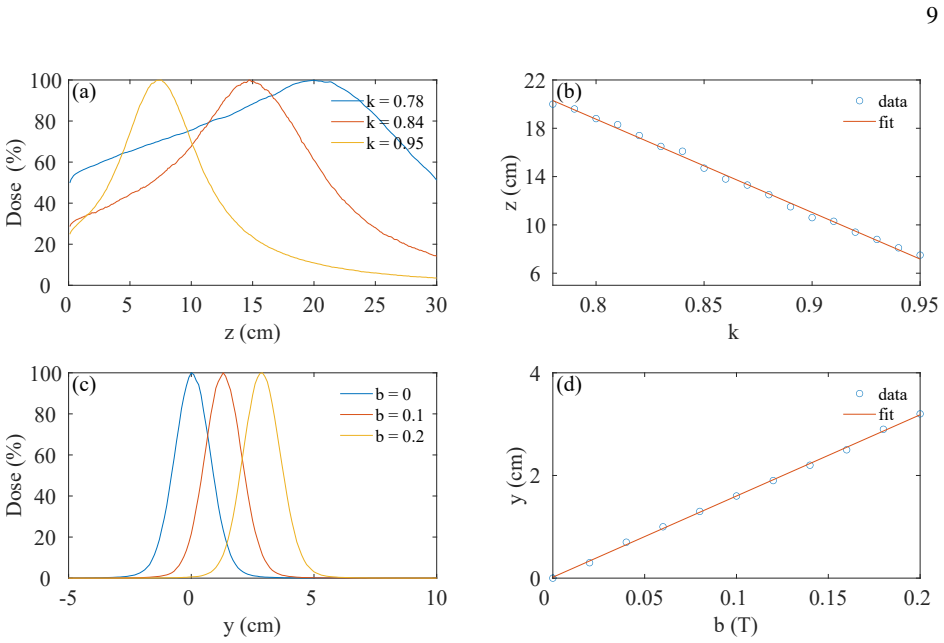
Two dipole magnets steer laser-accelerated electrons to create a dose maximum at depths up to 20 cm while reducing entrance dose.
A machine-rendered reading of the paper's core claim, the machinery that carries it, and where it could break.
Core claim
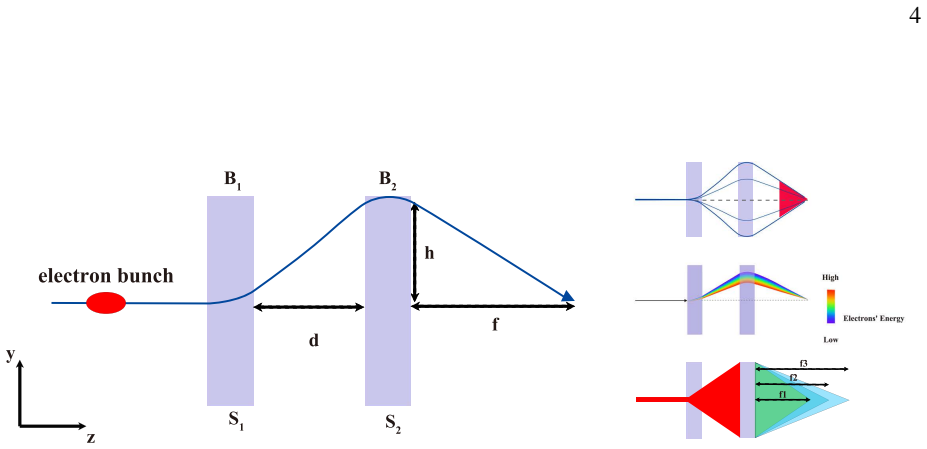
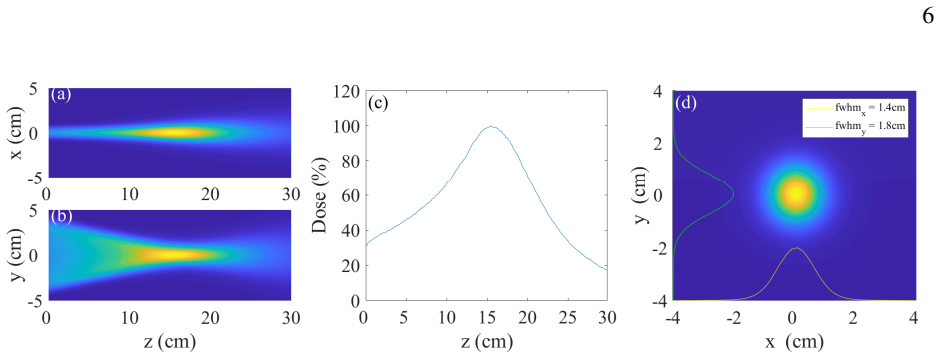
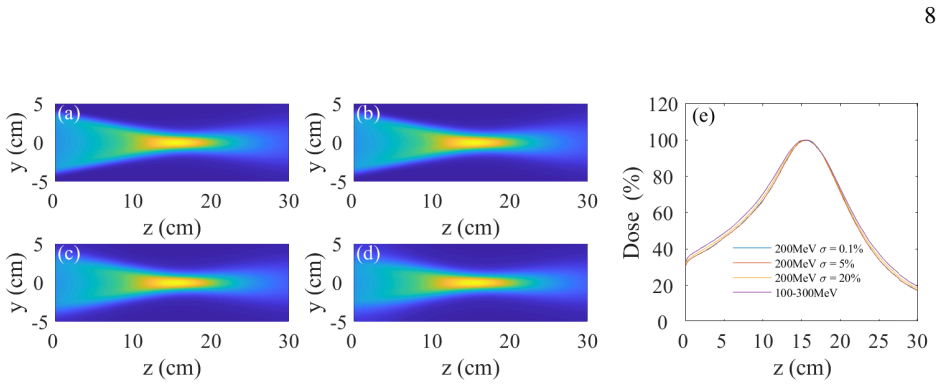
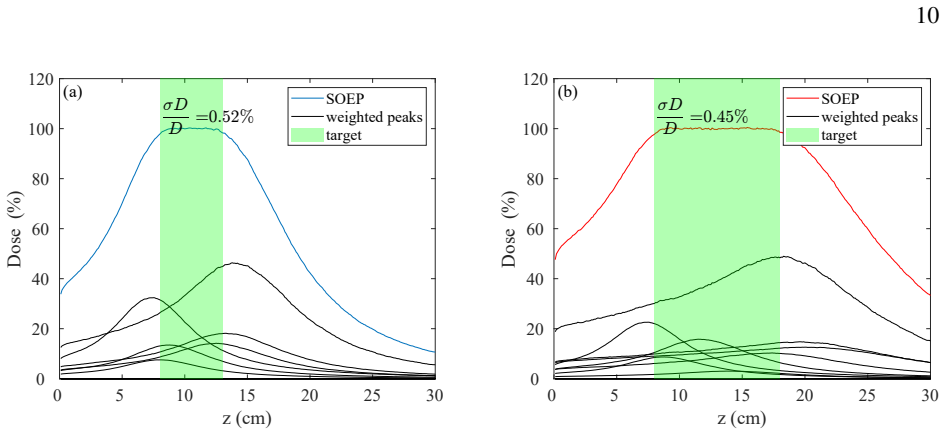
By adjusting the strengths of two dipole magnets, electron beams from a laser wakefield accelerator can be guided along different angular trajectories to intersect at a precise position as deep as 20 cm within a water phantom. This creates a maximum dose over the target region while significantly reducing the entrance dose. The scheme remains effective despite large beam energy spread and permits precise control of the dose-peak position in both lateral and longitudinal directions, so that a uniform peak can be formed by the weighted sum of beams reaching different depths.
What carries the argument
Two-dipole magnet transport line that bends electron trajectories to control the location of the dose peak.
If this is right
- Dose-peak position can be adjusted precisely in both lateral and longitudinal directions by changing magnet strengths.
- A uniform dose distribution over a target volume is obtained by summing deliveries at different depths.
- Entrance dose is reduced compared with direct delivery of the same beams.
- The approach does not require narrow energy selection and therefore works with the natural spread of laser-accelerated beams.
Where Pith is reading between the lines
- If the simulated performance holds in experiment, the overall radiotherapy system could be made substantially smaller and less expensive than radio-frequency accelerator versions.
- The same magnet-steering concept might be tested with other compact accelerator technologies that also produce broad-energy electron beams.
- Integration with existing laser systems could eventually support portable or in-room VHEE treatment units.
Load-bearing premise
Monte Carlo simulations accurately predict how real beams with large energy spread will travel through the magnets and deposit dose in tissue.
What would settle it
An experiment sending an actual laser-plasma electron beam through two adjustable dipole magnets into a water phantom and checking whether the measured dose peak occurs at the simulated depth with low surface dose.
Figures
read the original abstract
The use of very high energy electron (VHEE) beams for radiotherapy has been actively studied for over two decades due to their advantageous dose distribution, deep penetration depth and great potential of ultra-high dose-rate irradiation. Recently, laser-plasma wakefield accelerator (LWFA) has emerged as a promising method for the compact generation of VHEE beams, due to its substantially higher accelerating gradients compared to traditional radio-frequency accelerators. However, how to compactly deliver the LWFA-based VHEE beams of relatively large energy spread and create a maximum dose deeply inside the body remains very challenging. In this article, we present a simple dose delivery scheme utilizing only two dipole magnets for LWFA-based VHEE treatment. By adjusting the magnet strengths, the electron beams can be guided along different angular trajectories towards a precise position as deep as 20 cm within a water phantom, creating a maximum dose over the target region and significantly reducing the entrance dose. Supported by Monte Carlo simulations, such a beam delivery approach is demonstrated to be insensitive to the beam energy spread and meanwhile capable of controlling precisely the dose-peak position in both lateral and longitudinal directions. As such, a uniform dose peak can be generated by the weighted sum of VHEE beams that reach different dose-peak depths. These results demonstrate that LWFA-based VHEE beams can be compactly delivered into a deep-seated tumor region in a controllable manner, thus advancing the development of the VHEE radiotherapy towards the practical clinical applications in the near future.
Editorial analysis
A structured set of objections, weighed in public.
Referee Report
Summary. The manuscript proposes a compact beam-delivery scheme for laser-wakefield-accelerated very-high-energy electrons that uses only two dipole magnets. By varying the magnet strengths, the scheme steers beams along different trajectories to produce a dose maximum at depths up to 20 cm inside a water phantom while reducing entrance dose; Monte Carlo simulations are presented to demonstrate that the approach is insensitive to the beam’s large energy spread, permits precise lateral and longitudinal control of the dose peak, and can generate a uniform target dose by weighted superposition of beams with different peak depths.
Significance. If the Monte Carlo results prove robust, the two-magnet geometry would constitute a genuinely compact and controllable delivery method for LWFA-based VHEE radiotherapy, addressing the long-standing difficulty of transporting beams with large energy spread and divergence. The work therefore has clear potential relevance for the emerging field of laser-driven radiotherapy, provided the simulation fidelity can be established.
major comments (2)
- [simulation setup] Section describing simulation setup: the Monte Carlo model of the two-dipole transport is not specified in sufficient detail (beam emittance, energy spectrum shape, magnet fringe fields, scattering in the phantom) to allow independent assessment of whether the reported dose peaks at 20 cm depth and the claimed insensitivity to energy spread are robust against realistic LWFA beam properties.
- [results] Results section: the central claim that the dose-peak position can be controlled precisely in both lateral and longitudinal directions and that a uniform dose can be formed by weighted summation rests entirely on the unvalidated Monte Carlo outputs; no benchmark against measured data, analytic transport calculations, or alternative codes is provided, leaving the weakest assumption (accurate capture of chromatic and scattering effects for ~10–50 % energy-spread beams) untested.
Simulated Author's Rebuttal
We thank the referee for the constructive comments and the opportunity to clarify and strengthen our manuscript on the two-magnet delivery scheme for LWFA VHEE beams. We address each major comment below.
read point-by-point responses
-
Referee: [simulation setup] Section describing simulation setup: the Monte Carlo model of the two-dipole transport is not specified in sufficient detail (beam emittance, energy spectrum shape, magnet fringe fields, scattering in the phantom) to allow independent assessment of whether the reported dose peaks at 20 cm depth and the claimed insensitivity to energy spread are robust against realistic LWFA beam properties.
Authors: We agree that the simulation setup section requires more detail for reproducibility and independent assessment. In the revised manuscript we will expand this section to specify the beam emittance, the exact functional form and parameters of the energy spectrum (including the 10–50 % spread cases), the modeling approach for magnet fringe fields, and the physics processes and cut-offs used for scattering and energy deposition in the water phantom. revision: yes
-
Referee: [results] Results section: the central claim that the dose-peak position can be controlled precisely in both lateral and longitudinal directions and that a uniform dose can be formed by weighted summation rests entirely on the unvalidated Monte Carlo outputs; no benchmark against measured data, analytic transport calculations, or alternative codes is provided, leaving the weakest assumption (accurate capture of chromatic and scattering effects for ~10–50 % energy-spread beams) untested.
Authors: We acknowledge that the results rely on Monte Carlo simulations without new experimental benchmarks in this work. In revision we will add references to prior experimental and code-to-code validations of the Monte Carlo package for VHEE beams with comparable energy spreads, include a brief analytic ray-tracing comparison for the central trajectories to cross-check chromatic steering, and discuss the expected accuracy of scattering models at these energies. Full experimental validation lies outside the scope of the present simulation study. revision: partial
Circularity Check
No circularity: results are direct Monte Carlo outputs
full rationale
The paper's central claims rest on Monte Carlo simulations of a two-dipole transport system for LWFA VHEE beams. No equations, fitted parameters, or self-citations are invoked such that any reported dose peak or trajectory reduces to the inputs by construction. The simulation setup and outputs are presented as independent numerical experiments, with no renaming of known results, ansatz smuggling, or load-bearing self-citation chains. This is the normal case of a simulation study whose validity hinges on model fidelity rather than internal definitional equivalence.
Axiom & Free-Parameter Ledger
axioms (1)
- domain assumption Monte Carlo codes correctly model electron transport and energy deposition for VHEE beams in water under the two-magnet geometry.
Reference graph
Works this paper leans on
-
[1]
S. M. Bentzen, Radiation therapy: intensity modulated, image guided, biologically optimized and evidence based, Radiotherapy and Oncology 77, 227 (2005)
work page 2005
- [2]
-
[3]
Otto, V olumetric modulated arc therapy: Imrt in a single gantry arc, Medical physics 35, 310 (2008)
K. Otto, V olumetric modulated arc therapy: Imrt in a single gantry arc, Medical physics 35, 310 (2008)
work page 2008
-
[4]
M. Urie, M. Goitein, and M. Wagner, Compensating for heterogeneities in proton radiation therapy, Physics in Medicine & Biology 29, 553 (1984). 12
work page 1984
-
[5]
C. DesRosiers, V . Moskvin, A. F. Bielajew, and L. Papiez, 150-250 mev electron beams in radiation therapy, Physics in Medicine & Biology 45, 1781 (2000)
work page 2000
-
[6]
M. G. Ronga, M. Cavallone, A. Patriarca, A. M. Leite, P. Loap, V . Favaudon, G. Cr ´ehange, and L. De Marzi, Back to the future: very high-energy electrons (vhees) and their potential application in radiation therapy, Cancers 13, 4942 (2021)
work page 2021
-
[7]
C. Yeboah and G. Sandison, Optimized treatment planning for prostate cancer comparing impt, vheet and 15 mv imxt, Physics in Medicine & Biology 47, 2247 (2002)
work page 2002
- [8]
-
[9]
M. Bazalova-Carter, B. Qu, B. Palma, B. H ˚ardemark, E. Hynning, C. Jensen, P. G. Maxim, and B. W. Loo Jr, Treatment planning for radiotherapy with very high-energy electron beams and comparison of vhee and vmat plans, Medical physics 42, 2615 (2015)
work page 2015
-
[10]
E. Sch ¨uler, K. Eriksson, E. Hynning, S. L. Hancock, S. M. Hiniker, M. Bazalova-Carter, T. Wong, Q.- T. Le, B. W. Loo Jr, and P. G. Maxim, Very high-energy electron (vhee) beams in radiation therapy; treatment plan comparison between vhee, vmat, and ppbs, Medical physics 44, 2544 (2017)
work page 2017
- [11]
-
[12]
A. Lagzda, D. Angal-Kalinin, J. Jones, A. Aitkenhead, K. J. Kirkby, R. MacKay, M. Van Herk, W. Farabolini, S. Zeeshan, and R. M. Jones, Influence of heterogeneous media on very high en- ergy electron (vhee) dose penetration and a monte carlo-based comparison with existing radiotherapy modalities, Nuclear Instruments and Methods in Physics Research Section...
work page 2020
-
[13]
The chuv-cern collaboration to design and construct a high-energy electron flash therapy facility, CLIC Project Meeting #40 (2021)
work page 2021
-
[14]
T. Tajima and J. M. Dawson, Laser electron accelerator, Phys. Rev. Lett. 43, 267 (1979)
work page 1979
- [15]
- [16]
-
[17]
S. P. Mangles, C. Murphy, Z. Najmudin, A. G. R. Thomas, J. Collier, A. E. Dangor, E. Divall, P. Fos- ter, J. Gallacher, C. Hooker, et al., Monoenergetic beams of relativistic electrons from intense laser– plasma interactions, Nature 431, 535 (2004)
work page 2004
- [18]
-
[19]
R. Weingartner, S. Raith, A. Popp, S. Chou, J. Wenz, K. Khrennikov, M. Heigoldt, A. R. Maier, N. Kajumba, M. Fuchs, et al., Ultralow emittance electron beams from a laser-wakefield accelerator, Physical Review Special Topics-Accelerators and Beams 15, 111302 (2012)
work page 2012
-
[20]
Y . Wan, S. Tata, O. Seemann, E. Y . Levine, S. Smartsev, E. Kroupp, and V . Malka, Femtosecond electron microscopy of relativistic electron bunches, Light: Science & Applications 12, 116 (2023)
work page 2023
- [21]
-
[22]
A. R. Maier, N. M. Delbos, T. Eichner, L. H ¨ubner, S. Jalas, L. Jeppe, S. W. Jolly, M. Kirchen, V . Ler- oux, P. Messner, M. Schnepp, M. Trunk, P. A. Walker, C. Werle, and P. Winkler, Decoding sources of energy variability in a laser-plasma accelerator, Phys. Rev. X10, 031039 (2020)
work page 2020
- [23]
- [24]
- [25]
- [26]
-
[27]
K. Svendsen, D. Gu ´enot, J. B. Svensson, K. Petersson, A. Persson, and O. Lundh, A focused very high energy electron beam for fractionated stereotactic radiotherapy, Scientific Reports 11, 5844 (2021)
work page 2021
-
[28]
Z. Guo, S. Liu, B. Zhou, J. Liu, H. Wang, Y . Pi, X. Wang, Y . Mo, B. Guo, J. Hua, et al., Preclinical tumor control with a laser-accelerated high-energy electron radiotherapy prototype, Nature Commu- 14 nications 16, 1895 (2025)
work page 2025
-
[29]
L. Whitmore, R. I. Mackay, M. Van Herk, J. Jones, and R. Jones, Focused vhee (very high energy electron) beams and dose delivery for radiotherapy applications, Scientific Reports 11, 1 (2021)
work page 2021
-
[30]
L. Whitmore, R. I. Mackay, M. V . Herk, P. Korysko, W. Farabolini, A. Malyzhenkov, R. Corsini, and R. M. Jones, Cern-based experiments and monte-carlo studies on focused dose delivery with very high energy electron (vhee) beams for radiotherapy applications, Scientific Reports 14 (2024)
work page 2024
-
[31]
F. Reaz, K. N. Sjobak, E. Malinen, N. F. J. Edin, and E. Adli, Sharp dose profiles for high precision proton therapy using strongly focused proton beams, Scientific Reports 12, 18919 (2022)
work page 2022
-
[32]
K. Kokurewicz, E. Brunetti, A. Curcio, D. Gamba, L. Garolfi, A. Gilardi, E. Senes, K. N. Sjobak, W. Farabolini, R. Corsini, et al., An experimental study of focused very high energy electron beams for radiotherapy, Communications Physics 4, 33 (2021)
work page 2021
-
[33]
J. Perl, J. Shin, J. Sch ¨umann, B. Faddegon, and H. Paganetti, Topas: An innovative proton monte carlo platform for research and clinical applications, Medical Physics 39, 6818 (2012)
work page 2012
-
[34]
Y . Wan, O. Seemann, S. Tata, I. A. Andriyash, S. Smartsev, E. Kroupp, and V . Malka, Direct observa- tion of relativistic broken plasma waves, Nature Physics 18, 1186 (2022)
work page 2022
-
[35]
Y . Wan, S. Tata, O. Seemann, E. Y . Levine, E. Kroupp, and V . Malka, Real-time visualization of the laser-plasma wakefield dynamics, Science advances 10, eadj3595 (2024)
work page 2024
-
[36]
O. Seemann, Y . Wan, S. Tata, E. Kroupp, and V . Malka, Refractive plasma optics for relativistic laser beams, Nature Communications 14, 3296 (2023)
work page 2023
-
[37]
O. Seemann, Y . Wan, S. Tata, E. Kroupp, and V . Malka, Laser proton acceleration from a near-critical imploding gas target, Physical Review Letters 133, 025001 (2024)
work page 2024
- [38]
- [39]
discussion (0)
Sign in with ORCID, Apple, or X to comment. Anyone can read and Pith papers without signing in.