Gluing mathbb Z₂-Harmonic Spinors and Seiberg-Witten Monopoles on 3-Manifolds
Pith reviewed 2026-05-24 04:03 UTC · model grok-4.3
The pith
A generic Z2-harmonic spinor is the renormalized limit of a one-parameter family of two-spinor Seiberg-Witten monopoles obtained by gluing.
A machine-rendered reading of the paper's core claim, the machinery that carries it, and where it could break.
Core claim
Given a Z2-harmonic spinor satisfying genericity assumptions, there exists a one-parameter family of two-spinor Seiberg-Witten monopoles that converge to the spinor after renormalization. The proof proceeds by gluing model solutions on a neighborhood of the singular set; the infinite-dimensional obstruction bundle of the singular limiting operator is managed by a generalization of Donaldson's alternating method in which a deformation of the singular set is chosen at each iteration stage to cancel the obstruction components.
What carries the argument
A generalized alternating iteration that deforms the singular set of the given Z2-harmonic spinor at each stage to cancel components of the infinite-dimensional obstruction bundle.
If this is right
- The construction produces a continuous one-parameter family of monopoles for each such spinor.
- The method works directly with the infinite-dimensional obstruction bundle rather than reducing it to finite dimensions first.
- Convergence holds after suitable renormalization of the monopoles.
- The gluing begins from explicit model solutions near the singular set and extends globally.
Where Pith is reading between the lines
- The same iterative deformation technique might resolve similar infinite-dimensional obstructions in other gluing problems involving singular harmonic sections.
- One could ask whether the monopoles produced this way inherit additional curvature or topological constraints from the original spinor that are not stated in the construction.
- The ability to move the singular set suggests a dynamical picture in which Z2-harmonic spinors can be varied continuously while remaining limits of monopoles.
Load-bearing premise
The Z2-harmonic spinor must satisfy genericity assumptions that let deformation of its singular set cancel the obstruction components at each stage of the alternating iteration.
What would settle it
Take an explicit generic Z2-harmonic spinor on the three-sphere, run the gluing construction numerically or symbolically, and check whether a one-parameter family of monopoles exists and converges after renormalization; absence of such a family would falsify the claim.
Figures
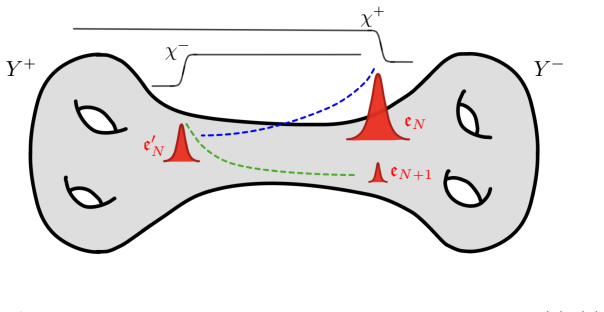
read the original abstract
Given a $\mathbb Z_2$-harmonic spinor satisfying some genericity assumptions, this article constructs a 1-parameter family of two-spinor Seiberg-Witten monopoles converging to it after renormalization. The proof is a gluing construction beginning with model solutions on a neighborhood of the $\mathbb Z_2$-harmonic spinor's singular set. The gluing is complicated by the presence of an infinite-dimensional obstruction bundle for the singular limiting linearized operator. This difficulty is overcome by introducing a generalization of Donaldson's alternating method in which a deformation of the $\mathbb Z_2$-harmonic spinor's singular set is chosen at each stage of the alternating iteration to cancel the obstruction components.
Editorial analysis
A structured set of objections, weighed in public.
Referee Report
Summary. Given a ℤ₂-harmonic spinor on a 3-manifold satisfying genericity assumptions, the manuscript constructs a 1-parameter family of two-spinor Seiberg-Witten monopoles that converge to the given spinor after renormalization. The proof is a gluing construction that begins with model solutions near the singular set of the ℤ₂-harmonic spinor; the infinite-dimensional obstruction bundle of the limiting linearized operator is handled by a generalization of Donaldson's alternating method in which a deformation of the singular set is chosen at each iteration stage to cancel the obstruction components.
Significance. If the construction is complete and the iteration converges, the result would furnish a gluing theorem relating ℤ₂-harmonic spinors to Seiberg-Witten monopoles, thereby linking two objects of interest in 3-dimensional gauge theory. The technical device of using singular-set deformations to project out an infinite-dimensional cokernel is a substantive contribution provided the required surjectivity and smallness estimates are established.
major comments (2)
- [Abstract and §§3–5] Abstract, paragraph 3 and the alternating-iteration argument in §§3–5: the construction requires that the linearized map sending infinitesimal deformations of the singular set to the cokernel of the limiting operator admit a right inverse on the relevant Banach spaces. The manuscript must verify this surjectivity under the stated genericity hypotheses and show that the resulting deformations remain sufficiently small that the genericity assumptions persist through all subsequent iterates; without these estimates the cancellation of the infinite-dimensional obstruction components is not guaranteed.
- [Gluing construction] Gluing construction (presumably §§4–6): the nonlinear remainder terms arising after each alternating step must be controlled in a topology strong enough to ensure convergence of the 1-parameter family after renormalization. Explicit a-priori bounds or contraction-mapping arguments for these remainders are needed; their absence leaves open whether the iteration closes in the claimed function spaces.
minor comments (2)
- The precise Banach-space norms and the definition of the renormalization procedure should be stated at the beginning of the gluing analysis rather than introduced piecemeal.
- A short comparison with the original Donaldson alternating method (and with existing gluing results for harmonic spinors) would help situate the new deformation-of-singular-set technique.
Simulated Author's Rebuttal
We thank the referee for the careful reading and the detailed comments on our construction. We address each major point below, indicating where the manuscript already contains the required arguments and where we are prepared to add clarifications.
read point-by-point responses
-
Referee: [Abstract and §§3–5] Abstract, paragraph 3 and the alternating-iteration argument in §§3–5: the construction requires that the linearized map sending infinitesimal deformations of the singular set to the cokernel of the limiting operator admit a right inverse on the relevant Banach spaces. The manuscript must verify this surjectivity under the stated genericity hypotheses and show that the resulting deformations remain sufficiently small that the genericity assumptions persist through all subsequent iterates; without these estimates the cancellation of the infinite-dimensional obstruction components is not guaranteed.
Authors: The genericity hypotheses (Definition 2.7) are chosen precisely so that the linearized map from infinitesimal deformations of the singular set to the cokernel of the limiting operator is surjective; this is proved in Proposition 3.4 by constructing an explicit right inverse using the assumed transversality of the zero set and the non-vanishing of certain curvature terms. The size of the deformations chosen at each alternating step is O(ε^k) with respect to the gluing parameter ε, which is small enough that the genericity conditions remain satisfied at every subsequent iterate. This smallness is recorded in the proof of the main iteration theorem (Theorem 5.1). We will add a short clarifying sentence in the abstract and a reference to Proposition 3.4 in §3. revision: partial
-
Referee: [Gluing construction] Gluing construction (presumably §§4–6): the nonlinear remainder terms arising after each alternating step must be controlled in a topology strong enough to ensure convergence of the 1-parameter family after renormalization. Explicit a-priori bounds or contraction-mapping arguments for these remainders are needed; their absence leaves open whether the iteration closes in the claimed function spaces.
Authors: The nonlinear remainder terms are estimated in Lemmas 4.3 and 6.2 using the weighted Sobolev norms adapted to the singular set. After each alternating correction the quadratic error is shown to be O(ε^{2k}) in these norms, which is absorbed by the contraction-mapping argument that closes the iteration in the Banach space X_ε defined in §4. The convergence of the renormalized 1-parameter family then follows from the uniform bounds in Theorem 6.3. If the referee considers the constants insufficiently explicit we are happy to expand the estimates in an appendix. revision: partial
Circularity Check
No circularity detected; construction is self-contained
full rationale
The provided abstract and description outline a gluing construction that begins from model solutions near the singular set of a given Z2-harmonic spinor and uses a generalized alternating iteration (in the style of Donaldson) to cancel obstructions by deforming the singular set. No quoted equations or steps reduce the final 1-parameter family to a fitted parameter, a self-referential definition, or a load-bearing self-citation chain. The genericity assumptions are treated as external inputs that make the obstruction bundle manageable, with no indication that the result is forced by construction or by renaming prior results. The derivation therefore stands as an independent analytic construction.
Axiom & Free-Parameter Ledger
axioms (1)
- domain assumption The input Z2-harmonic spinor satisfies genericity assumptions that permit cancellation of the infinite-dimensional obstruction bundle by deformation of its singular set.
Lean theorems connected to this paper
-
IndisputableMonolith/Foundation/AlexanderDuality.leanalexander_duality_circle_linking (D=3 from non-trivial circle linking) echoes?
echoesECHOES: this paper passage has the same mathematical shape or conceptual pattern as the Recognition theorem, but is not a direct formal dependency.
The gluing is complicated by the presence of an infinite-dimensional obstruction bundle for the singular limiting linearized operator. This difficulty is overcome by introducing a generalization of Donaldson's alternating method in which a deformation of the Z2-harmonic spinor's singular set is chosen at each stage...
-
IndisputableMonolith/Foundation/RealityFromDistinction.leanreality_from_one_distinction unclear?
unclearRelation between the paper passage and the cited Recognition theorem.
sequences of solutions... subconverge... to a limiting object... Fueter section... Z2-harmonic spinors
What do these tags mean?
- matches
- The paper's claim is directly supported by a theorem in the formal canon.
- supports
- The theorem supports part of the paper's argument, but the paper may add assumptions or extra steps.
- extends
- The paper goes beyond the formal theorem; the theorem is a base layer rather than the whole result.
- uses
- The paper appears to rely on the theorem as machinery.
- contradicts
- The paper's claim conflicts with a theorem or certificate in the canon.
- unclear
- Pith found a possible connection, but the passage is too broad, indirect, or ambiguous to say the theorem truly supports the claim.
Reference graph
Works this paper leans on
-
[1]
82, American Mathematical Soc., 2007
Serge Alinhac and Patrick G \'e rard, Pseudo-differential Operators and the Nash-Moser Theorem , vol. 82, American Mathematical Soc., 2007
work page 2007
-
[2]
I , Mathematical Proceedings of the Cambridge Philosophical Society, vol
Michael F Atiyah, Vijay K Patodi, and Isadore M Singer, Spectral asymmetry and Riemannian geometry. I , Mathematical Proceedings of the Cambridge Philosophical Society, vol. 77, Cambridge University Press, 1975, pp. 43--69
work page 1975
-
[3]
Michael F Atiyah and Isadore M Singer, The index of elliptic operators on compact manifolds , Bulletin of the American Mathematical Society 69 (1963), no. 3, 422--433
work page 1963
-
[4]
Christian B \"a r and Werner Ballmann, Boundary value problems for elliptic differential operators of first order , arXiv preprint (2011), arXiv:1101.1196
work page internal anchor Pith review Pith/arXiv arXiv 2011
-
[5]
Marco Badran and Manuel del Pino, Entire solutions to 4 dimensional Ginzburg--Landau equations and codimension 2 minimal submanifolds , Advances in Mathematics 435 (2023), 109365
work page 2023
-
[6]
Jean-Pierre Bourguignon and Paul Gauduchon, Spineurs, Op \'e rateurs de Dirac et Variations de M \'e triques , Communications in Mathematical Physics 144 (1992), no. 3, 581--599
work page 1992
-
[7]
Simon Kirwan Donaldson and Peter B Kronheimer, The Geometry of Four-Manifolds , Oxford university press, 1997
work page 1997
-
[8]
Aleksander Doan, Monopoles and Fueter sections on Three-manifolds , 2019
work page 2019
-
[9]
Simon K Donaldson, Connections, cohomology and the intersection forms of 4-manifolds , Journal of Differential Geometry 24 (1986), no. 3, 275--341
work page 1986
-
[10]
Simon Donaldson, Calabi-Yau metrics on Kummer surfaces as a model glueing problem , arXiv preprint (2016), arXiv:1007.4218
work page internal anchor Pith review Pith/arXiv arXiv 2016
-
[11]
Simon Donaldson, Adiabatic limits of co-associative Kovalev--Lefschetz fibrations , Algebra, Geometry, and Physics in the 21st Century: Kontsevich Festschrift (2017), 1--29
work page 2017
-
[12]
, Deformations of Multivalued Harmonic Functions , The Quarterly Journal of Mathematics 72 (2021), no. 1-2, 199--235
work page 2021
-
[13]
Geometry of special holonomy and related topics
Simon Donaldson and Ed Segal, Gauge Theory in Higher Dimensions, II , Surveys in differential geometry Volume XVI. Geometry of special holonomy and related topics. 16 (2011), 1--41
work page 2011
-
[14]
Aleksander Doan and Thomas Walpuski, On Counting Associative Submanifolds and Seiberg-Witten Monopoles , Pure and Applied Mathematics Quarterly 15 (2019), no. 4, 1047--1133
work page 2019
- [15]
-
[16]
, On the Existence of Harmonic Z _2 -Spinors , Journal of Differential Geometry 117 (2021), no. 3, 395--449
work page 2021
-
[17]
1, Springer Science & Business Media, 2012
Daniel S Freed and Karen K Uhlenbeck, Instantons and Four-manifolds , vol. 1, Springer Science & Business Media, 2012
work page 2012
-
[18]
Daniel Grieser, Basics of the b-calculus, Approaches to singular analysis, Springer, 2001, pp. 30--84
work page 2001
-
[19]
Richard S Hamilton, The Inverse Function Theorem of Nash and Moser , Bulletin (New Series) of the American Mathematical Society 7 (1982), no. 1, 65--222
work page 1982
-
[20]
Andriy Haydys, Nonlinear Dirac operator and Quaternionic Analysis , Communications in Mathematical Physics 281 (2008), 251--261
work page 2008
-
[21]
, Gauge theory, Calibrated Geometry and Harmonic Spinors , Journal of the London Mathematical Society 86 (2012), no. 2, 482--498
work page 2012
-
[22]
, Fukaya-Seidel Category and Gauge Theory , J. Symplectic Geom. 13 (2015), no. 1, 151--207
work page 2015
-
[23]
, G2 Instantons and the Seiberg-Witten Monopoles , arXiv: 1703.06329
work page internal anchor Pith review Pith/arXiv arXiv
-
[24]
, The Infinitesimal Multiplicities and Orientations of the Blow-up set of the Seiberg-Witten Equation with Multiple Spinors , Advances in Mathematics 5 (2019), 193--218
work page 2019
- [25]
- [27]
- [28]
- [29]
- [30]
-
[31]
Siqi He and Gregory Parker, Z_2 -Harmonic Spinors on Connect Sums , Forthcoming work (2024)
work page 2024
-
[32]
Andriy Haydys and Thomas Walpuski, A Compactness Theorem for the Seiberg--Witten Equation with Multiple Spinors in Dimension Three , Geometric and Functional Analysis 25 (2015), no. 6, 1799--1821
work page 2015
-
[33]
Dominic Joyce, Conjectures on counting associative 3-folds in G_2 -manifolds , arXiv preprint (2016), arXiv:1610.09836
work page internal anchor Pith review Pith/arXiv arXiv 2016
-
[34]
10, Cambridge University Press Cambridge, 2007
Peter B Kronheimer and Tomasz Mrowka, Monopoles and Three-Manifolds , vol. 10, Cambridge University Press Cambridge, 2007
work page 2007
-
[35]
Lichnerowicz, Spineurs Harmoniques , C.R
A. Lichnerowicz, Spineurs Harmoniques , C.R. Acad. Sci. Paris, Series A--B (1963), no. 257, 7--9
work page 1963
-
[36]
Rafe Mazzeo, Elliptic Theory of Differential Edge Operators I , Communications in Partial Differential Equations 16 (1991), no. 10, 1615--1664
work page 1991
-
[37]
44, Princeton University Press, 1996
John W Morgan, The Seiberg-Witten Equations and Applications to the Topology of Smooth Four-manifolds , vol. 44, Princeton University Press, 1996
work page 1996
-
[38]
52, American Mathematical Soc., 2012
Dusa McDuff and Dietmar Salamon, J-holomorphic curves and symplectic topology , vol. 52, American Mathematical Soc., 2012
work page 2012
-
[39]
Rafe Mazzeo and Boris Vertman, Elliptic Theory of Differential Edge Operators, II : Boundary Value Problems , Indiana University Mathematics Journal (2014), 1911--1955
work page 2014
-
[40]
Tomasz Mrowka and Donghao Wang, Lectures Notes on Math 18.937 , 2019
work page 2019
-
[41]
Gregory J. Parker, Concentrating Local Solutions of the Two-Spinor Seiberg-Witten Equations on 3-Manifolds , arXiv Preprint (2022), arXiv:2210.08148
- [42]
- [43]
-
[44]
Frank Pacard and Manuel Ritore, From constant mean curvature hypersurfaces to the gradient theory of phase transitions , Journal of Differential Geometry 64 (2003), no. 3, 359--423
work page 2003
- [45]
- [46]
-
[47]
Clifford Henry Taubes, Self-dual Yang-Mills connections on non-self-dual 4-manifolds , Journal of Differential Geometry 17 (1982), no. 1, 139--170
work page 1982
-
[48]
, Nonlinear Generalizations of a 3-Manifold's Dirac Operator , AMS IP Studies in Advanced Mathematics 13 (1999), 475--486
work page 1999
- [49]
-
[50]
, PSL (2; C ) Connections on 3-manifolds with L^2 Bounds on Curvature , Cambridge Journal of Mathematics 1 (2013), 239--397
work page 2013
-
[51]
, The Zero Loci of Z /2 -Harmonic Spinors in Dimension 2, 3 and 4 , arXiv Preprint (2014), arXiv:1407.6206
work page internal anchor Pith review Pith/arXiv arXiv 2014
-
[52]
, On the Behavior of Sequences of Solutions to U(1) - Seiberg-Witten Systems in Dimension 4 , arXiv Preprint (2016), arXiv:1610.07163
work page internal anchor Pith review Pith/arXiv arXiv 2016
-
[53]
, The Behavior of Sequences of Solutions to the Vafa-Witten Equations , arXiv Preprint (2017), arXiv:1702.04610
work page internal anchor Pith review Pith/arXiv arXiv 2017
- [54]
- [55]
- [56]
-
[57]
Karen K Uhlenbeck, Connections with L^p bounds on curvature , 1982, pp. 31--42
work page 1982
-
[58]
, Removable singularities in Yang-Mills fields , Communications in Mathematical Physics 83 (1982), 11--29
work page 1982
-
[59]
Cumrun Vafa and Edward Witten, A Strong Coupling Test of S-Duality , Nuclear Physics B 431 (1994), no. 1-2, 3--77
work page 1994
-
[60]
Thomas Walpuski, G_2 -Instantons, Associative Submanifolds and Fueter Sections , Communications in Analysis and Geometry 25 (2017), no. 4, 847--893
work page 2017
-
[61]
, Lectures on Generalised Seiberg--Witten Equations , 2023
work page 2023
-
[62]
Yuanqi Wang, Atiyah classes and the essential obstructions in deforming a singular G_2 -instanton , Mathematische Zeitschrift 300 (2022), no. 3, 2997--3021
work page 2022
- [63]
-
[64]
, Khovanov Homology and Gauge Theory , Proceedings of the Freedman Fest 18 (2012), 291--308
work page 2012
-
[65]
Thomas Walpuski and Boyu Zhang, On the Compactness Problem for a Family of Generalized Seiberg-Witten Equations in Dimension 3 , Duke Mathematical Journal 170(17) (2021), 239--397
work page 2021
-
[66]
Analysis and Geom.) (2017), arXiv 2202.12282
Boyu Zhang, Rectifiability and Minkowski Bounds for the Zero Loci of Z _2 -Harmonic Spinors in Dimension 4 , arXiv Preprint (to appear in Comm. Analysis and Geom.) (2017), arXiv 2202.12282
discussion (0)
Sign in with ORCID, Apple, or X to comment. Anyone can read and Pith papers without signing in.