Inferring neutron star properties through gravitational waves from r-modes and their relativistic counterparts
Pith reviewed 2026-05-24 00:02 UTC · model grok-4.3
The pith
Two frameworks allow inferring neutron star properties from r-mode gravitational waves, with the second measuring distance directly using universal relations.
A machine-rendered reading of the paper's core claim, the machinery that carries it, and where it could break.
Core claim
The authors show that axial-led hybrid modes provide additional information through a parameter kappa that obeys a universal relation with compactness, enabling a second framework where distance is inferred directly from gravitational wave data combined with pulsar frequency and an assumed equation of state, with the resulting parameter errors independent of the equation of state.
What carries the argument
The universal relation between the parameter kappa and the neutron star's compactness, together with the moment of inertia-compactness relation, which close the system of equations for parameter inference in the Fisher matrix analysis.
If this is right
- Distance measurement errors dominate the uncertainties in the first framework for any reasonable observation time.
- The second framework provides accurate inference without relying on electromagnetic distance data.
- Simulated errors in the second framework remain independent of the assumed equation of state.
- Applicability is limited to a restricted parameter space.
Where Pith is reading between the lines
- These methods could complement other gravitational wave observations of neutron stars by providing independent constraints on compactness.
- If the universal relations hold more broadly, they might enable distance measurements for isolated neutron stars without electromagnetic counterparts.
Load-bearing premise
The parameter kappa satisfies a universal relation with the star's compactness that holds across the relevant neutron star models.
What would settle it
A measurement of a neutron star where the inferred distance from the second framework deviates significantly from an independent electromagnetic distance, or where errors depend on the equation of state chosen.
Figures





read the original abstract
We present two frameworks to infer some of the properties of neutron stars from their electromagnetic radiation and the emission of continuous gravitational waves due to r-modes and their relativistic counterparts, termed axial-led hybrid modes. In the first framework, assuming a distance measurement via electromagnetic observations, we infer three neutron star properties: the moment of inertia, a parameter related to the mode's saturation amplitude, and the component of magnetic dipole moment perpendicular to the rotation axis. Unlike signals from mountains, axial-led hybrid oscillations provide additional information through a parameter ($\kappa$) that satisfies a universal relation with the star's compactness. In the second framework, we utilize this and the relation between the moment of inertia and compactness, in addition to assuming an equation of state and utilizing pulsar frequency measurements, to directly measure the neutron star's distance, along with the parameters above. We employ a Fisher information matrix-based approach for quantitative error estimation in both frameworks. We find that the error in the distance measurement dominates the errors in the first framework for any reasonable observation time. In contrast, the second framework enables accurate parameter inference because it does not depend on electromagnetic distance measurements. Although its applicability is limited to a restricted parameter space and relies on assumptions about the equation of state, the simulated errors in this framework are found to be independent of the equation of state. Finally, we discuss the potential utility and critical limitations of our analyses, and propose possible solutions and directions for future research.
Editorial analysis
A structured set of objections, weighed in public.
Referee Report
Summary. The paper presents two frameworks for inferring neutron-star properties (moment of inertia, saturation-amplitude parameter, perpendicular magnetic-dipole moment, and in the second case distance) from continuous gravitational waves emitted by r-modes and axial-led hybrid modes, combined with electromagnetic observations. Framework 1 assumes an electromagnetic distance measurement and employs a Fisher-matrix analysis to estimate parameter errors. Framework 2 replaces the electromagnetic distance with the kappa-compactness and moment-of-inertia-compactness universal relations, an assumed equation of state, and pulsar frequency, again using Fisher-matrix error propagation. The central results are that distance error dominates Framework 1 for any reasonable observation time, while Framework 2 yields accurate inference whose errors are independent of the equation of state.
Significance. If the universal relations hold with negligible scatter and the modeling assumptions are satisfied, Framework 2 would provide a distance measurement from gravitational-wave data alone whose error budget is independent of the equation of state. This would be a useful addition to multi-messenger neutron-star studies, particularly for sources lacking reliable electromagnetic distances. The Fisher-matrix approach is standard and the paper correctly identifies the limited applicability of Framework 2.
major comments (2)
- [Abstract, §4] Abstract and §4 (second framework): the claim that 'the simulated errors in this framework are found to be independent of the equation of state' is a direct consequence of imposing the kappa-compactness and I-compactness universal relations (taken from prior literature) together with a fixed EOS; once these relations close the system, EOS variation is removed by construction. The Fisher-matrix error budget does not appear to include the known few-percent scatter in these relations across EOS families, which would introduce systematic bias into the distance inference and propagate to the other parameters.
- [§3.2] §3.2 and Eq. (universal-relation statements): the distance inference in Framework 2 reduces in part to quantities defined by the same universal relations that were originally obtained by fitting families of equations of state. This introduces a circularity that is not quantified; any residual EOS dependence or scatter in the relations would undermine both the reported accuracy and the claimed EOS independence of the errors.
minor comments (2)
- Notation for the saturation-amplitude parameter and the perpendicular magnetic-dipole component should be defined explicitly at first use and kept consistent between text and equations.
- [Abstract] The abstract states that Framework 2 'does not depend on electromagnetic distance measurements,' but the pulsar frequency measurement is still required; this dependence should be stated clearly.
Simulated Author's Rebuttal
We thank the referee for their careful reading and constructive comments. We address each major comment below, agreeing on the need for clarification regarding the assumptions and limitations of Framework 2.
read point-by-point responses
-
Referee: [Abstract, §4] Abstract and §4 (second framework): the claim that 'the simulated errors in this framework are found to be independent of the equation of state' is a direct consequence of imposing the kappa-compactness and I-compactness universal relations (taken from prior literature) together with a fixed EOS; once these relations close the system, EOS variation is removed by construction. The Fisher-matrix error budget does not appear to include the known few-percent scatter in these relations across EOS families, which would introduce systematic bias into the distance inference and propagate to the other parameters.
Authors: We agree that the reported EOS independence of the errors follows directly from imposing the universal relations (which close the parameter system) together with a fixed EOS in Framework 2; this is the intended design of the framework to enable distance inference without explicit EOS dependence. However, the Fisher-matrix analysis indeed treats the relations as exact and does not incorporate their known scatter, which would represent an additional systematic uncertainty. We will revise the abstract, §4, and the discussion section to explicitly note this limitation and its potential effect on the inferred errors. revision: yes
-
Referee: [§3.2] §3.2 and Eq. (universal-relation statements): the distance inference in Framework 2 reduces in part to quantities defined by the same universal relations that were originally obtained by fitting families of equations of state. This introduces a circularity that is not quantified; any residual EOS dependence or scatter in the relations would undermine both the reported accuracy and the claimed EOS independence of the errors.
Authors: The universal relations are adopted from the literature as empirical constraints assumed to hold across EOS families. While the distance inference does rely on these relations (originally fitted to EOS ensembles), the framework treats them as fixed inputs independent of the specific EOS chosen for the simulation. We acknowledge that residual dependence or scatter is not quantified in the current analysis and could affect the results. We will add a dedicated paragraph in §3.2 and the conclusions to discuss this potential circularity as a caveat, without performing new calculations. revision: partial
Circularity Check
Framework 2's claimed EOS-independent distance errors reduce to exact imposition of fitted kappa(C) and I(C) universal relations
specific steps
-
fitted input called prediction
[Abstract]
"we utilize this and the relation between the moment of inertia and compactness, in addition to assuming an equation of state and utilizing pulsar frequency measurements, to directly measure the neutron star's distance... the simulated errors in this framework are found to be independent of the equation of state."
The distance measurement and the EOS-independence of its errors are obtained by substituting the kappa-compactness and I-compactness relations (which are fitted to EOS families) to close the system; once imposed exactly, the error budget is independent of EOS by construction, with no accounting for known scatter in the relations.
full rationale
The paper's second framework substitutes the two universal relations plus an assumed EOS and pulsar frequency for the EM distance to close the inference system. The abstract states that the resulting simulated errors are independent of the equation of state. Because those relations are themselves obtained by fitting families of EOS models (as noted in the reader's take), the EOS-independence and the distance inference are forced once the relations are imposed exactly; the Fisher-matrix analysis does not propagate any scatter or model dependence from the relations themselves. This matches the fitted_input_called_prediction pattern at the level of the central claim.
Axiom & Free-Parameter Ledger
free parameters (1)
- saturation amplitude parameter
axioms (2)
- domain assumption kappa satisfies a universal relation with compactness
- domain assumption moment of inertia satisfies a universal relation with compactness
Lean theorems connected to this paper
-
IndisputableMonolith/Foundation/RealityFromDistinction.leanreality_from_one_distinction unclear?
unclearRelation between the paper passage and the cited Recognition theorem.
κ satisfies a universal relation with the star’s compactness... ln(Ī)=0.8314C⁻¹+... (Eqs. 33-34); Fisher matrix Σ(f,ḟ, f̈) and σ(h0) (Eqs. 12-13)
-
IndisputableMonolith/Cost/FunctionalEquation.leanwashburn_uniqueness_aczel unclear?
unclearRelation between the paper passage and the cited Recognition theorem.
second framework... errors... independent of the equation of state (abstract)
What do these tags mean?
- matches
- The paper's claim is directly supported by a theorem in the formal canon.
- supports
- The theorem supports part of the paper's argument, but the paper may add assumptions or extra steps.
- extends
- The paper goes beyond the formal theorem; the theorem is a base layer rather than the whole result.
- uses
- The paper appears to rely on the theorem as machinery.
- contradicts
- The paper's claim conflicts with a theorem or certificate in the canon.
- unclear
- Pith found a possible connection, but the passage is too broad, indirect, or ambiguous to say the theorem truly supports the claim.
Reference graph
Works this paper leans on
-
[1]
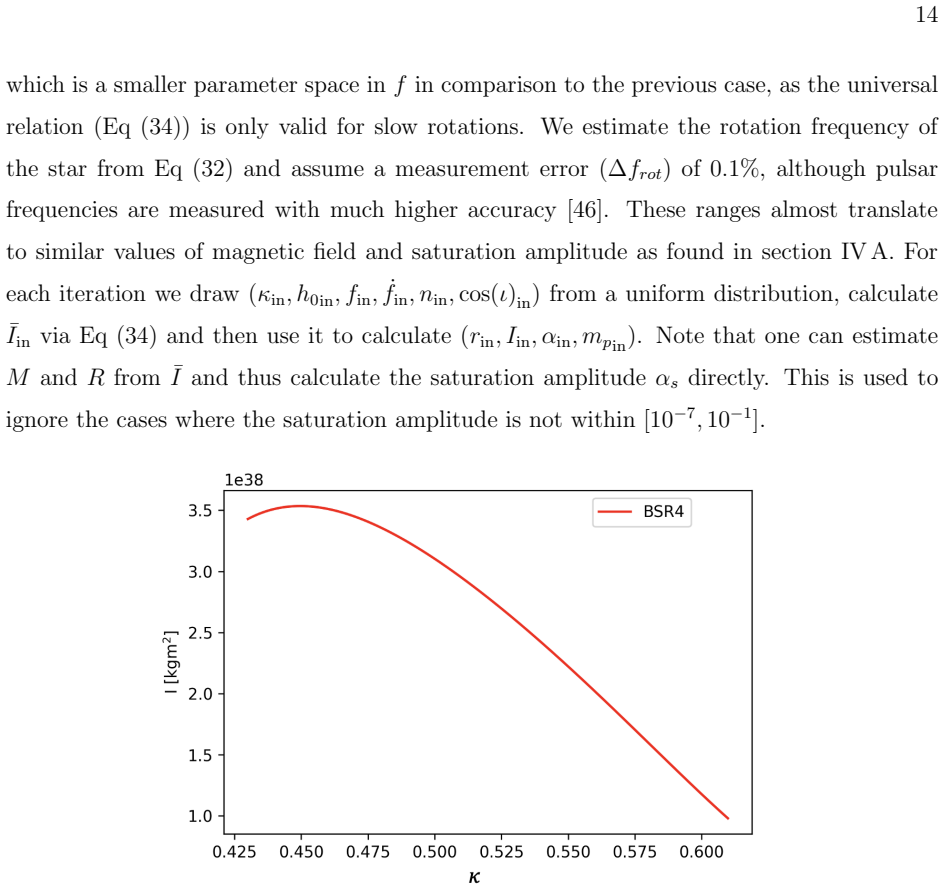
Various factors like relativistic effects, rapid rotation and magnetic field affect the value of κ. It has been shown that the relativistic effect is the strongest factor [28] and that κ satisfies a universal relation with the compactness ( C = M R ) of the star, given by ([28, 35]): κ = 0.667 − 0.478C − 1.11C 2. (33) The compactness of the star also sati...
-
[2]
Choice of input parameters Here we discuss the choice of the ranges/values of the 9 input parameters mentioned above. We consider an observation time of 0 .5 − 4 years, as gravitational wave detectors observing runs last at least a year. A fixed rin of 1 Kpc is assumed. This is expected to be within the range where all-sky searches are sensitive to neutro...
-
[3]
The output parameters hout, fout, ˙fout, and ¨fout are then calculated via Eq (40)
Output Parameters Post choosing values for the input parameters, we convert α into estimates of αs by using Eq (24) and fiducial values for M = 1.4M⊙, R = (5Iin/2M)1/2 and ˜J = 0.01635 [11]. The output parameters hout, fout, ˙fout, and ¨fout are then calculated via Eq (40). The output braking index nout is then calculated using Eq (5). We ignore cases whe...
-
[4]
We consider a similar observation time to the previous case
Choice of input parameters Now we discuss the choice of the ranges/values of the input parameters mentioned above. We consider a similar observation time to the previous case. A range of [10 −25 − 10−27] is explored for h0in, as this range includes signals that current and future detectors can po- tentially detect on narrow band searches [15, 44]. The ran...
-
[5]
Due to this, we again lose around 8% to 16% of data as nin increases from 3 to 7
Output parameters Similar to section IV A, we ignore cases where αs ̸∈ [10−8, 10−1] and nout ̸∈ [3, 7]. Due to this, we again lose around 8% to 16% of data as nin increases from 3 to 7. We again use 15 the median relative error (Eq (42)) to compare the input and output parameters, but we don’t normalise the error with the 0.1% error assumed for the rotati...
-
[6]
B. P. Abbott et al. (LIGO Scientific, Virgo), Phys. Rev. Lett. 116, 061102 (2016), arXiv:1602.03837 [gr-qc]
work page internal anchor Pith review Pith/arXiv arXiv 2016
-
[7]
B. P. Abbott et al. (LIGO Scientific, Virgo), Phys. Rev. X 9, 031040 (2019), arXiv:1811.12907 [astro-ph.HE]
work page internal anchor Pith review Pith/arXiv arXiv 2019
-
[8]
R. Abbott et al. (LIGO Scientific, Virgo), Phys. Rev. X 11, 021053 (2021), arXiv:2010.14527 26 [gr-qc]
work page internal anchor Pith review Pith/arXiv arXiv 2021
- [9]
-
[10]
B. P. Abbott et al. (LIGO Scientific, Virgo, Fermi GBM, INTEGRAL, IceCube, AstroSat Cadmium Zinc Telluride Imager Team, IPN, Insight-Hxmt, ANTARES, Swift, AGILE Team, 1M2H Team, Dark Energy Camera GW-EM, DES, DLT40, GRAWITA, Fermi-LAT, ATCA, ASKAP, Las Cumbres Observatory Group, OzGrav, DWF (Deeper Wider Faster Program), AST3, CAASTRO, VINROUGE, MASTER, J...
work page internal anchor Pith review Pith/arXiv arXiv 2017
-
[11]
Hybrid stars in the light of GW170817
R. Nandi and P. Char, Astrophys. J. 857, 12 (2018), arXiv:1712.08094 [astro-ph.HE]
work page internal anchor Pith review Pith/arXiv arXiv 2018
-
[12]
R. Nandi, P. Char, and S. Pal, Phys. Rev. C 99, 052802 (2019), arXiv:1809.07108 [astro- ph.HE]
work page internal anchor Pith review Pith/arXiv arXiv 2019
- [13]
-
[14]
J. L. Friedman and B. F. Schutz, Astrophys. J. 222, 281 (1978)
work page 1978
-
[15]
The r-mode instability in rotating neutron stars
N. Andersson and K. D. Kokkotas, Int. J. Mod. Phys. D 10, 381 (2001), arXiv:gr-qc/0010102
work page internal anchor Pith review Pith/arXiv arXiv 2001
-
[16]
B. J. Owen, L. Lindblom, C. Cutler, B. F. Schutz, A. Vecchio, and N. Andersson, Phys. Rev. D 58, 084020 (1998), arXiv:gr-qc/9804044
work page internal anchor Pith review Pith/arXiv arXiv 1998
-
[17]
Spin Evolution of Accreting Neutron Stars: Nonlinear Development of the R-mode Instability
R. Bondarescu, S. A. Teukolsky, and I. Wasserman, Phys. Rev. D 76, 064019 (2007), arXiv:0704.0799 [astro-ph]
work page internal anchor Pith review Pith/arXiv arXiv 2007
-
[18]
Spinning down newborn neutron stars: nonlinear development of the r-mode instability
R. Bondarescu, S. A. Teukolsky, and I. Wasserman, Phys. Rev. D 79, 104003 (2009), arXiv:0809.3448 [astro-ph]
work page internal anchor Pith review Pith/arXiv arXiv 2009
-
[19]
M. G. Alford and K. Schwenzer, Astrophys. J. 781, 26 (2014), arXiv:1210.6091 [gr-qc]
work page internal anchor Pith review Pith/arXiv arXiv 2014
-
[20]
K. Riles, Living Rev. Rel. 26, 3 (2023), arXiv:2206.06447 [astro-ph.HE]
-
[21]
B. Steltner, M. Papa, H.-B. Eggenstein, R. Prix, M. Bensch, B. Allen, and B. Machenschalk, The Astrophysical Journal 952, 55 (2023). 27
work page 2023
- [22]
- [23]
-
[24]
B. Rajbhandari, B. J. Owen, S. Caride, and R. Inta, Physical Review D 104, 122008 (2021)
work page 2021
-
[25]
M. Sieniawska and D. I. Jones, Mon. Not. Roy. Astron. Soc. 509, 5179 (2021), arXiv:2108.11710 [astro-ph.HE]
- [26]
-
[27]
Learning from the frequency content of continuous gravitational wave signals,
D. I. Jones, “Learning from the frequency content of continuous gravitational wave signals,” in Astrophysics in the XXI Century with Compact Stars (World Scientific, 2022) Chap. 6, pp. 201–217, arXiv:2111.08561 [astro-ph.HE]
-
[28]
S. D’Antonio, C. Palomba, P. Astone, S. Frasca, G. Intini, I. La Rosa, P. Leaci, S. Mastro- giovanni, A. Miller, F. Muciaccia, O. J. Piccinni, and A. Singhal, Phys. Rev. D 98, 103017 (2018)
work page 2018
- [29]
-
[30]
S. Ghosh, Mon. Not. Roy. Astron. Soc. 525, 448 (2023), arXiv:2304.12356 [gr-qc]
-
[31]
P. Jaranowski, A. Kr´ olak, and B. F. Schutz, Phys. Rev. D 58, 063001 (1998)
work page 1998
-
[32]
B. J. Owen, Phys. Rev. D 82, 104002 (2010), arXiv:1006.1994 [gr-qc]
work page internal anchor Pith review Pith/arXiv arXiv 2010
-
[33]
R-mode frequencies of slowly rotating relativistic neutron stars with realistic equations of state
A. Idrisy, B. J. Owen, and D. I. Jones, Phys. Rev. D 91, 024001 (2015), arXiv:1410.7360 [gr-qc]
work page internal anchor Pith review Pith/arXiv arXiv 2015
- [34]
- [35]
-
[36]
R. Prix, Phys. Rev. D 75, 023004 (2007), [Erratum: Phys.Rev.D 75, 069901 (2007)], arXiv:gr- qc/0606088
-
[37]
C. Dreissigacker, R. Prix, and K. Wette, Phys. Rev. D 98, 084058 (2018)
work page 2018
- [38]
-
[39]
R. Prix, Technical Report T0900149-v6, The F-statistic and its implementation in ComputeF- Statistic v2, Tech. Rep. (LIGO, 2011)
work page 2011
- [40]
-
[41]
Maximum mass, moment of inertia and compactness of relativistic stars
C. Breu and L. Rezzolla, Mon. Not. Roy. Astron. Soc. 459, 646 (2016), arXiv:1601.06083 [gr-qc]
work page internal anchor Pith review Pith/arXiv arXiv 2016
-
[42]
J. H. Taylor and J. M. Cordes, Astrophys. J. 411, 674 (1993)
work page 1993
-
[43]
Prospects for accurate distance measurements of pulsars with the SKA: enabling fundamental physics
R. Smits, S. J. Tingay, N. Wex, M. Kramer, and B. Stappers, Astron. Astrophys. 528, A108 (2011), arXiv:1101.5971 [astro-ph.IM]
work page internal anchor Pith review Pith/arXiv arXiv 2011
- [44]
- [45]
-
[46]
M. e. a. Kramer, Phys. Rev. X 11, 041050 (2021)
work page 2021
-
[47]
Abbott, R. and Abbott et. al (LIGO Scientific Collaboration, Virgo Collaboration, and KA- GRA Collaboration), Phys. Rev. D 104, 082004 (2021)
work page 2021
-
[48]
Saturation of the R-mode Instability
P. Arras, E. E. Flanagan, S. M. Morsink, A. K. Schenk, S. A. Teukolsky, and I. Wasserman, Astrophys. J. 591, 1129 (2003), arXiv:astro-ph/0202345
work page internal anchor Pith review Pith/arXiv arXiv 2003
-
[49]
R. Abbott and T. D. e. a. Abbott (LIGO Scientific Collaboration, Virgo Collaboration, and KAGRA Collaboration), Phys. Rev. D 105, 022002 (2022)
work page 2022
-
[50]
K. Wette, Astropart. Phys. 153, 102880 (2023), arXiv:2305.07106 [gr-qc]
-
[51]
High-precision timing of 42 millisecond pulsars with the European Pulsar Timing Array
G. Desvignes et al. (EPTA), Mon. Not. Roy. Astron. Soc. 458, 3341 (2016), arXiv:1602.08511 [astro-ph.HE]
work page internal anchor Pith review Pith/arXiv arXiv 2016
-
[52]
S. K. Dhiman, R. Kumar, and B. K. Agrawal, Phys. Rev. C 76, 045801 (2007)
work page 2007
-
[53]
R. Nandi and S. Pal, Eur. Phys. J. ST 230, 551 (2021), arXiv:2008.10943 [astro-ph.HE]
-
[54]
T. Nozawa, N. Stergioulas, E. Gourgoulhon, and Y. Eriguchi, Astron. Astrophys. Suppl. Ser. 132, 431 (1998), arXiv:gr-qc/9804048
work page internal anchor Pith review Pith/arXiv arXiv 1998
- [55]
- [56]
- [57]
-
[58]
The effect of magnetic fields on the r-modes of slowly rotating relativistic neutron stars
C. Chirenti and J. Sk´ akala, Phys. Rev. D 88, 104018 (2013), arXiv:1308.3685 [gr-qc]
work page internal anchor Pith review Pith/arXiv arXiv 2013
-
[59]
J. L. Friedman, L. Lindblom, L. Rezzolla, and A. I. Chugunov, Physical Review D 96, 124008 (2017)
work page 2017
-
[60]
F. Gittins and N. Andersson, Mon. Not. Roy. Astron. Soc. 521, 3043 (2023), arXiv:2212.04892 29 [gr-qc]
-
[61]
K. Yagi and N. Yunes, Science 341, 365 (2013), arXiv:1302.4499 [gr-qc]
work page internal anchor Pith review Pith/arXiv arXiv 2013
-
[62]
On the universality of I-Love-Q relations in magnetized neutron stars
B. Haskell, R. Ciolfi, F. Pannarale, and L. Rezzolla, Mon. Not. Roy. Astron. Soc. 438, L71 (2014), arXiv:1309.3885 [astro-ph.SR]
work page internal anchor Pith review Pith/arXiv arXiv 2014
-
[63]
K. D. Kokkotas and K. Schwenzer, Eur. Phys. J. A 52, 38 (2016), arXiv:1510.07051 [gr-qc]
work page internal anchor Pith review Pith/arXiv arXiv 2016
-
[64]
A. G. Pili, N. Bucciantini, and L. Del Zanna, Mon. Not. Roy. Astron. Soc. 447, 2821 (2015), arXiv:1412.4036 [astro-ph.HE]
work page internal anchor Pith review Pith/arXiv arXiv 2015
discussion (0)
Sign in with ORCID, Apple, or X to comment. Anyone can read and Pith papers without signing in.