Quantum-enhanced photoprotection in neuroprotein architectures emerges from collective light-matter interactions
Pith reviewed 2026-05-24 01:11 UTC · model grok-4.3
The pith
Collective superradiance among tryptophans produces high, disorder-robust quantum yields in neuroprotein structures
A machine-rendered reading of the paper's core claim, the machinery that carries it, and where it could break.
Core claim
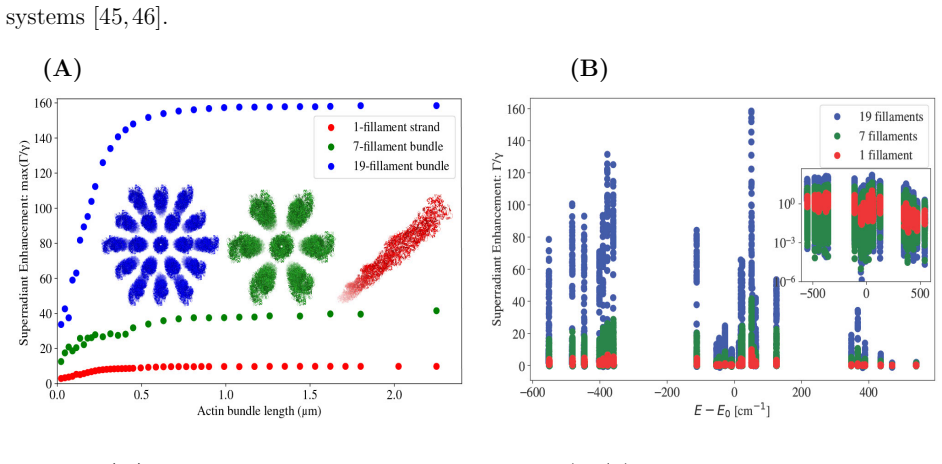
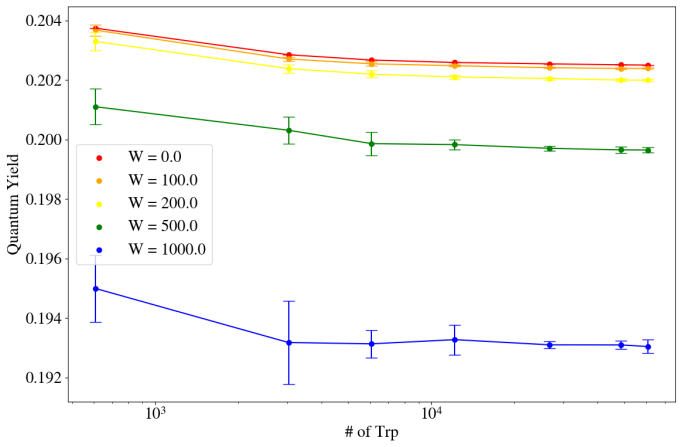
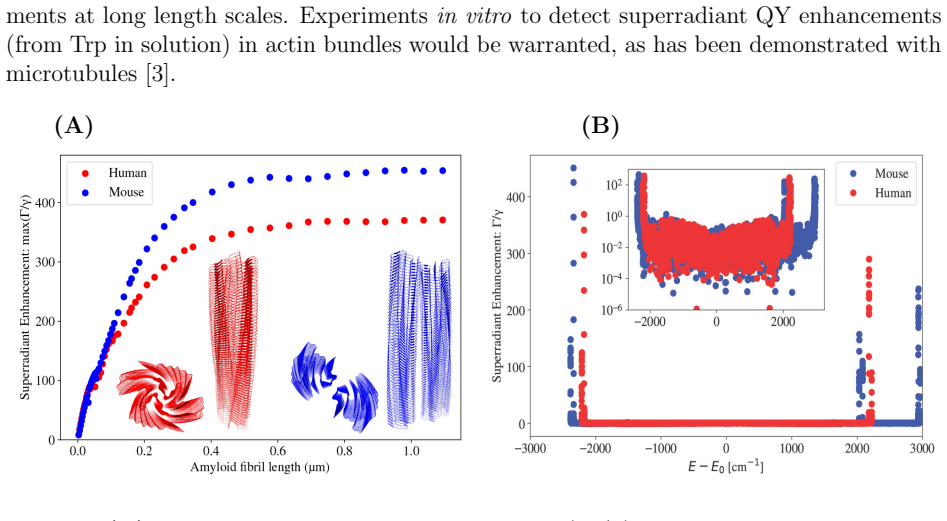
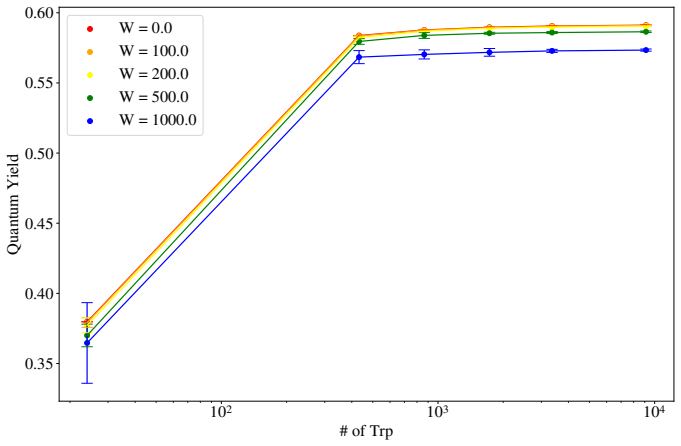
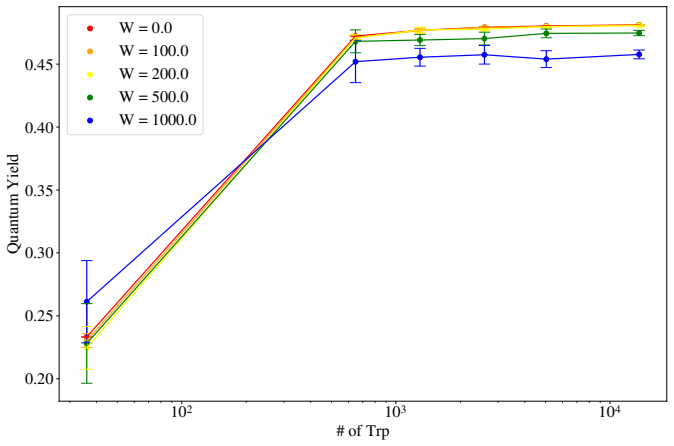
Bright superradiant states emerge in simulated actin filament bundles and amyloid fibrils, producing high quantum yields that remain robust to static disorder up to five times room temperature; for microtubules and amyloid fibrils the quantum yield increases with system size, opposite to conventional expectations for quantum effects in thermal equilibrium. The analysis employs a non-Hermitian Hamiltonian derived from the Lindblad equation for an open quantum system in the single-photon limit.
What carries the argument
Non-Hermitian Hamiltonian derived from the Lindblad master equation for the collective interaction of a tryptophan chromophore network with the electromagnetic field in the single-photon limit
Load-bearing premise
Each tryptophan acts as an isolated two-level emitter whose collective light-matter interaction is completely captured by the non-Hermitian Hamiltonian, and the computed quantum yields correspond directly to an in-vivo photoprotective function.
What would settle it
Measurement of UV quantum yield versus number of tryptophans in isolated microtubule or amyloid-fibril samples, testing whether yield rises with size and stays high when static disorder is increased to five times room-temperature strength.
Figures
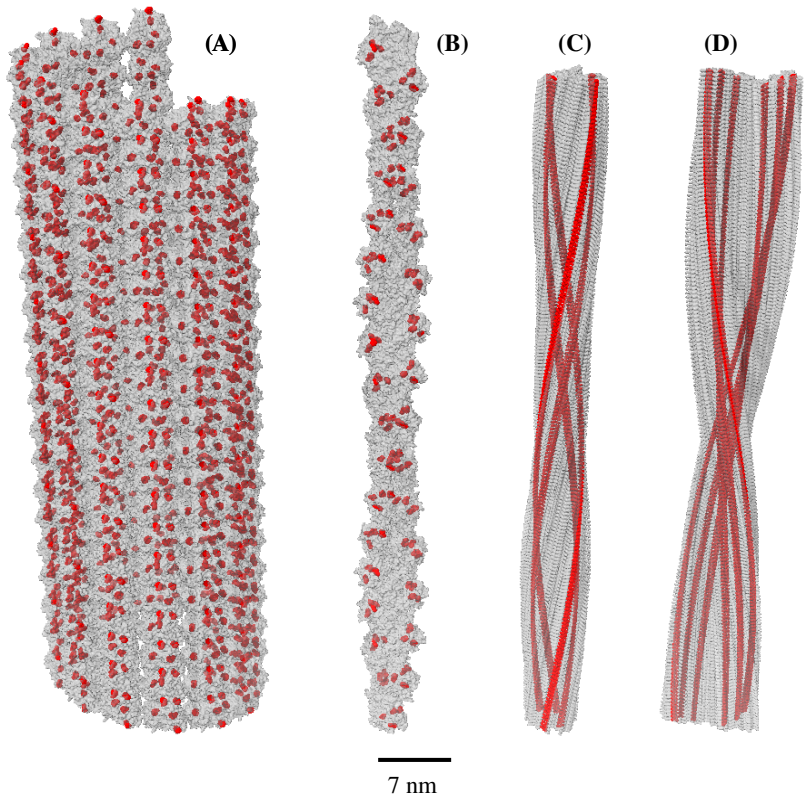
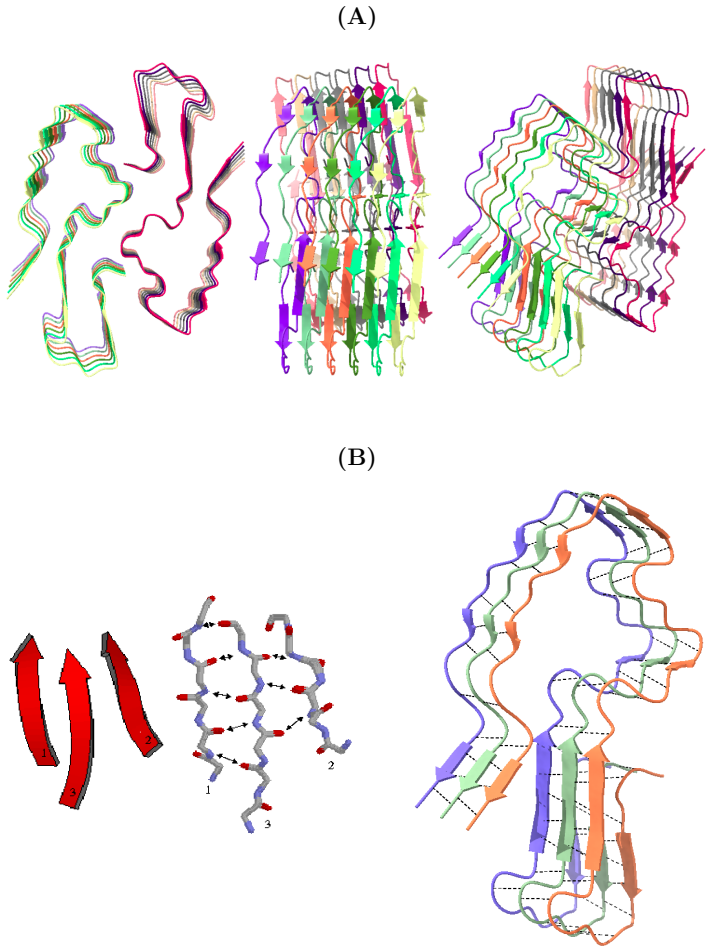
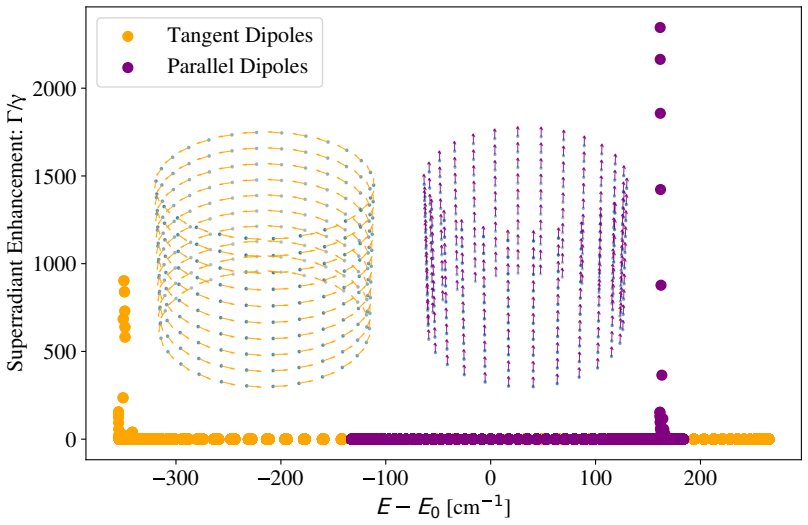
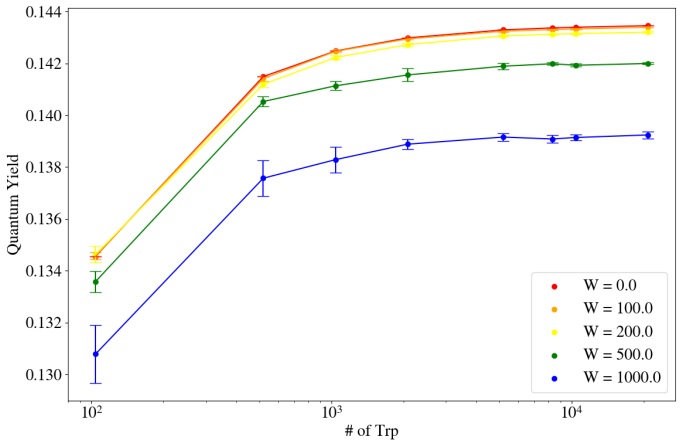

read the original abstract
We study here the collective quantum optical effect of superradiance in neuroprotein architectures. This phenomenon arises from the interaction of the electromagnetic field with an organized network of tryptophan chromophores, where each can be effectively modeled as a two-level quantum emitter. Building on our prior experimental confirmation of single-photon superradiance in microtubules, we predict that bright superradiant states will also emerge in simulated actin filament bundles and amyloid fibrils, which manifests in the form of high quantum yields that are robust to static disorder up to five times that of room temperature. For microtubules and amyloid fibrils, the quantum yield is enhanced with increasing system size, contrary to the conventional expectations of quantum effects in a thermally equilibrated environment. We conduct our analyses using a non-Hermitian Hamiltonian derived from the Lindblad equation for an open quantum system that describes the interaction of a chromophore network with the electromagnetic field, in the single-photon limit. Our detailed quantum yield predictions in realistic neuroprotein structures -- including analysis of the potential information-processing applications of correlated superradiant and subradiant states at divergent timescales -- provide motivation for a range of in vitro experiments to confirm these quantum enhancements, which can serve in vivo as a mechanism for dissipating or downconverting high-energy UV metabolic photon emissions in intensely oxidative pathological environments, including those found in Alzheimer's disease and related dementias.
Editorial analysis
A structured set of objections, weighed in public.
Referee Report
Summary. The manuscript claims that superradiant states emerge in tryptophan networks within neuroprotein architectures (microtubules, actin filament bundles, amyloid fibrils), producing high quantum yields that are robust to static disorder up to 5× room temperature and, for microtubules and amyloid, increase with system size. These predictions are obtained from a non-Hermitian Hamiltonian derived from the Lindblad master equation in the single-photon limit, building on the authors' prior experimental work on microtubules, and are interpreted as a possible in-vivo photoprotective mechanism against UV photons in oxidative environments such as Alzheimer's disease.
Significance. If the modeling assumptions are valid, the work would suggest that collective light-matter interactions can produce counter-intuitive size-enhanced quantum yields in biological structures at physiological temperatures, motivating targeted in-vitro experiments and offering a potential quantum-biological explanation for photoprotection. The explicit use of a Lindblad-derived non-Hermitian Hamiltonian and the focus on realistic protein geometries are positive features that make the predictions falsifiable.
major comments (1)
- [Abstract and modeling approach] Abstract and modeling section: the non-Hermitian Hamiltonian is constructed in the single-photon, zero-temperature limit of the Lindblad equation, treating each tryptophan as an isolated two-level emitter whose only decay channel is collective electromagnetic interaction. This construction omits the structured vibrational bath whose dephasing rates at 300 K are expected to be comparable to or larger than the superradiant linewidth; because the headline claims of disorder robustness up to 5× room temperature and size-enhanced yields rest directly on this truncated dynamics, the central predictions require either an explicit justification for neglecting vibrational effects or a demonstration that they do not qualitatively alter the reported scaling.
minor comments (1)
- [Abstract] The abstract states that analyses were performed but supplies no numerical values, error bars, or explicit parameter choices for the disorder strength or system sizes; adding a brief table or figure reference summarizing the key quantum-yield numbers would improve readability.
Simulated Author's Rebuttal
We thank the referee for the careful and constructive review of our manuscript. We address the single major comment below.
read point-by-point responses
-
Referee: [Abstract and modeling approach] Abstract and modeling section: the non-Hermitian Hamiltonian is constructed in the single-photon, zero-temperature limit of the Lindblad equation, treating each tryptophan as an isolated two-level emitter whose only decay channel is collective electromagnetic interaction. This construction omits the structured vibrational bath whose dephasing rates at 300 K are expected to be comparable to or larger than the superradiant linewidth; because the headline claims of disorder robustness up to 5× room temperature and size-enhanced yields rest directly on this truncated dynamics, the central predictions require either an explicit justification for neglecting vibrational effects or a demonstration that they do not qualitatively alter the reported scaling.
Authors: We agree that the non-Hermitian Hamiltonian is derived strictly in the single-photon, zero-temperature limit of the Lindblad equation and includes only collective radiative decay channels. This is an effective model chosen to isolate the consequences of collective light-matter interactions in realistic protein geometries, consistent with the approach used in our prior experimental work on microtubules. The reported robustness is to static (diagonal) disorder within this radiative dynamics. We will revise the modeling section to add an explicit paragraph justifying the approximation: it focuses on the radiative contribution to photoprotection and follows standard treatments of superradiance in molecular aggregates where the goal is to examine scaling with system size before including additional baths. A full demonstration that vibrational dephasing leaves the size-enhancement and disorder robustness qualitatively unchanged would require new simulations that incorporate a structured vibrational bath and is not performed here. revision: partial
- A quantitative demonstration that vibrational effects at 300 K do not qualitatively alter the reported size-enhanced yields and disorder robustness would require extending the model to include a structured vibrational bath and performing additional calculations, which are outside the scope of the present study.
Circularity Check
No significant circularity; predictions apply standard Lindblad-derived model to new structures
full rationale
The paper derives quantum yields for actin and amyloid from a non-Hermitian Hamiltonian obtained via the standard single-photon Lindblad master equation applied to simulated chromophore networks. The reference to prior experimental confirmation on microtubules cites independent external data rather than a self-referential result. No equations reduce by construction to fitted inputs, no ansatz is smuggled via self-citation, and no uniqueness theorem or renaming of known results is invoked. The derivation chain remains self-contained against the external Lindblad formalism and the cited experiments.
Axiom & Free-Parameter Ledger
axioms (2)
- domain assumption Each tryptophan can be modeled as a two-level quantum emitter
- domain assumption Single-photon limit of the Lindblad equation yields a valid non-Hermitian Hamiltonian for the chromophore network
Lean theorems connected to this paper
-
IndisputableMonolith/Cost/FunctionalEquation.leanwashburn_uniqueness_aczel unclear?
unclearRelation between the paper passage and the cited Recognition theorem.
We treat these proteinaceous Trp networks as open quantum systems, using a non-Hermitian Hamiltonian to describe interactions of the chromophore network with the electromagnetic field... Heff = H0 + Δ − i/2 G (Eq. 1)
-
IndisputableMonolith/Foundation/RealityFromDistinction.leanreality_from_one_distinction unclear?
unclearRelation between the paper passage and the cited Recognition theorem.
the thermal average of the quantum yield... ⟨Γ⟩th = 1/Z Σ Γj exp(−βEj)
What do these tags mean?
- matches
- The paper's claim is directly supported by a theorem in the formal canon.
- supports
- The theorem supports part of the paper's argument, but the paper may add assumptions or extra steps.
- extends
- The paper goes beyond the formal theorem; the theorem is a base layer rather than the whole result.
- uses
- The paper appears to rely on the theorem as machinery.
- contradicts
- The paper's claim conflicts with a theorem or certificate in the canon.
- unclear
- Pith found a possible connection, but the passage is too broad, indirect, or ambiguous to say the theorem truly supports the claim.
Reference graph
Works this paper leans on
-
[1]
R. H. Dicke. Coherence in spontaneous radiation processes. Phys. Rev., 93:99–110, Jan 1954
work page 1954
-
[2]
On the existence of superradiant excitonic states in microtubules
G L Celardo, M Angeli, T J A Craddock, and P Kurian. On the existence of superradiant excitonic states in microtubules. New Journal of Physics , 21(2):023005, feb 2019
work page 2019
-
[3]
N. S. Babcock, G. Montes-Cabrera, K. E. Oberhofer, M. Chergui, G. L. Celardo, and P. Kurian. Ultraviolet superradiance from mega-networks of tryptophan in biological architectures. The Journal of Physical Chemistry B , 128(17):4035–4046, April 2024
work page 2024
-
[4]
Philip Kurian, TO Obisesan, and Travis JA Craddock. Oxidative species-induced ex- citonic transport in tubulin aromatic networks: Potential implications for neurodegen- erative disease. Journal of Photochemistry and Photobiology B: Biology , 175:109–124, 2017
work page 2017
-
[5]
Patrik R. Callis. [7] 1La and 1Lb transitions of tryptophan: Applications of theory and experimental observations to fluorescence of proteins. In Flourescence Spectroscopy, volume 278 of Methods in Enzymology, pages 113–150. Academic Press, 1997
work page 1997
-
[6]
Gregory S Engel, Tessa R Calhoun, Elizabeth L Read, Tae-Kyu Ahn, Tom´ aˇ s Manˇ cal, Yuan-Chung Cheng, Robert E Blankenship, and Graham R Fleming. Evidence for wavelike energy transfer through quantum coherence in photosynthetic systems.Nature, 446(7137):782–786, 2007
work page 2007
-
[7]
Long-lived quantum coherence in photosynthetic complexes at physiological temperature
Gitt Panitchayangkoon, Dugan Hayes, Kelly A Fransted, Justin R Caram, Elad Harel, Jianzhong Wen, Robert E Blankenship, and Gregory S Engel. Long-lived quantum coherence in photosynthetic complexes at physiological temperature. Proceedings of the National Academy of Sciences , 107(29):12766–12770, 2010
work page 2010
-
[8]
Coherently wired light-harvesting in photosynthetic marine algae at ambient temperature
Elisabetta Collini, Cathy Y Wong, Krystyna E Wilk, Paul MG Curmi, Paul Brumer, and Gregory D Scholes. Coherently wired light-harvesting in photosynthetic marine algae at ambient temperature. Nature, 463(7281):644–647, 2010. 31
work page 2010
-
[9]
How quantum coherence assists photosynthetic light-harvesting
Johan Str¨ umpfer, Melih Sener, and Klaus Schulten. How quantum coherence assists photosynthetic light-harvesting. The journal of physical chemistry letters , 3(4):536–542, 2012
work page 2012
-
[10]
Delocalized excitons in natural light- harvesting complexes
Seogjoo J Jang and Benedetta Mennucci. Delocalized excitons in natural light- harvesting complexes. Reviews of Modern Physics , 90(3):035003, 2018
work page 2018
-
[11]
Photochemical control of exciton superradiance in light-harvesting nanotubes
Sandra Doria, Timothy S Sinclair, Nathan D Klein, Doran IG Bennett, Chern Chuang, Francesca S Freyria, Colby P Steiner, Paolo Foggi, Keith A Nelson, Jianshu Cao, et al. Photochemical control of exciton superradiance in light-harvesting nanotubes. ACS nano, 12(5):4556–4564, 2018
work page 2018
-
[12]
Thermal decoherence of superradiance in lead halide perovskite nanocrystal superlattices
Francesco Mattiotti, Masaru Kuno, Fausto Borgonovi, Boldizs´ ar Jank´ o, and G Luca Celardo. Thermal decoherence of superradiance in lead halide perovskite nanocrystal superlattices. Nano Letters, 20(10):7382–7388, 2020
work page 2020
-
[13]
Efficient light harvesting and photon sensing via engineered cooperative effects
Francesco Mattiotti, Mohan Sarovar, Giulio G Giusteri, Fausto Borgonovi, and G Luca Celardo. Efficient light harvesting and photon sensing via engineered cooperative effects. New Journal of Physics , 24(1):013027, 2022
work page 2022
-
[14]
Light harvesting enhanced by quan- tum ratchet states
Nicholas Werren, Will Brown, and Erik M Gauger. Light harvesting enhanced by quan- tum ratchet states. PRX Energy, 2(1):013002, 2023
work page 2023
-
[15]
Mark Winey and Eileen O’Toole. Centriole structure. Philosophical Transactions of the Royal Society B: Biological Sciences , 369(1650):20130457, September 2014
work page 2014
-
[16]
The centriole duplication cycle
Elif Nur Fırat-Karalar and Tim Stearns. The centriole duplication cycle. Philosophical Transactions of the Royal Society B: Biological Sciences , 369(1650):20130460, 2014
work page 2014
-
[17]
Ana Rodrigues-Martins, Maria Riparbelli, Giuliano Callaini, David M Glover, and Mon- ica Bettencourt-Dias. From centriole biogenesis to cellular function: centrioles are es- sential for cell division at critical developmental stages. Cell Cycle , 7(1):11–16, 2008
work page 2008
-
[18]
Rudimentary form of cellular “vision”
G Albrecht-Buehler. Rudimentary form of cellular “vision”. Proceedings of the National Academy of Sciences, 89(17):8288–8292, September 1992
work page 1992
-
[19]
Cellular infrared detector appears to be contained in the centrosome
Guenter Albrecht-Buehler. Cellular infrared detector appears to be contained in the centrosome. Cell Motility , 27(3):262–271, January 1994
work page 1994
-
[20]
Autofluorescence of live purple bacteria in the near infrared
Guenter Albrecht-Buehler. Autofluorescence of live purple bacteria in the near infrared. Experimental Cell Research, 236(1):43–50, October 1997
work page 1997
-
[21]
G Albrecht-Buehler. Phagokinetic tracks of 3t3 cells: Parallels between the orienta- tion of track segments and of cellular structures which contain actin or tubulin. Cell, 12(2):333–339, October 1977
work page 1977
-
[22]
Secondary structure (2 ◦) – beta strands
Stephen J Everse. Secondary structure (2 ◦) – beta strands. 2014. [ Online Website ]. 32
work page 2014
-
[23]
Fridoon J. Ahmad, Yan He, Kenneth A. Myers, Thomas P. Hasaka, Franto Francis, Mark M. Black, and Peter W. Baas. Effects of dynactin disruption and dynein depletion on axonal microtubules. Traffic, 7(5):524–537, 2006
work page 2006
-
[24]
Paul Matsudaira, Eckhard Mandelkow, Winfried Renner, Lyndal K. Hesterberg, and Klaus Weber. Role of fimbrin and villin in determining the interfilament distances of actin bundles. Nature, 301(5897):209–214, January 1983
work page 1983
-
[25]
Dendritic spines in alzheimer’s disease: How the actin cytoskeleton contributes to synaptic failure
Silvia Pelucchi, Ramona Stringhi, and Elena Marcello. Dendritic spines in alzheimer’s disease: How the actin cytoskeleton contributes to synaptic failure. International Jour- nal of Molecular Sciences , 21(3):908, January 2020
work page 2020
-
[26]
Linus Pauling, Robert B. Corey, and H. R. Branson. The structure of proteins: Two hydrogen-bonded helical configurations of the polypeptide chain. Proceedings of the National Academy of Sciences , 37(4):205–211, April 1951
work page 1951
-
[27]
Ben J. Eves, James J. Doutch, Ann E. Terry, Han Yin, Martine Moulin, Michael Haertlein, V. Trevor Forsyth, Patrick Flagmeier, Tuomas P. J. Knowles, David M. Dias, Gudrun Lotze, Annela M. Seddon, and Adam M. Squires. Elongation rate and average length of amyloid fibrils in solution using isotope-labelled small-angle neutron scattering. RSC Chemical Biology...
work page 2021
-
[28]
Brandon H. Toyama and Jonathan S. Weissman. Amyloid structure: Conformational diversity and consequences. Annual Review of Biochemistry , 80(1):557–585, July 2011
work page 2011
-
[29]
I. Segers-Nolten, M. van Raaij, and V. Subramaniam. Biophysical Analysis of Amyloid Formation, page 347–359. Elsevier, 2011
work page 2011
-
[30]
Mark A. Findeis, Gary M. Musso, Christopher C. Arico-Muendel, Howard W. Benjamin, Arvind M. Hundal, Jung-Ja Lee, Joseph Chin, Michael Kelley, James Wakefield, Neil J. Hayward, and Susan M. Molineaux. Modified-peptide inhibitors of amyloid β-peptide polymerization. Biochemistry, 38(21):6791–6800, 1999
work page 1999
-
[31]
Wong, Xiaoxue Zhang, Andisheh Abedini, Ann Marie Schmidt, and Daniel P
Rehana Akter, Ping Cao, Harris Noor, Zachary Ridgway, Ling-Hsien Tu, Hui Wang, Amy G. Wong, Xiaoxue Zhang, Andisheh Abedini, Ann Marie Schmidt, and Daniel P. Raleigh. Islet amyloid polypeptide: Structure, function, and pathophysiology. Journal of Diabetes Research, 2016:1–18, 2016
work page 2016
-
[32]
Robert A. Kyle. Amyloidosis: a convoluted story. British Journal of Haematology , 114(3):529–538, 2001
work page 2001
-
[33]
Liza Nielsen, Ritu Khurana, Alisa Coats, Sven Frokjaer, Jens Brange, Sandip Vyas, Vladimir N. Uversky, and Anthony L. Fink. Effect of environmental factors on the ki- netics of insulin fibril formation: Elucidation of the molecular mechanism.Biochemistry, 40(20):6036–6046, 2001. PMID: 11352739
work page 2001
-
[34]
Fabrizio Chiti and Christopher M. Dobson. Protein misfolding, amyloid formation, and human disease: A summary of progress over the last decade. Annual Review of Biochemistry, 86(1):27–68, June 2017. 33
work page 2017
-
[35]
Recent atomic models of amyloid fibril struc- ture
Rebecca Nelson and David Eisenberg. Recent atomic models of amyloid fibril struc- ture. Current Opinion in Structural Biology , 16(2):260–265, 2006. Theory and simula- tion/Macromolecular assemblages
work page 2006
-
[36]
Tau in alzheimer neurofibrillary tangles
J P Brion, D P Hanger, M T Bruce, A M Couck, J Flament-Durand, and B H Ander- ton. Tau in alzheimer neurofibrillary tangles. n- and c-terminal regions are differentially associated with paired helical filaments and the location of a putative abnormal phos- phorylation site. Biochemical Journal, 273(1):127–133, January 1991
work page 1991
-
[37]
Lester I. Binder, Angela L. Guillozet-Bongaarts, Francisco Garcia-Sierra, and Robert W. Berry. Tau, tangles, and alzheimer’s disease. Biochimica et Biophysica Acta (BBA) - Molecular Basis of Disease , 1739(2–3):216–223, January 2005
work page 2005
-
[38]
Sian-Yang Ow and Dave E. Dunstan. A brief overview of amyloids and alzheimer’s disease. Protein Science, 23(10):1315–1331, July 2014
work page 2014
-
[39]
Macroscopic coherence as an emergent property in molecular nanotubes
Marco Gull` ı, Alessia Valzelli, Francesco Mattiotti, Mattia Angeli, Fausto Borgonovi, and Giuseppe Luca Celardo. Macroscopic coherence as an emergent property in molecular nanotubes. New Journal of Physics , 21(1):013019, jan 2019
work page 2019
-
[40]
Non-Hermitian Quantum Mechanics
Nimrod Moiseyev. Non-Hermitian Quantum Mechanics . Cambridge University Press, February 2011
work page 2011
-
[41]
The Theory of Open Quantum Systems
Heinz-Peter Breuer and Francesco Petruccione. The Theory of Open Quantum Systems . Oxford University PressOxford, January 2007
work page 2007
-
[42]
A short introduction to the Lindblad master equation
Daniel Manzano. A short introduction to the Lindblad master equation. AIP Advances, 10(2):025106, 02 2020
work page 2020
- [43]
-
[44]
Daniel Havelka, Marco A Deriu, Michal Cifra, and Ondˇ rej Kuˇ cera. Deformation pattern in vibrating microtubule: Structural mechanics study based on an atomistic approach. Scientific Reports, 7(1):4227, 2017
work page 2017
-
[45]
Edge states and topological invariants of non-hermitian systems
Shunyu Yao and Zhong Wang. Edge states and topological invariants of non-hermitian systems. Physical Review Letters, 121(8), August 2018
work page 2018
-
[46]
Non-hermitian topological invariants in real space
Fei Song, Shunyu Yao, and Zhong Wang. Non-hermitian topological invariants in real space. Physical Review Letters, 123(24), December 2019
work page 2019
-
[47]
Exciton decay mechanism in dna single strands: back-electron transfer and ultrafast base motions
Benjamin Bauer, Rahul Sharma, Majed Chergui, and Malte Oppermann. Exciton decay mechanism in dna single strands: back-electron transfer and ultrafast base motions. Chemical Science, 13(18):5230–5242, 2022
work page 2022
-
[48]
Nicolas Renaud, Yuri A. Berlin, Frederick D. Lewis, and Mark A. Ratner. Between superexchange and hopping: An intermediate charge-transfer mechanism in poly(a)- poly(t) dna hairpins. Journal of the American Chemical Society , 135(10):3953–3963, February 2013. 34
work page 2013
-
[49]
Eric R. Bittner. Lattice theory of ultrafast excitonic and charge-transfer dynamics in dna. The Journal of Chemical Physics , 125(9), September 2006
work page 2006
-
[50]
Vincent A. Spata and Spiridoula Matsika. Role of excitonic coupling and charge- transfer states in the absorption and cd spectra of adenine-based oligonucleotides investigated through qm/mm simulations. The Journal of Physical Chemistry A , 118(51):12021–12030, September 2014
work page 2014
-
[51]
Azar, Luca Grisanti, Amberley D
Kwang Hyok Jong, Yavar T. Azar, Luca Grisanti, Amberley D. Stephens, Saul T. E. Jones, Dan Credgington, Gabriele S. Kaminski Schierle, and Ali Hassanali. Low en- ergy optical excitations as an indicator of structural changes initiated at the termini of amyloid proteins. Physical Chemistry Chemical Physics , 21(43):23931–23942, 2019
work page 2019
-
[52]
Mark T. Oakley and Jonathan D. Hirst. Charge-transfer transitions in protein circular dichroism calculations. Journal of the American Chemical Society, 128(38):12414–12415, September 2006
work page 2006
-
[53]
Carlo Andrea Rozzi, Sarah Maria Falke, Nicola Spallanzani, Angel Rubio, Elisa Moli- nari, Daniele Brida, Margherita Maiuri, Giulio Cerullo, Heiko Schramm, Jens Christof- fers, and Christoph Lienau. Quantum coherence controls the charge separation in a prototypical artificial light-harvesting system. Nature Communications, 4(1), March 2013
work page 2013
-
[54]
A. Asenjo-Garcia, M. Moreno-Cardoner, A. Albrecht, H. J. Kimble, and D. E. Chang. Exponential improvement in photon storage fidelities using subradiance and “selective radiance” in atomic arrays. Physical Review X, 7(3), August 2017
work page 2017
-
[55]
R. Guti´ errez-J´ auregui and A. Asenjo-Garcia. Directional transport along an atomic chain. Physical Review A, 105(4), April 2022
work page 2022
-
[56]
H. H. Jen. Phase-imprinted multiphoton subradiant states. Physical Review A , 96(2), August 2017
work page 2017
-
[57]
Luca Grisanti, Dorothea Pinotsi, Ralph Gebauer, Gabriele S. Kaminski Schierle, and Ali A. Hassanali. A computational study on how structure influences the optical proper- ties in model crystal structures of amyloid fibrils. Physical Chemistry Chemical Physics, 19(5):4030–4040, 2017
work page 2017
-
[58]
Stephens, Muhammad Nawaz Qaisrani, Michael T
Amberley D. Stephens, Muhammad Nawaz Qaisrani, Michael T. Ruggiero, Gonzalo D´ ıaz Mir´ on, Uriel N. Morzan, Mariano C. Gonz´ alez Lebrero, Saul T. E. Jones, Emiliano Poli, Andrew D. Bond, Philippa J. Woodhams, Elyse M. Kleist, Luca Grisanti, Ralph Gebauer, J. Axel Zeitler, Dan Credgington, Ali Hassanali, and Gabriele S. Kamin- ski Schierle. Short hydroge...
work page 2021
-
[59]
Falk Liberta, Sarah Loerch, Matthies Rennegarbe, Angelika Schierhorn, Per West- ermark, Gunilla T Westermark, Bouke PC Hazenberg, Nikolaus Grigorieff, Marcus 35 F¨ andrich, and Matthias Schmidt. Cryo-EM fibril structures from systemic AA amy- loidosis reveal the species complementarity of pathological amyloids. Nature communi- cations, 10(1):1–10, 2019
work page 2019
-
[60]
Dong-Hyuk Jang, Jin-Hee Han, Seung-Hee Lee, Yong-Seok Lee, Hyungju Park, Sue- Hyun Lee, Hyoung Kim, and Bong-Kiun Kaang. Cofilin expression induces cofilin- actin rod formation and disrupts synaptic structure and function in aplysia synapses. Proceedings of the National Academy of Sciences , 102(44):16072–16077, October 2005
work page 2005
-
[61]
James R. Bamburg and Barbara W. Bernstein. Actin dynamics and cofilin-actin rods in alzheimer disease. Cytoskeleton, 73(9):477–497, March 2016
work page 2016
-
[62]
T. W. Nichols, M. H. Berman, and Jack Tuszynski. Journal of multiscale neuroscience. Journal of Multiscale Neuroscience , 2(1):141–158, April 2023
work page 2023
-
[63]
Bazan, Anasheh Halabi, Monica Ertel, and Nicos A
Nicolas G. Bazan, Anasheh Halabi, Monica Ertel, and Nicos A. Petasis. Chapter 34 - neuroinflammation. In Scott T. Brady, George J. Siegel, R. Wayne Albers, and Don- ald L. Price, editors, Basic Neurochemistry (Eighth Edition) , pages 610–620. Academic Press, New York, eighth edition edition, 2012
work page 2012
-
[64]
P. A. Merz, H. M. Wisniewski, R. A. Somerville, S. A. Bobin, C. L. Masters, and K. Iqbal. Ultrastructural morphology of amyloid fibrils from neuritic and amyloid plaques. Acta Neuropathologica, 60(1–2):113–124, 1983
work page 1983
-
[65]
Shen Han, Marius Kollmer, Daniel Markx, Stephanie Claus, Paul Walther, and Marcus F¨ andrich. Amyloid plaque structure and cell surface interactions of β-amyloid fibrils revealed by electron tomography. Scientific Reports, 7(1), February 2017
work page 2017
-
[66]
Analysis of the stability of hemoglobin s double strands
Xiang-Qi Mu, Lee Makowski, and Beatrice Magdoff-Fairchild. Analysis of the stability of hemoglobin s double strands. Biophysical Journal, 74(1):655–668, January 1998
work page 1998
-
[67]
Eric R. Henry, Troy Cellmer, Emily B. Dunkelberger, Belhu Metaferia, James Hofrichter, Quan Li, David Ostrowski, Rodolfo Ghirlando, John M. Louis, St´ ephane Moutereau, Fr´ ed´ eric Galact´ eros, Swee Lay Thein, Pablo Bartolucci, and William A. Eaton. Al- losteric control of hemoglobin s fiber formation by oxygen and its relation to the patho- physiology ...
work page 2020
-
[68]
Travis JA Craddock, Jack A Tuszynski, and Stuart Hameroff. Cytoskeletal signaling: is memory encoded in microtubule lattices by camkii phosphorylation? PLoS compu- tational biology, 8(3):e1002421, 2012
work page 2012
-
[69]
The feasibility of coherent energy transfer in microtubules
Travis John Adrian Craddock, Douglas Friesen, Jonathan Mane, Stuart Hameroff, and Jack A Tuszynski. The feasibility of coherent energy transfer in microtubules. Journal of the Royal Society Interface , 11(100):20140677, 2014
work page 2014
-
[70]
Craddock, Philip Kurian, Jack A
Travis J.A. Craddock, Philip Kurian, Jack A. Tuszynski, and Stuart R. Hameroff. 9 - quantum processes in neurophotonics and the origin of the brain’s spatiotemporal 36 hierarchy. In Robert R. Alfano and Lingyan Shi, editors,Neurophotonics and Biomedical Spectroscopy, Nanophotonics, pages 189–213. Elsevier, 2019
work page 2019
-
[71]
Roger Penrose. Shadows of the mind . Oxford University Press, New York, NY, August 1996
work page 1996
-
[72]
Radiative decay and energy transfer in molecular aggregates: The role of intermolecular dephasing
Jonathan Grad, Griselda Hernandez, and Shaul Mukamel. Radiative decay and energy transfer in molecular aggregates: The role of intermolecular dephasing. Phys. Rev. A , 37:3835–3846, May 1988
work page 1988
-
[73]
Superradiance in molecular aggregates.The Journal of Chemical Physics , 91(2):683–700, 1989
Frank C Spano and Shaul Mukamel. Superradiance in molecular aggregates.The Journal of Chemical Physics , 91(2):683–700, 1989
work page 1989
-
[74]
T. Bienaim´ e, R. Bachelard, N. Piovella, and R. Kaiser. Cooperativity in light scattering by cold atoms. Fortschritte der Physik, 61(2-3):377–392, 2013
work page 2013
-
[75]
Giusteri, Francesco Mattiotti, and G
Giulio G. Giusteri, Francesco Mattiotti, and G. Luca Celardo. Non-hermitian hamilto- nian approach to quantum transport in disordered networks with sinks: Validity and effectiveness. Phys. Rev. B , 91:094301, Mar 2015
work page 2015
-
[76]
E. Akkermans, A. Gero, and R. Kaiser. Photon localization and dicke superradiance in atomic gases. Phys. Rev. Lett., 101:103602, Sep 2008
work page 2008
-
[77]
Jan L¨ owe, H Li, KH Downing, and E Nogales. Refined structure of α β -tubulin at 3.5 ˚ a resolution.Journal of molecular biology , 313(5):1045–1057, 2001
work page 2001
-
[78]
S. Schenkl, F. van Mourik, G. van der Zwan, S. Haacke, and M. Chergui. Probing the ultrafast charge translocation of photoexcited retinal in bacteriorhodopsin. Science, 309(5736):917–920, August 2005
work page 2005
-
[79]
Pinar S Gurel, Laura Y Kim, Paul V Ruijgrok, Tosan Omabegho, Zev Bryant, and Gregory M Alushin. Cryo-em structures reveal specialization at the myosin vi-actin interface and a mechanism of force sensitivity. Elife, 6:e31125, 2017. 37 Supplemental Information Supplementary Tables and Figures Figures We present data that show how mechanical motions in micro...
work page 2017
discussion (0)
Sign in with ORCID, Apple, or X to comment. Anyone can read and Pith papers without signing in.