Why detect forward muons at a muon collider
Pith reviewed 2026-05-23 17:51 UTC · model grok-4.3
The pith
Detecting forward muons enables Higgs property measurements and invisible new-particle searches at a muon collider.
A machine-rendered reading of the paper's core claim, the machinery that carries it, and where it could break.
Core claim
Detection of forward muons accompanying neutral effective vector bosons at a muon collider is essential for studying Higgs boson properties such as inclusive production cross section and invisible branching ratios, and for searching for invisible new heavy particles produced via Higgs portal interactions; additionally, their angular correlations can be used to characterize vector boson scattering and fusion processes including the CP nature of the Higgs-Z coupling.
What carries the argument
The forward muon detector that records muons at small angles relative to the beam line, tagging the production of effective neutral vector bosons in muon collisions.
If this is right
- Measurement of the inclusive Higgs production cross section is enabled by the extended angular coverage.
- The branching ratio of the Higgs to invisible final states can be determined.
- Searches for new heavy invisible particles become feasible when they are produced through the Higgs portal.
- Angular correlations of forward muons provide sensitivity to quantum interference in vector boson processes, such as the CP properties of the Higgs-Z coupling.
Where Pith is reading between the lines
- The design of muon collider experiments should prioritize dedicated forward muon detection systems to realize these physics opportunities.
- Similar forward detection strategies could be relevant for other high-energy collider proposals involving muon or electron beams.
- If the rates are as expected, this approach could provide complementary information to central detectors in vector boson fusion analyses.
Load-bearing premise
Sufficient production rates of neutral effective vector bosons accompanied by detectable forward muons exist in the kinematic regimes relevant for Higgs and new physics studies.
What would settle it
A measurement showing that the number of forward muons in vector boson production events falls significantly below theoretical predictions, rendering the proposed measurements statistically unfeasible.
Figures


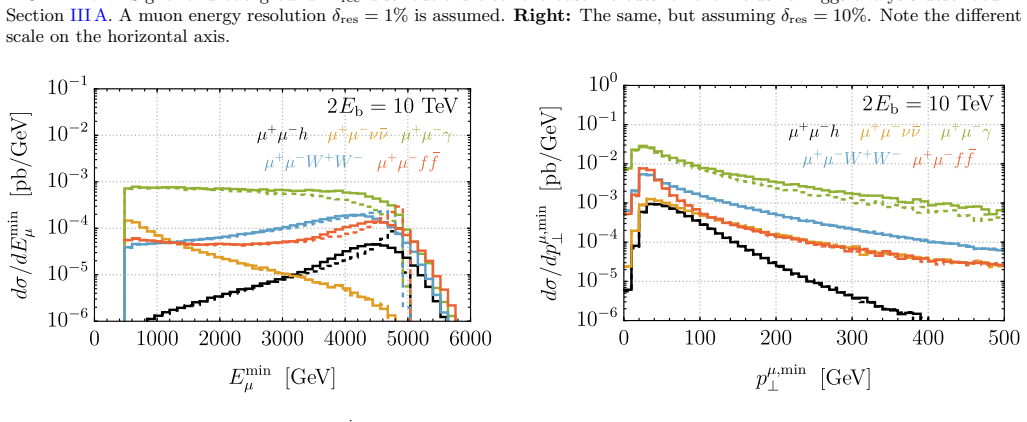
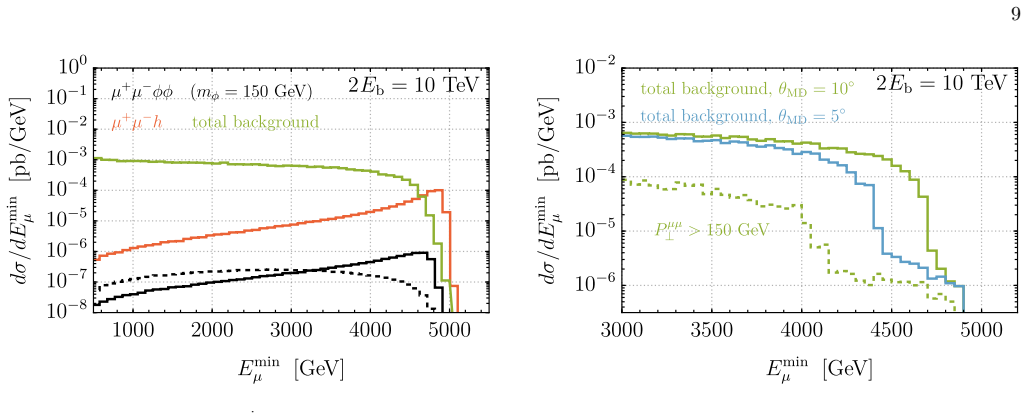


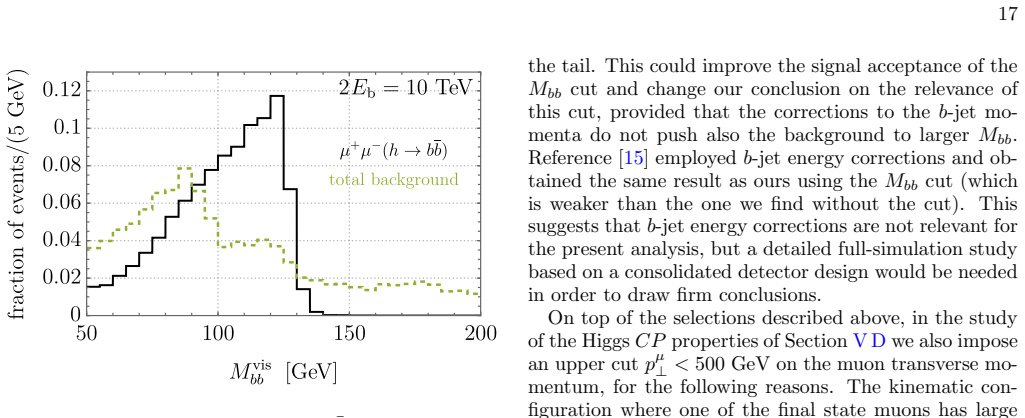


read the original abstract
We survey the opportunities offered by the detection of the forward muons that accompany the creation of neutral effective vector bosons at a muon collider, in different kinematic regimes. Vectors with relatively low energy produce the Higgs boson and the extended muon angular coverage enables studies of the Higgs properties, such as the measurement of the inclusive production cross section and of the branching ratio to invisible final states. New heavy particles could be produced by vectors of higher energy, through Higgs portal interactions. If the new particles are invisible, the detection of the forward muons is essential in order to search for this scenario. The angular correlations of the forward muons are sensitive to the quantum interference between the vector boson helicity amplitudes and can be exploited for the characterisation of vector boson scattering and fusion processes. This is illustrated by analysing the CP properties of the Higgs coupling to the Z boson. Our findings provide a physics case and a set of benchmarks for the design of a dedicated forward muon detector.
Editorial analysis
A structured set of objections, weighed in public.
Referee Report
Summary. The manuscript is a survey of physics opportunities enabled by detecting forward muons that accompany neutral effective vector bosons at a muon collider. It covers three main regimes: low-energy vectors for Higgs production and property measurements (including inclusive cross section and invisible branching ratios), higher-energy vectors for producing new heavy particles via Higgs-portal interactions (with forward muons essential for tagging invisible final states), and angular correlations among forward muons to probe helicity amplitudes and CP properties in vector boson scattering/fusion, illustrated with the Higgs-Z coupling. The paper supplies a physics case and benchmarks for designing a dedicated forward muon detector.
Significance. If the standard effective-vector-boson kinematics and production rates hold, the work supplies a clear, literature-grounded motivation for forward muon coverage that could meaningfully extend the Higgs and new-physics reach of a muon collider. The emphasis on invisible-particle searches and helicity-sensitive observables is a concrete strength for detector-design discussions.
minor comments (2)
- [Abstract] Abstract: the phrase 'our findings provide ... a set of benchmarks' is slightly ambiguous for a survey paper; it would help to state explicitly which quantitative benchmarks are newly derived versus drawn from the cited literature on VBF/VBS processes.
- The manuscript relies on qualitative arguments from standard collider phenomenology; adding a short table or paragraph that lists the relevant kinematic cuts, expected rates, or efficiency requirements (even if referenced) would make the detector-design case more actionable.
Simulated Author's Rebuttal
We thank the referee for the careful reading and positive assessment of our manuscript, including the clear summary of the physics opportunities and the recommendation for minor revision. No specific major comments were listed in the report, so we have no point-by-point revisions to address at this time.
Circularity Check
No significant circularity
full rationale
This is a survey paper outlining physics motivations and benchmarks for forward muon detection in VBF/VBS regimes at a muon collider. The abstract and structure present no derivation chain, no fitted parameters renamed as predictions, and no load-bearing self-citations or ansatze. Claims rest on standard effective-vector-boson kinematics already established in the literature, with the central argument (forward muons essential for tagging invisible new-particle production) being a conceptual motivation rather than a self-referential reduction. The paper is self-contained against external benchmarks.
Axiom & Free-Parameter Ledger
axioms (1)
- domain assumption Effective vector boson approximation holds for neutral vector boson production at muon colliders
Forward citations
Cited by 2 Pith papers
-
Heavy Vector Triplets at a Muon Collider
Muon colliders can probe heavy vector triplets up to 12 TeV, competitive with HE-LHC but below FCC-hh projections, including indirect electroweak precision limits.
-
New Physics Reach through Precision at Future Colliders: a Multi-Pronged Approach
Future e+e- colliders can constrain new physics through precision Higgs and electroweak measurements in Higgs-coupling, EFT, and SMEFT frameworks, with updated SMEFiT code released.
Reference graph
Works this paper leans on
- [1]
-
[2]
∝e−i∆h1ϕ+ ei∆h2ϕ− dρH h1,h2,h′ 1,h′ 2 , (28) where ∆h1,2 = h1,2 − h′ 1,2. The terms with h1 = h′ 1 and h2 = h′ 2 correspond to di- agonal entries of the hard density matrix (23). They are proportional to the modulus square of the individual he- licity amplitudes and so in turn to the polarisedZZ → X scattering cross sections. The terms with h1 ̸= h′ 1 and...
-
[3]
to label the different contributions to the cross section. Equation (28) becomes dσh⊗h′ ∝e−i∆h ∆ϕdρH h,h′ , (33) where ∆ϕ = ϕ+ − ϕ− and ∆h = h − h′. The helicity difference ∆ h can assume the values 0, ±1 and ±2. Therefore, owing to Eq. (33) the distribu- tion of ∆ϕ is the sum of a ∆ ϕ-independent contribution, plus two ∆ϕ-dependent terms composed by trig...
-
[4]
J. P. Delahaye, M. Diemoz, K. Long, B. Mansouli´ e, N. Pastrone, L. Rivkin, D. Schulte, A. Skrinsky, and A. Wulzer, arXiv:1901.06150 [physics.acc-ph]
work page internal anchor Pith review Pith/arXiv arXiv 1901
-
[5]
C. Accettura et al., Eur. Phys. J. C 83, 864 (2023), [Er- ratum: Eur. Phys. J. C 84, 36 (2024)], arXiv:2303.08533 [physics.acc-ph]
-
[6]
Mounet et al., CERN Yellow Rep
N. Mounet et al., CERN Yellow Rep. Monogr.1, 1 (2022), arXiv:2201.07895 [physics.acc-ph]
-
[7]
Narain et al., arXiv:2211.11084 [hep-ex]
M. Narain et al., arXiv:2211.11084 [hep-ex]
- [8]
-
[9]
H. Al Ali et al. , Rept. Prog. Phys. 85, 084201 (2022), arXiv:2103.14043 [hep-ph]
- [10]
-
[11]
Forward tracking at the next e+ e- collider part I: the physics case
J. Fuster, S. Heinemeyer, C. Lacasta, C. Mari˜ nas, A. Ruiz Jimeno, and M. Vos, JINST 4, P08002 (2009), arXiv:0905.2038 [hep-ex]
work page internal anchor Pith review Pith/arXiv arXiv 2009
-
[12]
S. Aplin, M. Boronat, D. Dannheim, J. Duarte, F. Gaede, A. Ruiz-Jimeno, A. Sailer, M. Valentan, I. Vila, and M. Vos, JINST 8, T06001 (2013), arXiv:1303.3187 [physics.ins-det]
work page internal anchor Pith review Pith/arXiv arXiv 2013
- [13]
-
[14]
Muon collider detector DELPHES card,
“Muon collider detector DELPHES card,” https: //github.com/delphes/delphes/blob/master/cards/ delphes_card_MuonColliderDet.tcl
-
[15]
M. Ruhdorfer, E. Salvioni, and A. Weiler, SciPost Phys. 8, 027 (2020), arXiv:1910.04170 [hep-ph]
-
[16]
M. Ruhdorfer, E. Salvioni, and A. Wulzer, Phys. Rev. D 107, 095038 (2023), arXiv:2303.14202 [hep-ph]
- [17]
-
[18]
M. Forslund and P. Meade, JHEP 08, 185 (2022), arXiv:2203.09425 [hep-ph]
-
[19]
M. Forslund and P. Meade, JHEP 01, 182 (2024), arXiv:2308.02633 [hep-ph]
-
[20]
P. Bandyopadhyay, S. Parashar, C. Sen, and J. Song, JHEP 07, 253 (2024), arXiv:2401.02697 [hep-ph]
-
[21]
D. Barducci and A. Dondarini, JHEP 10, 165 (2024), arXiv:2404.09609 [hep-ph]
- [22]
-
[23]
P. Bandyopadhyay and S. Parashar, Phys. Rev. D 110, 115032 (2024), arXiv:2410.06298 [hep-ph]
-
[24]
A. Costantini, F. De Lillo, F. Maltoni, L. Mantani, O. Mattelaer, R. Ruiz, and X. Zhao, JHEP 09, 080 (2020), arXiv:2005.10289 [hep-ph]
- [25]
-
[26]
D. Buttazzo, R. Franceschini, and A. Wulzer, JHEP 05, 219 (2021), arXiv:2012.11555 [hep-ph]
-
[27]
Fusing Vectors into Scalars at High Energy Lepton Colliders
D. Buttazzo, D. Redigolo, F. Sala, and A. Tesi, JHEP 11, 144 (2018), arXiv:1807.04743 [hep-ph]
work page internal anchor Pith review Pith/arXiv arXiv 2018
-
[28]
W. Liu and K.-P. Xie, JHEP 04, 015 (2021), arXiv:2101.10469 [hep-ph]
-
[29]
S. Argyropoulos, O. Brandt, and U. Haisch, Symmetry 13, 2406 (2021), arXiv:2109.13597 [hep-ph]
-
[30]
The Higgs Portal Above Threshold
N. Craig, H. K. Lou, M. McCullough, and A. Thalapillil, JHEP 02, 127 (2016), arXiv:1412.0258 [hep-ph]
work page internal anchor Pith review Pith/arXiv arXiv 2016
-
[31]
Testing Electroweak Baryogenesis with Future Colliders
D. Curtin, P. Meade, and C.-T. Yu, JHEP 11, 127 (2014), arXiv:1409.0005 [hep-ph]
work page internal anchor Pith review Pith/arXiv arXiv 2014
- [32]
-
[34]
Anomalous Higgs boson couplings in vector boson fusion at the CERN LHC
V. Hankele, G. Kl¨ amke, D. Zeppenfeld, and T. Figy, Phys. Rev. D 74, 095001 (2006), arXiv:hep-ph/0609075
work page internal anchor Pith review Pith/arXiv arXiv 2006
- [35]
- [36]
-
[37]
J. Alwall et al. , JHEP 07, 079 (2014), arXiv:1405.0301 [hep-ph]
work page internal anchor Pith review Pith/arXiv arXiv 2014
- [38]
-
[39]
WHIZARD: Simulating Multi-Particle Processes at LHC and ILC
W. Kilian, T. Ohl, and J. Reuter, Eur. Phys. J. C 71, 1742 (2011), arXiv:0708.4233 [hep-ph]
work page internal anchor Pith review Pith/arXiv arXiv 2011
-
[40]
A comprehensive guide to the physics and usage of PYTHIA 8.3
C. Bierlich et al. , SciPost Phys. Codebases 8 (2022), arXiv:2203.11601 [hep-ph]
work page internal anchor Pith review Pith/arXiv arXiv 2022
-
[41]
S. Frixione, O. Mattelaer, M. Zaro, and X. Zhao, arXiv:2108.10261 [hep-ph]
-
[42]
Automatic spin-entangled decays of heavy resonances in Monte Carlo simulations
P. Artoisenet, R. Frederix, O. Mattelaer, and R. Rietk- erk, JHEP 03, 015 (2013), arXiv:1212.3460 [hep-ph]
work page internal anchor Pith review Pith/arXiv arXiv 2013
-
[43]
de Blas et al., JHEP 01, 139 (2020), arXiv:1905.03764 [hep-ph]
J. de Blas et al., JHEP 01, 139 (2020), arXiv:1905.03764 [hep-ph]
- [44]
-
[45]
J. McDonald, Phys. Rev. D 50, 3637 (1994), arXiv:hep- ph/0702143
-
[46]
C. P. Burgess, M. Pospelov, and T. ter Veldhuis, Nucl. Phys. B 619, 709 (2001), arXiv:hep-ph/0011335
work page internal anchor Pith review Pith/arXiv arXiv 2001
-
[47]
LZ Collaboration, Phys. Rev. Lett. 131, 041002 (2023), arXiv:2207.03764 [hep-ex]
work page internal anchor Pith review Pith/arXiv arXiv 2023
-
[48]
Higgs portal dark matter in non-thermal cosmologies
E. Hardy, JHEP 06, 043 (2018), arXiv:1804.06783 [hep- ph]
work page internal anchor Pith review Pith/arXiv arXiv 2018
- [49]
-
[50]
Singlet Scalar Top Partners from Accidental Supersymmetry
H.-C. Cheng, L. Li, E. Salvioni, and C. B. Verhaaren, JHEP 05, 057 (2018), arXiv:1803.03651 [hep-ph]
work page internal anchor Pith review Pith/arXiv arXiv 2018
-
[51]
M. Frigerio, A. Pomarol, F. Riva, and A. Urbano, JHEP 07, 015 (2012), arXiv:1204.2808 [hep-ph]
work page internal anchor Pith review Pith/arXiv arXiv 2012
-
[52]
Dark matter shifts away from direct detection
R. Balkin, M. Ruhdorfer, E. Salvioni, and A. Weiler, JCAP 11, 050 (2018), arXiv:1809.09106 [hep-ph]
work page internal anchor Pith review Pith/arXiv arXiv 2018
-
[53]
Fermi-LAT and DES Collaborations, Astrophys. J. 834, 110 (2017), arXiv:1611.03184 [astro-ph.HE]
work page internal anchor Pith review Pith/arXiv arXiv 2017
-
[54]
“ForwardMuonMuC repository,” https://github.com/ maxruhdorfer/ForwardMuonMuC
-
[55]
C. Englert and J. Jaeckel, Phys. Rev. D 100, 095017 (2019), arXiv:1908.10615 [hep-ph]
-
[56]
N. Craig, C. Englert, and M. McCullough, Phys. Rev. Lett. 111, 121803 (2013), arXiv:1305.5251 [hep-ph]
work page internal anchor Pith review Pith/arXiv arXiv 2013
-
[57]
U. Haisch and G. Koole, JHEP 04, 166 (2022), 23 arXiv:2201.09711 [hep-ph]
- [58]
- [59]
-
[60]
C. F. von Weizsacker, Z. Phys. 88, 612 (1934)
work page 1934
- [61]
-
[62]
G. L. Kane, W. W. Repko, and W. B. Rolnick, Phys. Lett. B 148, 367 (1984)
work page 1984
-
[63]
Probing the Scattering of Equivalent Electroweak Bosons
P. Borel, R. Franceschini, R. Rattazzi, and A. Wulzer, JHEP 06, 122 (2012), arXiv:1202.1904 [hep-ph]
work page internal anchor Pith review Pith/arXiv arXiv 2012
- [64]
-
[65]
M. J. Duncan, G. L. Kane, and W. W. Repko, Phys. Rev. Lett. 55, 773 (1985)
work page 1985
-
[66]
K. Hagiwara, R. D. Peccei, D. Zeppenfeld, and K. Hikasa, Nucl. Phys. B 282, 253 (1987)
work page 1987
-
[67]
Precision diboson measurements at hadron colliders
A. Azatov, D. Barducci, and E. Venturini, JHEP 04, 075 (2019), arXiv:1901.04821 [hep-ph]
work page internal anchor Pith review Pith/arXiv arXiv 2019
- [68]
-
[69]
H. El Faham, G. Pelliccioli, and E. Vryonidou, JHEP 08, 087 (2024), arXiv:2405.19083 [hep-ph]
- [70]
- [71]
- [72]
- [73]
-
[74]
ATLAS Collaboration, ATLAS-CONF-2022-053
work page 2022
- [75]
- [76]
- [77]
-
[78]
FeynRules 2.0 - A complete toolbox for tree-level phenomenology
A. Alloul, N. D. Christensen, C. Degrande, C. Duhr, and B. Fuks, Comput. Phys. Commun.185, 2250 (2014), arXiv:1310.1921 [hep-ph]
work page internal anchor Pith review Pith/arXiv arXiv 2014
-
[79]
BSM Characterisation FeynRules model,
“BSM Characterisation FeynRules model,” https://feynrules.irmp.ucl.ac.be/wiki/ BSMCharacterisation
-
[80]
LHC Higgs Cross Section Working Group, CERN Yellow Rep. Monogr. 2, 1 (2017), arXiv:1610.07922 [hep-ph]
work page internal anchor Pith review Pith/arXiv arXiv 2017
-
[81]
DELPHES 3, A modular framework for fast simulation of a generic collider experiment
J. de Favereau, C. Delaere, P. Demin, A. Giammanco, V. Lemaˆ ıtre, A. Mertens, and M. Selvaggi ( DELPHES Collaboration), JHEP 02, 057 (2014), arXiv:1307.6346 [hep-ex]
work page internal anchor Pith review Pith/arXiv arXiv 2014
discussion (0)
Sign in with ORCID, Apple, or X to comment. Anyone can read and Pith papers without signing in.