REVIEW 3 major objections 5 minor 51 references
Evaluating Synthetic Command Attacks on Smart Voice Assistants
T0 review · 3 major / 5 minor · reviewed 2026-08-12 · deepseek-v4-flash
Pith's one-line read An attacker with only 30 seconds of a victim's unrelated speech can synthesize commands that Amazon's voice assistant recognizes and attributes to the victim with high speaker confidence.
desk verdict Useful direct measurements of concatenative synthesis against Alexa, but the speaker-matching and scaling claims are conditional on an untested TTS-enrollment confound and a post-hoc coverage model. read the letter →
The pith
A machine-rendered reading of the paper's core claim, the machinery that carries it, and where it could break.
The reading
What carries the argument
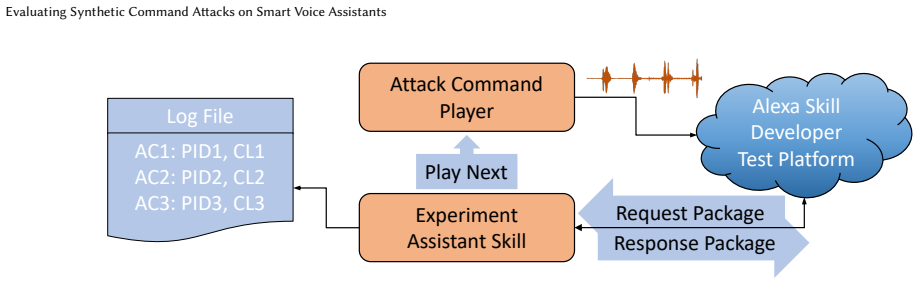
The load-bearing mechanism is unit-selection concatenative speech synthesis built on diphones, where a diphone is the transition between the last half of one phoneme and the first half of the next, with silence treated as a phoneme for word boundaries. A forced-alignment toolkit locates word and phoneme boundaries in the victim's speech; the synthesizer then cuts each needed diphone in the middle of the phoneme and concatenates the units to render a command. When the victim's audio lacks a required diphone, the system substitutes the same diphone from a donor profile of the same gender, chosen as the best-performing donor in cross-profile experiments. The evaluation harness is a custom Skill running on Amazon's Skill Developer Test Platform, which returns the recognized intent and a speaker-confidence level (0, 100, 200, 300) that a Skill can use to decide whether to honor the command.
What would settle it
Play the same nine synthesized commands to a physical Alexa device connected to a Skill that demands a specific confidence threshold and performs a genuine sensitive action, using commands built from 30 seconds and 4 minutes of the victim's speech collected in a real room; if fewer than 50% and 80% of the commands respectively pass the threshold, or if the confidence scores returned differ materially from those observed on the developer platform, the model-based scaling claims are empirically refuted.
Extended reading notes
Core claim
The central discovery is that an attacker does not need neural text-to-speech or voice cloning to defeat voice-based access control on a smart assistant. A basic unit-selection synthesizer that extracts diphones—the audio transitions between adjacent phonemes—from a victim's unrelated speech and concatenates the units needed to render a command achieves 93.8% intent recognition across nine commands and twenty user profiles on Amazon Alexa, and a speaker-confidence level of 300 (the maximum) for 19 of those profiles. When the victim's speech covers only part of the required diphones, missing units can be drawn from another speaker of the same gender; under that partial-coverage model, roughly half of commands succeed with 30 seconds of target speech and 80% succeed with four minutes, even when Skills require high speaker confidence. The attack also runs with a small footprint: about 34 MB of code and data versus 158 MB for a neural TTS alternative, with lower CPU and memory use while synthesizing.
Load-bearing premise
The headline scaling numbers—50% success from 30 seconds and 80% from four minutes—rest on a simulation that assumes the attacker always obtains the most frequent diphones, can fill every gap from a well-chosen same-gender donor, converts speech to diphones at 750 per minute, and can judge success from the speaker-confidence score alone rather than from executing a sensitive action on a real device.
Editorial extensions
If this is right
- Voice-profile matching as currently deployed on Alexa does not reliably separate concatenated synthetic commands from an authorized user's voice, so Skills that rely on it alone for sensitive actions are exposed.
- An attacker who harvests a small amount of unrelated speech—podcasts, videos, robocall recordings—can generate commands for sensitive actions such as unlocking a car or querying a bank account without any neural TTS infrastructure.
- Because the synthesis method is light on memory, CPU, and network download, it can run on a compromised device sitting near the assistant, staying under the radar of common resource-monitoring defenses.
- Short commands remain intelligible even at 20% diphone coverage, so the attack is most reliable for short high-value commands; longer commands degrade when coverage is low.
- The same technique should transfer to other voice assistants that use similar speaker-similarity scoring, although only Alexa was tested.
Reading between the lines
- The 30-second and four-minute success rates are extrapolations from a diphone-coverage model plus a fixed rate of 750 diphones per minute of speech; a direct end-to-end test on a physical device would be needed to confirm them, since the testbed routed audio internally without traversing a real room.
- The partial-coverage results define success by the speaker-confidence score alone and do not exercise an application's full authorization flow, so real-world Skills with additional steps (PINs, out-of-band confirmation) could raise the effective bar.
- The donor-substitution result suggests a stronger threat than the headline: even with no victim speech at all, the best-matching same-gender donor profile already achieved high confidence in cross-profile experiments, implying the voice check may be learnable from a look-alike voice.
- A natural extension would be to test whether the current version of the same technique defeats liveness or anti-spoofing checks that distinguish human speech from concatenated audio.
Signed reviews
Editorial analysis
A structured set of objections, weighed in public.
Referee Report
Summary. This paper investigates whether low-cost unit-selection concatenative speech synthesis can generate voice commands that are recognized by Amazon Alexa and pass voice-similarity checks. The authors built a testbed on the Alexa Skill Developer Test Platform, set up profiles for 20 VCTK speakers using Coqui TTS VITS, synthesized nine attack commands from diphones extracted from VCTK speech, and measured intent recognition and speaker-confidence scores. They report 93.8% intelligibility (169/180), confidence level 300 for 19 of 20 profiles, and, via a diphone-coverage model, success rates of 50% with 30 seconds of speech and 80% with 4 minutes. They also compare the computational and network footprints of their method against Coqui TTS.
Significance. The study addresses an important security question and provides a substantial empirical dataset with an automated testbed. The direct measurements of command intelligibility and speaker similarity under the authors' specific testbed conditions are concrete, and the resource-footprint comparison is a useful practical contribution. However, the central claims about the weakness of voice-profile matching in real deployments rest on two assumptions that are not fully validated: profiles are enrolled with synthetic TTS speech rather than natural user speech, and the partial-coverage success rates are model extrapolations rather than directly measured outcomes. If these issues are resolved with additional experiments or careful reframing, the paper would be a valuable contribution to the voice-assistant security literature.
major comments (3)
- [Section 4.1, Section 6.1.2, Fig. 7] The victim profiles are enrolled using Coqui TTS VITS synthetic speech (Section 4.1: 'to avoid privacy concerns related to voice-biometric data, we chose a well-trained and high quality text-to-speech (TTS) system to generate commands to set up a victim profile'), while the attack commands are concatenations of original VCTK audio (Section 4.3). Figure 7 therefore measures similarity between concatenated natural speech and a synthetic enrollment, not between an attacker's audio and a real user's enrolled voice. The high confidence values (300 for 19 of 20 profiles) could be an artifact of the enrollment being TTS-generated; a real attacker faces a profile enrolled from the victim's natural speech. The authors should add a control experiment in which profiles are enrolled from natural VCTK utterances (or from the same concatenative method) and show that the high confidence scores persist. Without this control, the central claim that 'voice profile matching provides little protection' (Section 8) is not established for real deployments.
- [Section 6.2, Section 6.4.3, Fig. 8, abstract] The headline scaling claims (50% success with 30 seconds of unrelated speech, 80% with 4 minutes) are not direct measurements. They are derived from a partial-coverage model that assumes the attacker has the p most frequent diphones (Section 6.2) and fills every missing diphone from donor profiles p288 and p360, which were selected because they 'provide the highest average confidence level in Fig. 7' (Section 6.4.3). Thus the attack success rates are effectively fit to the same experimental data used to choose the donors, making the 50% and 80% figures a best-case simulation rather than a validated prediction. The authors should either validate the partial-coverage model on held-out speakers and commands, or explicitly label these numbers as a sensitivity analysis with clearly stated assumptions, rather than presenting them as empirical attack outcomes in the abstract.
- [Section 6.4.3, Fig. 8] The success criterion for 'passing the speaker match process' is ambiguous: the paper reports confidence levels 0, 100, 200, and 300 (Section 6.3), but never states the threshold that a sensitive-action Skill would require, nor does it execute a sensitive operation end-to-end (e.g., actually invoking a bank Skill and observing a transaction). Figure 8's 'likelihood of successfully passing' the speaker match process at 20% coverage (~50%) is therefore undefined with respect to the threat model's central scenario of sensitive operations. The authors should specify the confidence threshold used to define success and justify it, or demonstrate a real Skill invocation, to make the reported success rates meaningful.
minor comments (5)
- [Section 6.4.2, Fig. 7] The sentence 'when the target profile on Alexa matches the profile which is the source of an attack command, the highest confidence level is returned independent of the method used for synthesizing the command' is contradicted by the one female profile where unit-selection returns 200 while Coqui TTS returns 300; rephrase to report the exact counts rather than the current generalization.
- [Section 5] The testbed uses loopback audio on the Alexa Skill Developer Test Platform rather than a physical device; this is acknowledged in Limitations, but it should also be mentioned when interpreting the intelligibility results, since microphone and echo conditions on real devices may affect recognition accuracy.
- [Fig. 7] The color bar ranges from 0 to 300 but is presented as a continuous scale; since only four discrete confidence levels (0, 100, 200, 300) are observed, consider adding a discrete legend to make the matrix entries easier to interpret.
- [Section 7] The statement 'We believe our results should be applicable for other voice assistants but we have not conducted similar experiments with them' is an unsupported generalization; either provide a reasoned argument for transferability or soften the claim to reflect that it is a conjecture.
- [Section 6.4.1, Fig. 5a] The text says 'for five of the ten male user profiles, intent for all 9 commands are correctly identified. For the other four profiles, the intent for only one command is missed' — this accounts for only 9 of 10 profiles; please correct the count or the description of the remaining profile.
Circularity Check
Partial-coverage success rates (50% from 30 seconds, 80% from 4 minutes) are fitted to the data: the donor profiles used to fill missing diphones are chosen because they already achieved the highest confidence in the same measurement being predicted, and the coverage model assumes the attacker receives the most frequent diphones.
-
fitted input called prediction
[Section 6.4.3 (Confidence Level Analysis for Different Diphone Coverage), building on Section 6.4.1 and the abstract's 30-second / 4-minute success claims]
"In our experiments, we used diphones from profile p288 for female and profile p360 for male targets as they provide the highest average confidence level in Fig. 7 when they are used to synthesize attack commands for the profiles of each gender. ... The results suggest that even with a relatively modest 20% coverage of the target's diphones, the likelihood of successfully passing the speaker match process remains about 50% with synthetic commands."
The donor profile used to supply missing diphones is selected precisely because it produced the highest confidence level, which is the outcome variable that the partial-coverage experiments then report as attack success. The same in-sample best donors (p288 and p360) are reused in Section 6.4.1 and feed the abstract's 50%/80% figures. In addition, Section 6.2 assumes the attacker obtains the most frequent diphones at any coverage level ('the diphones are ordered by popularity and the top half are chosen'), i.e., the best possible subset of target speech. Thus the headline limited-speech 'predictions' are conditional on fitted, best-case choices rather than being independent predictions.
full rationale
The full-coverage core measurements are genuine experiments and not circular: command intelligibility (93.8%, Section 6.4.1) and the 19-of-20 profiles receiving confidence 300 (Section 6.4.2) are direct testbed observations. The circularity is confined to the limited-speech extrapolation, where the attacker is assumed to have the most frequent diphones and missing diphones are filled from the empirically best-performing donor profiles chosen by looking at the same confidence matrix being used to define success. Because those donor choices and frequency assumptions are inputs selected to maximize the measured outcome, the resulting 50%-at-30-seconds and 80%-at-4-minutes claims in the abstract reduce to scenario assumptions rather than independent findings. Two non-circular correctness concerns are noted for context: the abstract's 30-second claim is hard to reconcile with Fig. 4 (50% diphone coverage requires roughly 2-4 minutes) and with the Section 7 limitation that 'target speech that is several minutes long will be required' for high confidence; and the abstract says the highest confidence was returned for '90%' of users while the body reports 19 of 20 (95%). The enrollment of profiles with Coqui TTS synthetic speech rather than the target's natural voice is an external-validity confound, but it is not circular because the similarity measurement is still an empirical comparison. Self-citations (e.g., reference [13]) are not load-bearing for the central claims.
Assumptions & free parameters
free parameters (4)
- diphones-per-minute estimate =
750
- partial-coverage availability rule =
top p% most frequent diphones
- best donor profiles for substitution =
p288 (female), p360 (male)
- success confidence threshold =
not explicitly stated (likely 300 or >=200)
assumptions (5)
- domain assumption An attacker can compromise a device near the target's voice assistant and use its speaker, microphone, and computation.
- domain assumption Unrelated speech of targets is practically harvestable from public sources or robocalls.
- domain assumption The Alexa Skill Developer Test Platform's intent recognition and speaker-confidence outputs are representative of real Echo devices.
- domain assumption Speaker profiles enrolled with TTS-generated voices behave like profiles enrolled with real user speech.
- standard math Forced alignment and diphone segmentation via MFA preserve the phonetic content needed for concatenative synthesis.
Cite this review
Pith. "Pith review of Evaluating Synthetic Command Attacks on Smart Voice Assistants." pith.science (2026). https://pith.science/paper/42XCT75Q
@misc{pith2026241108316,
  author       = {Pith},
  title        = {Pith review of: Evaluating Synthetic Command Attacks on Smart Voice Assistants},
  year         = {2026},
  howpublished = {\url{https://pith.science/paper/42XCT75Q}},
  note         = {Machine review of arXiv:2411.08316}
}
read the original abstract
Recent advances in voice synthesis, coupled with the ease with which speech can be harvested for millions of people, introduce new threats to applications that are enabled by devices such as voice assistants (e.g., Amazon Alexa, Google Home etc.). We explore if unrelated and limited amount of speech from a target can be used to synthesize commands for a voice assistant like Amazon Alexa. More specifically, we investigate attacks on voice assistants with synthetic commands when they match command sources to authorized users, and applications (e.g., Alexa Skills) process commands only when their source is an authorized user with a chosen confidence level. We demonstrate that even simple concatenative speech synthesis can be used by an attacker to command voice assistants to perform sensitive operations. We also show that such attacks, when launched by exploiting compromised devices in the vicinity of voice assistants, can have relatively small host and network footprint. Our results demonstrate the need for better defenses against synthetic malicious commands that could target voice assistants.
Figures


Figures from the paper (4 more)


Reference graph
Works this paper leans on
-
[1]
How malware can infect your PC
2018. How malware can infect your PC. https://support.microsoft.com/en- us/help/4466968/windows-10-how-malware-can-infect-your-pc
-
[2]
Hadi Abdullah, Washington Garcia, Christian Peeters, Patrick Traynor, Kevin R B Butler, and Joseph Wilson. 2018. Practical Hidden Voice Attacks against Speech and Speaker Recognition Systems. In Network and Distributed System Security Symposium. Internet Society, Reston, VA, 1–15
work page 2018
-
[3]
Amazon Alexa. 2023. Create Intents, Utterances, and Slots . https: //developer.amazon.com/en-US/docs/alexa/custom-skills/create-intents- utterances-and-slots.html Alexa Skills Kit
work page 2023
-
[4]
Logan Blue, Luis Vargas, and Patrick Traynor. 2018. Hello, Is It Me You’re Looking For?: Differentiating Between Human and Electronic Speakers for Voice Interface Security. InProceedings of the 11th ACM Conference on Security & Privacy in Wireless and Mobile Networks . ACM, 123–133
work page 2018
-
[5]
Nicholas Carlini, Pratyush Mishra, Tavish Vaidya, Yuankai Zhang, Micah Sherr, Clay Shields, David A Wagner 0001, and Wenchao Zhou. 2016. Hidden Voice Commands. USENIX Security Symposium (2016)
work page 2016
-
[6]
Nicholas Carlini and David Wagner. 2018. Audio Adversarial Examples: Targeted Attacks on Speech-to-Text. arXiv.org (Jan. 2018). arXiv:1801.01944v2 [cs.LG]
arXiv 2018
-
[7]
Papers With Code. 2023. Papers with Code - LJSpeech Benchmark (Text-To- Speech Synthesis). https://paperswithcode.com/sota/text-to-speech-synthesis- on-ljspeech The current state-of-the-art on LJSpeech is NaturalSpeech. See a full comparison of 15 papers with code
work page 2023
-
[8]
Coqui. 2023. Coqui: A New Way to Do Voice Overs. Available from: https: //coqui.ai/
work page 2023
Show all 51 references
-
[9]
Donghui Dai, Zhenlin An, and Lei Yang. 2022. Inducing wireless chargers to voice out for inaudible command attacks. In 2023 IEEE Symposium on Security and Privacy (SP). IEEE Computer Society, 503–520
2022
-
[10]
Hossein B Darbandi. 2002. Speech recognition & diphone extraction for natural speech synthesis. Ph. D. Dissertation. University of British Columbia
2002
-
[11]
Wenrui Diao, Xiangyu Liu, Zhe Zhou, and Kehuan Zhang. 2014. Your voice assis- tant is mine: How to abuse speakers to steal information and control your phone. In Proceedings of the 4th ACM Workshop on Security and Privacy in Smartphones & Mobile Devices. ACM, 63–74
2014
-
[12]
Adam Gabryś, Goeric Huybrechts, Manuel Sam Ribeiro, Chung-Ming Chien, Ju- lian Roth, Giulia Comini, Roberto Barra-Chicote, Bartek Perz, and Jaime Lorenzo- Trueba. 2022. Voice Filter: Few-shot text-to-speech speaker adaptation using voice conversion as a post-processing module....
2022
-
[13]
Zhengxian He, Mohit Narayan Rajput, and Mustaque Ahamad. 2021. Compro- mised computers meet voice assistants: Stealthily exfiltrating data as voice over telephony. In 2021 51st Annual IEEE/IFIP International Conference on Dependable Systems and Networks (DSN) . IEEE, 519–530
2021
-
[14]
Goeric Huybrechts, Thomas Merritt, Giulia Comini, Bartek Perz, Raahil Shah, and Jaime Lorenzo-Trueba. 2021. Low-resource expressive text-to-speech using data augmentation. In ICASSP 2021-2021 IEEE International Conference on Acoustics, Speech and Signal Processing (ICASSP) . I...
2021
-
[15]
ElevenLabs Inc. 2023. High Quality AI Voice Cloning. Available from: https: //elevenlabs.io/voice-cloning
2023
-
[16]
Yeongjin Jang, Chengyu Song, Simon P Chung, Tielei Wang, and Wenke Lee
-
[17]
Andre Kassis and Urs Hengartner. 2023. Breaking Security-Critical Voice Authen- tication. In 2023 IEEE Symposium on Security and Privacy (SP) . IEEE Computer Society, 951–968
2023
-
[18]
Jaehyeon Kim, Jungil Kong, and Juhee Son. 2021. Conditional variational autoen- coder with adversarial learning for end-to-end text-to-speech. In International Conference on Machine Learning . PMLR, 5530–5540
2021
-
[19]
Deepak Kumar, Riccardo Paccagnella, Paul Murley, Eric Hennenfent, Joshua Mason, Adam Bates, and Michael Bailey. 2018. Skill squatting attacks on Amazon Alexa. In 27th USENIX Security Symposium (USENIX Security 18) . 33–47
2018
-
[20]
Kevin A Lenzo and Alan W Black. 2000. Diphone collection and synthesis.. In INTERSPEECH. 306–309
2000
-
[21]
Jingyi Li, Weiping Tu, and Li Xiao. 2023. Freevc: Towards High-Quality Text-Free One-Shot Voice Conversion. In ICASSP 2023-2023 IEEE International Conference on Acoustics, Speech and Signal Processing (ICASSP) . IEEE, 1–5
2023
-
[22]
Zhuohang Li, Cong Shi, Yi Xie, Jian Liu, Bo Yuan, and Yingying Chen. 2020. Practical adversarial attacks against speaker recognition systems. In Proceedings of the 21st international workshop on mobile computing systems and applications . 9–14
2020
-
[23]
Barry Libert and Megan Beck. 2017. AI May Soon Replace Even the Most Elite Consultants. https://hbr.org/2017/07/ai-may-soon-replace-even-the-most-elite- consultants
2017
-
[24]
Mirko Marras, Pawel Korus, Nasir D Memon, and Gianni Fenu. 2019. Adversarial Optimization for Dictionary Attacks on Speaker Verification.. In Interspeech. 2913–2917
2019
-
[25]
Michael McAuliffe, Michaela Socolof, Sarah Mihuc, Michael Wagner, and Mor- gan Sonderegger. 2017. Montreal Forced Aligner: Trainable Text-Speech Align- ment Using Kaldi. In Proc. Interspeech 2017. 498–502. https://doi.org/10.21437/ Interspeech.2017-1386
2017
-
[26]
Microsoft. 2023. Test accuracy of a Custom Speech model - Speech service - Azure AI services. https://learn.microsoft.com/en-us/azure/ai-services/speech- service/how-to-custom-speech-evaluate-data?pivots=speech-studio Accessed: 2023-07-25
2023
-
[27]
Taiki Nakamura, Yuki Saito, Shinnosuke Takamichi, Yusuke Ijima, and Hiroshi Saruwatari. 2019. V2S attack: building DNN-based voice conversion from auto- matic speaker verification. arXiv preprint arXiv:1908.01454 (2019)
2019 arXiv
-
[28]
Douglas O’Shaughnessy, Louis Barbeau, David Bernardi, and Danièle Archam- bault. 1988. Diphone speech synthesis. Speech Communication 7, 1 (1988), 55–65. https://doi.org/10.1016/0167-6393(88)90021-0
1988 doi
-
[29]
Yao Qin, Nicholas Carlini, Garrison Cottrell, Ian Goodfellow, and Colin Raffel
-
[30]
Nirupam Roy, Sheng Shen, Haitham Hassanieh, and Romit Roy Choudhury. 2018. Inaudible Voice Commands: The Long-Range Attack and Defense. In the 15th USENIX Symposium on Networked Systems Design and Implementation . Renton, 546–560
2018
-
[31]
Yuki Saito, Shinnosuke Takamichi, and Hiroshi Saruwatari. 2017. Statistical parametric speech synthesis incorporating generative adversarial networks. IEEE/ACM Transactions on Audio, Speech, and Language Processing 26, 1 (2017), 84–96
2017
-
[32]
Yuki Saito, Shinnosuke Takamichi, and Hiroshi Saruwatari. 2017. Training algorithm to deceive anti-spoofing verification for DNN-based speech synthesis. In 2017 IEEE International Conference on Acoustics, Speech and Signal Processing (ICASSP). IEEE, 4900–4904
2017
-
[33]
Karen Scarfone and Peter Mell. 2012. Guide to intrusion detection and prevention systems (idps). Technical Report. National Institute of Standards and Technology
2012
-
[34]
Lea Schönherr, Katharina Kohls, Steffen Zeiler, Thorsten Holz, and Dorothea Kolossa. 2018. Adversarial attacks against automatic speech recognition systems via psychoacoustic hiding. arXiv preprint arXiv:1808.05665 (2018)
2018 arXiv
-
[35]
Faysal Hossain Shezan, Hang Hu, Jiamin Wang, Gang Wang, and Yuan Tian. 2020. Read between the lines: An empirical measurement of sensitive applications of voice personal assistant systems. In Proceedings of the Web Conference 2020 . 1006–1017
2020
-
[36]
Xu Tan, Tao Qin, Frank Soong, and Tie-Yan Liu. 2021. A survey on neural speech synthesis. arXiv preprint arXiv:2106.15561 (2021)
2021 arXiv
-
[37]
Xiaohai Tian, Rohan Kumar Das, and Haizhou Li. 2020. Black-box Attacks on Automatic Speaker Verification using Feedback-controlled Voice Conversion. In Proc. The Speaker and Language Recognition Workshop (Odyssey 2020) . 159–164. https://doi.org/10.21437/Odyssey.2020-23
2020 doi
-
[38]
Christophe Veaux, Junichi Yamagishi, Kirsten MacDonald, et al . 2017. CSTR VCTK corpus: English multi-speaker corpus for CSTR voice cloning toolkit. University of Edinburgh. The Centre for Speech Technology Research (CSTR) 6 (2017), 15
2017
-
[39]
Brandon Vigliarolo. 2017. Crestron, Amazon partner to bring Alexa to meet- ing rooms. https://www.techrepublic.com/article/crestron-amazon-partner-to- bring-alexa-to-meeting-rooms/
2017
-
[40]
Chengyi Wang, Sanyuan Chen, Yu Wu, Ziqiang Zhang, Long Zhou, Shujie Liu, Zhuo Chen, Yanqing Liu, Huaming Wang, Jinyu Li, Lei He, Sheng Zhao, and Furu Wei. 2023. Neural Codec Language Models are Zero-Shot Text to Speech Synthesizers. arXiv
2023
-
[41]
Wikipedia contributors. 2022. ARPABET — Wikipedia, The Free Encyclope- dia. https://en.wikipedia.org/w/index.php?title=ARPABET&oldid=1103994253 [Online; accessed 9-May-2024]
2022
-
[42]
Yi Xie, Cong Shi, Zhuohang Li, Jian Liu, Yingying Chen, and Bo Yuan. 2020. Real-time, universal, and robust adversarial attacks against speaker recognition systems. In ICASSP 2020-2020 IEEE international conference on acoustics, speech and signal processing (ICASSP) . IEEE, 1738–1742
2020
-
[43]
Jin Xu, Xu Tan, Yi Ren, Tao Qin, Jian Li, Sheng Zhao, and Tie-Yan Liu. 2020. Lrspeech: Extremely low-resource speech synthesis and recognition. In Proceed- ings of the 26th ACM SIGKDD International Conference on Knowledge Discovery & Data Mining. 2802–2812
2020
-
[44]
Junichi Yamagishi, Christophe Veaux, and Kirsten MacDonald. 2019. CSTR VCTK Corpus: English Multi-speaker Corpus for CSTR Voice Cloning Toolkit (version 0.92). https://doi.org/10.7488/ds/2645
2019 doi
-
[45]
Chen Yan, Xiaoyu Ji, Kai Wang, Qinhong Jiang, Zizhi Jin, and Wenyuan Xu
-
[46]
Qiben Yan, Kehai Liu, Qin Zhou, Hanqing Guo, and Ning Zhang. 2020. Surfin- gAttack: Interactive Hidden Attack on Voice Assistants Using Ultrasonic Guided Waves. In Network and Distributed System Security Symposium . Internet Society, Reston, VA, 1–18. 11 Zhengxian He, Ashish K...
2020
-
[47]
Xuejing Yuan, Yuxuan Chen, Yue Zhao, Yunhui Long, Xiaokang Liu, Kai Chen, Shengzhi Zhang, Heqing Huang, Xiaofeng Wang, and Carl A Gunter. 2018. Com- manderSong: A Systematic Approach for Practical Adversarial Voice Recognition. In the 27th USENIX Security Symposium . 1–17
2018
-
[48]
Guoming Zhang, Chen Yan, Xiaoyu Ji, Taimin Zhang, Tianchen Zhang, and Wenyuan Xu. 2017. DolphinAtack: Inaudible Voice Commands. In ACM Confer- ence on Computer and Communications Security . A APPENDIX ID AGE ACCENTS REGION p237 22 Scottish Fife p247 22 Scottish Argyll p251 26 ...
2017
-
[2014]
In Proceedings of the 2014 ACM SIGSAC Conference on Computer and Communications Security
A11y attacks: Exploiting accessibility in operating systems. In Proceedings of the 2014 ACM SIGSAC Conference on Computer and Communications Security . ACM, 103–115
2014
-
[2019]
In International Conference on Machine Learning
Imperceptible, robust, and targeted adversarial examples for automatic speech recognition. In International Conference on Machine Learning. 5231–5240
-
[2022]
A Survey on Voice Assistant Security: Attacks and Countermeasures.ACM Comput. Surv. 55, 4, Article 84 (nov 2022), 36 pages. https://doi.org/10.1145/ 3527153
2022
Reviewed August 12, 2026 · model on record in the stance chip above.
Discussion (0). Continue with ORCID to comment.