REVIEW 4 major objections 6 minor 14 references
Towards unearthing neglected climate innovations from scientific literature using Large Language Models
T0 review · 4 major / 6 minor · reviewed 2026-08-12 · deepseek-v4-flash
Pith's one-line read A context-prompted large language model can rank known climate spin-out papers ahead of nearly all random abstracts, offering a high-throughput way to surface neglected climate innovations from scientific literature.
desk verdict A well-intentioned pilot on using LLMs to surface neglected climate innovations, but the validation evidence for the ranking algorithm is too weak to support the central claim. read the letter →
The pith
A machine-rendered reading of the paper's core claim, the machinery that carries it, and where it could break.
The reading
What carries the argument
The central object is a prompted LLM evaluator: a large language model given title-abstract pairs plus the same textual context offered to human raters, producing yes/no or 1–10 answers to seven questions (mitigation potential, practical technology, proof-of-concept readiness, market need, enabling science, eco-focus, and neglectedness). The outputs are filtered by a mitigation-potential threshold, and the remaining six scores are combined with logistic-regression weights learned from five known spin-out papers to produce a ranked list. Scalar scoring replaces binary scoring to break ties and give the ranking practical resolution.
What would settle it
Run the same pipeline on a blinded set of 50 known climate spin-out abstracts mixed with 950 random abstracts; the central claim fails if fewer than half of the known spin-outs rank above the median random abstract, or if an expert panel finds no more real ventures among the top 50 than among a random 50.
Extended reading notes
Core claim
The paper's central claim is that an LLM provided with appropriate context and a scoring scheme can effectively augment human expertise in identifying overlooked climate innovations, finding potentially impactful solutions in scientific literature far faster and more consistently than manual review. The evidence is the ranking experiment: the context-prompted model put all five known spin-out papers at positions 5, 6, 9, 10, and 14 in a 100-abstract set, and in a 1,000-abstract validation it placed eight of ten independent spin-out papers in the top 95. The authors interpret this as demonstrating that the research evidence base for high-impact climate solutions is already documented and can be surfaced systematically. They also report that human scoring was highly variable, with negative inter-rater agreement on neglectedness, while the LLM was near-deterministic and most aligned with humans when given the same context text.
Load-bearing premise
The load-bearing premise is that six human survey participants provide a dependable gold standard for all seven evaluation criteria, including subjective ones such as neglectedness; the paper's own results show high human variability and negative agreement on neglectedness, so the benchmark against which the LLM is judged may itself be unstable.
Editorial extensions
If this is right
- The context-prompted LLM placed all five known climate spin-out papers at positions 5, 6, 9, 10, and 14 among 100 abstracts, and eight of ten independent spin-out papers in the top 95 of 1,000 unseen abstracts.
- Because the prompt-and-score workflow is region-agnostic, the same pipeline can be reapplied to other countries' scientific literature to surface neglected climate solutions.
- Scalar (1–10) scoring instead of binary scoring improved ranking resolution from 12 tied scores out of 25 filtered abstracts to 2 ties out of 24, making practical triage feasible.
- The logistic-regression weighting trained on only five positive controls leaves room for improvement; the validation set results suggest that training on more known spin-outs would sharpen the ranking.
Reading between the lines
- The negative human inter-rater agreement on neglectedness suggests the benchmark used to judge the LLM is itself unstable; a fairer test would compare the LLM's ranking against observed outcomes, such as which papers actually produced spin-outs, grants, or patents.
- The LLM's clear internal separation between market-readiness questions and early-stage/neglected questions mirrors the conceptual split the survey intended, which raises the possibility that the model is a more consistent first-pass screener than pooled human judgment.
- A testable extension would be an iterative loop: present the top-ranked abstracts to domain experts, let their corrections update the logistic-regression weights, and re-run on the remaining corpus, potentially lifting ranking precision well beyond the 8-of-10 validation result.
Editorial analysis
A structured set of objections, weighed in public.
Referee Report
Summary. The paper presents a workflow to identify neglected climate innovations from scientific abstracts using LLMs. It collects 100 abstracts from OpenAlex (including 5 positive controls linked to spin-out companies), obtains human and GPT-4o evaluations on seven binary questions under three prompting scenarios, and constructs a ranking algorithm based on a Q1 threshold and logistic-regression weights. The authors report that the context-prompted LLM ranks the 5 controls at positions 5, 6, 9, 10, and 14 in the 100-abstract set, and 8 of 10 independent controls appear in the top 95 of 176 filtered abstracts in a 1000-abstract validation.
Significance. The proposed workflow addresses a real and important problem: high-throughput screening of large research corpora for potentially impactful but neglected climate solutions. The paper's strengths are its use of a public, reproducible data source (OpenAlex), a concrete query script, three prompting scenarios, and an independent validation set. However, the central claim is not yet established: the ranking evidence is weakened by an unidentifiable logistic regression fit on 5 positives, in-sample ranks in the 100-abstract test, and an out-of-sample result that is not statistically distinguishable from chance at the 5% level. With additional analyses and more careful reporting, the workflow could become a useful contribution.
major comments (4)
- [Section 4.2.2] The logistic regression used to derive the Table 2 weights is not identifiable from the stated procedure: the likelihood L(β0, β) in Section 4.2.2 requires both y=1 and y=0 observations, yet the text states the regression was applied 'exclusively to the set of 5 known positive control abstracts.' With 6 predictors and only 5 positive examples (and no negatives), the coefficients are not uniquely determined and, if the likelihood is maximized on positives alone, the weights diverge. The reported weights therefore cannot be reproduced from the description, and the subsequent ranking depends on an arbitrary or implementation-specific solution.
- [Section 4.2.4] The ranks of the 5 positive controls (positions 5, 6, 9, 10, 14) are in-sample results: the same controls were used to fit the logistic regression weights in Section 4.2.2, so high ranks are expected by construction. These ranks do not provide out-of-sample evidence of the ranking algorithm's performance.
- [Section 4.3] The independent validation is the only out-of-sample evidence, but it is not statistically significant. With 176 papers passing the Q1 filter and 8 of 10 controls among the top 95, the one-sided hypergeometric probability of observing at least 8 controls in the top 95 under random ranking is approximately 0.09, which does not reject the null at the 5% level. No baseline (e.g., keyword matching, random ranking, or an embedding-based retriever), confidence interval, or significance test is reported, so the result is consistent with chance and does not support the abstract's claim that the LLM 'effectively' uncovers neglected climate innovations.
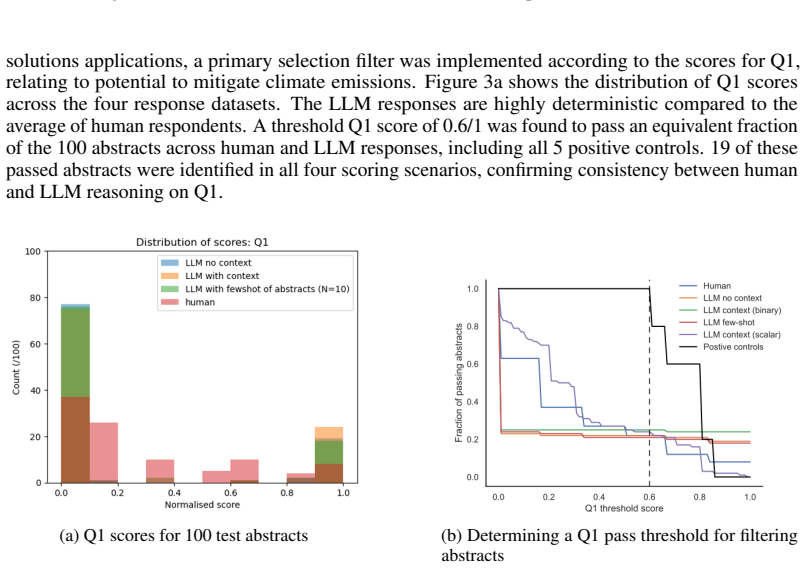
- [Section 4.2.1] The Q1 pass threshold of 0.6/1 is not a fixed, pre-registered criterion but was chosen so that 'an equivalent fraction of the 100 abstracts' passes and all 5 positive controls are included. This adds another degree of freedom tuned on the positive controls, further reducing the strength of the ranking evidence; the threshold's behavior on the validation set should be reported as a sensitivity analysis.
minor comments (6)
- [Section 3.2] The statement that the OpenAlex topic taxonomy was reduced to '1860 topic classifications out of 1416 total' is internally inconsistent; earlier the paper says OpenAlex has 4516 granular topics, so the intended numbers should be corrected.
- [Section 3.1] Use 'an LLM' instead of 'a LLM' in the first sentence of Section 3.1.
- [Section 4.1] 'higest' in the sentence about the sum of Cohen's Kappa scores should be 'highest'.
- [Section 4.2.4] 'under ownsership by one or more contributing authors' should be 'under ownership by one or more contributing authors'.
- [Section 4.2.2] The normalized weights w_i are described as positive, but Table 2 contains negative coefficients; clarify whether the normalization uses absolute values or how negative weights are handled.
- [Table 1 and Section 4.1] The negative Cohen's Kappa for Q7 (neglectedness) in the context scenario (κ = -0.256) indicates that the human raters disagree beyond chance; the paper should acknowledge this limitation when interpreting LLM-human alignment.
Circularity Check
In-sample ranking of training controls is presented as evidence, but an independent validation set keeps the central claim from being fully circular.
-
fitted input called prediction
[Section 4.2.2 and Section 4.2.4]
"we applied logistic regression exclusively to the set of 5 known positive control abstracts related to successful spin-out ventures. ... The LLM ranked the 5 positive control abstracts at positions 5, 6, 9, 10 and 14"
The logistic-regression weights are estimated from the same 5 positive control abstracts whose ranks are then reported in Section 4.2.4. Because the weights are fit to maximize separation of those very abstracts, their high ranks are an in-sample result obtained by construction, not an out-of-sample prediction. The Q1 threshold was also chosen to include all 5 controls. Thus the 100-abstract exhibit does not independently validate the ranking algorithm. The paper does provide separate out-of-sample evidence in Section 4.3 with 10 unseen controls, so the central claim does not rest solely on this circular step.
full rationale
The paper contains no load-bearing self-citations, no imported uniqueness theorems, and no ansatz smuggled via citation. The central methodological chain is: LLM scores abstracts, a logistic-regression weighting is fit on 5 positive controls, and abstracts are ranked. The one clear circular element is that the same 5 controls used for fitting are then reported as ranked at positions 5, 6, 9, 10 and 14 in the 100-abstract test; this is an in-sample evaluation and would be expected after fitting weights to those controls. However, Section 4.3 validates the optimized pipeline on 10 independent positive controls in a 1000-abstract corpus, providing genuinely out-of-sample evidence. Whether that evidence is statistically strong is a correctness concern, not a circularity concern. Therefore the central claim is not equivalent to its inputs; the circularity is partial and localized to the presentation of the in-sample rankings.
Assumptions & free parameters
free parameters (3)
- Q1 pass threshold =
0.6
- Logistic regression weights for Q2-Q7 =
Table 2 (varies by scenario); e.g., context binary Q2=0.211, Q3=0.339, Q4=0.102, Q5=-0.235, Q6=0.663, Q7=-0.080
- Normalized weights w_i =
Normalized from beta_i to sum to 1
assumptions (6)
- domain assumption OpenAlex metadata (corresponding author, institution, topic, type, year) is accurate and complete for the query.
- ad hoc to paper The manually curated subset of OpenAlex topics captures the majority of climate-relevant research.
- domain assumption Title-abstract pairs contain enough information to judge mitigation potential, readiness, market need, and neglectedness.
- domain assumption The six human evaluators provide a valid benchmark for climate innovation promise.
- ad hoc to paper Logistic regression on 5 positive controls produces generalizable weights.
- domain assumption Spin-out company formation is a valid proxy for successful climate innovation.
Cite this review
Pith. "Pith review of Towards unearthing neglected climate innovations from scientific literature using Large Language Models." pith.science (2026). https://pith.science/paper/EJWBUSNI
@misc{pith2026241110055,
  author       = {Pith},
  title        = {Pith review of: Towards unearthing neglected climate innovations from scientific literature using Large Language Models},
  year         = {2026},
  howpublished = {\url{https://pith.science/paper/EJWBUSNI}},
  note         = {Machine review of arXiv:2411.10055}
}
read the original abstract
Climate change poses an urgent global threat, needing the rapid identification and deployment of innovative solutions. We hypothesise that many of these solutions already exist within scientific literature but remain underutilised. To address this gap, this study employs a curated dataset sourced from OpenAlex, a comprehensive repository of scientific papers. Utilising Large Language Models (LLMs), such as GPT4-o from OpenAI, we evaluate title-abstract pairs from scientific papers on seven dimensions, covering climate change mitigation potential, stage of technological development, and readiness for deployment. The outputs of the language models are then compared with human evaluations to assess their effectiveness in identifying promising yet overlooked climate innovations. Our findings suggest that these LLM-based models can effectively augment human expertise, uncovering climate solutions that are potentially impactful but with far greater speed, throughput and consistency. Here, we focused on UK-based solutions, but the workflow is region-agnostic. This work contributes to the discovery of neglected innovations in scientific literature and demonstrates the potential of AI in enhancing climate action strategies.
Figures


Figures from the paper (1 more)

Reference graph
Works this paper leans on
-
[1]
I. E. Agency. Net zero by 2050: A roadmap for the global energy sector. https://www.iea. org/reports/net-zero-by-2050 , 2021. Accessed: 2024-10-04
work page 2021
-
[2]
L. Bornmann and R. Mutz. Growth rates of modern science: A bibliometric analysis based on the number of publications and cited references. Journal of the association for information science and technology, 66(11):2215–2222, 2015
work page 2015
-
[3]
C. Cao, J. Zhuang, and Q. He. Llm-assisted modeling and simulations for public sector decision- making: Bridging climate data and policy insights. In AAAI-2024 Workshop on Public Sector LLMs: Algorithmic and Sociotechnical Design , 2024
work page 2024
-
[4]
M. Desmond, Z. Ashktorab, Q. Pan, C. Dugan, and J. M. Johnson. Evalullm: Llm assisted eval- uation of generative outputs. In Companion Proceedings of the 29th International Conference on Intelligent User Interfaces , pages 30–32, 2024
work page 2024
-
[5]
Y . Liu, T. Yang, S. Huang, Z. Zhang, H. Huang, F. Wei, W. Deng, F. Sun, and Q. Zhang. Calibrating llm-based evaluator. arXiv preprint arXiv:2309.13308, 2023
arXiv 2023
-
[6]
M. Marx and A. Fuegi. Reliance on science by inventors: Hybrid extraction of in-text patent-to- article citations. Journal of Economics & Management Strategy , 31(2):369–392, 2022
work page 2022
-
[7]
The landscape of innovation approaches: Introducing version 2
Nesta. The landscape of innovation approaches: Introducing version 2. https://www.nesta. org.uk/blog/landscape-innovation-approaches-introducing-version-2/ , 2021. Accessed: 2024-10-04
work page 2021
- [8]
Show all 14 references
-
[9]
Rolnick, P
D. Rolnick, P. L. Donti, L. H. Kaack, K. Kochanski, A. Lacoste, K. Sankaran, A. S. Ross, N. Milojevic-Dupont, N. Jaques, A. Waldman-Brown, et al. Tackling climate change with machine learning. ACM Computing Surveys (CSUR), 55(2):1–96, 2022
2022
-
[10]
Shankar, J
S. Shankar, J. Zamfirescu-Pereira, B. Hartmann, A. G. Parameswaran, and I. Arawjo. Who validates the validators? aligning llm-assisted evaluation of llm outputs with human preferences. arXiv preprint arXiv:2404.12272, 2024
2024 arXiv
-
[11]
Stanny and K
E. Stanny and K. Ely. Corporate environmental disclosures about the effects of climate change. Corporate social responsibility and environmental management, 15(6):338–348, 2008
2008
-
[12]
The Department of Business and U
E. The Department of Business and U. Industrial Strategy. Business, energy and industrial strategy annual report. Report, 2022
2022
-
[13]
K. Wang, Z. Shen, C. Huang, C.-H. Wu, Y . Dong, and A. Kanakia. Microsoft academic graph: When experts are not enough. Quantitative Science Studies, 1(1):396–413, 2020
2020
-
[14]
i n s t i t u t i o n s
J. C. Yang, M. Korecki, D. Dailisan, C. I. Hausladen, and D. Helbing. Llm voting: Human choices and ai collective decision making. arXiv preprint arXiv:2402.01766, 2024. 9 A Appendix 1 import pyalex 2 query = Works () . filter ( a u t h o r s h i p s ={ " i n s t i t u t i o n...
2024 arXiv
Reviewed August 12, 2026 · model on record in the stance chip above.
Discussion (0). Continue with ORCID to comment.