REVIEW 3 major objections 6 minor 67 references
IKEA Manuals at Work: 4D Grounding of Assembly Instructions on Internet Videos
T0 review · 3 major / 6 minor · reviewed 2026-08-12 · deepseek-v4-flash
Pith's one-line read IKEA Video Manuals is the first dataset to ground assembly instructions in videos with dense spatio-temporal alignments among 3D part models, step-by-step manuals, and real-world internet videos.
desk verdict A useful, well-documented assembly dataset that deserves peer review; the pose ground truth lacks an independent accuracy check, and the paper should be revised to supply one. read the letter →
The pith
A machine-rendered reading of the paper's core claim, the machinery that carries it, and where it could break.
The reading
What carries the argument
The central object is the 4D grounding itself: a dense spatio-temporal alignment in which 3D furniture parts, manual steps, and video frames are tied together, with each frame's sub-assemblies given a segmentation mask and a 6-DoF pose in the camera coordinate frame, plus per-segment camera intrinsics. The machinery that produces it is a semi-automated annotation pipeline: videos are split into substeps defined by the appearance of a new part or the formation of a sub-assembly; part identities are assigned by watching the whole video; masks are generated interactively with the Segment Anything Model and manually corrected; and poses come from hand-labeled 2D-3D keypoints solved with PnP and RANSAC to estimate intrinsics per video segment, then refined by annotators in a 3D interface that checks relative poses, coplanarity, and cross-frame consistency from multiple viewpoints. The load-bearing link is the mapping from each manual image to a contiguous span of video frames, so that the same assembly step has both a pictorial and a physical demonstration.
What would settle it
Take a random sample of annotated frames, project the annotated 3D part poses into the image using the provided camera intrinsics, and measure the silhouette overlap against the annotated segmentation masks; if the projected outlines systematically drift from the masks in frames with camera motion or across segment boundaries, the intrinsic estimation is biased. A stronger test is to independently calibrate a subset of videos using structure-from-motion on static background or known planar surfaces such as tabletops and compare the recovered intrinsics and poses; if the independent calibration disagrees with the dataset's estimates beyond a few degrees or centimeters, the claimed 6-DoF ground truth is not yet established.
Extended reading notes
Core claim
On the paper's own terms, the discovery is the data itself: a benchmark in which each furniture item is represented by its 3D parts with 6-DoF poses, and each sampled video frame carries the identity, segmentation mask, and camera-frame 6-DoF pose of every sub-assembly in view, together with camera intrinsics estimated per video segment and a mapping from each manual step to a span of video substeps. The authors claim this is the first dataset to supply 6-DoF pose annotations for furniture assembly from internet videos, combining the 3D models and manuals of the IKEA-Manual dataset with in-the-wild part trajectories that prior datasets only approximated. The annotation process assembles these correspondences through temporal segmentation into substeps, part identity tracking, Segment Anything Model assisted mask annotation, keypoint-based camera estimation with PnP and RANSAC, and manual 3D refinement verified from multiple viewpoints. On this resource the paper defines five applications, assembly plan generation, part-conditioned segmentation, part-conditioned pose estimation, video object segmentation, and furniture assembly from instruction videos, and reports baselines showing that all of them remain difficult.
Load-bearing premise
The dataset's pose annotations are treated as ground truth, but the camera parameters they depend on are estimated from hand-labeled keypoints and manual refinement rather than measured or independently validated, so any systematic error in the cameras would silently bias every downstream pose number.
Editorial extensions
If this is right
- Because the dataset anchors manual steps, 3D poses, and video pixels to the same events, a system that masters its five benchmark tasks could watch an assembly video and produce an executable assembly plan grounded in real object poses rather than in 2D annotations alone.
- The reported baselines show that zero-shot part segmentation and pose estimation methods such as CNOS, SAM-6D, and MegaPose degrade substantially on internet video compared with lab-based benchmarks, quantifying a measurable gap between current methods and in-the-wild assembly understanding.
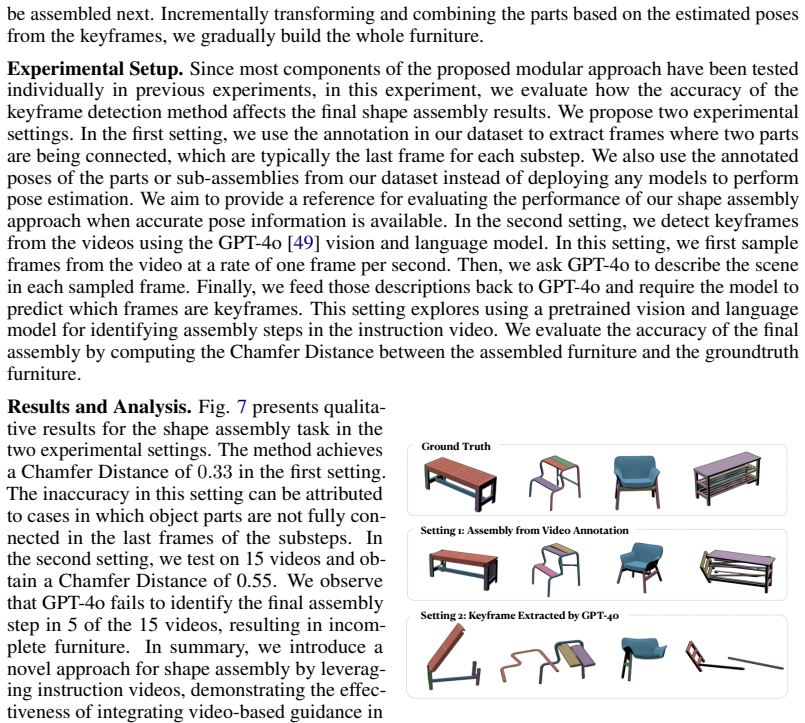
- The video-based assembly task demonstrates that with ground-truth keyframe and pose annotations a modular pipeline assembles furniture to a Chamfer distance of 0.33, while replacing keyframe detection with GPT-4o degrades this to 0.55, indicating that automatic step detection is currently the weakest link in video-guided assembly.
- The dataset's comparison with existing resources such as Assembly101, IKEA ASM, IKEA-Manual, and IKEA in the Wild positions it as the only one combining internet-sourced video, 3D object models, and dense 6-DoF annotations, enabling evaluation of generalization across environments and assembly sequences.
Reading between the lines
- The camera intrinsics estimated per video segment are the hidden load-bearing assumption: the paper states that correct camera parameters are a prerequisite for pose accuracy, yet reports no independent calibration check or inter-annotator agreement study, so a systematic bias in those estimates would transfer directly into every 6-DoF pose number in the benchmark.
- Because the annotation pipeline is built on Segment Anything Model prompts plus keypoint PnP, the marginal cost of extending the dataset to new furniture categories is plausibly much lower than for fully manual datasets; the same pipeline could be reapplied to other branded assembly products.
- All pose baselines run from monocular RGB with estimated depth, even though the dataset supplies true 3D geometry and camera parameters; a natural next experiment, not run in the paper, is to measure how much of the reported gap closes when methods are allowed to use the provided intrinsics and multi-frame consistency.
- The manual refinement step that corrects 2D-projection errors by checking part poses from top and side views suggests that pure automatic pose recovery from keypoints is insufficient for ground-truth quality, which implies the dataset's accuracy depends on human effort that future scaling of the resource will need to control.
Editorial analysis
A structured set of objections, weighed in public.
Referee Report
Summary. The paper introduces IKEA Video Manuals, a multimodal dataset that aligns 3D furniture models from IKEA-Manual with Internet assembly videos from IAW. For 98 videos and 36 furniture models it provides temporal step and substep alignments, per-frame part segmentation masks, per-frame 6-DoF part poses, and per-segment camera intrinsic estimates. The authors report five applications—assembly plan generation, part-conditioned segmentation, part-conditioned pose estimation, video object segmentation, and video-based shape assembly—with baseline evaluations showing that current methods perform poorly on this real-world data. The central claim is that this is the first dataset offering dense spatio-temporal (4D) grounding of assembly instructions in Internet videos.
Significance. If the annotation quality is adequate, this is a valuable benchmark contribution: it fills a real gap by combining real-world assembly videos with 3D models and manuals, and it includes a substantial annotation pipeline, detailed appendices, a datasheet, a public release under CC-BY-4.0, and a DOI. The five baseline tasks and the qualitative error analysis in Appendix H give the community concrete starting points. The paper's main weakness is that the novel 6-DoF pose and camera-intrinsic annotations are not validated quantitatively, which matters because the poses are the distinguishing asset of the dataset and are used as ground truth in Tables 4 and 5 and in Section 5.5.
major comments (3)
- [§4.4, App. C.6, Fig. A7] The load-bearing assumption is that the per-segment camera intrinsics estimated from manual 2D-3D keypoints with PnP and RANSAC, followed by manual pose refinement, are accurate enough to serve as benchmark ground truth. This is not checked. The focal-length/depth coupling in uncalibrated monocular video means near-perfect 2D reprojection can coexist with biased 3D poses, and a missed camera change contaminates all poses in a segment. Fig. A7 explicitly shows that correct 2D projection does not imply correct 3D relative pose, yet the refinement interface in App. E.3 re-checks against the same 2D video frames. The manuscript reports no inter-annotator agreement, no comparison against calibrated cameras or EXIF intrinsics, no synthetic-reprojection validation, and no final-assembly closure residual. I would like to see a quantitative validation study, even on a subset, that establishes a noise floor for the pose annotations; without it, the 4D-grounding claim and the numbers in Table 4 rest on an unmeasured quantity.
- [App. F] The 'Error Bar' appendix reports standard deviations from running the evaluated models with three random seeds. This measures model stochasticity, not annotation uncertainty. For a dataset paper, the relevant error bar is the inter-annotator or inter-method variability of the ground-truth poses and masks. Since the pose annotations are the novel annotation type, I ask the authors to add annotation-level agreement statistics (e.g., re-annotating a subset by a second annotator and reporting pose/rotation errors and mask IoU).
- [§5.5] The shape-assembly experiment in Setting 1 uses the annotated poses directly and reports a Chamfer Distance of 0.33. As written, this number conflates two things: the accuracy of the annotation pipeline and the quality of the assembly protocol. In particular, 'parts are not fully connected in the last frames of the substeps' is an annotation-consistency issue, not an algorithm failure. The discussion should separate annotation-induced error from method error, and ideally be tied to the validation requested above.
minor comments (6)
- [§4.1] The sentence ending 'as illustrated in Fig. 4a.' is grammatically incomplete; it should be merged with the preceding sentence or rewritten.
- [Table 1 / Table A1] The 'IKEA in the Wild' row lists '# Object' as 420; please clarify whether this is the number of videos, the number of object instances, or the number of distinct object types, since the same row reports 14 object classes.
- [Fig. 4 caption] The caption uses a full-width parenthesis in '(c) Parts in Frame Annotation'; please use consistent ASCII parentheses.
- [§5.5] The symbol K is used for the number of parts in a sub-assembly in the assembly task, whereas K was earlier used for the number of parts in a plan-graph node in Section 5.1; please use distinct notation or define it again at first use.
- [Fig. A2] The field value 'firstPerson' in the example JSON should be 'first-person' for consistency with the Person View description.
- [§5.5] The Chamfer Distance values are reported without units or normalization. Please state whether the distance is in the model's native scale and how the ground-truth furniture is normalized across different furniture sizes.
Circularity Check
No significant circularity: the paper's dataset construction and benchmark evaluations do not reduce a claimed output to its own inputs; the camera-estimation validation gap is a correctness concern, not a circular step.
full rationale
The paper's central contribution is a dataset with manually constructed annotations, and it does not claim a theoretical derivation or a prediction obtained by fitting a parameter and then re-predicting the same quantity. The closest candidate is Section 4.4, where camera intrinsics and 6-DoF part poses are estimated from manually labeled 2D-3D keypoints using PnP and RANSAC, and these poses are later used as ground truth in the part-conditioned pose estimation experiments of Section 5.3. This is standard dataset construction rather than circularity: the evaluated methods (SAM-6D, MegaPose, and differentiable rendering) are independent algorithms scored against those annotations, and the annotations are not produced by those methods. The paper's reliance on the IKEA-Manual dataset for 3D models is a transparent reuse of an external published resource by overlapping authors, but it does not import the paper's conclusions; the reused content is the geometry of the furniture models, not the 4D-grounding result being claimed. The absence of independent calibrated-camera or inter-annotator validation for the camera estimates in Section 4.4 and Appendix C.6 is a legitimate quality and correctness risk for any benchmark built on these poses, and Appendix F reports only model-seed variance rather than annotation noise. However, under the stated standards, lack of validation or a weak assumption is not circularity unless a claimed output is shown to be equivalent to its input by construction or by a self-citation chain. No such reduction appears in the paper, so the appropriate finding is no significant circularity.
Assumptions & free parameters
assumptions (3)
- domain assumption The 3D furniture models from IKEA-Manual accurately represent the real products in the videos.
- domain assumption The IAW dataset supplies correct video-to-model correspondences and manual-step timestamps.
- domain assumption Manual refinement by annotators yields physically consistent 3D poses.
Cite this review
Pith. "Pith review of IKEA Manuals at Work: 4D Grounding of Assembly Instructions on Internet Videos." pith.science (2026). https://pith.science/paper/LH6BFDZS
@misc{pith2026241111409,
  author       = {Pith},
  title        = {Pith review of: IKEA Manuals at Work: 4D Grounding of Assembly Instructions on Internet Videos},
  year         = {2026},
  howpublished = {\url{https://pith.science/paper/LH6BFDZS}},
  note         = {Machine review of arXiv:2411.11409}
}
read the original abstract
Shape assembly is a ubiquitous task in daily life, integral for constructing complex 3D structures like IKEA furniture. While significant progress has been made in developing autonomous agents for shape assembly, existing datasets have not yet tackled the 4D grounding of assembly instructions in videos, essential for a holistic understanding of assembly in 3D space over time. We introduce IKEA Video Manuals, a dataset that features 3D models of furniture parts, instructional manuals, assembly videos from the Internet, and most importantly, annotations of dense spatio-temporal alignments between these data modalities. To demonstrate the utility of IKEA Video Manuals, we present five applications essential for shape assembly: assembly plan generation, part-conditioned segmentation, part-conditioned pose estimation, video object segmentation, and furniture assembly based on instructional video manuals. For each application, we provide evaluation metrics and baseline methods. Through experiments on our annotated data, we highlight many challenges in grounding assembly instructions in videos to improve shape assembly, including handling occlusions, varying viewpoints, and extended assembly sequences.
Figures


Figures from the paper (4 more)


Reference graph
Works this paper leans on
-
[1]
Maneesh Agrawala, Doantam Phan, Julie Heiser, John Haymaker, Jeff Klingner, Pat Hanrahan, and Barbara Tversky. Designing effective step-by-step assembly instructions.ACM Transactions on Graphics (TOG), 22(3):828–837, 2003. 1
work page 2003
-
[2]
Ikea-manual: Seeing shape assembly step by step
Ruocheng Wang, Yunzhi Zhang, Jiayuan Mao, Ran Zhang, Chin-Yi Cheng, and Jiajun Wu. Ikea-manual: Seeing shape assembly step by step. Advances in Neural Information Processing Systems, 35:28428–28440, 2022. 1, 3, 5, 7, 19, 29
work page 2022
-
[3]
The ikea asm dataset: Understanding people assembling furniture through actions, objects and pose
Yizhak Ben-Shabat, Xin Yu, Fatemeh Saleh, Dylan Campbell, Cristian Rodriguez-Opazo, Hongdong Li, and Stephen Gould. The ikea asm dataset: Understanding people assembling furniture through actions, objects and pose. In Proceedings of the IEEE/CVF Winter Conference on Applications of Computer Vision, pages 847–859, 2021. 1, 2, 5, 29
work page 2021
-
[4]
Yongzhi Su, Mingxin Liu, Jason Rambach, Antonia Pehrson, Anton Berg, and Didier Stricker. Ikea object state dataset: A 6dof object pose estimation dataset and benchmark for multi-state assembly objects. arXiv preprint arXiv:2111.08614, 2021. 1
work page Pith review arXiv 2021
-
[5]
Aligning step-by-step instructional diagrams to video demonstrations
Jiahao Zhang, Anoop Cherian, Yanbin Liu, Yizhak Ben-Shabat, Cristian Rodriguez, and Stephen Gould. Aligning step-by-step instructional diagrams to video demonstrations. In Conference on Computer Vision and Pattern Recognition (CVPR), 2023. 1, 19
work page 2023
-
[6]
Towards automatic learning of procedures from web instructional videos
Luowei Zhou, Chenliang Xu, and Jason Corso. Towards automatic learning of procedures from web instructional videos. In Proceedings of the AAAI Conference on Artificial Intelligence , volume 32, 2018. 2
work page 2018
-
[7]
Coin: A large-scale dataset for comprehensive instructional video analysis
Yansong Tang, Dajun Ding, Yongming Rao, Yu Zheng, Danyang Zhang, Lili Zhao, Jiwen Lu, and Jie Zhou. Coin: A large-scale dataset for comprehensive instructional video analysis. In Proceedings of the IEEE/CVF Conference on Computer Vision and Pattern Recognition, pages 1207–1216, 2019. 2
work page 2019
-
[8]
Scaling egocentric vision: The epic-kitchens dataset
Dima Damen, Hazel Doughty, Giovanni Maria Farinella, Sanja Fidler, Antonino Furnari, Evangelos Kazakos, Davide Moltisanti, Jonathan Munro, Toby Perrett, Will Price, et al. Scaling egocentric vision: The epic-kitchens dataset. In Proceedings of the European conference on computer vision (ECCV), pages 720–736, 2018. 2
2018
Show all 67 references
-
[9]
Human action forecasting by learning task grammars
Tengda Han, Jue Wang, Anoop Cherian, and Stephen Gould. Human action forecasting by learning task grammars. arXiv:1709.06391, 2017. 2
2017 arXiv
-
[10]
Human pose forecasting via deep Markov models
Sam Toyer, Anoop Cherian, Tengda Han, and Stephen Gould. Human pose forecasting via deep Markov models. In DICTA, 2017. 2
2017
-
[11]
Assembly101: A large-scale multi-view video dataset for understanding procedural activities
Fadime Sener, Dibyadip Chatterjee, Daniel Shelepov, Kun He, Dipika Singhania, Robert Wang, and Angela Yao. Assembly101: A large-scale multi-view video dataset for understanding procedural activities. In Proceedings of the IEEE/CVF Conference on Computer Vision and Pattern Reco...
2022
-
[12]
Cross-task weakly supervised learning from instructional videos
Dimitri Zhukov, Jean-Baptiste Alayrac, Ramazan Gokberk Cinbis, David Fouhey, Ivan Laptev, and Josef Sivic. Cross-task weakly supervised learning from instructional videos. InProceedings of the IEEE/CVF Conference on Computer Vision and Pattern Recognition, pages 3537–3545,
-
[13]
Howto100m: Learning a text-video embedding by watching hundred million narrated video clips
Antoine Miech, Dimitri Zhukov, Jean-Baptiste Alayrac, Makarand Tapaswi, Ivan Laptev, and Josef Sivic. Howto100m: Learning a text-video embedding by watching hundred million narrated video clips. In Proceedings of the IEEE/CVF international conference on computer vision, pages ...
2019
-
[14]
Learning fine-grained view-invariant representa- tions from unpaired ego-exo videos via temporal alignment
Zihui Sherry Xue and Kristen Grauman. Learning fine-grained view-invariant representa- tions from unpaired ego-exo videos via temporal alignment. Advances in Neural Information Processing Systems, 36:53688–53710, 2023. 2
2023
-
[15]
Timeception for complex action recognition
Noureldien Hussein, Efstratios Gavves, and Arnold WM Smeulders. Timeception for complex action recognition. In Proceedings of the IEEE/CVF Conference on Computer Vision and Pattern Recognition, pages 254–263, 2019. 2
2019
-
[16]
Videograph: Recognizing minutes-long human activities in videos
Noureldien Hussein, Efstratios Gavves, and Arnold WM Smeulders. Videograph: Recognizing minutes-long human activities in videos. arXiv preprint arXiv:1905.05143, 2019
1905 arXiv
-
[17]
Graph-based high-order relation modeling for long-term action recognition
Jiaming Zhou, Kun-Yu Lin, Haoxin Li, and Wei-Shi Zheng. Graph-based high-order relation modeling for long-term action recognition. In Proceedings of the IEEE/CVF Conference on Computer Vision and Pattern Recognition, pages 8984–8993, 2021. 2
2021
-
[18]
Unsupervised learning from narrated instruction videos
Jean-Baptiste Alayrac, Piotr Bojanowski, Nishant Agrawal, Josef Sivic, Ivan Laptev, and Simon Lacoste-Julien. Unsupervised learning from narrated instruction videos. In Proceedings of the IEEE conference on computer vision and pattern recognition, pages 4575–4583, 2016. 2
2016
-
[19]
Modeling by example
Thomas Funkhouser, Michael Kazhdan, Philip Shilane, Patrick Min, William Kiefer, Ayellet Tal, Szymon Rusinkiewicz, and David Dobkin. Modeling by example. ACM transactions on graphics (TOG), 23(3):652–663, 2004. 3
2004
-
[20]
Proba- bilistic reasoning for assembly-based 3d modeling
Siddhartha Chaudhuri, Evangelos Kalogerakis, Leonidas Guibas, and Vladlen Koltun. Proba- bilistic reasoning for assembly-based 3d modeling. In ACM SIGGRAPH, pages 1–10, 2011
2011
-
[21]
A proba- bilistic model for component-based shape synthesis
Evangelos Kalogerakis, Siddhartha Chaudhuri, Daphne Koller, and Vladlen Koltun. A proba- bilistic model for component-based shape synthesis. Acm Transactions on Graphics (TOG), 31(4):1–11, 2012
2012
-
[22]
Assembly-based conceptual 3d modeling with unlabeled components using probabilistic factor graph
Prakhar Jaiswal, Jinmiao Huang, and Rahul Rai. Assembly-based conceptual 3d modeling with unlabeled components using probabilistic factor graph. Computer-Aided Design, 74:45–54,
-
[23]
Learning 3d part assembly from a single image
Yichen Li, Kaichun Mo, Lin Shao, Minhyuk Sung, and Leonidas Guibas. Learning 3d part assembly from a single image. In Computer Vision–ECCV 2020: 16th European Conference, Glasgow, UK, August 23–28, 2020, Proceedings, Part VI 16, pages 664–682. Springer, 2020. 3
2020
-
[24]
Componet: Learning to generate the unseen by part synthesis and composition
Nadav Schor, Oren Katzir, Hao Zhang, and Daniel Cohen-Or. Componet: Learning to generate the unseen by part synthesis and composition. In Proceedings of the IEEE/CVF International Conference on Computer Vision, pages 8759–8768, 2019
2019
-
[25]
Pq-net: A generative part seq2seq network for 3d shapes
Rundi Wu, Yixin Zhuang, Kai Xu, Hao Zhang, and Baoquan Chen. Pq-net: A generative part seq2seq network for 3d shapes. In Proceedings of the IEEE/CVF Conference on Computer Vision and Pattern Recognition, pages 829–838, 2020. 3
2020
-
[26]
Partnet: A large-scale benchmark for fine-grained and hierarchical part-level 3d object understanding
Kaichun Mo, Shilin Zhu, Angel X Chang, Li Yi, Subarna Tripathi, Leonidas J Guibas, and Hao Su. Partnet: A large-scale benchmark for fine-grained and hierarchical part-level 3d object understanding. In Proceedings of the IEEE/CVF conference on computer vision and pattern recogn...
2019
-
[27]
Generative 3d part assembly via dynamic graph learning
Guanqi Zhan, Qingnan Fan, Kaichun Mo, Lin Shao, Baoquan Chen, Leonidas J Guibas, Hao Dong, et al. Generative 3d part assembly via dynamic graph learning. Advances in Neural Information Processing Systems, 33:6315–6326, 2020. 3 12
2020
-
[28]
Rgl-net: A recurrent graph learning framework for progressive part assembly
Abhinav Narayan, Rajendra Nagar, and Shanmuganathan Raman. Rgl-net: A recurrent graph learning framework for progressive part assembly. In Proceedings of the IEEE/CVF Winter Conference on Applications of Computer Vision, pages 78–87, 2022. 3
2022
-
[29]
3d part assembly genera- tion with instance encoded transformer.IEEE Robotics and Automation Letters, 7(4):9051–9058,
Rufeng Zhang, Tao Kong, Weihao Wang, Xuan Han, and Mingyu You. 3d part assembly genera- tion with instance encoded transformer.IEEE Robotics and Automation Letters, 7(4):9051–9058,
-
[30]
Ha-vid: a human assembly video dataset for com- prehensive assembly knowledge understanding
Hao Zheng, Regina Lee, and Yuqian Lu. Ha-vid: a human assembly video dataset for com- prehensive assembly knowledge understanding. Advances in Neural Information Processing Systems, 36, 2024. 5, 29
2024
-
[31]
Ikea ego 3d dataset: Understanding furniture assembly actions from ego-view 3d point clouds
Yizhak Ben-Shabat, Jonathan Paul, Eviatar Segev, Oren Shrout, and Stephen Gould. Ikea ego 3d dataset: Understanding furniture assembly actions from ego-view 3d point clouds. In Proceedings of the IEEE/CVF Winter Conference on Applications of Computer Vision, pages 4355–4364, 2...
2024
-
[32]
Aligning step-by-step instructional diagrams to video demonstrations
Jiahao Zhang, Anoop Cherian, Yanbin Liu, Yizhak Ben-Shabat, Cristian Rodriguez, and Stephen Gould. Aligning step-by-step instructional diagrams to video demonstrations. In Proceedings of the IEEE/CVF Conference on Computer Vision and Pattern Recognition, pages 2483–2492,
-
[33]
Segment anything
Alexander Kirillov, Eric Mintun, Nikhila Ravi, Hanzi Mao, Chloe Rolland, Laura Gustafson, Tete Xiao, Spencer Whitehead, Alexander C Berg, Wan-Yen Lo, et al. Segment anything. arXiv preprint arXiv:2304.02643, 2023. 5
2023 arXiv
-
[34]
Ep n p: An accurate o (n) solution to the p n p problem
Vincent Lepetit, Francesc Moreno-Noguer, and Pascal Fua. Ep n p: An accurate o (n) solution to the p n p problem. International journal of computer vision, 81:155–166, 2009. 6
2009
-
[35]
Random sample consensus: a paradigm for model fitting with applications to image analysis and automated cartography
Martin A Fischler and Robert C Bolles. Random sample consensus: a paradigm for model fitting with applications to image analysis and automated cartography. Communications of the ACM, 24(6):381–395, 1981. 6
1981
-
[36]
Dynamic graph cnn for learning on point clouds
Yue Wang, Yongbin Sun, Ziwei Liu, Sanjay E Sarma, Michael M Bronstein, and Justin M Solomon. Dynamic graph cnn for learning on point clouds. ACM Transactions on Graphics (tog), 38(5):1–12, 2019. 7
2019
-
[37]
Cnos: A strong baseline for cad-based novel object segmentation
Van Nguyen Nguyen, Thibault Groueix, Georgy Ponimatkin, Vincent Lepetit, and Tomas Hodan. Cnos: A strong baseline for cad-based novel object segmentation. In Proceedings of the IEEE/CVF International Conference on Computer Vision, pages 2134–2140, 2023. 8, 9
2023
-
[38]
Sam-6d: Segment anything model meets zero-shot 6d object pose estimation
Jiehong Lin, Lihua Liu, Dekun Lu, and Kui Jia. Sam-6d: Segment anything model meets zero-shot 6d object pose estimation. arXiv preprint arXiv:2311.15707, 2023. 8, 9
2023 arXiv
-
[39]
Megapose: 6d pose estimation of novel objects via render & compare
Yann Labbé, Lucas Manuelli, Arsalan Mousavian, Stephen Tyree, Stan Birchfield, Jonathan Tremblay, Justin Carpentier, Mathieu Aubry, Dieter Fox, and Josef Sivic. Megapose: 6d pose estimation of novel objects via render & compare. arXiv preprint arXiv:2212.06870, 2022. 8, 9
2022 arXiv
-
[40]
Midas v3
Reiner Birkl, Diana Wofk, and Matthias Müller. Midas v3. 1–a model zoo for robust monocular relative depth estimation. arXiv preprint arXiv:2307.14460, 2023. 8
2023 arXiv
-
[41]
Perceiving 3d human-object spatial arrangements from a single image in the wild
Jason Y Zhang, Sam Pepose, Hanbyul Joo, Deva Ramanan, Jitendra Malik, and Angjoo Kanazawa. Perceiving 3d human-object spatial arrangements from a single image in the wild. In Computer Vision–ECCV 2020: 16th European Conference, Glasgow, UK, August 23–28, 2020, Proceedings, Par...
2020
-
[42]
Model based training, detection and pose estimation of texture-less 3d objects in heavily cluttered scenes
Stefan Hinterstoisser, Vincent Lepetit, Slobodan Ilic, Stefan Holzer, Gary Bradski, Kurt Kono- lige, and Nassir Navab. Model based training, detection and pose estimation of texture-less 3d objects in heavily cluttered scenes. In Computer Vision–ACCV 2012: 11th Asian Conferenc...
2012
-
[43]
Sam 2: Segment anything in images and videos
Nikhila Ravi, Valentin Gabeur, Yuan-Ting Hu, Ronghang Hu, Chaitanya Ryali, Tengyu Ma, Haitham Khedr, Roman Rädle, Chloe Rolland, Laura Gustafson, et al. Sam 2: Segment anything in images and videos. arXiv preprint arXiv:2408.00714, 2024. 9
2024 arXiv
-
[44]
Mose: A new dataset for video object segmentation in complex scenes
Henghui Ding, Chang Liu, Shuting He, Xudong Jiang, Philip HS Torr, and Song Bai. Mose: A new dataset for video object segmentation in complex scenes. In Proceedings of the IEEE/CVF International Conference on Computer Vision, pages 20224–20234, 2023. 9
2023
-
[45]
The 2017 davis challenge on video object segmentation
Jordi Pont-Tuset, Federico Perazzi, Sergi Caelles, Pablo Arbeláez, Alex Sorkine-Hornung, and Luc Van Gool. The 2017 davis challenge on video object segmentation. arXiv preprint arXiv:1704.00675, 2017. 9
2017 arXiv
-
[46]
Lvos: A benchmark for long-term video object segmentation
Lingyi Hong, Wenchao Chen, Zhongying Liu, Wei Zhang, Pinxue Guo, Zhaoyu Chen, and Wenqiang Zhang. Lvos: A benchmark for long-term video object segmentation. In Proceedings of the IEEE/CVF International Conference on Computer Vision, pages 13480–13492, 2023. 9
2023
-
[47]
The 2nd large-scale video object segmentation challenge - video object segmentation track, October 2019
Linjie Yang, Yuchen Fan, and Ning Xu. The 2nd large-scale video object segmentation challenge - video object segmentation track, October 2019. 9
2019
-
[48]
Putting the object back into video object segmentation
Ho Kei Cheng, Seoung Wug Oh, Brian Price, Joon-Young Lee, and Alexander Schwing. Putting the object back into video object segmentation. In Proceedings of the IEEE/CVF Conference on Computer Vision and Pattern Recognition, pages 3151–3161, 2024. 9
2024
-
[49]
not visible
Josh Achiam, Steven Adler, Sandhini Agarwal, Lama Ahmad, Ilge Akkaya, Florencia Leoni Aleman, Diogo Almeida, Janko Altenschmidt, Sam Altman, Shyamal Anadkat, et al. Gpt-4 technical report. arXiv preprint arXiv:2303.08774, 2023. 10 14 Supplementary Material for IKEA Manuals at ...
2023 arXiv
-
[50]
Select the appropriate category, subcategory, object, and step for the video you want to annotate
-
[51]
• Use the provided tools, such as a brush or eraser, to refine the mask based on the feedback provided
In the Segmentation Mask mode: • Select points that best represent the overall shape and area of the part to ensure optimal performance of the Segment Anything Model (SAM). • Use the provided tools, such as a brush or eraser, to refine the mask based on the feedback provided
-
[52]
• Review the rendered image and adjust the selected points if necessary to improve the alignment between the 3D model and the 2D video frame
In the 2D-3D Points Correspondence mode: • Select corresponding points on the 3D model and the 2D video frame that represent key features or edges of the furniture parts. • Review the rendered image and adjust the selected points if necessary to improve the alignment between t...
-
[53]
Navigate frames using the ’Next Frame’ button and review the predicted points from the TAPIR model, modifying any unsatisfactory points
-
[54]
E.2 Mask Re-Annotation Interface (Fig
Review the segmented images and estimated poses for accuracy and consistency, and submit the annotations. E.2 Mask Re-Annotation Interface (Fig. A9)
-
[55]
mask was annotated to the wrong part,
Review Previous Mask: • The interface will display the previously annotated mask in the bottom left corner of the screen, along with the reason for the decline. Reviewing the previous mask and the reason for the decline helps the annotator understand the required corrections. ...
-
[56]
These tools allow precise modifications to the mask
Refine Mask: • Use the provided tools, such as a brush or eraser, to refine the mask based on the feedback provided. These tools allow precise modifications to the mask. • Ensure the refined mask accurately captures the entire part while excluding any neigh- bouring parts or b...
-
[57]
Additional Buttons: (Same as in the Segmentation Mask Annotation Interface.)
-
[58]
This final review step verifies that the necessary corrections have been made
Review and Submit: Review the refined mask for accuracy and completeness, ensuring it addresses the reason for the decline. This final review step verifies that the necessary corrections have been made. Submit the updated mask using the provided submission functionality to sav...
-
[59]
Review the initial poses of all parts in the frame, estimated from the previous annotation
-
[60]
Use the provided controls to adjust the position and orientation of each part in the camera frame
-
[61]
Ensure that the relative positions and orientations of the parts are consistent with the assembly process
-
[62]
Review the refined poses for accuracy and submit the updated poses. By following these instructions and leveraging the provided video demonstrations, annotators can effectively use the annotation interfaces to generate high-quality segmentation masks, 2D-3D point correspondenc...
2023
-
[63]
For all authors... (a) Do the main claims made in the abstract and introduction accurately reflect the paper’s contributions and scope? [Yes] Justification: The dataset and experiments match our main claims. See Section 3 and Section 5 for details. (b) Did you describe the lim...
-
[64]
If you are including theoretical results... (a) Did you state the full set of assumptions of all theoretical results? [N/A] (b) Did you include complete proofs of all theoretical results? [N/A] Justification: The paper does not include theoretical results; it is primarily focu...
-
[65]
for benchmarks)
If you ran experiments (e.g. for benchmarks)... (a) Did you include the code, data, and instructions needed to reproduce the main experi- mental results (either in the supplemental material or as a URL)? [Yes] Justification: The datasets we build upon are cited and discussed i...
-
[66]
(a) If your work uses existing assets, did you cite the creators? [Yes] Justification: The datasets we build upon are cited and discussed in Section 4
If you are using existing assets (e.g., code, data, models) or curating/releasing new assets... (a) If your work uses existing assets, did you cite the creators? [Yes] Justification: The datasets we build upon are cited and discussed in Section 4. (b) Did you mention the licen...
-
[67]
If you used crowdsourcing or conducted research with human subjects... (a) Did you include the full text of instructions given to participants and screenshots, if applicable? [Yes] Justification: Details for the annotation process and compensation for annotators are in Appendi...
Reviewed August 12, 2026 · model on record in the stance chip above.
Discussion (0). Continue with ORCID to comment.