REVIEW 3 major objections 5 minor 1 cited by
JESTR: Joint Embedding Space Technique for Ranking Candidate Molecules for the Annotation of Untargeted Metabolomics Data
T0 review · 3 major / 5 minor · reviewed 2026-08-12 · deepseek-v4-flash
Pith's one-line read JESTR ranks metabolite candidates by contrastively learning a joint molecule-spectrum embedding space, avoiding explicit fingerprint or spectrum reconstruction.
desk verdict Solid empirical paper on joint embedding for metabolomics, with a strong evaluation and an honest ablation—but the headline gains over ESP/MIST need an overlap analysis between regularization candidates and test decoys before I trust them. read the letter →
The pith
A machine-rendered reading of the paper's core claim, the machinery that carries it, and where it could break.
The reading
What carries the argument
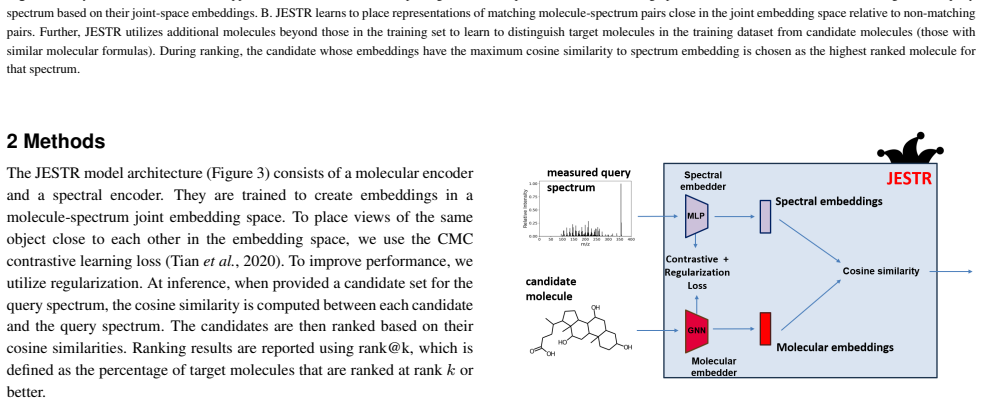
The central object is the joint molecule-spectrum embedding space learned by two encoders: a graph-convolutional network over molecular graphs and a three-layer MLP over 1000-dimension binned spectra, trained with Contrastive Multiview Coding (CMC) — a contrastive objective using temperature-scaled cosine similarity (InfoNCE loss) that pulls matching views together and pushes non-matching views apart. The second mechanism is regularization: during the last 3% of training, an additional loss minimizes cosine similarity between each spectrum embedding and the $k_{aug}$ most Tanimoto-similar formula-matched candidate molecules fetched from PubChem, teaching the model to suppress near-target candidates. Ranking at inference is then pure cosine similarity between the query spectrum embedding and each candidate molecular embedding, which the paper argues is sufficient because the joint space already separates targets from candidates.
What would settle it
Compute the overlap between the regularization candidate pool (all formula-matched PubChem molecules retrieved for training targets) and the test candidate sets for NPLIB1, NIST2020, MoNA, and MassSpecGym, e.g., by InChIKey; if a large fraction of test candidates appear in the regularization pool, the rank@1 improvements over the no-regularization baseline would be suspect. A complementary falsifier would be retraining with regularization candidates restricted to molecules whose Tanimoto similarity to every test target is low and checking whether rank@1 gains persist.
Extended reading notes
Core claim
The paper's central claim is that a molecule and its mass spectrum are views of the same object, so the annotation problem reduces to learning a joint embedding space in which matching molecule-spectrum pairs are close and non-matching pairs are far apart. Using Contrastive Multiview Coding with a temperature-scaled InfoNCE loss, JESTR trains a GNN encoder for molecular graphs and an MLP encoder for binned, intensity-normalized spectra. At inference, candidates are ranked purely by cosine similarity between the spectrum embedding and each candidate's molecular embedding, with no learned ranking layer and no intermediate fingerprint or spectrum reconstruction. The paper reports that this simple scheme outperforms explicit-construction baselines on all four datasets (NPLIB1, NIST2020, MoNA, MassSpecGym) on nearly all ranks, and demonstrates via ablation that the regularization loss, which pushes the most Tanimoto-similar formula-matched candidates away from each training spectrum, is responsible for substantial rank@1 gains on the three curated datasets. The paper also attributes the advantage over CMSSP to the combination of the InfoNCE loss and cosine-similarity ranking, arguing that magnitude normalization prevents embedding-scale artifacts.
Load-bearing premise
The load-bearing premise is that the millions of PubChem molecules used as regularization candidates during training do not substantially overlap the molecules in the test candidate sets; if they do overlap, the model could learn to suppress those specific identities and inflate the reported rank@k numbers.
Editorial extensions
If this is right
- If JESTR's results hold, explicit reconstruction of fingerprints or spectra is not a necessary step for accurate candidate ranking; a contrastively learned joint space plus cosine similarity is sufficient.
- The regularization recipe — fine-tuning with formula-matched candidates drawn from PubChem — sharpens the target-versus-candidate boundary, improving rank@1 by up to 37.1% on the MoNA dataset.
- On held-out MassSpecGym subsets, JESTR generalizes to structurally novel molecules better than pretrained SIRIUS (31% relative rank@1 gain) and CFM-ID (238% relative gain), suggesting implicit embedding methods scale better to unseen chemistry.
- The temperature-scaled cosine similarity combined with InfoNCE loss, rather than dot-product cross-entropy, is the component that gives JESTR its edge over the similarly structured CMSSP, per the paper's ablation.
- Because JESTR needs no spectral library coverage, its annotation capability is not limited by reference spectra availability, directly addressing the low 2.3% library-search identification rate cited in the introduction.
Reading between the lines
- The paper leaves implicit that the regularization pool (millions of formula-matched PubChem molecules) may overlap the test candidate sets; if a large fraction of test candidates appeared in training regularization, part of the reported rank@1 gains could come from suppressing already-seen identities rather than learning view-invariant chemistry.
- The ablation shows regularization lifts rank@1 on the three curated datasets but slightly reduces rank@20 on NPLIB1 and yields no consistent gain on MassSpecGym, hinting that the last-3%-of-epochs, 0.1-weight schedule is dataset-dependent rather than a universal recipe.
- Because JESTR's encoders are independent of how candidates are produced, the same joint space could be reused for de novo generation, e.g., by decoding the molecular embedding manifold, connecting this ranking technique to spec-to-mol generation.
- A stricter head-to-head against CMSSP's released pretrained weights, rather than weights retrained on each dataset, would clarify how much of the 302.56% margin is architectural (InfoNCE plus cosine ranking) versus a training-from-scratch disadvantage.
Signed reviews
Editorial analysis
A structured set of objections, weighed in public.
Referee Report
Summary. The paper proposes JESTR, a contrastive-learning method that embeds mass spectra and molecular graphs in a shared space and ranks candidate molecules by cosine similarity, adding a regularization loss that uses PubChem formula-matched candidate molecules to push non-targets away. The method is evaluated on NPLIB1, NIST2020, MoNA, and MassSpecGym, with rank@1/5/20 comparisons against ESP, MIST, CMSSP, and against SIRIUS and CFM-ID on MassSpecGym subsets. The authors report large average improvements over ESP, MIST, and CMSSP, and an ablation showing that regularization improves rank@1 on three datasets.
Significance. The paper's central idea of avoiding explicit fingerprint or spectrum reconstruction is well motivated, and the evaluation is broad, covering four datasets and multiple baselines. The authors are honest about several cases where baselines beat JESTR, such as MIST on MoNA rank@1 and CMSSP pretrained on NPLIB1 rank@1, and they report that regularization does not help on MassSpecGym. The release of code and data is a strength. However, two methodological issues—possible overlap between regularization candidates and test candidate sets, and hyperparameter selection without a validation split—currently make the magnitude of the reported improvements uncertain. If these are resolved, the paper would be a solid contribution to the metabolomics annotation literature.
major comments (3)
- [Section 2.3 and Section 3.1] The regularization candidates and the test candidate sets are both retrieved from PubChem by molecular formula, yet the paper never measures their overlap. The InChIKey-disjoint split only excludes test target molecules from training targets; it does not prevent test candidate decoys or even test target molecules from appearing as regularization negatives. If such overlap is substantial, the regularization loss of Eq. (6) may have directly suppressed test decoys during training, inflating the rank@k results in Table 2 and the ablation gains in Section 3.6. Please quantify, for each dataset, the fraction of test candidate molecules (and test targets) that appear in the regularization pool, and re-run the main experiments with overlapping candidates removed (or with a candidate-disjoint split) to establish that the reported improvements over ESP, MIST, and CMSSP are not an artifact of this exposure.
- [Section S2, Table S1] Hyperparameters were selected by grid search and 'the values of the parameters that achieved the best performance were selected and used to train and test the model for all datasets.' Because there is no separate validation split, the reported test numbers are selected on the test set, which is circular and can overstate accuracy. Please introduce a validation split (or nested resampling) and report test results using hyperparameters chosen solely from validation data. The same concern applies to how hyperparameters were selected for the MIST and ESP baselines, which is not described.
- [Section 3.6 and Conclusion] The text states that regularization improves rank@1 by 11.4%, 6.0%, and 37.1% on NPLIB1, NIST2020, and MoNA, respectively, but the abstract and conclusion report an average improvement of 5.72% across all datasets. This number does not correspond to any simple average of the per-dataset improvements in Table 2, especially since regularization is neutral or slightly negative on MassSpecGym. Please clarify the averaging procedure or correct the reported average.
minor comments (5)
- [Section 3.1] The MassSpecGym dataset is described as containing 32,010 molecules, but later in the same section it is said to contain 29,000 unique molecular structures; these numbers should be reconciled.
- [Section 3.3] There is a typo: 'CMF-ID' should be 'CFM-ID' in the sentence reporting a 238.00% improvement.
- [Section 3.3] The CFM-ID comparison uses a single random draw of spectra per collision-energy bin; please report results over multiple random draws or provide a seed and variance estimate, since random selection can affect the merged-spectrum evaluation.
- [Table 3] The header of Table 3 repeats 'CE loss' for two columns; the caption should clarify which columns correspond to the CMSSP architecture and which to the JESTR architecture.
- [Section S2] Table S2 reports that JESTR was trained for 800 epochs on NPLIB1, while Section S1 says contrastive learning was stopped at 1000 epochs; please clarify the stopping criterion and the exact number of epochs used.
Circularity Check
No significant circularity; the central rank@k claims are supported by held-out test evaluation against external baselines, and the regularization result is an ablation, not a fitted prediction.
full rationale
This is an empirical machine-learning paper, not a derivation. The central claims (Sections 3.3 and 3.6) are supported by evaluating JESTR on held-out test splits against external baselines (ESP, MIST, CMSSP, SIRIUS, CFM-ID), with structure-disjoint train/test splits. The regularization procedure (Eq. 6) is an additional training loss applied to training-batch candidates, and its value is assessed by an ablation that retrains without it; it is not a parameter fitted to the test ranking metric and then reported as a prediction. No equation in the paper reduces by construction to its own output, and no load-bearing premise is justified only by a self-citation. The one legitimate concern — that regularization candidates and test candidate sets are both drawn from the same formula-matched PubChem pools and the overlap is not quantified — is a potential data-leakage or correctness risk, not a circularity: the model never sees test target labels, and the reported gains are measured, not derived. Self-citations to prior work (e.g., CMC, ESP, PUMA) are used as background or as baselines, not as unverified premises that force the conclusion. The paper also discloses limitations, including the inconsistent benefit of regularization on MassSpecGym and possible leakage in the CMSSP comparison, which further supports a non-circular reading.
Assumptions & free parameters
free parameters (7)
- InfoNCE temperature tau =
0.05
- Contrastive batch size =
32
- Regularization candidate batch size kaug =
32
- Regularization loss weight beta =
0.1
- Regularization epoch percentage =
3%
- Learning rate =
5e-4
- Early stopping patience =
80
assumptions (4)
- domain assumption A molecule and its MS/MS spectra are views of the same object, so contrastive learning can align their embeddings.
- domain assumption PubChem-derived, formula-matched candidate sets are representative of the isomer space for metabolites in the test sets and are appropriate for both training regularization and evaluation.
- domain assumption Binning spectra into 1 Da m/z bins and applying log10/3 intensity scaling preserves enough information for ranking.
- domain assumption In-batch random negatives provide a sufficient contrastive signal for learning a discriminative joint space.
Cite this review
Pith. "Pith review of JESTR: Joint Embedding Space Technique for Ranking Candidate Molecules for the Annotation of Untargeted Metabolomics Data." pith.science (2026). https://pith.science/paper/7JVME4OB
@misc{pith2026241114464,
  author       = {Pith},
  title        = {Pith review of: JESTR: Joint Embedding Space Technique for Ranking Candidate Molecules for the Annotation of Untargeted Metabolomics Data},
  year         = {2026},
  howpublished = {\url{https://pith.science/paper/7JVME4OB}},
  note         = {Machine review of arXiv:2411.14464}
}
read the original abstract
Motivation: A major challenge in metabolomics is annotation: assigning molecular structures to mass spectral fragmentation patterns. Despite recent advances in molecule-to-spectra and in spectra-to-molecular fingerprint prediction (FP), annotation rates remain low. Results: We introduce in this paper a novel paradigm (JESTR) for annotation. Unlike prior approaches that explicitly construct molecular fingerprints or spectra, JESTR leverages the insight that molecules and their corresponding spectra are views of the same data and effectively embeds their representations in a joint space. Candidate structures are ranked based on cosine similarity between the embeddings of query spectrum and each candidate. We evaluate JESTR against mol-to-spec and spec-to-FP annotation tools on three datasets. On average, for rank@[1-5], JESTR outperforms other tools by 23.6%-71.6%. We further demonstrate the strong value of regularization with candidate molecules during training, boosting rank@1 performance by 11.4% and enhancing the model's ability to discern between target and candidate molecules. When comparing JESTR's performance against that of publicly available pretrained models of SIRIUS and CFM-ID on appropriate subsets of MassSpecGym benchmark dataset, JESTR outperforms these tools by 31% and 238%, respectively. Through JESTR, we offer a novel promising avenue towards accurate annotation, therefore unlocking valuable insights into the metabolome.
Figures


Figures from the paper (2 more)


Forward citations
Cited by 1 Pith paper
-
MADGEN: Mass-Spec attends to De Novo Molecular generation
A two-stage model first retrieves a molecular scaffold from an MS/MS spectrum, then generates the full molecule by adding bonds to that scaffold under spectral guidance, and reports high accuracy only when the scaffol...
Reference graph
Works this paper leans on
-
[1]
Butler, T., Frandsen, A., Lightheart, R., Bargh, B., Taylor, J., Bollerman, T., Kerby, T., West, K., Voronov, G., Moon, K., et al. (2023). Ms2mol: A transformer model for illuminating dark chemical space from mass spectra. ChemRxiv. 2023; doi:10.26434/chemrxiv-2023-vsmpx-v3\/
-
[2]
Chen, T., Kornblith, S., Norouzi, M., and Hinton, G. (2020). A simple framework for contrastive learning of visual representations. In International conference on machine learning\/ , pages 1597--1607. PMLR
work page 2020
-
[3]
Chopra, S., Hadsell, R., and LeCun, Y. (2005). Learning a similarity metric discriminatively, with application to face verification. In 2005 IEEE computer society conference on computer vision and pattern recognition (CVPR'05)\/ , volume 1, pages 539--546. IEEE
work page 2005
-
[4]
de Jonge, N. F., Louwen, J. J., Chekmeneva, E., Camuzeaux, S., Vermeir, F. J., Jansen, R. S., Huber, F., and van der Hooft, J. J. (2023). Ms2query: reliable and scalable ms2 mass spectra-based analogue search. Nature Communications\/ , 14 (1), 1--12
work page 2023
-
[5]
u hrkop, K., Shen, H., Meusel, M., Rousu, J., and B \
D \"u hrkop, K., Shen, H., Meusel, M., Rousu, J., and B \"o cker, S. (2015). Searching molecular structure databases with tandem mass spectra using csi: Fingerid. Proceedings of the National Academy of Sciences\/ , 112 (41), 12580--12585
work page 2015
-
[6]
D \"u hrkop, K., Fleischauer, M., Ludwig, M., Aksenov, A. A., Melnik, A. V., Meusel, M., Dorrestein, P. C., Rousu, J., and B \"o cker, S. (2019). Sirius 4: a rapid tool for turning tandem mass spectra into metabolite structure information. Nature methods\/ , 16 (4), 299--302
work page 2019
-
[7]
D \"u hrkop, K., Nothias, L.-F., Fleischauer, M., Reher, R., Ludwig, M., Hoffmann, M. A., Petras, D., Gerwick, W. H., Rousu, J., Dorrestein, P. C., et al. (2021). Systematic classification of unknown metabolites using high-resolution fragmentation mass spectra. Nature biotechnology\/ , 39 (4), 462--471
work page 2021
-
[8]
Goldman, S., Wohlwend, J., Stra z ar, M., Haroush, G., Xavier, R. J., and Coley, C. W. (2023). Annotating metabolite mass spectra with domain-inspired chemical formula transformers. Nature Machine Intelligence\/ , 5 (9), 965--979
work page 2023
Show all 37 references
-
[9]
Heinonen, M., Shen, H., Zamboni, N., and Rousu, J. (2012). Metabolite identification and molecular fingerprint prediction through machine learning. Bioinformatics\/ , 28 (18), 2333--2341
2012
-
[10]
J., and Ridder, L
Huber, F., van der Burg, S., van der Hooft, J. J., and Ridder, L. (2021). Ms2deepscore: a novel deep learning similarity measure to compare tandem mass spectra. Journal of cheminformatics\/ , 13 (1), 84
2021
-
[11]
Khosla, P., Teterwak, P., Wang, C., Sarna, A., Tian, Y., Isola, P., Maschinot, A., Liu, C., and Krishnan, D. (2020). Supervised contrastive learning. Advances in neural information processing systems\/ , 33 , 18661--18673
2020
-
[12]
A., Thiessen, P
Kim, S., Chen, J., Cheng, T., Gindulyte, A., He, J., He, S., Li, Q., Shoemaker, B. A., Thiessen, P. A., Yu, B., et al. (2019). Pubchem 2019 update: improved access to chemical data. Nucleic acids research\/ , 47 (D1), D1102--D1109
2019
-
[13]
S., Wohlgemuth, G., Barupal, D
Kind, T., Tsugawa, H., Cajka, T., Ma, Y., Lai, Z., Mehta, S. S., Wohlgemuth, G., Barupal, D. K., Showalter, M. R., Arita, M., et al. (2018). Identification of small molecules using accurate mass ms/ms search. Mass spectrometry reviews\/ , 37 (4), 513--532
2018
-
[14]
Kingma, D. P. and Ba, J. (2014). Adam: A method for stochastic optimization. arXiv preprint arXiv:1412.6980\/
2014 arXiv
-
[15]
Kipf, T. N. and Welling, M. (2016). Semi-supervised classification with graph convolutional networks. arXiv preprint arXiv:1609.02907\/
2016 arXiv
-
[16]
Li, X., Zhou Chen, Y., Kalia, A., Zhu, H., Liu, L.-p., and Hassoun, S. (2024). An ensemble spectral prediction ( ESP ) model for metabolite annotation. Bioinformatics\/ , 40 (8), btae490
2024
-
[17]
E., Chenthamarakshan, V., Das, P., and Kavraki, L
Litsa, E. E., Chenthamarakshan, V., Das, P., and Kavraki, L. E. (2023). An end-to-end deep learning framework for translating mass spectra to de-novo molecules. Communications Chemistry\/ , 6 (1), 132
2023
-
[18]
Martin, M., Bittremieux, W., and Hassoun, S. (2024). Molecular structure discovery for untargeted metabolomics using biotransformation rules and global molecular networking. bioRxiv\/ , pages 2024--02
2024
-
[19]
MassBank of North America
MoNA (2024). MassBank of North America . https://mona.fiehnlab.ucdavis.edu/
2024
-
[20]
NIST20 : Updates to the nist tandem and electron ionization spectral libraries
NIST (2020). NIST20 : Updates to the nist tandem and electron ionization spectral libraries. https://www.nist.gov/ programs-projects/tandem-mass-spectral-library/
2020
-
[21]
W., Hallacy, C., Ramesh, A., Goh, G., Agarwal, S., Sastry, G., Askell, A., Mishkin, P., Clark, J., et al
Radford, A., Kim, J. W., Hallacy, C., Ramesh, A., Goh, G., Agarwal, S., Sastry, G., Askell, A., Mishkin, P., Clark, J., et al. (2021). Learning transferable visual models from natural language supervision. In International Conference on Machine Learning\/ , pages 8748--8763. PMLR
2021
-
[22]
L., Wolf, S., Hollender, J., and Neumann, S
Ruttkies, C., Schymanski, E. L., Wolf, S., Hollender, J., and Neumann, S. (2016). Metfrag relaunched: incorporating strategies beyond in silico fragmentation. Journal of cheminformatics\/ , 8 , 1--16
2016
-
[23]
u hrkop, K., B \
Stravs, M. A., D \"u hrkop, K., B \"o cker, S., and Zamboni, N. (2022). Msnovelist: de novo structure generation from mass spectra. Nature Methods\/ , 19 (7), 865--870
2022
-
[24]
and Zhang, Y
Tian, Y. and Zhang, Y. (2022). A comprehensive survey on regularization strategies in machine learning. Information Fusion\/ , 80 , 146--166
2022
-
[25]
Tian, Y., Krishnan, D., and Isola, P. (2020). Contrastive multiview coding. In Computer Vision--ECCV 2020: 16th European Conference, Glasgow, UK, August 23--28, 2020, Proceedings, Part XI 16\/ , pages 776--794. Springer
2020
-
[26]
Wang, F., Liigand, J., Tian, S., Arndt, D., Greiner, R., and Wishart, D. S. (2021). Cfm-id 4.0: more accurate esi-ms/ms spectral prediction and compound identification. Analytical chemistry\/ , 93 (34), 11692--11700
2021
-
[27]
J., Phelan, V
Wang, M., Carver, J. J., Phelan, V. V., Sanchez, L. M., Garg, N., Peng, Y., Nguyen, D. D., Watrous, J., Kapono, C. A., Luzzatto-Knaan, T., et al. (2016). Sharing and community curation of mass spectrometry data with global natural products social molecular networking. Nature b...
2016
-
[28]
N., Belanger, D., Adams, R
Wei, J. N., Belanger, D., Adams, R. P., and Sculley, D. (2019). Rapid prediction of electron--ionization mass spectrometry using neural networks. ACS central science\/ , 5 (4), 700--708
2019
-
[29]
Wolf, S., Schmidt, S., M \"u ller-Hannemann, M., and Neumann, S. (2010). In silico fragmentation for computer assisted identification of metabolite mass spectra. BMC bioinformatics\/ , 11 , 1--12
2010
-
[30]
Young, A., Wang, B., and R \"o st, H. (2021). Massformer: Tandem mass spectrum prediction for small molecules using graph transformers. arXiv preprint arXiv:2111.04824\/
2021 arXiv
-
[31]
Zhu, H., Liu, L., and Hassoun, S. (2020). Using graph neural networks for mass spectrometry prediction. arXiv preprint arXiv:2010.04661\/
2020 arXiv
-
[32]
, " * write output.state after.block = add.period write newline
ENTRY address author booktitle chapter edition editor howpublished institution journal key month note number organization pages publisher school series title type volume year label extra.label sort.label INTEGERS output.state before.all mid.sentence after.sentence after.block ...
-
[33]
write newline
" write newline "" before.all 'output.state := FUNCTION n.dashify 't := "" t empty not t #1 #1 substring "-" = t #1 #2 substring "--" = not "--" * t #2 global.max substring 't := t #1 #1 substring "-" = "-" * t #2 global.max substring 't := while if t #1 #1 substring * t #2 gl...
-
[34]
\@ifclassloaded aguplus natbib The aguplus class already includes natbib coding, so you should not add it explicitly Type <Return> for now, but then later remove the command natbib from the document \@ifclassloaded nlinproc natbib The nlinproc class already includes natbib cod...
-
[35]
@stdbsttrue NAT@ctr \@lbibitem[ NAT@ctr ] \@lbibitem[#1]#2 \@extra@b@citeb \@ifundefined br@#2\@extra@b@citeb \@namedef br@#2 \@nameuse br@#2\@extra@b@citeb \@ifundefined b@#2\@extra@b@citeb @num @parse #2 [ @natanchorstart #2\@extra@b@citeb \@biblabel @num @natanchorend] @ifc...
-
[36]
, " * write output.state after.block = add.period write newline
and \@ifundefined chapter * \@mkboth \@ifundefined NAT@sectionbib * \@mkboth * \@mkboth\@gobbletwo \@ifclassloaded amsart * \@ifclassloaded amsbook * \@ifundefined bib@heading @heading thebibliography [1] 1 @ @ \@biblabel NAT@ctr \@bibsetup #1 NAT@ctr 0 @openbib .11em \@plus.3...
-
[37]
write newline
" write newline "" before.all 'output.state := FUNCTION fin.entry add.period write newline FUNCTION new.block output.state before.all = 'skip after.block 'output.state := if FUNCTION new.sentence output.state after.block = 'skip output.state before.all = 'skip after.sentence '...
Reviewed August 12, 2026 · model on record in the stance chip above.
Discussion (0). Continue with ORCID to comment.