REVIEW 4 major objections 7 minor 1 cited by
SparseGrasp: Robotic Grasping via 3D Semantic Gaussian Splatting from Sparse Multi-View RGB Images
T0 review · 4 major / 7 minor · reviewed 2026-08-11 · deepseek-v4-flash
Pith's one-line read SparseGrasp reconstructs a language-queryable 3D scene from three RGB images in about four minutes and uses it to grasp objects on a real robot, reporting 55/70 successes.
desk verdict A solid sparse-view language-guided grasping system; the real-robot results are plausible but the retrained GraspNet is under-specified and generalization beyond seven objects remains open. read the letter →
The pith
A machine-rendered reading of the paper's core claim, the machinery that carries it, and where it could break.
The reading
What carries the argument
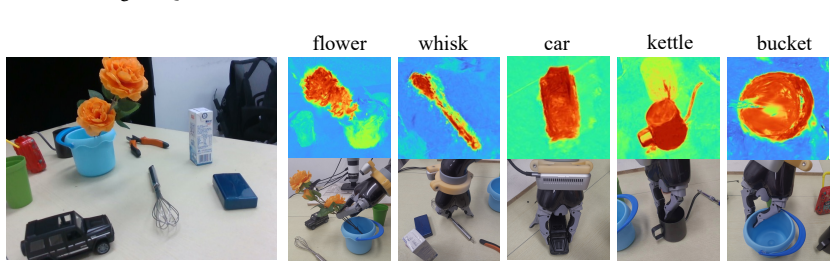
The load-bearing mechanism is a 3D semantic Gaussian field: each Gaussian carries its usual position, scale, rotation, opacity, and color, plus a 16-dimensional semantic feature obtained by PCA-compressing MaskCLIP/FastSAM features. DUSt3R provides a dense point cloud as the initial geometry, which prevents sparse-view overfitting; during training the RGB loss and the semantic-feature L1 loss are optimized jointly with the same tile-based rasterizer. For scene updates, a render-and-compare loop uses MOG2 to detect moved pixels, matches them to Gaussians by mean semantic-feature cosine similarity, and optimizes only the moved object's translation and rotation against a combined pixel and 2D-position loss. Grasp poses come from a retrained GraspNet that consumes Gaussian parameters directly, so no voxelization is needed.
What would settle it
Replace the retrained GraspNet with the original GraspNet on the same three-view 3DGS scenes and measure grasp success on the same seven objects; a success rate that stays near 55/70 would show the retraining is not load-bearing, while a sharp drop would confirm that the system's performance rests on the simulated training transfer.
Extended reading notes
Core claim
On its own terms, the paper's central discovery is that 3D Gaussian Splatting can carry both geometry and open-vocabulary semantics well enough for robotic grasping when it is initialized with dense points from DUSt3R rather than COLMAP's sparse points, and when patch-level MaskCLIP features are averaged inside FastSAM masks, compressed by PCA from 768 to 16 dimensions, and distilled into Gaussians with a joint RGB-plus-semantics loss. From that representation, the system generates six-degree-of-freedom grasps directly from the Gaussian parameters via a retrained GraspNet, bypassing the voxelization and depth back-projection that the NeRF-based baselines need. For changed scenes, a render-and-compare optimization that adjusts only the translation and rotation of the moved object's Gaussians restores graspability in roughly 200 ms. The paper supports these claims with real-robot trials across seven objects, reporting 55/70 successes from three views, and with a moved-object study where the 200 ms update reaches 22/25 successes across five scenes.
Load-bearing premise
The reported grasp rates depend on the retrained GraspNet, trained on a modified GraspNet-1B dataset, transferring to the real KINOVA robot; if that sim-to-real transfer fails, the success numbers would not hold even if the reconstruction and semantics are accurate.
Editorial extensions
If this is right
- A robot can complete a multi-turn pick-and-place sequence from a single three-image reconstruction, without rescanning between commands.
- Scene updates for moved objects drop from minutes of full reconstruction to about 200 ms, so the system can react to a rearrangement while the operator waits.
- The PCA compression shows that 16 dimensions suffice for open-vocabulary grounding in these scenes, which keeps the 3DGS memory and rendering cost near plain color rendering.
- Because grasp generation runs directly on Gaussian parameters, the method avoids the precision loss that voxelization introduces in NeRF-based pipelines.
Reading between the lines
- The same render-and-compare trick might extend beyond rigid moves to object removal or addition if combined with 3D inpainting, a direction the paper itself flags as future work.
- If 16 PCA components suffice for grounding, then semantic fields for grasping may be intrinsically low-rank, which suggests that even cheaper feature distillation is possible.
- The retrained GraspNet's inputs are Gaussian parameters; this design implies any representation expressible as anisotropic Gaussians could reuse the grasp head, but the sim-to-real gap remains the main uncertainty.
Signed reviews
Editorial analysis
A structured set of objections, weighed in public.
Referee Report
Summary. The paper proposes SparseGrasp, a language-guided robotic grasping system that reconstructs a 3D semantic Gaussian Splatting scene from as few as three RGB images. It combines DUSt3R-based dense point initialization, MaskCLIP and FastSAM semantic feature extraction with PCA compression, and a render-and-compare module for updating moved objects. The authors report a 55/70 grasp success rate on a KINOVA Gen2 robot using three views, outperforming F3RM (38/70) and LERF-TOGO (33/70) at seventeen views, and scene updates in about 200 ms. The central claim is that sparse views and fast updates are sufficient for practical multi-turn open-vocabulary grasping.
Significance. If the reported results hold, SparseGrasp would be a meaningful advance in making language-guided manipulation practical in changing environments, reducing reconstruction from minutes with dense views to about four minutes with three views and enabling near-instant scene updates. The use of DUSt3R for dense initialization, PCA for feature compression, and a retrained GraspNet operating directly on Gaussian parameters are sensible engineering contributions. The real-robot evaluation on seven objects is a strength. However, the significance is currently limited by the absence of statistical rigor, the brevity of the grasp-network description, and the lack of validation for the sim-to-real transfer of the retrained GraspNet, which is the sole source of grasp poses.
major comments (4)
- [III-D and Table I] The retrained GraspNet is the only component that generates grasp poses, yet its description is only five sentences: no architecture, loss function, training schedule, or inference procedure is given for ingesting pi, si, qi. There is no held-out synthetic evaluation and no comparison against the original GraspNet on the same 3DGS output. The headline 55/70 success rate therefore depends on unvalidated sim-to-real transfer of this network. Please provide a standalone evaluation of the grasp model (e.g., held-out objects or scenes, an original-GraspNet baseline, or simulation results) and full implementation details.
- [Tables I and II] All success rates are reported as raw counts with no confidence intervals or statistical tests. With 10 trials per object, the 95% binomial confidence interval for 8/10 spans roughly 44% to 97%, so differences such as 8/10 vs 7/10 are not meaningful. Table II uses only five scenes per condition, and the improvement from 3/5 to 5/5 at different update times is not statistically reliable. The claim that SparseGrasp 'significantly outperforms' the baselines needs error bars, confidence intervals, or a paired statistical test across objects and scenes.
- [III-C, Eq. (6)] The render-and-compare loss in Eq. (6) uses d_gt, the MOG2-detected center of moved pixels, as supervision for the predicted object position. As presented, this is an alignment procedure that assumes a known foreground mask or center, not a predictor that autonomously detects arbitrary scene changes. The paper should explicitly state the assumptions on d_gt and evaluate robustness when MOG2 is imperfect, for example with overlapping objects, lighting changes, or partial occlusion, before Table II can support the claim of rapid updating in general changeable environments.
- [IV-B, Table III] The 2D IoU evaluation is the only quantitative semantic distillation result, but the paper does not specify how the continuous feature heatmaps are thresholded to binary masks, how novel-view ground-truth regions are obtained, or whether the IoU is averaged over all queries. Without this protocol detail, the reported values (e.g., Ours 0.71 vs F3RM 0.75 at 17 views) cannot be interpreted or reproduced. Please describe the evaluation protocol and report per-query or per-object variability.
minor comments (7)
- [Abstract and Introduction] The phrase 'handles scene updates fastly' is ungrammatical; use 'quickly' or 'fast'.
- [Fig. 5] The column labels in Fig. 5 appear fused as 'F3RMLERFOurs', making the comparison difficult to read; please separate the labels.
- [Fig. 8] The caption references the query 'metal hug' while the text uses 'metal mug'; this typo should be corrected.
- [III-D] The definition of the 'objectness' label for Gaussians is ambiguous for objects that touch or occlude each other; clarify how boundary Gaussians are assigned.
- [IV, Environment and Setup] The description 'equipped with three common cameras' is vague; please specify the camera models, resolution, and the extrinsic calibration procedure used to provide poses to DUSt3R.
- [References] References [4] and [43] are the same work (Object-aware Gaussian Splatting for Robotic Manipulation) and should be consolidated.
- [I, Contributions] The phrase 'significantly outperforms' in the Introduction and Conclusion should be qualified with the statistical evidence, or deferred to the results section where the uncertainty can be reported.
Circularity Check
No significant circularity: SparseGrasp's central claims rest on external pretrained models and independent real-robot evaluations, not on fitted parameters or self-citations.
full rationale
No circular step reduces a claimed prediction to its own input. The reconstruction and semantic-distillation pipeline (Secs. III-A and III-B) is trained from sparse RGB views with losses defined against observed images and MaskCLIP/FastSAM features, so the quality of the 3D semantic field is independently constrained rather than assumed. The render-and-compare update in Eq. (6) optimizes an object's translation and rotation to match the observed moved-pixel center d_gt and the current image; this is a fitting procedure for scene update, not a reported predictive quantity, and it is not used to explain the paper's headline grasp-success numbers. The retrained GraspNet (Sec. III-D) is trained on modified GraspNet-1B scenes and then evaluated on a real KINOVA robot, so the real-robot grasp outcomes in Table I are not encoded in the training labels; the lack of held-out synthetic scenes and error bars is a robustness concern, not circularity. The only self-citations ([29]-[31]) appear in related work and carry no load-bearing argument. The main claims are compared against external F3RM and LERF-TOGO baselines using independent metrics such as grasp success, IoU, and runtime, so the central derivation is not equivalent to its inputs by construction.
Assumptions & free parameters
free parameters (4)
- PCA component count =
16
- lambda_1 =
0.2
- lambda_2 =
1.0
- lambda_3 =
0.1
assumptions (5)
- domain assumption DUSt3R dense point clouds from sparse RGB views provide a sufficiently accurate geometric initialization for 3DGS.
- domain assumption MaskCLIP patch features averaged within FastSAM masks capture the semantic information needed for open-vocabulary grounding.
- domain assumption MOG2 background subtraction correctly identifies moved pixels in the current frame.
- domain assumption GraspNet retrained on reconstructed GraspNet-1B scenes with added Gaussian noise transfers to the real KINOVA robot and KG-3 gripper.
- domain assumption Calibrated camera poses are available for each sparse view.
Cite this review
Pith. "Pith review of SparseGrasp: Robotic Grasping via 3D Semantic Gaussian Splatting from Sparse Multi-View RGB Images." pith.science (2026). https://pith.science/paper/ROAF457E
@misc{pith2026241202140,
  author       = {Pith},
  title        = {Pith review of: SparseGrasp: Robotic Grasping via 3D Semantic Gaussian Splatting from Sparse Multi-View RGB Images},
  year         = {2026},
  howpublished = {\url{https://pith.science/paper/ROAF457E}},
  note         = {Machine review of arXiv:2412.02140}
}
read the original abstract
Language-guided robotic grasping is a rapidly advancing field where robots are instructed using human language to grasp specific objects. However, existing methods often depend on dense camera views and struggle to quickly update scenes, limiting their effectiveness in changeable environments. In contrast, we propose SparseGrasp, a novel open-vocabulary robotic grasping system that operates efficiently with sparse-view RGB images and handles scene updates fastly. Our system builds upon and significantly enhances existing computer vision modules in robotic learning. Specifically, SparseGrasp utilizes DUSt3R to generate a dense point cloud as the initialization for 3D Gaussian Splatting (3DGS), maintaining high fidelity even under sparse supervision. Importantly, SparseGrasp incorporates semantic awareness from recent vision foundation models. To further improve processing efficiency, we repurpose Principal Component Analysis (PCA) to compress features from 2D models. Additionally, we introduce a novel render-and-compare strategy that ensures rapid scene updates, enabling multi-turn grasping in changeable environments. Experimental results show that SparseGrasp significantly outperforms state-of-the-art methods in terms of both speed and adaptability, providing a robust solution for multi-turn grasping in changeable environment.
Figures


Figures from the paper (6 more)




Forward citations
Cited by 1 Pith paper
-
VistaVLA: Geometry- and Semantic-Aware 3D Gaussian-Grounded VLA for Robotic Manipulation
VistaVLA lifts multi-view vision-language features into 3D Gaussians, compresses them 99% via Merge-then-Query, and improves real-robot manipulation success by ~23% over baselines.
Reference graph
Works this paper leans on
-
[1]
Distilled feature fields enable few-shot language-guided manipula- tion,
W. Shen, G. Yang, A. Yu, J. Wong, L. P. Kaelbling, and P. Isola, “Distilled feature fields enable few-shot language-guided manipula- tion,” arXiv preprint arXiv:2308.07931 , 2023
arXiv 2023
-
[2]
Language embedded radiance fields for zero- shot task-oriented grasping,
A. Rashid, S. Sharma, C. M. Kim, J. Kerr, L. Y . Chen, A. Kanazawa, and K. Goldberg, “Language embedded radiance fields for zero- shot task-oriented grasping,” in 7th Annual Conference on Robot Learning, 2023. [Online]. Available: https://openreview.net/forum?id= k-Fg8JDQmc
work page 2023
-
[3]
Dust3r: Geometric 3d vision made easy,
S. Wang, V . Leroy, Y . Cabon, B. Chidlovskii, and J. Revaud, “Dust3r: Geometric 3d vision made easy,” in Proceedings of the IEEE/CVF Conference on Computer Vision and Pattern Recognition , 2024, pp. 20 697–20 709
2024
-
[4]
Object-aware gaussian splatting for robotic manipulation,
Y . Li and D. Pathak, “Object-aware gaussian splatting for robotic manipulation,” in ICRA 2024 Workshop on 3D Visual Representations for Robot Manipulation , 2024
work page 2024
-
[5]
Gnfactor: Multi-task real robot learning with generalizable neural feature fields,
Y . Ze, G. Yan, Y .-H. Wu, A. Macaluso, Y . Ge, J. Ye, N. Hansen, L. E. Li, and X. Wang, “Gnfactor: Multi-task real robot learning with generalizable neural feature fields,” in Conference on Robot Learning. PMLR, 2023, pp. 284–301
work page 2023
-
[6]
Learning transferable visual models from natural language supervision,
A. Radford, J. W. Kim, C. Hallacy, A. Ramesh, G. Goh, S. Agarwal, G. Sastry, A. Askell, P. Mishkin, J. Clark et al., “Learning transferable visual models from natural language supervision,” in International conference on machine learning . PMLR, 2021, pp. 8748–8763
2021
-
[7]
3d gaussian splatting for real-time radiance field rendering
B. Kerbl, G. Kopanas, T. Leimk ¨uhler, and G. Drettakis, “3d gaussian splatting for real-time radiance field rendering.” ACM Trans. Graph., vol. 42, no. 4, pp. 139–1, 2023
2023
-
[8]
Extract free dense labels from clip,
C. Zhou, C. C. Loy, and B. Dai, “Extract free dense labels from clip,” in European Conference on Computer Vision . Springer, 2022, pp. 696–712
2022
Show all 43 references
-
[9]
Segment anything,
A. Kirillov, E. Mintun, N. Ravi, H. Mao, C. Rolland, L. Gustafson, T. Xiao, S. Whitehead, A. C. Berg, W.-Y . Lo et al. , “Segment anything,” in Proceedings of the IEEE/CVF International Conference on Computer Vision , 2023, pp. 4015–4026
2023
-
[10]
Graspnet-1billion: A large- scale benchmark for general object grasping,
H.-S. Fang, C. Wang, M. Gou, and C. Lu, “Graspnet-1billion: A large- scale benchmark for general object grasping,” in Proceedings of the IEEE/CVF Conference on Computer Vision and Pattern Recognition , 2020, pp. 11 444–11 453
2020
-
[11]
Nerf: Representing scenes as neural radiance fields for view synthesis,
B. Mildenhall, P. P. Srinivasan, M. Tancik, J. T. Barron, R. Ramamoor- thi, and R. Ng, “Nerf: Representing scenes as neural radiance fields for view synthesis,” Communications of the ACM , vol. 65, no. 1, pp. 99–106, 2021
2021
-
[12]
Evo-nerf: Evolving nerf for sequen- tial robot grasping of transparent objects,
J. Kerr, L. Fu, H. Huang, Y . Avigal, M. Tancik, J. Ichnowski, A. Kanazawa, and K. Goldberg, “Evo-nerf: Evolving nerf for sequen- tial robot grasping of transparent objects,” in Conference on Robot Learning. PMLR, 2023, pp. 353–367
2023
-
[13]
Dex-nerf: Using a neural radiance field to grasp transparent objects,
J. Ichnowski, Y . Avigal, J. Kerr, and K. Goldberg, “Dex-nerf: Using a neural radiance field to grasp transparent objects,” arXiv preprint arXiv:2110.14217, 2021
2021 arXiv
-
[14]
Graspnerf: Multiview-based 6-dof grasp detection for transparent and specular ob- jects using generalizable nerf,
Q. Dai, Y . Zhu, Y . Geng, C. Ruan, J. Zhang, and H. Wang, “Graspnerf: Multiview-based 6-dof grasp detection for transparent and specular ob- jects using generalizable nerf,” in 2023 IEEE International Conference on Robotics and Automation (ICRA) . IEEE, 2023, pp. 1757–1763
2023
-
[15]
Nerf-supervision: Learning dense object descriptors from neural radiance fields,
L. Yen-Chen, P. Florence, J. T. Barron, T.-Y . Lin, A. Rodriguez, and P. Isola, “Nerf-supervision: Learning dense object descriptors from neural radiance fields,” in 2022 International Conference on Robotics and Automation (ICRA) . IEEE, 2022, pp. 6496–6503
2022
-
[16]
imap: Implicit map- ping and positioning in real-time,
E. Sucar, S. Liu, J. Ortiz, and A. J. Davison, “imap: Implicit map- ping and positioning in real-time,” in Proceedings of the IEEE/CVF International Conference on Computer Vision , 2021, pp. 6229–6238
2021
-
[17]
Nice-slam: Neural implicit scalable encoding for slam,
Z. Zhu, S. Peng, V . Larsson, W. Xu, H. Bao, Z. Cui, M. R. Oswald, and M. Pollefeys, “Nice-slam: Neural implicit scalable encoding for slam,” in Proceedings of the IEEE/CVF Conference on Computer Vision and Pattern Recognition, 2022, pp. 12 786–12 796
2022
-
[18]
Nerf-slam: Real-time dense monocular slam with neural radiance fields,
A. Rosinol, J. J. Leonard, and L. Carlone, “Nerf-slam: Real-time dense monocular slam with neural radiance fields,” in 2023 IEEE/RSJ International Conference on Intelligent Robots and Systems (IROS) . IEEE, 2023, pp. 3437–3444
2023
-
[19]
Vision-only robot navigation in a neural radiance world,
M. Adamkiewicz, T. Chen, A. Caccavale, R. Gardner, P. Culbertson, J. Bohg, and M. Schwager, “Vision-only robot navigation in a neural radiance world,” IEEE Robotics and Automation Letters , vol. 7, no. 2, pp. 4606–4613, 2022
2022
-
[20]
Splatam: Splat, track & map 3d gaussians for dense rgb-d slam,
N. Keetha, J. Karhade, K. M. Jatavallabhula, G. Yang, S. Scherer, D. Ramanan, and J. Luiten, “Splatam: Splat, track & map 3d gaussians for dense rgb-d slam,” arXiv preprint arXiv:2312.02126 , 2023
2023 arXiv
-
[21]
Gaussian-slam: Photo-realistic dense slam with gaussian splatting,
V . Yugay, Y . Li, T. Gevers, and M. R. Oswald, “Gaussian-slam: Photo-realistic dense slam with gaussian splatting,” arXiv preprint arXiv:2312.10070, 2023
2023 arXiv
-
[22]
Gs- slam: Dense visual slam with 3d gaussian splatting,
C. Yan, D. Qu, D. Wang, D. Xu, Z. Wang, B. Zhao, and X. Li, “Gs- slam: Dense visual slam with 3d gaussian splatting,” arXiv preprint arXiv:2311.11700, 2023
2023 arXiv
-
[23]
Manigaussian: Dynamic gaussian splatting for multi-task robotic manipulation,
G. Lu, S. Zhang, Z. Wang, C. Liu, J. Lu, and Y . Tang, “Manigaussian: Dynamic gaussian splatting for multi-task robotic manipulation,”arXiv preprint arXiv:2403.08321, 2024
2024 arXiv
-
[24]
Open-vocabulary object retrieval
S. Guadarrama, E. Rodner, K. Saenko, N. Zhang, R. Farrell, J. Don- ahue, and T. Darrell, “Open-vocabulary object retrieval.” in Robotics: science and systems , vol. 2, no. 5, 2014, p. 6
2014
-
[25]
Interactively picking real-world objects with un- constrained spoken language instructions,
J. Hatori, Y . Kikuchi, S. Kobayashi, K. Takahashi, Y . Tsuboi, Y . Unno, W. Ko, and J. Tan, “Interactively picking real-world objects with un- constrained spoken language instructions,” in 2018 IEEE International Conference on Robotics and Automation (ICRA) . IEEE, 2018, pp. ...
2018
-
[26]
Interactive visual grounding of re- ferring expressions for human-robot interaction,
M. Shridhar and D. Hsu, “Interactive visual grounding of re- ferring expressions for human-robot interaction,” arXiv preprint arXiv:1806.03831, 2018
2018 arXiv
-
[27]
Robot object retrieval with contextual natural language queries,
T. Nguyen, N. Gopalan, R. Patel, M. Corsaro, E. Pavlick, and S. Tellex, “Robot object retrieval with contextual natural language queries,” arXiv preprint arXiv:2006.13253 , 2020
2006 arXiv
-
[28]
A joint network for grasp detection conditioned on natural language commands,
Y . Chen, R. Xu, Y . Lin, and P. A. Vela, “A joint network for grasp detection conditioned on natural language commands,” in 2021 IEEE International Conference on Robotics and Automation (ICRA). IEEE, 2021, pp. 4576–4582
2021
-
[29]
Learning 6-dof object poses to grasp category-level objects by language instructions,
C. Cheang, H. Lin, Y . Fu, and X. Xue, “Learning 6-dof object poses to grasp category-level objects by language instructions,” in 2022 International Conference on Robotics and Automation (ICRA). IEEE, 2022, pp. 8476–8482
2022
-
[30]
Language guided robotic grasping with fine-grained instructions,
Q. Sun, H. Lin, Y . Fu, Y . Fu, and X. Xue, “Language guided robotic grasping with fine-grained instructions,” in 2023 IEEE/RSJ International Conference on Intelligent Robots and Systems (IROS) . IEEE, 2023, pp. 1319–1326
2023
-
[31]
Sar-net: Shape alignment and recovery network for category-level 6d object pose and size estimation,
H. Lin, Z. Liu, C. Cheang, Y . Fu, G. Guo, and X. Xue, “Sar-net: Shape alignment and recovery network for category-level 6d object pose and size estimation,” in Proceedings of the IEEE/CVF Conference on Computer Vision and Pattern Recognition , 2022, pp. 6707–6717
2022
-
[32]
Cliport: What and where pathways for robotic manipulation,
M. Shridhar, L. Manuelli, and D. Fox, “Cliport: What and where pathways for robotic manipulation,” in Conference on Robot Learning. PMLR, 2022, pp. 894–906
2022
-
[33]
Structure-from-motion revisited,
J. L. Schonberger and J.-M. Frahm, “Structure-from-motion revisited,” in Proceedings of the IEEE conference on computer vision and pattern recognition, 2016, pp. 4104–4113
2016
-
[34]
State of the art on 3d reconstruction with rgb-d cameras,
M. Zollh ¨ofer, P. Stotko, A. G¨orlitz, C. Theobalt, M. Nießner, R. Klein, and A. Kolb, “State of the art on 3d reconstruction with rgb-d cameras,” in Computer graphics forum, vol. 37, no. 2. Wiley Online Library, 2018, pp. 625–652
2018
-
[35]
Robust 3d reconstruction with an rgb-d camera,
K. Wang, G. Zhang, and H. Bao, “Robust 3d reconstruction with an rgb-d camera,” IEEE Transactions on Image Processing , vol. 23, no. 11, pp. 4893–4906, 2014
2014
-
[36]
Lerf: Language embedded radiance fields,
J. Kerr, C. M. Kim, K. Goldberg, A. Kanazawa, and M. Tancik, “Lerf: Language embedded radiance fields,” in Proceedings of the IEEE/CVF International Conference on Computer Vision , 2023, pp. 19 729–19 739
2023
-
[37]
Fast segment anything,
X. Zhao, W. Ding, Y . An, Y . Du, T. Yu, M. Li, M. Tang, and J. Wang, “Fast segment anything,” arXiv preprint arXiv:2306.12156 , 2023
2023 arXiv
-
[38]
Feature 3dgs: Supercharging 3d gaussian splatting to enable distilled feature fields,
S. Zhou, H. Chang, S. Jiang, Z. Fan, Z. Zhu, D. Xu, P. Chari, S. You, Z. Wang, and A. Kadambi, “Feature 3dgs: Supercharging 3d gaussian splatting to enable distilled feature fields,” Proceedings of the IEEE/CVF Conference on Computer Vision and Pattern Recognition , 2024
2024
-
[39]
Langsplat: 3d language gaussian splatting,
M. Qin, W. Li, J. Zhou, H. Wang, and H. Pfister, “Langsplat: 3d language gaussian splatting,” arXiv preprint arXiv:2312.16084 , 2023
2023 arXiv
-
[40]
Improved adaptive gaussian mixture model for back- ground subtraction,
Z. Zivkovic, “Improved adaptive gaussian mixture model for back- ground subtraction,” in Proceedings of the 17th International Confer- ence on Pattern Recognition, 2004. ICPR 2004. , vol. 2. IEEE, 2004, pp. 28–31
2004
-
[41]
Gaussian grouping: Segment and edit anything in 3d scenes,
M. Ye, M. Danelljan, F. Yu, and L. Ke, “Gaussian grouping: Segment and edit anything in 3d scenes,” arXiv preprint arXiv:2312.00732 , 2023
2023 arXiv
-
[42]
Track2act: Predicting point tracks from internet videos enables diverse zero-shot robot manipulation,
H. Bharadhwaj, R. Mottaghi, A. Gupta, and S. Tulsiani, “Track2act: Predicting point tracks from internet videos enables diverse zero-shot robot manipulation,” arXiv preprint arXiv:2405.01527 , 2024
2024 arXiv
-
[43]
Object-aware gaussian splatting for robotic manipulation,
Y . Li and D. Pathak, “Object-aware gaussian splatting for robotic manipulation,” in ICRA 2024 Workshop on 3D Visual Representations for Robot Manipulation , 2024. [Online]. Available: https://openreview.net/forum?id=gdRI43hDgo
2024
Reviewed August 11, 2026 · model on record in the stance chip above.
Discussion (0). Continue with ORCID to comment.