REVIEW 5 major objections 5 minor 1 cited by
Accelerating Manufacturing Scale-Up from Material Discovery Using Agentic Web Navigation and Retrieval-Augmented AI for Process Engineering Schematics Design
T0 review · 5 major / 5 minor · reviewed 2026-08-11 · deepseek-v4-flash
Pith's one-line read The paper claims that an autonomous agentic web-navigation framework can generate regulation-compliant PFD and PID diagram drafts for novel chemicals from public web data.
desk verdict Claims diagram generation but actually evaluates prose descriptions; central claim unsupported, though the integrated system and dataset are real. read the letter →
The pith
A machine-rendered reading of the paper's core claim, the machinery that carries it, and where it could break.
The reading
What carries the argument
The central mechanism is a two-stage pipeline. Stage one uses a meta-agent that scores each subtask against each sub-agent's documented capabilities by cosine similarity, selects the best match, and runs subtasks as a directed acyclic graph so independent retrievals happen in parallel; the image sub-agent ranks images by CLIP embedding similarity. Stage two builds an ontological knowledge graph: documents are chunked with a sliding window, each chunk is enriched by an LLM-generated context string, entities and relations are extracted as triples, duplicates are merged by both semantic and string similarity, communities are found by modularity-maximizing Leiden clustering, and the top-K communities are retrieved by cosine similarity to the query. A language model then produces the answer or diagram description from the extracted paths of this query-specific subgraph, which is stored in Neo4j.
What would settle it
Hand the auto-generated PFD and PID sets for the 50-chemical evaluation subset to a licensed process engineer, ask them to check each against ISA/ANSI symbology, mass and energy balances, and regulatory documentation requirements, and count the pass rate; a pass rate near zero would falsify the 'regulation-compliant with minimal expert intervention' claim.
Extended reading notes
Core claim
The paper claims that PFD/PID generation splits cleanly into a knowledge-acquisition stage and a knowledge-structuring-and-generation stage. In the first stage, a meta-agent decomposes a user query and dispatches specialized sub-agents—image, scholar, patent, wiki, and web insights—that use SerpAPI and LLMs to retrieve and synthesize multimodal public data. In the second stage, this knowledge is converted into an ontological knowledge graph with entity-relation triples, deduplicated, and organized by community detection; a Graph RAG module then retrieves query-specific subgraphs and uses a language model to generate PFD/PID descriptions and open-domain answers. The paper reports that Graph RAG with a pre-trained small LLM improves over traditional RAG on reward-model scores and approaches the scores of fine-tuned baselines and large proprietary models, while generating diagram drafts for unseen chemicals from public data alone.
Load-bearing premise
The load-bearing premise is that LLM-generated textual outputs and LLM-as-judge reward scores are valid evidence that the diagrams are engineering-correct and regulation-compliant, rather than merely fluent-sounding text.
Editorial extensions
If this is right
- Process engineers could obtain a first-pass PFD/PID draft for a novel chemical from public web data in minutes rather than weeks of manual design work.
- The same knowledge graph supports open-domain question answering, letting operators ask procedural, causal, or interpretive questions about a process and receive context-aware answers.
- Smaller open-weight models paired with Graph RAG narrow the gap with large closed models on reward-model scores, lowering the compute barrier for deployment.
- The framework's regulation-compliant output claim, if established, would make automated pre-screening of process designs feasible before human experts do final certification.
Reading between the lines
- A natural extension the authors mention as future work is feeding the generated descriptions into first-principles process simulators to check mass and energy balances, which would also provide an objective test of diagram correctness.
- The knowledge-acquisition stage is domain-agnostic, so the same agentic web navigation plus Graph RAG recipe could be applied to other regulated engineering document types, such as water-treatment flowsheets or food-safety process diagrams.
- A testable prediction is that output quality degrades as the target chemical becomes more obscure, because public web data thins out; stratifying the evaluation set by data availability would quantify this.
- A validation experiment in which licensed engineers review generated diagrams against ISA/ANSI symbology, line lists, and equipment tags would test whether reward-model scores track human judgment of regulatory compliance.
Signed reviews
Editorial analysis
A structured set of objections, weighed in public.
Referee Report
Summary. The paper proposes a two-stage agentic framework for manufacturing scale-up: an autonomous multi-agent web navigation system (meta-agent plus image, scholar, patent, wiki, and web-insight sub-agents) collects and synthesizes publicly available information about chemical processes; the outputs are then organized into ontological knowledge graphs and used with Graph RAG to generate PFD and PID descriptions and to answer open-domain questions. The authors claim that this framework automates diagram generation and achieves regulation-compliant PFDs/PIDs with minimal expert intervention. Experiments report Nemotron-4-340B-Reward scores, embedding similarities, BLEU/ROUGE results, and PCA/t-SNE visualizations comparing Graph RAG with pre-trained and fine-tuned LLMs. The central claimed capability, however, is not demonstrated by the reported artifacts or metrics, which evaluate textual descriptions through self-referential LLM-based measures.
Significance. If validated, a system that automatically turns public web data into accurate, regulation-compliant PFDs and PIDs would have substantial industrial value, bridging materials discovery and process scale-up. The paper does describe a sizeable pipeline and corpus (1,070 chemicals, 6,000 QA pairs) and provides clear algorithm descriptions in the appendix. However, the significance of the contribution as submitted is undercut by three problems: the generated artifacts are textual PFD/PID descriptions rather than graphical diagrams; the promised ground-truth comparison is absent; and the evaluation metrics are largely self-referential LLM scores and embedding similarities to the very model (GPT-4o) that generated the knowledge base. The current evidence supports at most a claim about generating fluent process-description prose, not about engineering correctness, regulatory compliance, or actual schematic diagrams.
major comments (5)
- [Experimental Studies, task (a) and Results] The paper announces a comparison of auto-generated PFDs and PIDs against ground-truth data (Experimental Studies, task (a)), but no such comparison appears anywhere in the Results or Appendix. No tables, figures, or statistical measures are provided for this ground-truth validation. Since this comparison is the most direct test of 'regulation-compliant diagrams with minimal expert intervention,' its absence removes the central evidence for the paper's headline claim.
- [Figure 4 and Experimental Settings] There is a modality mismatch between the claimed capability and the evaluated artifact. The final output shown in Figure 4 consists of 'Synthesis Description,' 'PFD Description,' and 'P&ID Description' prose blocks, and the fine-tuning dataset is described as 'producing descriptions of PFDs and PIDs.' No generated graphical PFD/PID schematic is shown or evaluated; Figures 1 and 2 are cited reference diagrams, and Figures 3 and 15 are architecture or graph visualizations. All reported metrics (Nemotron reward model scores, embedding similarities, BLEU/ROUGE) operate on text. Consequently, the abstract's claims of 'diagram generation' and 'regulation-compliant diagrams' are not supported by the reported experiments, which evaluate language model text generation.
- [Experiments, Datasets and Figure 7] The evaluation is self-referential. The ODQA answers in the custom dataset were 'produced by benchmark LLMs like GPT-4o,' and Figure 7 measures the framework's output quality by embedding similarity to GPT-4o text. The feedback loop in the agentic framework also uses a 'Gold-LLM-as-a-Judge.' Therefore, the reported 'high contextual accuracy' partly reduces to how closely the output mimics the generating model. Independent human-expert assessment or a check against actual regulatory standards is not reported, so the claim of 'regulation-compliant' diagrams is not established by the evidence.
- [Results, Figures 5 and 9-14] The Nemotron-4-340B-Reward model scores (helpfulness, correctness, coherence, complexity, verbosity) are LLM-based judgments. While useful as a rough text-quality proxy, they do not validate engineering correctness, process safety, or regulatory compliance. For instance, a PFD description could be coherent and fluent while omitting a required pressure-relief valve or mislabeling a control loop. The paper does not define what 'regulation-compliant' means (e.g., ISA-5.1 symbology, PSM requirements), and no expert or standards-based verification is provided.
- [Technical Appendix, Additional details] The knowledge graph construction relies on several free hyperparameters (window size w=1024, stride s=128, cosine threshold τ_sim=0.9, Levenshtein limit=5, maximum triples per chunk M=20, top-K communities). The paper reports no sensitivity analysis or ablation for these parameters. Since retrieval quality and downstream 'accuracy' claims depend on them, some robustness evidence is needed, especially if the framework is presented as generally applicable across chemicals.
minor comments (5)
- [Abstract and Introduction] The term 'regulation-compliant' is used repeatedly but never defined or tied to specific regulations or standards; please clarify which regulatory frameworks apply and how compliance would be assessed.
- [Figure 4] The figure is crowded and hard to read; consider larger font sizes and clearer separation of the agent outputs, aggregation, and final document.
- [Experimental Settings] The paper should state explicitly which LLM variants (e.g., GPT-4o vs. Haiku) were used for each component, including the meta-agent, the sub-agent synthesis, and the chunk-context generation, because the choice affects reproducibility.
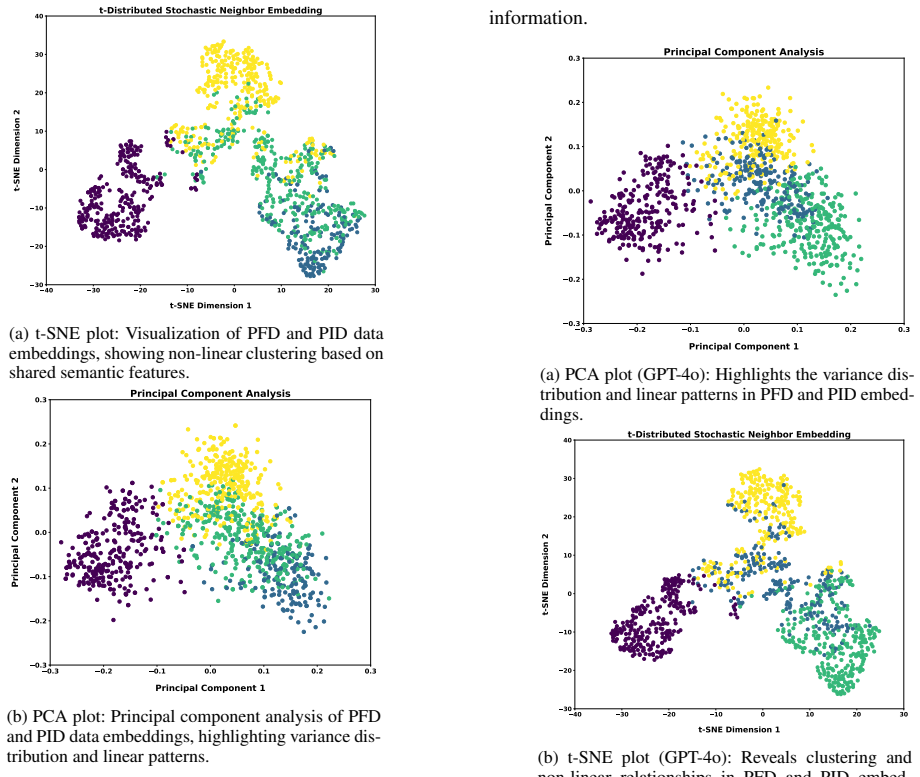
- [Figures 6, 10, 11] The PCA and t-SNE plots are descriptive and provide no quantitative cluster-quality metrics; they do not support claims of 'accurate' or 'context-aware' knowledge generation and should be framed as exploratory visualization only.
- [Technical Appendix, Additional details] The hyperparameter list would benefit from a short table and a brief explanation of how each value was chosen, rather than a single paragraph.
Circularity Check
One evaluation result reduces to GPT-4o self-similarity; the framework's other comparisons are not circular, but the 'high contextual accuracy' claim is partially supported by a by-construction similarity.
-
other
[Agentic Web Navigation Framework, Figure 4 caption; Results, Figure 7 and surrounding text]
"uses tools like SerpAPI for accessing search results and LLMs (e.g., OpenAI GPT-4o) for synthesizing information. ... Figure 7 presents a box-and-whisker plot comparing the embedding similarities of knowledge generated by the agentic web navigation framework with two proprietary LLMs (GPT-4o and Anthropic-Haiku) ... The plot suggests that the generated knowledge has a closer semantic relationship to text from GPT-4o compared to Anthropic-Haiku."
The 'generated knowledge' is produced by the agentic framework whose sub-agents use GPT-4o to synthesize retrieved information. Comparing the embeddings of that output with 'text from GPT-4o' therefore measures the output's similarity to its own generator. The closer relationship to GPT-4o than to Haiku is entailed by the choice of generator, so Figure 7 cannot independently support the claim of high contextual accuracy. This is a by-construction similarity rather than an external validation.
full rationale
The paper's construction pipeline (web retrieval, sub-agent orchestration, knowledge-graph construction, Leiden community detection, Graph RAG traversal) is self-contained and does not fit parameters to the evaluation targets. The Graph RAG versus traditional RAG and fine-tuned versus pre-trained comparisons use the same generated knowledge base and are not circular in a formal sense. The main circular element is the Figure 7 embedding-similarity evidence: because GPT-4o is used inside the generation loop, high similarity to GPT-4o text is expected by construction. Separately, the abstract's claim of delivering 'regulation-compliant diagrams' is not backed by any generated diagram artifact—the outputs are prose PFD/PID descriptions and all reported metrics are computed on text—but that is a correctness/evidence gap, not a circularity. Overall, one evaluation result reduces to generator self-similarity while the central system retains independent engineering content; score 4 reflects that partial circularity.
Assumptions & free parameters
free parameters (6)
- chunk window size w =
1024 tokens
- chunk stride s =
128 tokens
- cosine similarity threshold tau_sim =
0.9
- Levenshtein distance limit =
5
- maximum triples per chunk M =
20
- top-K communities K
assumptions (4)
- domain assumption Publicly available web content is sufficient and accurate enough to construct process diagrams for novel chemicals
- domain assumption LLM-generated text and reward-model scores are valid proxies for regulatory compliance and engineering correctness
- domain assumption The agentic framework's subtask decomposition and agent selection by cosine similarity are sufficient to retrieve the necessary information
- domain assumption Contextual chunk enrichment plus sliding window preserves all details needed for diagram generation
Cite this review
Pith. "Pith review of Accelerating Manufacturing Scale-Up from Material Discovery Using Agentic Web Navigation and Retrieval-Augmented AI for Process Engineering Schematics Design." pith.science (2026). https://pith.science/paper/T237NGTP
@misc{pith2026241205937,
  author       = {Pith},
  title        = {Pith review of: Accelerating Manufacturing Scale-Up from Material Discovery Using Agentic Web Navigation and Retrieval-Augmented AI for Process Engineering Schematics Design},
  year         = {2026},
  howpublished = {\url{https://pith.science/paper/T237NGTP}},
  note         = {Machine review of arXiv:2412.05937}
}
read the original abstract
Process Flow Diagrams (PFDs) and Process and Instrumentation Diagrams (PIDs) are critical tools for industrial process design, control, and safety. However, the generation of precise and regulation-compliant diagrams remains a significant challenge, particularly in scaling breakthroughs from material discovery to industrial production in an era of automation and digitalization. This paper introduces an autonomous agentic framework to address these challenges through a twostage approach involving knowledge acquisition and generation. The framework integrates specialized sub-agents for retrieving and synthesizing multimodal data from publicly available online sources and constructs ontological knowledge graphs using a Graph Retrieval-Augmented Generation (Graph RAG) paradigm. These capabilities enable the automation of diagram generation and open-domain question answering (ODQA) tasks with high contextual accuracy. Extensive empirical experiments demonstrate the frameworks ability to deliver regulation-compliant diagrams with minimal expert intervention, highlighting its practical utility for industrial applications.
Figures


Figures from the paper (8 more)




Forward citations
Cited by 1 Pith paper
-
AutoChemSchematic AI: Agentic Physics-Aware Automation for Chemical Manufacturing Scale-Up
The framework trains small models on synthetic AI-generated data to produce PFD/PID text, then validates two examples by manual DWSIM setup, leaving the industrial-viability claim unproven.
Reference graph
Works this paper leans on
-
[1]
, " * write output.state after.block = add.period write newline
ENTRY address archivePrefix author booktitle chapter edition editor eid eprint howpublished institution isbn journal key month note number organization pages publisher school series title type volume year label extra.label sort.label short.list INTEGERS output.state before.all mid.sentence after.sentence after.block FUNCTION init.state.consts #0 'before.a...
-
[2]
write newline
" write newline "" before.all 'output.state := FUNCTION n.dashify 't := "" t empty not t #1 #1 substring "-" = t #1 #2 substring "--" = not "--" * t #2 global.max substring 't := t #1 #1 substring "-" = "-" * t #2 global.max substring 't := while if t #1 #1 substring * t #2 global.max substring 't := if while FUNCTION word.in bbl.in capitalize " " * FUNCT...
-
[3]
Abuelsaad, T.; Akkil, D.; Dey, P.; Jagmohan, A.; Vempaty, A.; and Kokku, R. 2024. Agent-E: From Autonomous Web Navigation to Foundational Design Principles in Agentic Systems. arXiv:2407.13032
arXiv 2024
-
[4]
Ansari, M.; Watchorn, J.; Brown, C. E.; and Brown, J. S. 2024. dZiner: Rational Inverse Design of Materials with AI Agents. arXiv preprint arXiv:2410.03963
arXiv 2024
-
[5]
Anthropic. 2023. Introducing Contextual Retrieval
work page 2023
-
[6]
Halim, M.; Lakshmanan, V.; Chen, J.; Kumar, S.; DasGupta, S.; and Dehn, M. 2022. Potential Processes for Producing High-Purity Lithium Hydroxide: A Critical Review. In Conference of Metallurgists, 645--653. Springer
work page 2022
-
[7]
He, H.; Yao, W.; Ma, K.; Yu, W.; Dai, Y.; Zhang, H.; Lan, Z.; and Yu, D. 2024. WebVoyager: Building an End-to-End Web Agent with Large Multimodal Models. arXiv preprint arXiv:2401.13919
arXiv 2024
-
[8]
Jia, S.; Zhang, C.; and Fung, V. 2024. LLMatDesign: Autonomous Materials Discovery with Large Language Models. arXiv preprint arXiv:2406.13163
arXiv 2024
Show all 14 references
-
[9]
B.; and Na, J
Kim, H.; Choi, H.; Kang, D.; Lee, W. B.; and Na, J. 2024. Materials discovery with extreme properties via reinforcement learning-guided combinatorial chemistry. Chemical Science
2024
-
[10]
u ttler, H.; Lewis, M.; Yih, W.-t.; Rockt \
Lewis, P.; Perez, E.; Piktus, A.; Petroni, F.; Karpukhin, V.; Goyal, N.; K \"u ttler, H.; Lewis, M.; Yih, W.-t.; Rockt \"a schel, T.; et al. 2020. Retrieval-augmented generation for knowledge-intensive nlp tasks. Advances in Neural Information Processing Systems, 33: 9459--9474
2020
-
[11]
J.; Wilson, A
Liu, Y.; Jovanovic, M.; Mallayya, K.; Maddox, W. J.; Wilson, A. G.; Klemenz, S.; Schoop, L. M.; and Kim, E.-A. 2023. Materials Expert-Artificial Intelligence for Materials Discovery. arXiv preprint arXiv:2312.02796
2023
-
[12]
Putta, P.; Mills, E.; Garg, N.; Motwani, S.; Finn, C.; Garg, D.; and Rafailov, R. 2024. Agent Q: Advanced Reasoning and Learning for Autonomous AI Agents. arXiv:2408.07199
2024 arXiv
-
[13]
W.; Hallacy, C.; Ramesh, A.; Goh, G.; Agarwal, S.; Sastry, G.; Askell, A.; Mishkin, P.; Clark, J.; et al
Radford, A.; Kim, J. W.; Hallacy, C.; Ramesh, A.; Goh, G.; Agarwal, S.; Sastry, G.; Askell, A.; Mishkin, P.; Clark, J.; et al. 2021. Learning transferable visual models from natural language supervision. In International conference on machine learning, 8748--8763. PMLR
2021
-
[14]
Sotelo, D.; Favela-Contreras, A.; Sotelo, C.; Jim \'e nez, G.; and Gallegos-Canales, L. 2017. Design and implementation of a control structure for quality products in a crude oil atmospheric distillation column. ISA transactions, 71: 573--584
2017
Reviewed August 11, 2026 · model on record in the stance chip above.
Discussion (0). Continue with ORCID to comment.