REVIEW 4 major objections 5 minor 31 references
On Motion Blur and Deblurring in Visual Place Recognition
T0 review · 4 major / 5 minor · reviewed 2026-08-11 · deepseek-v4-flash
Pith's one-line read A new synthetic-blur benchmark shows how motion blur degrades visual place recognition and how deblurring can recover most of the lost accuracy.
desk verdict A genuinely useful VPR motion-blur benchmark with a thorough method comparison, but the central rankings rest on an unvalidated synthetic-blur transfer assumption and a deblurring comparison that is partly confounded by training data overlap. read the letter →
The pith
A machine-rendered reading of the paper's core claim, the machinery that carries it, and where it could break.
The reading
What carries the argument
The benchmark generation is carried by the blur formation model in Eq. 3: a blurred image is the average of L consecutive sharp frames from a 240fps video, approximating the temporal integral of the physical image-formation process. This makes blur intensity directly controllable through L, with an implied exposure time of τ = L/240 seconds, and avoids filter-based blur that would not embed real scene motion. The adaptive-deblurring experiments additionally rely on Laplacian variance as a lightweight blur detector to decide which queries warrant deblurring.
What would settle it
Collect real motion-blurred images from a camera moving at known angular velocity and compare VPR accuracy against synthetic blur at the corresponding L value; if method rankings or deblurring gains systematically differ, the benchmark's conclusions do not transfer to real robots.
Extended reading notes
Core claim
The paper's central claim is that motion blur, which VPR research has largely ignored, measurably degrades place recognition and that deblurring can offset much of this degradation, but only when the blur is severe enough and the VPR model relies on global image descriptors. The authors establish this by constructing the first benchmark purpose-built for motion blur together with VPR-specific appearance changes, and by systematically showing that deblurring's benefit depends on the VPR method, the blur level, and the scene variations present. They further claim that an adaptive scheme—Laplacian-variance blur detection followed by deblurring of only blurred queries—achieves the same accuracy as deblurring all frames while reducing energy consumption.
Load-bearing premise
The results depend on synthetic motion blur produced by averaging frames faithfully representing real-world motion blur, including its rolling-shutter distortion, non-uniform camera motion, and sensor noise.
Editorial extensions
If this is right
- VPR evaluations can now include well-controlled motion blur without field acquisition, using the released Blurry Places data and generation scripts.
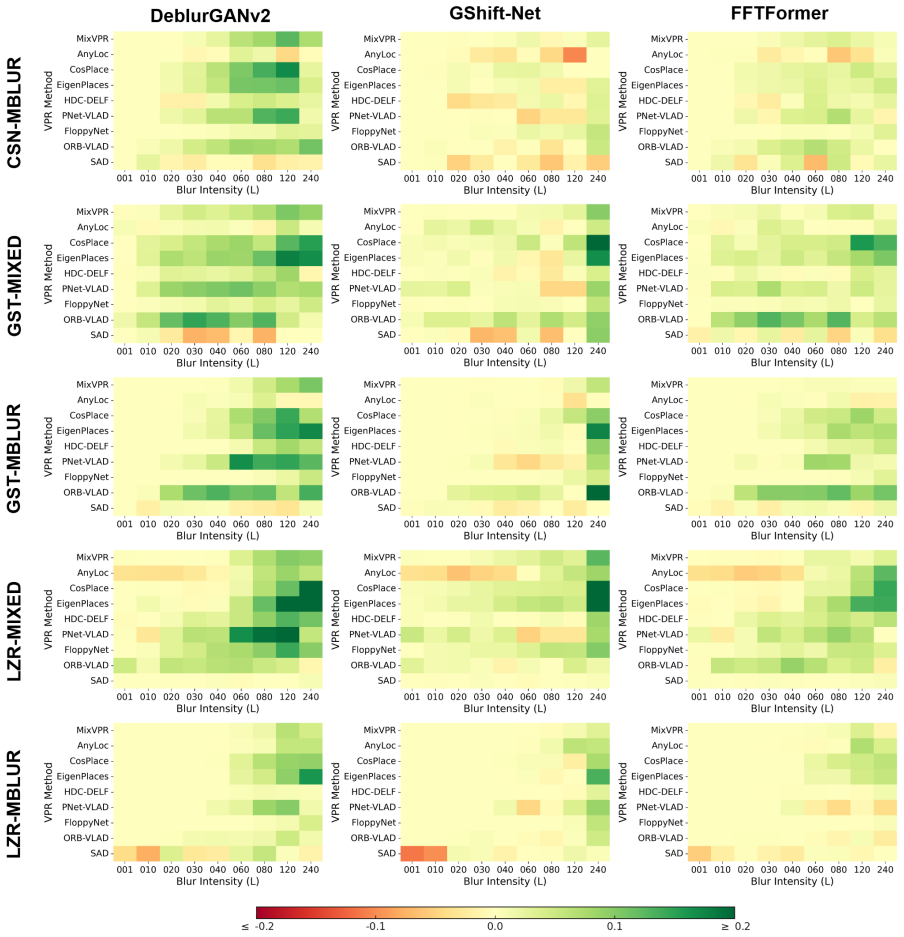
- Deblurring should be applied selectively: it helps most at high blur levels (L ≥ 120) and with global-descriptor models such as CosPlace and EigenPlaces, while giving little or no benefit to already blur-tolerant models like AnyLoc at low blur.
- DeblurGANv2 is the recommended deblurring method among the three tested for VPR, producing larger and more consistent AUC improvements than GShift-Net or FFTFormer.
- Adaptive deblurring with a Laplacian-variance detector matches the accuracy of full deblurring while cutting energy and processing time when sharp images are common.
Reading between the lines
- The benchmark's frame-averaging technique could be extended to simulate low-light long-exposure blur, where motion blur and sensor noise interact, to test VPR in night conditions.
- The results imply that VPR systems should treat deblurring as a conditional module rather than a fixed preprocessing step, with the blur-detection threshold tuned per model and deployment environment.
- Because the video-deblurring method GShift-Net produced the best extreme-blur scores with some models, temporal information from adjacent frames may be valuable for VPR at very high blur levels—a direction the authors explicitly flag for future work.
Signed reviews
Editorial analysis
A structured set of objections, weighed in public.
Referee Report
Summary. The paper introduces Blurry Places, a new benchmark for evaluating visual place recognition (VPR) under motion blur. Blurred query images are generated by averaging L consecutive frames from 240 fps videos recorded along three outdoor routes in Italy, yielding nine blur levels (L=1 to L=240) and both same-traverse and mixed-condition (weather, illumination, viewpoint) query-reference pairs. The authors evaluate nine VPR methods under increasing blur and three deblurring methods (DeblurGANv2, FFTFormer, GShift-Net), reporting that motion blur degrades VPR performance and that DeblurGANv2 is the most effective and robust deblurring method. They also propose an adaptive deblurring strategy that detects blurred queries and deblurs selectively, claiming the same performance gain as full deblurring at lower energy cost. A public repository for the blur generator is provided.
Significance. If the benchmark is valid, it fills a genuine gap: motion blur is an underexplored but practically important challenge for VPR, and existing datasets are limited in blur intensity and scene diversity. The paper's systematic sweep over blur levels combined with other appearance changes is a useful resource, and the code release supports reproducibility. The observation that global-descriptor VPR methods benefit most from deblurring and the energy analysis of adaptive deblurring are practically relevant. However, the significance is conditional on the synthetic blur being representative of real-world motion blur, which is not validated, and on the deblurring comparison not being confounded by training-domain overlap.
major comments (4)
- [Section III-A, Eq. (3)] The synthetic blur is generated by averaging L consecutive frames from 240fps video, but this process is not validated against real motion-blurred images. The paper's central contribution is a benchmark that 'enables comprehensive analysis without field image acquisition,' which depends on the synthetic blur faithfully representing real-world motion blur. However, real cameras exhibit rolling-shutter distortion, finite per-frame exposure, sensor noise, and non-uniform motion, so averaging frames is not mathematically equivalent to a single exposure of duration L/240 s as implied by Eq. (4). Please provide a validation study comparing the synthetic blur against real blurred images (e.g., captured with longer exposure or with known blur kernels), or at minimum a qualitative and quantitative discussion of the domain gap. The absence of this validation weakens the external validity of all subsequent rankings and conclusions.
- [Section V-C, Table III] The comparison of deblurring methods is confounded by training-data distribution. DeblurGANv2 and GShift-Net were additionally trained on DVD (and DeblurGANv2 on NFS), both containing 240fps video data, while FFTFormer was trained on RealBlur and HIDE. Since the Blurry Places benchmark is generated by averaging 240fps frames, DeblurGANv2 and GShift-Net are effectively in-domain for this synthetic blur. The conclusion that 'DeblurGANv2 proves to be the most effective and robust choice of the three when applied to VPR' may be an artifact of this overlap. Please control for training distribution, e.g., by fine-tuning all methods on the same data, or by evaluating on real blurred images, or by reporting performance with held-out synthetic blur and analyzing the domain gap.
- [Section IV, Experimental Setup] The evaluation protocol is under-specified, which hampers reproducibility. The paper does not state which similarity measure is used (e.g., cosine similarity, Euclidean distance), how the reference set is defined, or how AUC is computed (e.g., area under a precision-recall curve, average top-N recall, or rank-based metric). It also omits descriptor normalization and key hyperparameters for each VPR method. Please provide a complete protocol description, including any preprocessing steps, so that the reported figures can be independently reproduced and compared with future work.
- [Section V-D, Table IV] The adaptive deblurring analysis lacks details needed to interpret the results. No threshold or calibration procedure is given for the Laplacian-variance blur detector, so the operating point of 'Detect+Deblur' is not reproducible. Furthermore, the efficiency numbers are inconsistent: in Table IV(b), Detect+Deblur has a higher total time than All Deblur (16.46 s vs 15.40 s) yet a lower energy consumption (5.25 kJ vs 5.42 kJ), which is not explained. Please specify the detection threshold, report the false-positive/negative rates of the detector, and clarify how energy and time are measured.
minor comments (5)
- [Eq. (3)] The summation notation is incorrect: the sum should be over I_i(x) for i = j to j+L-1, not I_j(x), and the current expression implies L+1 terms while dividing by L.
- [Section I, Contributions] The phrase 'without field image acquisition' overstates the case, because the dataset is built from field-recorded videos; it would be more accurate to say 'without dedicated acquisition of blurred images on the field.'
- [Section V-C] The model name is written inconsistently as 'P-NetVLAD' and 'PNet-VLAD'; please use a single spelling throughout.
- [Table I] The 'Frames' column lists raw counts without stating whether these are total sharp frames per video or the number used after processing; please clarify the unit and selection.
- [Section V, Results] The tables and figures report single AUC values without variance across runs. Given that some methods involve stochastic components, providing confidence intervals or repeated evaluations would strengthen the reliability of the observed rankings.
Circularity Check
No circularity: the benchmark conclusions are empirical, externally evaluated, and not forced by the benchmark construction.
full rationale
The paper's derivation chain is empirical rather than definitional. Blurred images are generated by averaging L consecutive 240fps frames (Eq. 3), which is an operational construction, not a fit to the outcome variable. The central claims—that increasing synthetic blur degrades VPR performance, that DeblurGANv2 gives the most consistent deblurring gains, and that detection-then-deblur matches all-deblur AUC at lower energy—are read off from tables and figures using external VPR and deblurring methods. Blur levels in Eq. 5 were chosen by hand, not tuned to AUC, so no prediction is forced by construction. Self-citations appear only as baseline methods (e.g., FloppyNet, [22]) and are not load-bearing premises; no uniqueness theorem or prior-work ansatz is invoked to restrict alternatives. The concern that synthetic frame-averaging blur may not transfer to real motion blur, including rolling-shutter and sensor effects, is a valid external-validity and correctness risk, but it is not circular reasoning: the reported rankings follow from experiments on the proposed benchmark, not from the transfer assumption itself. The authors even acknowledge the training-data domain alignment of DeblurGANv2 and GShift-Net with 240fps video datasets, which further confirms the analysis is empirical rather than tautological.
Assumptions & free parameters
assumptions (3)
- domain assumption Motion blur is modeled as a temporal average of sharp frames over exposure time (Eq. 1), discretized to an average of L video frames (Eq. 3).
- domain assumption The recorded 240fps videos provide sharp latent frames whose temporal average is equivalent to a real camera's motion blur.
- domain assumption Laplacian variance is a sufficient and accurate blur detector for the adaptive deblurring strategy.
Cite this review
Pith. "Pith review of On Motion Blur and Deblurring in Visual Place Recognition." pith.science (2026). https://pith.science/paper/K2EG76GG
@misc{pith2026241207751,
  author       = {Pith},
  title        = {Pith review of: On Motion Blur and Deblurring in Visual Place Recognition},
  year         = {2026},
  howpublished = {\url{https://pith.science/paper/K2EG76GG}},
  note         = {Machine review of arXiv:2412.07751}
}
read the original abstract
Visual Place Recognition (VPR) in mobile robotics enables robots to localize themselves by recognizing previously visited locations using visual data. While the reliability of VPR methods has been extensively studied under conditions such as changes in illumination, season, weather and viewpoint, the impact of motion blur is relatively unexplored despite its relevance not only in rapid motion scenarios but also in low-light conditions where longer exposure times are necessary. Similarly, the role of image deblurring in enhancing VPR performance under motion blur has received limited attention so far. This paper bridges these gaps by introducing a new benchmark designed to evaluate VPR performance under the influence of motion blur and image deblurring. The benchmark includes three datasets that encompass a wide range of motion blur intensities, providing a comprehensive platform for analysis. Experimental results with several well-established VPR and image deblurring methods provide new insights into the effects of motion blur and the potential improvements achieved through deblurring. Building on these findings, the paper proposes adaptive deblurring strategies for VPR, designed to effectively manage motion blur in dynamic, real-world scenarios.
Figures


Figures from the paper (2 more)

Reference graph
Works this paper leans on
-
[1]
On the performance of convnet features for place recognition,
N. S ¨underhauf, S. Shirazi, F. Dayoub, B. Upcroft, and M. Milford, “On the performance of convnet features for place recognition,” in 2015 IEEE/RSJ International Conference on Intelligent Robots and Systems (IROS), 2015, pp. 4297–4304
work page 2015
-
[2]
Seqslam: Visual route-based naviga- tion for sunny summer days and stormy winter nights,
M. J. Milford and G. F. Wyeth, “Seqslam: Visual route-based naviga- tion for sunny summer days and stormy winter nights,” in 2012 IEEE International Conference on Robotics and Automation . IEEE, 2012, pp. 1643–1649
2012
-
[3]
Visual place recognition with repetitive structures,
A. Torii, J. Sivic, T. Pajdla, and M. Okutomi, “Visual place recognition with repetitive structures,” in 2013 IEEE Conference on Computer Vision and Pattern Recognition , 2013, pp. 883–890
work page 2013
-
[4]
M. Zaffar, S. Garg, M. Milford, J. Kooij, D. Flynn, K. McDonald- Maier, and S. Ehsan, “Vpr-bench: An open-source visual place recognition evaluation framework with quantifiable viewpoint and appearance change,” International Journal of Computer Vision , pp. 1–39, 2021
work page 2021
-
[5]
A novel motion blur resistant vslam framework for micro/nano-uavs,
B. S ¸ims ¸ek and H. S ¸. Bilge, “A novel motion blur resistant vslam framework for micro/nano-uavs,” Drones, vol. 5, no. 4, 2021. [Online]. Available: https://www.mdpi.com/2504-446X/5/4/121
work page 2021
-
[6]
BAD SLAM: Bundle Ad- justed Direct RGB-D SLAM,
T. Schops, T. Sattler, and M. Pollefeys, “BAD SLAM: Bundle Ad- justed Direct RGB-D SLAM,” in 2019 IEEE/CVF Conference on Computer Vision and Pattern Recognition (CVPR) . Long Beach, CA, USA: IEEE, Jun. 2019, pp. 134–144
work page 2019
-
[7]
Real-time and high precision feature matching between blur aerial images,
D. Dai, L. Zheng, G. Yuan, H. Zhang, Y . Zhang, H. Wang, and Q. Kang, “Real-time and high precision feature matching between blur aerial images,” PLOS ONE , vol. 17, no. 9, p. e0274773, Sep. 2022, publisher: Public Library of Science. [Online]. Available: https: //journals.plos.org/plosone/article?id=10.1371/journal.pone.0274773
-
[8]
MBA-VO: Motion Blur Aware Visual Odometry
P. Liu, X. Zuo, V . Larsson, and M. Pollefeys, “MBA-VO: Motion Blur Aware Visual Odometry.”
Show all 31 references
-
[9]
Deep multi-scale convolutional neural network for dynamic scene deblurring,
S. Nah, T. H. Kim, and K. M. Lee, “Deep multi-scale convolutional neural network for dynamic scene deblurring,” 2018. [Online]. Available: https://arxiv.org/abs/1612.02177
2018 arXiv
-
[10]
Human-aware motion deblurring,
Z. Shen, W. Wang, X. Lu, J. Shen, H. Ling, T. Xu, and L. Shao, “Human-aware motion deblurring,” 2020. [Online]. Available: https://arxiv.org/abs/2001.06816
2020 arXiv
-
[11]
Frequency-aware event-based video deblurring for real-world motion blur,
T. Kim, H. Cho, and K.-J. Yoon, “Frequency-aware event-based video deblurring for real-world motion blur,” in Proceedings of the IEEE/CVF Conference on Computer Vision and Pattern Recognition (CVPR), June 2024, pp. 24 966–24 976
2024
-
[12]
Deep learning in motion deblurring: current status, benchmarks and future prospects,
Y . Xiang, H. Zhou, C. Li, F. Sun, Z. Li, and Y . Xie, “Deep learning in motion deblurring: current status, benchmarks and future prospects,” The Visual Computer , pp. 1–27, 09 2024
2024
-
[13]
Spatially-attentive patch-hierarchical network for adaptive motion deblurring,
M. Suin, K. Purohit, and A. N. Rajagopalan, “Spatially-attentive patch-hierarchical network for adaptive motion deblurring,” 2020. [Online]. Available: https://arxiv.org/abs/2004.05343
2020 arXiv
-
[14]
Ikeuchi, Ed., Computer Vision: A Reference Guide
K. Ikeuchi, Ed., Computer Vision: A Reference Guide . Cham: Springer International Publishing, 2021. [Online]. Available: https: //link.springer.com/10.1007/978-3-030-63416-2
2021 doi
-
[15]
Unaided stereo vision based pose estimation,
M. Warren, D. McKinnon, H. He, and B. Upcroft, “Unaided stereo vision based pose estimation,” in Australasian Conference on Robotics and Automation , G. Wyeth and B. Upcroft, Eds. Brisbane: Australian Robotics and Automation Association, 2010. [Online]. Available: http://eprin...
2010
-
[16]
1 Year, 1000km: The Oxford RobotCar Dataset,
W. Maddern, G. Pascoe, C. Linegar, and P. Newman, “1 Year, 1000km: The Oxford RobotCar Dataset,” The International Journal of Robotics Research (IJRR) , vol. 36, no. 1, pp. 3–15, 2017. [Online]. Available: http://dx.doi.org/10.1177/0278364916679498
2017 doi
-
[17]
MixVPR: Feature Mixing for Visual Place Recognition,
A. Ali-bey, B. Chaib-draa, and P. Gigu `ere, “MixVPR: Feature Mixing for Visual Place Recognition,” 2023, pp. 2998–3007. [Online]. Available: https://openaccess.thecvf.com/content/W ACV2023/html/ Ali-bey MixVPR Feature Mixing for Visual Place Recognition W ACV2023 paper.html
2023
-
[18]
AnyLoc: Towards Universal Visual Place Recognition,
N. Keetha, A. Mishra, J. Karhade, K. M. Jatavallabhula, S. Scherer, M. Krishna, and S. Garg, “AnyLoc: Towards Universal Visual Place Recognition,” Aug. 2023, arXiv:2308.00688 [cs]. [Online]. Available: http://arxiv.org/abs/2308.00688
2023 arXiv
-
[19]
Rethinking visual geo- localization for large-scale applications,
G. Berton, C. Masone, and B. Caputo, “Rethinking visual geo- localization for large-scale applications,” in Proceedings of the IEEE/CVF Conference on Computer Vision and Pattern Recognition (CVPR), June 2022, pp. 4878–4888
2022
-
[20]
Eigenplaces: Training viewpoint robust models for visual place recognition,
G. Berton, G. Trivigno, B. Caputo, and C. Masone, “Eigenplaces: Training viewpoint robust models for visual place recognition,” in Proceedings of the IEEE/CVF International Conference on Computer Vision (ICCV), October 2023, pp. 11 080–11 090
2023
-
[21]
Hyperdimensional computing as a framework for systematic aggregation of image descriptors,
P. Neubert and S. Schubert, “Hyperdimensional computing as a framework for systematic aggregation of image descriptors,” in 2021 IEEE/CVF Conference on Computer Vision and Pattern Recognition (CVPR). Nashville, TN, USA: IEEE, Jun. 2021, pp. 16 933–16 942. [Online]. Available: ...
2021
-
[22]
Binary neural networks for memory-efficient and effective visual place recognition in changing environments,
B. Ferrarini, M. J. Milford, K. D. McDonald-Maier, and S. Ehsan, “Binary neural networks for memory-efficient and effective visual place recognition in changing environments,” IEEE Transactions on Robotics, vol. 38, no. 4, pp. 2617–2631, 2022
2022
-
[23]
Patch- NetVLAD: Multi-Scale Fusion of Locally-Global Descriptors for Place Recognition,
S. Hausler, S. Garg, M. Xu, M. Milford, and T. Fischer, “Patch- NetVLAD: Multi-Scale Fusion of Locally-Global Descriptors for Place Recognition,” in 2021 IEEE/CVF Conference on Computer Vision and Pattern Recognition (CVPR) . Nashville, TN, USA: IEEE, Jun. 2021, pp. 14 136–14 ...
2021
-
[24]
Orb: An efficient alternative to sift or surf,
E. Rublee, V . Rabaud, K. Konolige, and G. Bradski, “Orb: An efficient alternative to sift or surf,” in Computer Vision (ICCV), 2011 IEEE international conference on . IEEE, 2011, pp. 2564–2571
2011
-
[25]
Deblurgan-v2: Deblurring (orders-of-magnitude) faster and better,
O. Kupyn, T. Martyniuk, J. Wu, and Z. Wang, “Deblurgan-v2: Deblurring (orders-of-magnitude) faster and better,” in The IEEE International Conference on Computer Vision (ICCV) , Oct 2019
2019
-
[26]
Efficient frequency domain-based transformers for high-quality image deblurring,
L. Kong, J. Dong, M. Li, J. Ge, and J. Pan, “Efficient frequency domain-based transformers for high-quality image deblurring,” 2022. [Online]. Available: https://arxiv.org/abs/2211.12250
2022 arXiv
-
[27]
A simple baseline for video restoration with grouped spatial-temporal shift,
D. Li, X. Shi, Y . Zhang, K. C. Cheung, S. See, X. Wang, H. Qin, and H. Li, “A simple baseline for video restoration with grouped spatial-temporal shift,” in Proceedings of the IEEE/CVF Conference on Computer Vision and Pattern Recognition (CVPR) , June 2023, pp. 9822–9832
2023
-
[28]
Are we there yet? challeng- ing seqslam on a 3000 km journey across all four seasons,
N. S ¨underhauf, P. Neubert, and P. Protzel, “Are we there yet? challeng- ing seqslam on a 3000 km journey across all four seasons,” in Proc. of Workshop on Long-Term Autonomy, IEEE International Conference on Robotics and Automation (ICRA) , 2013, p. 2013
2013
-
[29]
Real-world blur dataset for learning and benchmarking deblurring algorithms,
J. Rim, H. Lee, J. Won, and S. Cho, “Real-world blur dataset for learning and benchmarking deblurring algorithms,” in Proceedings of the European Conference on Computer Vision (ECCV) , 2020
2020
-
[30]
Deep video deblurring for hand-held cameras,
S. Su, M. Delbracio, J. Wang, G. Sapiro, W. Heidrich, and O. Wang, “Deep video deblurring for hand-held cameras,” in Proceedings of the IEEE Conference on Computer Vision and Pattern Recognition (CVPR), July 2017
2017
-
[31]
Need for speed: A benchmark for higher frame rate object tracking,
H. K. Galoogahi, A. Fagg, C. Huang, D. Ramanan, and S. Lucey, “Need for speed: A benchmark for higher frame rate object tracking,” arXiv preprint arXiv:1703.05884 , 2017
2017 arXiv
Reviewed August 11, 2026 · model on record in the stance chip above.
Discussion (0). Continue with ORCID to comment.