REVIEW 3 major objections 7 minor 12 references
Self-Consistent Nested Diffusion Bridge for Accelerated MRI Reconstruction
T0 review · 3 major / 7 minor · reviewed 2026-08-11 · deepseek-v4-flash
Pith's one-line read Nested diffusion bridge beats MRI baselines in 20 steps.
desk verdict A clinically motivated nested diffusion bridge for magnitude-only MRI, with a plausible but unvalidated self-consistency mechanism; worth reviewing but needs controls. read the letter →
The pith
A machine-rendered reading of the paper's core claim, the machinery that carries it, and where it could break.
The reading
What carries the argument
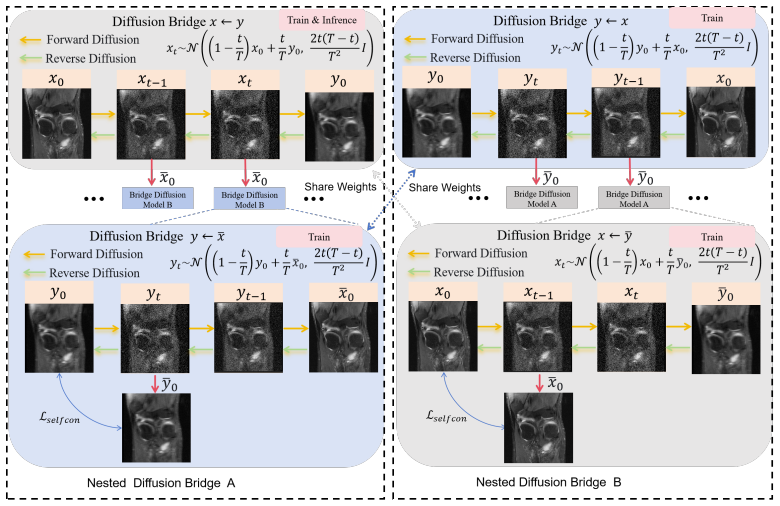
The central object is the nested diffusion bridge: an outer Brownian bridge between under-sampled y0 and fully-sampled x0, and a second bridge started from the model's own one-step estimate \(\bar{x}_0\) (or \(\bar{y}_0\)). A self-consistency loss measures the distance between the original image and the reconstruction produced by running the opposite denoiser on this second bridge, forcing the two networks to encode consistent source priors. The supporting machinery is the Contourlet Decomposition Embedding Module (CDEM), which uses Laplacian pyramids and directional filter banks to extract multi-scale, orientation-selective high-frequency features and injects them into the U-Net denoiser.
What would settle it
Train a variant in which the second bridge is built on the true ground-truth image rather than the model's estimate \(\bar{x}_0\); if this variant achieves the same PSNR and SSIM as SC-NDB, the self-consistency mechanism is not the source of the improvement. A cheaper check is to measure early in training whether the one-step estimates \(\bar{x}_0\) overlap the distribution of real fully-sampled images.
Extended reading notes
Core claim
SC-NDB models accelerated MRI reconstruction as a bidirectional image-translation problem between under-sampled and fully-sampled magnitude images, and shows that forcing two nested diffusion bridges to agree with each other during training improves the accuracy of the single-network reverse path used at inference. Concretely, the training objective combines the usual reconstruction losses for x←y and y←x with a self-consistency loss that runs each denoiser on the other's one-step estimate and penalizes the resulting mismatch. On fastMRI knee at 4x acceleration the method reaches 34.84 dB PSNR and 89.73% SSIM, beating the previous magnitude-image diffusion baselines BBDM (33.79 dB / 87.85%) and selfRDB (34.20 dB / 89.19%), and also beating k-space and image-space diffusion models such as MC-DDPM and HFS-SDE. The gains hold at 8x acceleration, on the IXI T1 dataset, and in out-of-distribution fastMRI brain scans, and the whole pipeline uses only 20 diffusion steps.
Load-bearing premise
The training loop treats the model's own one-step estimate of the fully-sampled image as a trustworthy endpoint for the second diffusion bridge, even though early in training that estimate is far from a real image; if this assumption fails, the self-consistency loss can reinforce the model's errors instead of correcting them.
Editorial extensions
If this is right
- Reconstruction quality on magnitude-only MRI improves by roughly 0.6 to 1.0 dB PSNR over the previous best magnitude-image diffusion baselines, at both 4x and 8x acceleration.
- Inference becomes much cheaper: 20 steps and a single denoising network, compared with 200-step DDIM sampling for the other diffusion baselines.
- The method generalizes across anatomy: models trained on knee scans transfer to brain scans, with the largest gains over baselines appearing in the out-of-distribution setting.
- The same training-time self-consistency regularizer could strengthen any bridge-based image translation model without adding inference cost.
Reading between the lines
- If self-consistency acts as a training regularizer rather than a new inference procedure, similar nested-consistency losses could be bolted onto other diffusion bridges (e.g., Schrödinger bridges) to stabilize few-step training.
- The magnitude-image-only setup removes the need for raw k-space access, which could make diffusion-based reconstruction deployable on existing hospital DICOM workflows.
- The CDEM's contourlet features are task-agnostic; one testable extension is to apply SC-NDB to other inverse problems dominated by high-frequency loss, such as super-resolution or deblurring of magnitude images.
- Since the paper reports results with only 20 training steps, a systematic study of how few steps the nested bridge can tolerate (e.g., 4 or 8) would clarify the practical speed-up limits.
Editorial analysis
A structured set of objections, weighed in public.
Referee Report
Summary. The paper proposes SC-NDB, a training-time nested diffusion-bridge scheme for undersampled-to-fully-sampled magnitude MRI reconstruction. It trains two denoising networks θ1 and θ2 on the forward and reverse Brownian-bridge losses between under-sampled and fully-sampled magnitude images, and adds a self-consistency loss that treats each network's one-step estimate (¯x0, ¯y0) as the endpoint of a second bridge. A contourlet-decomposition embedding module (CDEM) injects multi-scale directional features into the U-Net backbone. The method is evaluated on fastMRI knee (in-distribution), IXI (in-distribution), and fastMRI brain (out-of-distribution), reporting improved PSNR/SSIM/NMSE relative to BBDM, selfRDB, DDPM, I2SB, and several non-magnitude-based methods, while using only 20 training and sampling steps and a single denoising network at inference.
Significance. The target scenario—magnitude-image-only MRI reconstruction from DICOM data—is clinically relevant and relatively underexplored. The 20-step training and sampling regime with a single inference network is practically appealing, and CDEM is a conceptually sensible way to inject explicit structural and textural features. The self-consistency idea, if it genuinely improves the single-network inference path, would be a useful training-time regularizer. However, the empirical support is currently incomplete: the main comparisons are not matched in step counts, and the self-consistency term is trained against the model's own predictions without a control for co-adaptation. With the additional controlled experiments described below, the paper could make a solid contribution.
major comments (3)
- [§4.1, §4.4, Tables 1–3] The central state-of-the-art claim is not yet supported because the comparison protocol is uncontrolled. For SC-NDB, both training and sampling use T=20; for BBDM, DDPM, and I2SB, training uses T=1000 and sampling uses 200 DDIM steps. Performance differences in Tables 1–3 therefore conflate the proposed nested self-consistency mechanism with the step-count schedule. In particular, the reported 0.64 dB gain over selfRDB (34.84 vs 34.20 dB in Table 1) is of the same order as the sensitivity to the noise-variance multiplier shown in Table 6. Please add matched-step experiments, for example by training BBDM and selfRDB with T=20 and sampling with 20 steps, or by training SC-NDB with T=1000 and sampling with 200 steps, and report both quality and inference time under those matched settings. Also clarify the apparent contradiction between §4.1, which says other diffusion methods use 1000 training and 200 sampling steps, and §4.4, which says the training and sampling steps for SC-NDB and selfRDB were set to 20 each.
- [Algorithm 1, Eqs. (7)–(11), Table 4] The self-consistency loss can be minimized by co-adaptation between θ1 and θ2 rather than by an improved single-network inference path. In Algorithm 1, the endpoint ¯x0 is produced by θ1 and then used as the target endpoint of the second bridge whose reconstruction ¯¯y0 is supervised by ||y0−¯¯y0||, with gradients flowing into both θ1 and θ2. Early in training, ¯x0 is far from a clean fully-sampled image, so θ2 can learn to invert θ1's particular errors; the paper provides no analysis of this bias. The ablation in Table 4 only toggles the whole self-consistency term on and off and does not distinguish a genuine prior from co-adaptation. I request (a) a clean-endpoint control replacing ¯x0 with ground-truth x0 in Eq. (8), (b) a detached-endpoint control with stop-gradient on ¯x0 and ¯y0, and (c) ideally an EMA target-network variant. Without at least one of these controls, the 0.36 dB self-consistency gain in Table 4 cannot be attributed to the intended mechanism.
- [§3.2, Eqs. (6)–(8)] The derivation implicitly assumes that the one-step estimate ¯x0 is an approximate sample from the fully-sampled magnitude-image distribution, so that the second Brownian bridge y0 → ¯x0 in Eq. (8) has valid marginals. This is not established. Since ¯x0 depends on θ1 and on the same noise ε used in xt1, its distribution is neither independent of the bridge state nor equal to qdata(x0); during early training it is a heavily biased prediction. Because only θ1 is used at inference, the correctness of the whole approach rests on the claim that the training-time nested bridge improves θ1's marginal prediction. Please provide a justification or, at minimum, empirical diagnostics (for example, PSNR of ¯x0 versus training iteration, and the evolution of ||x0−¯x0|| relative to ||x0−¯¯x0||) showing that the endpoint assumption holds in the regime where the self-consistency loss is active.
minor comments (7)
- [Eq. (7)] The second line should read ¯y0 = yt1 − ϵθ2(yt1, t1); as printed it mixes xt1 with θ2's output and is inconsistent with Algorithm 1.
- [§4.1 and §4.4] The step count used for selfRDB is ambiguous: §4.1 appears to include selfRDB among methods using 1000/200, while §4.4 states selfRDB uses 20 steps. Please state explicitly which T was used for each baseline in each table.
- [Fig. 5 and §3.3] The caption says 'Denosing network' instead of 'Denoising network', and the module is called 'Contourlet Decomposition' in §3.3 but 'Contour Decomposition' in the title and abstract; please use one name consistently.
- [Table 5] The header 't1 = t2 ∼ U t 1 ∼ U, t2 ∼ U' is garbled and should be reformatted; also clarify whether the two timesteps are sampled jointly or independently.
- [References] Zhang and Ghanem (2018a) and (2018b) refer to the same ISTA-Net paper; the duplicate should be merged into one reference.
- [Fig. 11 and §4.4] Please specify how inference time was measured (GPU model, batch size, image size) and whether all compared methods used the same hardware and sampling-step settings; without this, the efficiency comparison is difficult to reproduce.
- [§4.5, Table 6] The noise-variance multiplier √σt2 is tuned on the validation set; the selection procedure should be described so that the reported result is understood as a tuned configuration rather than a fixed hyperparameter.
Circularity Check
No significant circularity; the nested self-consistency objective is anchored to ground-truth reconstructions and benchmarked against external baselines.
full rationale
The derivation chain is self-contained: the self-consistency loss in Eq. (10) minimizes distance to the ground-truth targets x0 and y0, not to the model's own outputs, and the reconstruction losses in Eq. (5) anchor both denoisers to paired data. The intermediate estimates â¢x0/â¢y0 in Algorithm 1 and Eq. (8) serve as auxiliary training-time bridge endpoints, but they are not the final supervision; the reported PSNR/SSIM/NMSE numbers are computed against held-out ground-truth images on fastMRI and IXI. The tuning of the variance multiplier √σt2 and the loss weight λ is validation-based model selection rather than a fitted quantity disguised as a prediction. No load-bearing claim relies on a self-citation or on a uniqueness theorem imported from the authors' prior work; the method is compared with independent external baselines (BBDM, I2SB, selfRDB, DDPM) under shared protocols. The skeptical concern that θ1 and θ2 could co-adapt during training is a legitimate training-dynamics risk, but it does not make the stated derivation circular, because the objective is not equivalent to its own input by construction. Therefore no circular step is exhibited.
Assumptions & free parameters
free parameters (4)
- loss weight λ =
1.0
- noise variance multiplier √σt2 =
1.2
- diffusion steps T (train and sample) =
20
- contourlet decomposition levels and directional subbands =
not fully specified
assumptions (5)
- domain assumption The Brownian bridge diffusion model (Li et al., 2023) with forward process q(xt|x0,y0)=N(xt;(1-mt)x0+mt y0, σt I) is a valid base model.
- standard math The target x0 can be estimated at any time step t as x0 = xt - ϵθ(xt,t), given a well-trained noise predictor.
- ad hoc to paper The model's own estimate ¯x0 is a valid endpoint for a second Brownian bridge, meaning it is approximately a sample from qdata(x0).
- domain assumption Magnitude images generated by inverse Fourier transform and root-sum-of-squares from simulated k-space undersampling are representative of clinical magnitude images.
- standard math U-Net with time embedding can serve as the denoising backbone.
Cite this review
Pith. "Pith review of Self-Consistent Nested Diffusion Bridge for Accelerated MRI Reconstruction." pith.science (2026). https://pith.science/paper/O6TKMF2P
@misc{pith2026241209998,
  author       = {Pith},
  title        = {Pith review of: Self-Consistent Nested Diffusion Bridge for Accelerated MRI Reconstruction},
  year         = {2026},
  howpublished = {\url{https://pith.science/paper/O6TKMF2P}},
  note         = {Machine review of arXiv:2412.09998}
}
read the original abstract
Accelerated MRI reconstruction plays a vital role in reducing scan time while preserving image quality. While most existing methods rely on complex-valued image-space or k-space data, these formats are often inaccessible in clinical practice due to proprietary reconstruction pipelines, leaving only magnitude images stored in DICOM files. To address this gap, we focus on the underexplored task of magnitude-image-based MRI reconstruction. Recent advancements in diffusion models, particularly denoising diffusion probabilistic models (DDPMs), have demonstrated strong capabilities in modeling image priors. However, their task-agnostic denoising nature limits performance in source-to-target image translation tasks, such as MRI reconstruction. In this work, we propose a novel Self-Consistent Nested Diffusion Bridge (SC-NDB) framework that models accelerated MRI reconstruction as a bi-directional image translation process between under-sampled and fully-sampled magnitude MRI images. SC-NDB introduces a nested diffusion architecture with a self-consistency constraint and reverse bridge diffusion pathways to improve intermediate prediction fidelity and better capture the explicit priors of source images. Furthermore, we incorporate a Contour Decomposition Embedding Module (CDEM) to inject structural and textural knowledge by leveraging Laplacian pyramids and directional filter banks. Extensive experiments on the fastMRI and IXI datasets demonstrate that our method achieves state-of-the-art performance compared to both magnitude-based and non-magnitude-based diffusion models, confirming the effectiveness and clinical relevance of SC-NDB.
Figures


Figures from the paper (8 more)


Reference graph
Works this paper leans on
-
[4]
Equilibrated Zeroth-Order Unrolled Deep Networks for Accelerated MRI
Equilibrated zeroth-order unrolled deep networks for accelerated mri. arXiv preprint arXiv:2112.09891 . Fabian, Z., Heckel, R., Soltanolkotabi, M.,
-
[7]
arXiv preprint arXiv:2411.16535
Adobi: Adaptive diffusion bridge for blind inverse problems with application to mri reconstruction. arXiv preprint arXiv:2411.16535 . Hyun, C.M., Kim, H.P., Lee, S.M., Lee, S., Seo, J.K.,
-
[9]
arXiv preprint arXiv:2302.05872
I2sb: Image-to-image schr \” odinger bridge. arXiv preprint arXiv:2302.05872 . Lu, C., Zhou, Y., Bao, F., Chen, J., Li, C.,
-
[12]
arXiv preprint arXiv:2204.13902
Fast sampling of diffusion models with exponen- tial integrator. arXiv preprint arXiv:2204.13902 . 26 Zheng, H., Fang, F., Zhang, G.,
-
[2016]
Accelerating magnetic resonance imaging via deep learning, in: Proceedings of the International Symposium on Biomedical Imaging, pp. 514–517. doi: 10.1109/ISBI.2016.7493320. Xie, Y., Li, Q.,
arXiv 2016
-
[2017]
Accelerated magnetic resonance imag- ing by adversarial neural network, in: Deep Learning in Medical Image Analysis, DLMIA 2017, Springer. pp. 30–38. Song, J., Meng, C., Ermon, S., 2020a. Denoising diffusion implicit models. arXiv preprint arXiv:2010.02502 . 25 Song, Y., Sohl-Dickstein, J., Kingma, D.P., Kumar, A., Ermon, S., Poole, B., 2020b. Score-based...
arXiv 2017
-
[2020]
arXiv preprint arXiv:2008.13065
Unsupervised mri reconstruction with generative adversarial networks. arXiv preprint arXiv:2008.13065 . Cui, Z.X., Cheng, J., Zhu, Q., Liu, Y., Jia, S., Zhao, K., Ke, Z., Huang, W., Wang, H., Zhu, Y.,
arXiv 2008
-
[2021]
Wavelet improved gan for mri re- construction, in: Medical Imaging 2021: Physics of Medical Imaging, pp. 285–295. Chung, H., Kim, J., Ye, J.C.,
work page 2021
Show all 12 references
-
[2022]
arXiv preprint arXiv:2207.12598
Classifier-free diffusion guidance. arXiv preprint arXiv:2207.12598 . Hou, R., Li, F.,
-
[2023]
1952–1961
Bbdm: Image-to-image translation with brownian bridge diffusion models, in: Proceedings of the IEEE/CVF Conference on Computer Vision and Pattern Recognition, pp. 1952–1961. Liu, G.H., Vahdat, A., Huang, D.A., Theodorou, E.A., Nie, W., Anandku- mar, A.,
1952
-
[2024]
arXiv preprint arXiv:2405.06789
Self- consistent recursive diffusion bridge for medical image translation. arXiv preprint arXiv:2405.06789 . Bamberger, R.H., Smith, M.J.,
-
[2025]
arXiv preprint arXiv:2501.03430
A self-supervised diffusion bridge for mri reconstruction. arXiv preprint arXiv:2501.03430 . Goodfellow, I., Pouget-Abadie, J., Mirza, M., Xu, B., Warde-Farley, D., Ozair, S., Courville, A., Bengio, Y.,
Reviewed August 11, 2026 · model on record in the stance chip above.
Discussion (0). Continue with ORCID to comment.