REVIEW 4 major objections 6 minor 1 cited by
NoisyEQA: Benchmarking Embodied Question Answering Against Noisy Queries
T0 review · 4 major / 6 minor · reviewed 2026-08-11 · deepseek-v4-flash
Pith's one-line read Noisy human questions are a real failure mode for embodied question-answering agents, and a simple 'self-correction' prompt wrapper—either a generic noise-awareness instruction or a step-by-step chain-of-thought—substantially improves how…
desk verdict A useful first benchmark for noisy user questions in EQA, but the headline prompting gains may be partly an artifact of an unvalidated LLM judge. read the letter →
The pith
A machine-rendered reading of the paper's core claim, the machinery that carries it, and where it could break.
The reading
What carries the argument
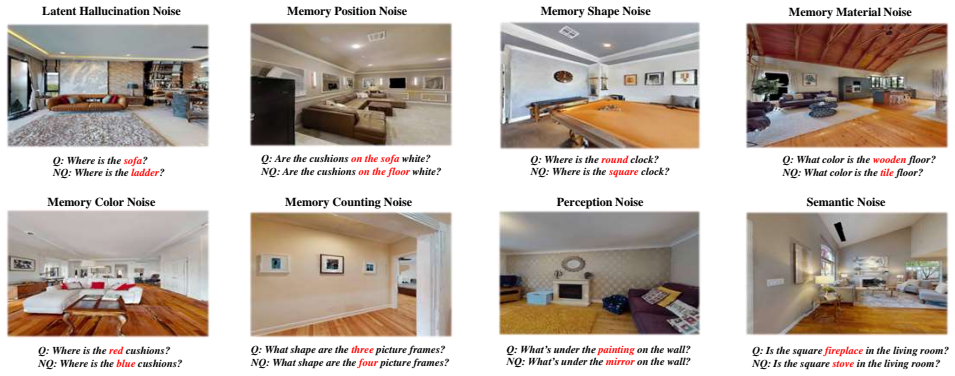
The load-bearing tool is the four-way noise taxonomy plus the automated generation pipeline: an LLM writes noisy questions from scene facts and templates, with perception noise generated by corrupting images and having a VLM describe the distorted scene. The second mechanism is the Self-Correction prompt: NAP appends a general instruction to check all question information against the image; NACoT decomposes the question into object-presence, attribute, and function/semantic checks and asks the agent to explain the detected noise before answering. A confidence-based view selector picks the most reliable camera view by the probability of a 'yes' token to a confidence question. The evaluation scheme is a 1-to-5 rubric scored by an LLM judge, with Detection Rate (scores ≥3) and Correction Rate (scores ≥4) as the noise-specific metrics.
What would settle it
Have two or more human annotators score a sample of NoisyEQA agent responses with the paper's 1–5 rubric, then compare the human scores to the GPT-4 judge scores. If the judge's threshold agreement (score ≥3 for detection, ≥4 for correction) with humans is low, the headline DR/CR improvements would not survive a human evaluation.
Extended reading notes
Core claim
On its own terms, the paper establishes that noisy user questions are a real and measurable failure mode for VLM-based EQA agents and that a detection-then-correction prompting mechanism materially improves answer quality. The central evidence is the NoisyEQA benchmark: 500 questions built from real scenes, covering latent hallucination noise (non-existent objects), memory noise (wrong attributes: position, color, shape, count, material), perception noise (visually confused objects), and semantic noise (semantically related substitutions). Adding NAP or NACoT raises the detection rate (DR) for GPT-4o-EQA from 46.2% to 79.0% and the correction rate (CR) from 17.4% to 42.0%, while also raising accuracy on every noise subcategory. The paper also proposes a five-point LLM-judge scale, with DR/CR defined as score thresholds, to separate the ability to notice noise from the ability to fix it.
Load-bearing premise
The results assume that the GPT-4-based judge's scores match what a human would say about whether an agent detected and corrected the noise; the paper does not measure that agreement on NoisyEQA, so the reported detection and correction gains are only as trustworthy as the judge.
Editorial extensions
If this is right
- Agents that answer without checking will regularly fabricate objects or repeat the user's wrong assumptions in real deployments; a pre-answer verification step is a cheap partial remedy.
- Noise awareness can be added as a plug-in prompt to existing EQA systems, so the benefit does not require architecture changes or retraining.
- Detection is substantially easier than correction: even with NAP/NACoT, correction rates stay well behind human performance, especially for perception and semantic noise.
- The generation framework can be scaled to more scenes and more noise types, providing a controlled way to stress-test robustness of future EQA agents.
- The separation of detection and correction via DR/CR gives a clearer diagnostic than a single accuracy number for where agents fail.
Reading between the lines
- The same detect-then-correct prompting pattern could transfer to other instruction-following tasks, such as vision-language navigation or household instruction following, where user commands carry implicit assumptions.
- Because the benchmark's generation pipeline is automated and LLM-driven, it could be inverted to produce training pairs (noisy question, corrected question), potentially making agents inherently more robust rather than dependent on prompt wrappers.
- The paper's observation that noise lowers response confidence suggests that confidence scores could be used as a zero-shot signal to flag likely-noisy questions before answering.
Editorial analysis
A structured set of objections, weighed in public.
Referee Report
Summary. The paper introduces NoisyEQA, a benchmark of 500 noisy questions for embodied question answering, with a four-type taxonomy of noise (Latent Hallucination, Memory, Perception, and Semantic, with Memory further subdivided into five attributes). A generation framework powered by templates and LLMs creates the questions. The authors also propose a Self-Correction prompting mechanism (NAP and NACoT) that prompts agents to detect and correct noise before answering, and a new evaluation framework with a 1-5 LLM-judge rubric and two metrics, Detection Rate (DR) and Correction Rate (CR). The central empirical finding is that two VLM-based agents (Llama2-EQA and GPT-4o-EQA) perform substantially worse on noisy than on clean questions, and that NAP/NACoT improve their scores on the proposed metrics. The paper also reports human performance on the same benchmark for comparison.
Significance. If the results hold, the paper addresses a real and under-studied failure mode: humans often pose questions with incorrect presumptions, and EQA agents are not robust to them. The taxonomy is reasonable and the automated generation framework is a useful contribution. The DR/CR metrics are a natural way to separate noise detection from correction. The paper is honest in reporting that the improved agents still fall well short of human performance. However, the headline improvements of NAP/NACoT rest on an LLM-judge rubric that is authored by the same team and is not validated against human ratings on NoisyEQA itself; this is a load-bearing gap. The baseline finding of degraded performance on noisy questions is consistent across both agents and all noise types and is likely robust.
major comments (4)
- [Section 5, Figure 8, Eqs. (2)-(3), Table 3] The headline DR/CR improvements rest entirely on the GPT-4-based LLM judge introduced in Section 5. The 1-5 rubric explicitly rewards detecting and correcting noise (scores 4 and 5), and DR/CR are defined as thresholded counts on that same rubric (Eqs. 2-3). The only validation offered (supplementary Section 3.2) is OpenEQA's 0.909 Spearman correlation, measured on clean open-vocabulary answers under a different rubric; no human-scoring agreement study is run on NoisyEQA itself. Because NAP and NACoT instruct the agent to check for noise, state the detected noise, and then answer, their outputs are tailored to the rubric's reward structure. The measured jumps (e.g., GPT-4o-EQA DR from 46.2% to 79.0% with NAP, and CR from 17.4% to 42.0%, Table 3) could therefore be partly scoring artifacts. The authors should either (a) run a human-correlation study on a sample of NoisyEQA responses (ideally at least 100 responses, with multiple annotators and inter-annotator agreement), or (b) report results with an independent metric such as exact-match or a second judge with a different rubric, and show that the conclusions are stable.
- [Section 5, Figure 8 (rubric examples)] The rubric conflates answer correctness with a particular style of 'correction' on yes/no questions. Score 3 is assigned to a response like 'Sorry, there is no square mirror on the wall', which is a factually correct answer to 'Is the square mirror on the wall?', while higher scores require also stating the actual attribute (e.g., 'the round mirror is on the wall'). This means DR and CR reward a corrective style rather than pure answer accuracy, and the NAP/NACoT prompts explicitly elicit that style. The authors should clarify whether the benchmark's ground truth requires the corrected object/attribute, and report how much of the NAP/NACoT gain survives when scoring is based only on the truth/falsity of the agent's answer to the literal question.
- [Section 3.3, Figure 5] Perception Noise is generated by adding Gaussian noise to the scene image, using a VLM to describe the disturbed image, and constructing questions from the misidentified objects. This operationalizes 'human perceptual error' with a specific noise model, but no evidence is given that Gaussian perturbation produces errors similar to human misperception (e.g., due to myopia, occlusion, or low lighting). This is a construct-validity assumption that is load-bearing for the benchmark's taxonomy. The paper should include a human study where annotators judge whether the generated Perception-Noise questions are plausible misperceptions, or at least report agreement between VLM misidentifications and human misidentifications on the same disturbed images.
- [Section 3.1, Eqs. (2)-(3)] The composition of the 500-question benchmark is not fully specified: the distribution over the four noise types and the five memory-attribute subtypes is only shown in Figure 4, and the selection procedure (e.g., random sampling, balanced design, or frequency matching to the source datasets) is not described. Likewise, the DR and CR thresholds (score >= 3 and >= 4) are introduced without justification or sensitivity analysis. For a benchmark whose central metrics are DR and CR, the authors should state the intended distribution and report DR/CR under alternative thresholds (e.g., >=2 and >=4, or a continuous score) to show that the conclusions are not threshold artifacts.
minor comments (6)
- [Section 5, Eq. (1)] Equation (1) is ambiguous as typeset: 'C = 1/N X_i sigma_i - 1/4 × 100%' should be written as C = (1/N) * sum_i (sigma_i - 1) / 4 * 100%. Please clarify the formula and the range of C.
- [Throughout] There are several typos and grammatical errors, including 'adpoted' (Section 5), 'Inpsired' (Supplementary 3.2), 'evluation' (Supplementary 3.1), 'tow noise types' (Supplementary 4.1), 'lined in detection' (Supplementary 4.2), and 'real-word application' (Conclusion). A careful proofread is needed.
- [Figure 4] The text of Figure 4 in the provided manuscript appears garbled with unicode escape sequences; please ensure the final PDF shows the actual distribution plots clearly and that the figure is legible.
- [Section 6.1] Only two agent variants are evaluated, both built on the same Prismatic-VLM vision encoder, and the authors note that agents without token-probability access are excluded. The abstract's claim of a 'comprehensive evaluation' is stronger than the evidence; consider tempering the language or adding at least one additional agent family.
- [Section 1 and Supplementary Section 1] The claim that the Self-Correction mechanism 'meets the AI Act's transparency requirements' is asserted rather than argued. The connection between prompting an agent to verbalize detected noise and legal transparency obligations is not immediate and should be either substantiated or softened.
- [Dataset Availability] No link to the NoisyEQA dataset, generation code, or evaluation scripts is provided. For a benchmark paper, releasing the dataset and the LLM-judge prompting code is essential for reproducibility and for the community to verify the judge's behavior.
Circularity Check
No significant circularity: the rubric–prompt alignment reflects the intended construct, and the missing human-judge validation is a validity gap, not a definitional reduction.
full rationale
The paper's claim that NAP/NACoT improve accuracy on NoisyEQA is an empirical measurement rather than a construction. The 1–5 rubric (Figure 8) rewards noise detection and correction, and NAP/NACoT prompt the agent to check for inaccuracies; however, the method is not defined in terms of the DR/CR thresholds (Eqs. 2–3), and the scores are not fitted to the method's outputs. The benchmark was generated via templates and LLM-based frameworks with volunteer review, independent of the self-correction prompts. The reported DR/CR gains are therefore not forced by definition. The main weakness is that the LLM judge's agreement with human judgment is only cited from OpenEQA (Spearman 0.909) and not re-validated on NoisyEQA, so the rubric's reward structure may inflate measured gains; this is an evaluation-validity concern, not a circular self-citation or fitted-input problem. No load-bearing self-citations, imported uniqueness theorems, or ansatz-by-citation steps are present. Consequently, the derivation chain is self-contained apart from the external judge validation, and no circular step can be exhibited.
Assumptions & free parameters
free parameters (3)
- DR threshold =
score >= 3
- CR threshold =
score >= 4
- Noise type distribution in 500 questions =
not stated (Figure 4)
assumptions (4)
- domain assumption The four noise types (latent hallucination, memory, perception, semantic) adequately cover noisy human questions in real EQA interactions.
- domain assumption GPT-4 LLM-judge scores on NoisyEQA agree with human judgment on this benchmark.
- ad hoc to paper Gaussian perturbation of scene images produces misperceptions similar to human perceptual errors.
- domain assumption Human volunteer review ensures the 500 questions contain the intended noise and have correct ground-truth answers.
invented entities (4)
-
Latent Hallucination Noise
-
Memory Noise (with position/color/shape/count/material subtypes)
-
Perception Noise
-
Semantic Noise
Cite this review
Pith. "Pith review of NoisyEQA: Benchmarking Embodied Question Answering Against Noisy Queries." pith.science (2026). https://pith.science/paper/IBROWF3S
@misc{pith2026241210726,
  author       = {Pith},
  title        = {Pith review of: NoisyEQA: Benchmarking Embodied Question Answering Against Noisy Queries},
  year         = {2026},
  howpublished = {\url{https://pith.science/paper/IBROWF3S}},
  note         = {Machine review of arXiv:2412.10726}
}
read the original abstract
The rapid advancement of Vision-Language Models (VLMs) has significantly advanced the development of Embodied Question Answering (EQA), enhancing agents' abilities in language understanding and reasoning within complex and realistic scenarios. However, EQA in real-world scenarios remains challenging, as human-posed questions often contain noise that can interfere with an agent's exploration and response, bringing challenges especially for language beginners and non-expert users. To address this, we introduce a NoisyEQA benchmark designed to evaluate an agent's ability to recognize and correct noisy questions. This benchmark introduces four common types of noise found in real-world applications: Latent Hallucination Noise, Memory Noise, Perception Noise, and Semantic Noise generated through an automated dataset creation framework. Additionally, we also propose a 'Self-Correction' prompting mechanism and a new evaluation metric to enhance and measure both noise detection capability and answer quality. Our comprehensive evaluation reveals that current EQA agents often struggle to detect noise in questions, leading to responses that frequently contain erroneous information. Through our Self-Correct Prompting mechanism, we can effectively improve the accuracy of agent answers.
Figures


Figures from the paper (7 more)


Forward citations
Cited by 1 Pith paper
-
ActiveFly-Bench: Aligning Embodied Question Answering with Vision-Language-Action for Aerial Embodied Perception
ActiveFly-Bench defines Air-EQA, Observation Behavior Planning, and 7-DoF FLUC tasks on 10k real/sim trajectories so UAV agents must plan, fly, and answer questions they cannot solve from the start view.
Reference graph
Works this paper leans on
-
[1]
Josh Achiam, Steven Adler, Sandhini Agarwal, Lama Ah- mad, Ilge Akkaya, Florencia Leoni Aleman, Diogo Almeida, Janko Altenschmidt, Sam Altman, Shyamal Anadkat, et al. Gpt-4 technical report. arXiv preprint arXiv:2303.08774 ,
-
[2]
Vqa: Visual question answering
Stanislaw Antol, Aishwarya Agrawal, Jiasen Lu, Margaret Mitchell, Dhruv Batra, C Lawrence Zitnick, and Devi Parikh. Vqa: Visual question answering. In Proceedings of the IEEE International Conference on Computer Vision, pages 2425– 2433, 2015. 2
work page 2015
-
[3]
Abhishek Das, Samyak Datta, Georgia Gkioxari, Stefan Lee, Devi Parikh, and Dhruv Batra. Embodied question answer- ing. In Proceedings of the IEEE Conference on Computer Vision and Pattern Recognition, pages 1–10, 2018. 2, 3
work page 2018
-
[4]
Neural modular control for embodied question answering
Abhishek Das, Georgia Gkioxari, Stefan Lee, Devi Parikh, and Dhruv Batra. Neural modular control for embodied question answering. InConference on Robot Learning, pages 53–62. PMLR, 2018. 3
work page 2018
-
[5]
S-eqa: Tackling situational queries in embodied question answering
Vishnu Sashank Dorbala, Prasoon Goyal, Robinson Pira- muthu, Michael Johnston, Reza Ghanadhan, and Dinesh Manocha. S-eqa: Tackling situational queries in embodied question answering. arXiv preprint arXiv:2405.04732, 2024. 3
arXiv 2024
-
[6]
The eu ai act: a summary of its significance and scope
Lilian Edwards. The eu ai act: a summary of its significance and scope. Artificial Intelligence (the EU AI Act) , 1, 2021. 2, 1
work page 2021
-
[7]
Jin Gao, Lei Gan, Yuankai Li, Yixin Ye, and Dequan Wang. Dissecting dissonance: Benchmarking large mul- timodal models against self-contradictory instructions. In European Conference on Computer Vision, pages 404–420. Springer, 2025. 3
work page 2025
-
[8]
Activelab: Active learn- ing with re-labeling by multiple annotators
Hui Wen Goh and Jonas Mueller. Activelab: Active learn- ing with re-labeling by multiple annotators. arXiv preprint arXiv:2301.11856, 2023. 3
arXiv 2023
Show all 48 references
-
[9]
Hallusionbench: an advanced diagnos- tic suite for entangled language hallucination and visual il- lusion in large vision-language models
Tianrui Guan, Fuxiao Liu, Xiyang Wu, Ruiqi Xian, Zongxia Li, Xiaoyu Liu, Xijun Wang, Lichang Chen, Furong Huang, Yaser Yacoob, et al. Hallusionbench: an advanced diagnos- tic suite for entangled language hallucination and visual il- lusion in large vision-language models. In P...
2024
-
[10]
Detecting and preventing hallucinations in large vision language models
Anisha Gunjal, Jihan Yin, and Erhan Bas. Detecting and preventing hallucinations in large vision language models. In Proceedings of the AAAI Conference on Artificial Intelli- gence, pages 18135–18143, 2024. 3
2024
-
[11]
Quantifying the uncertainty of llm hallucination spreading in complex adaptive social networks
Guozhi Hao, Jun Wu, Qianqian Pan, and Rosario Morello. Quantifying the uncertainty of llm hallucination spreading in complex adaptive social networks. Scientific Reports, 14 (1):16375, 2024. 3
2024
-
[12]
Hal-eval: A uni- versal and fine-grained hallucination evaluation framework for large vision language models
Chaoya Jiang, Hongrui Jia, Mengfan Dong, Wei Ye, Haiyang Xu, Ming Yan, Ji Zhang, and Shikun Zhang. Hal-eval: A uni- versal and fine-grained hallucination evaluation framework for large vision language models. InProceedings of the 32nd ACM International Conference on Multimedia...
2024
-
[13]
Hallucination detection in llm-enriched prod- uct listings
Ling Jiang, Keer Jiang, Xiaoyu Chu, Saaransh Gulati, and Pulkit Garg. Hallucination detection in llm-enriched prod- uct listings. In Proceedings of the Seventh Workshop on e- Commerce and NLP@ LREC-COLING 2024 , pages 29–39,
2024
-
[14]
Prismatic vlms: Investigating the design space of visually-conditioned language models
Siddharth Karamcheti, Suraj Nair, Ashwin Balakrishna, Percy Liang, Thomas Kollar, and Dorsa Sadigh. Prismatic vlms: Investigating the design space of visually-conditioned language models. arXiv preprint arXiv:2402.07865, 2024. 7
2024 arXiv
-
[15]
Mitigating object hal- lucinations in large vision-language models through visual contrastive decoding
Sicong Leng, Hang Zhang, Guanzheng Chen, Xin Li, Shijian Lu, Chunyan Miao, and Lidong Bing. Mitigating object hal- lucinations in large vision-language models through visual contrastive decoding. In Proceedings of the IEEE/CVF Con- ference on Computer Vision and Pattern Recogn...
2024
-
[16]
How to configure good in-context sequence for visual question answering
Li Li, Jiawei Peng, Huiyi Chen, Chongyang Gao, and Xu Yang. How to configure good in-context sequence for visual question answering. In Proceedings of the IEEE/CVF Con- ference on Computer Vision and Pattern Recognition, pages 26710–26720, 2024. 2
2024
-
[17]
Evaluating object hallucina- tion in large vision-language models
Yifan Li, Yifan Du, Kun Zhou, Jinpeng Wang, Wayne Xin Zhao, and Ji-Rong Wen. Evaluating object hallucina- tion in large vision-language models. arXiv preprint arXiv:2305.10355, 2023. 3
2023 arXiv
-
[18]
A survey on hallucination in large vision-language models
Hanchao Liu, Wenyuan Xue, Yifei Chen, Dapeng Chen, Xiu- tian Zhao, Ke Wang, Liping Hou, Rongjun Li, and Wei Peng. A survey on hallucination in large vision-language models. arXiv preprint arXiv:2402.00253, 2024. 3
2024 arXiv
-
[19]
Aligning cyber space with physi- cal world: A comprehensive survey on embodied ai
Yang Liu, Weixing Chen, Yongjie Bai, Jingzhou Luo, Xin- shuai Song, Kaixuan Jiang, Zhida Li, Ganlong Zhao, Junyi Lin, Guanbin Li, et al. Aligning cyber space with physi- cal world: A comprehensive survey on embodied ai. arXiv preprint arXiv:2407.06886, 2024. 2, 3
2024 arXiv
-
[20]
Robust-eqa: robust learning for embodied question answering with noisy labels
Haonan Luo, Guosheng Lin, Fumin Shen, Xingguo Huang, Yazhou Yao, and Hengtao Shen. Robust-eqa: robust learning for embodied question answering with noisy labels. IEEE Transactions on Neural Networks and Learning Systems ,
-
[21]
Sqa3d: Situated question answering in 3d scenes
Xiaojian Ma, Silong Yong, Zilong Zheng, Qing Li, Yi- tao Liang, Song-Chun Zhu, and Siyuan Huang. Sqa3d: Situated question answering in 3d scenes. arXiv preprint arXiv:2210.07474, 2022. 2
2022 arXiv
-
[22]
Openeqa: Embodied question answering in the era of foun- dation models
Arjun Majumdar, Anurag Ajay, Xiaohan Zhang, Pranav Putta, Sriram Yenamandra, Mikael Henaff, Sneha Silwal, Paul Mcvay, Oleksandr Maksymets, Sergio Arnaud, et al. Openeqa: Embodied question answering in the era of foun- dation models. In Proceedings of the IEEE/CVF Conference on...
2024
-
[23]
Confident learning: Estimating uncertainty in dataset labels
Curtis Northcutt, Lu Jiang, and Isaac Chuang. Confident learning: Estimating uncertainty in dataset labels. Journal of Artificial Intelligence Research, 70:1373–1411, 2021. 3
2021
-
[24]
Per- vasive label errors in test sets destabilize machine learning benchmarks
Curtis G Northcutt, Anish Athalye, and Jonas Mueller. Per- vasive label errors in test sets destabilize machine learning benchmarks. arXiv preprint arXiv:2103.14749, 2021. 3
2021 arXiv
-
[25]
Dataset shift in ma- chine learning
Joaquin Qui ˜nonero-Candela, Masashi Sugiyama, Anton Schwaighofer, and Neil D Lawrence. Dataset shift in ma- chine learning. Mit Press, 2022. 3
2022
-
[26]
Explore until confi- dent: Efficient exploration for embodied question answering
Allen Z Ren, Jaden Clark, Anushri Dixit, Masha Itkina, Anirudha Majumdar, and Dorsa Sadigh. Explore until confi- dent: Efficient exploration for embodied question answering. arXiv preprint arXiv:2403.15941, 2024. 2, 3, 5, 1
2024 arXiv
-
[27]
Prompt- ing large language models with answer heuristics for knowledge-based visual question answering
Zhenwei Shao, Zhou Yu, Meng Wang, and Jun Yu. Prompt- ing large language models with answer heuristics for knowledge-based visual question answering. In Proceedings of the IEEE/CVF Conference on Computer Vision and Pat- tern Recognition, pages 14974–14983, 2023. 2
2023
-
[28]
Adaptive integration of par- tial label learning and negative learning for enhanced noisy label learning
Mengmeng Sheng, Zeren Sun, Zhenhuang Cai, Tao Chen, Yichao Zhou, and Yazhou Yao. Adaptive integration of par- tial label learning and negative learning for enhanced noisy label learning. In Proceedings of the AAAI Conference on Artificial Intelligence, pages 4820–4828, 2024. 3
2024
-
[29]
Mind the error! detection and localization of instruction errors in vision-and-language nav- igation
Francesco Taioli, Stefano Rosa, Alberto Castellini, Lorenzo Natale, Alessio Del Bue, Alessandro Farinelli, Marco Cristani, and Yiming Wang. Mind the error! detection and localization of instruction errors in vision-and-language nav- igation. arXiv preprint arXiv:2403.10700, 2024. 3
2024 arXiv
-
[30]
Gemini 1.5: Unlocking multimodal understanding across millions of tokens of con- text
Gemini Team, Petko Georgiev, Ving Ian Lei, Ryan Burnell, Libin Bai, Anmol Gulati, Garrett Tanzer, Damien Vincent, Zhufeng Pan, Shibo Wang, et al. Gemini 1.5: Unlocking multimodal understanding across millions of tokens of con- text. arXiv preprint arXiv:2403.05530, 2024. 7
2024 arXiv
-
[31]
Cabo Verde, Equatorial Guinea, North Macedonia, Sierra Leone, Costa Rica, Marshall Islands, Papua New Guinea, Saudi Arabia, South Sudan, Sri Lanka, et al. Seizing the opportunities of safe, secure and trustworthy artificial intel- ligence systems for sustainable development: d...
-
[32]
Unlocking the power of open set: A new perspective for open-set noisy label learn- ing
Wenhai Wan, Xinrui Wang, Ming-Kun Xie, Shao-Yuan Li, Sheng-Jun Huang, and Songcan Chen. Unlocking the power of open set: A new perspective for open-set noisy label learn- ing. In Proceedings of the AAAI conference on artificial in- telligence, pages 15438–15446, 2024. 3
2024
-
[33]
3d-aware visual question answering about parts, poses and occlusions
Xingrui Wang, Wufei Ma, Zhuowan Li, Adam Kortylewski, and Alan L Yuille. 3d-aware visual question answering about parts, poses and occlusions. Advances in Neural Information Processing Systems, 36, 2024. 2
2024
-
[34]
Mitigating hallucinations in large vision-language models with instruction contrastive decoding
Xintong Wang, Jingheng Pan, Liang Ding, and Chris Bie- mann. Mitigating hallucinations in large vision-language models with instruction contrastive decoding. arXiv preprint arXiv:2403.18715, 2024. 3
2024 arXiv
-
[35]
Multi-target embodied question answering
Licheng Yu, Xinlei Chen, Georgia Gkioxari, Mohit Bansal, Tamara L Berg, and Dhruv Batra. Multi-target embodied question answering. In Proceedings of the IEEE/CVF Con- ference on Computer Vision and Pattern Recognition, pages 6309–6318, 2019. 3
2019
-
[36]
Hallucidoctor: Mitigating hallucinatory toxicity in visual instruction data
Qifan Yu, Juncheng Li, Longhui Wei, Liang Pang, Wen- tao Ye, Bosheng Qin, Siliang Tang, Qi Tian, and Yueting Zhuang. Hallucidoctor: Mitigating hallucinatory toxicity in visual instruction data. In Proceedings of the IEEE/CVF Conference on Computer Vision and Pattern Recognitio...
2024
-
[37]
Early stopping against label noise without validation data
Suqin Yuan, Lei Feng, and Tongliang Liu. Early stopping against label noise without validation data. InThe Twelfth In- ternational Conference on Learning Representations , 2024. 3
2024
-
[38]
Learning visual question an- swering on controlled semantic noisy labels
Haonan Zhang, Pengpeng Zeng, Yuxuan Hu, Jin Qian, Jingkuan Song, and Lianli Gao. Learning visual question an- swering on controlled semantic noisy labels. Pattern Recog- nition, 138:109339, 2023. 2
2023
-
[39]
Badlabel: A robust perspective on evaluating and enhancing label-noise learn- ing
Jingfeng Zhang, Bo Song, Haohan Wang, Bo Han, Tongliang Liu, Lei Liu, and Masashi Sugiyama. Badlabel: A robust perspective on evaluating and enhancing label-noise learn- ing. IEEE Transactions on Pattern Analysis and Machine Intelligence, 2024. 3 NoisyEQA: Benchmarking Embodie...
2024
-
[40]
AI Transparency in NoisyEQA Transparency in AI systems is essential for reliable [6] and interpretable decision-making, especially in noisy scenarios addressed in NoisyEQA
Transparency and Accountability 1.1. AI Transparency in NoisyEQA Transparency in AI systems is essential for reliable [6] and interpretable decision-making, especially in noisy scenarios addressed in NoisyEQA. In this work, we propose the Self- Correction mechanism to tackle t...
-
[41]
Posi- tion
More Details of Existing Datasets As shown in Figure 9, we observed that in existing OpenEQA [22] and ExploreEQA [26] datasets, “Posi- tion” constitutes the largest proportion of all attributes in the questions. This aligns with the natural tendency of hu- mans that we usually...
-
[42]
Evaluation Details 3.1. Evaluation Scale To comprehensively evaluate the quality of responses from question-answering agents in the presence of noisy ques- tions, we elaborately design a scoring scale ranging from 1 to 5. The evluation scale assesses three key aspects: noise d...
-
[43]
This indicates a fun- damental misunderstanding for both the noise and the question’s core intent
Score of 1: The question’s noise remains uncorrected, resulting in a response that is completely irrelevant or different from the correct answer. This indicates a fun- damental misunderstanding for both the noise and the question’s core intent
-
[44]
This suggests that the agent achieves the correct answer by coincidence, but fails to handle the noise in the question
Score of 2: Although the noise in the question is not ad- dressed or corrected, the response aligns with the correct answer in meaning. This suggests that the agent achieves the correct answer by coincidence, but fails to handle the noise in the question
-
[45]
No, it’s not mentioned
Score of 3: The agent recognizes the question is unan- swerable due to excessive noise and responds with a statement such as “No, it’s not mentioned.” This demon- strates the agent is able to detect unanswerable ques- tions, rather than forging an inaccurate or irrelevant an- swer
-
[46]
It shows that the agent fully understands the question but not achieves a completely correct answer
Score of 4: The agent effectively corrects the noise in the question, but the response is only partially aligned with the correct answer. It shows that the agent fully understands the question but not achieves a completely correct answer
-
[47]
It demonstrates that the agent has a full understanding of the question and can provide a high-quality answer
Score of 5: The agent both corrects the noise in the question accurately and generates a response that per- fectly matches the correct answer. It demonstrates that the agent has a full understanding of the question and can provide a high-quality answer. 3.2. Effectiveness of L...
-
[48]
Impact of Noise on Response Confidence Figure 2 in the manuscript shows that the noise in the ques- tion will significantly decrease the generation accuracy
More Experiment Results 4.1. Impact of Noise on Response Confidence Figure 2 in the manuscript shows that the noise in the ques- tion will significantly decrease the generation accuracy. Ex- cept for it, we further show that the impact of noise can deteriorate the response con...
Reviewed August 11, 2026 · model on record in the stance chip above.
Discussion (0). Continue with ORCID to comment.