REVIEW 4 major objections 4 minor 45 references
A Shapley Value Estimation Speedup for Efficient Explainable Quantum AI
T0 review · 4 major / 4 minor · reviewed 2026-08-11 · deepseek-v4-flash
Pith's one-line read This paper establishes that Shapley values—the standard measure of feature importance in explainable AI—can be estimated on a quantum computer with a quadratic speedup over classical Monte Carlo sampling.
desk verdict Worth a serious referee, but the headline quadratic bound in Theorem 5 does not follow from the paper's own error analysis. read the letter →
The pith
A machine-rendered reading of the paper's core claim, the machinery that carries it, and where it could break.
The reading
What carries the argument
The carrying object is an amplitude-encoded Riemann sum: a partition register prepared in a superposition whose amplitudes are the interval widths w_ℓ(k), followed by controlled rotations that create binomial amplitudes b_{n,m}(t'_ℓ(k)) over player coalitions. Tracing out the auxiliary registers leaves exactly the Shapley weights γ(n,m) up to a bounded error. Combining this construction with a quantum amplitude-estimation subroutine reduces the query count from quadratic to linear in 1/ε. In the improved version, the same Riemann sum is built on a uniform grid using a quantum arcsin circuit, which bypasses the costly non-uniform partition preparation of the earlier version.
What would settle it
Implement the quantum arcsin subroutine from reference [30] on a simulator for ℓ in the range 8 to 12 and compare its CNOT count and output error against the claimed O(ℓ²) gates and $2^{{-(ℓ+1)}}$ bound: if the error does not decay at that rate, or the gate count grows faster than ℓ², then Theorem 5's complexity bound collapses. A complementary check is to measure the empirical error of the earlier algorithm's Step-1 approximation on random weighted voting games and verify it decays like $2^{{-ℓ}}$, as Theorem 7 predicts.
Extended reading notes
Core claim
The central claim is that Shapley weights γ(n,m) coincide exactly with a beta function integral, so the weighted average defining Φ(i) can be rewritten as a Riemann sum and prepared directly in quantum amplitudes. Then the Shapley value appears as the difference of two expected measurements, extractable by amplitude estimation. The improved version removes the expensive state-preparation step by using a quantum arcsin circuit on a uniform partition, giving a query complexity of O(√(ΔV(Φ_i − V_min))/ε · (log²(ΔV n/ε) + n log(ΔV n/ε) + C_V(ε/(4ΔV)))) operations for fixed success probability, compared with classical Monte Carlo's O(σ²/ε² · C_V(ε)).
Load-bearing premise
The improved algorithm's speedup rests entirely on a cited quantum arcsin circuit (reference [30]) whose claimed O(ℓ²) cost and $2^{{-(ℓ+1)}}$ error are not proved or reproduced in this paper; if that circuit is flawed, the algorithm falls back to a version whose weight-preparation cost can erase the quantum advantage.
Editorial extensions
If this is right
- For any cooperative game with an efficient quantum implementation of the value function, Shapley values can be approximated to additive error ε using O(1/ε) queries instead of O(1/ε²).
- Doubling precision costs only twice the work, whereas classical Monte Carlo quadruples the work.
- The method yields additive explanations, in the style of SHAP, for quantum classifier circuits, including local explanations of particular decisions.
- For Boolean value functions with range {0,1}, the speedup is quadratic up to polylogarithmic factors in ε and the value-function implementation cost.
- When the value-function implementation is complex enough to dominate the logarithmic overhead, the polylogarithmic terms drop out and the complexity matches the paper's Table 4 comparison.
Reading between the lines
- If the cited quantum arcsin construction holds up, the same circuit could replace other expensive state-preparation subroutines in quantum Monte Carlo and quantum-simulation algorithms, not just Shapley estimation.
- The identity between Shapley weights and beta-function integrals suggests a classical reduction: any integral-approximation scheme for x^m(1−x)^{n−m} yields a Shapley approximation with the same error behavior, which could inspire new classical estimators.
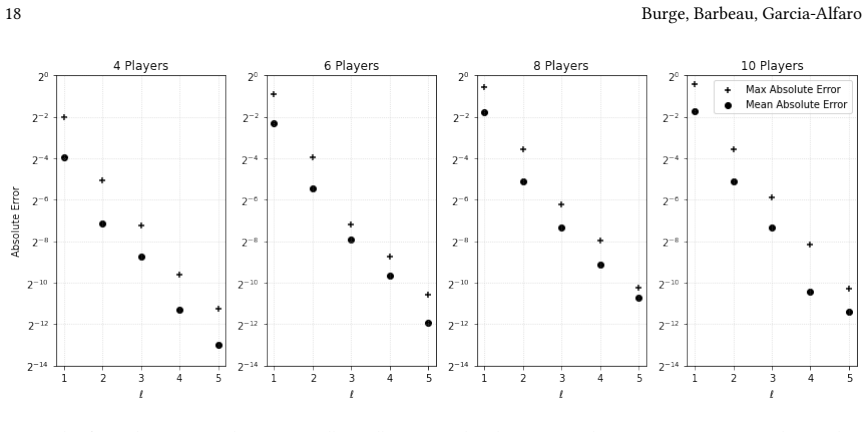
- A testable extension is to run the improved algorithm on larger random weighted voting games and check whether empirical error scales like 1/ε rather than 1/ε², as the complexity bound predicts.
- The local-explanation construction points toward a direct quantum analogue of SHAP for quantum classifiers, where the classifier itself could also benefit from quantum speedups.
Signed reviews
Editorial analysis
A structured set of objections, weighed in public.
Referee Report
Summary. The paper proposes quantum algorithms for estimating Shapley values of cooperative games, with applications to explainable AI. The main construction encodes Shapley weights as expected values of a constructed quantum state and uses Montanaro amplitude estimation to achieve a claimed quadratic speedup over classical Monte Carlo. Section 5 gives a first algorithm relying on a partition-register state D_ℓ that approximates Riemann sums of beta functions; Section 7 replaces D_ℓ with a Quantum CORDIC arcsin circuit from a companion paper to improve the overhead. Empirical demonstrations on weighted voting games and a companion repository are included. The central claimed result is Theorem 5 and Table 4: the quantum algorithm estimates Φ_i with additive error ε and fixed success probability using O(sqrt(ΔV(Φ_i - V_min))/ε · (log²(ΔV n/ε) + n log(ΔV n/ε) + C_V(ε/(4ΔV)))) operations, versus classical O(σ²/ε² C_V(ε)).
Significance. If the claims were correct, the paper would be a meaningful contribution to quantum Monte Carlo speedups and to explainable quantum AI: it gives an explicit circuit-level construction, a rigorous error-propagation framework in Appendix D, and concrete simulations with reproducible code. The identification of Shapley weights with beta functions and the use of Riemann-sum state preparation are elegant. However, the flagship Theorem 5 and Table 4 rest on an error analysis that conflates two independent amplitude-estimation runs, so the stated complexity bound is not proven and can be arbitrarily wrong. The qualitative idea is plausible and may survive a corrected analysis, but the manuscript in its current form does not establish its main speedup theorem.
major comments (4)
- [§7 Theorem 5; Appendix D.3; Eq. (40)] The Step 3 error analysis treats two separate amplitude-estimation runs as a single run estimating μ = (Φ_i - V_min)/(V_max - V_min). The algorithm described in Section 5, Step 3, and used again in Section 7, performs one amplitude-estimation run on |ψ_+⟩ and a second run on |ψ_-⟩, then subtracts the estimates. Montanaro's bound applies separately to μ_+ = (Φ_+ - V_min)/ΔV and μ_- = (Φ_- - V_min)/ΔV, so the error of the difference is bounded by ΔV(2π(√μ_+ + √μ_-)/t + 2π²/t²), not by ΔV(2π√μ/t + π²/t²). For an almost-null player with Φ_i = δ > 0 and μ_+, μ_- both near 1/2, Eq. (40) chooses t = O(√(ΔVδ)/ε), while each of the two runs requires t = Ω(1/ε) to keep the per-run error at ε/2. The ratio of required t to claimed t grows as 1/√δ, so Theorem 5's complexity bound and the corresponding entry in Table 4 are unsupported by the algorithm as written.
- [§7 Theorem 5 statement] The recovery formula in Theorem 5 is inconsistent with the construction. From Equations (8) and (9), the utility-register expectation values satisfy E_± = (Φ_± - V_min)/ΔV, so the difference E_+ - E_- equals Φ_i/ΔV; multiplying by ΔV yields Φ_i, with no subtraction of V_min. The phrase 'multiplying by V_max - V_min, and subtracting by V_min' does not reconstruct Φ_i from the two measured expectations and should be corrected.
- [§7 Theorem 5 proof] The complexity count for the arcsin-based weight preparation appears undercounted. The Quantum CORDIC arcsin operation from [30] produces a single-qubit rotation whose angle depends on the partition-register value k; applying this operation to each of the n player qubits costs n · O(ℓ²) CNOTs in the obvious implementation, i.e., n · O(log²(ΔV n/ε)). The proof instead states that the results are encoded using O(n log(ΔV n/ε)) operations. Unless a sharing or fan-out mechanism that avoids repeating the arcsin computation n times is intended and explicitly described, the polylogarithmic overhead claimed in Theorem 5 does not follow.
- [§7, first paragraph after Eq. (25)] The improved algorithm depends entirely on the claim from [30] that arcsin can be implemented with O(ℓ²) CNOTs, 4ℓ + O(log ℓ) ancillary qubits, and error 2^{-(ℓ+1)}. This result is not proved or reproduced in the present manuscript. Because the entire advantage of the improved algorithm over the Section 5 version rests on this external result, the paper should either supply a proof in an appendix or refer to a peer-reviewed published version of [30].
minor comments (4)
- [Appendix D.3] The error bound contains typographical inconsistencies: the text alternately writes '2π t√μ' and '2π/(t√μ)', while Montanaro's bound and the subsequent choice of t require '2π√μ/t'. These expressions should be corrected and made consistent.
- [Title page affiliation] The affiliation for Michel Barbeau reads 'carleron'; it should be 'Carleton'.
- [Reference [31]] The name 'Riberio' should be spelled 'Ribeiro'.
- [§6.1, Figure 4] The caption and text should clarify whether the reported errors include only the Step 1 (weight-preparation) error or also the statistical error of the amplitude estimation step, and how the exact Shapley values used as ground truth were computed.
Circularity Check
No significant circularity: the algorithm implements the Shapley formula rather than fitting it, and the only self-citation (Quantum CORDIC arcsin) is a separable subroutine, not an input-to-conclusion reduction.
full rationale
The paper's derivation is not circular. Definition 3 independently defines the Shapley value as a weighted sum of marginal contributions. The quantum algorithm is then constructed so that the expectation value of a utility-register measurement reproduces that weighted sum: Theorem 2 and the derivation in Section 5 show the equality up to controlled Riemann-sum and amplitude-estimation errors. This is a correctness proof, not a self-definitional reversal. No parameter is fitted from Shapley-value data and then renamed as a prediction; the iteration count t in Equation (40) is an analytic choice based on the desired error and the target value, which is standard for complexity statements. The only overlapping-author citation is the Quantum CORDIC arcsin construction [30], used in Section 7 to replace the expensive D_l preparation. That citation is a separable subroutine with its own stated resource complexity; it is not the theorem being proved, nor is it invoked as a uniqueness argument or an ansatz that smuggles in the conclusion. Even if [30] were flawed, the Section 5 algorithm stands on its own with the external Montanaro amplitude-estimation result [22]. The skeptical concern about treating two separate amplitude-estimation runs as one is a mathematical error-analysis issue, not circularity, and does not affect the circularity score. Therefore the derivation is self-contained with respect to circularity.
Assumptions & free parameters
assumptions (5)
- standard math Shapley value definition and axioms (efficiency, equal treatment, null player, additivity).
- standard math Montanaro's quantum amplitude estimation algorithm for mean estimation with error bound |μ~-μ| ≤ 2π sqrt(μ(1-μ))/t + π²/t².
- ad hoc to paper Quantum CORDIC arcsin circuit from [30] approximates arcsin with O(ℓ²) CNOTs and error 2^{-(ℓ+1)} using 4ℓ+O(log ℓ) ancillas.
- standard math Stirling's approximation with explicit error bounds [45].
- standard math Standard properties of Darboux sums and Riemann sums for bounding discretization error.
Cite this review
Pith. "Pith review of A Shapley Value Estimation Speedup for Efficient Explainable Quantum AI." pith.science (2026). https://pith.science/paper/QJXIACOM
@misc{pith2026241214639,
  author       = {Pith},
  title        = {Pith review of: A Shapley Value Estimation Speedup for Efficient Explainable Quantum AI},
  year         = {2026},
  howpublished = {\url{https://pith.science/paper/QJXIACOM}},
  note         = {Machine review of arXiv:2412.14639}
}
read the original abstract
This work focuses on developing efficient post-hoc explanations for quantum AI algorithms. In classical contexts, the cooperative game theory concept of the Shapley value adapts naturally to post-hoc explanations, where it can be used to identify which factors are important in an AI's decision-making process. An interesting question is how to translate Shapley values to the quantum setting and whether quantum effects could be used to accelerate their calculation. We propose quantum algorithms that can extract Shapley values within some confidence interval. Our method is capable of quadratically outperforming classical Monte Carlo approaches to approximating Shapley values up to polylogarithmic factors in various circumstances. We demonstrate the validity of our approach empirically with specific voting games and provide rigorous proofs of performance for general cooperative games.
Figures


Figures from the paper (1 more)
Reference graph
Works this paper leans on
- [30]
-
[1]
B. Goodman and S. Flaxman. European Union regulations on algorithmic decision-making and a “right to explanation”. AI magazine, 38(3):50–57, 2017
work page 2017
-
[2]
M. Nisevic, A. Cuypers, and J. De Bruyne. Explainable ai: Can the ai act and the gdpr go out for a date? In 2024 International Joint Conference on Neural Networks (IJCNN), pages 1–8. IEEE, 2024
work page 2024
-
[3]
L. Nannini, A. Balayn, and A. L. Smith. Explainability in ai policies: A critical review of communications, reports, regulations, and standards in the eu, us, and uk. In Proceedings of the 2023 ACM conference on fairness, accountability, and transparency , pages 1198–1212, 2023
work page 2023
-
[4]
C. Rudin. Stop explaining black box machine learning models for high stakes decisions and use interpretable models instead. Nature Machine Intelligence, 1(5):206–215, 2019
work page 2019
- [5]
-
[6]
S. M. Lundberg and S.-I. Lee. A unified approach to interpreting model predictions. Advances in neural information processing systems , 30, 2017
work page 2017
-
[7]
Y. Matsui and T. Matsui. NP-completeness for calculating power indices of weighted majority games. Theoretical Computer Science, 263(1-2):305–310, 2001
work page 2001
Show all 45 references
-
[8]
Prasad and J
K. Prasad and J. S. Kelly. NP-completeness of some problems concerning voting games. International Journal of Game Theory , 19(1):1–9, 1990
1990
-
[9]
Castro, D
J. Castro, D. Gómez, and J. Tejada. Polynomial calculation of the Shapley value based on sampling.Computers & Operations Research, 36(5):1726–1730, 2009
2009
-
[10]
Biamonte, P
J. Biamonte, P. Wittek, N. Pancotti, P. Rebentrost, N. Wiebe, and S. Lloyd. Quantum machine learning. Nature, 549(7671):195–202, 2017
2017
- [11]
- [12]
-
[13]
Deshmukh, B
S. Deshmukh, B. K. Behera, P. Mulay, E. A. Ahmed, S. Al-Kuwari, P. Tiwari, and A. Farouk. Explainable quantum clustering method to model medical data. Knowledge-Based Systems, 267:110413, 2023
2023
-
[14]
J. G. Saw, M. C. Yang, and T. C. Mo. Chebyshev inequality with estimated mean and variance. The American Statistician, 38(2):130–132, 1984
1984
-
[15]
R. J. Aumann. Some non-superadditive games, and their Shapley values, in the Talmud. International Journal of Game Theory , 39:1–10, 2010
2010
-
[16]
E. Winter. The Shapley value. Handbook of game theory with economic applications , 3:2025–2054, 2002
2025
-
[17]
S. Hart. Shapley value. In Game theory, pages 210–216. The New Palgrave. Palgrave Macmillan, London, 1989
1989
-
[18]
L. S. Shapley. A Value for N-Person Games . RAND Corporation, Santa Monica, CA, 1952
1952
-
[19]
R. M. Byrne. Counterfactuals in Explainable Artificial Intelligence (XAI): Evidence from Human Reasoning. In IJCAI, pages 6276–6282, 2019
2019
-
[20]
Guidotti
R. Guidotti. Counterfactual explanations and how to find them: literature review and benchmarking. Data Mining and Knowledge Discovery , 38(5):2770–2824, 2024
2024
-
[21]
G. Chen, Q. Chen, S. Long, W. Zhu, Z. Yuan, and Y. Wu. Quantum convolutional neural network for image classification. Pattern Analysis and Applications, 26(2):655–667, 2023
2023
-
[22]
Montanaro
A. Montanaro. Quantum speedup of Monte Carlo methods. Proceedings of the Royal Society A: Mathematical, Physical and Engineering Sciences , 471(2181):20150301, 2015. Manuscript submitted to ACM TQC Quantum Shapley Value Estimation Speedup 23
2015
-
[23]
K. A. Ross. Elementary analysis. Springer, New York, NY, 2013
2013
-
[24]
A. G. Rattew and B. Koczor. Preparing arbitrary continuous functions in quantum registers with logarithmic complexity. arXiv preprint arXiv:2205.00519, 2022
2022 arXiv
-
[25]
Plesch and Č
M. Plesch and Č. Brukner. Quantum-state preparation with universal gate decompositions. Physical Review A, 83(3):032302, 2011
2011
-
[26]
A. Kay. Tutorial on the Quantikz package, arXiv: 1809.03842, https://arxiv.org/abs/1809.03842, March 2023
2023
-
[27]
Giovannetti, S
V. Giovannetti, S. Lloyd, and L. Maccone. Quantum random access memory. Physical review letters, 100(16):160501, 2008
2008
-
[28]
Burge, M
I. Burge, M. Barbeau, and J. Garcia-Alfaro. Quantum Algorithms for Shapley Value Calculation [extended simulation github repository], github, https://github.com/iain-burge/QuantumShapleyValueAlgorithm, May 2023
2023
-
[29]
L. K. Grover. A fast quantum mechanical algorithm for database search. In Proceedings of the twenty-eighth annual ACM symposium on Theory of computing, pages 212–219, 1996
1996
-
[31]
why should i trust you?
M. T. Ribeiro, S. Singh, and C. Guestrin. " why should i trust you?" explaining the predictions of any classifier. In Proceedings of the 22nd ACM SIGKDD international conference on knowledge discovery and data mining , pages 1135–1144, 2016
2016
-
[32]
S. Bach, A. Binder, G. Montavon, F. Klauschen, K.-R. Müller, and W. Samek. On pixel-wise explanations for non-linear classifier decisions by layer-wise relevance propagation. PloS one, 10(7):e0130140, 2015
2015
-
[33]
Marques-Silva and X
J. Marques-Silva and X. Huang. Explainability is not a game. Communications of the ACM, 67(7):66–75, 2024
2024
-
[34]
Ghassemi, L
M. Ghassemi, L. Oakden-Rayner, and A. L. Beam. The false hope of current approaches to explainable artificial intelligence in health care. The Lancet Digital Health, 3(11):e745–e750, 2021
2021
-
[35]
A. J. London. Artificial intelligence and black-box medical decisions: accuracy versus explainability. Hastings Center Report, 49(1):15–21, 2019
2019
-
[36]
Lipovetsky
S. Lipovetsky. Quantum-like data modeling in applied sciences. Stats, 6(1):345–353, 2023
2023
-
[37]
Van den Broeck, A
G. Van den Broeck, A. Lykov, M. Schleich, and D. Suciu. On the tractability of SHAP explanations. Journal of Artificial Intelligence Research , 74:851–886, 2022
2022
-
[38]
Bertossi, J
L. Bertossi, J. Li, M. Schleich, D. Suciu, and Z. Vagena. Causality-based explanation of classification outcomes. In Proceedings of the Fourth International Workshop on Data Management for End-to-End Machine Learning , pages 1–10, 2020
2020
-
[39]
M. K. Tarkowski, T. P. Michalak, T. Rahwan, and M. Wooldridge. Game-theoretic network centrality: A review.arXiv preprint arXiv:1801.00218, 2017
2017 arXiv
-
[40]
Lloyd, M
S. Lloyd, M. Mohseni, and P. Rebentrost. Quantum principal component analysis. Nature physics, 10(9):631–633, 2014
2014
-
[41]
Rebentrost, M
P. Rebentrost, M. Mohseni, and S. Lloyd. Quantum support vector machine for big data classification. Physical review letters, 113(13):130503, 2014
2014
-
[42]
K. Beer, D. Bondarenko, T. Farrelly, T. J. Osborne, R. Salzmann, D. Scheiermann, and R. Wolf. Training deep quantum neural networks. Nature communications, 11(1):808, 2020
2020
-
[43]
Pira and C
L. Pira and C. Ferrie. On the interpretability of quantum neural networks. Quantum Machine Intelligence, 6(2):52, 2024
2024
-
[44]
Steinmüller, T
P. Steinmüller, T. Schulz, F. Graf, and D. Herr. eXplainable AI for Quantum Machine Learning. arXiv preprint arXiv:2211.01441, 2022
2022 arXiv
-
[45]
H. Robbins. A remark on stirling’s formula. The American mathematical monthly, 62(1):26–29, 1955. A Calculation for Alice Quantum estimation of Alice’s Shapley value by hand. Letℓ be equal to 2. Note that an auxiliary register stores the vote count. To perform𝑈− 𝑉 , we begin w...
1955
Reviewed August 11, 2026 · model on record in the stance chip above.
Discussion (0). Continue with ORCID to comment.