REVIEW 3 major objections 4 minor 64 references
Associative memory inspires improvements for in-context learning using a novel attention residual stream architecture
T0 review · 3 major / 4 minor · reviewed 2026-08-11 · deepseek-v4-flash
Pith's one-line read Adding a residual connection that passes attention values from each head to the same-index head in the next layer improves in-context learning in Transformers across scales from a two-layer synthetic task to 1-billion-parameter language…
desk verdict Useful small-scale result; the 1B scale-up claim rests on a single run per architecture and a statistically invalid paired t-test, so treat the headline as unproven. read the letter →
The pith
A machine-rendered reading of the paper's core claim, the machinery that carries it, and where it could break.
The reading
What carries the argument
The load-bearing object is the residual values stream: a residual connection, present in every layer but the first, that feeds the value vectors $V_{n-1}$ of each attention head into the values $V_n$ of the same-index head in the next layer, so that $V_n = W_v^n X_n + V_{n-1}$. It adds no trainable parameters. In AMICL, the values are the input tokens themselves, so the stream is the Transformer analogue of retaining the remembered pattern; in a trained network it preserves 'look-back' information in the answers that attention produces, acting as a memory pathway across layers. The argument is framed through the universal associative memory operation $\mathrm{projection}(\mathrm{separation}(\mathrm{similarity}(K,Q)),V)$, with the value stream carrying the projection term that determines what is retrieved.
What would settle it
Train the 1B classic and residual-values-stream architectures from several fresh random seeds, holding data order and compute budget fixed, and compare the distributions of final accuracy on ARC, OpenBookQA, and IOI-Hard; if the residual stream's advantage does not exceed run-to-run variance, the scaling claim fails. As a mechanism check at small scale, scramble the head-index mapping of the residual stream: if the IOI gain persists under scrambling, the improvement is not about preserving specific head values.
Extended reading notes
Core claim
The paper's central claim is that residual attention value streams improve in-context learning. It first defines AMICL, an associative memory model in which each token's key and query are a weighted average of the previous and current token, the value is the token itself, and next-token prediction is the universal associative memory operation $\mathrm{projection}(\mathrm{separation}(\mathrm{similarity}(K,Q)),V)$. Because values equal inputs, retrieval returns the original stored label, which the paper identifies as auto-association. Training experiments show that deleting value projections outright destabilizes learning, so the paper retains learned value matrices and instead adds the previous layer's values to the current layer's values, $V_2 = W_v^2 X + V_1$, with multi-head models adding same-index heads. In the two-layer synthetic Transformer, residual values streams cross the 0.95-accuracy threshold on the in-context probes IC and IC2 about 24 percent sooner than the classic architecture and beat residual streams applied to queries or keys. In 8M-parameter language models trained on TinyStories, an indirect-object-identification probe improves from about 7 percent to about 41 percent correct; in 1B-parameter Llama-style models, average single- and five-shot accuracy on ARC, PIQA, OpenBookQA, and HellaSwag is moderately higher, with the largest gains on ARC, OpenBookQA, and a 1,000-prompt IOI-Hard probe.
Load-bearing premise
The 1-billion-parameter comparison rests on a single training run for each architecture, and the reported significance test compares evaluation checkpoints of those same two runs, so the observed advantage could shrink or vanish when the models are retrained from different random seeds.
Editorial extensions
If this is right
- In the two-layer synthetic setup, residual values streams make in-context probes IC and IC2 cross the 0.95-accuracy threshold about 24 percent sooner than the classic network, and the ordering holds at lower thresholds of 0.5 and 0.9.
- The benefit is tied to values rather than to any skip connection: residual streams on queries or keys also speed learning relative to classic, but residual values streams are significantly faster on IC and IC2.
- At 8M parameters, the residual values stream lifts correct next-token probability on an indirect-object-identification probe from about 7 percent to about 41 percent while reducing confusion between the subject and the indirect object.
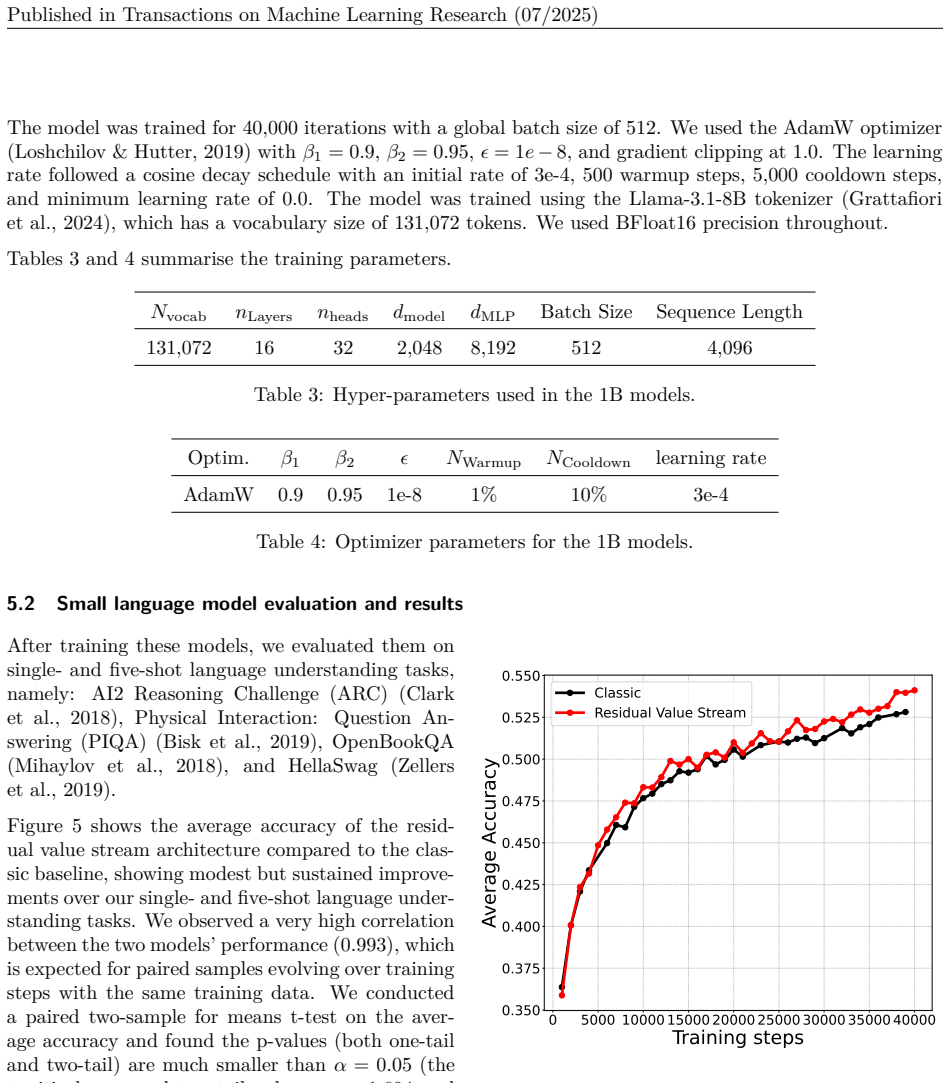
- At 1B parameters, the modification yields modest but sustained average accuracy gains across ARC, PIQA, OpenBookQA, and HellaSwag, with a large gain on the IOI-Hard probe, suggesting the effect transfers to more naturalistic data and larger scale.
- Because the modification adds no parameters, it is a pure wiring change that can be layered onto existing Transformer stacks without altering parameter count.
Reading between the lines
- If the mechanism is preservation of input-identity information, then weighting the added value stream (analogous to AMICL's parameter $a$ or a successor-representation discount factor) could tune how far across layers a contextual association persists; the paper leaves that weight fixed at 1.
- The same-index-head coupling is a convenience choice; a learned or random permutation of head indices between layers would test whether the benefit comes from preserving particular head values or from any preserved value information.
- The 1B result is one training run per architecture, so a natural next experiment is to train both architectures from several random seeds and compare final accuracies; the paper's paired t-test over checkpoints does not capture seed variance.
- If value streams make intermediate activations more stable, they may also aid interpretability by creating a linear path through layers that can be inspected to see where in-context associations are formed.
Signed reviews
Editorial analysis
A structured set of objections, weighed in public.
Referee Report
Summary. The paper introduces AMICL, a one-layer associative memory model that performs an in-context classification task through an attention-like update, and uses it as inspiration for a residual values stream: in each Transformer layer after the first, the values of each attention head are added to the values of the same-index head in the next layer. The authors report that in a two-layer Transformer on the synthetic ICL task, the residual values stream reaches 0.95 accuracy on held-out in-context probes roughly 24% faster than the classic architecture, with t-tests over four seeds. They then apply the same modification to 8M-parameter and 1B-parameter language models; the 8M models show higher accuracy on an IOI probe, and the single pair of 1B models shows modest average gains on ARC/OpenBookQA and a large gain on a constructed IOI-Hard task. The central claim is that this simple, parameter-neutral architectural change improves in-context learning and that the improvement scales to naturalistic language-model settings.
Significance. If the 1B-scale result were secure, this would be a practically interesting result: a one-line residual connection between same-index attention head values, requiring no additional parameters, that improves ICL at scale. The paper has real strengths: the code is released, the two-layer experiments use four seeds with standard deviations and t-tests on held-out probes, and the 8M experiments use three matched seeds. The AMICL construction is a useful conceptual bridge between associative memory and attention, although it is a constructed model rather than a derivation, and the smoothing parameter a is hand-set after a grid scan; this does not create circularity for the architecture experiments because those are evaluated on tasks not used to tune a. The main weakness is that the scale-up claim rests on a single pair of 1B training runs and an invalid paired t-test over correlated checkpoints, which is the load-bearing evidence for the abstract's claim of improved performance at larger scales.
major comments (3)
- [§5.2, Figures 5 and 6, t-test paragraph] The 1B-scale conclusion rests on a single training run per architecture, so there is no estimate of seed or initialization variance. The paired two-sample t-test is applied to evaluation checkpoints from these same two runs; the checkpoints are highly autocorrelated, and the authors themselves report a 0.993 correlation between the two accuracy trajectories. The effective sample size is therefore far smaller than the number of checkpoints, and the reported p-values do not provide valid evidence that the improvement would replicate across runs. Because this is the only evidence at the 1B scale, the abstract's claim of improved performance 'at these larger and more naturalistic scales' is not secured. Please provide multiple independent runs per architecture, or analyze final-checkpoint differences with appropriate uncertainty, and calibrate the language of the claims.
- [§5.2, Figure 5 and Appendix Figure 14] The reported significance test is applied to average accuracy over training steps, which conflates learning speed with final performance. If the residual model learns faster but converges to the same final accuracy, the average-over-training would show a significant difference even though the final deployed model is no better. Please report final-checkpoint accuracies (with uncertainty if multiple runs become available) separately from the learning-speed comparison, and state whether the observed gap persists at the end of training.
- [§4.2, Table 2, and §5.2, Figure 6] The two natural-language ICL evaluations lack adequate inferential support for the strength of the claims. Table 2 reports large per-sentence standard deviations (for example, classic Sentence 1 correct probability 11.73 ± 15.62) but no significance test across the three seeds, and Figure 6 shows IOI-Hard curves with no error bars because each curve is a single run. Since these evaluations carry the scaling narrative from the synthetic task to language models, please add per-seed breakdowns or appropriate tests, or explicitly label the comparisons as descriptive.
minor comments (4)
- [§5.2] Please report the actual t-statistics, degrees of freedom, and p-values rather than 'much smaller than 0.05', and state whether the test was one-tailed or two-tailed in the main text.
- [Figure 5 caption] Please state explicitly what is averaged in the 'average accuracy': four tasks, two shot settings, and which checkpoints, and whether the average is unweighted.
- [Appendix E, notation table] There are minor typographical issues: 'langauge models' and the extra space in 'V ariables'; these should be corrected.
- [§6.3] The limitations paragraph appropriately acknowledges that the gains are modest and task-specific, but this sits in tension with the abstract and Section 5.2's concluding sentence; the strength of the claims should be aligned across the abstract, the results, and the limitations.
Circularity Check
No significant circularity: the architecture experiments are evaluated on held-out tasks and benchmarks, and the AMICL model is a constructive demonstration rather than a fitted prediction.
full rationale
The paper's derivation chain is constructive rather than derivational, and no load-bearing step reduces to its own inputs by the paper's own equations or by self-citation. AMICL is an explicitly built associative-memory-style model: keys/queries are pairwise averages of adjacent tokens and values are the input tokens themselves, so its success on the synthetic ICL task is a demonstration of a designed mechanism, not a prediction extracted from a fitted quantity. The scalar a is tuned on that same task ('after testing within the range [0, 2], is set as a = 2'), but no subsequent claim depends on that fit: the residual-value-stream modification uses an implicit weight of 1 and the two-layer, 8M, and 1B comparisons are trained architectures evaluated on data and tasks not used to select a. The residual stream adds no learned parameters, so the improvements cannot be explained by additional capacity fitted to the evaluation sets. The 1B results are assessed on ARC, PIQA, OpenBookQA, HellaSwag, and IOI-Hard, none of which were used for architectural hyperparameter selection. Citations to the authors' own prior work (e.g., Burns 2024 for hetero-association, Burns et al. 2022 and Burns & Fukai 2023 for associative-memory capacity) are contextual or illustrative, not load-bearing; there is no imported uniqueness theorem and no ansatz smuggled in via a self-citation. The main weakness flagged by the skeptical reading — a paired t-test over autocorrelated checkpoints from a single run per architecture — is a statistical-validity limitation, not a circular reduction, and the paper's own limitations section explicitly concedes that the gains are modest and task-specific. No step meets the required evidence threshold of exhibiting Eq. X = Eq. Y by construction or a fitted parameter renamed as a prediction.
Assumptions & free parameters
free parameters (2)
- AMICL smoothing parameter a =
2
- object inter-instance variability epsilon =
0.1
assumptions (4)
- domain assumption Synthetic ICL task token embeddings are i.i.d. Gaussian with variance 1/e
- domain assumption The universal associative memory framework (Millidge et al.) correctly generalizes attention
- domain assumption IOI and IOI-Hard tasks measure in-context learning rather than memorization
- ad hoc to paper Paired t-test across evaluation checkpoints is valid inference for architecture comparison
invented entities (1)
-
residual attention stream (residual values stream)
independent evidence
Cite this review
Pith. "Pith review of Associative memory inspires improvements for in-context learning using a novel attention residual stream architecture." pith.science (2026). https://pith.science/paper/EK4NJR3K
@misc{pith2026241215113,
  author       = {Pith},
  title        = {Pith review of: Associative memory inspires improvements for in-context learning using a novel attention residual stream architecture},
  year         = {2026},
  howpublished = {\url{https://pith.science/paper/EK4NJR3K}},
  note         = {Machine review of arXiv:2412.15113}
}
read the original abstract
Large language models (LLMs) demonstrate an impressive ability to utilise information within the context of their input sequences to appropriately respond to data unseen by the LLM during its training procedure. This ability is known as in-context learning (ICL). Humans and non-human animals demonstrate similar abilities, however their neural architectures differ substantially from LLMs. Despite this, a critical component within LLMs, the attention mechanism, resembles modern associative memory models, widely used in and influenced by the computational neuroscience community to model biological memory systems. Using this connection, we introduce an associative memory model capable of performing ICL. We use this as inspiration for a novel residual stream architecture which allows information to directly flow between attention heads. We test this architecture during training within a two-layer Transformer and show its ICL abilities manifest more quickly than without this modification. We then apply our architecture in small language models with 8 million and 1 billion parameters, focusing on attention head values, with results also indicating improved performance at these larger and more naturalistic scales.
Figures


Figures from the paper (11 more)



Reference graph
Works this paper leans on
-
[1]
Learning patterns and pattern sequences by self-organizing nets of threshold elements
Shun'ichi Amari. Learning patterns and pattern sequences by self-organizing nets of threshold elements. IEEE Transactions on Computers, C-21 0 (11): 0 1197--1206, 1972. doi:10.1109/T-C.1972.223477
-
[2]
Modeling brain function: The world of attractor neural networks
Daniel J Amit. Modeling brain function: The world of attractor neural networks. Cambridge university press, 1989
work page 1989
-
[3]
Attractor neural networks and biological reality: associative memory and learning
Daniel J Amit. Attractor neural networks and biological reality: associative memory and learning. Future Generation Computer Systems, 6 0 (2): 0 111--119, 1990
work page 1990
-
[4]
Cognitive maps and novel inferences: a flexibility hierarchy
Erie D Boorman, Sarah C Sweigart, and Seongmin A Park. Cognitive maps and novel inferences: a flexibility hierarchy. Current Opinion in Behavioral Sciences, 38: 0 141--149, 2021. ISSN 2352-1546. doi:https://doi.org/10.1016/j.cobeha.2021.02.017. URL https://www.sciencedirect.com/science/article/pii/S2352154621000395. Computational cognitive neuroscience
-
[5]
Attention approximates sparse distributed memory
Trenton Bricken and Cengiz Pehlevan. Attention approximates sparse distributed memory. In A. Beygelzimer, Y. Dauphin, P. Liang, and J. Wortman Vaughan (eds.), Advances in Neural Information Processing Systems, 2021. URL https://openreview.net/forum?id=WVYzd7GvaOM
work page 2021
-
[6]
Language models are few-shot learners
Tom Brown, Benjamin Mann, Nick Ryder, Melanie Subbiah, Jared D Kaplan, Prafulla Dhariwal, Arvind Neelakantan, Pranav Shyam, Girish Sastry, Amanda Askell, et al. Language models are few-shot learners. Advances in neural information processing systems, 33: 0 1877--1901, 2020
1901
-
[7]
Semantically-correlated memories in a dense associative model
Thomas F Burns. Semantically-correlated memories in a dense associative model. In Ruslan Salakhutdinov, Zico Kolter, Katherine Heller, Adrian Weller, Nuria Oliver, Jonathan Scarlett, and Felix Berkenkamp (eds.), Proceedings of the 41st International Conference on Machine Learning, volume 235 of Proceedings of Machine Learning Research, pp.\ 4936--4970. PM...
work page 2024
-
[8]
Thomas F Burns and Tomoki Fukai. Simplicial hopfield networks. In The Eleventh International Conference on Learning Representations, 2023. URL https://openreview.net/forum?id=_QLsH8gatwx
work page 2023
Show all 64 references
-
[9]
Multiscale and extended retrieval of associative memory structures in a cortical model of local-global inhibition balance
Thomas F Burns, Tatsuya Haga, and Tomoki Fukai. Multiscale and extended retrieval of associative memory structures in a cortical model of local-global inhibition balance. eNeuro, 9 0 (3), 2022. doi:10.1523/ENEURO.0023-22.2022. URL https://www.eneuro.org/content/9/3/ENEURO.0023-22.2022
2022 doi
-
[10]
Neural syntax: Cell assemblies, synapsembles, and readers
György Buzsáki. Neural syntax: Cell assemblies, synapsembles, and readers. Neuron, 68 0 (3): 0 362--385, 2010. ISSN 0896-6273. doi:https://doi.org/10.1016/j.neuron.2010.09.023. URL https://www.sciencedirect.com/science/article/pii/S0896627310007658
2010 doi
-
[11]
Trade-off between multiple constraints enables simultaneous formation of modules and hubs in neural systems
Yuhan Chen, Shengjun Wang, Claus C Hilgetag, and Changsong Zhou. Trade-off between multiple constraints enables simultaneous formation of modules and hubs in neural systems. PLoS Comput. Biol., 9 0 (3): 0 e1002937, March 2013
2013
-
[12]
A memory-based theory of emotional disorders
Rivka T Cohen and Michael Jacob Kahana. A memory-based theory of emotional disorders. Psychological Review, 129 0 (4): 0 742, 2022
2022
-
[13]
Hypothalamic and other connections with dorsal ca2 area of the mouse hippocampus
Zhenzhong Cui, Charles R Gerfen, and W Scott Young 3rd. Hypothalamic and other connections with dorsal ca2 area of the mouse hippocampus. Journal of comparative neurology, 521 0 (8): 0 1844--1866, 2013
2013
-
[14]
Resvit: residual vision transformers for multimodal medical image synthesis
Onat Dalmaz, Mahmut Yurt, and Tolga C ukur. Resvit: residual vision transformers for multimodal medical image synthesis. IEEE Transactions on Medical Imaging, 41 0 (10): 0 2598--2614, 2022
2022
-
[15]
Exploring the relationship between in-context learning and instruction tuning, 2023
Hanyu Duan, Yixuan Tang, Yi Yang, Ahmed Abbasi, and Kar Yan Tam. Exploring the relationship between in-context learning and instruction tuning, 2023. URL https://arxiv.org/abs/2311.10367
2023 arXiv
-
[16]
Rediscovering area ca2: unique properties and functions
Serena M Dudek, Georgia M Alexander, and Shannon Farris. Rediscovering area ca2: unique properties and functions. Nature Reviews Neuroscience, 17 0 (2): 0 89--102, 2016
2016
-
[17]
Tinystories: How small can language models be and still speak coherent english?, 2023
Ronen Eldan and Yuanzhi Li. Tinystories: How small can language models be and still speak coherent english?, 2023. URL https://arxiv.org/abs/2305.07759
2023 arXiv
-
[18]
A mathematical framework for transformer circuits
Nelson Elhage, Neel Nanda, Catherine Olsson, Tom Henighan, Nicholas Joseph, Ben Mann, Amanda Askell, Yuntao Bai, Anna Chen, Tom Conerly, et al. A mathematical framework for transformer circuits. Transformer Circuits Thread, 1 0 (1): 0 12, 2021
2021
-
[19]
The successor representation and temporal context
Samuel J Gershman, Christopher D Moore, Michael T Todd, Kenneth A Norman, and Per B Sederberg. The successor representation and temporal context. Neural Computation, 24 0 (6): 0 1553--1568, 2012
2012
-
[20]
Vinod Goel and Raymond J. Dolan. Anatomical Segregation of Component Processes in an Inductive Inference Task . Journal of Cognitive Neuroscience, 12 0 (1): 0 110--119, 01 2000. ISSN 0898-929X. doi:10.1162/08989290051137639. URL https://doi.org/10.1162/08989290051137639
-
[21]
The organization of behavior: A neuropsychological theory
Donald Olding Hebb. The organization of behavior: A neuropsychological theory. Wiley, 1949
1949
-
[22]
Linearity of relation decoding in transformer language models
Evan Hernandez, Arnab Sen Sharma, Tal Haklay, Kevin Meng, Martin Wattenberg, Jacob Andreas, Yonatan Belinkov, and David Bau. Linearity of relation decoding in transformer language models. In The Twelfth International Conference on Learning Representations, 2024. URL https://op...
2024
-
[23]
Neural networks and physical systems with emergent collective computational abilities
John J Hopfield. Neural networks and physical systems with emergent collective computational abilities. Proceedings of the National Academy of Sciences, 79 0 (8): 0 2554--2558, 1982. doi:10.1073/pnas.79.8.2554. URL https://www.pnas.org/doi/abs/10.1073/pnas.79.8.2554
1982 doi
-
[24]
The temporal context model in spatial navigation and relational learning: toward a common explanation of medial temporal lobe function across domains
Marc W Howard, Mrigankka S Fotedar, Aditya V Datey, and Michael E Hasselmo. The temporal context model in spatial navigation and relational learning: toward a common explanation of medial temporal lobe function across domains. Psychological review, 112 0 (1): 0 75, 2005
2005
-
[25]
Scalelong: Towards more stable training of diffusion model via scaling network long skip connection
Zhongzhan Huang, Pan Zhou, Shuicheng YAN, and Liang Lin. Scalelong: Towards more stable training of diffusion model via scaling network long skip connection. In Thirty-seventh Conference on Neural Information Processing Systems, 2023. URL https://openreview.net/forum?id=0N73P8pH2l
2023
-
[26]
Gamma-models: Generative temporal difference learning for infinite-horizon prediction
Michael Janner, Igor Mordatch, and Sergey Levine. Gamma-models: Generative temporal difference learning for infinite-horizon prediction. In H. Larochelle, M. Ranzato, R. Hadsell, M.F. Balcan, and H. Lin (eds.), Advances in Neural Information Processing Systems, volume 33, pp.\...
2020
-
[27]
Zhou, Marcus K
Li Ji-An, Corey Y. Zhou, Marcus K. Benna, and Marcelo G. Mattar. Linking in-context learning in transformers to human episodic memory, 2024. URL https://arxiv.org/abs/2405.14992
2024 arXiv
-
[28]
Do llms dream of elephants (when told not to)? latent concept association and associative memory in transformers, 2024
Yibo Jiang, Goutham Rajendran, Pradeep Ravikumar, and Bryon Aragam. Do llms dream of elephants (when told not to)? latent concept association and associative memory in transformers, 2024. URL https://arxiv.org/abs/2406.18400
2024 arXiv
-
[29]
The perceiver architecture is a functional global workspace
Arthur Juliani, Ryota Kanai, and Shuntaro Sasai Sasai. The perceiver architecture is a functional global workspace. In Proceedings of the Annual Meeting of the Cognitive Science Society, volume 44, 2022
2022
-
[30]
Nonoptimal component placement, but short processing paths, due to long-distance projections in neural systems
Marcus Kaiser and Claus C Hilgetag. Nonoptimal component placement, but short processing paths, due to long-distance projections in neural systems. PLoS Comput. Biol., 2 0 (7): 0 e95, July 2006
2006
-
[31]
Attractor and integrator networks in the brain
Mikail Khona and Ila R Fiete. Attractor and integrator networks in the brain. Nature Reviews Neuroscience, 23 0 (12): 0 744--766, 2022
2022
-
[32]
Kastanenka, and Dmitry Krotov
Leo Kozachkov, Ksenia V. Kastanenka, and Dmitry Krotov. Building T ransformers from neurons and astrocytes. bioRxiv, 2022. doi:10.1101/2022.10.12.511910. URL https://www.biorxiv.org/content/early/2022/10/15/2022.10.12.511910
2022 doi
-
[33]
Learning to learn: Single session acquisition of new rules by freely moving mice
Amir Levi, Noam Aviv, and Eran Stark. Learning to learn: Single session acquisition of new rules by freely moving mice . PNAS Nexus, 3 0 (5): 0 pgae203, 05 2024. ISSN 2752-6542. doi:10.1093/pnasnexus/pgae203. URL https://doi.org/10.1093/pnasnexus/pgae203
2024 doi
-
[34]
Transformers as algorithms: Generalization and stability in in-context learning
Yingcong Li, Muhammed Emrullah Ildiz, Dimitris Papailiopoulos, and Samet Oymak. Transformers as algorithms: Generalization and stability in in-context learning. In Andreas Krause, Emma Brunskill, Kyunghyun Cho, Barbara Engelhardt, Sivan Sabato, and Jonathan Scarlett (eds.), Pr...
2023
-
[35]
The existence of persistent states in the brain
William A Little. The existence of persistent states in the brain. Mathematical Biosciences, 19 0 (1): 0 101--120, 1974. ISSN 0025-5564. doi:https://doi.org/10.1016/0025-5564(74)90031-5. URL https://www.sciencedirect.com/science/article/pii/0025556474900315
1974
-
[36]
Expanding the scope of memory search: Modeling intralist and interlist effects in free recall
Lynn J Lohnas, Sean M Polyn, and Michael J Kahana. Expanding the scope of memory search: Modeling intralist and interlist effects in free recall. Psychological review, 122 0 (2): 0 337, 2015
2015
-
[37]
Analysis of the activity of the chains of internuncial neurons
Rafael Lorente de Nó. Analysis of the activity of the chains of internuncial neurons. Journal of Neurophysiology, 1 0 (3): 0 207--244, 1938
1938
-
[38]
Language conditioned imitation learning over unstructured data, 2021
Corey Lynch and Pierre Sermanet. Language conditioned imitation learning over unstructured data, 2021. URL https://arxiv.org/abs/2005.07648
2021 arXiv
-
[39]
Emergence of abstract rules in the primate brain
Farshad Alizadeh Mansouri, David J Freedman, and Mark J Buckley. Emergence of abstract rules in the primate brain. Nature Reviews Neuroscience, 21 0 (11): 0 595--610, 2020
2020
-
[40]
A logical calculus of the ideas immanent in nervous activity
Warren S McCulloch and Walter Pitts. A logical calculus of the ideas immanent in nervous activity. The bulletin of mathematical biophysics, 5: 0 115--133, 1943
1943
-
[41]
Distributed representations of words and phrases and their compositionality, 2013
Tomas Mikolov, Ilya Sutskever, Kai Chen, Greg Corrado, and Jeffrey Dean. Distributed representations of words and phrases and their compositionality, 2013. URL https://arxiv.org/abs/1310.4546
2013 arXiv
-
[42]
An integrative theory of prefrontal cortex function
Earl K Miller and Jonathan D Cohen. An integrative theory of prefrontal cortex function. Annual review of neuroscience, 24 0 (1): 0 167--202, 2001
2001
-
[43]
Universal hopfield networks: A general framework for single-shot associative memory models
Beren Millidge, Tommaso Salvatori, Yuhang Song, Thomas Lukasiewicz, and Rafal Bogacz. Universal hopfield networks: A general framework for single-shot associative memory models. In International Conference on Machine Learning, pp.\ 15561--15583. PMLR, 2022
2022
-
[44]
Large language models as general pattern machines, 2023
Suvir Mirchandani, Fei Xia, Pete Florence, Brian Ichter, Danny Driess, Montserrat Gonzalez Arenas, Kanishka Rao, Dorsa Sadigh, and Andy Zeng. Large language models as general pattern machines, 2023. URL https://arxiv.org/abs/2307.04721
2023 arXiv
-
[45]
Associatron-a model of associative memory
Kaoru Nakano. Associatron-a model of associative memory. IEEE Transactions on Systems, Man, and Cybernetics, SMC-2 0 (3): 0 380--388, 1972. doi:10.1109/TSMC.1972.4309133
1972
-
[46]
In-context learning and induction heads
Catherine Olsson, Nelson Elhage, Neel Nanda, Nicholas Joseph, Nova DasSarma, Tom Henighan, Ben Mann, Amanda Askell, Yuntao Bai, Anna Chen, Tom Conerly, Dawn Drain, Deep Ganguli, Zac Hatfield-Dodds, Danny Hernandez, Scott Johnston, Andy Jones, Jackson Kernion, Liane Lovitt, Kam...
2022
-
[47]
a fl, Johannes Lehner, Philipp Seidl, Michael Widrich, Lukas Gruber, Markus Holzleitner, Thomas Adler, David Kreil, Michael K Kopp, G \
Hubert Ramsauer, Bernhard Sch \"a fl, Johannes Lehner, Philipp Seidl, Michael Widrich, Lukas Gruber, Markus Holzleitner, Thomas Adler, David Kreil, Michael K Kopp, G \"u nter Klambauer, Johannes Brandstetter, and Sepp Hochreiter. H opfield networks is all you need. In Internat...
2021
-
[48]
Prefrontal cortex and episodic memory: Integrating findings from neuropsychology and functional brain imaging
Charan Ranganath and Robert T Knight. Prefrontal cortex and episodic memory: Integrating findings from neuropsychology and functional brain imaging. The cognitive neuroscience of memory: Encoding and retrieval, 1: 0 83, 2002
2002
-
[49]
The mechanistic basis of data dependence and abrupt learning in an in-context classification task
Gautam Reddy. The mechanistic basis of data dependence and abrupt learning in an in-context classification task. In The Twelfth International Conference on Learning Representations, 2024. URL https://openreview.net/forum?id=aN4Jf6Cx69
2024
-
[50]
Hippocampal area ca2: properties and contribution to hippocampal function
Vincent Robert, Sadiyah Cassim, Vivien Chevaleyre, and Rebecca A Piskorowski. Hippocampal area ca2: properties and contribution to hippocampal function. Cell and tissue research, 373: 0 525--540, 2018
2018
-
[51]
Mice in a labyrinth show rapid learning, sudden insight, and efficient exploration
Matthew Rosenberg, Tony Zhang, Pietro Perona, and Markus Meister. Mice in a labyrinth show rapid learning, sudden insight, and efficient exploration. eLife, 10: 0 e66175, jul 2021. ISSN 2050-084X. doi:10.7554/eLife.66175. URL https://doi.org/10.7554/eLife.66175
2021 doi
-
[52]
Principles of neurodynamics: Perceptrons and the theory of brain mechanisms, 1961
Frank Rosenblatt. Principles of neurodynamics: Perceptrons and the theory of brain mechanisms, 1961
1961
-
[53]
Prefrontal cortex and flexible cognitive control: Rules without symbols
Nicolas P Rougier, David C Noelle, Todd S Braver, Jonathan D Cohen, and Randall C O'Reilly. Prefrontal cortex and flexible cognitive control: Rules without symbols. Proceedings of the National Academy of Sciences, 102 0 (20): 0 7338--7343, 2005
2005
-
[54]
Human curriculum effects emerge with in-context learning in neural networks
Jacob Russin, Ellie Pavlick, and Michael J Frank. Human curriculum effects emerge with in-context learning in neural networks. ArXiv, 2024
2024
-
[55]
Riechers, Lucas Teixeira, Alexander Gietelink Oldenziel, and Sarah Marzen
Adam Shai, Paul M. Riechers, Lucas Teixeira, Alexander Gietelink Oldenziel, and Sarah Marzen. Transformers represent belief state geometry in their residual stream. In The Thirty-eighth Annual Conference on Neural Information Processing Systems, 2024. URL https://openreview.ne...
2024
-
[56]
Learning to predict by the methods of temporal differences
Richard S Sutton. Learning to predict by the methods of temporal differences. Machine learning, 3: 0 9--44, 1988
1988
-
[57]
Attention is all you need
Ashish Vaswani, Noam Shazeer, Niki Parmar, Jakob Uszkoreit, Llion Jones, Aidan N Gomez, ukasz Kaiser, and Illia Polosukhin. Attention is all you need. In I. Guyon, U. Von Luxburg, S. Bengio, H. Wallach, R. Fergus, S. Vishwanathan, and R. Garnett (eds.), Advances in Neural Info...
2017
-
[58]
Mrsic-Flogel
Ivan Voitov and Thomas D. Mrsic-Flogel. Cortical feedback loops bind distributed representations of working memory. Nature, 608 0 (7922): 0 381--389, Aug 2022. ISSN 1476-4687. doi:10.1038/s41586-022-05014-3. URL https://doi.org/10.1038/s41586-022-05014-3
2022 doi
-
[59]
Transformers learn in-context by gradient descent
Johannes Von Oswald, Eyvind Niklasson, Ettore Randazzo, Joao Sacramento, Alexander Mordvintsev, Andrey Zhmoginov, and Max Vladymyrov. Transformers learn in-context by gradient descent. In Andreas Krause, Emma Brunskill, Kyunghyun Cho, Barbara Engelhardt, Sivan Sabato, and Jona...
2023
-
[60]
Interpretability in the wild: a circuit for indirect object identification in GPT -2 small
Kevin Ro Wang, Alexandre Variengien, Arthur Conmy, Buck Shlegeris, and Jacob Steinhardt. Interpretability in the wild: a circuit for indirect object identification in GPT -2 small. In The Eleventh International Conference on Learning Representations, 2023. URL https://openrevi...
2023
-
[61]
Nonparametric classification on low dimensional manifolds using overparameterized convolutional residual networks
Zixuan Zhang, Kaiqi Zhang, Minshuo Chen, Yuma Takeda, Mengdi Wang, Tuo Zhao, and Yu-Xiang Wang. Nonparametric classification on low dimensional manifolds using overparameterized convolutional residual networks. In The Thirty-eighth Annual Conference on Neural Information Proce...
2024
-
[62]
In-context exemplars as clues to retrieving from large associative memory
Jiachen Zhao. In-context exemplars as clues to retrieving from large associative memory. In Associative Memory & Hopfield Networks in 2023 , 2023. URL https://openreview.net/forum?id=pgPAsSv5ga
2023
-
[63]
Episodic retrieval for model-based evaluation in sequential decision tasks, 2023
Corey Y Zhou, Deborah Talmi, Nathaniel Daw, and Marcelo G Mattar. Episodic retrieval for model-based evaluation in sequential decision tasks, 2023
2023
-
[64]
write newline
" write newline "" before.all 'output.state := FUNCTION n.dashify 't := "" t empty not t #1 #1 substring "-" = t #1 #2 substring "--" = not "--" * t #2 global.max substring 't := t #1 #1 substring "-" = "-" * t #2 global.max substring 't := while if t #1 #1 substring * t #2 gl...
Reviewed August 11, 2026 · model on record in the stance chip above.
Discussion (0). Continue with ORCID to comment.