REVIEW 2 major objections 6 minor 1 cited by
CaseSumm: A Large-Scale Dataset for Long-Context Summarization from U.S. Supreme Court Opinions
T0 review · 2 major / 6 minor · reviewed 2026-08-10 · deepseek-v4-flash
Pith's one-line read A 25,600-case Supreme Court dataset shows automatic metrics and expert human rankings disagree on which AI summary is best.
desk verdict A genuinely useful legal summarization dataset, paired with an evaluation section whose headline human-vs-automatic discrepancy is not yet supported by the reported statistics. read the letter →
The pith
A machine-rendered reading of the paper's core claim, the machinery that carries it, and where it could break.
The reading
What carries the argument
The central object is the dataset itself: pairs of Supreme Court majority opinions and their official summaries, or syllabuses, which serve as gold-standard references because they are written by a Court-employed attorney and approved by the Justices. The argument's mechanism is a side-by-side evaluation in which five candidate summaries (Mistral Base, Mistral FT, GPT-4 Turbo, and human-written Oyez and Westlaw summaries) are scored against the official syllabus with ROUGE, BERTScore, and G-Eval, and are also ranked by law students who read the original opinion on sensitivity, specificity, clarity, style, and factual error. Comparing the rankings produced by these different methods is what exposes the discrepancy between automatic and human judgment.
What would settle it
Re-run the human evaluation with a cohort of practicing attorneys who are told only that the summaries 'may be written by humans or machines,' and compare their rankings to the law-student rankings from the paper; if GPT-4 no longer outranks Mistral FT and the official syllabuses, the claimed human-versus-automatic discrepancy does not generalize.
Extended reading notes
Core claim
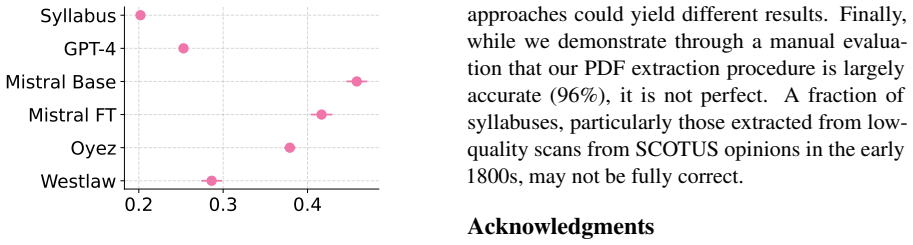
The paper's central comparative claim is that evaluation method changes the winner: automatic metrics (ROUGE, BERTScore) and even LLM-based G-Eval disagree with expert human rankings when judging LLM-generated legal summaries. In the 622-case automatic evaluation, fine-tuned Mistral 7B leads on recall and F1, and its summaries are closest in length and compression to official syllabuses; but in a human evaluation where second- and third-year law students ranked five candidate summaries against the source opinion, GPT-4 most often ranks first on sensitivity, specificity, clarity, and style, while Mistral FT roughly matches the official syllabus on those dimensions yet is the only candidate with a conspicuous error rate (about 20% of Mistral FT summaries contain at least one factual error). The paper further finds that G-Eval, whether used with its default prompts or prompts adapted to the human rubric, does not correlate with human rankings better than traditional automatic metrics, and that GPT-4 summaries often outperformed human-written summaries including official syllabuses in several quality dimensions except factual correctness.
Load-bearing premise
The human rankings that drive the main discrepancy come from 33 unique cases read by second- and third-year law students, and the recruitment email told them they were grading summaries from the authors' AI tool, so the load-bearing premise is that these rankings are a valid, unbiased proxy for expert legal judgment.
Editorial extensions
If this is right
- Legal summarization evaluation should include human reading; automatic metrics alone can pick a winner that human experts reject.
- LLM-based judges such as G-Eval do not yet offer a better reference-free alternative to traditional lexical and semantic metrics.
- Fine-tuning an open 7B model can match or beat much larger models on lexical overlap, but it can also increase the risk of confident factual hallucinations.
- Human-written summaries, including official syllabuses and paid commercial services, are not inherently better than strong LLM summaries on clarity or style, though they remain more factually reliable.
- The 200-year span of the dataset makes it possible to study how summary length, compression, and responsiveness to source length have changed over time.
Reading between the lines
- The recruitment email shown in Figure 7 tells participants they are grading summaries from the authors' AI tool, so it is untested whether the reported preference for GPT-4 would survive a fully blinded protocol; that is an inference because the paper claims participants were not told the source of each summary.
- A practical consequence is that legal research tools optimized toward ROUGE-like scores may be rewarded for stylistic mimicry while still producing citation errors and fact misrepresentations that require separate verification.
- Because the human evaluation rests on only 33 unique cases read by a median of 5 cases per student, the effect sizes are uncertain; a larger replication with practicing attorneys could change the ranking even if the direction holds.
- The dataset's temporal structure could support tests of whether modern LLMs reproduce the historical drift in syllabus style, such as the emergence of the 'Held:' section, although the paper does not run those tests.
Signed reviews
Editorial analysis
A structured set of objections, weighed in public.
Referee Report
Summary. The paper introduces CaseSumm, a dataset of 25,642 U.S. Supreme Court opinion/syllabus pairs spanning 1815–2019, with the official Court syllabus serving as a gold-standard summary. The authors describe an extraction pipeline using PDFs from Public Resource Org and the Library of Congress, validate it on 100 randomly sampled cases (96 perfect extractions), and release the dataset publicly. They then benchmark GPT-4 Turbo, Mistral 7B (base and fine-tuned), and two human-written controls (Westlaw, Oyez) against the syllabuses using ROUGE, BERTScore, and human evaluation by second- and third-year law students. The central reported finding is a discrepancy: automatic metrics favor fine-tuned Mistral, while human evaluators most often rank GPT-4 higher, and G-Eval (an LLM-based metric) does not correlate better with human judgments than traditional automatic metrics. The paper also includes a hallucination error analysis with examples from both models.
Significance. The dataset contribution is substantial: CaseSumm is the largest open legal summarization dataset by document count, spans two centuries, and provides official syllabuses rather than crowd-sourced or machine-constructed summaries. The 96% manual extraction check and public release on HuggingFace are concrete strengths. If the evaluation findings hold, the paper would provide valuable evidence that automatic metrics and LLM-based judges diverge from human judgment in a high-stakes domain, which is an important result for summarization evaluation research. However, the human evaluation underpinning the headline discrepancy rests on a small sample (33 unique cases, 57 readings, ~11 students) and lacks inferential statistics, so the central comparative claims should be treated as preliminary rather than definitive.
major comments (2)
- [§4.2, §5.3, Figure 3] The central claim that expert humans most commonly rank GPT-4 over Mistral FT is not statistically supported. The human evaluation consists of 57 opinion readings across 33 unique cases by second- and third-year law students (median 5 readings per student). No confidence intervals, effect sizes, or pairwise significance tests are reported for the rank differences in Figure 3, so the observed GPT-4-vs-Mistral-FT gap cannot be distinguished from sampling noise; the authors' own minimum detectable effect of 0.52 rank points is computed but never applied to the actual results. In addition, the recruitment email in Figure 7 states that participants will "evaluate the quality of the summaries produced by our AI-based tool," which is in tension with the §4.2 statement that students were not told the source of each summary. This does not necessarily break the GPT-4/Mistral pairwise comparison, but it undermines the claimed neutrality of the evaluation and the comparisons against human-written controls (e.g., the conclusion that GPT-4 outperforms official syllabuses on some dimensions). Please report raw rank distributions, effect sizes with confidence intervals, and clarify exactly what participants were told about the provenance of the summaries.
- [§5.3, Table 4, Abstract] The conclusion that "LLM-based evaluation does not correlate with human judgments better than traditional automatic metrics" is too strong for the evidence presented. Table 4 shows that G-Eval correlates much more strongly with human specificity judgments (adapted G-Eval specificity 0.51 vs. ROUGE-1 -0.28) and clarity (0.23–0.28 vs. ~0.0 for ROUGE-2), which the paper's own bullet points acknowledge. No confidence intervals or tests for differences between dependent correlations are reported; with 33 unique cases (or 57 opinion readings), differences such as ROUGE-1 sensitivity 0.54 vs. adapted G-Eval sensitivity 0.43 are likely within sampling noise. The abstract's blanket claim should be qualified to state that traditional metrics perform comparably or better on sensitivity/style, while G-Eval performs better on specificity/clarity, and the correlation comparisons should include uncertainty quantification.
minor comments (6)
- [§4.1, Appendix A.1] GPT-4's prompt was optimized with DSPy using ROUGE-2 as the optimization metric, and the same ROUGE family is later used as an evaluation metric for GPT-4. This means GPT-4's ROUGE scores are partially fitted to the evaluation metric; the paper should acknowledge this when interpreting the automatic evaluation comparison, even though the prompt optimization likely biases in GPT-4's favor.
- [Table 1] The row for "GovReport*" has an asterisk but no footnote or citation identifying the dataset source; please add the reference.
- [§5.2] The statement "doubling opinion length increases syllabus length by nearly 2/3" appears to be based on an unreported regression; the correlation of 0.676 reported in Table 3 does not by itself imply this elasticity. Please report the underlying regression or rephrase the claim.
- [References] In the reference for Kapoor et al., "Peter Henderon" should be "Peter Henderson."
- [Appendix C.1] The sentence "For all measures where the outcome is rank, we mark the mean rank identically 3) with a red dashed line" is garbled and should be rewritten (e.g., "we mark the mean rank, 3, with a red dashed line").
- [Abstract, §4.2] The evaluators are described as "expert human annotators" in the abstract and as "expert humans" in §5, but the participants are second- and third-year law students. Please either adjust the terminology to "law student evaluators" or justify the "expert" label with information about their legal training and experience.
Circularity Check
Minor fitted-component in GPT-4 ROUGE evaluation; no central circularity.
-
fitted input called prediction
[§4.1 Modeling; §4.2 Automatic Evaluation]
"For GPT-4, we optimize prompt-selection using DSPy (Khattab et al., 2023) with 10 opinion/syllabus pairs from the training set and ROUGE-2 as the optimization metric. ... Following recent work on summarization (Koh et al., 2022), we use ROUGE and BERTScore (Lin, 2004; Zhang et al., 2019) as our automated metrics for evaluating generated summaries against the reference syllabuses."
The paper fits GPT-4's prompt by maximizing ROUGE-2 on a small training subsample, then presents ROUGE and BERTScore scores as automatic evaluations of GPT-4 in Table 2. Because the same metric family used for optimization is later used for evaluation, the GPT-4 ROUGE results are partly a product of that fit rather than an independent measurement of an unoptimized model. This is a mild fitted-component in the reported automatic scores. It does not force the paper's central metric-vs-human discrepancy, since Mistral FT still beats the ROUGE-optimized GPT-4 on ROUGE-2 (23.0 vs 19.2), and the human evaluation and G-Eval correlation analyses are independent of this optimization.
full rationale
The paper's central claims are empirical comparisons rather than derivations, and no load-bearing step reduces to its own inputs by construction. The only partial fitted-component is the DSPy prompt optimization for GPT-4 using ROUGE-2, after which ROUGE-family metrics are used in the automatic evaluation; this contaminates GPT-4's absolute ROUGE scores but does not manufacture the headline discrepancy, since Mistral FT still wins on ROUGE despite GPT-4 being optimized for it. The human evaluation, though potentially affected by the recruitment email in Figure 7 that tells participants they are evaluating 'summaries produced by our AI-based tool,' is independent of the automatic metrics and is a validity concern rather than a circularity. Self-citations (e.g., Cao et al. 2024) are related-work extensions and not load-bearing. The dataset construction is externally validated by manual inspection of 100 sampled extractions. Overall, no significant circularity is present; the fitted ROUGE component is minor and localized.
Assumptions & free parameters
free parameters (3)
- DSPy-optimized GPT-4 prompt =
Not stated; optimized prompt in Listing 2
- LoRA fine-tuning learning rate =
Selected from {2e-5, 2e-4, 2e-3}
- Mistral generation fallback hyperparameters =
repetition_penalty=1.3, top_p=0.9
assumptions (5)
- domain assumption The official syllabus is a gold-standard summary of the majority opinion.
- domain assumption Second- and third-year law students provide valid expert human judgments of legal summary quality.
- domain assumption The 100-case manual extraction check (96% perfect) generalizes to the full 25.6K dataset.
- domain assumption The 33-case human evaluation sample has sufficient power to detect meaningful ranking differences.
- domain assumption ROUGE and BERTScore are meaningful proxies for legal summarization relevance.
Cite this review
Pith. "Pith review of CaseSumm: A Large-Scale Dataset for Long-Context Summarization from U.S. Supreme Court Opinions." pith.science (2026). https://pith.science/paper/3PDEGQYY
@misc{pith2026250100097,
  author       = {Pith},
  title        = {Pith review of: CaseSumm: A Large-Scale Dataset for Long-Context Summarization from U.S. Supreme Court Opinions},
  year         = {2026},
  howpublished = {\url{https://pith.science/paper/3PDEGQYY}},
  note         = {Machine review of arXiv:2501.00097}
}
read the original abstract
This paper introduces CaseSumm, a novel dataset for long-context summarization in the legal domain that addresses the need for longer and more complex datasets for summarization evaluation. We collect 25.6K U.S. Supreme Court (SCOTUS) opinions and their official summaries, known as "syllabuses." Our dataset is the largest open legal case summarization dataset, and is the first to include summaries of SCOTUS decisions dating back to 1815. We also present a comprehensive evaluation of LLM-generated summaries using both automatic metrics and expert human evaluation, revealing discrepancies between these assessment methods. Our evaluation shows Mistral 7b, a smaller open-source model, outperforms larger models on most automatic metrics and successfully generates syllabus-like summaries. In contrast, human expert annotators indicate that Mistral summaries contain hallucinations. The annotators consistently rank GPT-4 summaries as clearer and exhibiting greater sensitivity and specificity. Further, we find that LLM-based evaluations are not more correlated with human evaluations than traditional automatic metrics. Furthermore, our analysis identifies specific hallucinations in generated summaries, including precedent citation errors and misrepresentations of case facts. These findings demonstrate the limitations of current automatic evaluation methods for legal summarization and highlight the critical role of human evaluation in assessing summary quality, particularly in complex, high-stakes domains. CaseSumm is available at https://huggingface.co/datasets/ChicagoHAI/CaseSumm
Figures


Figures from the paper (4 more)


Forward citations
Cited by 1 Pith paper
-
100-LongBench: Are de facto Long-Context Benchmarks Literally Evaluating Long-Context Ability?
100-LongBench and LongScore evaluate LLMs at controlled context lengths and rank models by relative performance drop from a short-context baseline, not by raw accuracy.
Reference graph
Works this paper leans on
-
[1]
online" 'onlinestring :=
ENTRY address archivePrefix author booktitle chapter edition editor eid eprint eprinttype howpublished institution journal key month note number organization pages publisher school series title type volume year doi pubmed url lastchecked label extra.label sort.label short.list INTEGERS output.state before.all mid.sentence after.sentence after.block STRING...
-
[2]
write newline
" write newline "" before.all 'output.state := FUNCTION n.dashify 't := "" t empty not t #1 #1 substring "-" = t #1 #2 substring "--" = not "--" * t #2 global.max substring 't := t #1 #1 substring "-" = "-" * t #2 global.max substring 't := while if t #1 #1 substring * t #2 global.max substring 't := if while FUNCTION word.in bbl.in capitalize " " * FUNCT...
-
[3]
Emmanuel Bauer, Dominik Stammbach, Nianlong Gu, and Elliott Ash. 2023. Legal extractive summarization of us court opinions. arXiv preprint arXiv:2305.08428
work page Pith review arXiv 2023
-
[4]
Manik Bhandari, Pranav Narayan Gour, Atabak Ashfaq, Pengfei Liu, and Graham Neubig. 2020. https://doi.org/10.18653/v1/2020.emnlp-main.751 Re-evaluating evaluation in text summarization . In Proceedings of the 2020 Conference on Empirical Methods in Natural Language Processing (EMNLP), pages 9347--9359, Online. Association for Computational Linguistics
-
[5]
G. Bradski. 2000. The OpenCV Library . Dr. Dobb's Journal of Software Tools
work page 2000
-
[6]
Sébastien Bubeck, Varun Chandrasekaran, Ronen Eldan, Johannes Gehrke, Eric Horvitz, Ece Kamar, Peter Lee, Yin Tat Lee, Yuanzhi Li, Scott Lundberg, Harsha Nori, Hamid Palangi, Marco Tulio Ribeiro, and Yi Zhang. 2023. https://arxiv.org/abs/2303.12712 Sparks of artificial general intelligence: Early experiments with gpt-4 . Preprint, arXiv:2303.12712
arXiv 2023
-
[7]
Tianyu Cao, Natraj Raman, Danial Dervovic, and Chenhao Tan. 2024. https://arxiv.org/abs/2404.06162 Characterizing multimodal long-form summarization: A case study on financial reports . Preprint, arXiv:2404.06162
arXiv 2024
-
[8]
Ilias Chalkidis, Abhik Jana, Dirk Hartung, Michael Bommarito, Ion Androutsopoulos, Daniel Katz, and Nikolaos Aletras. 2022. https://doi.org/10.18653/v1/2022.acl-long.297 L ex GLUE : A benchmark dataset for legal language understanding in E nglish . In Proceedings of the 60th Annual Meeting of the Association for Computational Linguistics (Volume 1: Long P...
Show all 47 references
-
[9]
Yapei Chang, Kyle Lo, Tanya Goyal, and Mohit Iyyer. 2024. https://arxiv.org/abs/2310.00785 Booookscore: A systematic exploration of book-length summarization in the era of llms . Preprint, arXiv:2310.00785
2024 arXiv
-
[10]
Claude Team . 2024. https://www.anthropic.com/news/claude-3-family Introducing the next generation of claude
2024
-
[11]
Arman Cohan and Nazli Goharian. 2016. https://aclanthology.org/L16-1130 Revisiting summarization evaluation for scientific articles . In Proceedings of the Tenth International Conference on Language Resources and Evaluation ( LREC '16) , pages 806--813, Portoro z , Slovenia. E...
2016
-
[12]
Junyun Cui, Xiaoyu Shen, and Shaochun Wen. 2023. A survey on legal judgment prediction: Datasets, metrics, models and challenges. IEEE Access
2023
-
[13]
Vladimir Eidelman. 2019. https://doi.org/10.18653/v1/d19-5406 Billsum: A corpus for automatic summarization of us legislation . In Proceedings of the 2nd Workshop on New Frontiers in Summarization, page 48–56. Association for Computational Linguistics
2019 doi
-
[14]
Alexander Fabbri, Chien-Sheng Wu, Wenhao Liu, and Caiming Xiong. 2022. https://doi.org/10.18653/v1/2022.naacl-main.187 QAF act E val: Improved QA -based factual consistency evaluation for summarization . In Proceedings of the 2022 Conference of the North American Chapter of th...
2022 doi
-
[15]
Fabbri, Wojciech Kryściński, Bryan McCann, Caiming Xiong, Richard Socher, and Dragomir Radev
Alexander R. Fabbri, Wojciech Kryściński, Bryan McCann, Caiming Xiong, Richard Socher, and Dragomir Radev. 2021. https://doi.org/10.1162/tacl_a_00373 SummEval: Re-evaluating Summarization Evaluation . Transactions of the Association for Computational Linguistics, 9:391--409
2021 doi
-
[16]
Tobias Falke, Leonardo F. R. Ribeiro, Prasetya Ajie Utama, Ido Dagan, and Iryna Gurevych. 2019. https://doi.org/10.18653/v1/P19-1213 Ranking generated summaries by correctness: An interesting but challenging application for natural language inference . In Proceedings of the 57...
2019 doi
-
[17]
Biaoyan Fang, Trevor Cohn, Timothy Baldwin, and Lea Frermann. 2023. Super-scotus: A multi-sourced dataset for the supreme court of the us. In Proceedings of the Natural Legal Language Processing Workshop 2023, pages 202--214
2023
-
[18]
Diego Garat and Dina Wonsever. 2022. Automatic curation of court documents: Anonymizing personal data. Information, 13(1):27
2022
-
[19]
GPT-4 Team . 2024. https://arxiv.org/abs/2303.08774 Gpt-4 technical report . Preprint, arXiv:2303.08774
2024 arXiv
-
[20]
Peter Henderson, Mark Krass, Lucia Zheng, Neel Guha, Christopher D Manning, Dan Jurafsky, and Daniel Ho. 2022. Pile of law: Learning responsible data filtering from the law and a 256gb open-source legal dataset. Advances in Neural Information Processing Systems, 35:29217--29234
2022
-
[21]
Hu, Yelong Shen, Phillip Wallis, Zeyuan Allen-Zhu, Yuanzhi Li, Shean Wang, Lu Wang, and Weizhu Chen
Edward J. Hu, Yelong Shen, Phillip Wallis, Zeyuan Allen-Zhu, Yuanzhi Li, Shean Wang, Lu Wang, and Weizhu Chen. 2021. https://arxiv.org/abs/2106.09685 Lora: Low-rank adaptation of large language models . Preprint, arXiv:2106.09685
2021 arXiv
-
[22]
Lei Huang, Weijiang Yu, Weitao Ma, Weihong Zhong, Zhangyin Feng, Haotian Wang, Qianglong Chen, Weihua Peng, Xiaocheng Feng, Bing Qin, and Ting Liu. 2023. https://arxiv.org/abs/2311.05232 A survey on hallucination in large language models: Principles, taxonomy, challenges, and ...
2023 arXiv
-
[23]
Luyang Huang, Shuyang Cao, Nikolaus Parulian, Heng Ji, and Lu Wang. 2021. https://arxiv.org/abs/2104.02112 Efficient attentions for long document summarization . Preprint, arXiv:2104.02112
2021 arXiv
-
[24]
Albert Q. Jiang, Alexandre Sablayrolles, Arthur Mensch, Chris Bamford, Devendra Singh Chaplot, Diego de las Casas, Florian Bressand, Gianna Lengyel, Guillaume Lample, Lucile Saulnier, Lélio Renard Lavaud, Marie-Anne Lachaux, Pierre Stock, Teven Le Scao, Thibaut Lavril, Thomas ...
2023 arXiv
-
[25]
Sayash Kapoor, Peter Henderon, and Arvind Narayanan. 2024. Promises and pitfalls of artificial intelligence for legal applications. Journal of Cross-Disciplinary Research in Computational Law
2024
-
[26]
Daniel Martin Katz, Michael James Bommarito, Shang Gao, and Pablo Arredondo. 2023 a . Gpt-4 passes the bar exam. Available at SSRN 4389233
2023
-
[27]
Daniel Martin Katz, Dirk Hartung, Lauritz Gerlach, Abhik Jana, and Michael J Bommarito II. 2023 b . Natural language processing in the legal domain. arXiv preprint arXiv:2302.12039
2023 arXiv
-
[28]
Joshi, Hanna Moazam, Heather Miller, Matei Zaharia, and Christopher Potts
Omar Khattab, Arnav Singhvi, Paridhi Maheshwari, Zhiyuan Zhang, Keshav Santhanam, Sri Vardhamanan, Saiful Haq, Ashutosh Sharma, Thomas T. Joshi, Hanna Moazam, Heather Miller, Matei Zaharia, and Christopher Potts. 2023. https://arxiv.org/abs/2310.03714 Dspy: Compiling declarati...
2023 arXiv
-
[29]
Huan Yee Koh, Jiaxin Ju, Ming Liu, and Shirui Pan. 2022. https://doi.org/10.1145/3545176 An empirical survey on long document summarization: Datasets, models, and metrics . ACM Computing Surveys, 55(8):1–35
2022 doi
-
[30]
Kalpesh Krishna, Erin Bransom, Bailey Kuehl, Mohit Iyyer, Pradeep Dasigi, Arman Cohan, and Kyle Lo. 2023. https://doi.org/10.18653/v1/2023.eacl-main.121 L ong E val: Guidelines for human evaluation of faithfulness in long-form summarization . In Proceedings of the 17th Confere...
2023 doi
-
[31]
Wojciech Kryściński, Nazneen Rajani, Divyansh Agarwal, Caiming Xiong, and Dragomir Radev. 2022. https://arxiv.org/abs/2105.08209 Booksum: A collection of datasets for long-form narrative summarization . Preprint, arXiv:2105.08209
2022 arXiv
-
[32]
Bennett, and Marti A
Philippe Laban, Tobias Schnabel, Paul N. Bennett, and Marti A. Hearst. 2022. https://doi.org/10.1162/tacl_a_00453 SummaC: Re-Visiting NLI-based Models for Inconsistency Detection in Summarization . Transactions of the Association for Computational Linguistics, 10:163--177
2022 doi
-
[33]
Washington University Law. 2024. http://scdb.wustl.edu/documentation.php The supreme court database
2024
-
[34]
Library of Congress . 2024. https://www.loc.gov/collections/united-states-reports/about-this-collection/ United states reports (official opinions of the u.s. supreme court)
2024
-
[35]
Chin-Yew Lin. 2004. https://aclanthology.org/W04-1013 ROUGE : A package for automatic evaluation of summaries . In Text Summarization Branches Out, pages 74--81, Barcelona, Spain. Association for Computational Linguistics
2004
-
[36]
Yang Liu, Dan Iter, Yichong Xu, Shuohang Wang, Ruochen Xu, and Chenguang Zhu. 2023. https://arxiv.org/abs/2303.16634 G-eval: Nlg evaluation using gpt-4 with better human alignment . Preprint, arXiv:2303.16634
2023 arXiv
-
[37]
Masha Medvedeva, Martijn Wieling, and Michel Vols. 2023. Rethinking the field of automatic prediction of court decisions. Artificial Intelligence and Law, 31(1):195--212
2023
-
[38]
Public Resource Org . 2024. https://law.resource.org/pub/us/case/reporter/US/ United states reports
2024
-
[39]
Natalie Schluter. 2017. https://aclanthology.org/E17-2007 The limits of automatic summarisation according to ROUGE . In Proceedings of the 15th Conference of the E uropean Chapter of the Association for Computational Linguistics: Volume 2, Short Papers , pages 41--45, Valencia...
2017
-
[40]
Eva Sharma, Chen Li, and Lu Wang. 2019. https://doi.org/10.18653/v1/P19-1212 BIGPATENT : A large-scale dataset for abstractive and coherent summarization . In Proceedings of the 57th Annual Meeting of the Association for Computational Linguistics, pages 2204--2213, Florence, I...
2019 doi
-
[41]
Hwanjun Song, Hang Su, Igor Shalyminov, Jason Cai, and Saab Mansour. 2024. https://doi.org/10.18653/v1/2024.acl-long.51 F ine S ur E : Fine-grained summarization evaluation using LLM s . In Proceedings of the 62nd Annual Meeting of the Association for Computational Linguistics...
2024 doi
-
[42]
Pawan Trivedi, Digha Jain, Shilpa Gite, Ketan Kotecha, Anant Bhatt, and Nithesh Naik. 2024. https://doi.org/10.30919/es1022 Indian legal corpus (ilc): A dataset for summarizing indian legal proceeding using natural language . Engineered Science, 27:1022
2024 doi
-
[43]
Alex Wang, Kyunghyun Cho, and Mike Lewis. 2020. https://doi.org/10.18653/v1/2020.acl-main.450 Asking and answering questions to evaluate the factual consistency of summaries . In Proceedings of the 58th Annual Meeting of the Association for Computational Linguistics, pages 500...
2020 doi
-
[44]
Zhao, Kelvin Guu, Adams Wei Yu, Brian Lester, Nan Du, Andrew M
Jason Wei, Maarten Bosma, Vincent Y. Zhao, Kelvin Guu, Adams Wei Yu, Brian Lester, Nan Du, Andrew M. Dai, and Quoc V. Le. 2021. https://arxiv.org/abs/2109.01652 Finetuned language models are zero-shot learners . CoRR, abs/2109.01652
2021 arXiv
-
[45]
Weizhe Yuan, Graham Neubig, and Pengfei Liu. 2021. Bartscore: Evaluating generated text as text generation. Advances in Neural Information Processing Systems, 34:27263--27277
2021
-
[46]
Tianyi Zhang, Varsha Kishore, Felix Wu, Kilian Q Weinberger, and Yoav Artzi. 2019. Bertscore: Evaluating text generation with bert. arXiv preprint arXiv:1904.09675
2019 arXiv
-
[47]
Jie Zou and Evangelos Kanoulas. 2020. Towards question-based high-recall information retrieval: Locating the last few relevant documents for technology-assisted reviews. ACM Transactions on Information Systems (TOIS), 38(3):1--35
2020
Reviewed August 10, 2026 · model on record in the stance chip above.
Discussion (0). Continue with ORCID to comment.