REVIEW 3 major objections 5 minor 1 cited by
A Near-IR Search for Helium in the Superluminous Supernova SN 2024ahr
T0 review · 3 major / 5 minor · reviewed 2026-08-10 · deepseek-v4-flash
Pith's one-line read This paper argues that the superluminous supernova SN 2024ahr carries no detectable helium in its outer ejecta, with a conservative upper limit near 0.05 solar masses, indicating a hydrogen- and helium-stripped, Ic-like progenitor.
desk verdict A clean NIR helium non-detection for a typical SLSN-I, with a model-dependent mass limit that needs more transparency before the Ic-like conclusion can carry much weight. read the letter →
The pith
A machine-rendered reading of the paper's core claim, the machinery that carries it, and where it could break.
The reading
What carries the argument
The central probe is the He I $\lambda2.058\,\mu\mathrm{m}$ line, the strongest near-infrared helium line that does not suffer serious blending with ejecta features such as C I or Mg II, so its absence is directly interpretable as an absence of helium in the line-forming region. The mass limit is carried by a Monte Carlo spectral synthesis model of the ejecta, tuned to match SN 2024ahr's luminosity, velocity, temperature, density, and non-helium abundances, in which helium masses of 0, 0.025, and $0.05\,M_\odot$ are added to the outer layers. The model that reproduces the observed spectrum also predicts that $0.05\,M_\odot$ of helium would create a noticeable absorption feature at $2.058\,\mu\mathrm{m}$, and no such feature appears in the data.
What would settle it
A later or deeper near-infrared spectrum of SN 2024ahr that reveals absorption at the blueshifted position of He I $\lambda2.058\,\mu\mathrm{m}$ would overturn the conclusion that the outer ejecta are helium-free. An independent spectral synthesis calculation showing that $0.05\,M_\odot$ of helium in the adopted ejecta produces no detectable absorption at that wavelength would invalidate the upper limit, since the limit is set by the predicted visibility of that feature.
Extended reading notes
Core claim
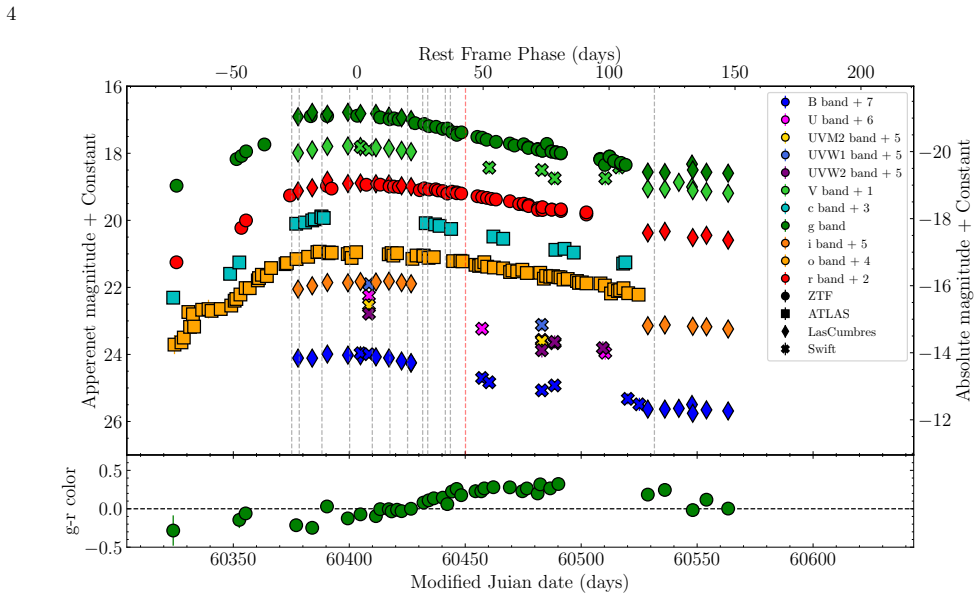
The paper establishes that SN 2024ahr is a normal, luminous SLSN-I (peak $M_g\approx M_r\approx -21$ mag, with magnetar spin-down parameters $P_\mathrm{spin}\approx3.3$ ms, $B\approx5\times10^{13}$ G, and $M_\mathrm{ej}\approx9.5\,M_\odot$) and that its +43 day near-infrared spectrum shows no significant absorption at He I $\lambda2.058\,\mu\mathrm{m}$. Spectral synthesis modeling places a conservative upper limit of $\sim0.05\,M_\odot$ on the helium mass in the outer ejecta, so the progenitor was stripped of both hydrogen and helium and exploded as an Ic-like object. The same spectrum shows broad Mg I $\lambda1.575\,\mu\mathrm{m}$ and a Mg II $\lambda2.136\,\mu\mathrm{m}$ + Co II $\lambda2.126\,\mu\mathrm{m}$ blend, features typical of Type Ic supernovae but at higher velocities, and the paper argues that SN 2024ahr is a typical SLSN-I, unlike the peculiar events that make up the existing near-infrared sample.
Load-bearing premise
The upper limit rests on the assumption that $0.05\,M_\odot$ of helium placed in the outer ejecta of a model tuned to this supernova would actually produce a visible absorption feature at $2.058\,\mu\mathrm{m}$; if the true helium line formation is weaker than the model predicts, or the model is not representative of such explosions at day 43, the limit would be too strict.
Editorial extensions
If this is right
- SN 2024ahr's progenitor was stripped of both hydrogen and helium before explosion, placing the event in the Ic-like subclass rather than the Ib-like subclass.
- The He I $\lambda2.058\,\mu\mathrm{m}$ line is a usable helium search tool for SLSNe-I at $z\lesssim0.1$ with ground-based 8-meter telescopes, as demonstrated by this observation.
- The current near-infrared sample of SLSNe-I is dominated by unusual events (low-luminosity, a pair-instability candidate, and an optical helium claim not confirmed at $2.058\,\mu\mathrm{m}$), so SN 2024ahr gives the cleanest benchmark for a typical SLSN-I.
- A larger, unbiased near-infrared survey of prototypical SLSNe-I would constrain the fraction of hydrogen-poor superluminous explosions that retain helium, testing the possible evolutionary paths to these events.
- The inferred magnetar parameters ($P_\mathrm{spin}\approx3.3$ ms, $B\approx5\times10^{13}$ G, $M_\mathrm{ej}\approx9.5\,M_\odot$) are typical of the SLSN-I population, supporting the magnetar central-engine interpretation.
Reading between the lines
- If this upper limit is representative, optical helium searches in SLSNe-I should generally fail, because optical He I lines require helium masses of roughly 0.2-1.0 $M_\odot$ to be visible, while the near-infrared line probes below $0.05\,M_\odot$.
- A testable extension is late-time nebular spectroscopy of SN 2024ahr: a helium-poor CO-core explosion should show strong oxygen and carbon emission with little or no helium recombination emission, directly checking the Ic-like interpretation.
- Because SN 2024ahr is one of the nearest SLSNe-I, the same observing strategy can be repeated for a modest sample of $z\lesssim0.1$ events; if most show no He I $2.058\,\mu\mathrm{m}$ absorption, the Ic-like channel dominates the population, while occasional detections would reveal a minority Ib-like path.
Signed reviews
Editorial analysis
A structured set of objections, weighed in public.
Referee Report
Summary. The paper presents multi-band UV/optical photometry, optical spectroscopy, and a Gemini-South near-IR spectrum of SN 2024ahr, a hydrogen-poor superluminous supernova at z=0.0861. The authors determine the redshift from host-galaxy lines, characterize a typical SLSN-I light curve (M_g ≈ M_r ≈ −21 mag, rise and decline times near 40 and 80 rest-frame days), fit a magnetar spin-down model with P_spin ≈ 3.3 ms, B ≈ 6×10^13 G, and M_ej ≈ 9.5 M_sun, and use a +43 d rest-frame NIR spectrum to search for He I λ2.058 μm. No significant He I absorption is detected; TARDIS models with helium added to the outer ejecta predict a detectable feature at 0.05 M_sun, which the authors adopt as a rough upper limit and use to argue that the progenitor was Ic-like, i.e., stripped of both hydrogen and helium.
Significance. The non-detection is a useful addition: SN 2024ahr is among the nearest typical SLSNe-I, the NIR spectrum has high signal-to-noise, and the identifications of Mg I λ1.575 μm and the Mg II/Co II blend are credible and place the event closer to Type Ic than Type Ib in the NIR. The compilation of the small existing NIR SLSN-I sample is also valuable, and the authors are appropriately cautious in places, noting that the limit applies to the outer ejecta. The helium limit is not circular: the TARDIS calculation is a forward sensitivity test rather than a fit to the non-detection. The main weakness is that the quantitative helium mass limit and the Ic-like progenitor conclusion rest on a single TARDIS line-formation calculation whose inputs and validation are not reported, so the central claim is not yet fully supported.
major comments (3)
- [§3.3, Figure 7] The TARDIS models that set the 0.05 M_sun limit are not reproducible from the text. The authors state that luminosity, ejecta mass, velocity, temperature, density, and abundances were adjusted to match the photometric and spectroscopic properties, but none of these values is quoted and no goodness-of-fit statistic or uncertainty is given. Because the upper limit is entirely a prediction of this model, the adopted parameter set and its justification must be provided, at minimum in a table or appendix, before the limit can be assessed.
- [§3.3, Figure 7] The He I λ2.058 μm line-strength calibration is not validated at the relevant phase. TARDIS's standard treatment does not include non-thermal excitation from magnetar spin-down or radioactive decay, which is known to affect He I line formation in stripped-envelope supernovae (Hachinger et al. 2012; Teffs et al. 2020), and no comparison to He lines in SNe Ib/c at similar phases is shown. A factor-of-few error in the predicted line strength would change the mass limit in either direction; the paper should quantify this sensitivity, for example by varying the TARDIS inputs or cross-checking against a He-rich SN, before calling the limit conservative.
- [Abstract and §4] The statement that the progenitor was stripped of both hydrogen and helium and is therefore Ic-like goes beyond the analysis, since the upper limit applies only to helium in the outer ejecta at +43 d and does not exclude helium at lower velocities or in mixed regions. Please soften the conclusion to 'the outer ejecta are helium-poor' or explicitly discuss how the outer-ejecta limit maps to a full progenitor-stripping conclusion.
minor comments (5)
- [§3.2] The word 'metalicity' should be 'metallicity'; the sentence introducing the R23 diagnostic also reads awkwardly and should be rephrased.
- [§3.3, Figure 4 caption] There are small typographical issues in the caption and text: 'aout 6000 km s−1' should be 'about 6000 km s−1', and the sentence describing SN 2019hge contains a misplaced period.
- [§4] The text has 'hogher expansion velocities', which should be 'higher expansion velocities'.
- [Figure 6 caption] The caption has 'Wavelngth' instead of 'Wavelength'; in addition, the comparison phases range from +34 to +101 d, so the text should state explicitly that this spread is a caveat for the comparison.
- [Abstract and §4] The abstract calls the upper limit 'conservative' while the conclusions call it 'rough'; please reconcile the terminology and state the dominant systematic uncertainty.
Circularity Check
No significant circularity: the helium upper limit in SN 2024ahr is a forward TARDIS sensitivity test with injected helium, not a fit to the non-detection.
full rationale
The central claim—a conservative upper limit of ~0.05 M_sun on helium in the outer ejecta—is derived from TARDIS models in which helium is added by hand (0, 0.025, and 0.05 M_sun) and the synthetic spectra are compared with the observed NIR spectrum at the He I 2.058 um line. The non-detection itself is not a fitted target; the paper explicitly says the model parameters are adjusted to match the photometric and spectroscopic properties and then varying amounts of helium are added to estimate detectability. This is a forward sensitivity calculation, so the derived limit is not equivalent to its input by construction. The light-curve magnetar fit supplies inputs such as ejecta mass and velocity, but those inputs do not encode the answer to whether helium would be visible at 2.058 um; the helium line is an added synthetic opacity, not a fitted parameter. Self-citations to population studies and MOSFiT fitting priors (e.g., Nicholl et al. 2017; Gomez et al. 2024) provide context and are not the load-bearing evidence for the helium limit. Concerns about TARDIS's treatment of He I 2.058 um line formation, especially non-thermal excitation in SLSNe-I, are model-validation or soundness issues, not circularity. The comparison to external SN Ib/Ic NIR spectra and published SLSNe-I NIR spectra further supports the classification argument independently of the TARDIS limit. Overall, no circular step that reduces a prediction to its own inputs was identified.
Assumptions & free parameters
free parameters (6)
- Magnetar spin period (Pspin) =
3.32 ms (posterior, Table 1)
- Magnetar magnetic field (B) =
5.6e13 G (posterior, Table 1)
- Ejecta mass (Mej) =
9.51 M_sun (posterior, Table 1)
- Ejecta velocity (vej) =
~5000 km/s (posterior, Table 1)
- TARDIS abundance set (excluding helium) =
Not quoted
- TARDIS luminosity, temperature, and density profile =
Not quoted
assumptions (5)
- domain assumption The He I 2.058 μm line is an uncontaminated helium diagnostic in stripped-envelope SNe at this phase.
- domain assumption The TARDIS code, with the Williamson et al. 2021 style model and parameters adjusted to SN 2024ahr, correctly predicts the strength of He I 2.058 μm for a given helium mass at +43 days.
- domain assumption The MOSFiT slsnni magnetar model gives an approximately correct ejecta mass and velocity distribution.
- domain assumption Any helium present would reside in the outer layers of the ejecta and produce an absorption signature.
- domain assumption The early light-curve bump and late UV data can be excluded from the magnetar fit without biasing the parameters.
Cite this review
Pith. "Pith review of A Near-IR Search for Helium in the Superluminous Supernova SN 2024ahr." pith.science (2026). https://pith.science/paper/MSDOQHTK
@misc{pith2026250101485,
  author       = {Pith},
  title        = {Pith review of: A Near-IR Search for Helium in the Superluminous Supernova SN 2024ahr},
  year         = {2026},
  howpublished = {\url{https://pith.science/paper/MSDOQHTK}},
  note         = {Machine review of arXiv:2501.01485}
}
abstract
We present a detailed study of SN 2024ahr, a hydrogen-poor superluminous supernova (SLSN-I), for which we determine a redshift of $z=0.0861$. SN 2024ahr has a peak absolute magnitude of $M_g\approx M_r\approx -21$ mag, rest-frame rise and decline times (50$\%$ of peak) of about 40 and 80 days, respectively, and typical spectroscopic evolution in the optical band. Similarly, modeling of the UV/optical light curves with a magnetar spin-down engine leads to typical parameters: an initial spin period of $\approx 3.3$ ms, a magnetic field strength of $\approx 6\times 10^{13}$ G, and an ejecta mass of $\approx 9.5$ M$_\odot$. Due to its relatively low redshift we obtained a high signal-to-noise ratio near-IR spectrum about 43 rest-frame days post-peak to search for the presence of helium. We do not detect any significant feature at the location of the He I $\,\lambda 2.058$ $\mu$m feature, and place a conservative upper limit of $\sim 0.05$ M$_\odot$ on the mass of helium in the outer ejecta. We detect broad features of Mg I $\,\lambda 1.575$ $\mu$m and a blend of Co II $\,\lambda 2.126$ $\mu$m and Mg II, $\lambda 2.136$ $\mu$m, which are typical of Type Ic SNe, but with higher velocities. Examining the sample of SLSNe-I with NIR spectroscopy, we find that, unlike SN 2024ahr, these events are generally peculiar. This highlights the need for a large sample of prototypical SLSNe-I with NIR spectroscopy to constrain the fraction of progenitors with helium (Ib-like) and without helium (Ic-like) at the time of the explosion, and hence the evolutionary path(s) leading to the rare outcome of SLSNe-I.
Figures


Figures from the paper (4 more)


Forward citations
Cited by 1 Pith paper
-
A Detection of Helium in the Bright Superluminous Supernova SN 2024rmj
Near-infrared spectra of SN 2024rmj show blueshifted He I 1.083 and 2.058 micron lines, the first definitive helium detection in a bright hydrogen-poor superluminous supernova.
Reference graph
Works this paper leans on
-
[1]
R., Smith, M., Sullivan, M., et al
Angus, C. R., Smith, M., Sullivan, M., et al. 2019, MNRAS, 487, 2215, doi: 10.1093/mnras/stz1321 Astropy Collaboration, Robitaille, T. P., Tollerud, E. J., et al. 2013, A&A, 558, A33, doi: 10.1051/0004-6361/201322068 Astropy Collaboration, Price-Whelan, A. M., Sip˝ ocz, B. M., et al. 2018, AJ, 156, 123, doi: 10.3847/1538-3881/aabc4f Astropy Collaboration,...
-
[2]
Barbary, K., Dawson, K. S., Tokita, K., et al. 2009, ApJ, 690, 1358, doi: 10.1088/0004-637X/690/2/1358
-
[3]
2014, in The Third Hot-wiring the Transient Universe Workshop, ed
Bellm, E. 2014, in The Third Hot-wiring the Transient Universe Workshop, ed. P. R. Wozniak, M. J. Graham, A. A. Mahabal, & R. Seaman, 27–33, doi: 10.48550/arXiv.1410.8185
-
[4]
Bellm, E. C., Kulkarni, S. R., Graham, M. J., et al. 2019, PASP, 131, 018002, doi: 10.1088/1538-3873/aaecbe
-
[5]
1996, A&AS, 117, 393, doi: 10.1051/aas:1996164
Bertin, E., & Arnouts, S. 1996, A&AS, 117, 393, doi: 10.1051/aas:1996164
-
[6]
K., Berger, E., Nicholl, M., & Villar, V
Blanchard, P. K., Berger, E., Nicholl, M., & Villar, V. A. 2020, ApJ, 897, 114, doi: 10.3847/1538-4357/ab9638
-
[7]
2022, astropy/photutils: 1.5.0, 1.5.0, Zenodo, doi: 10.5281/zenodo.6825092
Bradley, L., Sip˝ ocz, B., Robitaille, T., et al. 2022, astropy/photutils: 1.5.0, 1.5.0, Zenodo, doi: 10.5281/zenodo.6825092
-
[8]
Brown, T. M., Baliber, N., Bianco, F. B., et al. 2013, PASP, 125, 1031, doi: 10.1086/673168
doi:10.1086/673168 2013
Show all 66 references
-
[9]
W., Smartt, S
Chen, T. W., Smartt, S. J., Jerkstrand, A., et al. 2015, MNRAS, 452, 1567, doi: 10.1093/mnras/stv1360
2015 doi
-
[10]
H., Yan, L., Kangas, T., et al
Chen, Z. H., Yan, L., Kangas, T., et al. 2023, ApJ, 943, 41, doi: 10.3847/1538-4357/aca161
2023 doi
-
[11]
M., et al
Chomiuk, L., Chornock, R., Soderberg, A. M., et al. 2011, ApJ, 743, 114, doi: 10.1088/0004-637X/743/2/114
2011 doi
-
[12]
L., & Nicholl, M
Cleland, C., McGee, S. L., & Nicholl, M. 2023, MNRAS, 524, 3559, doi: 10.1093/mnras/stad2118
2023 doi
-
[13]
2019, PASP, 131, 075004, doi: 10.1088/1538-3873/ab1d78
Fabricant, D., Fata, R., Epps, H., et al. 2019, PASP, 131, 075004, doi: 10.1088/1538-3873/ab1d78
2019 doi
-
[14]
Filippenko, A. V. 1982, PASP, 94, 715, doi: 10.1086/131052
1982 doi
-
[15]
Fitzpatrick, E. L. 1999, PASP, 111, 63, doi: 10.1086/316293
1999 doi
-
[16]
2018, in American Astronomical Society Meeting Abstracts, Vol
Flewelling, H. 2018, in American Astronomical Society Meeting Abstracts, Vol. 231, American Astronomical Society Meeting Abstracts #231, 436.01 F¨ orster, F., Cabrera-Vives, G., Castillo-Navarrete, E., et al. 2021, AJ, 161, 242, doi: 10.3847/1538-3881/abe9bc
2018 doi
-
[17]
2024, Transient Name Server Discovery Report, 2024-168, 1
Fremling, C. 2024, Transient Name Server Discovery Report, 2024-168, 1
2024
-
[18]
R., Vincenzi, M., et al
Frohmaier, C., Angus, C. R., Vincenzi, M., et al. 2021, MNRAS, 500, 5142, doi: 10.1093/mnras/staa3607
2021 doi
-
[19]
2012, Science, 337, 927, doi: 10.1126/science.1203601 —
Gal-Yam, A. 2012, Science, 337, 927, doi: 10.1126/science.1203601 —. 2019a, ARA&A, 57, 305, doi: 10.1146/annurev-astro-081817-051819 —. 2019b, ApJ, 882, 102, doi: 10.3847/1538-4357/ab2f79
2012 doi
-
[20]
O., et al
Gal-Yam, A., Mazzali, P., Ofek, E. O., et al. 2009, Nature, 462, 624, doi: 10.1038/nature08579
2009 doi
-
[21]
L., Fesen, R
Gerardy, C. L., Fesen, R. A., Marion, G. H., et al. 2002, in American Astronomical Society Meeting Abstracts, Vol. 200, American Astronomical Society Meeting Abstracts #200, 14.04
2002
-
[22]
2022, ApJ, 941, 107, doi: 10.3847/1538-4357/ac9842
Hosseinzadeh, G. 2022, ApJ, 941, 107, doi: 10.3847/1538-4357/ac9842
2022 doi
-
[23]
2024, MNRAS, 535, 471, doi: 10.1093/mnras/stae2270
Gomez, S., Nicholl, M., Berger, E., et al. 2024, MNRAS, 535, 471, doi: 10.1093/mnras/stae2270
2024 doi
-
[24]
A., et al
Guillochon, J., Nicholl, M., Villar, V. A., et al. 2017, MOSFiT: Modular Open-Source Fitter for Transients, Astrophysics Source Code Library, record ascl:1710.006
2017
-
[25]
A., Taubenberger, S., et al
Hachinger, S., Mazzali, P. A., Taubenberger, S., et al. 2012, MNRAS, 422, 70, doi: 10.1111/j.1365-2966.2012.20464.x 19
2012
-
[26]
D., Karamehmetoglu, E., et al
Holmbo, S., Stritzinger, M. D., Karamehmetoglu, E., et al. 2023, A&A, 675, A83, doi: 10.1051/0004-6361/202245334
2023 doi
-
[27]
2010, ApJ, 717, 245, doi: 10.1088/0004-637X/717/1/245
Kasen, D., & Bildsten, L. 2010, ApJ, 717, 245, doi: 10.1088/0004-637X/717/1/245
2010 doi
-
[28]
2024, tardis-sn/tardis: TARDIS v2024.10.14, release-2024.10.14, Zenodo, doi: 10.5281/zenodo.13929578
Kerzendorf, W., Sim, S., Vogl, C., et al. 2024, tardis-sn/tardis: TARDIS v2024.10.14, release-2024.10.14, Zenodo, doi: 10.5281/zenodo.13929578
2024 doi
-
[29]
E., & Sim, S
Kerzendorf, W. E., & Sim, S. A. 2014, MNRAS, 440, 387, doi: 10.1093/mnras/stu055
2014 doi
-
[30]
A., Kennicutt, Robert C., J., & Pizagno, J
Kobulnicky, H. A., Kennicutt, Robert C., J., & Pizagno, J. L. 1999, ApJ, 514, 544, doi: 10.1086/306987
1999 doi
-
[31]
2014, ApJ, 787, 138, doi: 10.1088/0004-637X/787/2/138
Lunnan, R., Chornock, R., Berger, E., et al. 2014, ApJ, 787, 138, doi: 10.1088/0004-637X/787/2/138
2014 doi
-
[32]
Shields, J. C. 2001, AJ, 121, 1648, doi: 10.1086/319390
2001 doi
-
[33]
A., Sullivan, M., Pian, E., Greiner, J., & Kann, D
Mazzali, P. A., Sullivan, M., Pian, E., Greiner, J., & Kann, D. A. 2016, MNRAS, 458, 3455, doi: 10.1093/mnras/stw512
2016 doi
-
[34]
2006, A&A, 459, 85, doi: 10.1051/0004-6361:20065216
Nagao, T., Maiolino, R., & Marconi, A. 2006, A&A, 459, 85, doi: 10.1051/0004-6361:20065216
2006 doi
-
[35]
2021, Astronomy and Geophysics, 62, 5.34, doi: 10.1093/astrogeo/atab092
Nicholl, M. 2021, Astronomy and Geophysics, 62, 5.34, doi: 10.1093/astrogeo/atab092
2021 doi
-
[36]
2017, ApJ, 850, 55, doi: 10.3847/1538-4357/aa9334
Nicholl, M., Guillochon, J., & Berger, E. 2017, ApJ, 850, 55, doi: 10.3847/1538-4357/aa9334
2017 doi
-
[37]
Nicholl, M., & Smartt, S. J. 2016, MNRAS, 457, L79, doi: 10.1093/mnrasl/slv210
2016 doi
-
[38]
B., Cohen, J
Oke, J. B., Cohen, J. G., Carr, M., et al. 1995, PASP, 107, 375, doi: 10.1086/133562
1995 doi
-
[39]
Oliphant, T. E. 2015, USA: CreateS-pace Independent Publishing Platform
2015
-
[40]
Pagel, B. E. J., Edmunds, M. G., Blackwell, D. E., Chun, M. S., & Smith, G. 1979, MNRAS, 189, 95, doi: 10.1093/mnras/189.1.95
1979 doi
-
[41]
Perley, D. A. 2019, PASP, 131, 084503, doi: 10.1088/1538-3873/ab215d
2019 doi
-
[42]
A., Quimby, R
Perley, D. A., Quimby, R. M., Yan, L., et al. 2016, ApJ, 830, 13, doi: 10.3847/0004-637X/830/1/13 Planck Collaboration, Aghanim, N., Akrami, Y., et al. 2020, A&A, 641, A6, doi: 10.1051/0004-6361/201833910
2016 doi
-
[43]
X., Hennawi, J
Prochaska, J. X., Hennawi, J. F., Westfall, K. B., et al. 2020, Journal of Open Source Software, 5, 2308, doi: 10.21105/joss.02308
2020 doi
-
[44]
X., Hennawi, J., Cooke, R., et al
Prochaska, J. X., Hennawi, J., Cooke, R., et al. 2020, pypeit/PypeIt: Release 1.0.0, v1.0.0, Zenodo, doi: 10.5281/zenodo.3743493
2020 doi
-
[45]
2022, A&A, 666, A30, doi: 10.1051/0004-6361/202243256
Pursiainen, M., Leloudas, G., Paraskeva, E., et al. 2022, A&A, 666, A30, doi: 10.1051/0004-6361/202243256
2022 doi
-
[46]
M., Aldering, G., Wheeler, J
Quimby, R. M., Aldering, G., Wheeler, J. C., et al. 2007, ApJL, 668, L99, doi: 10.1086/522862
2007 doi
-
[47]
M., Yuan, F., Akerlof, C., & Wheeler, J
Quimby, R. M., Yuan, F., Akerlof, C., & Wheeler, J. C. 2013, MNRAS, 431, 912, doi: 10.1093/mnras/stt213
2013 doi
-
[48]
M., Kulkarni, S
Quimby, R. M., Kulkarni, S. R., Kasliwal, M. M., et al. 2011, Nature, 474, 487, doi: 10.1038/nature10095
2011 doi
-
[49]
Roming, P. W. A., Kennedy, T. E., Mason, K. O., et al. 2005, SSRv, 120, 95, doi: 10.1007/s11214-005-5095-4
2005 doi
-
[50]
F., & Finkbeiner, D
Schlafly, E. F., & Finkbeiner, D. P. 2011, ApJ, 737, 103, doi: 10.1088/0004-637X/737/2/103
2011 doi
-
[51]
2024, A&A, 683, A223, doi: 10.1051/0004-6361/202346855 Science Software Branch at STScI
Schulze, S., Fransson, C., Kozyreva, A., et al. 2024, A&A, 683, A223, doi: 10.1051/0004-6361/202346855 Science Software Branch at STScI. 2012, PyRAF: Python alternative for IRAF, Astrophysics Source Code Library, record ascl:1207.011
2024 doi
-
[52]
Y., Ashall, C., et al
Shahbandeh, M., Hsiao, E. Y., Ashall, C., et al. 2022, ApJ, 925, 175, doi: 10.3847/1538-4357/ac4030
2022 doi
-
[53]
W., Young, D
Shingles, L., Smith, K. W., Young, D. R., et al. 2021, Transient Name Server AstroNote, 7, 1
2021
-
[54]
C., et al
Smith, M., Sullivan, M., Nichol, R. C., et al. 2018, ApJ, 854, 37, doi: 10.3847/1538-4357/aaa126
2018 doi
-
[55]
B., Bean, J
Stevenson, K. B., Bean, J. L., Seifahrt, A., et al. 2016, ApJ, 817, 141, doi: 10.3847/0004-637X/817/2/141
2016 doi
-
[56]
Sukhbold, T., & Woosley, S. E. 2016, ApJL, 820, L38, doi: 10.3847/2041-8205/820/2/L38
2016 doi
-
[57]
Teffs, J., Ertl, T., Mazzali, P., Hachinger, S., & Janka, H. T. 2020, MNRAS, 499, 730, doi: 10.1093/mnras/staa2549
2020 doi
-
[58]
2014, MNRAS, 438, L101, doi: 10.1093/mnrasl/slt171
Valenti, S., Sand, D., Pastorello, A., et al. 2014, MNRAS, 438, L101, doi: 10.1093/mnrasl/slt171
2014 doi
-
[59]
A., Stritzinger, M
Valenti, S., Howell, D. A., Stritzinger, M. D., et al. 2016, MNRAS, 459, 3939, doi: 10.1093/mnras/stw870
2016 doi
-
[60]
E., et al
Virtanen, P., Gommers, R., Oliphant, T. E., et al. 2020, Nature Methods, 17, 261, doi: 10.1038/s41592-019-0686-2
2020 doi
-
[61]
2021, ApJ, 908, 150, doi: 10.3847/1538-4357/abd244
Williamson, M., Kerzendorf, W., & Modjaz, M. 2021, ApJ, 908, 150, doi: 10.3847/1538-4357/abd244
2021 doi
-
[62]
2024, Transient Name Server Classification Report, 2024-619, 1
Wise, J., Brennan, S., Sollerman, J., Schulze, S., & Perley, D. 2024, Transient Name Server Classification Report, 2024-619, 1
2024
-
[63]
Woosley, S. E. 2010, ApJL, 719, L204, doi: 10.1088/2041-8205/719/2/L204
2010 doi
-
[64]
A., Schulze, S., et al
Yan, L., Perley, D. A., Schulze, S., et al. 2020, ApJL, 902, L8, doi: 10.3847/2041-8213/abb8c5
2020 doi
-
[65]
O., & Gal-Yam, A
Zackay, B., Ofek, E. O., & Gal-Yam, A. 2016, ApJ, 830, 27, doi: 10.3847/0004-637X/830/1/27 20
2016 doi
-
[66]
2023, ApJ, 949, 23, doi: 10.3847/1538-4357/acc2c3
Zhu, J., Jiang, N., Dong, S., et al. 2023, ApJ, 949, 23, doi: 10.3847/1538-4357/acc2c3
2023 doi
Reviewed August 10, 2026 · model on record in the stance chip above.
Discussion (0). Continue with ORCID to comment.