REVIEW 3 major objections 6 minor 1 cited by
Empowering Bengali Education with AI: Solving Bengali Math Word Problems through Transformer Models
T0 review · 3 major / 6 minor · reviewed 2026-08-10 · deepseek-v4-flash
Pith's one-line read Fine-tuned mT5 solves Bengali math word problems with 97.30% accuracy.
desk verdict A small but genuinely new Bengali MWP dataset with near-ceiling numbers that deserve a skeptical read because of the template-based random split. read the letter →
The pith
A machine-rendered reading of the paper's core claim, the machinery that carries it, and where it could break.
The reading
What carries the argument
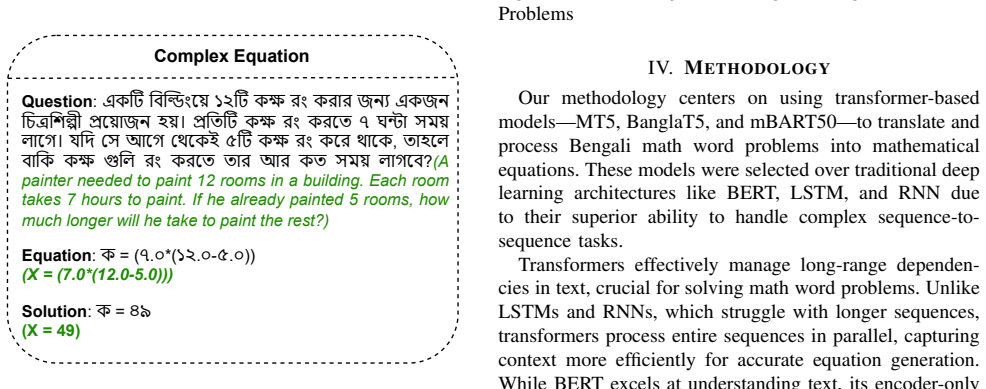
The load-bearing object is PatiGonit, a 10,000-problem Bengali dataset translated and culturally adapted from MAWPS, split 80/10/10 for training, validation, and testing. The mechanism is text-to-text equation generation: each fine-tuned encoder-decoder model reads the Bengali problem and outputs a templated equation such as 'ক = ৩৯ × ১৭', and a deterministic equation solver evaluates that equation to a number. Accuracy is scored by comparing the solver's number with the correct answer, which sidesteps surface variation in equation order.
What would settle it
Write 1,000 fresh Bengali arithmetic word problems with the same grade level and operation mix but new story structures and new number combinations, none drawn from MAWPS templates, and run the fine-tuned mT5 model on them. If accuracy on that set falls substantially below 97.30%, the original score is explained by template pattern recall rather than by a general ability to turn Bengali text into equations.
Extended reading notes
Core claim
On the paper's own terms, the central discovery is that a multilingual text-to-text transformer, fine-tuned on 8,000 Bengali examples, can map word problems to arithmetic equations at near-ceiling accuracy: mT5 reaches 97.30% solution accuracy with batch size 8 and 15 epochs, and mBART50 reaches 97.20%, while a from-scratch Basic Transformer tops out at 77.30%. The evaluation metric is the final numerical answer produced by solving the predicted equation, not the equation string itself; the paper shows that BLEU can penalize mathematically equivalent reorderings and even prefer a wrong equation, so answer accuracy is the stated measure of success. The contribution is therefore an application result: a new Bengali benchmark and a demonstration that existing pretrained multilingual sequence-to-sequence models are sufficient for elementary Bengali arithmetic word problems.
Load-bearing premise
The 97.30% figure assumes that the random 10% test sample consists of genuinely unseen problems, rather than rewordings of training problems whose equation forms the model has already memorized.
Editorial extensions
If this is right
- A publicly available Bengali math word problem benchmark now exists where none did, so future Bengali NLP work can be compared on the same 10,000 problems.
- Multilingual text-to-text models, not language-specific ones, give the best reported accuracy: mT5 and mBART50 both exceed 97%, while BanglaT5 peaks at 95.80%.
- Equation evaluation should be done by solving the equation and checking the numerical answer, not by comparing generated tokens with BLEU, which can score a wrong equation higher than a correct one.
- The same fine-tuning recipe can be applied to other low-resource languages that have a translated arithmetic corpus, without designing a new architecture.
- The paper's own limitation statement means the result should be read as covering elementary one-operation arithmetic, not complex multi-step problems.
Reading between the lines
- Because PatiGonit is translated from MAWPS, a corpus built from templates, the 97.30% accuracy likely overstates performance on freely written Bengali word problems; a benchmark assembled from original Bengali textbooks or student-written problems would be a harder test.
- The near-tie between mT5 and mBART50 despite different pretraining data suggests that pretraining breadth, not Bengali-specific pretraining, drives this result; an ablation on a non-template test set would settle that.
- Reporting equation-template accuracy separately from answer accuracy would tell whether the model actually selects the right operation or just lands on the right number by chance; the paper does not report that breakdown.
- If the template-memorization concern is confirmed, the same dataset could still be used to measure generalization by re-splitting so that every equation template appears in only one of train/test, which would give a ceiling for real transfer.
Editorial analysis
A structured set of objections, weighed in public.
Referee Report
Summary. The paper introduces PatiGonit, a 10,000-problem Bengali math word problem (MWP) dataset obtained by manually translating and culturally adapting a subset of the MAWPS corpus, and fine-tunes four transformer-based sequence-to-sequence models—Basic Transformer, mT5, BanglaT5, and mBART50—to generate equations from Bengali problem text. On a random 80:10:10 split of the dataset, the authors report that mT5 achieves the highest solution accuracy of 97.30%, followed by mBART50 at 97.20%, BanglaT5 at 95.80%, and Basic Transformer at 77.30%. The paper concludes that transformer models are effective for Bengali MWP solving and that PatiGonit is a viable benchmark.
Significance. If the reported accuracy reflected genuine generalization to unseen Bengali word problems, the paper would be a useful contribution: PatiGonit would fill a genuine gap for low-resource Bengali MWP research, and the fine-tuning comparison would provide baselines for future work. The authors deserve credit for manually translating and reviewing the dataset, for using solution accuracy rather than BLEU as the primary correctness metric, for reporting hyperparameter settings, and for explicitly acknowledging in Section VIII that the dataset is dominated by basic arithmetic problems. However, the central claim of near-ceiling accuracy is not yet supported because the evaluation protocol allows template leakage from MAWPS and because the reported differences between top models are within the noise level. The absence of a released dataset or code also limits reproducibility.
major comments (3)
- [Section III.A, Section III.D, Table III] The random 80:10:10 split does not control for the fact that MAWPS is a template-based corpus. Many problems in the test set are surface variants of templates whose instantiations appear in the training set, so the model can succeed by matching a template and emitting its equation skeleton with the test quantities substituted. The near-ceiling accuracies (mT5 97.30%, mBART50 97.20%) are therefore consistent with template memorization rather than with Bengali mathematical reasoning. The authors should report an evaluation in which all instantiations of each MAWPS template are assigned to a single split (template-disjoint split) and should temper the generalisation claim in the Abstract and Section VI until such results are provided. The paper's own limitation in Section VIII—that the dataset is mostly simple arithmetic—reinforces the need for this narrower interpretation.
- [Section VI, Table III] The claim that mT5 achieved the highest accuracy is not statistically supported. The difference between mT5's 97.30% and mBART50's 97.20% is a single problem out of 1,000 test instances, and the paper reports no multiple seeds, confidence intervals, or significance tests. Additionally, the first paragraph of Section VI states that mBART50 'achieved the highest accuracy of 97.20%', which contradicts Table III and the later claim that mT5 is best. The authors should fix this internal contradiction and provide statistical evidence, or avoid making a comparative claim between the two top models.
- [Section VI, Table III] The statement that mT5's performance 'remained consistently high across different configurations' is contradicted by Table III, where mT5 with batch size 16 and 5 epochs achieves only 14.40% accuracy, and BanglaT5 with batch size 16 and 10 epochs collapses to 1.30% accuracy. These extreme failures are not discussed. If the authors wish to claim robustness, they need to explain these configurations or report the training instability; otherwise the robustness claim should be removed.
minor comments (6)
- [Section I, Figure 1] The example in Figure 1 contains punctuation and spacing errors in the Bengali text (e.g., missing spaces after dandas), which should be cleaned for readability.
- [Section III.B] The dataset annotation section describes manual review by native speakers but provides no inter-annotator agreement measure, no quality-control protocol, and no public release URL for PatiGonit. A dataset link or availability statement is needed for reproducibility.
- [Section IV.D / Section V.B] The equation solver used to compute final solutions from generated equations is never described. Since solution accuracy is the primary metric, the reader needs to know how equations are parsed and evaluated, especially for multi-operation equations.
- [Section VI, Table III] Table III lists only one configuration for mBART50 (batch size 8, 5 epochs) due to resource constraints. This should be stated in the table caption or in Section V.C, and the comparison with other models at 15 epochs should be interpreted accordingly.
- [References] Reference [4] is incomplete: the URL stops at 'MathBot-' and no publication venue or year is given. Several other references also lack page numbers; please verify completeness.
- [Figure 6] The multilingual example in Figure 6 includes 'President Paul <M> born <M> April 2000' and its translations, which is unrelated to math word problems and may confuse readers; it should be replaced with a math-word-problem example or removed.
Circularity Check
No circularity: the reported accuracies are measured on a held-out test split after fine-tuning, and no load-bearing derivation reduces to its own inputs.
full rationale
The paper's central claim is an empirical accuracy result (mT5, 97.30%) obtained by fine-tuning pretrained transformer models on the PatiGonit dataset and evaluating on a randomly held-out 10% test split (Section III.D, Table III). The evaluation is not a derivation: the model outputs are compared against reference equations and final answers using solution accuracy, and the test examples were not used for training. The dataset is constructed by translating a 10,000-problem subset of MAWPS, and the random 80:10:10 split may place template-similar problems in both training and test; however, that is a generalizability or data-leakage concern about whether the test set measures true reasoning, not circular reasoning in which a fitted parameter or self-cited result is renamed as a prediction. There are no self-citations that are load-bearing, no uniqueness theorem imported from the authors' prior work, and no ansatz smuggled in via citation. The paper's accuracy figures stand as an in-distribution evaluation of the fine-tuned models on the introduced dataset. Accordingly, no specific circular step can be exhibited, and the appropriate score is 0.
Assumptions & free parameters
assumptions (3)
- domain assumption MAWPS dataset is a valid source for Bengali math word problems.
- domain assumption The random 80:10:10 split yields an i.i.d. test set.
- domain assumption Solution accuracy (final answer equality) correctly measures model ability.
Cite this review
Pith. "Pith review of Empowering Bengali Education with AI: Solving Bengali Math Word Problems through Transformer Models." pith.science (2026). https://pith.science/paper/XA7AKOVZ
@misc{pith2026250102599,
  author       = {Pith},
  title        = {Pith review of: Empowering Bengali Education with AI: Solving Bengali Math Word Problems through Transformer Models},
  year         = {2026},
  howpublished = {\url{https://pith.science/paper/XA7AKOVZ}},
  note         = {Machine review of arXiv:2501.02599}
}
read the original abstract
Mathematical word problems (MWPs) involve the task of converting textual descriptions into mathematical equations. This poses a significant challenge in natural language processing, particularly for low-resource languages such as Bengali. This paper addresses this challenge by developing an innovative approach to solving Bengali MWPs using transformer-based models, including Basic Transformer, mT5, BanglaT5, and mBART50. To support this effort, the "PatiGonit" dataset was introduced, containing 10,000 Bengali math problems, and these models were fine-tuned to translate the word problems into equations accurately. The evaluation revealed that the mT5 model achieved the highest accuracy of 97.30%, demonstrating the effectiveness of transformer models in this domain. This research marks a significant step forward in Bengali natural language processing, offering valuable methodologies and resources for educational AI tools. By improving math education, it also supports the development of advanced problem-solving skills for Bengali-speaking students.
Figures


Figures from the paper (2 more)


Forward citations
Cited by 1 Pith paper
-
Artificial Intelligence for Mathematical Reasoning: An Integrated Survey of Language Models, Neuro-symbolic Systems, and Verified Discovery
An integrated survey organizing AI mathematical reasoning into informal, formal, discovery, and technique axes while cataloging benchmarks and assessing failure modes.
Reference graph
Works this paper leans on
-
[1]
Patel, Arkil, Satwik Bhattamishra, and Navin Goyal. ”Are NLP models really able to solve simple math word problems?.” arXiv preprint arXiv:2103.07191 (2021)
arXiv 2021
-
[2]
”Attention is all you need.” Advances in Neural Infor- mation Processing Systems (2017)
Vaswani, A. ”Attention is all you need.” Advances in Neural Infor- mation Processing Systems (2017)
work page 2017
-
[3]
Bhattacharjee, Abhik, et al. ”BanglaBERT: Language model pre- training and benchmarks for low-resource language understanding evaluation in Bangla.” arXiv preprint arXiv:2101.00204 (2021)
arXiv 2021
-
[4]
”MathBot–A Deep Learning based Elementary School Math Word Problem Solver.” https://www
Nayak, Anish Kumar, Rajeev Patwari, and Viswanathan Subramanian. ”MathBot–A Deep Learning based Elementary School Math Word Problem Solver.” https://www. semanticscholar. org/paper/MathBot-
-
[5]
Feigenbaum, Edward A. ”Some challenges and grand challenges for computational intelligence.” Journal of the ACM (JACM) 50.1 (2003): 32-40
work page 2003
-
[6]
”Variational neural machine translation.” arXiv preprint arXiv:1605.07869 (2016)
Zhang, Biao, et al. ”Variational neural machine translation.” arXiv preprint arXiv:1605.07869 (2016)
arXiv 2016
-
[7]
Wang, Yan, Xiaojiang Liu, and Shuming Shi. ”Deep neural solver for math word problems.” Proceedings of the 2017 conference on empirical methods in natural language processing. 2017
work page 2017
-
[8]
Chiang, Ting-Rui, and Yun-Nung Chen. ”Semantically-aligned equa- tion generation for solving and reasoning math word problems.” arXiv preprint arXiv:1811.00720 (2018)
arXiv 2018
Show all 19 references
-
[9]
”Mwp-bert: Numeracy-augmented pre-training for math word problem solving.” arXiv preprint arXiv:2107.13435 (2021)
Liang, Zhenwen, et al. ”Mwp-bert: Numeracy-augmented pre-training for math word problem solving.” arXiv preprint arXiv:2107.13435 (2021)
2021 arXiv
-
[10]
”Math word problem solving by gen- erating linguistic variants of problem statements.” arXiv preprint arXiv:2306.13899 (2023)
Raiyan, Syed Rifat, et al. ”Math word problem solving by gen- erating linguistic variants of problem statements.” arXiv preprint arXiv:2306.13899 (2023)
2023 arXiv
-
[11]
”Translating a math word problem to an expression tree.” arXiv preprint arXiv:1811.05632 (2018)
Wang, Lei, et al. ”Translating a math word problem to an expression tree.” arXiv preprint arXiv:1811.05632 (2018)
2018 arXiv
-
[12]
”A goal-driven tree-structured neural model for math word problems.” Ijcai
Xie, Zhipeng, and Shichao Sun. ”A goal-driven tree-structured neural model for math word problems.” Ijcai. 2019
2019
-
[13]
”W ARM: A Weakly (+ Semi) Super- vised Model for Solving Math word Problems.” arXiv preprint arXiv:2104.06722 (2021)
Chatterjee, Oishik, et al. ”W ARM: A Weakly (+ Semi) Super- vised Model for Solving Math word Problems.” arXiv preprint arXiv:2104.06722 (2021)
2021 arXiv
-
[14]
”Semantically-aligned universal tree-structured solver for math word problems.” arXiv preprint arXiv:2010.06823 (2020)
Qin, Jinghui, et al. ”Semantically-aligned universal tree-structured solver for math word problems.” arXiv preprint arXiv:2010.06823 (2020)
2020 arXiv
-
[15]
”Math word problem generation with multilingual language models.” Proceedings of the 15th International Conference on Natural Language Generation
Niyarepola, Kashyapa, et al. ”Math word problem generation with multilingual language models.” Proceedings of the 15th International Conference on Natural Language Generation. 2022
2022
-
[16]
”mt5: A massively multilingual pre-trained text-to-text transformer.” arXiv preprint arXiv:2010.11934 (2020)
Xue, L. ”mt5: A massively multilingual pre-trained text-to-text transformer.” arXiv preprint arXiv:2010.11934 (2020)
2020 arXiv
-
[17]
”BanglaNLG and BanglaT5: Benchmarks and resources for evaluating low-resource natural language genera- tion in Bangla.” arXiv preprint arXiv:2205.11081 (2022)
Bhattacharjee, Abhik, et al. ”BanglaNLG and BanglaT5: Benchmarks and resources for evaluating low-resource natural language genera- tion in Bangla.” arXiv preprint arXiv:2205.11081 (2022)
2022 arXiv
-
[18]
”Multilingual translation with extensible multi- lingual pretraining and finetuning.” arXiv preprint arXiv:2008.00401 (2020)
Tang, Yuqing, et al. ”Multilingual translation with extensible multi- lingual pretraining and finetuning.” arXiv preprint arXiv:2008.00401 (2020)
2020 arXiv
-
[19]
”Improve Mathematical Reasoning in Lan- guage Models by Automated Process Supervision.” arXiv preprint arXiv:2406.06592 (2024)
Luo, Liangchen, et al. ”Improve Mathematical Reasoning in Lan- guage Models by Automated Process Supervision.” arXiv preprint arXiv:2406.06592 (2024)
2024 arXiv
Reviewed August 10, 2026 · model on record in the stance chip above.
Discussion (0). Continue with ORCID to comment.