REVIEW 4 major objections 6 minor 1 cited by
Layer-Level Self-Exposure and Patch: Affirmative Token Mitigation for Jailbreak Attack Defense
T0 review · 4 major / 6 minor · reviewed 2026-08-10 · deepseek-v4-flash
Pith's one-line read The paper claims that jailbreak vulnerability in LLMs concentrates in specific layers that produce affirmative tokens, and that adversarially exposing then unlearning just those layers plus one neighbor reduces attack success without…
desk verdict The paper's central claim is contradicted by its own Table 1, but the self-exposure idea is worth a serious look after a corrected evaluation. read the letter →
The pith
A machine-rendered reading of the paper's core claim, the machinery that carries it, and where it could break.
The reading
What carries the argument
The load-bearing object is the toxic score of Equation (3): at each transformer layer, the summed probability that the decoding head assigns to a hand-curated set of affirmative tokens, averaged over a set of harmful prompts. This score identifies which layers to edit; adversarial augmentation (Equation (4)) then tunes only the most toxic layer to amplify harmful outputs and, together with random token dropping, generates a diverse augmented dataset. Finally, toxic-layer editing combines a forgetting loss (gradient ascent on harmful examples), a random-mismatch loss that pairs harmful prompts with non-harmful outputs, and a KL regularization loss on normal data (Equations (5)–(8)), applied only to the identified toxic layers and one neighboring layer. The mechanism's work is to localize the safety edit so that defenses do not perturb the rest of the network.
What would settle it
Run the same layer identification and unlearning against a jailbreak that produces harmful content without any affirmative-token onset, for instance a Base64-encoded or 'continue the story' style prompt. The paper's own Table 6 reports that Layer-AdvPatcher leaves attack success near 100% on Base64 and Leetspeak prompts for Mistral and above 90% for Llama2, which would falsify any claim that affirmative-token layer editing is sufficient for jailbreak defense generally.
Extended reading notes
Core claim
The central discovery is that a small set of late transformer layers accounts for a disproportionate share of a model's tendency to begin harmful responses with affirmative tokens, and that a three-step pipeline—toxic layer identification via the affirmative-token probability of Equation (3), adversarial augmentation by fine-tuning only the most toxic layer on self-generated harmful data, and gradient-ascent-based unlearning of the toxic layers plus one neighbor—reduces jailbreak attack success relative to parameter-editing baselines. The authors report that on Mistral-7B-Instruct-v0.3 and Llama-2-7B-chat, editing only layers 29–30 or 30–31 with query-value plus layer-norm parameters yields lower attack success than full-layer or full-model unlearning, and that utility as measured by MMLU and Just-Eval is preserved or slightly improved. In short, the paper argues that localized, affirmative-token-guided editing is sufficient to mitigate many jailbreak attacks.
Load-bearing premise
The argument stands on the assumption that the layers which assign high probability to affirmative tokens when shown harmful prompts are exactly the layers whose editing suppresses harmful generation, and that removing those behaviors does not quietly damage safety reasoning elsewhere in the network.
Editorial extensions
If this is right
- If the claim holds, a defender needs to modify only a handful of layers—on the two studied models, two adjacent layers—rather than fine-tuning the whole model, cutting compute and preserving general knowledge.
- The affirmative-token toxic score provides a cheap diagnostic: a defender can inspect layer-wise probabilities on a small set of harmful prompts to decide where to edit, without retraining or external classifiers.
- Because the augmented dataset comes from the model's own toxic layers, the defense is self-augmenting: it can be regenerated for a new model or after an attack update, as long as the affirmative-token set is re-curated.
- The paper's combination experiments suggest that editing-based and prompt-based defenses are complementary, so a practical deployment could stack Layer-AdvPatcher with an input filter and get lower attack success than either alone.
Reading between the lines
- A testable extension is to scale the same toxic-score metric to larger models (13B and up) and check whether the toxic layers remain a single contiguous late block; the paper's own limitation section notes only 7B models were evaluated.
- The method's dependence on a hand-curated affirmative-token set implies that jailbreak families that do not begin with affirmative tokens lie outside the defended region; the paper's Table 6, showing near-100% attack success for Base64 and Leetspeak prompts, is consistent with that boundary.
- The released dataset of layer-specific harmful generations could be reused as a probe to ask whether affirmative-token concentration is an architectural property of transformers or an artifact of specific safety-training recipes, a question the paper leaves open.
Editorial analysis
A structured set of objections, weighed in public.
Referee Report
Summary. The paper proposes Layer-AdvPatcher, a jailbreak defense that (i) identifies 'toxic layers' by accumulating the probability of affirmative tokens under harmful prompts (Eq. 3), (ii) adversarially augments harmful training data by fine-tuning those layers and generating responses from randomly corrupted prompts, and (iii) unlearns harmful behavior in the toxic layers and their neighboring layers while adding random-mismatch and KL-regularization losses. The evaluation covers Mistral-7B-Instruct-v0.3 and Llama-2-7B-Chat under AdvBench, HEx-PHI, GCG, PAIR, and DeepInception, with utility measured on Just-Eval and MMLU. The central claim is that the method reduces harmfulness and attack success rate without hurting benign utility.
Significance. The layer-level hypothesis is interesting and the released code and dataset are useful assets for reproducibility. If the central claim were supported, showing that editing a small set of layers suppresses affirmative-token-driven jailbreaks would be a meaningful contribution to the defense literature. However, the paper's own Table 1 contradicts the advertised result: Layer-AdvPatcher increases attack success rate relative to No Defense in most Mistral settings and in several Llama2 settings, and it is worse than Unlearning on multiple Mistral attack columns. Because the main quantitative claim is not supported, the significance of the contribution as stated is not realized.
major comments (4)
- [Abstract, Section 4.2, Table 1] The central claim that Layer-AdvPatcher 'reduces the harmfulness and attack success rate' is contradicted by the paper's own data. For Mistral, ASR rises from No Defense to Layer-AdvPatcher on AdvBench (5.77% to 7.69%), HEx-PHI (17.24% to 23.79%), GCG (41.35% to 58.65%), and PAIR (62.50% to 75.00%). For Llama2, DeepInception rises from 62.00% to 70.00% and HEx-PHI from 0.69% to 1.38%. The Section 4.2 claim that Layer-AdvPatcher 'outperforms parameter modification-based defenses (e.g., Unlearning and SafeDecoding)' is also not supported: on Mistral, Unlearning has lower ASR than Layer-AdvPatcher on AdvBench, HEx-PHI, GCG, and PAIR, and SafeDecoding has lower ASR on GCG and PAIR. The paper's advertised success criterion therefore fails against both the No Defense baseline and the principal editing-based baselines.
- [Table 1 vs Table 5] The Mistral Layer-AdvPatcher row is internally inconsistent across the two tables: Table 1 reports GCG as 3.22 (58.65%) and PAIR as 3.65 (75.00%), while Table 5 reports GCG as 3.65 (75.00%) and PAIR as 3.22 (58.65%). Since GCG and PAIR are two of only five attack evaluations, this discrepancy must be resolved before any of the comparative results can be trusted.
- [Section 3.3, Eq. (5)] The forgetting loss as written is inconsistent with the intended unlearning update. The text states that the method uses gradient ascent to increase the loss on harmful responses, but Eq. (5) defines L_fgt = -L(Dharm, theta(l)) = sum log P_{theta(l)}(Y'_harm | X'_harm); maximizing this quantity would increase, not decrease, the likelihood of harmful continuations, while minimizing it would implement forgetting but is not the stated update. The sign convention and the role of L_fgt in the total loss in Eq. (8) need to be corrected and reconciled with the actual implementation.
- [Sections 3.1, 3.2, Appendix A.1] The claimed generalization to diverse and unpredictable jailbreak prompts is not established by the reported experiments. The toxic-layer locator uses prompts selected from AdvBench, the adversarial augmentation uses AdvBench-derived harmful prompts, and the GCG and PAIR evaluations are also run on an AdvBench test set. This is not circular by construction, but it means the same prompt distribution is used to identify the edited layers, generate the self-augmented data, and construct the attacks. Held-out attack families and non-AdvBench-derived prompts would be needed to support the generalization claim.
minor comments (6)
- [Section 4.2] SafeDecoding is described as a 'parameter modification-based defense,' but the paper's own setup and the cited literature treat it as a decoding-time method; this classification should be corrected.
- [Section 3.1 and Appendix A.2] The set T_affirm is only fully specified in the appendix; stating the exact token set at the point of Eq. (3) would make the method easier to reproduce.
- [Section 7 Limitations] The limitation paragraph says the method has not been tested on 'larger models (e.g., Llama3-13B),' but Llama 3 does not have a 13B configuration; the example should be replaced with an actual model size, e.g., Llama-3-8B or Llama-2-13B.
- [Sections 3.2 and 3.3] The relationship between the single layer updated in adversarial tuning ('only update the layer with the highest toxic score') and the several layers edited in toxic-layer editing ('the most toxic layer and its neighborhoods') should be stated explicitly, since the reader cannot tell whether the same layer set is used in both stages.
- [Figure 1 and Section 3.3] The layer-numbering convention is unclear: Figure 1 refers to 'layer 28 (0-indexed)' while Section 3.3 reports editing 'layers 29-30' for Mistral; please clarify whether all indices are consistently 0-based or 1-based.
- [Appendix A.3] The heading contains a typo ('Explaination'), and the text preceding Eq. (9) should state explicitly that n is the number of tokens in the harmful prompt.
Circularity Check
No significant circularity: Eq. (3) is an observational probe, the unlearning losses are not restatements of the evaluation metric, and AdvBench train/test are split so the evaluation is not a re-statement of the training objective.
full rationale
The derivation chain is not circular. Eq. (3) defines a toxic score as the summed probability of manually chosen affirmative tokens over 100 AdvBench prompts; this is an observational probe used to select layers, not an objective that is later optimized and then reported as a prediction. The toxic layers (29-30 for Mistral, 30-31 for Llama2) are edited with Lfgt, Lrand, and Lreg (Eqs. 5-8), and the defense is evaluated by GPT-Judge harmfulness and ASR on AdvBench, HEx-PHI, GCG, PAIR, and DeepInception. None of these evaluation quantities is defined as the affirmative-token probability from Eq. (3), so the claim 'editing toxic layers reduces jailbreak risk' is not true by construction. The augmented data for unlearning is generated from AdvBench-Train (80%), while the GCG and PAIR test attacks are generated from the held-out 20% (Appendix A.1), so the evaluation is not a re-statement of the training distribution. The cited prior results on affirmative tokens (Zou et al., 2023), toxic layers (Wang et al., 2024a; Zhao et al., 2024a), and unlearning (Yao et al., 2024c) are external works rather than the present authors' own theorems or ansatz, and no load-bearing self-citation appears; the only overlapping-author citation (TrustLLM) is an introductory citation. The paper's own Table 1 contradicts its headline claim by showing higher ASR for Layer-AdvPatcher than No Defense on several Mistral and Llama2 settings, and the Mistral GCG/PAIR numbers are swapped between Table 1 and Table 5. These are correctness and consistency problems, not circularity. Because the central pipeline is testable against external attack benchmarks and its losses are not equivalent to its evaluation metric, the circularity score is 0.
Assumptions & free parameters
free parameters (5)
- lambda (random mismatch loss weight) =
not reported
- beta (KL regularization weight) =
not reported
- alpha (random token dropping fraction) =
0.1
- edited layer indices =
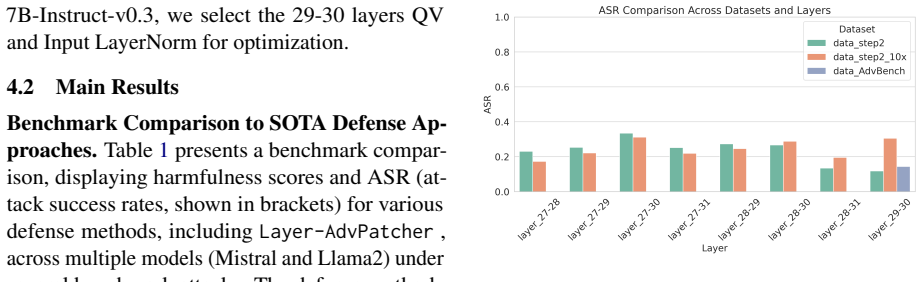
Mistral: 29-30 QV + Input LayerNorm; Llama2: 30-31
- affirmative token set T_affirm =
['absolute', 'certain', 'definite', 'glad', 'course', 'sure', 'yes', 'happy', 'delight', 'please']
assumptions (3)
- domain assumption Affirmative-token probability at a hidden layer (Eq. 3) identifies the layers responsible for jailbreak vulnerability.
- domain assumption Unlearning on the self-generated adversarial dataset transfers to unseen jailbreak prompts.
- domain assumption KL regularization to non-harmful data preserves general utility after layer editing.
Cite this review
Pith. "Pith review of Layer-Level Self-Exposure and Patch: Affirmative Token Mitigation for Jailbreak Attack Defense." pith.science (2026). https://pith.science/paper/L7D77QV4
@misc{pith2026250102629,
  author       = {Pith},
  title        = {Pith review of: Layer-Level Self-Exposure and Patch: Affirmative Token Mitigation for Jailbreak Attack Defense},
  year         = {2026},
  howpublished = {\url{https://pith.science/paper/L7D77QV4}},
  note         = {Machine review of arXiv:2501.02629}
}
read the original abstract
As large language models (LLMs) are increasingly deployed in diverse applications, including chatbot assistants and code generation, aligning their behavior with safety and ethical standards has become paramount. However, jailbreak attacks, which exploit vulnerabilities to elicit unintended or harmful outputs, threaten LLMs' safety significantly. In this paper, we introduce Layer-AdvPatcher, a novel methodology designed to defend against jailbreak attacks by utilizing an unlearning strategy to patch specific layers within LLMs through self-augmented datasets. Our insight is that certain layer(s), tend to produce affirmative tokens when faced with harmful prompts. By identifying these layers and adversarially exposing them to generate more harmful data, one can understand their inherent and diverse vulnerabilities to attacks. With these exposures, we then "unlearn" these issues, reducing the impact of affirmative tokens and hence minimizing jailbreak risks while keeping the model's responses to safe queries intact. We conduct extensive experiments on two models, four benchmark datasets, and multiple state-of-the-art jailbreak attacks to demonstrate the efficacy of our approach. Results indicate that our framework reduces the harmfulness and attack success rate of jailbreak attacks without compromising utility for benign queries compared to recent defense methods. Our code is publicly available at: https://github.com/oyy2000/LayerAdvPatcher
Figures


Figures from the paper (1 more)

Forward citations
Cited by 1 Pith paper
-
SafeLLM: Unlearning Harmful Outputs from Large Language Models against Jailbreak Attacks
SafeLLM detects unsafe outputs, traces them to specific feedforward-network components, and applies constrained optimization to unlearn harmful generation while preserving general capability.
Reference graph
Works this paper leans on
-
[1]
Josh Achiam, Steven Adler, Sandhini Agarwal, Lama Ahmad, Ilge Akkaya, Florencia Leoni Aleman, Diogo Almeida, Janko Altenschmidt, Sam Altman, Shyamal Anadkat, et al. 2023. Gpt-4 technical report. arXiv preprint arXiv:2303.08774
arXiv 2023
-
[2]
Alex Albert. 2023. Jailbreak chat. https://www.jailbreakchat.com. Accessed: 2024-03-01
2023
-
[3]
Gabriel Alon and Michael Kamfonas. 2023. Detecting language model attacks with perplexity. arXiv preprint arXiv:2308.14132
arXiv 2023
-
[4]
Yuntao Bai, Andy Jones, Kamal Ndousse, Amanda Askell, Anna Chen, Nova DasSarma, Dawn Drain, Stanislav Fort, Deep Ganguli, Tom Henighan, et al. 2022. Training a helpful and harmless assistant with reinforcement learning from human feedback. arXiv preprint arXiv:2204.05862
arXiv 2022
-
[7]
Wei-Lin Chiang, Zhuohan Li, Zi Lin, Ying Sheng, Zhanghao Wu, Hao Zhang, Lianmin Zheng, Siyuan Zhuang, Yonghao Zhuang, Joseph E Gonzalez, et al. 2023. Vicuna: An open-source chatbot impressing gpt-4 with 90\ See https://vicuna. lmsys. org (accessed 14 April 2023)
2023
-
[8]
Nicola De Cao, Wilker Aziz, and Ivan Titov. 2021. Editing factual knowledge in language models. arXiv preprint arXiv:2104.08164
arXiv 2021
-
[10]
Siqi Fan, Xin Jiang, Xiang Li, Xuying Meng, Peng Han, Shuo Shang, Aixin Sun, Yequan Wang, and Zhongyuan Wang. 2024. Not all layers of llms are necessary during inference. arXiv preprint arXiv:2403.02181
arXiv 2024
-
[11]
Mor Geva, Avi Caciularu, Kevin Ro Wang, and Yoav Goldberg. 2022. Transformer feed-forward layers build predictions by promoting concepts in the vocabulary space. arXiv preprint arXiv:2203.14680
arXiv 2022
Show all 84 references
-
[12]
Mor Geva, Roei Schuster, Jonathan Berant, and Omer Levy. 2020. Transformer feed-forward layers are key-value memories. arXiv preprint arXiv:2012.14913
2020 arXiv
-
[13]
Amelia Glaese, Nat McAleese, Maja Tr e bacz, John Aslanides, Vlad Firoiu, Timo Ewalds, Maribeth Rauh, Laura Weidinger, Martin Chadwick, Phoebe Thacker, et al. 2022. Improving alignment of dialogue agents via targeted human judgements. arXiv preprint arXiv:2209.14375
2022 arXiv
-
[14]
Andrey Gromov, Kushal Tirumala, Hassan Shapourian, Paolo Glorioso, and Daniel A. Roberts. 2024. https://arxiv.org/abs/2403.17887 The unreasonable ineffectiveness of the deeper layers . Preprint, arXiv:2403.17887
2024 arXiv
-
[15]
Jonathan Hayase, Ema Borevkovic, Nicholas Carlini, Florian Tram \`e r, and Milad Nasr. 2024. Query-based adversarial prompt generation. arXiv preprint arXiv:2402.12329
2024 arXiv
-
[17]
Edward J Hu, Yelong Shen, Phillip Wallis, Zeyuan Allen-Zhu, Yuanzhi Li, Shean Wang, Lu Wang, and Weizhu Chen. 2021. Lora: Low-rank adaptation of large language models. arXiv preprint arXiv:2106.09685
2021 arXiv
-
[18]
Yangsibo Huang, Samyak Gupta, Mengzhou Xia, Kai Li, and Danqi Chen. 2024. https://openreview.net/forum?id=r42tSSCHPh Catastrophic jailbreak of open-source LLM s via exploiting generation . In The Twelfth International Conference on Learning Representations
2024
-
[20]
Albert Q Jiang, Alexandre Sablayrolles, Arthur Mensch, Chris Bamford, Devendra Singh Chaplot, Diego de las Casas, Florian Bressand, Gianna Lengyel, Guillaume Lample, Lucile Saulnier, et al. 2023. Mistral 7b. arXiv preprint arXiv:2310.06825
2023 arXiv
-
[21]
Kyungjae Lee, Wookje Han, Seung-won Hwang, Hwaran Lee, Joonsuk Park, and Sang-Woo Lee. 2022. Plug-and-play adaptation for continuously-updated qa. arXiv preprint arXiv:2204.12785
2022 arXiv
-
[24]
Bill Yuchen Lin, Abhilasha Ravichander, Ximing Lu, Nouha Dziri, Melanie Sclar, Khyathi Chandu, Chandra Bhagavatula, and Yejin Choi. 2023. The unlocking spell on base llms: Rethinking alignment via in-context learning. arXiv preprint arXiv:2312.01552
2023 arXiv
-
[25]
Xiaogeng Liu, Nan Xu, Muhao Chen, and Chaowei Xiao. 2024. https://openreview.net/forum?id=7Jwpw4qKkb Generating stealthy jailbreak prompts on aligned large language models . In The Twelfth International Conference on Learning Representations
2024
-
[26]
Xinbei Ma, Tianjie Ju, Jiyang Qiu, Zhuosheng Zhang, Hai Zhao, Lifeng Liu, and Yulong Wang. 2024. Is it possible to edit large language models robustly? arXiv preprint arXiv:2402.05827
2024 arXiv
-
[27]
Xin Men, Mingyu Xu, Qingyu Zhang, Bingning Wang, Hongyu Lin, Yaojie Lu, Xianpei Han, and Weipeng Chen. 2024. Shortgpt: Layers in large language models are more redundant than you expect. arXiv preprint arXiv:2403.03853
2024 arXiv
-
[28]
Kevin Meng, David Bau, Alex Andonian, and Yonatan Belinkov. 2022. Locating and editing factual associations in gpt. Advances in Neural Information Processing Systems, 35:17359--17372
2022
-
[29]
Kevin Meng, Arnab Sen Sharma, Alex J Andonian, Yonatan Belinkov, and David Bau. 2023. https://openreview.net/forum?id=MkbcAHIYgyS Mass-editing memory in a transformer . In The Eleventh International Conference on Learning Representations
2023
-
[30]
Eric Mitchell, Charles Lin, Antoine Bosselut, Chelsea Finn, and Christopher D Manning. 2022. https://openreview.net/forum?id=0DcZxeWfOPt Fast model editing at scale . In International Conference on Learning Representations
2022
-
[31]
Zvi Mowshowitz. 2022. Jailbreaking chatgpt on release day. https://www.lesswrong.com/posts/RYcoJdvmoBbi5Nax7/jailbreaking-chatgpt-on-release-day. Accessed: 2024-04-15
2022
-
[32]
Shiwen Ni, Dingwei Chen, Chengming Li, Xiping Hu, Ruifeng Xu, and Min Yang. 2023. Forgetting before learning: Utilizing parametric arithmetic for knowledge updating in large language models. arXiv preprint arXiv:2311.08011
2023 arXiv
-
[33]
TDC 2023 Organizers. 2023. The trojan detection challenge 2023 (llm edition). https://trojandetection.ai/ [Accessed: 2023-11-28]
2023
-
[34]
Long Ouyang, Jeffrey Wu, Xu Jiang, Diogo Almeida, Carroll Wainwright, Pamela Mishkin, Chong Zhang, Sandhini Agarwal, Katarina Slama, Alex Ray, et al. 2022. Training language models to follow instructions with human feedback. Advances in neural information processing systems, 3...
2022
-
[35]
Koyena Pal, Jiuding Sun, Andrew Yuan, Byron C Wallace, and David Bau. 2023. Future lens: Anticipating subsequent tokens from a single hidden state. arXiv preprint arXiv:2311.04897
2023 arXiv
-
[36]
Vaidehi Patil, Peter Hase, and Mohit Bansal. 2023. Can sensitive information be deleted from llms? objectives for defending against extraction attacks. arXiv preprint arXiv:2309.17410
2023 arXiv
-
[37]
Judea Pearl. 2009. Causality. Cambridge university press
2009
-
[38]
Ethan Perez, Saffron Huang, Francis Song, Trevor Cai, Roman Ring, John Aslanides, Amelia Glaese, Nat McAleese, and Geoffrey Irving. 2022. Red teaming language models with language models. arXiv preprint arXiv:2202.03286
2022 arXiv
-
[39]
Alexander Robey, Eric Wong, Hamed Hassani, and George J Pappas. 2023. Smoothllm: Defending large language models against jailbreaking attacks. arXiv preprint arXiv:2310.03684
2023 arXiv
-
[43]
Yufei Wang, Wanjun Zhong, Liangyou Li, Fei Mi, Xingshan Zeng, Wenyong Huang, Lifeng Shang, Xin Jiang, and Qun Liu. 2023. Aligning large language models with human: A survey. arXiv preprint arXiv:2307.12966
2023 arXiv
-
[45]
Zeming Wei, Yifei Wang, and Yisen Wang. 2023 b . Jailbreak and guard aligned language models with only few in-context demonstrations. arXiv preprint arXiv:2310.06387
2023 arXiv
-
[46]
Xinwei Wu, Junzhuo Li, Minghui Xu, Weilong Dong, Shuangzhi Wu, Chao Bian, and Deyi Xiong. 2023. Depn: Detecting and editing privacy neurons in pretrained language models. arXiv preprint arXiv:2310.20138
2023 arXiv
-
[47]
Yueqi Xie, Jingwei Yi, Jiawei Shao, Justin Curl, Lingjuan Lyu, Qifeng Chen, Xing Xie, and Fangzhao Wu. 2023. Defending chatgpt against jailbreak attack via self-reminders. Nature Machine Intelligence, 5(12):1486--1496
2023
-
[49]
Jiahao Yu, Xingwei Lin, and Xinyu Xing. 2023. Gptfuzzer: Red teaming large language models with auto-generated jailbreak prompts. arXiv preprint arXiv:2309.10253
2023 arXiv
-
[50]
Yi Zeng, Hongpeng Lin, Jingwen Zhang, Diyi Yang, Ruoxi Jia, and Weiyan Shi. 2024. How johnny can persuade llms to jailbreak them: Rethinking persuasion to challenge ai safety by humanizing llms. arXiv preprint arXiv:2401.06373
2024 arXiv
-
[51]
Wei Zhao, Zhe Li, and Jun Sun. 2023. Causality analysis for evaluating the security of large language models. arXiv preprint arXiv:2312.07876
2023 arXiv
-
[52]
Lianmin Zheng, Wei-Lin Chiang, Ying Sheng, Siyuan Zhuang, Zhanghao Wu, Yonghao Zhuang, Zi Lin, Zhuohan Li, Dacheng Li, Eric Xing, et al. 2024. Judging llm-as-a-judge with mt-bench and chatbot arena. Advances in Neural Information Processing Systems, 36
2024
-
[53]
Chunting Zhou, Pengfei Liu, Puxin Xu, Srinivasan Iyer, Jiao Sun, Yuning Mao, Xuezhe Ma, Avia Efrat, Ping Yu, Lili Yu, et al. 2024 a . Lima: Less is more for alignment. Advances in Neural Information Processing Systems, 36
2024
-
[55]
Chen Zhu, Ankit Singh Rawat, Manzil Zaheer, Srinadh Bhojanapalli, Daliang Li, Felix Yu, and Sanjiv Kumar. 2020. Modifying memories in transformer models. arXiv preprint arXiv:2012.00363
2020 arXiv
-
[57]
Xiaotian Zou, Yongkang Chen, and Ke Li. 2024. Is the system message really important to jailbreaks in large language models? arXiv preprint arXiv:2402.14857
2024 arXiv
-
[58]
online" 'onlinestring :=
ENTRY address archivePrefix author booktitle chapter edition editor eid eprint eprinttype howpublished institution journal key month note number organization pages publisher school series title type volume year doi pubmed url lastchecked label extra.label sort.label short.list...
-
[59]
write newline
" write newline "" before.all 'output.state := FUNCTION n.dashify 't := "" t empty not t #1 #1 substring "-" = t #1 #2 substring "--" = not "--" * t #2 global.max substring 't := t #1 #1 substring "-" = "-" * t #2 global.max substring 't := while if t #1 #1 substring * t #2 gl...
-
[60]
Bochuan Cao, Yuanpu Cao, Lu Lin, and Jinghui Chen. 2024. https://arxiv.org/abs/2309.14348 Defending against alignment-breaking attacks via robustly aligned llm . Preprint, arXiv:2309.14348
2024 arXiv
-
[61]
Yinzhi Cao and Junfeng Yang. 2015. Towards making systems forget with machine unlearning. In 2015 IEEE symposium on security and privacy, pages 463--480. IEEE
2015
-
[62]
Patrick Chao, Alexander Robey, Edgar Dobriban, Hamed Hassani, George J Pappas, and Eric Wong. 2023. https://arxiv.org/abs/2310.08419 Jailbreaking black box large language models in twenty queries . ArXiv preprint, abs/2310.08419
2023 arXiv
-
[63]
Gelei Deng, Yi Liu, Yuekang Li, Kailong Wang, Ying Zhang, Zefeng Li, Haoyu Wang, Tianwei Zhang, and Yang Liu. 2023. Jailbreaker: Automated jailbreak across multiple large language model chatbots. arXiv preprint arXiv:2307.08715
2023 arXiv
-
[64]
Alec Helbling, Mansi Phute, Matthew Hull, and Duen Horng Chau. 2023. https://arxiv.org/abs/2308.07308 Llm self defense: By self examination, llms know they are being tricked . ArXiv preprint, abs/2308.07308
2023 arXiv
-
[65]
Dan Hendrycks, Collin Burns, Steven Basart, Andy Zou, Mantas Mazeika, Dawn Song, and Jacob Steinhardt. 2021. Measuring massive multitask language understanding. Proceedings of the International Conference on Learning Representations (ICLR)
2021
-
[66]
Yangsibo Huang, Samyak Gupta, Mengzhou Xia, Kai Li, and Danqi Chen. 2023. https://arxiv.org/abs/2310.06987 Catastrophic jailbreak of open-source llms via exploiting generation . Preprint, arXiv:2310.06987
2023 arXiv
-
[67]
Yue Huang, Lichao Sun, Haoran Wang, Siyuan Wu, Qihui Zhang, Yuan Li, Chujie Gao, Yixin Huang, Wenhan Lyu, Yixuan Zhang, Xiner Li, Hanchi Sun, Zhengliang Liu, Yixin Liu, Yijue Wang, Zhikun Zhang, Bertie Vidgen, Bhavya Kailkhura, Caiming Xiong, Chaowei Xiao, Chunyuan Li, Eric P....
2024
-
[68]
Neel Jain, Avi Schwarzschild, Yuxin Wen, Gowthami Somepalli, John Kirchenbauer, Ping-yeh Chiang, Micah Goldblum, Aniruddha Saha, Jonas Geiping, and Tom Goldstein. 2023. https://arxiv.org/abs/2309.00614 Baseline defenses for adversarial attacks against aligned language models ....
2023 arXiv
-
[69]
Ziwei Ji, Nayeon Lee, Rita Frieske, Tiezheng Yu, Dan Su, Yan Xu, Etsuko Ishii, Ye Jin Bang, Andrea Madotto, and Pascale Fung. 2023. Survey of hallucination in natural language generation. ACM Computing Surveys, 55(12):1--38
2023
-
[70]
Aounon Kumar, Chirag Agarwal, Suraj Srinivas, Aaron Jiaxun Li, Soheil Feizi, and Himabindu Lakkaraju. 2024. https://arxiv.org/abs/2309.02705 Certifying llm safety against adversarial prompting . Preprint, arXiv:2309.02705
2024 arXiv
-
[72]
Xuan Li, Zhanke Zhou, Jianing Zhu, Jiangchao Yao, Tongliang Liu, and Bo Han. 2024. https://arxiv.org/abs/2311.03191 Deepinception: Hypnotize large language model to be jailbreaker . Preprint, arXiv:2311.03191
2024 arXiv
-
[73]
Yuhui Li, Fangyun Wei, Jinjing Zhao, Chao Zhang, and Hongyang Zhang. 2023 b . https://arxiv.org/abs/2309.07124 Rain: Your language models can align themselves without finetuning . Preprint, arXiv:2309.07124
2023 arXiv
-
[74]
Bill Yuchen Lin, Abhilasha Ravichander, Ximing Lu, Nouha Dziri, Melanie Sclar, Khyathi Chandu, Chandra Bhagavatula, and Yejin Choi. 2023. The unlocking spell on base llms: Rethinking alignment via in-context learning. ArXiv preprint
2023
-
[75]
Bo Liu, Qiang Liu, and Peter Stone. 2022. Continual learning and private unlearning. arXiv preprint arXiv:2203.12817
2022 arXiv
-
[76]
Kang Liu, Brendan Dolan-Gavitt, and Siddharth Garg. 2018. Fine-pruning: Defending against backdooring attacks on deep neural networks. In International symposium on research in attacks, intrusions, and defenses, pages 273--294. Springer
2018
-
[77]
Xiaogeng Liu, Nan Xu, Muhao Chen, and Chaowei Xiao. 2023. https://arxiv.org/abs/2310.04451 Autodan: Generating stealthy jailbreak prompts on aligned large language models . ArXiv preprint, abs/2310.04451
2023 arXiv
-
[78]
Xiaogeng Liu, Nan Xu, Muhao Chen, and Chaowei Xiao. 2024. https://openreview.net/forum?id=7Jwpw4qKkb Autodan: Generating stealthy jailbreak prompts on aligned large language models . In The Twelfth International Conference on Learning Representations
2024
-
[79]
Matthew Pisano, Peter Ly, Abraham Sanders, Bingsheng Yao, Dakuo Wang, Tomek Strzalkowski, and Mei Si. 2024. https://arxiv.org/abs/2312.00029 Bergeron: Combating adversarial attacks through a conscience-based alignment framework . Preprint, arXiv:2312.00029
2024 arXiv
-
[80]
Xiangyu Qi, Yi Zeng, Tinghao Xie, Pin-Yu Chen, Ruoxi Jia, Prateek Mittal, and Peter Henderson. 2024. https://openreview.net/forum?id=hTEGyKf0dZ Fine-tuning aligned language models compromises safety, even when users do not intend to! In The Twelfth International Conference on ...
2024
-
[81]
Ayush Sekhari, Jayadev Acharya, Gautam Kamath, and Ananda Theertha Suresh. 2021. Remember what you want to forget: Algorithms for machine unlearning. Advances in Neural Information Processing Systems, 34:18075--18086
2021
-
[82]
do anything now
Xinyue Shen, Zeyuan Chen, Michael Backes, Yun Shen, and Yang Zhang. 2024. https://arxiv.org/abs/2308.03825 "do anything now": Characterizing and evaluating in-the-wild jailbreak prompts on large language models . Preprint, arXiv:2308.03825
2024 arXiv
-
[83]
Ayush K Tarun, Vikram S Chundawat, Murari Mandal, and Mohan Kankanhalli. 2023. Fast yet effective machine unlearning. IEEE Transactions on Neural Networks and Learning Systems
2023
-
[84]
Hugo Touvron, Louis Martin, Kevin Stone, Peter Albert, Amjad Almahairi, Yasmine Babaei, Nikolay Bashlykov, Soumya Batra, Prajjwal Bhargava, Shruti Bhosale, et al. 2023. https://arxiv.org/abs/2307.09288 Llama 2: Open foundation and fine-tuned chat models . ArXiv preprint, abs/2...
2023 arXiv
-
[85]
Mengru Wang, Ningyu Zhang, Ziwen Xu, Zekun Xi, Shumin Dengand Yunzhi Yao, Qishen Zhang, Linyi Yang, Jindong Wang, and Huajun Chen. 2024 a . https://arxiv.org/abs/2403.14472 Detoxifying large language models via knowledge editing . Preprint, arXiv:2403.14472
2024 arXiv
-
[86]
Zhilong Wang, Haizhou Wang, Nanqing Luo, Lan Zhang, Xiaoyan Sun, Yebo Cao, and Peng Liu. 2024 b . https://arxiv.org/abs/2408.11182 Hide your malicious goal into benign narratives: Jailbreak large language models through neural carrier articles . Preprint, arXiv:2408.11182
2024 arXiv
-
[87]
Alexander Wei, Nika Haghtalab, and Jacob Steinhardt. 2023. https://arxiv.org/abs/2307.02483 Jailbroken: How does LLM safety training fail? ArXiv preprint, abs/2307.02483
2023 arXiv
-
[88]
Yuanwei Wu, Xiang Li, Yixin Liu, Pan Zhou, and Lichao Sun. 2024. https://arxiv.org/abs/2311.09127 Jailbreaking gpt-4v via self-adversarial attacks with system prompts . Preprint, arXiv:2311.09127
2024 arXiv
-
[89]
Zhangchen Xu, Fengqing Jiang, Luyao Niu, Jinyuan Jia, Bill Yuchen Lin, and Radha Poovendran. 2024 a . Safedecoding: Defending against jailbreak attacks via safety-aware decoding. arXiv preprint arXiv:2402.08983
2024 arXiv
-
[90]
Zihao Xu, Yi Liu, Gelei Deng, Yuekang Li, and Stjepan Picek. 2024 b . https://arxiv.org/abs/2402.13457 A comprehensive study of jailbreak attack versus defense for large language models . Preprint, arXiv:2402.13457
2024 arXiv
-
[91]
Jia-Yu Yao, Kun-Peng Ning, Zhenhui Liu, Munan Ning, and Li Yuan. 2024 a . https://openreview.net/forum?id=Rh1aThKliu LLM lies: Hallucinations are not bugs, but features as adversarial examples
2024
-
[92]
Yifan Yao, Jinhao Duan, Kaidi Xu, Yuanfang Cai, Zhibo Sun, and Yue Zhang. 2024 b . A survey on large language model (llm) security and privacy: The good, the bad, and the ugly. High-Confidence Computing, page 100211
2024
-
[93]
Yuanshun Yao, Xiaojun Xu, and Yang Liu. 2024 c . https://arxiv.org/abs/2310.10683 Large language model unlearning . Preprint, arXiv:2310.10683
2024 arXiv
-
[94]
Sibo Yi, Yule Liu, Zhen Sun, Tianshuo Cong, Xinlei He, Jiaxing Song, Ke Xu, and Qi Li. 2024. https://arxiv.org/abs/2407.04295 Jailbreak attacks and defenses against large language models: A survey . Preprint, arXiv:2407.04295
2024 arXiv
-
[95]
Zhexin Zhang, Junxiao Yang, Pei Ke, Fei Mi, Hongning Wang, and Minlie Huang. 2024. https://arxiv.org/abs/2311.09096 Defending large language models against jailbreaking attacks through goal prioritization . In ACL
2024 arXiv
-
[96]
Wei Zhao, Zhe Li, Yige Li, Ye Zhang, and Jun Sun. 2024 a . https://arxiv.org/abs/2405.18166 Defending large language models against jailbreak attacks via layer-specific editing . Preprint, arXiv:2405.18166
2024 arXiv
-
[97]
Xuandong Zhao, Xianjun Yang, Tianyu Pang, Chao Du, Lei Li, Yu-Xiang Wang, and William Yang Wang. 2024 b . Weak-to-strong jailbreaking on large language models. arXiv preprint arXiv:2401.17256
2024 arXiv
-
[98]
Weikang Zhou, Xiao Wang, Limao Xiong, Han Xia, Yingshuang Gu, Mingxu Chai, Fukang Zhu, Caishuang Huang, Shihan Dou, Zhiheng Xi, et al. 2024. Easyjailbreak: A unified framework for jailbreaking large language models. arXiv preprint arXiv:2403.12171
2024 arXiv
-
[99]
Andy Zou, Zifan Wang, J Zico Kolter, and Matt Fredrikson. 2023. https://arxiv.org/abs/2307.15043 Universal and transferable adversarial attacks on aligned language models . ArXiv preprint, abs/2307.15043
2023 arXiv
Reviewed August 10, 2026 · model on record in the stance chip above.
Discussion (0). Continue with ORCID to comment.