REVIEW 1 major objections 5 minor 63 references
LAMS: LLM-Driven Automatic Mode Switching for Assistive Teleoperation
T0 review · 1 major / 5 minor · reviewed 2026-08-10 · deepseek-v4-flash
Pith's one-line read An LLM can decide which robot action each joystick movement should trigger, so teleoperators stop manually toggling modes.
desk verdict A useful, well-constructed LLM teleoperation aid; the main quantitative headline vs. Grouped Mapping is weakened by a counting artifact, but the core improvement-over-time result holds. read the letter →
The pith
A machine-rendered reading of the paper's core claim, the machinery that carries it, and where it could break.
The reading
What carries the argument
The central object is the mode mapping $M_t$, a set of four joystick-direction-to-action assignments. LAMS constructs it by (1) grounding the task state into a natural-language prompt $l_t = [l_{\text{pre}}, l_{\text{rule}}, l_{\text{pose}}]$; (2) prompting an LLM to score candidate actions in each of four groups (for example, 'move forward', 'move up', 'pitch up', or 'open gripper') using the probability distribution over next tokens $p(w_k \mid w_{<k})$; and (3) choosing the top action unless it was just executed and the runner-up exceeds a threshold of 0.2, in which case it picks the runner-up. User corrections are converted into examples, summarized by a separate LLM into a rule list $R$, and shuffled into $l_{\text{rule}}$ on subsequent switch calls. The load-bearing mechanism is the LLM's ability to translate a natural-language scene description into sensible joystick mappings without training.
What would settle it
Run LAMS on a task that requires clearly separating roll from yaw, such as rotating a key in a lock, where the paper already reports only 40% accuracy for yaw and 50% for roll; if manual switches for rotational actions do not decrease across trials and remain well above translation-related switches, the claim that LAMS improves over time is false.
Extended reading notes
Core claim
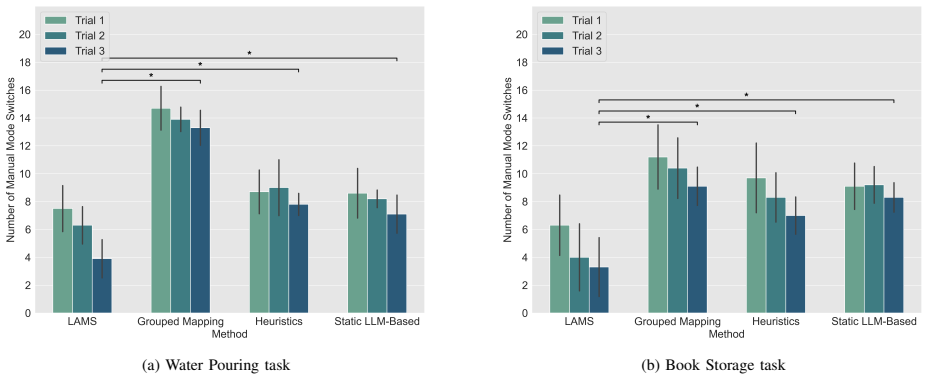
The paper claims that an LLM with no task-specific demonstrations can perform automatic mode switching for teleoperated manipulation, and that it improves with use. Concretely, LAMS predicts the mapping between each joystick direction and a robot action direction (move, rotate, or gripper) by converting the robot's and objects' poses into natural language and reading the LLM's next-token probabilities for candidate actions. When a user manually corrects a mapping, the correction is stored as an example, summarized into rules by a second LLM, and injected into future prompts. In three trials of two long-horizon tasks, LAMS required fewer manual switches than grouped mapping, hand-engineered heuristic switching, and a static LLM baseline; by trial 3 the reductions were statistically significant (corrected $p<0.05$), and a generalized linear mixed model found a significant condition-trial interaction versus the static baseline (coefficient $-1.075$, $p=0.003$). The authors also report that LAMS improved even within the first trial, mainly by avoiding spurious 'open gripper' and 'close gripper' mappings.
Load-bearing premise
The assumption that carries the system is that a short natural-language description of where the robot and the objects are gives the LLM enough spatial information to pick the right joystick mapping; the paper itself reports that this fails for roll versus yaw rotations.
Editorial extensions
If this is right
- Users of low-degree-of-freedom assistive devices could complete multi-stage daily tasks without memorizing mode-switch sequences.
- The framework transfers to new tasks with no demonstrations; only the task instruction and live pose text change.
- A static LLM baseline is measurably worse, so the per-task rule accumulation is what drives the observed improvement.
- Summarizing user corrections into rules is more effective than feeding raw examples, which degrade performance as the list grows.
- Mode switching based on token probabilities, with the second-choice fallback, beats always taking the top prediction.
Reading between the lines
- The same probability-distribution trick could generalize to other discrete control choices in teleoperation, such as selecting which object to manipulate when several are in view.
- Rules learned on one task may transfer to other tasks that share subtasks, such as reaching and aligning before a grasp; the paper leaves this as future work, but the example rules in Appendix F suggest it is plausible.
- The 0.2 threshold on the runner-up probability is a fixed hedging rule; a task with stronger action ambiguity would likely need it tuned, and a controlled sweep would be a quick test.
- Because LAMS improves during the first trial, a deployment could treat the first minutes of use as calibration; one testable implication is that the ordering of subtasks affects how quickly rules accumulate.
Editorial analysis
A structured set of objections, weighed in public.
Referee Report
Summary. This paper proposes LAMS, an LLM-driven automatic mode-switching system for teleoperating a high-DoF robot arm with a low-DoF joystick. LAMS converts the robot and object state into natural-language prompts, uses GPT-4o token probabilities to select joystick-to-robot-action mappings, and incrementally updates a rule prompt from user corrections. The authors validate LAMS through an ablation study and a 10-participant user study on water-pouring and book-storage tasks, reporting fewer manual mode switches, user preference, and improvement over time relative to a static LLM-based method.
Significance. The incremental-improvement design is a genuine contribution: LAMS requires no task-specific demonstrations or hand-engineered heuristics, and the user study's comparison against a static LLM baseline is well controlled (same D-pad switching semantics, counterbalanced order, and a significant GLMM interaction). The paper is also commendably transparent about its limitations, including the text-grounding challenges and ambiguous-object scenarios. However, the headline reduction against Grouped Mapping is undermined by a metric-comparability problem, and the H1 claim should be revised or re-analyzed with a normalized unit.
major comments (1)
- [Section IV-C and Appendix A] The primary metric is not unit-comparable across conditions. In Grouped Mapping, each X-press cycles the entire predefined group and changes all four joystick mappings simultaneously, yet it is counted as one 'manual mode switch'; in LAMS, Heuristic, and Static LLM, each D-pad press changes a single mapping and is also counted as one switch. Consequently, the reported 70.7% (water) and 63.7% (book) reductions in trial 3 against Grouped Mapping conflate correction effort with the size of the change unit. Because Section IV-C explicitly declines to analyze task completion time or end-effector travel, the H1 claim that LAMS 'reduces manual mode switches' relative to Grouped Mapping is not established by the current metric. I recommend re-analyzing the data with a normalized unit (e.g., number of individual joystick-direction remappings) or reporting a secondary time/efficiency metric, and adjusting the headline claim accordingly.
minor comments (5)
- [Appendix F.2] The rule list contains two rules both numbered '16'; the second should be renumbered to 17.
- [Appendix F.1/F.5] The prompt listings use both 'theta x' and 'theta_x' for the same orientation quantity; please standardize the notation for clarity and reproducibility.
- [Section IV-C] The GLMM interaction (coefficient = -1.075, p = 0.003) is reported without specifying the distribution family, link function, or random-effects structure; please add these details so the analysis can be verified.
- [Section V] The rotational prediction accuracies (80%, 40%, 50%) are reported with denominators defined only in the surrounding text; please either pre-specify this metric or clearly label it as a post-hoc descriptive analysis.
- [Section IV-B] The ablation study uses five runs by one researcher and no significance tests; the text should explicitly label these results as preliminary rather than implying the same evidentiary strength as the user study.
Circularity Check
No significant circularity: LAMS is validated by an empirical user study with independent baselines; the primary metric-comparability concern is a validity issue, not a circularity.
full rationale
LAMS is an empirical systems paper whose central claims are established by a user study comparing manual mode-switch counts and user preferences across four conditions. No predicted quantity is constructed by definition from fitted constants: the 0.2 probability threshold and the 5 cm / 15 degree discretization are hand-set design parameters evaluated in ablation, not fit to the evaluation data. The incremental-improvement loop does use user corrections both as training examples and as the evaluation metric, but this is the intended learning mechanism rather than a circularity, because the metric is an external behavioral count and the Static LLM baseline controls for practice effects; the improvement claim could have failed if the rule-generation LLM produced unhelpful rules. Self-citations appear in the paper, but they support background claims about common mode-switching interfaces and prior assistive-teleoperation systems, and none carries the load of the main comparison. The notable threat identified by a skeptical reading is that Grouped Mapping counts one X-button press that changes all four joystick mappings as one manual switch, whereas LAMS counts one D-pad correction that changes a single mapping as one switch; this is a unit-comparability and measurement-validity concern, not a circularity, since no equation or fitted parameter reduces the claimed reduction to its own input. Appendix E's acknowledged limitation about text grounding in complex environments and Appendix C's admission that shadow-mode analysis is approximate are honest scope restrictions, not circular arguments. Therefore no circular steps are present.
Assumptions & free parameters
free parameters (3)
- second-action probability threshold =
0.2
- pose discretization granularity =
5 cm for position, 15 degrees for orientation
- mode-switch pause threshold =
1.5 seconds
assumptions (4)
- domain assumption Textual pose descriptions are a sufficient state representation for mode selection
- domain assumption User manual corrections are correct training signals
- domain assumption GPT-4o's token probability distribution is a reliable proxy for action preference
- domain assumption LLM-generated rules from examples improve future predictions within a task
Cite this review
Pith. "Pith review of LAMS: LLM-Driven Automatic Mode Switching for Assistive Teleoperation." pith.science (2026). https://pith.science/paper/W2AGFHMT
@misc{pith2026250108558,
  author       = {Pith},
  title        = {Pith review of: LAMS: LLM-Driven Automatic Mode Switching for Assistive Teleoperation},
  year         = {2026},
  howpublished = {\url{https://pith.science/paper/W2AGFHMT}},
  note         = {Machine review of arXiv:2501.08558}
}
read the original abstract
Teleoperating high degrees-of-freedom (DoF) robotic manipulators via low-DoF controllers like joysticks often requires frequent switching between control modes, where each mode maps controller movements to specific robot actions. Manually performing this frequent switching can make teleoperation cumbersome and inefficient. On the other hand, existing automatic mode-switching solutions, such as heuristic-based or learning-based methods, are often task-specific and lack generalizability. In this paper, we introduce LLM-Driven Automatic Mode Switching (LAMS), a novel approach that leverages Large Language Models (LLMs) to automatically switch control modes based on task context. Unlike existing methods, LAMS requires no prior task demonstrations and incrementally improves by integrating user-generated mode-switching examples. We validate LAMS through an ablation study and a user study with 10 participants on complex, long-horizon tasks, demonstrating that LAMS effectively reduces manual mode switches, is preferred over alternative methods, and improves performance over time. The project website with supplementary materials is at https://lams-assistance.github.io/.
Figures


Figures from the paper (3 more)


Reference graph
Works this paper leans on
-
[1]
M. Mohammadi, H. Knoche, M. Gaihede, B. Bentsen, and L. N. A. Struijk, “A high-resolution tongue-based joystick to enable robot control for individuals with severe disabilities,” in 2019 IEEE 16th International Conference on Rehabilitation Robotics (ICORR) . IEEE, 2019, pp. 1043–1048
work page 2019
-
[2]
M. Mohammadi, H. Knoche, and L. N. A. Struijk, “Continuous tongue robot mapping for paralyzed individuals improves the functional per- formance of tongue-based robotic assistance,” IEEE transactions on biomedical engineering, vol. 68, no. 8, pp. 2552–2562, 2021
work page 2021
-
[3]
Independence in the home: A wearable interface for a person with quadriplegia to teleoperate a mobile manipu- lator,
A. Padmanabha, J. Gupta, C. Chen, J. Yang, V . Nguyen, D. J. Weber, C. Majidi, and Z. Erickson, “Independence in the home: A wearable interface for a person with quadriplegia to teleoperate a mobile manipu- lator,” in Proceedings of the 2024 ACM/IEEE International Conference on Human-Robot Interaction , 2024, pp. 542–551
2024
-
[4]
Hat: Head-worn assistive teleoperation of mobile manipulators,
A. Padmanabha, Q. Wang, D. Han, J. Diyora, K. Kacker, H. Khalid, L.-J. Chen, C. Majidi, and Z. Erickson, “Hat: Head-worn assistive teleoperation of mobile manipulators,” in 2023 IEEE International Conference on Robotics and Automation (ICRA) . IEEE, 2023, pp. 12 542–12 548
2023
-
[5]
An image based eye controlled assistive system for paralytic patients,
M. Alva, N. Castellino, R. Deshpande, K. Sonawane, and M. Lopes, “An image based eye controlled assistive system for paralytic patients,” in 2017 2nd International Conference on Communication Systems, Computing and IT Applications (CSCITA) . IEEE, 2017, pp. 178–183
work page 2017
-
[6]
C. A. Chin, A. Barreto, J. G. Cremades, and M. Adjouadi, “Integrated electromyogram and eye-gaze tracking cursor control system for com- puter users with motor disabilities,” 2008
work page 2008
-
[7]
I. Mougharbel, R. El-Hajj, H. Ghamlouch, and E. Monacelli, “Compar- ative study on different adaptation approaches concerning a sip and puff controller for a powered wheelchair,” in 2013 Science and Information Conference. IEEE, 2013, pp. 597–603
work page 2013
-
[8]
Sip- and-puff autonomous wheelchair for individuals with severe disabilities,
H. S. Grewal, A. Matthews, R. Tea, V . Contractor, and K. George, “Sip- and-puff autonomous wheelchair for individuals with severe disabilities,” in 2018 9th IEEE Annual Ubiquitous Computing, Electronics & Mobile Communication Conference (UEMCON) . IEEE, 2018, pp. 705–710
work page 2018
Show all 63 references
-
[9]
Assistive teleopera- tion of robot arms via automatic time-optimal mode switching,
L. V . Herlant, R. M. Holladay, and S. S. Srinivasa, “Assistive teleopera- tion of robot arms via automatic time-optimal mode switching,” in 2016 11th ACM/IEEE International Conference on Human-Robot Interaction (HRI). IEEE, 2016, pp. 35–42
2016
-
[10]
High-density elec- tromyography for effective gesture-based control of physically assistive mobile manipulators,
J. Yang, K. Shibata, D. Weber, and Z. Erickson, “High-density elec- tromyography for effective gesture-based control of physically assistive mobile manipulators,” arXiv preprint arXiv:2312.07745 , 2023
2023 arXiv
-
[11]
The cost of a voluntary task switch,
C. M. Arrington and G. D. Logan, “The cost of a voluntary task switch,” Psychological science, vol. 15, no. 9, pp. 610–615, 2004
2004
-
[12]
Mode switch assistance to maximize human intent disambiguation
D. E. Gopinath and B. D. Argall, “Mode switch assistance to maximize human intent disambiguation.” inRobotics: Science and Systems, vol. 13, 2017, p. 4
2017
-
[13]
Shared control templates for assistive robotics,
G. Quere, A. Hagengruber, M. Iskandar, S. Bustamante, D. Leidner, F. Stulp, and J. V ogel, “Shared control templates for assistive robotics,” in 2020 IEEE international conference on robotics and automation (ICRA). IEEE, 2020, pp. 1956–1962
2020
-
[14]
Dynamic switching and real-time machine learning for im- proved human control of assistive biomedical robots,
P. M. Pilarski, M. R. Dawson, T. Degris, J. P. Carey, and R. S. Sutton, “Dynamic switching and real-time machine learning for im- proved human control of assistive biomedical robots,” in 2012 4th IEEE RAS & EMBS International Conference on Biomedical Robotics and Biomechatroni...
2012
-
[15]
Intelli- gent mode-switching framework for teleoperation,
B. Kizilkaya, C. She, G. Zhao, and M. A. Imran, “Intelli- gent mode-switching framework for teleoperation,” arXiv preprint arXiv:2402.06047, 2024
2024 arXiv
-
[16]
Automating code review activities by large-scale pre-training,
Z. Li, S. Lu, D. Guo, N. Duan, S. Jannu, G. Jenks, D. Majumder, J. Green, A. Svyatkovskiy, S. Fu et al. , “Automating code review activities by large-scale pre-training,” in Proceedings of the 30th ACM Joint European Software Engineering Conference and Symposium on the Foundat...
2022
-
[17]
Cct5: A code- change-oriented pre-trained model,
B. Lin, S. Wang, Z. Liu, Y . Liu, X. Xia, and X. Mao, “Cct5: A code- change-oriented pre-trained model,” in Proceedings of the 31st ACM Joint European Software Engineering Conference and Symposium on the Foundations of Software Engineering , 2023, pp. 1509–1521
2023
-
[18]
Llama-reviewer: Advancing code review automation with large language models through parameter- efficient fine-tuning,
J. Lu, L. Yu, X. Li, L. Yang, and C. Zuo, “Llama-reviewer: Advancing code review automation with large language models through parameter- efficient fine-tuning,” in 2023 IEEE 34th International Symposium on Software Reliability Engineering (ISSRE) . IEEE, 2023, pp. 647–658
2023
-
[19]
Coditt5: Pretraining for source code and natural language editing,
J. Zhang, S. Panthaplackel, P. Nie, J. J. Li, and M. Gligoric, “Coditt5: Pretraining for source code and natural language editing,” inProceedings of the 37th IEEE/ACM International Conference on Automated Software Engineering, 2022, pp. 1–12
2022
-
[20]
Ccbert: Self- supervised code change representation learning,
X. Zhou, B. Xu, D. Han, Z. Yang, J. He, and D. Lo, “Ccbert: Self- supervised code change representation learning,” in 2023 IEEE Inter- national Conference on Software Maintenance and Evolution (ICSME) . IEEE, 2023, pp. 182–193
2023
-
[21]
Toward grounded social reasoning,
M. Kwon, H. Hu, V . Myers, S. Karamcheti, A. Dragan, and D. Sadigh, “Toward grounded social reasoning,” arXiv preprint arXiv:2306.08651 , 2023
2023 arXiv
-
[22]
Learning latent actions to control assistive robots,
D. P. Losey, H. J. Jeon, M. Li, K. Srinivasan, A. Mandlekar, A. Garg, J. Bohg, and D. Sadigh, “Learning latent actions to control assistive robots,” Autonomous robots, vol. 46, no. 1, pp. 115–147, 2022
2022
-
[23]
Shared autonomy with learned latent actions,
H. J. Jeon, D. P. Losey, and D. Sadigh, “Shared autonomy with learned latent actions,” arXiv preprint arXiv:2005.03210 , 2020
2005 arXiv
-
[24]
Lila: Language- informed latent actions,
S. Karamcheti, M. Srivastava, P. Liang, and D. Sadigh, “Lila: Language- informed latent actions,” in Conference on Robot Learning . PMLR, 2022, pp. 1379–1390
2022
-
[25]
Controlling assistive robots with learned latent actions,
D. P. Losey, K. Srinivasan, A. Mandlekar, A. Garg, and D. Sadigh, “Controlling assistive robots with learned latent actions,” in 2020 IEEE International Conference on Robotics and Automation (ICRA) . IEEE, 2020, pp. 378–384
2020
-
[26]
Learning latent actions without human demonstrations,
S. A. Mehta, S. Parekh, and D. P. Losey, “Learning latent actions without human demonstrations,” in 2022 International Conference on Robotics and Automation (ICRA) . IEEE, 2022, pp. 7437–7443
2022
-
[27]
Inner monologue: Embod- ied reasoning through planning with language models,
W. Huang, F. Xia, T. Xiao, H. Chan, J. Liang, P. Florence, A. Zeng, J. Tompson, I. Mordatch, Y . Chebotaret al., “Inner monologue: Embod- ied reasoning through planning with language models,” arXiv preprint arXiv:2207.05608, 2022
2022 arXiv
-
[28]
Socratic models: Composing zero-shot multimodal reasoning with language,
A. Zeng, M. Attarian, B. Ichter, K. Choromanski, A. Wong, S. Welker, F. Tombari, A. Purohit, M. Ryoo, V . Sindhwani et al. , “Socratic models: Composing zero-shot multimodal reasoning with language,” arXiv preprint arXiv:2204.00598 , 2022
2022 arXiv
-
[29]
Llm-planner: Few-shot grounded planning for embodied agents with large language models,
C. H. Song, J. Wu, C. Washington, B. M. Sadler, W.-L. Chao, and Y . Su, “Llm-planner: Few-shot grounded planning for embodied agents with large language models,” in Proceedings of the IEEE/CVF International Conference on Computer Vision , 2023, pp. 2998–3009
2023
-
[30]
Grounded decoding: Guiding text generation with grounded models for robot control,
W. Huang, F. Xia, D. Shah, D. Driess, A. Zeng, Y . Lu, P. Florence, I. Mordatch, S. Levine, K. Hausman et al. , “Grounded decoding: Guiding text generation with grounded models for robot control,” arXiv preprint arXiv:2303.00855, 2023
2023 arXiv
-
[31]
Code as policies: Language model programs for embodied control,
J. Liang, W. Huang, F. Xia, P. Xu, K. Hausman, B. Ichter, P. Florence, and A. Zeng, “Code as policies: Language model programs for embodied control,” in 2023 IEEE International Conference on Robotics and Automation (ICRA). IEEE, 2023, pp. 9493–9500
2023
-
[32]
Tidybot: Personalized robot assis- tance with large language models,
J. Wu, R. Antonova, A. Kan, M. Lepert, A. Zeng, S. Song, J. Bohg, S. Rusinkiewicz, and T. Funkhouser, “Tidybot: Personalized robot assis- tance with large language models,” Autonomous Robots, vol. 47, no. 8, pp. 1087–1102, 2023
2023
-
[33]
Progprompt: Generating situated robot task plans using large language models,
I. Singh, V . Blukis, A. Mousavian, A. Goyal, D. Xu, J. Tremblay, D. Fox, J. Thomason, and A. Garg, “Progprompt: Generating situated robot task plans using large language models,” in 2023 IEEE International Conference on Robotics and Automation (ICRA) . IEEE, 2023, pp. 11 523–11 530
2023
-
[34]
V oyager: An open-ended embodied agent with large language models,
G. Wang, Y . Xie, Y . Jiang, A. Mandlekar, C. Xiao, Y . Zhu, L. Fan, and A. Anandkumar, “V oyager: An open-ended embodied agent with large language models,” arXiv preprint arXiv:2305.16291 , 2023
2023 arXiv
-
[35]
Large language models as general pattern machines,
S. Mirchandani, F. Xia, P. Florence, B. Ichter, D. Driess, M. G. Arenas, K. Rao, D. Sadigh, and A. Zeng, “Large language models as general pattern machines,” arXiv preprint arXiv:2307.04721 , 2023
2023 arXiv
-
[36]
Saytap: Lan- guage to quadrupedal locomotion,
Y . Tang, W. Yu, J. Tan, H. Zen, A. Faust, and T. Harada, “Saytap: Lan- guage to quadrupedal locomotion,” arXiv preprint arXiv:2306.07580 , 2023
2023 arXiv
-
[37]
Generative expressive robot behaviors using large language models,
K. Mahadevan, J. Chien, N. Brown, Z. Xu, C. Parada, F. Xia, A. Zeng, L. Takayama, and D. Sadigh, “Generative expressive robot behaviors using large language models,” in Proceedings of the 2024 ACM/IEEE International Conference on Human-Robot Interaction , 2024, pp. 482– 491
2024
-
[38]
V oicepilot: Harnessing llms as speech interfaces for physically assistive robots,
A. Padmanabha, J. Yuan, J. Gupta, Z. Karachiwalla, C. Majidi, H. Ad- moni, and Z. Erickson, “V oicepilot: Harnessing llms as speech interfaces for physically assistive robots,” arXiv preprint arXiv:2404.04066, 2024
2024 arXiv
-
[39]
Chatgpt-enabled davinci surgical robot prototype: advance- ments and limitations,
A. Pandya, “Chatgpt-enabled davinci surgical robot prototype: advance- ments and limitations,” Robotics, vol. 12, no. 4, p. 97, 2023
2023
-
[40]
Harmonic: A multimodal dataset of assistive human–robot collaboration,
B. A. Newman, R. M. Aronson, S. S. Srinivasa, K. Kitani, and H. Admoni, “Harmonic: A multimodal dataset of assistive human–robot collaboration,” The International Journal of Robotics Research , vol. 41, no. 1, pp. 3–11, 2022
2022
-
[41]
Usability analysis of 3d rotation techniques,
K. Hinckley, J. Tullio, R. Pausch, D. Proffitt, and N. Kassell, “Usability analysis of 3d rotation techniques,” in Proceedings of the 10th annual ACM symposium on User interface software and technology , 1997, pp. 1–10
1997
-
[42]
3d-llm: Injecting the 3d world into large language models,
Y . Hong, H. Zhen, P. Chen, S. Zheng, Y . Du, Z. Chen, and C. Gan, “3d-llm: Injecting the 3d world into large language models,” Advances in Neural Information Processing Systems , vol. 36, pp. 20 482–20 494, 2023
2023
-
[43]
Rt-2: Vision-language- action models transfer web knowledge to robotic control,
A. Brohan, N. Brown, J. Carbajal, Y . Chebotar, X. Chen, K. Choroman- ski, T. Ding, D. Driess, A. Dubey, C. Finnet al., “Rt-2: Vision-language- action models transfer web knowledge to robotic control,” arXiv preprint arXiv:2307.15818, 2023. APPENDIX A GROUPED MAPPING : DETAILS...
2023 arXiv
-
[44]
- ‘x‘: The position along the x- axis, an integer value in centimeters
**Current State of the Robot Arm: ** - **Type:** Dictionary - **Keys:** - ‘position‘: A dictionary indicating the coordinates of the robot arm’ s position in centimeters. - ‘x‘: The position along the x- axis, an integer value in centimeters. - ‘y‘: The position along the y- a...
-
[45]
The robot arm is holding the object
**Object Information: ** - **Type:** Dictionary - **Keys:** The object type as a string. - **Values:** - A dictionary containing: - ‘relative_pos‘: Either a natural language string "The robot arm is holding the object." or "has been dropped ", or a dictionary with two keys ‘re...
-
[46]
Pitch up
**Gripper State and Object Proximity :** - If the robot arm’s gripper is open and an object (e.g., a bottle cap) is close to the robot arm along all axes (x, y, z), the most likely action is to adjust the orientation to align with the object’s orientation. This may involve act...
-
[47]
close to the robot arm
**Object Proximity and Gripper Action :** - When an object, such as a bottle cap , is "close to the robot arm" in all axes and the gripper is open, the most likely action is to close the gripper to grasp the object. This is typically the first step in manipulating an object th...
-
[48]
This action is necessary to release the cap, which is a prerequisite for picking up the bottle
**Rule for Opening the Gripper: ** - If the robot arm is holding the bottle cap and the gripper is closed, the most likely action is to open the gripper. This action is necessary to release the cap, which is a prerequisite for picking up the bottle
-
[49]
The robot should adjust its orientation to facilitate the pouring action, ensuring the gripper is closed to maintain a secure hold on the pouring object
**Relative Positioning for Pouring: ** - When the task involves pouring contents from one object (e.g., a bottle) into another (e.g., a bowl) , the robot should ensure the pouring object is positioned above the receiving object. The robot should adjust its orientation to facil...
-
[50]
If an object is close to the robot arm, the arm should adjust its orientation to align with the object’s orientation for effective manipulation
**General Positioning and Orientation Considerations:** - The robot arm’s actions are influenced by the relative position and orientation of the objects. If an object is close to the robot arm, the arm should adjust its orientation to align with the object’s orientation for ef...
-
[51]
Pitch up
**Rule for Group 1 Actions: ** - If the robot arm’s gripper is open and the bottle cap is close to the robot arm in all axes (x, y, z), and the cap’s pitch is more up compared to the robot arm, the most likely action is to "Pitch up" to align the robot arm’s orientation with t...
-
[52]
rolled more right compared to the robot arm
**Roll Adjustments for Object Orientation:** - When an object is "rolled more right compared to the robot arm", the robot may need to "roll right" to align with the object’s orientation . Conversely, if the object is " rolled more left", the robot may need to "roll left"
-
[53]
to the forward of the robot arm
**Horizontal Position Adjustments: ** - If an object like a bowl is "to the forward of the robot arm" and the task involves moving towards it, the robot may need to "move forward ". If the object is "to the backward of the robot arm", the robot may need to "move backward"
-
[54]
below the robot arm
**Vertical Position Adjustments: ** - If an object like a bottle is "below the robot arm" and the task involves interacting with it, the robot may need to "move down" to align with the object. Conversely, if the object is "above the robot arm", the robot may need to "move up"
-
[55]
For tasks involving multiple steps, such as opening a cap and then pouring, the robot arm must first complete the initial step (e
**Task Sequence Consideration: ** - The sequence of actions is determined by the task requirements . For tasks involving multiple steps, such as opening a cap and then pouring, the robot arm must first complete the initial step (e. g., opening the cap) before proceeding to the...
-
[56]
This is to lift the cap away from the bottle, indicating the completion of the cap removal task
**Rule for Group 1 Actions: ** - If the robot arm is holding the bottle cap (gripper is closed), and the cap is not in the robot’s immediate vicinity, the most likely action is to move the robot arm upwards. This is to lift the cap away from the bottle, indicating the completi...
-
[57]
Roll left
**Task-Specific Actions: ** - For tasks that involve pouring, such as pouring contents from a bottle into a bowl, the robot arm may need to "Roll left" or "Roll right" to achieve the correct pouring angle, especially if the bottle is already being held
-
[58]
This ensures a secure grip and effective manipulation
**Relative Position and Task Execution:** - If an object (e.g., a bottle) is close to the robot arm along the x and y axes but below it along the z -axis, the robot should prepare to pick up the object by adjusting its orientation to match the object’s roll and yaw. This ensur...
-
[59]
Pitch down
**Rule for Group 2 Actions: ** - If the robot arm’s gripper is open, the bottle cap has been dropped, and the bottle is close to the robot arm along the x and y axes but below it along the z-axis, the most likely action is to "Pitch down" to align the robot arm’s orientation w...
-
[60]
This action aligns the bottle for pouring into the bowl
**Rule for Group 3 Actions: ** - **Condition:** When the robot arm is holding the bottle (indicating the gripper is closed), and the bowl is positioned close to the robot arm along the x-axis, to the left along the y-axis, and below along the z-axis, with the pitch orientation...
-
[61]
close to the robot arm along the x- axis
**Rule for Moving Forward: ** - If the task involves interacting with an object that is positioned " close to the robot arm along the x- axis" and "close to the robot arm along the y-axis," and the object is "below the robot arm" or "close to the robot arm along the z-axis," t...
-
[62]
- ‘x‘: The position along the x-axis, an integer value in centimeters
**Current State of the Robot Arm: ** - **Type:** Dictionary - **Keys:** - ‘position‘: A dictionary indicating the coordinates of the robot arm’s position in centimeters. - ‘x‘: The position along the x-axis, an integer value in centimeters. - ‘y‘: The position along the y-axis...
-
[63]
The robot arm is holding the object
**Object Information: ** - **Type:** Dictionary - **Keys:** The object type as a string. - **Values:** - A dictionary containing: - ‘relative_pos‘: Either a natural language string "The robot arm is holding the object." or "has been dropped ", or a dictionary with two keys ‘re...
Reviewed August 10, 2026 · model on record in the stance chip above.
Discussion (0). Continue with ORCID to comment.