REVIEW 5 major objections 4 minor 37 references
HyperCam: Low-Power Onboard Computer Vision for IoT Cameras
T0 review · 5 major / 4 minor · reviewed 2026-08-10 · deepseek-v4-flash
Pith's one-line read HyperCam shows that hyperdimensional computing can run image classification entirely on a low-power IoT camera, using under 63 KB of flash and 22.25 KB of RAM while matching or beating tiny neural networks on several vision tasks.
desk verdict Credible systems paper with a genuinely new sparse-bundling encoding; the resource numbers hold up, the accuracy claims need error bars and a held-out d. read the letter →
The pith
A machine-rendered reading of the paper's core claim, the machinery that carries it, and where it could break.
The reading
What carries the argument
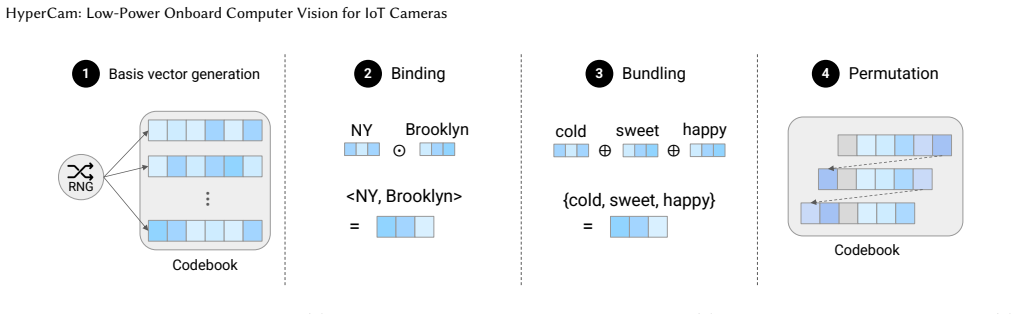
The load-bearing object is the sparse bundling operator (Algorithm 1), which approximates the standard HDC bundling of a set of permuted hypervectors. Given a set of integer pixel positions, it hashes each element into d=20 positions of a 10,000-bit hypervector, either setting bits (Bloom Filter backend) or adding ±1 signed increments and then thresholding at zero (Count Sketch backend). This replaces O(n)=10,000 bit operations per bundle with O(d)=20, a 500-fold reduction, while preserving the key property that similar sets produce nearby hypervectors. Around it, the encoder uses permutation-based codebooks so no position hypervectors are stored, level-based value hypervectors generated on the fly, and weighted bundling to restore pixel-value frequency lost in factoring. Together these make the per-image cost 19,200 sparse bundling operations plus 256 dense bundling operations instead of 19,200 full bundling operations.
What would settle it
Retrain HyperCam on a task with more classes or higher-resolution images (for example, 10-class or 32x32 CIFAR-10, or the 8-class face dataset upscaled) and compare accuracy, memory, and latency against the exact Rewrite2 encoder; if the accuracy gap grows well beyond the 1-point MNIST drop reported here while exact bundling holds, then the sparse approximation, not the HDC representation, is the accuracy bottleneck.
Extended reading notes
Core claim
The central claim is that a carefully rewritten HDC encoder can classify images on a microcontroller with accuracy close to neural networks but with a fraction of the memory and latency. The paper shows this by starting from a naive pixel-based HDC encoding and applying four rewrites: permutation-based position codebooks, coalescing row and column indices into a single codebook, factoring value hypervectors out of the bundling with a weighted re-introduction of pixel-value frequency, and finally replacing dense bundling with a sparse bundling operator built on a Bloom Filter or Count Sketch. The resulting encoding uses two orders of magnitude fewer bundling operations, cutting the codebook from 536 stored hypervectors to two on-the-fly generated ones. On the hardware prototype, HyperCam's Count Sketch version achieves 93.60% MNIST accuracy at 63.00 KB flash and 0.26 s latency, and the Bloom Filter version cuts latency to 0.08 s at 52.62 KB flash with a 3.24-point MNIST accuracy drop. The paper's claim is that this trade-off is the right operating point for IoT cameras, where energy, not peak accuracy, is the binding constraint.
Load-bearing premise
The sparse bundling operator preserves enough of the distance structure of full hyperdimensional bundling that learned class hypervectors remain separable, even though no error bound or approximation analysis is provided.
Editorial extensions
If this is right
- HyperCam can be ported to any MCU with bitwise operations, needing no floating-point units, NPUs, or ML libraries.
- Adding a new class to the classifier costs only n=10,000 bits of flash, so models can be extended in the field.
- Onboard inference removes the need to transmit raw images, reducing communication overhead and privacy exposure for IoT cameras.
- The reported latency of 0.08–0.27 s supports real-time event-triggered sensing on battery power.
- The Bloom Filter backend offers an explicit accuracy-versus-latency knob for deployments.
Reading between the lines
- The same sparse bundling operator could accelerate other HDC workloads beyond vision, such as sensor fusion or sequence encoding, wherever bundling over sets of permuted hypervectors dominates cost.
- The density parameter d=20 is selected experimentally; a theoretical analysis of how d scales with hypervector dimension and set size could turn HyperCam into a tunable system rather than a fixed configuration.
- Because the encoder loses accuracy on high-resolution or many-class inputs, a hybrid design could use sparse bundling for an initial pass and exact bundling only for hard examples.
- The paper's comparison omits the energy cost of the camera sensor itself; a full system-level energy model including capture and transmission would let one test whether the 0.08–0.27 s inference window is the dominant power term.
Editorial analysis
A structured set of objections, weighed in public.
Referee Report
Summary. The paper presents HyperCam, an HDC-based image classification pipeline for low-power IoT cameras. It introduces four encoding rewrites to reduce codebook memory, binding, and bundling operations, culminating in a sparse bundling operator based on Bloom filters and Count Sketches. The authors implement the pipeline on an STM32U585AI MCU with a Himax camera and BLE, and report accuracy, flash, RAM, latency, and power across MNIST, Fashion-MNIST, and custom face detection/identification tasks. They claim HyperCam is the only classifier that combines competitive accuracy with resource usage suitable for low-power camera systems.
Significance. If the measurements are robust, HyperCam provides a compelling data point that HDC image classification can run on commodity MCUs with 53-63 KB flash, 22.25 KB RAM, and under 0.3 s latency while retaining useful accuracy on simple vision tasks. The detailed algorithm pseudocode, per-stage latency profiling, flash-memory breakdown, and real hardware power measurements are valuable for the embedded ML and IoT camera communities. However, the significance is currently limited by the lack of statistical error bars, the unanalyzed and task-tuned sparse bundling approximation, and a few inconsistencies in the reported comparison.
major comments (5)
- [Section 6.1.3, Table 2] Accuracy is reported as a single point estimate from one 80/20 split, without standard deviations, confidence intervals, or multiple random seeds. This matters because HyperCam's encoding uses randomly generated codebooks and OnlineHD training is stochastic, and several comparisons in Table 2 are very close (e.g., HyperCam* 92.98% vs. MicroNets 92.86% on Face Detection; HyperCam* 84.06% vs. MobileNetV3 86.48% on Fashion-MNIST). With no variance estimate, the abstract's claim that HyperCam is 'the only classifier that achieves competitive accuracy while maintaining competitive memory footprint and inference latency' is not statistically supported. Please report mean and standard deviation over multiple splits and seeds and, where possible, a paired significance test.
- [Section 4.2.4 and Section 4.3] The sparse bundling approximation is the only semantics-breaking rewrite that affects all reported accuracies, yet no approximation guarantee or distance-preservation analysis is provided. The density parameter d=20 is selected experimentally on the same four evaluation tasks, and the paper states that d<20 leads to a sharp accuracy drop, but no held-out task, resolution, class-count sweep, or error bound is reported. This is load-bearing: Table 2 shows that Rewrite 4 costs 5.84 accuracy points on Face Identification (Rewrite 2 78.63% to HyperCam* 72.79%), the largest drop in the table and exactly the task used in the abstract headline. Please provide either a theoretical bound on the distance distortion introduced by SparseBundle, or a systematic sensitivity analysis on tasks and distributions not used to choose d, before the claimed generality can be evaluated.
- [Algorithm 1, lines 15-21] The Count Sketch finalization in Algorithm 1 as written is `if not bloom then for i in 0..n: hv[i] = 1 ? hv[i] >= 0 : 0`, i.e., every non-negative entry (including all zero entries) is mapped to 1. For a singleton set this yields a vector with about n - d/2 ones rather than d ones, contradicting the claimed sparse density and the O(d) complexity argument; for large sets the output density saturates differently than exact HDC bundling. If the actual implementation thresholds at `hv[i] > 0` or uses a different rule, the pseudocode must be corrected and the density behavior analyzed. The dependence of output density on set size is not accounted for in Eq. (1), where sparse bundles for different pixel values are weighted and combined before a global threshold; the paper should explain why this structural mismatch does not bias classes with different pixel-value histograms.
- [Abstract and Section 6.2] The headline claim that HyperCam is 'the only classifier that achieves competitive accuracy while maintaining competitive memory footprint and inference latency' is not operationalized. In Table 2, MCUNetV3* achieves higher accuracy on all four tasks (e.g., 99.34% vs. 93.60% on MNIST) at 1190 KB flash and 6.7 s latency, and xgBoost achieves 94.46% vs. 92.98% on Face Detection at 134.92 KB flash and 0.01 s latency. Without a stated definition of 'competitive accuracy' (e.g., within X percentage points of the best model) and a stated resource envelope, the 'only' claim cannot be evaluated or falsified. Please state the accuracy threshold and resource budget used to justify the claim, or weaken the claim accordingly.
- [Table 2, OnlineHD row] The OnlineHD row reports the same accuracy, 84.62%, for both Face Detection and Face Identification. If this is a typo, it should be corrected; if it is not, the paper should explain why the 7-class identification accuracy exactly equals the binary detection accuracy. As printed, this number also undermines the text's assertion that HD classifiers including HyperCam show a 'graceful decline' to 72.79% on Face Identification, because a baseline HDC method is listed at 84.62% on the same task. Please verify this entry and clarify the comparison.
minor comments (4)
- [Section 5.3] The microcontroller is referred to as 'STM32UF855AI' in Section 5.3 but as 'STM32U585AI' elsewhere; please correct the typo.
- [Section 6.2] The text says 'HyperCam's most memory-efficient version (count-sketch) requires only 63 KB of flash memory,' but Table 2 shows that the Bloom Filter version (HyperCam**) uses 52.62 KB, which is smaller than the Count Sketch version's 63.00 KB; this appears to be a swapped label and should be fixed.
- [Section 6.3 and Table 4] The active power is reported as 128 mW during image processing and as 102 mW average over the 450 ms active period in Section 6.3, while Table 4 lists Active Power as 128 mW; please clarify which quantity is being reported and make the table consistent with the text.
- [Contributions and Section 8] The paper states that HyperCam code is open source, but no repository URL or access instructions are provided; please add a link to the code to support reproducibility.
Circularity Check
No significant circularity: HyperCam's accuracy claims are empirical benchmark results, not derivations that assume their own conclusions.
full rationale
HyperCam's central claims are evaluated externally rather than derived from fitted inputs. The accuracy numbers in Table 2 are measured on held-out test splits (8:2 split, Section 6.1.3), and the sparse-bundling density d=20 is an experimental configuration reported as selected by accuracy behavior, not a parameter fitted to reproduce the table's results. The paper explicitly identifies Rewrite 4 as semantics-breaking and reports the accuracy loss versus Rewrite 2, so the approximation is not disguised as an exact derivation. Self-citations (WISPCam, FarmBeats) appear only in related-work context and are not load-bearing; no uniqueness theorem or prior result by the same authors is invoked to force the design. The lack of an error bound for the sparse-bundling approximation is a generalization and soundness concern, not circularity: the approximation is evaluated by its measured accuracy on external datasets rather than defined to match those accuracies. The Rewrite 2 baseline is an internal comparison point, but the final HyperCam accuracy is independently benchmarked against external datasets and external baselines. No equation or claim in the paper reduces by construction to its own inputs.
Assumptions & free parameters
free parameters (3)
- Sparse bundling density d =
20
- Hypervector dimension n =
10,000
- OnlineHD training hyperparameters =
not reported
assumptions (5)
- domain assumption Randomly generated binary hypervectors are near orthogonal, and XOR binding, majority bundling, and permutation preserve the similarity structure needed for classification.
- ad hoc to paper Sparse bundling with Bloom Filter and Count Sketch approximates full HDC bundling well enough at d = 20 for image classification.
- domain assumption The binarized modification of OnlineHD retains the convergence and accuracy properties of the real-valued OnlineHD algorithm.
- domain assumption Post-training integer quantization of SVM, XGBoost, MicroNets, MobileNetV3, and MCUNetV3 does not unfairly disadvantage them relative to HyperCam.
- domain assumption One 80/20 train/test split per dataset yields a reliable accuracy estimate.
Cite this review
Pith. "Pith review of HyperCam: Low-Power Onboard Computer Vision for IoT Cameras." pith.science (2026). https://pith.science/paper/HSB2STIH
@misc{pith2026250110547,
  author       = {Pith},
  title        = {Pith review of: HyperCam: Low-Power Onboard Computer Vision for IoT Cameras},
  year         = {2026},
  howpublished = {\url{https://pith.science/paper/HSB2STIH}},
  note         = {Machine review of arXiv:2501.10547}
}
read the original abstract
We present HyperCam, an energy-efficient image classification pipeline that enables computer vision tasks onboard low-power IoT camera systems. HyperCam leverages hyperdimensional computing to perform training and inference efficiently on low-power microcontrollers. We implement a low-power wireless camera platform using off-the-shelf hardware and demonstrate that HyperCam can achieve an accuracy of 93.60%, 84.06%, 92.98%, and 72.79% for MNIST, Fashion-MNIST, Face Detection, and Face Identification tasks, respectively, while significantly outperforming other classifiers in resource efficiency. Specifically, it delivers inference latency of 0.08-0.27s while using 42.91-63.00KB flash memory and 22.25KB RAM at peak. Among other machine learning classifiers such as SVM, xgBoost, MicroNets, MobileNetV3, and MCUNetV3, HyperCam is the only classifier that achieves competitive accuracy while maintaining competitive memory footprint and inference latency that meets the resource requirements of low-power camera systems.
Figures


Figures from the paper (5 more)


Reference graph
Works this paper leans on
-
[1]
Sayed Saad Afzal, Waleed Akbar, Osvy Rodriguez, Mario Doumet, Unsoo Ha, Reza Ghaffarivardavagh, and Fadel Adib. 2022. Battery-free wireless imaging of underwater environments. Nature Communica- tions 13 (2022), 5546. https://doi.org/10.1038/s41467-022-33223-x
-
[2]
Jorge A Ahumada, Eric Fegraus, Tanya Birch, Nicole Flores, Roland Kays, Timothy G O’Brien, Jonathan Palmer, Stephanie Schuttler, Jen- nifer Y Zhao, Walter Jetz, and et al. 2020. Wildlife Insights: A Platform to Maximize the Potential of Camera Trap and Other Passive Sensor Wildlife Data for the Planet. Environmental Conservation 47, 1 (2020), 1–6. https:/...
-
[3]
Colby R. Banbury, Chuteng Zhou, Igor Fedorov, Ramon Matas Navarro, Urmish Thakker, Dibakar Gope, Vijay Janapa Reddi, Matthew Mat- tina, and Paul N. Whatmough. 2020. MicroNets: Neural Network Architectures for Deploying TinyML Applications on Commodity Microcontrollers. CoRR abs/2010.11267 (2020). arXiv:2010.11267 12 HyperCam: Low-Power Onboard Computer Vi...
arXiv 2020
-
[4]
Ron Banner, Itay Hubara, Elad Hoffer, and Daniel Soudry. 2018. Scal- able methods for 8-bit training of neural networks. In Proceedings of the 32nd International Conference on Neural Information Processing Systems (Montréal, Canada) (NIPS’18). Curran Associates Inc., Red Hook, NY, USA, 5151–5159
work page 2018
-
[5]
Burton H Bloom. 1970. Space/time trade-offs in hash coding with allowable errors. Commun. ACM 13, 7 (1970), 422–426
1970
-
[6]
Moses Charikar, Kevin Chen, and Martin Farach-Colton. 2002. Find- ing frequent items in data streams. In International Colloquium on Automata, Languages, and Programming. Springer, 693–703
work page 2002
-
[7]
Kenneth L Clarkson, Shashanka Ubaru, and Elizabeth Yang. 2023. Capacity analysis of vector symbolic architectures. arXiv preprint arXiv:2301.10352 (2023)
work page Pith review arXiv 2023
-
[8]
Robert David, Jared Duke, Advait Jain, Vijay Janapa Reddi, Nat Jeffries, Jian Li, Nick Kreeger, Ian Nappier, Meghna Natraj, Tiezhen Wang, et al. 2021. Tensorflow lite micro: Embedded machine learning for tinyml systems. Proceedings of Machine Learning and Systems 3 (2021), 800–811
work page 2021
Show all 37 references
-
[9]
Alejandro Hernández-Cano, Namiko Matsumoto, Eric Ping, and Mohsen Imani. 2021. OnlineHD: Robust, Efficient, and Single-Pass Online Learning Using Hyperdimensional System. In 2021 Design, Automation & Test in Europe Conference & Exhibition (DATE) . 56–61. https://doi.org/10.239...
2021
-
[10]
Himax. 2024. HM01B0 Ultralow Power CIS. https: //www.himax.com.tw/products/cmos-image-sensor/always-on- vision-sensors/hm01b0/
2024
-
[11]
Mohsen Imani, Abbas Rahimi, Deqian Kong, Tajana Rosing, and Jan M Rabaey. 2017. Exploring hyperdimensional associative memory. In 2017 IEEE International Symposium on High Performance Computer Architecture (HPCA). IEEE, 445–456. https://doi.org/10.1109/HPCA. 2017.28
2017 doi
-
[12]
Mohsen Imani, Ali Zakeri, Hanning Chen, TaeHyun Kim, Prathyush Poduval, Hyunsei Lee, Yeseong Kim, Elaheh Sadredini, and Farhad Imani. 2022. Neural computation for robust and holographic face detection. In Proceedings of the 59th ACM/IEEE Design Automation Conference (San Franc...
2022
-
[13]
Vikram Iyer, Ali Najafi, Johannes James, Sawyer Fuller, and Shyamnath Gollakota. 2020. Wireless steerable vision for live insects and insect- scale robots. Science robotics 5, 44 (2020), eabb0839
2020
-
[14]
Benoit Jacob, Skirmantas Kligys, Bo Chen, Menglong Zhu, Matthew Tang, Andrew Howard, Hartwig Adam, and Dmitry Kalenichenko
-
[15]
Colleen Josephson, Lei Yang, Pengyu Zhang, and Sachin Katti. 2019. Wireless computer vision using commodity radios. In Proceedings of the 18th International Conference on Information Processing in Sensor Networks. 229–240
2019
-
[16]
Joulescope. 2024. Joulescope JS220: Precision Energy Ana- lyzer. https://www.joulescope.com/products/js220-joulescope- precision-energy-analyzer
2024
-
[17]
Pentti Kanerva. 1997. Fully distributed representation. PAT 1, 5 (1997), 10000
1997
-
[18]
Denis Kleyko, Mike Davies, Edward Paxon Frady, Pentti Kanerva, Spencer J Kent, Bruno A Olshausen, Evgeny Osipov, Jan M Rabaey, Dmitri A Rachkovskij, Abbas Rahimi, et al . 2022. Vector symbolic architectures as a computing framework for emerging hardware. Proc. IEEE 110, 10 (20...
2022
-
[19]
Kleyko, D
D. Kleyko, D. A. Rachkovskij, E. Osipov, and A. Rahimi. 2022. A Survey on Hyperdimensional Computing Aka Vector Symbolic Architectures, Part I: Models and Data Transformations. ACM Comput. Surv. 55, 6, Article 130 (dec 2022), 40 pages. https://doi.org/10.1145/3538531
2022 doi
-
[20]
Denis Kleyko, Abbas Rahimi, Ross W Gayler, and Evgeny Osipov. 2020. Autoscaling bloom filter: controlling trade-off between true and false positives. Neural Computing and Applications 32 (2020), 3675–3684
2020
-
[21]
Jovin Langenegger, Geethan Karunaratne, Michael Hersche, Luca Benini, Abu Sebastian, and Abbas Rahimi. 2023. In-memory factoriza- tion of holographic perceptual representations.Nature Nanotechnology 18, 5 (2023), 479–485
2023
-
[22]
Yann LeCun, Corinna Cortes, and Christopher J.C. Burges. 1998. The MNIST Database of Handwritten Digits. http://yann.lecun.com/exdb/ mnist/
1998
-
[23]
Ji Lin, Wei-Ming Chen, Yujun Lin, John Cohn, Chuang Gan, and Song Han. 2020. MCUNet: tiny deep learning on IoT devices. In Proceedings of the 34th International Conference on Neural Information Processing Systems (Vancouver, BC, Canada) (NIPS’20). Curran Associates Inc., Red H...
2020
-
[24]
Ji Lin, Wei-Ming Chen, Yujun Lin, Chuang Gan, Song Han, et al. 2020. Mcunet: Tiny deep learning on iot devices. Advances in Neural Infor- mation Processing Systems 33 (2020), 11711–11722
2020
-
[25]
Ji Lin, Ligeng Zhu, Wei-Ming Chen, Wei-Chen Wang, Chuang Gan, and Song Han. 2022. On-device training under 256kb memory. Advances in Neural Information Processing Systems 35 (2022), 22941–22954
2022
-
[26]
Erez Manor and Shlomo Greenberg. 2022. Custom hardware inference accelerator for tensorflow lite for microcontrollers. IEEE Access 10 (2022), 73484–73493
2022
-
[27]
Saman Naderiparizi, Zerina Kapetanovic, and Joshua R Smith. 2016. Wispcam: An rf-powered smart camera for machine vision appli- cations. In Proceedings of the 4th International Workshop on Energy Harvesting and Energy-Neutral Sensing Systems . 19–22
2016
-
[28]
Saman Naderiparizi, Aaron N Parks, Zerina Kapetanovic, Benjamin Ransford, and Joshua R Smith. 2015. WISPCam: A battery-free RFID camera. In 2015 IEEE International Conference on RFID (RFID) . IEEE, 166–173
2015
-
[29]
Dmitriy A Rachkovskiy, Sergey V Slipchenko, Ernst M Kussul, and Tatyana N Baidyk. 2005. Sparse binary distributed encoding of scalars. Journal of Automation and Information Sciences 37, 6 (2005)
2005
-
[30]
Nordic Semiconductor. 2024. nRF52840. https://www.nordicsemi. com/products/nrf52840
2024
-
[31]
STMicroelectronics. 2024. Discovery Kit for IoT Node with STM32U5 Series. https://www.st.com/en/evaluation-tools/b-u585i-iot02a.html
2024
-
[32]
STMicroelectronics. 2024. STM32U585AI. https://www.st.com/ en/microcontrollers-microprocessors/stm32u585ai.html?rt=db&id= DB4410
2024
-
[33]
2017.{FarmBeats}: an{IoT} platform for{Data- Driven} agriculture
Deepak Vasisht, Zerina Kapetanovic, Jongho Won, Xinxin Jin, Ranveer Chandra, Sudipta Sinha, Ashish Kapoor, Madhusudhan Sudarshan, and Sean Stratman. 2017.{FarmBeats}: an{IoT} platform for{Data- Driven} agriculture. In 14th USENIX Symposium on Networked Systems Design and Imple...
2017
-
[34]
Veluri, C
B. Veluri, C. Pernu, A. Saffari, J. Smith, M. Taylor, and S. Gollakota
-
[35]
Han Xiao, Kashif Rasul, and Roland Vollgraf. 2017. Fashion-MNIST: A Novel Image Dataset for Benchmarking Machine Learning Algorithms. arXiv preprint arXiv:1708.07747 (2017). https://arxiv.org/abs/1708. 07747 13
2017 arXiv
-
[2017]
arXiv preprint arXiv:1712.05877 (2017)
Quantizing deep convolutional networks for efficient inference: A whitepaper. arXiv preprint arXiv:1712.05877 (2017)
2017 arXiv
-
[2023]
NeuriCam: Key-Frame Video Super-Resolution and Colorization for IoT Cameras. 1–17
Reviewed August 10, 2026 · model on record in the stance chip above.
Discussion (0). Continue with ORCID to comment.