REVIEW 4 major objections 5 minor 2 cited by
Ensemble score filter with image inpainting for data assimilation in tracking surface quasi-geostrophic dynamics with partial observations
T0 review · 4 major / 5 minor · reviewed 2026-08-10 · deepseek-v4-flash
Pith's one-line read With inpainting, a training-free diffusion filter tracks turbulent flow from only 5% observed grid points.
desk verdict Useful proof-of-concept for training-free diffusion DA with partial observations, but the numerical validation needs error bars, a no-assimilation baseline, and a softened conclusion. read the letter →
The pith
A machine-rendered reading of the paper's core claim, the machinery that carries it, and where it could break.
The reading
What carries the argument
The ensemble score filter (EnSF) is a training-free diffusion method in which the prior filtering distribution is transported to a standard Gaussian by a forward SDE and sampled by solving a reverse SDE whose score function is evaluated by Monte Carlo from the prior ensemble; observations enter by adding the likelihood gradient to the score with a time-damping weight h(t). The likelihood gradient has a nonzero block only for observed variables, so the unobserved block is untouched. The paper's addition is an inpainting step after each score update: the Navier-Stokes inpainting propagates isophotes from observed into unobserved pixels by a vorticity transport equation; biharmonic inpainting solves a fourth-order PDE for a smooth extension; and dictionary-learning inpainting represents the full state sparsely in a discrete-cosine basis thresholded by the prior ensemble and optimizes the coefficients against the updated observed field with a total-variation penalty. This inpainting step plays the role that the cross-covariance matrix plays in Kalman filters: it spreads observational information from observed to unobserved variables.
What would settle it
Run the same EnSF+inpainting on a system where unobserved variables are dynamically decoupled from observed variables (e.g., two independent SQG layers with observations only from one layer); if the unobserved-layer RMSE is not identical to a pure forecast, the inpainting step is fabricating correlation. Alternatively, in a 64×64, 5%-observation, nonlinear case, compare the EnSF+inpainting ensemble against a particle filter with a modest number of particles; if the ensemble spread/RMSE ratio deviates strongly from 1 or the filtered trajectories diverge, the inpainted ensemble is not a posterior sample.
Extended reading notes
Core claim
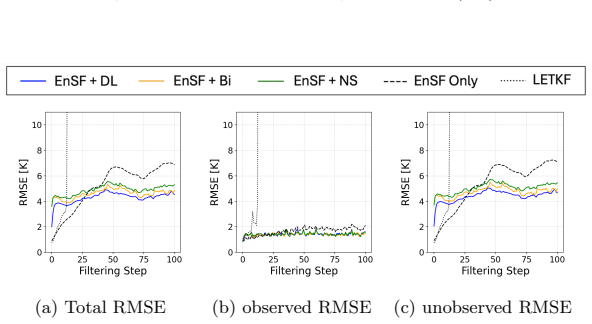
The central discovery is that the zero likelihood gradient on unobserved variables in EnSF can be compensated, not by learning a covariance, but by treating the observed field as a partial image and reconstructing the full state with classical or dictionary-based inpainting at every filtering step. In the most demanding scenario tested—64×64 grid, 12-hour assimilation interval, 5% fixed-point observations through a nonlinear arctangent operator—the original EnSF and LETKF both diverge, while EnSF with any of the three inpainting variants keeps the total RMSE around 4.6 and visually tracks the main SQG dynamics. At 256×256 resolution the same setup yields total RMSE near 2.8. The paper further claims that inpainting is not always needed: with 3-hour assimilation and 25% observation coverage, EnSF without inpainting is already accurate, and the inpainting step can add small errors. The authors frame the result as a proof of concept for using image inpainting as a substitute for covariance-based cross-variable updates in data assimilation.
Load-bearing premise
The load-bearing premise is that the unobserved part of the state can be recovered from the observed part by image inpainting; since the likelihood gradient on unobserved variables is zero, the paper replaces their Bayesian update with a deterministic reconstruction and gives no proof that this produces samples from the posterior conditional on the observations.
Editorial extensions
If this is right
- If correct, EnSF with inpainting offers a training-free alternative to localization-tuned ensemble Kalman filters for nonlinear, sparsely observed systems.
- The method needs no re-tuning when resolution changes from 64×64 to 256×256, while LETKF's transferred hyperparameters degrade sharply.
- Dictionary-learning inpainting is the better choice under 5% observations; PDE-based inpainting is competitive when 25% is observed.
- The approach separates observed-state accuracy from unobserved-state accuracy, which could let operational systems report observed-variable reliability even when full-state RMSE is moderate.
- Combining EnSF's nonlinear observation handling with a cheap deterministic reconstruction step suggests a path to assimilating radar or satellite operators similar to arctangent compression.
Reading between the lines
- The inpainting step implicitly defines a conditional model for the unobserved given the observed field; if that conditional is misspecified, the ensemble will be overconfident, so the spread/RMSE ratio near 1 reported in the paper should be checked case by case.
- The dictionary method's DCT basis is generic; replacing it with physics-informed bases (e.g., vorticity or wave modes) could improve the 5%-observation regime while preserving training-free operation.
- The failure of inpainting in dense-observation cases suggests a hybrid controller could switch off inpainting when the forecast step is short and observation density is high, gaining EnSF-only accuracy without losing robustness.
- Testable extension: apply the same split update to a primitive-equation or coupled model where the observed and unobserved variables live on different physical fields (e.g., sea-surface temperature observed, subsurface velocity unobserved), where the inpainting analogy to images is weaker.
Signed reviews
Editorial analysis
A structured set of objections, weighed in public.
Referee Report
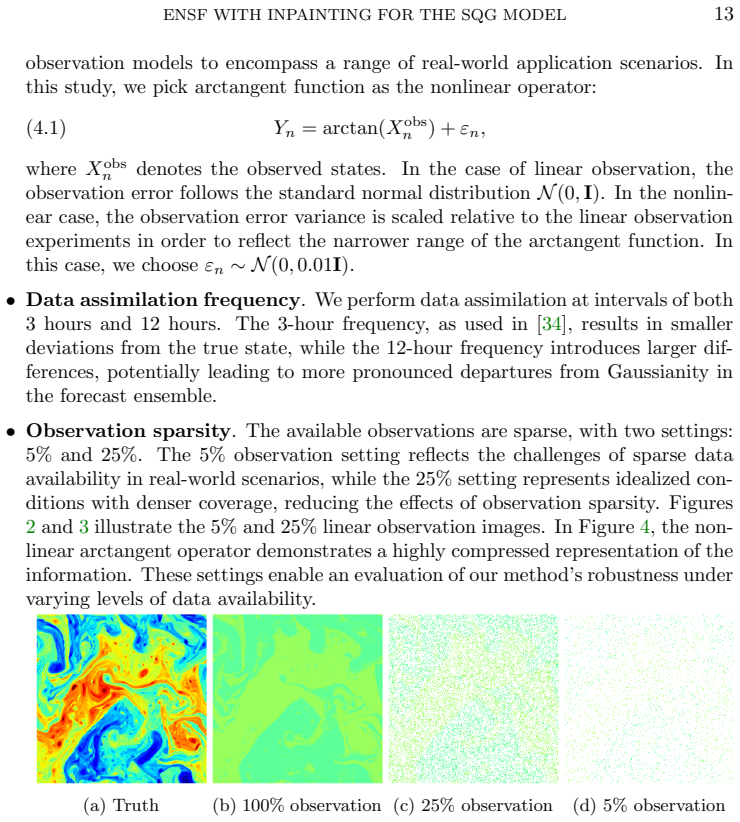
Summary. The paper proposes an extension of the ensemble score filter (EnSF) to data assimilation with partial observations by integrating image inpainting. At each filtering step, the observed state variables are updated via the EnSF likelihood score, and the unobserved variables are reconstructed using one of three inpainting techniques: biharmonic, Navier-Stokes, or dictionary-learning-based inpainting. The method is tested on the surface quasi-geostrophic (SQG) model in 16 scenarios that vary spatial resolution, observation operator (linear vs. arctangent), assimilation frequency, and observation sparsity (5% and 25%). The main claim is that EnSF with inpainting can track the SQG dynamics even under 5% observations and nonlinear observation operators, where the LETKF fails, with average total RMSE around 4.6 in the hardest 64x64 case (C7) and around 2.8 at 256x256 (C15). The paper also includes a comparison against the original EnSF without inpainting and a fine-tuned LETKF, and reports ensemble spread/RMSE ratios as a measure of uncertainty estimation.
Significance. If the main claim is fully supported, the paper makes a valuable methodological contribution: it demonstrates a training-free, localization-free diffusion-based data assimilation approach that can handle nonlinear observation operators and highly sparse observations in a chaotic geophysical model. The breadth of tested scenarios (16 cases across two resolutions, two observation operators, two frequencies, and two observation densities) is a strength, and the public availability of the code supports reproducibility. However, the current evidence has two important gaps: the absolute RMSE values are not calibrated against any unconstrained reference (free run, persistence, or climatology), and all experiments appear to be single realizations with no error bars. These gaps make the central 'can track' claim underdetermined and weaken the quantitative comparisons among inpainting variants. The theoretical justification for replacing the Bayesian update of unobserved states with inpainting is also not provided. With these issues addressed, the paper could be a solid proof-of-concept for a new class of DA methods.
major comments (4)
- [Section 4.2.2, Table 3] The central claim that EnSF with inpainting 'can track' the SQG dynamics is not calibrated by an appropriate reference scale. The RMSE values of about 4.6 (C7) and 2.8 (C15) are reported without comparison to any unconstrained baseline, such as a free run, persistence, or climatological forecast, for the same truth trajectory, observation mask, and error metric. Since the biharmonic, Navier-Stokes, and DCT-threshold inpainting methods are all spatial smoothing operations, a static or slowly varying field could achieve a moderate RMSE without tracking the time evolution of unobserved scales. Please add such a baseline or use a skill score (e.g., anomaly correlation) to calibrate the absolute RMSE and substantiate the word 'tracking'.
- [Section 4.2.2, Figures 6 and Table 3] All reported results appear to come from a single realization (one draw of observation noise and one model-error trajectory). Without repeated seeds, multiple observation-noise replicates, or error bars, the differences among EnSF+DL, EnSF+Bi, and EnSF+NS (e.g., 4.46 versus 4.61 in C7) cannot be distinguished from run-to-run variability. Please report statistics over at least several independent runs, or otherwise demonstrate that the relative ordering of methods is robust to stochastic variability.
- [Section 3.1 and Sections 3.2-3.3] The methodological core of the paper, which replaces the Bayesian update of unobserved states with image inpainting, lacks a theoretical or empirical justification that the resulting ensemble approximates the posterior p(X_{n+1}|Y_{1:n+1}). Eq. (3.7) shows that the likelihood gradient for unobserved variables is zero, and then the unobserved states are reconstructed by inpainting from the observed states without any proof that this corresponds to a Bayesian update. The paper should either prove that this reconstruction is asymptotically correct under specific priors (e.g., smoothness or sparsity priors) or demonstrate in a controlled synthetic experiment that the inpainting-based update yields calibrated posterior samples (e.g., via rank histograms or coverage probabilities).
- [Section 4.2.1] The LETKF at 256x256 resolution is evaluated with hyperparameters fine-tuned only at 64x64 and then transferred without retuning. This is acknowledged in the text, but it gives EnSF with inpainting a substantial advantage in the 256x256 experiments because the LETKF is not adapted to the finer resolution. The paper should either tune LETKF at 256x256 for at least a subset of cases (e.g., a coarse grid search or a few trial runs), or explicitly reframe the 256x256 comparisons as demonstrating sensitivity to parameter transfer rather than as a head-to-head method comparison. The current statement in Section 4.2.2 that 'LETKF performs poorly, as expected' conflates these two interpretations.
minor comments (5)
- [Section 3.3, Step 3] The values of the DCT threshold nu and the total variation weight gamma are not reported in the paper. Please provide these values, either in the main text or in a table, for reproducibility.
- [Section 3.4] The title of Section 3.4 contains a typo: 'inpaintitng' should be 'inpainting'.
- [Introduction and various figures] There are several typographical errors, including 'dyanmics' in the Introduction, 'pursue' in the Figure 2 caption, 'obserable' in the Figure 3 caption, and 'Spacial' in Section 4.1. These should be corrected.
- [Table 3] The text states that 'The best-performing method in each case is highlighted,' but the table as rendered does not show any highlighting. Please ensure the highlighting is visible or remove the statement.
- [Section 4.4] The paper's own admission that inpainting introduces additional error in the ideal cases (C2, C6, C10, C14) is a useful and honest limitation statement. Consider making this limitation more prominent in the abstract or conclusions, since it tempers the generality of the main claim.
Circularity Check
No significant circularity: the EnSF-with-inpainting results are measured against an external synthetic truth and an independent LETKF baseline, and no fitted parameter is renamed as a prediction.
full rationale
The paper's central claim is empirical: EnSF with inpainting tracks the SQG model under partial, nonlinear observations with lower total RMSE than LETKF or EnSF without inpainting. Nothing in the construction forces this result. The EnSF score update in Eq. (3.6) uses the likelihood gradient from Eq. (3.7), which is zero on unobserved variables, and the inpainting step then reconstructs unobserved states from observed states using biharmonic, Navier-Stokes, or DCT-dictionary methods. These reconstructions are not fit to the truth trajectory; they use only current observed values and prior samples from the model. The reported RMSE numbers are compared against the synthetic nature run, so the evaluation is external to the method's own outputs. The self-citations to the authors' prior EnSF papers [2,3,4] supply the score-based diffusion framework and the choices of alpha_t and beta_t, but the target result (tracking SQG under partial observations) is not assumed by those references, and the key novelty of this paper, the inpainting extension, is implemented and tested here rather than imported. Table 3 also shows that inpainting can hurt relative to plain EnSF in the dense-observation cases C2, C6, C10, and C14, which further demonstrates that the inpainting results are not forced by construction. The absence of an unconstrained reference RMSE and of replicate runs is a correctness/statistical concern, not a circularity concern.
Assumptions & free parameters
free parameters (5)
- DCT coefficient threshold nu =
not reported
- Total variation weight gamma =
not reported
- Time damping function h(t) =
h(t)=1-t (example)
- LETKF localization and RTPS inflation parameters =
grid-searched at 64x64, transferred to 256x256
- Ensemble size K =
20
assumptions (5)
- domain assumption Observation noise eps is Gaussian with covariance R
- standard math The prior distribution can be represented by a diffusion bridge with alpha_t=1-t and beta_t^2=t
- ad hoc to paper Inpainting reproduces the conditional distribution of unobserved states given observed states
- domain assumption A dictionary learned from prior samples remains valid for the current state
- domain assumption The SQG model is a representative testbed for geophysical turbulence
Cite this review
Pith. "Pith review of Ensemble score filter with image inpainting for data assimilation in tracking surface quasi-geostrophic dynamics with partial observations." pith.science (2026). https://pith.science/paper/5GX3TU7O
@misc{pith2026250112419,
  author       = {Pith},
  title        = {Pith review of: Ensemble score filter with image inpainting for data assimilation in tracking surface quasi-geostrophic dynamics with partial observations},
  year         = {2026},
  howpublished = {\url{https://pith.science/paper/5GX3TU7O}},
  note         = {Machine review of arXiv:2501.12419}
}
read the original abstract
Data assimilation plays a pivotal role in understanding and predicting turbulent systems within geoscience and weather forecasting, where data assimilation is used to address three fundamental challenges, i.e., high-dimensionality, nonlinearity, and partial observations. Recent advances in machine learning (ML)-based data assimilation methods have demonstrated encouraging results. In this work, we develop an ensemble score filter (EnSF) that integrates image inpainting to solve the data assimilation problems with partial observations. The EnSF method exploits an exclusively designed training-free diffusion models to solve high-dimensional nonlinear data assimilation problems. Its performance has been successfully demonstrated in the context of having full observations, i.e., all the state variables are directly or indirectly observed. However, because the EnSF does not use a covariance matrix to capture the dependence between the observed and unobserved state variables, it is nontrivial to extend the original EnSF method to the partial observation scenario. In this work, we incorporate various image inpainting techniques into the EnSF to predict the unobserved states during data assimilation. At each filtering step, we first use the diffusion model to estimate the observed states by integrating the likelihood information into the score function. Then, we use image inpainting methods to predict the unobserved state variables. We demonstrate the performance of the EnSF with inpainting by tracking the Surface Quasi-Geostrophic (SQG) model dynamics under a variety of scenarios. The successful proof of concept paves the way to more in-depth investigations on exploiting modern image inpainting techniques to advance data assimilation methodology for practical geoscience and weather forecasting problems.
Figures


Figures from the paper (36 more)




Forward citations
Cited by 2 Pith papers
-
Multimodal Spatiotemporal Atmospheric Data Assimilation with Latent Video Flow-matching
A single latent video flow-matching prior, with posterior guidance, performs super-resolution, multimodal data fusion, filtering/smoothing, and observation-to-forecast for the global atmosphere using real station obse...
-
IEnSF: Iterative Ensemble Score Filter for Reducing Error in Posterior Score Estimation in Nonlinear Data Assimilation
By iteratively refitting a Gaussian reference posterior inside a reverse-time diffusion sampler, IEnSF reduces posterior-score bias and outperforms LETKF on 1000-D Lorenz-96 with nonlinear observations.
Reference graph
Works this paper leans on
-
[1]
M. Asch, M. Bocquet, and M. Nodet, Data Assimilation, Society for Industrial and Applied Mathematics, Philadelphia, PA, 2016
work page 2016
-
[2]
F. Bao, H. G. Chipilski, S. Liang, G. Zhang, and J. S. Whitaker , Nonlinear ensemble filtering with diffusion models: Application to the surface quasi-geostrophic dynamics , 2024
work page 2024
-
[3]
F. Bao, Z. Zhang, and G. Zhang , An ensemble score filter for tracking high-dimensional nonlinear dynamical system , Computer Methods in Applied Mechanics and Engineering, 432 (2024), p. 117447
work page 2024
-
[4]
, A score-based nonlinear filter for data assimilation , Journal of Computational Physics, 514 (2024), p. 113207
work page 2024
-
[5]
M. Bertalm´ıo, A. Bertozzi, and G. Sapiro , Navier-stokes, fluid dynamics, and image and video inpainting, Proceedings of the 2001 IEEE Computer Society Conference on Computer Vision and Pattern Recognition. CVPR 2001, 1 (2001), pp. I–I
work page 2001
-
[6]
E. J. Candes and D. L. Donoho , Recovering edges in ill-posed inverse problems: Optimality of curvelet frames , The Annals of Statistics, 30 (2002), pp. 784–842
work page 2002
-
[7]
E. J. Cand`es and D. L. Donoho, New tight frames of curvelets and optimal representations of objects with piecewise c2 singularities, Communications on Pure and Applied Mathematics, 57 (2004), pp. 219–266
work page 2004
-
[8]
A. Carrassi, M. Bocquet, L. Bertino, and G. Evensen , Data assimilation in the geo- sciences: An overview of methods, issues, and perspectives , Wiley Interdisciplinary Re- views: Climate Change, 9 (2017)
work page 2017
Show all 35 references
-
[9]
X. Chen, H. Wen, and Y. Li , Differentiable particle filters through conditional normalizing flow, in Proc. Euro. Sig. Process. Conf. (EUSIPCO), Belgrade, Serbia, 2021
2021
-
[10]
Crisan and A
D. Crisan and A. Doucet , A survey of convergence results on particle filtering methods for practitioners, IEEE Transactions on Signal Processing, 50 (2002), pp. 736–746
2002
-
[11]
S. B. Damelin and N. S. Hoang , On surface completion and image inpainting by biharmonic functions: Numerical aspects , International Journal of Mathematics and Mathematical Sciences, 2018 (2018), p. 3950312
2018
-
[12]
D. R. Durran and M. Gingrich , Atmospheric predictability: why butterflies are not of prac- tical importance, Journal of the Atmospheric Sciences, 71 (2014), p. 2476–2488
2014
-
[13]
G. Evensen , Sequential data assimilation with a nonlinear quasi-geostrophic model using monte carlo methods to forecast error statistics , Journal of Geophysical Research: Oceans, 99 (1994), pp. 10143–10162
1994
-
[14]
, Data Assimilation: The Ensemble Kalman Filter , Springer-Verlag, Berlin, Heidelberg, 2006
2006
-
[15]
Gordon, D
N. Gordon, D. Salmond, and A. Smith , Novel approach to nonlinear/non-gaussian bayesian state estimation , IEE PROCEEDING-F, 140 (1993), pp. 107–113
1993
-
[16]
P. L. Houtekamer and H. L. Mitchell , Data assimilation using an ensemble kalman filter technique, Monthly Weather Review, 126 (1998), pp. 796 – 811
1998
-
[17]
Hu and P
C.-C. Hu and P. J. van Leeuwen , A particle flow filter for high-dimensional system applica- tions, Quart. J. Roy. Meteor. Soc., 147 (2021), p. 2352–2374
2021
-
[18]
B. R. Hunt, E. J. Kostelich, and I. Szunyogh, Efficient data assimilation for spatiotemporal chaos: A local ensemble transform Kalman filter , Physica D, 230 (2007), pp. 112–126
2007
-
[19]
Lguensat, P
R. Lguensat, P. Tandeo, P. Ailliot, M. Pulido, and R. F ablet , The analog data assimi- lation, Monthly Weather Review, 145 (2017), pp. 4093 – 4107
2017
-
[20]
Lorenz , The predictability of a flow which possesses many scales of motion , Tellus, 21 (1969), p
E. Lorenz , The predictability of a flow which possesses many scales of motion , Tellus, 21 (1969), p. 289–307
1969
-
[21]
Mairal, M
J. Mairal, M. Elad, and G. Sapiro, Sparse representation for color image restoration, IEEE Transactions on Image Processing, 17 (2008), p. 53 – 69. Cited by: 1469; All Open Access, Green Open Access
2008
-
[22]
Mallat, A wavelet tour of signal processing , 1999
S. Mallat, A wavelet tour of signal processing , 1999
1999
-
[23]
Miyoshi, A
T. Miyoshi, A. Amemiya, S. Otsuka, Y. Maejima, J. Taylor, T. Honda, H. Tomita, S. Nishizawa, K. Sueki, T. Yamaura, Y. Ishikawa, S. Satoh, T. Ushio, K. Koike, and A. Uno, Big data assimilation: Real-time 30-second-refresh heavy rain forecast using fugaku during tokyo olympics a...
2023
-
[24]
G. D. Nastrom and K. S. Gage , A climatology of atmo- spheric wavenumber spectra of wind and temperature ob- served by comercial aircraft , Journal of the Atmospheric Sciences, 42 (1985), pp. 950–960. ENSF WITH INPAINTING FOR THE SQG MODEL 27
1985
-
[25]
M. K. Pitt and N. Shephard , Filtering via simulation: auxiliary particle filters , J. Amer. Statist. Assoc., 94 (1999), pp. 590–599
1999
-
[26]
Pulido and P
M. Pulido and P. J. van Leeuwen , Sequential Monte Carlo with kernel embedded mappings: The mapping particle filter , J. Comp. Phys., 396 (2019), pp. 400–415
2019
-
[27]
R. J. Purser, W.-S. Wu, D. F. Parrish, and N. M. Roberts, Numerical aspects of the appli- cation of recursive filters to variational statistical analysis. part i: Spatially homogeneous and isotropic gaussian covariances, Monthly Weather Review, 131 (2003), pp. 1524 – 1535
2003
-
[28]
Rojahn, N
A. Rojahn, N. Schenk, P. J. van Leeuwen, and R. Potthast , Particle filtering and Gauss- ian mixtures - on a localized mixture coefficients particle filter (LMCPF) for global NWP , J. Meteor. Soc. Japan, 101 (2023), pp. 233–253
2023
-
[29]
Rotunno and C
R. Rotunno and C. Snyder, A generalization of Lorenz’s model for the predictability of flows with many sclaes of motion , J. Atmos. Sci., 65 (2008), p. 1063–1076
2008
-
[30]
Si and P
P. Si and P. Chen , Latent-ensf: A latent ensemble score filter for high-dimensional data assimilation with sparse observation data , 2024
2024
-
[31]
T. A. Smith, S. G. Penny, J. A. Platt, and T.-C. Chen , Temporal subsampling dimin- ishes small spatial scales in recurrent neural network emulators of geophysical turbulence , Journal of Advances in Modeling Earth Systems, 15 (2023), p. e2023MS003792
2023
-
[32]
Tulloch and K
R. Tulloch and K. S. Smith , A note on the numerical presentation of surface dynamics in quasigeostrophic turbulence, J. Atmos. Sci., 66 (2009), pp. 1063–1068
2009
-
[33]
, Quasigeostrophic turbulence with explicit surface dynamics: Application to the atmo- spheric energy spectrum, J. Atmos. Sci., 66 (2009), pp. 450–467
2009
-
[34]
W ang, H
X. W ang, H. G. Chipilski, C. H. Bishop, E. Satterfield, N. Baker, and J. S. Whitaker , A multiscale local gain form ensemble transform kalman filter (MLGETKF) , Mon. Wea. Rev., 149 (2021), p. 605–622
2021
-
[35]
A. B. W atson et al., Image compression using the discrete cosine transform , Mathematica journal, 4 (1994), p. 81. 28 S. LIANG, H. TRAN, F. BAO, H. G. CHIPILSKI, P. J. V AN LEEUWEN, G. ZHANG Appendix A. Additional ablation study results. This section provides additional ablat...
1994
Reviewed August 10, 2026 · model on record in the stance chip above.
Discussion (0). Continue with ORCID to comment.