REVIEW 4 major objections 5 minor 18 references
Multilinguality in LLM-Designed Reward Functions for Restless Bandits: Effects on Task Performance and Fairness
T0 review · 4 major / 5 minor · reviewed 2026-08-10 · deepseek-v4-flash
Pith's one-line read This paper claims that prompting an LLM reward designer in English instead of Hindi, Tamil, or Tulu changes both task performance and fairness in restless-bandit resource allocation.
desk verdict The paper's headline claim of significantly better English performance is not backed by its own statistics, but the question is real, the study is honest, and it deserves a rigorous peer review. read the letter →
The pith
A machine-rendered reading of the paper's core claim, the machinery that carries it, and where it could break.
The reading
What carries the argument
The central object is the DLM (Decision-Language Model) pipeline: an LLM is given a chain-of-thought prompt with a goal and is asked to write a Python reward function, then an evolutionary search with an LLM-based reflection step refines proposals, and a Whittle-index policy solves the resulting restless multi-armed bandit, a sequential resource-allocation model where each arm's state evolves regardless of whether it is pulled. The paper varies the language of the goal prompt (English, Hindi, Tamil, Tulu) and the complexity and phrasing of the prompt, and measures outcomes with two instruments: the rate of 'acceptable' reward functions that use all and only the intended features, and demographic-parity variance across feature buckets, where high variance on unintended features counts as unfairness. The work these parts do is to separate language effects from prompt-complexity and phrasing effects in a controlled synthetic environment.
What would settle it
Have native speakers back-translate the eight Hindi, Tamil, and Tulu prompts into English without seeing the originals, then rerun the DLM pipeline with the back-translated prompts; if acceptable-reward rates and fairness metrics match the English-prompt results, the claimed language effects collapse, while if the gaps persist under faithful translations, they are confirmed.
Extended reading notes
Core claim
On the paper's own terms, the central discovery is that the DLM algorithm's LLM-proposed reward functions are significantly better when prompted in English than in Hindi, Tamil, or Tulu, and that this gap shows up both in task performance and in fairness. The intended reward features are identified correctly at a higher rate under English prompts, and the resulting Whittle-index allocations deviate less from what the prompt asks for. The paper further claims that the exact phrasing of a prompt alters allocations even when the meaning is unchanged, that explicit statements of the goal help, and that increasing prompt complexity hurts all languages but hurts lower-resource languages more. On the fairness side, low-resource languages and more complex prompts are both highly likely to create demographic-parity variance on unintended features, which the paper treats as unfairness. Because the system is aimed at grassroots public-health workers who may prefer local languages, the claim implies that deployment language alone could shift who gets calls.
Load-bearing premise
The load-bearing premise is that the Hindi, Tamil, and Tulu prompts are faithful translations of the English prompts; the paper provides no back-translation, native-speaker verification, or translation-quality scores, so the observed gaps could in principle be artifacts of translation quality rather than of language itself.
Editorial extensions
If this is right
- English prompts yield significantly higher rates of acceptable reward functions than Hindi, Tamil, or Tulu prompts across the tested goal prompts.
- Semantically equivalent rephrasings produce noticeably different allocations, so prompt wording is a performance variable, not a nuisance.
- As prompts involve more intended features, success rates drop for all languages, and English remains more stable; past roughly three intended features, performance collapses regardless of language.
- Low-resource-language prompts and more complex prompts are more likely to produce demographic-parity variance on unintended features, meaning unfair allocations along dimensions the user did not specify.
- For deployed public-health allocation, these gaps imply that outcomes would differ across language communities unless the DLM pipeline is modified.
Reading between the lines
- A reasonable reading is that the performance gap may reflect the LLM's weaker command of Hindi, Tamil, and Tulu rather than any property of those languages; if so, improving multilingual instruction-following or adding a prompt-rewriting stage could close most of the gap.
- The fairness result suggests a cheap testable safeguard: compute demographic-parity variance on all non-target features before deployment and reject reward functions that exceed a threshold on unintended dimensions.
- One could extend the study by back-translating the translated prompts and comparing reward quality on the back-translations, which would separate translation fidelity from intrinsic language handling.
- The collapse past roughly three intended features hints that the evolutionary search and reflection stage, not the LLM's language ability, may be the binding constraint for complex goals.
Signed reviews
Editorial analysis
A structured set of objections, weighed in public.
Referee Report
Summary. The paper studies how the language of goal prompts affects the DLM algorithm, which uses an LLM (Gemini 1.0 Pro) to design reward functions for restless multi-armed bandits in a public-health-inspired resource allocation setting. The authors construct a synthetic environment with six features, run eight prompts (six increasing in complexity and two rephrased versions) in English, Hindi, Tamil, and Tulu, and evaluate three outcomes: the rate of 'acceptable' reward functions, task performance, and fairness measured by demographic-parity variance. The paper reports that English prompts produce better reward functions and task performance, that phrasing matters, that performance degrades with prompt complexity but less so for English, and that low-resource languages and complex prompts are more likely to induce unfairness along unintended features.
Significance. If fully supported, this would be a valuable early empirical result on language-dependent behavior of LLM-based reward design, with direct implications for equitable deployment of automated resource allocation in multilingual, low-resource settings. The paper addresses an understudied question—non-English prompts and fairness rather than performance alone—and includes a low-resource language (Tulu), multiple prompt complexities, and two correlation strengths. Its strengths include the explicit study of prompt phrasing and the use of a fairness metric beyond task success. However, the central comparisons are not yet supported by the evidence as presented: the 'significantly better' claim lacks inferential tests, the multilingual manipulation is not validated as translation-equivalent, and the task-success/fairness thresholds are not operationalized. These issues are fixable in revision and do not invalidate the research direction, but they block acceptance in the current form.
major comments (4)
- [Abstract and Section 3.1, Table 3] The claim that LLM-proposed reward functions are 'significantly better when prompted in English' is not supported by any significance test. In Table 3, the reported standard errors overlap for most language pairs: for Prompt 1, English is 0.65 ± 0.15 versus Hindi 0.60 ± 0.15; for Prompt 5, all four languages report 0.10. The paper provides no paired test across the 20 runs, no confidence intervals for differences, and no effect-size measure. Because this claim is the paper's headline result, the authors must report appropriate inferential statistics (for example, paired bootstrap or McNemar-style tests on the per-run acceptability outcomes) or soften the language to descriptive trends.
- [Section 2.2, Table 2] The English-versus-other-languages comparison presupposes that the Hindi, Tamil, and Tulu prompts are semantically equivalent translations of the English originals, but the paper gives no evidence for this. Table 2 lists only English prompts; the translated prompts, the translation procedure, translator qualifications, back-translations, and any native-speaker validation are absent. Without this information, observed performance and fairness gaps are confounded with translation quality and cannot be attributed to language per se. The authors should include the full translated prompt set and a validation protocol, and ideally a control condition that perturbs the English prompts to quantify sensitivity to wording.
- [Section 4.3 and Figure 6/7] The 'task success rate' used to support Result 4 is not operationally defined. The text says success occurs when 'the allocations have deviated from the relevant features to the point where the allocation is higher than what it would have been had the allocation been uniform across feature values,' but no threshold, comparison procedure, or code is provided. This makes the complexity-degradation and English-robustness claims non-reproducible. In addition, the authors' own Note in Section 4.3 states that the very poor performance for Prompts 2 and 3 is due to failure on ordered categorical features; because Prompt 2 (two features) is not systematically easier than Prompt 5 (two features plus an inference step) in Table 3, the monotonic complexity story is not supported by the raw acceptability rates. The analysis should separate feature-type effects from complexity effects and precisely define the success criterion.
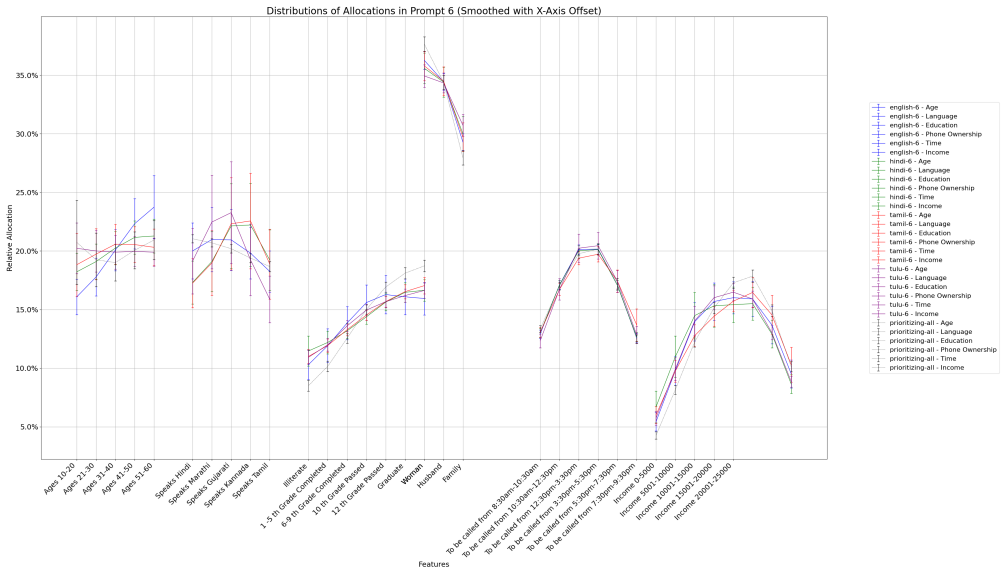
- [Section 5, Figures 8–11] The fairness results depend on two unspecified choices. First, the 'certain threshold' used for the absolute DP-variance counts in Figures 9 and 10 is not reported, so the reader cannot tell whether the plotted differences are robust or an artifact of one threshold value. Second, the relative count (unintended-feature DP variance greater than intended-feature DP variance) may be trivially sensitive to whether the intended feature has high variance by construction. Furthermore, Result 5 is reported as strong for α = 0.2 but 'not as pronounced' for α = 0.8; the paper explains this by correlation propagation but does not provide a sensitivity analysis. The fairness claim 'low-resource languages create unfairness' is therefore conditional on one synthetic correlation structure and should be qualified accordingly, with thresholds reported and confidence intervals or error bars given for the counts.
minor comments (5)
- [Section 2.3, Equation (3)] Equation (3) defines P(Y=1) as the unweighted average of group-level allocation probabilities, not the overall allocation rate across arms; this should be clarified because the demographic-parity variance in Equation (2) then compares group probabilities against an unweighted mean rather than the population prevalence.
- [Section 3, Table 3] The caption calls the entries 'acceptable prompt rates,' but the rate is of acceptable reward functions, not prompts; please reword for clarity.
- [Section 2.2] The full set of translated prompts is not included in the paper or an appendix; providing them is essential for reproducibility and for any verification of translation equivalence.
- [Section 2.1, Table 1] The feature weight vector is described as 'inspired by' prior work, but the choice of signs and magnitudes is one of several plausible specifications; a sensitivity check over the weight vector would strengthen the claim that the results are not artifacts of the synthetic environment.
- [Section 4.3, Figures 6–7] The x-axis label 'increasing complexity' is not numerically defined; consider reporting the number of intended features and the reasoning step for each prompt directly in the figure.
Circularity Check
No significant circularity: the multilingual performance and fairness results are empirical measurements, not derivations that reduce to their inputs.
full rationale
This paper is an empirical evaluation, not a derivation. The LLM-generated reward functions are obtained from a fixed prompting pipeline and then evaluated against externally defined criteria (feature inclusion, allocation deviation, and DP variance). No parameter is fitted to the target results, and no claim is justified by defining the input in terms of the output. The authors rely on the DLM algorithm from Behari et al. (2024), and authors Taneja and Tambe overlap with that work and with Verma et al. (2024); however, the DLM algorithm is the object under study rather than the authority for the paper's conclusions, so the self-citation is not load-bearing. The 'acceptable reward function' and 'success' definitions are operationalizations of task adherence; the complexity trend is observed from allocations across prompts, not entailed by the definitions used. Translation equivalence is an unverified assumption and a validity threat, but a confound is not a circular derivation. No quoted step reduces an equation to itself by construction or renames a fitted quantity as a prediction. Hence the appropriate finding is no significant circularity.
Assumptions & free parameters
free parameters (4)
- alpha (strength of structural relationships) =
0.2 and 0.8
- Feature weight vector for transition probabilities =
Age 0.8, Income 1.5, Language Spoken -0.3, Education 1.5, Phone Ownership -1.5, Times To Be Called 0.3
- DP variance threshold for fairness counts =
not specified numerically
- Task success threshold =
not specified numerically
assumptions (5)
- domain assumption Synthetic structural equations (Age to Income, Education to Income, Income to Phone Ownership, Phone Ownership to Times To Be Called, Language Spoken independent) reflect real-world causal structure.
- domain assumption Feature distributions are uniform in the population.
- standard math Whittle index policy is an appropriate optimal or near-optimal solver for the RMAB.
- ad hoc to paper An 'acceptable reward function' is one that contains all relevant features and no spurious features, as defined by the authors.
- domain assumption The feature 'Language Spoken' does not influence likelihood of conversion.
Cite this review
Pith. "Pith review of Multilinguality in LLM-Designed Reward Functions for Restless Bandits: Effects on Task Performance and Fairness." pith.science (2026). https://pith.science/paper/BO2KGRNC
@misc{pith2026250113120,
  author       = {Pith},
  title        = {Pith review of: Multilinguality in LLM-Designed Reward Functions for Restless Bandits: Effects on Task Performance and Fairness},
  year         = {2026},
  howpublished = {\url{https://pith.science/paper/BO2KGRNC}},
  note         = {Machine review of arXiv:2501.13120}
}
read the original abstract
Restless Multi-Armed Bandits (RMABs) have been successfully applied to resource allocation problems in a variety of settings, including public health. With the rapid development of powerful large language models (LLMs), they are increasingly used to design reward functions to better match human preferences. Recent work has shown that LLMs can be used to tailor automated allocation decisions to community needs using language prompts. However, this has been studied primarily for English prompts and with a focus on task performance only. This can be an issue since grassroots workers, especially in developing countries like India, prefer to work in local languages, some of which are low-resource. Further, given the nature of the problem, biases along population groups unintended by the user are also undesirable. In this work, we study the effects on both task performance and fairness when the DLM algorithm, a recent work on using LLMs to design reward functions for RMABs, is prompted with non-English language commands. Specifically, we run the model on a synthetic environment for various prompts translated into multiple languages. The prompts themselves vary in complexity. Our results show that the LLM-proposed reward functions are significantly better when prompted in English compared to other languages. We also find that the exact phrasing of the prompt impacts task performance. Further, as prompt complexity increases, performance worsens for all languages; however, it is more robust with English prompts than with lower-resource languages. On the fairness side, we find that low-resource languages and more complex prompts are both highly likely to create unfairness along unintended dimensions.
Figures


Figures from the paper (25 more)




Reference graph
Works this paper leans on
-
[1]
E.; Fort, S.; Lanham, T.; Telleen-Lawton, T.; Conerly, T.; Henighan, T.; Hume, T.; Bowman, S
Bai, Y.; Kadavath, S.; Kundu, S.; Askell, A.; Kernion, J.; Jones, A.; Chen, A.; Goldie, A.; Mirhoseini, A.; McKinnon, C.; Chen, C.; Olsson, C.; Olah, C.; Hernandez, D.; Drain, D.; Ganguli, D.; Li, D.; Tran-Johnson, E.; Perez, E.; Kerr, J.; Mueller, J.; Ladish, J.; Landau, J.; Ndousse, K.; Lukosuite, K.; Lovitt, L.; Sellitto, M.; Elhage, N.; Schiefer, N.; ...
arXiv 2022
-
[2]
Behari, N.; Zhang, E.; ZHAO, Y.; Taneja, A.; Nagaraj, D. M.; and Tambe, M. 2024. A Decision-Language Model ( DLM ) for Dynamic Restless Multi-Armed Bandit Tasks in Public Health. In The Thirty-eighth Annual Conference on Neural Information Processing Systems
work page 2024
-
[3]
Cao, Y.; Zhao, H.; Cheng, Y.; Shu, T.; Chen, Y.; Liu, G.; Liang, G.; Zhao, J.; Yan, J.; and Li, Y. 2024. Survey on Large Language Model-Enhanced Reinforcement Learning: Concept, Taxonomy, and Methods. IEEE Transactions on Neural Networks and Learning Systems, 1–21
work page 2024
-
[4]
Demidova, A.; Atwany, H.; Rabih, N.; Sha ' ban, S.; and Abdul-Mageed, M. 2024. John vs. Ahmed: Debate-Induced Bias in Multilingual LLM s. In Habash, N.; Bouamor, H.; Eskander, R.; Tomeh, N.; Abu Farha, I.; Abdelali, A.; Touileb, S.; Hamed, I.; Onaizan, Y.; Alhafni, B.; Antoun, W.; Khalifa, S.; Haddad, H.; Zitouni, I.; AlKhamissi, B.; Almatham, R.; and Mri...
work page 2024
-
[5]
Koller, D.; and Friedman, N. 2009. Probabilistic Graphical Models: Principles and Techniques - Adaptive Computation and Machine Learning. The MIT Press. ISBN 0262013193
work page 2009
-
[6]
J.; Loftus, J.; Russell, C.; and Silva, R
Kusner, M. J.; Loftus, J.; Russell, C.; and Silva, R. 2017. Counterfactual Fairness. In Guyon, I.; Luxburg, U. V.; Bengio, S.; Wallach, H.; Fergus, R.; Vishwanathan, S.; and Garnett, R., eds., Advances in Neural Information Processing Systems, volume 30. Curran Associates, Inc
work page 2017
-
[7]
M.; Bullard, K.; and Sadigh, D
Kwon, M.; Xie, S. M.; Bullard, K.; and Sadigh, D. 2023. Reward Design with Language Models. arXiv:2303.00001
arXiv 2023
-
[8]
Lai, W.; Mesgar, M.; and Fraser, A. 2024. LLM s Beyond E nglish: Scaling the Multilingual Capability of LLM s with Cross-Lingual Feedback. In Ku, L.-W.; Martins, A.; and Srikumar, V., eds., Findings of the Association for Computational Linguistics: ACL 2024, 8186--8213. Bangkok, Thailand: Association for Computational Linguistics
work page 2024
Show all 18 references
-
[9]
Liu, H.; Liu, K.; and Zhao, Q. 2013. Learning in a Changing World: Restless Multiarmed Bandit With Unknown Dynamics. IEEE Trans. Inf. Theor., 59(3): 1902–1916
2013
-
[10]
J.; Liang, W.; Wang, G.; Huang, D.-A.; Bastani, O.; Jayaraman, D.; Zhu, Y.; Fan, L.; and Anandkumar, A
Ma, Y. J.; Liang, W.; Wang, G.; Huang, D.-A.; Bastani, O.; Jayaraman, D.; Zhu, Y.; Fan, L.; and Anandkumar, A. 2024. Eureka: Human-Level Reward Design via Coding Large Language Models. In The Twelfth International Conference on Learning Representations
2024
-
[11]
Pearl, J. 2009. Causality. Cambridge University Press, 2 edition
2009
-
[12]
Sun, S.; Liu, R.; Lyu, J.; Yang, J.-W.; Zhang, L.; and Li, X. 2024. A Large Language Model-Driven Reward Design Framework via Dynamic Feedback for Reinforcement Learning. arXiv:2410.14660
2024 arXiv
-
[13]
M.; Hauth, A.; Millican, K.; et al
Team, G.; Anil, R.; Borgeaud, S.; Alayrac, J.-B.; Yu, J.; Soricut, R.; Schalkwyk, J.; Dai, A. M.; Hauth, A.; Millican, K.; et al. 2023. Gemini: a family of highly capable multimodal models. arXiv preprint arXiv:2312.11805
2023 arXiv
-
[14]
Verma, S.; Boehmer, N.; Kong, L.; and Tambe, M. 2024. Balancing Act: Prioritization Strategies for LLM -Designed Restless Bandit Rewards. In Workshop on Socially Responsible Language Modelling Research
2024
-
[15]
Whittle, P. 1988. Restless bandits: Activity allocation in a changing world. Journal of applied probability, 25(A): 287--298
1988
-
[16]
G.; Chiang, H.-T
Yu, W.; Gileadi, N.; Fu, C.; Kirmani, S.; Lee, K.-H.; Arenas, M. G.; Chiang, H.-T. L.; Erez, T.; Hasenclever, L.; Humplik, J.; Ichter, B.; Xiao, T.; Xu, P.; Zeng, A.; Zhang, T.; Heess, N.; Sadigh, D.; Tan, J.; Tassa, Y.; and Xia, F. 2023. Language to Rewards for Robotic Skill ...
2023
-
[17]
, " * write output.state after.block = add.period write newline
ENTRY address archivePrefix author booktitle chapter edition editor eid eprint howpublished institution isbn journal key month note number organization pages publisher school series title type volume year label extra.label sort.label short.list INTEGERS output.state before.all...
-
[18]
write newline
" write newline "" before.all 'output.state := FUNCTION n.dashify 't := "" t empty not t #1 #1 substring "-" = t #1 #2 substring "--" = not "--" * t #2 global.max substring 't := t #1 #1 substring "-" = "-" * t #2 global.max substring 't := while if t #1 #1 substring * t #2 gl...
Reviewed August 10, 2026 · model on record in the stance chip above.
Discussion (0). Continue with ORCID to comment.