REVIEW 3 major objections 5 minor 90 references
Two decades of optical variability of Small Magellanic Cloud high-mass X-ray binaries
T0 review · 3 major / 5 minor · reviewed 2026-08-10 · deepseek-v4-flash
Pith's one-line read Two photometric metrics organize 111 SMC high-mass X-ray binaries into five super-orbital variability types, with Types 1–3 reflecting a red Be-star disk growing and depleting.
desk verdict A data-rich, transparent taxonomy of SMC HMXB super-orbital variability that is genuinely useful despite a detrending-sensitivity blind spot in the Type 3/4/5 boundaries. read the letter →
The pith
A machine-rendered reading of the paper's core claim, the machinery that carries it, and where it could break.
The reading
What carries the argument
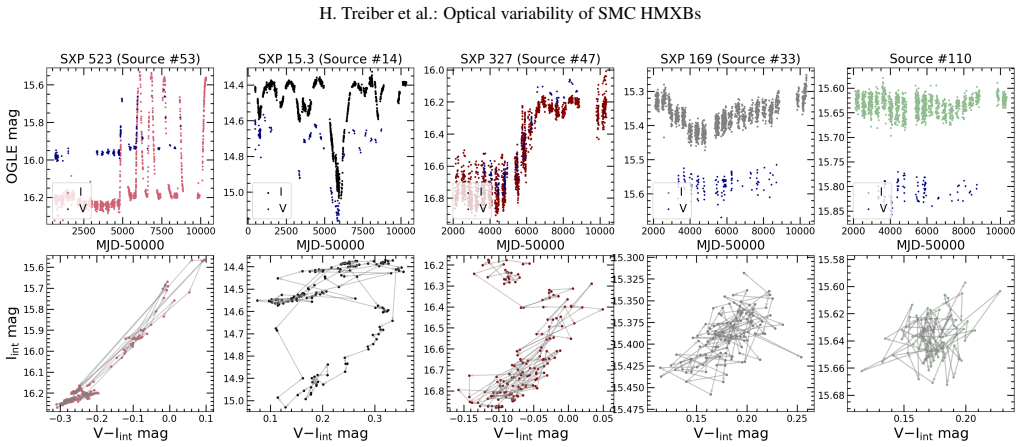
The taxonomy rests on two metrics computed from OGLE I-band light curves. The base number, $(\text{Max}\,I - \text{Median}\,I) - (\text{Median}\,I - \text{Min}\,I)$, uses the third-brightest and third-faintest points to measure whether a light curve returns to a consistent faint level (negative; flares) or a consistent bright level (positive; dips). The stochastic variability metric is the ratio of the standard deviation of the detrended light curve (spline-detrended with wotan's rspline, window 200, break tolerance 50) to that of the original data, measuring how much short-term variability remains after removing super-orbital signal. Cuts in this two-dimensional plane at base-number $-0.55$ and $0.15$ and stochastic-metric $0.40$ and $0.75$ define Types 1–5.
What would settle it
Recompute the stochastic variability metric for all 111 sources with a range of spline windows and break tolerances (e.g., windows from 100 to 400 days, tolerances from 20 to 200) and count how many sources cross the 0.40 or 0.75 cutoffs; if a substantial fraction move between Types 4 and 5, the taxonomy's boundary is an artifact of detrending. Alternatively, take a Type 1 source during a flare and a Type 2 source during a dip, obtain contemporaneous spectroscopy (H-alpha or V/R line profiles), and check whether the observed disk state matches the predicted growing-versus-depleting phase; a mismatch would refute the disk-growth interpretation.
Extended reading notes
Core claim
The central claim is that the base number and stochastic variability metric define a meaningful five-type taxonomy of super-orbital optical variability for SMC HMXBs, and that Types 1–3 can generally be interpreted as a relatively red Be decretion disk growing and depleting. Type 1 light curves have a faint blue baseline consistent with a nearly bare B star, with intermittent flares corresponding to disk growth events. Type 2 light curves return to a bright red level that represents the source's maximal disk, with dips corresponding to partial depletion. Type 3 sources show coherent variability without reaching either extreme. The paper further claims that Type 4 sources are longer-timescale versions of Type 2 that may show depletion events in future data, and that Type 5 sources, especially a faint blue cluster, may largely be interlopers rather than BeXRBs.
Load-bearing premise
The classification depends on the spline detrending used to remove super-orbital signal: if that detrending absorbs real coherent variability, sources would be misclassified across the Type 4/5 cutoffs, weakening the claimed links to spin and orbital periods.
Editorial extensions
If this is right
- Type 1 sources, with their bare-star baselines and near-identical ~1000-day flare spacings, can be used as a clean sample to study disk growth events in isolation.
- Type 2 bright red baselines mark each system's maximal disk; comparing H-alpha equivalent widths across Type 2 sources would directly test the truncation model.
- No SMC BeXRB shows a persistent super-orbital periodicity; quasi-periodic behavior is locally stable but changes over the ~8000-day baseline, so correlations between orbital and super-orbital periods should be treated with caution.
- Confident orbital periodicities are found in 25% of Type 2 and 41% of Type 3 sources but in none of the Type 1 sources, consistent with the idea that an extended disk is needed to produce an orbital signal.
- The faint blue cluster of Type 5 sources, if confirmed as interlopers, would revise the SMC HMXB census.
Reading between the lines
- The same two-metric plane could be computed for isolated Be stars in the SMC and LMC; comparing their distribution to the HMXB distribution would isolate the compact object's effect on the disk.
- Because the metrics are survey-agnostic, OGLE, TESS, ASAS-SN, and Rubin data could be placed on the same plane, offering a data-driven way to track type transitions as light curves lengthen.
- The claim that Type 4 sources become Type 2 after depletion events predicts a specific temporal sequence within individual light curves; a systematic search for such transitions in the existing OGLE data would test it.
- If Type 5 sources are mostly interlopers, then the remaining Type 5 BeXRBs may represent a distinct class of persistently stable disks, potentially probing the long end of the disk-growth timescale distribution.
Signed reviews
Editorial analysis
A structured set of objections, weighed in public.
Referee Report
Summary. Using OGLE II-IV I- and V-band light curves of 111 SMC HMXBs, the paper defines a five-type taxonomy of super-orbital optical variability based on two metrics: the 'base number' (difference between median brightness and the third-brightest/third-faintest points) and a 'stochastic variability metric' (ratio of spline-detrended to original standard deviation, computed with wotan rspline at window=200 and break_tolerance=50). Types 1-3 are interpreted as Be-disk growth/depletion states (faint blue base with flares; bright red maximum with dips; intermediate), while Types 4-5 are low-coherence states, with Type 5 possibly containing non-BeXRB interlopers. The paper also performs Lomb-Scargle period searches, reports 33 confident orbital-period candidates, validates the optical search against 24 X-ray orbital periods (75% same or harmonic), discusses CMD loops, and connects types to spin periods, colors, and H-alpha emission.
Significance. The paper's value is in presenting a large, homogeneous, publicly available dataset and a transparent attempt to systematize super-orbital variability of SMC HMXBs. The periodicity validation against X-ray periods and the use of external disk models (de Wit et al. 2006; Haubois et al. 2012) are strengths, as is the explicit acknowledgment that the taxonomy is a heuristic tool. If the taxonomy and its physical interpretation survive robustness checks, it would provide a useful population-level framework for connecting optical light-curve morphology to Be-disk state, orbital architecture, and NS spin. At present the central classification rests on reported but untested analysis choices, so the quantitative type-dependent correlations should be treated as provisional.
major comments (3)
- [Sect. 3, Table 1] Table 1 defines Types 1-3 as having a stochastic variability metric <0.35 and Type 4 as >0.40 and <0.75, leaving the interval 0.35-0.40 formally undefined. This conflicts with Table B.3, which lists sources with metrics of 0.36 (Source 5), 0.37 (Source 35), and 0.40 (Source 77) as Type 4. Please state the intended boundary and ensure Table 1, Fig. 1, and Table B.3 are mutually consistent; the discrepancy matters because sources in this interval sit exactly at the Type 3/4 transition.
- [Sect. 3, Sect. 5, Table 1] The stochastic variability metric, which sets the Type 3/4 and Type 4/5 boundaries, is explicitly sensitive to the spline-detrending choice (wotan rspline, window=200, break_tolerance=50; Sect. 5), but no sensitivity analysis is reported. A shorter window would absorb more real super-orbital signal and lower the metric, while a stiffer spline would leave coherent signal in the residuals and raise it. Several sources lie near the cutoffs (e.g., Source 44: metric 0.77; Source 5: 0.36; Source 77: 0.40; Source 58/SXP 756 has a 393-day modulation near the 200-day window). Please quantify how the type distribution, the confident-period fractions quoted in Sect. 7.3, and the Type 4/5 spin-period statistics in Sect. 7.4 change for plausible alternative values (e.g., window 100, 300, 400 days; break_tolerance 20, 100).
- [Sect. 5.5 (and Sect. 5.2)] The super-orbital periodicity search is described only as 'we checked for super-orbital periodicities,' but all period searches in Sect. 5 are otherwise performed on data detrended with a 200-day spline. If the same detrended light curves are used for the >200-day search, the spline would suppress exactly the signal being sought, making the conclusion that there are 'no true super-orbital periodicities' an artifact of the detrending. Please state explicitly whether original or detrended light curves were used for Sect. 5.5 and, if detrended, repeat the search on the original data (or with a very stiff spline), and report any peaks above the FAL.
minor comments (5)
- [Sect. 2] For the 21 sources with manual OGLE-IV calibration (median set to the prior median), please state how many lie within 0.1 in base number or 0.05 in stochastic metric of the nearest type boundary, since the median adjustment directly enters the base number definition.
- [Sect. 5.2] The confidence criteria (range/error >9, at least one-third of rolling periodogram peaks within 5%, mean phase change ≤2 bins) are described as chosen by visual inspection; reporting the distributions of these three metrics and the number of sources passing each cut would make the 'confident' list more reproducible.
- [Fig. 7 caption] The caption contains a typo: 'Savitzy-Golay' should be 'Savitzky-Golay'.
- [Sect. 7.4] The mean spin-period comparison between Type 2 (166 s) and Type 4 (743 s) is driven by a long-period tail; please report sample sizes and a significance test (e.g., two-sample KS test) before using it as evidence that Type 4 systems are longer-timescale versions of Type 2.
- [Sect. 3] In the transition analysis, please state the number of Type 1-3 sources used for the 84%/54% statistics and whether the 1000-day segments are independent, so the reader can assess the uncertainty on those fractions.
Circularity Check
No significant circularity; the taxonomy is an observational classification interpreted with external disk models and independent X-ray/periodic data.
full rationale
This paper is an observational taxonomy study; no derivation reduces to its own inputs. The two classifying metrics (base number and stochastic variability metric) are measured statistics of the OGLE light curves, and the five-type taxonomy is a cut-based classification, not a prediction fitted to the same target. The physical interpretation of Types 1-3 as red Be-disk growth/depletion is supported by color-magnitude behavior, external disk models (de Wit et al. 2006; Haubois et al. 2012), and external X-ray/EW/spin data, not by parameters fitted to the taxonomy. The paper explicitly acknowledges that the stochastic variability metric is sensitive to the detrending approach (Sect. 3) and that type cutoffs are somewhat arbitrary (Sect. 3; Sect. 5.2); these are robustness caveats, not circularity. The only self-citations (Treiber et al. 2021 for LXP 69.5 comparison; Treiber et al. 2024 for Source #84 periodicity) are supporting and non-load-bearing; the latter periodicity is independently re-derived in Table B.3. The exploratory reclassification of Type 1-3 quiescent segments using the same Fig. 1 definitions is explicitly framed as a consistency check (Sect. 3), not as evidence that the taxonomy is derived from itself. No uniqueness theorems or ansatz smuggled via self-citation appear. Score 1 reflects one minor self-reference, not circularity.
Assumptions & free parameters
free parameters (4)
- Base number taxonomy cutoffs =
-0.55 and 0.15 mag
- Stochastic variability metric cutoffs =
0.35, 0.40, and 0.75
- Spline detrending parameters =
wotan rspline window=200, break_tolerance=50
- Period confidence cutoffs =
FAL 0.001; range/error ratio >9; rolling peaks >=1/3 within 5%; phase stability <2 bins
assumptions (4)
- domain assumption All SMC sources are assumed to lie at a fixed distance of about 62 kpc.
- domain assumption Optical variability is dominated by the flux of the Be star plus its decretion disk, with the disk redder than the star.
- domain assumption The OGLE optical counterparts from Haberl and Sturm (2016) are the correct stellar counterparts of the X-ray sources.
- standard math Lomb-Scargle false alarm levels remain meaningful for red, correlated optical variability.
Cite this review
Pith. "Pith review of Two decades of optical variability of Small Magellanic Cloud high-mass X-ray binaries." pith.science (2026). https://pith.science/paper/TJC66NHG
@misc{pith2026250113147,
  author       = {Pith},
  title        = {Pith review of: Two decades of optical variability of Small Magellanic Cloud high-mass X-ray binaries},
  year         = {2026},
  howpublished = {\url{https://pith.science/paper/TJC66NHG}},
  note         = {Machine review of arXiv:2501.13147}
}
read the original abstract
We present an analysis of the long-term optical/IR behavior of 111 high-mass X-ray binaries (HMXBs) in the Small Magellanic Cloud based on data from the OGLE collaboration. Most systems exhibit variability on a range of time scales. This variability regulates the mass transfer to the compact object, while the compact object can, in turn, affect the donor star's behavior. To better understand this complex interaction and the resulting X-ray properties in these systems, we define a new taxonomy for the observed super-orbital variability. This taxonomy connects to the color changes, orbital periods, and X-ray behavior of the sources. In most cases, these properties can be explained by differences between the flux of the disk around the Be star and the flux from the star itself. We also refine and present new potential orbital periods and sub-orbital variability in the sources.
Figures


Figures from the paper (9 more)


Reference graph
Works this paper leans on
-
[1]
A., Alves, D
Alcock, C., Allsman, R. A., Alves, D. R., et al. 2001, MNRAS, 321, 678
2001
-
[2]
2009, ApJ, 707, 1080
Antoniou, V ., Hatzidimitriou, D., Zezas, A., & Reig, P. 2009, ApJ, 707, 1080
2009
-
[3]
J., Coe, M
Bird, A. J., Coe, M. J., McBride, V . A., & Udalski, A. 2012, MNRAS, 423, 3663
2012
-
[4]
M., Bird, A
Boon, C. M., Bird, A. J., Coe, M. J., et al. 2017, MNRAS, 466, 1149
2017
-
[5]
O., Coe, M
Brown, R. O., Coe, M. J., Ho, W. C. G., & Okazaki, A. T. 2019, MNRAS, 486, 3078
2019
-
[6]
2022, A&A, 661, A20
Carpano, S., Haberl, F., Maitra, C., et al. 2022, A&A, 661, A20
2022
-
[7]
2017, A&A, 602, A81 Article number, page 16 H
Carpano, S., Haberl, F., & Sturm, R. 2017, A&A, 602, A81 Article number, page 16 H. Treiber et al.: Optical variability of SMC HMXBs
2017
-
[8]
J., Bird, A
Coe, M. J., Bird, A. J., Hill, A. B., et al. 2014, The Astronomer’s Telegram, 5766, 1
2014
Show all 90 references
-
[9]
J., Edge, W
Coe, M. J., Edge, W. R. T., Galache, J. L., & McBride, V . A. 2005, MNRAS, 356, 502
2005
-
[10]
J., Kennea, J
Coe, M. J., Kennea, J. A., Gaudin, T. M., et al. 2023, The Astronomer’s Telegram, 16321, 1
2023
-
[11]
Coe, M. J. & Kirk, J. 2015, MNRAS, 452, 969
2015
-
[12]
J., Schurch, M., Corbet, R
Coe, M. J., Schurch, M., Corbet, R. H. D., et al. 2008, MNRAS, 387, 724
2008
-
[13]
J., Schurch, M., McBride, V
Coe, M. J., Schurch, M., McBride, V . A., et al. 2009, MNRAS, 394, 2191
2009
-
[14]
J., Udalski, A., Kennea, J
Coe, M. J., Udalski, A., Kennea, J. A., & Evans, P. A. 2021, MNRAS, 505, 4417
2021
-
[15]
Corbet, R. H. D. 1984, A&A, 141, 91
1984
-
[16]
Corbet, R. H. D., Markwardt, C. B., Marshall, F. E., et al. 2003, The As- tronomer’s Telegram, 163, 1
2003
-
[17]
& Ostriker, J
Davidson, K. & Ostriker, J. P. 1973, ApJ, 179, 585 de Wit, W. J., Lamers, H. J. G. L. M., Marquette, J. B., & Beaulieu, J. P. 2006, A&A, 456, 1027
1973
-
[18]
L., Corbet, R
Galache, J. L., Corbet, R. H. D., Coe, M. J., et al. 2008, ApJS, 177, 189
2008
-
[19]
M., Coe, M
Gaudin, T. M., Coe, M. J., Kennea, J. A., et al. 2024a, arXiv e-prints, arXiv:2408.01388
-
[20]
Gies, D. R. 2019, IAU Symposium, 346, 489
2019
-
[21]
B., et al
Graczyk, D., Pietrzy´nski, G., Thompson, I. B., et al. 2020, ApJ, 904, 13
2020
-
[22]
2018, The Astronomer’s Tele- gram, 12219, 1
Guillot, S., Vasilopoulos, G., Pasham, D., et al. 2018, The Astronomer’s Tele- gram, 12219, 1
2018
-
[23]
V ., Kniazev, A
Gvaramadze, V . V ., Kniazev, A. Y ., & Oskinova, L. M. 2019, MNRAS, 485, L6
2019
-
[24]
2023, A&A, 671, A90
Haberl, F., Maitra, C., Kaltenbrunner, D., et al. 2023, A&A, 671, A90
2023
-
[25]
& Sturm, R
Haberl, F. & Sturm, R. 2016, A&A, 586, A81
2016
-
[26]
1982, in Be Stars, ed
Harmanec, P., Horn, J., & Koubsky, P. 1982, in Be Stars, ed. M. Jaschek & H. G
1982
-
[27]
C., Rivinius, T., Okazaki, A
Haubois, X., Carciofi, A. C., Rivinius, T., Okazaki, A. T., & Bjorkman, J. E. 2012, ApJ, 756, 156
2012
-
[28]
J., Mulders, G
Hippke, M., David, T. J., Mulders, G. D., & Heller, R. 2019, AJ, 158, 143
2019
-
[29]
1982, in Be Stars, ed
Hirata, R. 1982, in Be Stars, ed. M. Jaschek & H. G. Groth, V ol. 98, 41–43
1982
-
[30]
Hubert, A. M. & Floquet, M. 1998, A&A, 335, 565 Ivezi´c, Ž., Kahn, S. M., Tyson, J. A., et al. 2019, ApJ, 873, 111
1998
-
[31]
K., Guillot, S., Ng, M., et al
Jaisawal, G. K., Guillot, S., Ng, M., et al. 2024, The Astronomer’s Telegram, 16636, 1
2024
-
[32]
A., Burrows, D
Kennea, J. A., Burrows, D. N., Coe, M. J., et al. 2015, The Astronomer’s Tele- gram, 8091, 1
2015
-
[33]
A., Coe, M
Kennea, J. A., Coe, M. J., Evans, P. A., et al. 2020, MNRAS, 499, L41
2020
-
[34]
A., Coe, M
Kennea, J. A., Coe, M. J., Gaudin, T., & Evans, P. A. 2024, The Astronomer’s Telegram, 16633, 1
2024
-
[35]
Z., Soszy´nski, I., et al
Kourniotis, M., Bonanos, A. Z., Soszy´nski, I., et al. 2014, A&A, 562, A125
2014
-
[36]
A., Evans, P
Krimm, H. A., Evans, P. A., Kennea, J. A., & Corbet, R. H. D. 2014, The As- tronomer’s Telegram, 5772, 1
2014
-
[37]
D., Whelan, D
Labadie-Bartz, J., Chojnowski, S. D., Whelan, D. G., et al. 2018, AJ, 155, 53
2018
-
[38]
V ., et al
Labadie-Bartz, J., Pepper, J., McSwain, M. V ., et al. 2017, AJ, 153, 252
2017
-
[39]
F., Hornschemeier, A
Lazzarini, M., Williams, B. F., Hornschemeier, A. E., et al. 2019, ApJ, 884, 2
2019
-
[40]
Lomb, N. R. 1976, Ap&SS, 39, 447
1976
-
[41]
2023, The Astronomer’s Tele- gram, 15886, 1
Maitra, C., Haberl, F., Kaltenbrunner, D., et al. 2023, The Astronomer’s Tele- gram, 15886, 1
2023
-
[42]
2024, arXiv e-prints, arXiv:2407.21371
Marino, A., Yang, H., Coti Zelati, F., et al. 2024, arXiv e-prints, arXiv:2407.21371
2024 arXiv
-
[43]
Martin, R. G. 2023, MNRAS, 523, L75
2023
-
[44]
G., Pringle, J
Martin, R. G., Pringle, J. E., Tout, C. A., & Lubow, S. H. 2011, MNRAS, 416, 2827
2011
-
[45]
C., Degioia-Eastwood, K., & Garmany, C
Massey, P., Lang, C. C., Degioia-Eastwood, K., & Garmany, C. D. 1995, ApJ, 438, 188
1995
-
[46]
A., Coe, M
McBride, V . A., Coe, M. J., Negueruela, I., Schurch, M. P. E., & McGowan, K. E. 2008, MNRAS, 388, 1198
2008
-
[47]
E., Coe, M
McGowan, K. E., Coe, M. J., Schurch, M., et al. 2007, MNRAS, 376, 759
2007
-
[48]
E., Coe, M
McGowan, K. E., Coe, M. J., Schurch, M. P. E., et al. 2008, MNRAS, 384, 821
2008
-
[49]
E., Pietrzy ´nski, G., Gieren, W., & Szewczyk, O
Mennickent, R. E., Pietrzy ´nski, G., Gieren, W., & Szewczyk, O. 2002, A&A, 393, 887
2002
-
[50]
A., Mushtukov, A
Mereminskiy, I. A., Mushtukov, A. A., Lutovinov, A. A., et al. 2022, A&A, 661, A33
2022
-
[51]
P., Bedin, L
Milone, A. P., Bedin, L. R., Piotto, G., & Anderson, J. 2009, A&A, 497, 755
2009
-
[52]
M., Coe, M
Monageng, I. M., Coe, M. J., Buckley, D. A. H., et al. 2020, MNRAS, 496, 3615
2020
-
[53]
E., Hasselquist, S., Peek, J
Murray, C. E., Hasselquist, S., Peek, J. E. G., et al. 2024, ApJ, 962, 120
2024
-
[54]
& Okazaki, A
Negueruela, I. & Okazaki, A. T. 2001, A&A, 369, 108
2001
-
[55]
T., Fabregat, J., et al
Negueruela, I., Okazaki, A. T., Fabregat, J., et al. 2001, A&A, 369, 117
2001
-
[56]
2023, A&A, 677, A134
Neumann, M., Avakyan, A., Doroshenko, V ., & Santangelo, A. 2023, A&A, 677, A134
2023
-
[57]
Okazaki, A. T. 1991, PASJ, 43, 75
1991
-
[58]
T., Bate, M
Okazaki, A. T., Bate, M. R., Ogilvie, G. I., & Pringle, J. E. 2002, MNRAS, 337, 967
2002
-
[59]
Okazaki, A. T. & Kato, S. 1985, PASJ, 37, 683
1985
-
[60]
Okazaki, A. T. & Negueruela, I. 2001, A&A, 377, 161
2001
-
[61]
2002, ApJ, 574, 364 Pietrzy´nski, G., Graczyk, D., Gallenne, A., et al
Pfahl, E., Rappaport, S., Podsiadlowski, P., & Spruit, H. 2002, ApJ, 574, 364 Pietrzy´nski, G., Graczyk, D., Gallenne, A., et al. 2019, Nature, 567, 200
2002
-
[62]
S., Bjorkman, J
Quirrenbach, A., Bjorkman, K. S., Bjorkman, J. E., et al. 1997, ApJ, 479, 477
1997
-
[63]
F., Charles, P
Rajoelimanana, A. F., Charles, P. A., & Udalski, A. 2011, MNRAS, 413, 1600
2011
-
[64]
& Fabregat, J
Reig, P. & Fabregat, J. 2022, A&A, 667, A18
2022
-
[65]
Reig, P., Fabregat, J., & Coe, M. J. 1997, A&A, 322, 193
1997
-
[66]
& Roche, P
Reig, P. & Roche, P. 1999, MNRAS, 306, 100
1999
-
[67]
R., Winn, J
Ricker, G. R., Winn, J. N., Vanderspek, R., et al. 2014, in Society of Photo- Optical Instrumentation Engineers (SPIE) Conference Series, V ol. 9143, Space Telescopes and Instrumentation 2014: Optical, Infrared, and Millime- ter Wave, ed. J. Oschmann, Jacobus M., M. Clampin, G...
2014
-
[68]
2003, A&A, 411, 229
Rivinius, T., Baade, D., & Štefl, S. 2003, A&A, 411, 229
2003
-
[69]
2001, A&A, 369, 1058
Rivinius, T., Baade, D., Štefl, S., et al. 2001, A&A, 369, 1058
2001
-
[70]
C., & Martayan, C
Rivinius, T., Carciofi, A. C., & Martayan, C. 2013, A&A Rev., 21, 69
2013
-
[71]
J., & Schmidtke, P
Sarraj, I., Sanders, R. J., & Schmidtke, P. C. 2012, Information Bulletin on Vari- able Stars, 6030, 1
2012
-
[72]
& Golay, M
Savitzky, A. & Golay, M. J. E. 1964, Analytical Chemistry, 36, 1627
1964
-
[73]
Scargle, J. D. 1982, ApJ, 263, 835
1982
-
[74]
C., Cowley, A
Schmidtke, P. C., Cowley, A. P., & Udalski, A. 2013, MNRAS, 431, 252
2013
-
[75]
C., Cowley, A
Schmidtke, P. C., Cowley, A. P., & Udalski, A. 2015, The Astronomer’s Tele- gram, 7498, 1
2015
-
[76]
C., Cowley, A
Schmidtke, P. C., Cowley, A. P., & Udalski, A. 2022, Research Notes of the American Astronomical Society, 6, 164
2022
-
[77]
1972, ApJ, 178, L71
Schreier, E., Giacconi, R., Gursky, H., Kellogg, E., & Tananbaum, H. 1972, ApJ, 178, L71
1972
-
[78]
Schurch, M. P. E., Coe, M. J., Galache, J. L., et al. 2009, MNRAS, 392, 361
2009
-
[79]
Z., et al
Shappee, B., Prieto, J., Stanek, K. Z., et al. 2014, in American Astronomical So- ciety Meeting Abstracts, V ol. 223, American Astronomical Society Meeting Abstracts #223, 236.03
2014
-
[80]
E., Guillot, S., Vasilopoulos, G., et al
Strohmayer, T. E., Guillot, S., Vasilopoulos, G., et al. 2018, The Astronomer’s Telegram, 12222, 1
2018
-
[81]
D., & Udalski, A
Treiber, H., Haberl, F., Vasilopoulos, G., Bailyn, C. D., & Udalski, A. 2024, The Astronomer’s Telegram, 16638, 1
2024
-
[82]
D., et al
Treiber, H., Vasilopoulos, G., Bailyn, C. D., et al. 2021, MNRAS, 503, 6187
2021
-
[83]
1992, Acta Astron., 42, 253
Udalski, A., Szymanski, M., Kaluzny, J., Kubiak, M., & Mateo, M. 1992, Acta Astron., 42, 253
1992
-
[84]
K., Soszynski, I., & Poleski, R
Udalski, A., Szymanski, M. K., Soszynski, I., & Poleski, R. 2008, Acta Astron., 58, 69
2008
-
[85]
K., & Szyma´nski, G
Udalski, A., Szyma´nski, M. K., & Szyma´nski, G. 2015, Acta Astron., 65, 1
2015
-
[86]
K., Maitra, C., et al
Vasilopoulos, G., Jaisawal, G. K., Maitra, C., et al. 2022, A&A, 664, A194
2022
-
[87]
2017, MNRAS, 470, 4354
Vasilopoulos, G., Zezas, A., Antoniou, V ., & Haberl, F. 2017, MNRAS, 470, 4354
2017
-
[88]
A., Fabregat, J., & Coburn, W
Wilson, C. A., Fabregat, J., & Coburn, W. 2005, ApJ, 620, L99
2005
-
[89]
N., Chen, W., Pan, X., et al
Yang, H. N., Chen, W., Pan, X., et al. 2024, The Astronomer’s Telegram, 16631, 1
2024
-
[90]
confident
Zamanov, R. K., Reig, P., Martí, J., et al. 2001, A&A, 367, 884 Article number, page 17 A&A proofs: manuscript no. arxiv Appendix A: Light curve and color-magnitude gallery Appendix B: Long data tables Article number, page 18 H. Treiber et al.: Optical variability of SMC HMXBs...
2016
Reviewed August 10, 2026 · model on record in the stance chip above.
Discussion (0). Continue with ORCID to comment.