REVIEW 4 major objections 5 minor 28 references
AgentRec: Agent Recommendation Using Sentence Embeddings Aligned to Human Feedback
T0 review · 4 major / 5 minor · reviewed 2026-08-10 · deepseek-v4-flash
Pith's one-line read AgentRec is an architecture that decides which LLM agent should handle a natural-language prompt by encoding the prompt as a sentence embedding and comparing it against per-agent corpora; on its synthetic benchmark it reaches 92.2% top-1…
desk verdict Legitimate new application of sentence-embedding routing, but the headline accuracy is test-set tuned and the RLHF claim is unsubstantiated. read the letter →
The pith
A machine-rendered reading of the paper's core claim, the machinery that carries it, and where it could break.
The reading
What carries the argument
The central mechanism is the sentence-embedding similarity matcher: a Sentence-BERT (SBERT) encoder maps each user prompt into a vector, while per-agent corpora of prompts are encoded and cached. A query is rephrased via rephrase-and-respond, encoded with the same encoder, and scored against each corpus by the logarithm of the generalized p-mean of cosine similarities. Fine-tuning with BatchAllTripletLoss makes same-agent prompts closer, and RLHF aligns the embedding geometry with human feedback. The generalized p-mean with $p=200$ is the object that makes the numbers work: by accentuating high-confidence similar and dissimilar scores, it turns a noisy nearest-neighbor search into reliable routing.
What would settle it
Collect a log of real user prompts to an operating multi-agent system with ground-truth agent labels, run AgentRec on it, and compare top-1 accuracy; if accuracy on the real distribution falls substantially below the 92.2% synthetic figure, the practical-accuracy claim is falsified.
Extended reading notes
Core claim
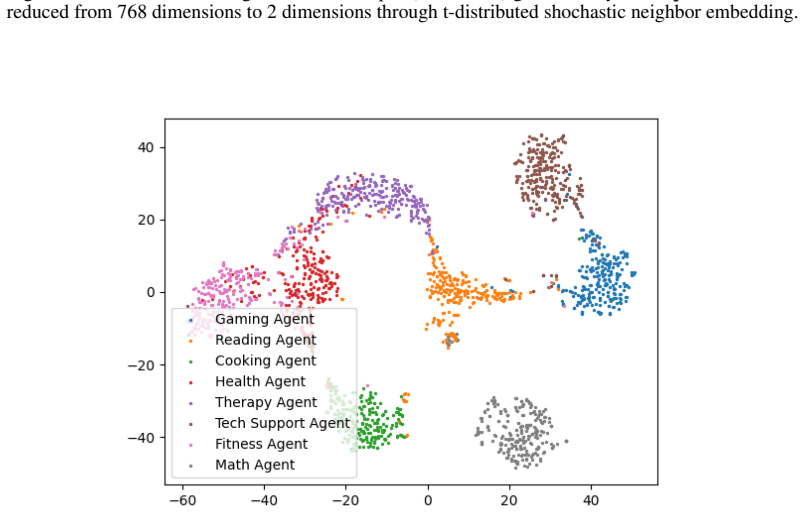
AgentRec's central claim is that encoding natural-language prompts as sentence embeddings and comparing them to cached embedding corpora for each agent provides an effective, efficient, and human-aligned agent recommender. The paper demonstrates that fine-tuning a base SBERT model with triplet loss and then applying RLHF yields separable clusters for eight agents, so a query's nearest neighbors identify the right agent. The scoring uses a logarithmic generalized p-mean with $p=200$, which amplifies extreme cosine similarities; this choice lifts accuracy from 90.05% (arithmetic mean) to 92.2%. The system also uses rephrase-and-respond to standardize variable-length prompts, making the first-sentence restriction of SBERT less limiting.
Load-bearing premise
The whole 92.2% figure rests on the assumption that single-sentence prompts generated synthetically by Llama-3.1-8B mimic the prompts real users will send to a multi-agent LLM system; the authors state that a lack of real-world data prevents them from assessing real-world impact.
Editorial extensions
If this is right
- Multi-agent systems can route to specialized agents without rigid pipelines, because AgentRec accepts arbitrary natural-language prompts after rephrasing.
- Because embeddings can be cached, adding a new agent only requires generating prompts for it and encoding them, not retraining the full system.
- The reward-model stage lets system builders optimize agent choice for arbitrary metrics, not just classification accuracy.
- Recommendations take under 300 milliseconds per prompt on a single GPU, making real-time routing feasible.
- The synthetic dataset and code are released, so the benchmark can be reproduced and extended by other researchers.
Reading between the lines
- A natural extension the authors leave implicit is testing AgentRec on real user traffic to multi-agent systems, since the paper itself flags the absence of real-world data as a limit on assessing real-world impact.
- The $p=200$ scoring choice suggests a cheap empirical lever: varying $p$ trades off precision and sensitivity, and other central-tendency measures could be explored for domains with different similarity distributions.
- A testable extension would be to use the reward model to inject domain-specific constraints such as safety or latency into the embedding geometry, going beyond the human-preference alignment shown here.
- Because the method is class-agnostic, it may transfer to other text-routing tasks such as email triage or customer-support ticket assignment.
Editorial analysis
A structured set of objections, weighed in public.
Referee Report
Summary. The paper proposes AgentRec, a method for routing natural-language prompts to one of several LLM agents. The architecture encodes prompts and agent-corpus prompts with a Sentence-BERT encoder, fine-tunes the encoder with triplet loss on a synthetic dataset of 10,000 single-sentence prompts for eight agents, and then recommends the agent whose corpus has the highest logarithmic generalized p-mean of cosine similarities. The authors report a top-1 test accuracy of 92.2% with per-prompt latency under 300 ms and claim that the model is cheap, adaptive, interpretable, and controllable through RLHF. The code and synthetic dataset are open-sourced.
Significance. If the reported accuracy and efficiency hold under proper evaluation, AgentRec would be a useful, simple baseline for agent routing in multi-agent LLM systems. The paper addresses a real problem, and the open-sourced dataset and code are a concrete contribution to a task that has not been widely standardized. The strongest parts are the clean formulation of agent recommendation as a sentence-similarity problem and the use of cached embeddings for low-latency inference. However, the paper's central claims are currently supported by a single synthetic benchmark with test-set-based model selection, no external baselines, and an RLHF component that is described but not demonstrated. The significance would be substantially increased by honest validation, comparisons, and either real human feedback or removal of the RLHF claim.
major comments (4)
- [3.1, Score Function] The headline accuracy of 92.2% is obtained after selecting the score-function parameter p=200 on the same test set used to report the final number. Section 3.1 first reports that 'preliminary testing' identified the mean as promising and then lists arithmetic mean (90.05%), geometric mean (61.05%), and p=200 (92.2%) without any validation split or model-selection procedure. As a result, the 92.2% figure is an optimistic estimate of generalization, and the claimed advantage of generalized p-means over the arithmetic mean could shrink or reverse under honest selection. Please use a held-out validation set to select p and the pooling scheme, report nested cross-validation, and provide confidence intervals over multiple data-generation and fine-tuning seeds.
- [3.2, RLHF] The abstract, introduction, and Section 3.2 claim that recommendations are 'aligned to human values through reinforcement learning from human feedback,' but the manuscript contains no human feedback data, no reward-model training details, no RLHF algorithm or loss, and no comparison of the policy before and after RLHF. The only information given is that a reward-model dataset of N=2000 prompts exists and that the training pipeline takes about 20 minutes. This is a central advertised component of the method, yet it is not evaluated anywhere in the paper. The authors should either provide a full RLHF experiment with reward-model and policy details or remove the RLHF claims from the title, abstract, and method description.
- [2 and 3.3, Evaluation] The evaluation is entirely on a synthetic dataset of single-sentence prompts generated by Llama-3.1-8B, and Section 3.3 explicitly concedes that a lack of real-world data prevents assessing real-world impact. Since the stated purpose is routing prompts in real multi-agent LLM systems, this admission is load-bearing: the 92.2% accuracy is only measured on the same generation distribution used for training. The paper should add a domain-shift evaluation, for example using public real-user prompt datasets, multi-sentence prompts processed with RaR, or held-out agent domains, and should report per-agent accuracy, especially for the overlapping health and fitness agents.
- [4, Results] No external baselines are reported. The paper compares score functions within a single architecture but does not compare against a standard multi-class classifier on the same embeddings (e.g., logistic regression), a k-nearest-neighbor classifier on the raw SBERT embeddings, or an LLM-based router. Without such comparisons, the assertion that AgentRec is preferable to 'traditional classification methods' is unsupported, and it is impossible to tell how much of the 92.2% accuracy comes from the fine-tuning, the generalized p-mean score, or simply the separability of the synthetic task.
minor comments (5)
- [2, Dataset] The description of top-k sampling says 'we set the probability of any candidate out of the top k=50 likely next tokens in the LLM to 0,' which appears to be backwards; the intent is presumably to zero out candidates not in the top k. The equation also uses a set K that is never defined.
- [3.1, Score Function] The sentence 'any exponentiation of numbers farther from the extremes of the range will reduce the impact of moderate numbers closer to 0, whereas multiplication will increase the impact of moderate numbers' is confusing and appears to mix up exponentiation and multiplication; please clarify the intended monotonicity argument.
- [3.3 and 4, Results] The paper reports that a higher learning rate without RLHF reaches 93.55% top-1 accuracy but then presents 92.2% as the final result. The relationship between these numbers, the final checkpoint selection, and the role of RLHF in the final model should be stated explicitly.
- [3, Architecture] The use of 'rephrase and respond' (RaR) is introduced but never evaluated. Since RaR adds latency and may change the prompt distribution, the paper should either report the accuracy/latency with and without RaR or describe it as a recommended preprocessing step rather than part of the measured system.
- [A, Additional Visualizations] The appendix contains a typo: 'shochastic neighbor embedding' should be 'stochastic neighbor embedding.'
Circularity Check
Headline accuracy 92.2% is selected on the test set rather than predicted; the score-function parameter p=200 and the pooling choice were both chosen by maximizing top-1 test accuracy on the same split.
-
fitted input called prediction
[Section 3.1 (Score Function)]
"During preliminary testing, it was found that comparing the mean of the cosine similarity values of each corpus results in the highest top-1 test accuracies. ... With a value of p= 200 —which accentuates the extreme cosine similarity scores to a high degree—we were able to produce a top-1 accuracy rating of92.2%."
The reported 92.2% is not an independent evaluation of AgentRec but the maximum over score functions (arithmetic mean 90.05%, geometric mean 61.05%, p=200 92.2%) computed on the same test split. Because p=200 and the mean-pooling design were selected by comparing top-1 test accuracy on this split, the headline number is an optimistically biased selection statistic, not a prediction. The paper reports no validation split or correction for multiple comparisons, so the central quantitative claim reduces to 'the best test-set number among the variants tried.'
full rationale
The paper's contribution is a recommendation architecture and a synthetic benchmark. The architecture itself is a straightforward extension of SBERT with cosine similarity and generalized p-mean pooling, and most of the derivation (embedding, caching, cosine similarity) is self-contained and not circular. However, the load-bearing empirical claim—top-1 test accuracy of 92.2%—is compromised by test-set selection: Section 3.1 states that the arithmetic-mean score function was chosen because it 'results in the highest top-1 test accuracies' during preliminary testing, and then reports that p=200 'produce[s] a top-1 accuracy rating of 92.2%' on the same test split. No validation split or model-selection procedure is described, so the accuracy is a selected maximum rather than a prediction. This is a fitted-input-called-prediction pattern and it is load-bearing because the abstract, introduction, and results all advertise the 92.2% figure. The paper's own limitation note in Section 3.3 (lack of real-world data prevents assessing real-world impact) is honest but does not repair the test-set selection issue. No other circularity was found: the SBERT and RLHF components are cited to external prior work, and the self-citations (OpenAGI, AIOS) are contextual, not load-bearing.
Assumptions & free parameters
free parameters (3)
- p exponent in generalized p-mean score function =
200
- Pooling function choice (arithmetic vs geometric vs max) =
arithmetic / p=200
- LLM generation hyperparameters for synthetic data =
top-k=50, nucleus p=0.95, repetition penalty=1.2, temperature=0.6
assumptions (3)
- domain assumption The synthetic dataset is representative of real user prompts for these eight agents.
- domain assumption SBERT fine-tuned with triplet loss produces embeddings where nearest-neighbor matches agent identity.
- ad hoc to paper RLHF with a reward model trained on 2,000 prompts aligns recommendations to human values.
Cite this review
Pith. "Pith review of AgentRec: Agent Recommendation Using Sentence Embeddings Aligned to Human Feedback." pith.science (2026). https://pith.science/paper/XGZZQ3L7
@misc{pith2026250113333,
  author       = {Pith},
  title        = {Pith review of: AgentRec: Agent Recommendation Using Sentence Embeddings Aligned to Human Feedback},
  year         = {2026},
  howpublished = {\url{https://pith.science/paper/XGZZQ3L7}},
  note         = {Machine review of arXiv:2501.13333}
}
read the original abstract
Multi-agent systems must decide which agent is the most appropriate for a given task. We propose a novel architecture for recommending which LLM agent out of many should perform a task given a natural language prompt by extending the Sentence-BERT (SBERT) encoder model. On test data, we are able to achieve a top-1 accuracy of 92.2% with each classification taking less than 300 milliseconds. In contrast to traditional classification methods, our architecture is computationally cheap, adaptive to new classes, interpretable, and controllable with arbitrary metrics through reinforcement learning. By encoding natural language prompts into sentence embeddings, our model captures the semantic content relevant to recommending an agent. The distance between sentence embeddings that belong to the same agent is then minimized through fine-tuning and aligned to human values through reinforcement learning from human feedback. This allows the classification of natural language prompts based on their nearest neighbors by measuring the cosine similarity between embeddings. This work is made possible through the generation of a synthetic dataset for agent recommendation, which we have open-sourced to the public along with the code for AgentRec recommendation system at https://github.com/joshprk/agentrec.
Figures


Figures from the paper (5 more)




Reference graph
Works this paper leans on
-
[1]
T. Abramovich, M. Udeshi, M. Shao, K. Lieret, H. Xi, K. Milner, S. Jancheska, J. Y ang, C. E. Jimenez, F. Khorrami, P . Krishnamurthy, B. Dolan-Gavitt, M. Shaque, K. Narasimhan, R. Karri, and O. Press. Enigma: Enhanced interactive generative model agent for ctf challenges,
- [2]
-
[3]
T. B. Brown, B. Mann, N. Ryder, M. Subbiah, J. Kaplan, P . Dhariwal, A. Neelakantan, P . Shyam, G. Sastry, A. Askell, S. Agarwal, A. Herbert-V oss, G. Krueger, T. Henighan, R. Child, A. Ramesh, D. M. Ziegler, J. Wu, C. Winter, C. Hesse, M. Chen, E. Sigler, M. Litwin, S. Gray, B. Chess, J. Clark, C. Berner, S. McCandlish, A. Radford, I. Sutskever, and D. A...
arXiv 2020
-
[4]
F. Chollet. On the measure of intelligence, 2019. URL https://arxiv.org/abs/1911. 01547
work page 2019
-
[5]
H. W. Chung, L. Hou, S. Longpre, B. Zoph, Y . Tay, W. Fedus, Y . Li, X. Wang, M. Dehghani, S. Brahma, et al. Scaling instruction-netuned language models, 2022. URL https://arxiv. org/abs/2210.11416
arXiv 2022
-
[6]
Y . Deng, W. Zhang, Z. Chen, and Q. Gu. Rephrase and respond: Let large language models ask better questions for themselves, 2024. URLhttps://arxiv.org/abs/2311.04205
arXiv 2024
-
[7]
A. Fan, M. Lewis, and Y . Dauphin. Hierarchical neural story generation, 2018. URL https: //arxiv.org/abs/1805.04833
arXiv 2018
-
[8]
Y . Ge, W. Hua, K. Mei, J. Ji, J. Tan, S. Xu, Z. Li, and Y . Zhang. Openagi: When llm meets domain experts, 2023. URLhttps://arxiv.org/abs/2304.04370
arXiv 2023
Show all 28 references
-
[9]
Grattaori, A
A. Grattaori, A. Dubey, A. Jauhri, A. Pandey, A. Kadian, A. Al-Dahle, A. Letman, A. Mathur, A. Schelten, A. V aughan, et al. The llama 3 herd of models, 2024. URL https://arxiv.org/ abs/2407.21783
2024 arXiv
-
[10]
Gunasekar, Y
S. Gunasekar, Y . Zhang, J. Aneja, C. C. T. Mendes, A. D. Giorno, S. Gopi, M. Javaheripi, P . Kauffmann, G. de Rosa, O. Saarikivi, A. Salim, S. Shah, H. S. Behl, X. Wang, S. Bubeck, R. Eldan, A. T. Kalai, Y . T. Lee, and Y . Li. Textbooks are all you need, 2023. URL https: //a...
2023 arXiv
-
[11]
Holtzman, J
A. Holtzman, J. Buys, L. Du, M. Forbes, and Y . Choi. The curious case of neural text degeneration, 2020. URLhttps://arxiv.org/abs/1904.09751
2020 arXiv
-
[12]
Huang, T
Y . Huang, T. Gao, H. Xu, Q. Zhao, Y . Song, Z. Gui, T. Lv, H. Chen, L. Cui, S. Li, and F. Wei. Peace: Empowering geologic map holistic understanding with mllms, 2025. URL https://arxiv.org/abs/2501.06184
2025 arXiv
-
[13]
Lewis, E
P . Lewis, E. Perez, A. Piktus, F. Petroni, V . Karpukhin, N. Goyal, H. Küttler, M. Lewis, W. tau Yih, T. Rocktäschel, S. Riedel, and D. Kiela. Retrieval-augmented generation for knowledge- intensive nlp tasks, 2021. URLhttps://arxiv.org/abs/2005.11401
2021 arXiv
-
[14]
G. Marcus. The next decade in ai: Four steps towards robust articial intelligence, 2020. URL https://arxiv.org/abs/2002.06177
2020 arXiv
-
[15]
K. Mei, X. Zhu, W. Xu, W. Hua, M. Jin, Z. Li, S. Xu, R. Y e, Y . Ge, and Y . Zhang. Aios: Llm agent operating system, 2024. URLhttps://arxiv.org/abs/2403.16971
2024 arXiv
-
[16]
Ouyang, J
L. Ouyang, J. Wu, X. Jiang, D. Almeida, C. L. Wainwright, P . Mishkin, C. Zhang, S. Agarwal, K. Slama, A. Ray, J. Schulman, J. Hilton, F. Kelton, L. Miller, M. Simens, A. Askell, P . Welinder, P . Christiano, J. Leike, and R. Lowe. Training language models to follow instructio...
2022 arXiv
-
[17]
S. J. Prince.Understanding Deep Learning. The MIT Press, 2023. URL http://udlbook. com
2023
-
[18]
S. Qi, Z. Cao, J. Rao, L. Wang, J. Xiao, and X. Wang. What is the limitation of multimodal llms? a deeper look into multimodal llms through prompt probing.Inf. Process. Manag., 60(6): 103510, November 2023. URLhttps://doi.org/10.1016/j.ipm.2023.103510
2023
-
[19]
Reimers and I
N. Reimers and I. Gurevych. Sentence-bert: Sentence embeddings using siamese bert-networks,
-
[20]
Sahoo, A
P . Sahoo, A. K. Singh, S. Saha, V . Jain, S. Mondal, and A. Chadha. A systematic survey of prompt engineering in large language models: Techniques and applications, 2024. URL https://arxiv.org/abs/2402.07927
2024 arXiv
-
[21]
Schick, J
T. Schick, J. Dwivedi-Y u, R. Dessì, R. Raileanu, M. Lomeli, L. Zettlemoyer, N. Cancedda, and T. Scialom. Toolformer: Language models can teach themselves to use tools, 2023. URL https://arxiv.org/abs/2302.04761
2023 arXiv
-
[22]
K. Song, X. Tan, T. Qin, J. Lu, and T.-Y . Liu. Mpnet: Masked and permuted pre-training for language understanding, 2020. URLhttps://arxiv.org/abs/2004.09297
2020 arXiv
-
[23]
V aswani, N
A. V aswani, N. Shazeer, N. Parmar, J. Uszkoreit, L. Jones, A. N. Gomez, L. Kaiser, and I. Polosukhin. Attention is all you need, 2023. URL https://arxiv.org/abs/1706.03762
2023 arXiv
-
[24]
J. Wei, X. Wang, D. Schuurmans, M. Bosma, B. Ichter, F. Xia, E. Chi, Q. Le, and D. Zhou. Chain-of-thought prompting elicits reasoning in large language models, 2023. URL https: //arxiv.org/abs/2201.11903
2023 arXiv
-
[25]
Q. Xu, F. Hong, B. Li, C. Hu, Z. Chen, and J. Zhang. On the tool manipulation capability of open-source large language models, 2023. URLhttps://arxiv.org/abs/2305.16504
2023 arXiv
-
[26]
Y ang, C
J. Y ang, C. E. Jimenez, A. Wettig, K. Lieret, S. Y ao, K. R. Narasimhan, and O. Press. SWE- agent: Agent-computer interfaces enable automated software engineering. InThe Thirty- eighth Annual Conference on Neural Information Processing Systems, 2024. URL https: //arxiv.org/ab...
2024 arXiv
-
[2019]
URLhttps://arxiv.org/abs/1908.10084
1908 arXiv
-
[2024]
URLhttps://arxiv.org/abs/2409.16165
Reviewed August 10, 2026 · model on record in the stance chip above.
Discussion (0). Continue with ORCID to comment.