REVIEW 3 major objections 5 minor 2 cited by
Cataclysmic Variables in Triples: Formation Models and New Discoveries
T0 review · 3 major / 5 minor · reviewed 2026-08-10 · deepseek-v4-flash
Pith's one-line read The paper argues that a substantial fraction of cataclysmic variables form in triple-star systems via the eccentric Kozai-Lidov mechanism, with many bypassing common-envelope evolution entirely.
desk verdict First real census of CVs in wide triples, with a plausible but not yet load-bearing no-common-envelope fraction; the observations are the strongest part. read the letter →
The pith
A machine-rendered reading of the paper's core claim, the machinery that carries it, and where it could break.
The reading
What carries the argument
The load-bearing object is the eccentric Kozai-Lidov (EKL) mechanism: a distant tertiary's secular torque drives the inner binary's eccentricity and inclination through coupled oscillations, and at extreme eccentricities the periastron distance can shrink to a few solar radii, where tides and mass transfer tighten the orbit. The paper couples this to stellar evolution through SSE tracks, to binary mass transfer through COSMIC with a Rappaport-style magnetic braking prescription, and to equilibrium tides that circularize the inner orbit when it shrinks. The central simplification is that once the inner binary crosses its Roche limit it is decoupled from the tertiary and handed to COSMIC, which circularizes the orbit instantly at the onset of mass transfer.
What would settle it
A volume-limited sample of nearby CVs imaged at high angular resolution that finds essentially no tertiary companions at 10–500 au would contradict the prediction that about 30% of CV tertiaries reside there; alternatively, if such a sample shows no excess of CVs with birth periods of 8–20 hours, the dominant eccentric Kozai-Lidov, no-common-envelope channel would be ruled out.
Extended reading notes
Core claim
On the paper's own terms, the central discovery is that triple-star dynamics are a first-order ingredient in CV formation. The observed sample of 49 CVs with resolved Gaia tertiaries at 150–30,000 au implies a lower-limit tertiary fraction of about 10% for CVs within 150 pc. In a population synthesis of 2,000 hierarchical triples, 47 inner binaries become CVs; seven of these (15% in Section 4.2.1, quoted as 20% in the abstract and conclusions) begin stable mass transfer only after the primary has already become a white dwarf, meaning they never went through a common envelope. Another roughly 60% of the CV-forming triples would not have produced a CV at all if the tertiary were removed, and about half of the common-envelope-forming cases owe their interaction to the tertiary's eccentricity forcing. The simulated and observed populations agree that CV tertiaries are systematically wider than field wide binaries, because stable triples need wide outer orbits to host the initially wide inner binaries that feed the eccentric Kozai-Lidov channel.
Load-bearing premise
The simulations assume that the inner binary instantly circularizes when mass transfer begins, ignoring the eccentric mass transfer that the EKL channel itself produces, and the paper notes that self-consistent eccentric mass transfer could change which systems survive to become CVs.
Editorial extensions
If this is right
- Isolated-binary common-envelope models are incomplete: the triple channel contributes a non-negligible minority of CVs, and about half of the common-envelope systems that form in triples would not have interacted without the tertiary.
- CVs formed through the triple channel should be born at longer orbital periods (8–20 hr) with more evolved or massive donors, then evolve to shorter periods; observed CVs with tertiaries already show a period excess.
- CV triples should be wider on average than field wide binaries; the observed 150–30,000 au separations match the simulations, so wide outer orbits are a fingerprint of triple formation.
- About 30% of CV tertiaries are predicted to lie within 500 au, below Gaia's resolution for most of the sample; high-resolution imaging should uncover them.
- The same eccentric Kozai-Lidov, no-common-envelope machinery applies to related populations, including ultracompact binaries and low-mass X-ray binaries, making CVs a testbed for triple formation channels.
Reading between the lines
- I would infer that the 15–20% no-common-envelope fraction is a lower bound if eccentric mass transfer proves more dissipative than instant circularization, since eccentricity would be damped gradually rather than all at once.
- The predicted roughly 4.7×10^5 Galactic CV triples implies that a few percent of all CVs formed through triples, but this hinges on the assumed binary-to-triple ratio; if triples are rarer or wider, the number drops.
- A direct test of the EKL channel is to look for faint white-dwarf tertiaries: the models predict many such companions that Gaia misses, and deep ultraviolet or blue imaging of nearby CVs should reveal them.
- The same eccentricity-forcing channel that makes CVs without a common envelope likely operates for black-hole X-ray binaries, so the CV population is a statistical probe of that rarer channel.
Editorial analysis
A structured set of objections, weighed in public.
Referee Report
Summary. The manuscript constructs a sample of 49 CVs with wide Gaia-resolved tertiaries within 1 kpc, derives an observational lower limit for the CV triple fraction, evolves 2000 hierarchical triples with three-body dynamics and stellar evolution, and compares the simulated CV population to the observed one. It concludes that a significant fraction of CVs in triples form without a common envelope via the eccentric Kozai-Lidov mechanism and that observed CV triples are wider than typical wide binaries, as predicted.
Significance. The paper delivers a new, carefully validated sample of ~50 CVs with wide tertiary companions and a detailed population-synthesis study of CV formation in triples. If the conclusions hold, the work demonstrates that isolated-binary common-envelope models are incomplete for a nontrivial fraction of the CV population and connects CV formation to the broader EKL-driven binary-evolution literature. The observational analysis uses explicit chance-alignment probabilities, and the simulations are not fit to the observed sample, making the predicted wider tertiary separations and longer periods falsifiable. The main quantitative claims, however, contain an internal inconsistency and rely on an assumption the authors themselves identify as potentially qualitatively wrong.
major comments (3)
- [Abstract and Section 4.2.1] The abstract and conclusion state that 20% of CVs in triples form without a common envelope, but Section 4.2.1 explicitly reports 7 out of 47 systems, i.e., 15%, as the fraction that never experience a common envelope. This is a direct numerical inconsistency in a headline result. Please adopt one number throughout and justify the denominator used to compute the percentage, or explain how 20% is derived if 7/47 is not the intended fraction.
- [Section 3.1 and Section 4.2.1] The no-CE channel is supported by only four simulated systems that begin WD+MS mass transfer on wide (a1 ~ 10^3 au), extremely eccentric (e1 ~ 0.9999) orbits and are then handed to COSMIC, which instantaneously circularizes the orbit at the onset of mass transfer. Section 5 concedes that this neglect of eccentric mass transfer "can lead to qualitatively different outcomes." For such near-radial encounters, a self-consistent treatment could plausibly produce mergers or failed captures, removing up to four of the seven no-CE systems and lowering the no-CE fraction from 15% to about 6%. Because this fraction is a central claim, please either include an eccentric mass-transfer prescription (e.g., Sepinsky et al. 2009; Hamers & Dosopoulou 2019; Glanz & Perets 2021) in the simulations, or present a dedicated numerical test of the survival and circularization of these four systems, and adjust the claimed fraction accordingly.
- [Section 2.6] The paper infers "at least 10% of CVs host wide tertiaries," but the supporting numbers do not establish a strict lower limit. Within 150 pc, the RK catalog yields 2/37 (5.4%) triple systems, or 8% if the borderline system V1108 Her is included, while the 10% figure in the footnote applies to the ZTF catalog. With only two or three systems in the volume-limited sample, the Poisson uncertainty is large and the choice of parent catalog changes the lower limit by a factor of two. Please report the measured fractions with uncertainties for each catalog and either rephrase the claim as an estimate or justify a conservative lower bound that holds across catalogs.
minor comments (5)
- [Section 2.1 and Figure 8] The text states that the final sample contains 49 CVs, while the histogram in Figure 8 labels the observed CV triples as N=53; please reconcile this count or clarify what the additional four objects are.
- [Section 3.1] The phrase "and see latter appendix B from the full set of equations" is confusing; please rephrase to point directly to the relevant equations in Naoz (2016).
- [Section 4.2.1] The statement that applying Poisson error bars "would likely overestimate the uncertainty" is too strong for a sample of seven systems; please soften this claim or provide a supporting argument.
- [Section 5] "suggesting two episode of mass loss" should read "two episodes of mass loss."
- [Section 2.6] The sentence "For the 150 pc sample, RK has the smallest triple fraction compared to the other catalogs, though the CVs here are almost all spectroscopically confirmed" uses "though" in a confusing way; consider "and" or "since" instead.
Circularity Check
No circularity found: the simulated no-CE fraction is a model output, not a fitted input, and the observed CV-triple sample is an independent benchmark.
full rationale
I find no circular step in the derivation chain. The observational sample (Sec. 2) is constructed by cross-matching external CV catalogs with the Gaia wide-binary catalog and is used as an independent comparison for the simulations; the inferred >=10% wide-tertiary fraction is a measurement, not a fitted prediction. The population synthesis (Sec. 3) draws initial masses, periods, and mass ratios from literature distributions (Kroupa, Raghavan et al., Moe & Di Stefano) and evolves them with secular three-body equations plus SSE/COSMIC; the headline no-CE fraction is reported as 7/47 simulated CVs in Sec. 4.2.1, a simulation outcome rather than a parameter fitted to the observed CVs. The period and tertiary-separation comparisons (Figs. 7 and 8) are genuine out-of-sample tests. Self-citations to Shariat et al. 2023/2024 are method and initial-condition references, and the robustness claim in Sec. 4.2.1 also cites external work (Toonen et al. 2016; Stephan et al. 2019), so no load-bearing self-citation chain forces the result. The paper's own caveats - Sec. 5's admission that COSMIC's instantaneous circularization neglects eccentric mass transfer and can produce qualitatively different outcomes, and the abstract's 20% vs Sec. 4.2.1's 15% for the no-CE fraction - are real correctness risks and an internal inconsistency, but they are modeling limitations rather than definitional reductions of a prediction to an input. Accordingly, no circular step can be quoted, and the score is 0.
Assumptions & free parameters
free parameters (5)
- Raghavan et al. (2010) orbital period distribution =
log-normal with <log10(P/days)> = 5.03, sigma = 2.28
- Kroupa IMF and mass ratio distributions =
m1 from Kroupa (1-8 Msun), q1 and q2 uniform in [0.1,1]
- Initial eccentricity and inclination distributions =
e1,e2 uniform in [0,1]; mutual inclination isotropic
- Magnetic braking normalization (Rappaport et al. 1983) =
torque 6.8e-34 (cgs), gamma_MB=3, off for fully convective donors
- Galactic CV estimate inputs =
tau_CV=1 Gyr, SFR=2/yr, fm1>1=0.1, ftriple=0.1
assumptions (5)
- domain assumption The triple dynamics are captured by secular equations to octupole order with 1PN precession and equilibrium tides (Naoz 2016).
- domain assumption The inner binary can be handed to COSMIC when it crosses the Roche limit, and COSMIC's instantaneous circularization at mass transfer adequately represents the first mass transfer event.
- domain assumption The initial distributions for triple orbital elements (Raghavan period distribution, isotropic inclinations, uniform eccentricities) are representative of CV progenitors.
- domain assumption The wide binary catalog of El-Badry et al. (2021a) and the chance-alignment criterion R_chance_align < 0.1 correctly identify bound companions.
- standard math The standard physical background: Newtonian gravity, stellar evolution through SSE, and the Kozai-Lidov mechanism.
Cite this review
Pith. "Pith review of Cataclysmic Variables in Triples: Formation Models and New Discoveries." pith.science (2026). https://pith.science/paper/J4IYMST7
@misc{pith2026250114025,
  author       = {Pith},
  title        = {Pith review of: Cataclysmic Variables in Triples: Formation Models and New Discoveries},
  year         = {2026},
  howpublished = {\url{https://pith.science/paper/J4IYMST7}},
  note         = {Machine review of arXiv:2501.14025}
}
abstract
The formation of cataclysmic variables (CVs) has long been modeled as a product of common envelope evolution (CEE) in isolated binaries. However, a significant fraction of intermediate-mass stars -- the progenitors of the white dwarfs (WDs) in CVs -- are in triples. We therefore investigate the importance of triple star dynamics in CV formation. Using Gaia astrometry and existing CV catalogs, we construct a sample of $\sim50$ CVs in hierarchical triples within 1 kpc of the Sun, containing main-sequence (MS) and WD tertiaries at separations of 100 - 30,000 au. We infer that at least 10% of CVs host wide tertiaries. To interpret this discovery, we evolve a population of 2000 triples using detailed three-body simulations, 47 of which become CVs. We predict that 20% of CVs in triples form without ever experiencing CEE, where the WD and donor are brought together by the eccentric Kozai-Lidov (EKL) mechanism after the formation of the WD. These systems favor larger donor stars and longer birth orbital periods (8-20 hrs) than typical CVs. Among systems that do undergo CEE, about half would not have interacted without the presence of the tertiary. Triple formation channels both with and without CEE require initially wide inner orbits ($\gtrsim 1$ au), which in turn require larger tertiary separations to be stable. Consistent with this prediction, we find that the observed Gaia CV triples have wider separations on average than normal wide binaries selected in the same way. Our work underscores the importance of triples in shaping interacting binary populations including CVs, ultracompact binaries, and low-mass X-ray binaries.
Figures


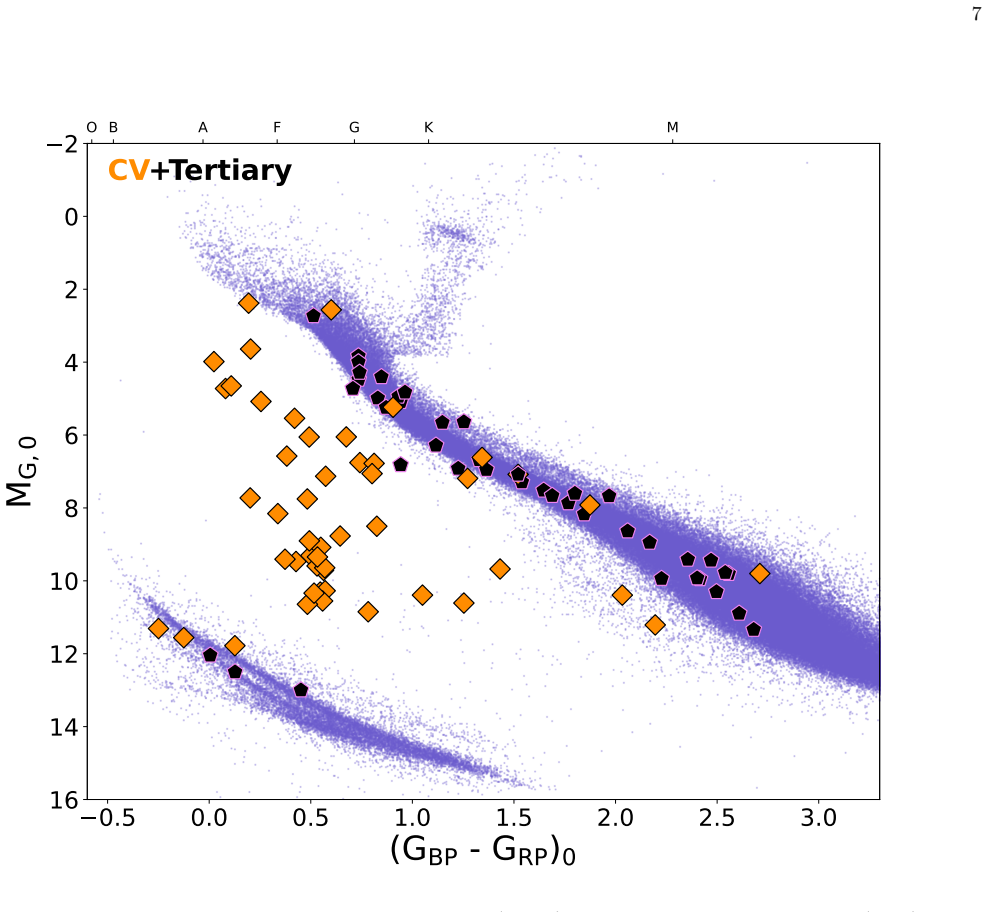
Figures from the paper (12 more)


Forward citations
Cited by 2 Pith papers
-
V407 Vul: a triple star system with an AM CVn detectable by gravitational wave observatories
V407 Vul is a hierarchical triple: a 569-s AM CVn white-dwarf binary bound to a G-type tertiary at ~120 AU, the first 'verification triple' for LISA.
-
Unveiling the nature of G6096: a likely hierarchical triple system
G6096 is likely a hierarchical triple of main-sequence stars rather than a binary hosting a white dwarf or neutron star.
Reference graph
Works this paper leans on
-
[1]
2020, MNRAS, 492, L40, doi: 10.1093/mnrasl/slz181
Abril, J., Schmidtobreick, L., Ederoclite, A., & L´ opez-Sanjuan, C. 2020, MNRAS, 492, L40, doi: 10.1093/mnrasl/slz181
-
[2]
Mass Transfer in Eccentric Orbits with Self-consistent Stellar Evolution
Ak, T., Bilir, S., Ak, S., Co¸ skuno˘ glu, K. B., & Eker, Z. 2010, NewA, 15, 491, doi: 10.1016/j.newast.2009.11.007 Akira Rocha, K., Hur, R., Kalogera, V., et al. 2024, arXiv e-prints, arXiv:2411.11840, doi: 10.48550/arXiv.2411.11840
work page Pith review arXiv doi:10.48550/arxiv.2411.11840 2010
-
[3]
Alcock, C., Fristrom, C. C., & Siegelman, R. 1986, ApJ, 302, 462, doi: 10.1086/164005
doi:10.1086/164005 1986
-
[4]
2003, ApJ, 582, 358, doi: 10.1086/343030
Andronov, N., Pinsonneault, M., & Sills, A. 2003, ApJ, 582, 358, doi: 10.1086/343030
doi:10.1086/343030 2003
-
[5]
Antognini, J. M. O. 2015, MNRAS, 452, 3610, doi: 10.1093/mnras/stv1552
-
[6]
2014, ApJ, 781, 45, doi: 10.1088/0004-637X/781/1/45
Antonini, F., Murray, N., & Mikkola, S. 2014, ApJ, 781, 45, doi: 10.1088/0004-637X/781/1/45
-
[7]
Antonini, F., & Perets, H. B. 2012, ApJ, 757, 27, doi: 10.1088/0004-637X/757/1/27
-
[8]
2023, A&A, 675, A199, doi: 10.1051/0004-6361/202346522
Avakyan, A., Neumann, M., Zainab, A., et al. 2023, A&A, 675, A199, doi: 10.1051/0004-6361/202346522
Show all 150 references
-
[9]
2024, A&A, 692, A247, doi: 10.1051/0004-6361/202452637 Belczy´ nski, K., Miko lajewska, J., Munari, U., Ivison, R
Bashi, D., & Tokovinin, A. 2024, A&A, 692, A247, doi: 10.1051/0004-6361/202452637 Belczy´ nski, K., Miko lajewska, J., Munari, U., Ivison, R. J., & Friedjung, M. 2000, A&AS, 146, 407, doi: 10.1051/aas:2000280
2024 doi
-
[10]
C., Kulkarni, S
Bellm, E. C., Kulkarni, S. R., Graham, M. J., et al. 2019, PASP, 131, 018002, doi: 10.1088/1538-3873/aaecbe
2019 doi
-
[11]
2016, MNRAS, 462, 2950, doi: 10.1093/mnras/stw1841
Belloni, D., Giersz, M., Askar, A., Leigh, N., & Hypki, A. 2016, MNRAS, 462, 2950, doi: 10.1093/mnras/stw1841
2016 doi
-
[12]
J., Leigh, N
Belloni, D., Giersz, M., Rocha-Pinto, H. J., Leigh, N. W. C., & Askar, A. 2017, MNRAS, 464, 4077, doi: 10.1093/mnras/stw2516
2017 doi
-
[13]
2021, in The Golden Age of Cataclysmic Variables and Related Objects V, Vol
Belloni, D., & Rivera Sandoval, L. 2021, in The Golden Age of Cataclysmic Variables and Related Objects V, Vol. 2-7, 13, doi: 10.22323/1.368.0013
2021 doi
-
[14]
Shen, K. J. 2024, A&A, 682, A33, doi: 10.1051/0004-6361/202347931
2024 doi
-
[15]
R., Zorotovic, M., et al
Belloni, D., Schreiber, M. R., Zorotovic, M., et al. 2018, MNRAS, 478, 5626, doi: 10.1093/mnras/sty1421
2018 doi
-
[16]
Thomas, H. C. 2021, A&A, 645, A56, doi: 10.1051/0004-6361/202038598
2021 doi
-
[17]
J., & Holman, M
Bhaskar, H., Li, G., Hadden, S., Payne, M. J., & Holman, M. J. 2021, AJ, 161, 48, doi: 10.3847/1538-3881/abcbfc
2021 doi
-
[18]
Bodaghee, A., Courvoisier, T. J. L., Rodriguez, J., et al. 2007, A&A, 467, 585, doi: 10.1051/0004-6361:20077091
2007 doi
-
[19]
2017, PASP, 129, 034002, doi: 10.1088/1538-3873/aa5455
Brahm, R., Jord´ an, A., & Espinoza, N. 2017, PASP, 129, 034002, doi: 10.1088/1538-3873/aa5455
2017 doi
-
[20]
Breivik, K., Mingarelli, C. M. F., & Larson, S. L. 2020, ApJ, 901, 4, doi: 10.3847/1538-4357/abab99
2020 doi
-
[21]
2024, AJ, 168, 121, doi: 10.3847/1538-3881/ad6260
Bruch, A. 2024, AJ, 168, 121, doi: 10.3847/1538-3881/ad6260
2024 doi
-
[22]
Bruch, A., & Diaz, M. P. 2017, NewA, 50, 109, doi: 10.1016/j.newast.2016.07.011
2017 doi
-
[23]
Buckley, D. A. H., & Tuohy, I. R. 1987, PASA, 7, 151, doi: 10.1017/S1323358000022128
1987 doi
-
[24]
B., El-Badry, K., Kara, E., et al
Burdge, K. B., El-Badry, K., Kara, E., et al. 2024, Nature, 635, 316, doi: 10.1038/s41586-024-08120-6
2024 doi
- [25]
-
[26]
G., et al
Chamandy, L., Tu, Y., Blackman, E. G., et al. 2019, MNRAS, 486, 1070, doi: 10.1093/mnras/stz887
2019 doi
-
[27]
E., Georgakarakos, N., Aviles, A., et al
Chavez, C. E., Georgakarakos, N., Aviles, A., et al. 2022, MNRAS, 514, 4629, doi: 10.1093/mnras/stac1112
2022 doi
-
[28]
E., Tovmassian, G., Aguilar, L
Chavez, C. E., Tovmassian, G., Aguilar, L. A., Zharikov, S., & Henden, A. A. 2012, A&A, 538, A122, doi: 10.1051/0004-6361/201117209
2012 doi
-
[29]
2020, ApJS, 249, 18, doi: 10.3847/1538-4365/ab9cae
Chen, X., Wang, S., Deng, L., et al. 2020, ApJS, 249, 18, doi: 10.3847/1538-4365/ab9cae
2020 doi
-
[30]
D., & M´ enard, B
Cheng, S., Cummings, J. D., & M´ enard, B. 2019, ApJ, 886, 100, doi: 10.3847/1538-4357/ab4989
2019 doi
-
[31]
T., & Bowyer, S
Clarke, J. T., & Bowyer, S. 1984, A&A, 140, 345
1984
-
[32]
S., Littlefair, S
Dhillon, V. S., Littlefair, S. P., Marsh, T. R., Sarna, M. J., & Boakes, E. H. 2002, A&A, 393, 611, doi: 10.1051/0004-6361:20021045
2002 doi
-
[33]
J., & Liu, M
Dupuy, T. J., & Liu, M. C. 2011, ApJ, 733, 122, doi: 10.1088/0004-637X/733/2/122
2011 doi
-
[34]
2024, A&A, 685, A82, doi: 10.1051/0004-6361/202347628
Edenhofer, G., Zucker, C., Frank, P., et al. 2024, A&A, 685, A82, doi: 10.1051/0004-6361/202347628
2024 doi
-
[35]
P., Kiseleva, L
Eggleton, P. P., Kiseleva, L. G., & Hut, P. 1998, ApJ, 499, 853, doi: 10.1086/305670
1998 doi
-
[36]
2022, MNRAS, 517, 4916, doi: 10.1093/mnras/stac2945
El-Badry, K., Conroy, C., Fuller, J., et al. 2022, MNRAS, 517, 4916, doi: 10.1093/mnras/stac2945
2022 doi
-
[37]
2018, Monthly Notices of the Royal Astronomical Society, 480, 4884, doi: 10.1093/mnras/sty2186
El-Badry, K., & Rix, H.-W. 2018, Monthly Notices of the Royal Astronomical Society, 480, 4884, doi: 10.1093/mnras/sty2186
2018 doi
-
[38]
El-Badry, K., Rix, H.-W., & Heintz, T. M. 2021a, MNRAS, 506, 2269, doi: 10.1093/mnras/stab323
-
[39]
2021b, MNRAS, 505, 2051, doi: 10.1093/mnras/stab1318
El-Badry, K., Quataert, E., Rix, H.-W., et al. 2021b, MNRAS, 505, 2051, doi: 10.1093/mnras/stab1318
-
[40]
R., Carpenter, K
Evans, N. R., Carpenter, K. G., Robinson, R., Kienzle, F., & Dekas, A. E. 2005, AJ, 130, 789, doi: 10.1086/430458
2005 doi
-
[41]
2007, ApJ, 669, 1298, doi: 10.1086/521702 33
Fabrycky, D., & Tremaine, S. 2007, ApJ, 669, 1298, doi: 10.1086/521702 33
2007 doi
-
[42]
Nitschelm, C. H. R. 2018, A&A, 618, A150, doi: 10.1051/0004-6361/201731265
2018 doi
-
[43]
M., Richer, H
Fregeau, J. M., Richer, H. B., Rasio, F. A., & Hurley, J. R. 2009, ApJL, 695, L20, doi: 10.1088/0004-637X/695/1/L20
2009 doi
-
[44]
S., Long, K
Froning, C. S., Long, K. S., G¨ ansicke, B., & Szkody, P. 2012, ApJS, 199, 7, doi: 10.1088/0067-0049/199/1/7 Gentile Fusillo, N. P., Tremblay, P. E., Cukanovaite, E., et al. 2021, MNRAS, 508, 3877, doi: 10.1093/mnras/stab2672
2012 doi
-
[45]
Glanz, H., & Perets, H. B. 2021, MNRAS, 507, 2659, doi: 10.1093/mnras/stab2291
2021 doi
-
[46]
B., & Fragione, G
Grishin, E., Perets, H. B., & Fragione, G. 2018, MNRAS, 481, 4907, doi: 10.1093/mnras/sty2477
2018 doi
-
[47]
B., Zenati, Y., & Michaely, E
Grishin, E., Perets, H. B., Zenati, Y., & Michaely, E. 2017, MNRAS, 466, 276, doi: 10.1093/mnras/stw3096
2017 doi
-
[48]
Halpern, J. P. 2013, The Astronomer’s Telegram, 5208, 1
2013
-
[49]
P., & Thorstensen, J
Halpern, J. P., & Thorstensen, J. R. 2015, AJ, 150, 170, doi: 10.1088/0004-6256/150/6/170
2015 doi
-
[50]
S., & Dosopoulou, F
Hamers, A. S., & Dosopoulou, F. 2019, ApJ, 872, 119, doi: 10.3847/1538-4357/ab001d
2019 doi
-
[51]
2020, PASJ, 72, 76, doi: 10.1093/pasj/psaa065
Han, Z., Boonrucksar, S., Qian, S., et al. 2020, PASJ, 72, 76, doi: 10.1093/pasj/psaa065
2020 doi
-
[52]
M., Hermes, J
Heintz, T. M., Hermes, J. J., El-Badry, K., et al. 2022, ApJ, 934, 148, doi: 10.3847/1538-4357/ac78d9
2022 doi
-
[53]
N., Tonry, J
Heinze, A. N., Tonry, J. L., Denneau, L., et al. 2018, AJ, 156, 241, doi: 10.3847/1538-3881/aae47f
2018 doi
-
[54]
A., & Szkody, P
Horne, K., Wade, R. A., & Szkody, P. 1986, MNRAS, 219, 791, doi: 10.1093/mnras/219.4.791
1986 doi
-
[55]
B., & Liebert, J
Howell, S. B., & Liebert, J. 1994, Information Bulletin on Variable Stars, 4073, 1
1994
-
[56]
R., Pols, O
Hurley, J. R., Pols, O. R., & Tout, C. A. 2000, MNRAS, 315, 543, doi: 10.1046/j.1365-8711.2000.03426.x
2000
-
[57]
R., Tout, C
Hurley, J. R., Tout, C. A., & Pols, O. R. 2002, Monthly Notices of the Royal Astronomical Society, 329, 897, doi: 10.1046/j.1365-8711.2002.05038.x
2002
-
[58]
P., Perets, H
Igoshev, A. P., Perets, H. B., & Michaely, E. 2020, MNRAS, 494, 1448, doi: 10.1093/mnras/staa833
2020 doi
-
[59]
T., Breedt, E., et al
Inight, K., G¨ ansicke, B. T., Breedt, E., et al. 2023, MNRAS, 524, 4867, doi: 10.1093/mnras/stad2018
2023 doi
-
[60]
Ivanova, N., & Taam, R. E. 2003, ApJ, 599, 516, doi: 10.1086/379192
2003 doi
-
[61]
2013, A&A Rv, 21, 59, doi: 10.1007/s00159-013-0059-2
Ivanova, N., Justham, S., Chen, X., et al. 2013, A&A Rv, 21, 59, doi: 10.1007/s00159-013-0059-2
2013 doi
-
[62]
J., Engels, D., Wei, J
Jiang, X. J., Engels, D., Wei, J. Y., Tesch, F., & Hu, J. Y. 2000, A&A, 362, 263
2000
- [63]
-
[64]
1999, The Messenger, 95, 8
Kaufer, A., Stahl, O., Tubbesing, S., et al. 1999, The Messenger, 95, 8
1999
- [65]
-
[66]
G., Eggleton, P
Kiseleva, L. G., Eggleton, P. P., & Mikkola, S. 1998, MNRAS, 300, 292, doi: 10.1046/j.1365-8711.1998.01903.x
1998
-
[67]
2015, A&A, 584, A40, doi: 10.1051/0004-6361/201526102
Kjurkchieva, D., Khruzina, T., Dimitrov, D., et al. 2015, A&A, 584, A40, doi: 10.1051/0004-6361/201526102
2015 doi
- [68]
- [69]
-
[70]
Knigge, C., Toonen, S., & Boekholt, T. C. N. 2022, MNRAS, 514, 1895, doi: 10.1093/mnras/stac1336
2022 doi
-
[71]
1996, MNRAS, 282, 1454, doi: 10.1093/mnras/282.4.1454
Kolb, U., & Stehle, R. 1996, MNRAS, 282, 1454, doi: 10.1093/mnras/282.4.1454
1996 doi
- [72]
-
[73]
M., & Perets, H
Kratter, K. M., & Perets, H. B. 2012, ApJ, 753, 91, doi: 10.1088/0004-637X/753/1/91
2012 doi
-
[74]
S., Rui, N
Kremer, K., Ye, C. S., Rui, N. Z., et al. 2020, ApJS, 247, 48, doi: 10.3847/1538-4365/ab7919
2020 doi
-
[75]
A., & Gilmore, G
Kroupa, P., Tout, C. A., & Gilmore, G. 1993, MNRAS, 262, 545, doi: 10.1093/mnras/262.3.545
1993 doi
-
[76]
2022, PhRvD, 105, 024017, doi: 10.1103/PhysRevD.105.024017 La Dous, C
Kuntz, A. 2022, PhRvD, 105, 024017, doi: 10.1103/PhysRevD.105.024017 La Dous, C. 1990, SSRv, 52, 203, doi: 10.1007/BF00167124
2022 doi
-
[77]
Lidov, M. L. 1962, Planet. Space Sci., 9, 719, doi: 10.1016/0032-0633(62)90129-0
1962 doi
-
[78]
Lim, H., & Rodriguez, C. L. 2020, PhRvD, 102, 064033, doi: 10.1103/PhysRevD.102.064033
2020 doi
-
[79]
P., Godon, P., Hubeny, I., et al
Linnell, A. P., Godon, P., Hubeny, I., et al. 2009, ApJ, 703, 1839, doi: 10.1088/0004-637X/703/2/1839
2009 doi
-
[80]
P., Dhillon, V
Littlefair, S. P., Dhillon, V. S., Marsh, T. R., et al. 2008, MNRAS, 388, 1582, doi: 10.1111/j.1365-2966.2008.13539.x
2008
-
[81]
S., Rasio, F
Lombardi, James C., J., Warren, J. S., Rasio, F. A., Sills, A., & Warren, A. R. 2002, ApJ, 568, 939, doi: 10.1086/339060
2002 doi
- [82]
-
[83]
2016, MNRAS, 458, 3060, doi: 10.1093/mnras/stw475
Luo, L., Katz, B., & Dong, S. 2016, MNRAS, 458, 3060, doi: 10.1093/mnras/stw475
2016 doi
-
[84]
A., & Aarseth, S
Mardling, R. A., & Aarseth, S. J. 2001, MNRAS, 321, 398, doi: 10.1046/j.1365-8711.2001.03974.x Mart ´ ınez-Pais, I. G., Mart ´ ın-Hern´ andez, N. L., Casares, J., & Rodr ´ ıguez-Gil, P. 2000, ApJ, 538, 315, doi: 10.1086/309092
2001
-
[85]
2015, ApJL, 799, L23, doi: 10.1088/2041-8205/799/2/L23 34
Chabrier, G. 2015, ApJL, 799, L23, doi: 10.1088/2041-8205/799/2/L23 34
2015 doi
-
[86]
Michaely, E., & Perets, H. B. 2014, ApJ, 794, 122, doi: 10.1088/0004-637X/794/2/122 —. 2019a, MNRAS, 484, 4711, doi: 10.1093/mnras/stz352 —. 2019b, ApJL, 887, L36, doi: 10.3847/2041-8213/ab5b9b
2014 doi
-
[87]
2017, ApJS, 230, 15, doi: 10.3847/1538-4365/aa6fb6
Moe, M., & Di Stefano, R. 2017, ApJS, 230, 15, doi: 10.3847/1538-4365/aa6fb6
2017 doi
-
[88]
2020, MNRAS, 498, 665, doi: 10.1093/mnras/staa2492
Mushkin, J., & Katz, B. 2020, MNRAS, 498, 665, doi: 10.1093/mnras/staa2492
2020 doi
-
[89]
2024, PASP, 136, 094203, doi: 10.1088/1538-3873/ad7981
Nagarajan, P., & El-Badry, K. 2024, PASP, 136, 094203, doi: 10.1088/1538-3873/ad7981
2024 doi
-
[90]
2024, arXiv e-prints, arXiv:2405.17560
Nagarajan, P., El-Badry, K., Lam, C., & Reggiani, H. 2024, arXiv e-prints, arXiv:2405.17560. https://arxiv.org/abs/2405.17560
2024 arXiv
-
[91]
2016, ARA&A, 54, 441, doi: 10.1146/annurev-astro-081915-023315
Naoz, S. 2016, ARA&A, 54, 441, doi: 10.1146/annurev-astro-081915-023315
2016 doi
-
[92]
Naoz, S., & Fabrycky, D. C. 2014, ApJ, 793, 137, doi: 10.1088/0004-637X/793/2/137
2014 doi
-
[93]
2013a, MNRAS, 431, 2155, doi: 10.1093/mnras/stt302
Teyssandier, J. 2013a, MNRAS, 431, 2155, doi: 10.1093/mnras/stt302
-
[94]
P., & Rasio, F
Naoz, S., Fragos, T., Geller, A., Stephan, A. P., & Rasio, F. A. 2016, ApJL, 822, L24, doi: 10.3847/2041-8205/822/2/L24
2016 doi
-
[95]
2013b, ApJ, 773, 187, doi: 10.1088/0004-637X/773/2/187
Naoz, S., Kocsis, B., Loeb, A., & Yunes, N. 2013b, ApJ, 773, 187, doi: 10.1088/0004-637X/773/2/187
-
[96]
2021, ApJ, 921, 118, doi: 10.3847/1538-4357/ac14be
Nelson, T., Ting, Y.-S., Hawkins, K., et al. 2021, ApJ, 921, 118, doi: 10.3847/1538-4357/ac14be
2021 doi
-
[97]
P., & Warner, B
Odonoghue, D., Fairall, A. P., & Warner, B. 1987, MNRAS, 225, 43, doi: 10.1093/mnras/225.1.43
1987 doi
- [98]
- [99]
-
[100]
1976, in IAU Symposium, Vol
Paczynski, B. 1976, in IAU Symposium, Vol. 73, Structure and Evolution of Close Binary Systems, ed. P. Eggleton, S. Mitton, & J. Whelan, 75
1976
-
[101]
F., G¨ ansicke, B
Pala, A. F., G¨ ansicke, B. T., Breedt, E., et al. 2020, MNRAS, 494, 3799, doi: 10.1093/mnras/staa764
2020 doi
-
[102]
F., et al
Parisi, P., Masetti, N., Rojas, A. F., et al. 2014, A&A, 561, A67, doi: 10.1051/0004-6361/201322409
2014 doi
-
[103]
A., Warner, B., et al
Paterson, K., Woudt, P. A., Warner, B., et al. 2019, MNRAS, 486, 2422, doi: 10.1093/mnras/stz1018
2019 doi
-
[104]
1984, ApJS, 54, 443, doi: 10.1086/190940
Patterson, J. 1984, ApJS, 54, 443, doi: 10.1086/190940
1984 doi
-
[106]
B., Augusteijn, T., & Tappert, C
Potter, S. B., Augusteijn, T., & Tappert, C. 2005, MNRAS, 364, 565, doi: 10.1111/j.1365-2966.2005.09569.x
2005
-
[107]
2004, PASP, 116, 1117, doi: 10.1086/427272
Price, A., Gary, B., Bedient, J., et al. 2004, PASP, 116, 1117, doi: 10.1086/427272
2004 doi
-
[108]
D., Mallett, J., & von Harrach, S
Pulley, D., Sharp, I. D., Mallett, J., & von Harrach, S. 2022, MNRAS, 514, 5725, doi: 10.1093/mnras/stac1676
2022 doi
-
[109]
A., Henry, T
Raghavan, D., McAlister, H. A., Henry, T. J., et al. 2010, ApJS, 190, 1, doi: 10.1088/0067-0049/190/1/1
2010 doi
-
[110]
Rappaport, S., Verbunt, F., & Joss, P. C. 1983, ApJ, 275, 713, doi: 10.1086/161569
1983 doi
-
[111]
M., van Grunsven, T
Ratti, E. M., van Grunsven, T. F. J., Torres, M. A. P., et al. 2013, MNRAS, 431, L10, doi: 10.1093/mnrasl/sls052
2013 doi
-
[112]
2003, A&A, 404, 301, doi: 10.1051/0004-6361:20030330 Rivera Sandoval, L., Belloni, D., & Ramos Arevalo, M
Ritter, H., & Kolb, U. 2003, A&A, 404, 301, doi: 10.1051/0004-6361:20030330 Rivera Sandoval, L., Belloni, D., & Ramos Arevalo, M. 2024, ApJL, 964, L20, doi: 10.3847/2041-8213/ad2c8f
2003 doi
- [113]
-
[114]
A., & Chaty, S
Rodriguez, J., Tomsick, J. A., & Chaty, S. 2008, A&A, 482, 731, doi: 10.1051/0004-6361:20079208 Rodr ´ ıguez-Gil, P., Torres, M. A. P., G¨ ansicke, B. T., et al. 2009, A&A, 496, 805, doi: 10.1051/0004-6361/200811312
2008 doi
-
[115]
E., & Vrielmann, S
Barrett, P. E., & Vrielmann, S. 2003, MNRAS, 339, 685, doi: 10.1046/j.1365-8711.2003.06209.x
2003
-
[116]
C., Naoz, S., & Geller, A
Rose, S. C., Naoz, S., & Geller, A. M. 2019, MNRAS, 488, 2480, doi: 10.1093/mnras/stz1846
2019 doi
-
[117]
L., Taam, R
Sandquist, E. L., Taam, R. E., Chen, X., Bodenheimer, P., & Burkert, A. 1998, ApJ, 500, 909, doi: 10.1086/305778
1998 doi
-
[118]
J., Dhillon, V
Sarna, M. J., Dhillon, V. S., Marsh, T. R., & Marks, P. B. 1995, MNRAS, 272, L41, doi: 10.1093/mnras/272.1.L41
1995 doi
-
[119]
R., Zorotovic, M., & Wijnen, T
Schreiber, M. R., Zorotovic, M., & Wijnen, T. P. G. 2016, MNRAS, 455, L16, doi: 10.1093/mnrasl/slv144
2016 doi
-
[120]
D., Nebot Gomez-Moran, A., Schreiber, M
Schwope, A. D., Nebot Gomez-Moran, A., Schreiber, M. R., & G¨ ansicke, B. T. 2009, A&A, 500, 867, doi: 10.1051/0004-6361/200911699
2009 doi
-
[121]
F., Willems, B., Kalogera, V., & Rasio, F
Sepinsky, J. F., Willems, B., Kalogera, V., & Rasio, F. A. 2009, ApJ, 702, 1387, doi: 10.1088/0004-637X/702/2/1387
2009 doi
-
[122]
J., & Thompson, T
Shappee, B. J., & Thompson, T. A. 2013, ApJ, 766, 64, doi: 10.1088/0004-637X/766/1/64
2013 doi
-
[123]
M., Howell, S
Shara, M. M., Howell, S. B., Furlan, E., et al. 2021, MNRAS, 507, 560, doi: 10.1093/mnras/stab2212
2021 doi
- [124]
-
[125]
Shariat, C., Naoz, S., Hansen, B. M. S., et al. 2023, ApJL, 955, L14, doi: 10.3847/2041-8213/acf76b
2023 doi
-
[126]
2019, MNRAS, 488, 5615, doi: 10.1093/mnras/stz2013 35
Shiber, S., Iaconi, R., De Marco, O., & Soker, N. 2019, MNRAS, 488, 5615, doi: 10.1093/mnras/stz2013 35
2019 doi
-
[127]
1972, ApJ, 171, 565, doi: 10.1086/151310
Skumanich, A. 1972, ApJ, 171, 565, doi: 10.1086/151310
1972 doi
-
[128]
Solheim, J. E. 2010, PASP, 122, 1133, doi: 10.1086/656680
2010 doi
-
[129]
2024, ApJ, 972, 33, doi: 10.3847/1538-4357/ad6b0e
Souza, L., & Baptista, R. 2024, ApJ, 972, 33, doi: 10.3847/1538-4357/ad6b0e
2024 doi
-
[130]
P., Naoz, S., & Gaudi, B
Stephan, A. P., Naoz, S., & Gaudi, B. S. 2018, AJ, 156, 128, doi: 10.3847/1538-3881/aad6e5 —. 2021, ApJ, 922, 4, doi: 10.3847/1538-4357/ac22a9
2018 doi
-
[131]
P., Naoz, S., Ghez, A
Stephan, A. P., Naoz, S., Ghez, A. M., et al. 2019, in AAS/Division of Dynamical Astronomy Meeting, Vol. 51, AAS/Division of Dynamical Astronomy Meeting, 202.02
2019
-
[132]
Szkody, P., & Howell, S. B. 1993, ApJ, 403, 743, doi: 10.1086/172245
1993 doi
-
[133]
Szkody, P., Dicenzo, B., Ho, A. Y. Q., et al. 2020, AJ, 159, 198, doi: 10.3847/1538-3881/ab7cce
2020 doi
-
[134]
Thompson, T. A. 2011, ApJ, 741, 82, doi: 10.1088/0004-637X/741/2/82
2011 doi
-
[135]
R., & Skinner, J
Thorstensen, J. R., & Skinner, J. N. 2012, AJ, 144, 81, doi: 10.1088/0004-6256/144/3/81
2012 doi
-
[136]
2014, AJ, 147, 87, doi: 10.1088/0004-6256/147/4/87 —
Tokovinin, A. 2014, AJ, 147, 87, doi: 10.1088/0004-6256/147/4/87 —. 2022, ApJ, 926, 1, doi: 10.3847/1538-4357/ac4584
2014 doi
-
[137]
2006, A&A, 450, 681, doi: 10.1051/0004-6361:20054427
Tokovinin, A., Thomas, S., Sterzik, M., & Udry, S. 2006, A&A, 450, 681, doi: 10.1051/0004-6361:20054427
2006 doi
-
[138]
Toonen, S., Boekholt, T. C. N., & Portegies Zwart, S. 2022, A&A, 661, A61, doi: 10.1051/0004-6361/202141991
2022 doi
-
[139]
2016, Computational Astrophysics and Cosmology, 3, 6, doi: 10.1186/s40668-016-0019-0
Toonen, S., Hamers, A., & Portegies Zwart, S. 2016, Computational Astrophysics and Cosmology, 3, 6, doi: 10.1186/s40668-016-0019-0
2016 doi
-
[140]
T., & Boekholt, T
Toonen, S., Hollands, M., G¨ ansicke, B. T., & Boekholt, T. 2017, A&A, 602, A16, doi: 10.1051/0004-6361/201629978
2017 doi
-
[141]
2020, A&A, 640, A16, doi: 10.1051/0004-6361/201936835
Bandopadhyay, D. 2020, A&A, 640, A16, doi: 10.1051/0004-6361/201936835
2020 doi
-
[142]
2023, MNRAS, 522, 937, doi: 10.1093/mnras/stad1029
Tremaine, S. 2023, MNRAS, 522, 937, doi: 10.1093/mnras/stad1029
2023 doi
-
[143]
1981, A&A, 100, L7
Verbunt, F., & Zwaan, C. 1981, A&A, 100, L7
1981
-
[144]
Bellinger, E. P. 2022, MNRAS, 516, 4146, doi: 10.1093/mnras/stac2540
2022 doi
-
[145]
1995, Cataclysmic variable stars, Vol
Warner, B. 1995, Cataclysmic variable stars, Vol. 28
1995
-
[146]
C., Naoz, S., & Hansen, B
Weldon, G. C., Naoz, S., & Hansen, B. M. S. 2024, ApJ, 974, 302, doi: 10.3847/1538-4357/ad77a9
2024 doi
-
[147]
T.-C., Chou, Y., Ngeow, C.-C., et al
Yang, M. T.-C., Chou, Y., Ngeow, C.-C., et al. 2017, PASP, 129, 094202, doi: 10.1088/1538-3873/aa7a99
2017 doi
-
[148]
G., Li, H
Yang, Y. G., Li, H. L., Dai, H. F., & Zhang, L. Y. 2010, AJ, 140, 1687, doi: 10.1088/0004-6256/140/6/1687
2010 doi
-
[149]
Zahn, J. P. 1977, A&A, 57, 383
1977
- [150]
-
[151]
Zorotovic, M., & Schreiber, M. R. 2020, Advances in Space Research, 66, 1080, doi: 10.1016/j.asr.2019.08.044
2020 doi
Reviewed August 10, 2026 · model on record in the stance chip above.
Discussion (0). Continue with ORCID to comment.