REVIEW 4 major objections 6 minor 225 references
Advancing MRI Reconstruction: A Systematic Review of Deep Learning and Compressed Sensing Integration
T0 review · 4 major / 6 minor · reviewed 2026-08-10 · deepseek-v4-flash
Pith's one-line read This systematic review claims that integrating deep learning with compressed sensing, particularly through unrolled networks with data-consistency layers, is the most promising path to faster MRI without sacrificing diagnostic quality.
desk verdict A workmanlike systematic review of DL+CS MRI reconstruction: useful as an entry point and reference, with a couple of correctable technical slips and a trend claim that should be read with the screening rule in mind. read the letter →
The pith
A machine-rendered reading of the paper's core claim, the machinery that carries it, and where it could break.
The reading
What carries the argument
The load-bearing mechanism is the data-consistency (DC) layer, a closed-form update that replaces the network's predicted k-space values with the measured values wherever k-space was sampled: $\hat{X}(k)=X_\Omega(k)$ for $k\in\Omega$ and $\hat{X}_{f_\psi}(k)$ otherwise, as in the review's Equation (3). The DC layer turns a network output into a solution that always agrees with the acquired data, and it is what makes unrolled models the most-used framework among the 130 reviewed studies. The review also uses the compressed-sensing encoding operator $E_\Omega=\Omega F S$ (sampling mask, Fourier transform, coil sensitivities) as the physics backbone that unrolled networks mimic layer by layer.
What would settle it
Rerun the same search across several bibliographic databases and count the training framework of every deep-learning compressed-sensing MRI paper without excluding method-extension papers; if end-to-end models or non-compressed-sensing approaches are actually the majority, the claimed exponential growth and data-consistency-layer dominance would be contradicted.
Extended reading notes
Core claim
The central discovery of the review is a field-level pattern: after screening 886 records, the 130 retained studies show that deep learning has shifted MRI reconstruction from purely iterative compressed sensing to hybrid physics-driven networks, and the dominant design is an unrolled network capped by a data-consistency layer that keeps reconstructed k-space equal to measured k-space at sampled positions. The authors argue this integration inherits the guarantees of compressed sensing while adding data-driven priors, and they support it with clinical studies reporting no significant difference from fully sampled acquisitions in liver, brain, knee, and prostate imaging.
Load-bearing premise
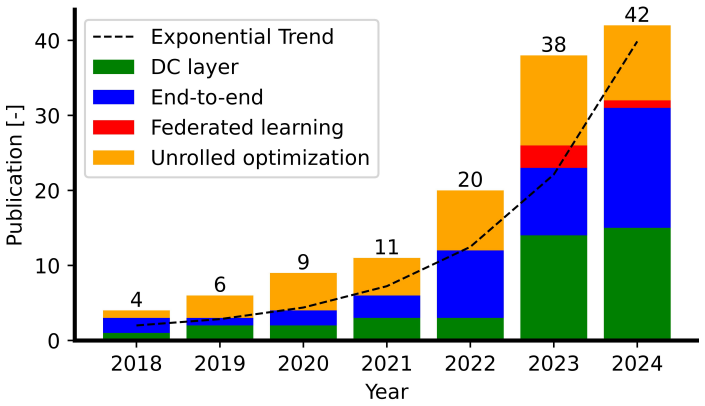
The trend statistics assume that the 130 papers remaining after the review's screening rule, which rejected papers that did not propose a new method or did not use compressed sensing, are a representative sample of all deep-learning MRI reconstruction research.
Editorial extensions
If this is right
- Unrolled architectures with data-consistency layers are the de facto standard in the reviewed literature and are likely to remain the reference point for new reconstruction methods.
- Acceleration factors of 2 to under 6 are the best-evidenced operating range; claims made at $R\ge12$ should be treated as exploratory until more studies accumulate.
- Clinical adoption is feasible: several reviewed studies found no statistically significant difference from fully sampled MRI while reducing scan time by more than 85 percent or by about 3.7-fold.
- Public datasets need to expand to include raw multi-coil 3D and 4D k-space with pathologies, because generalization across scanners and protocols currently limits deployment.
- Federated learning and self-supervised training are the emerging frameworks most likely to address data sharing, generalization, and the shortage of fully sampled references.
Reading between the lines
- The authors do not analyze whether their screening exclusions (206 papers that do not propose a new method and 82 non-compressed-sensing approaches) could bias the trend lines; if those papers were counted, the exponential growth curve and framework shares might look different.
- The clinical equivalence evidence comes from a small set of anatomies and reconstruction products; extending the claim safely would require prospective multi-site reader studies with diagnostic endpoints, not just SSIM and PSNR.
- A natural next experiment, not run in the review, is to attach a learned sampling-pattern optimizer in front of a DC-layer unrolled network and test whether acceleration factors beyond 12 become clinically viable.
Editorial analysis
A structured set of objections, weighed in public.
Referee Report
Summary. The manuscript is a systematic review of deep learning (DL) based MRI reconstruction, with emphasis on the integration of DL with compressed sensing (CS). The authors report a PubMed search from January 2016 to January 2025 that yields 130 included papers after screening; they categorize methods into end-to-end, unrolled optimization, data-consistency (DC) layer, and federated learning approaches; and they summarize quantitative metrics, datasets, acceleration factors, and publication trends. The paper concludes that integrating CS principles with DL, especially through unrolled models and DC layers, is a promising future direction for MRI reconstruction.
Significance. If the trend claims are properly scoped, the review is a useful contribution to the DL-MRI literature: it aggregates a structured corpus of 130 CS-related DL reconstruction papers, provides detailed method tables (Tables 4–8), summarizes benchmark datasets and challenges, and offers a public GitHub repository for ongoing updates. These assets go beyond existing reviews summarized in Table 1. The main risk is that the quantitative claims—exponential growth in publications, dominance of unrolled/DC models, and the promise of DL+CS integration—are computed from a corpus that was deliberately filtered to CS-based method proposals. The review is therefore valuable as a systematic map of DL-based CS-MRI reconstruction, but its field-level conclusions require qualification or additional sensitivity analysis.
major comments (4)
- [§1.1.2, Eq. (1)] The compressed sensing objective is printed as arg min_x ∥y − E_Ω x∥_2 − β∥τ(x)∥_1. The minus sign before β∥τ(x)∥_1 makes the minimization ill-posed and contradicts the standard CS formulation that the paper invokes in §3.2.1 when describing unrolled models as mappings of iterations of Equation (1). Please correct the sign to plus and make the squared L2 fidelity norm explicit.
- [§1.1 / Figure 4] The PRISMA-style flow counts do not reconcile: 886 identified minus 79 duplicates gives 807; subtracting the 679 title/abstract exclusions leaves 128, not 151, for the full-text stage. The stated 151 full-text reads minus 21 exclusions gives 130 included, but the preceding numbers cannot produce 151. Since the review's quantitative claims are a stated contribution over prior reviews (Table 1), the screening arithmetic must be corrected or the flow diagram amended.
- [§3 (Figures 8–9) and §5.1] The corpus is constructed by a screening rule that explicitly excludes 82 'Non-Compressed Sensing Approaches' and 206 papers that 'do not propose a new method' (Figure 4). Therefore the observations that unrolled optimization and DC-layer models are the most common training frameworks and that publication counts grow exponentially are conditional on this CS-filtered, method-proposal-based inclusion rule; they do not by themselves establish that CS-integrated DL is the dominant or most promising direction in the broader field of DL-based MRI reconstruction. Please qualify these statements as describing the included CS-DL corpus and, ideally, conduct a sensitivity analysis against a broader inclusion criterion.
- [§5.2 and §6] The clinical-equivalence evidence is presented as five illustrative studies, not as a meta-analysis with search protocol and risk-of-bias assessment. In the current wording, the Discussion's conclusion that the integration of CS and DL is 'a promising future direction' leans on these studies plus the trend statistics from the filtered corpus. Please state explicitly the evidential weight of Section 5.2, or add the corresponding systematic-review elements if clinical conclusions are intended.
minor comments (6)
- [Figure 4] The figure contains typos ('screend', 'absract') that should be corrected.
- [Abbreviations and Figure 9] The abbreviation list defines MSE twice, once as 'Mean absolute error' and once as 'Mean square error'; align the definition with the usage in Figure 9 and Section 5.1.
- [§3.2.2, Eq. (2)–(3)] The typesetting of Equation (2) is broken ('x ˆfψ = arg min'); please use proper notation for the reconstructed image and the estimator.
- [§1.1.2] The norm in Equation (1) is written as ∥·∥2 without an explicit square; indicate whether the squared L2 norm is intended, as is conventional in this objective.
- [§6.4] The sentence 'while most MRI reconstruction methods require prior knowledge of the sampling pattern, recent advancements have developed techniques to predict or optimize sampling patterns using DL [120, 219, 220] may further expedite...' is grammatically incomplete; add the missing main verb.
- [§2.3.2] The statement that diffusion models 'are not standalone MRI reconstruction methods' is too strong given the existence of unconditional posterior-sampling reconstruction methods in the reviewed literature; consider softening to 'are often integrated into reconstruction pipelines.'
Circularity Check
No significant circularity: the review's statistics are descriptive aggregates of a deliberately scoped corpus, not derivations forced by its own inputs.
full rationale
This paper is a systematic review, not a derivation, so the circularity patterns of fitted-input-called-prediction, self-citation load-bearing argument, or imported uniqueness theorems do not apply. The central statistics in Figures 8 and 9 are descriptive aggregates computed from the 130 papers that survived the screening flowchart in Figure 4; the explicit exclusion of 82 'Non-Compressed Sensing Approaches' is a scope definition, and the finding that unrolled optimization and data-consistency layers are the most common training frameworks is not forced by that inclusion rule, because end-to-end, federated, and self-supervised approaches were eligible and are separately counted in Tables 4-8. The exponential trend line in Figure 8 is a descriptive fit to the publication counts and is not used to generate a prediction from its own fitted parameters. Author self-citations appear in background and future-work contexts, but none is load-bearing for the review's categorization, trend claims, or concluding recommendation that DL-CS integration is a promising direction. The main weakness is potential selection bias from a PubMed-only, novel-method-only corpus, which is a validity concern about generalizability rather than circularity. No step in the paper's argument reduces by construction to its own inputs.
Assumptions & free parameters
assumptions (3)
- domain assumption The PubMed query ('deep learning reconstruction' OR 'fastMRI' OR 'unrolled optimization' OR 'MRI reconstruction' OR 'MRI acceleration', 2016-2025) captures the relevant DL-based CS-MRI reconstruction literature.
- domain assumption Self-reported quality metrics and acceleration factors across heterogeneous datasets can be aggregated without normalization.
- standard math The compressed sensing formulation in Equation (1) is the standard sparsity-plus-data-consistency objective.
Cite this review
Pith. "Pith review of Advancing MRI Reconstruction: A Systematic Review of Deep Learning and Compressed Sensing Integration." pith.science (2026). https://pith.science/paper/RO7DDMYU
@misc{pith2026250114158,
  author       = {Pith},
  title        = {Pith review of: Advancing MRI Reconstruction: A Systematic Review of Deep Learning and Compressed Sensing Integration},
  year         = {2026},
  howpublished = {\url{https://pith.science/paper/RO7DDMYU}},
  note         = {Machine review of arXiv:2501.14158}
}
read the original abstract
Magnetic resonance imaging (MRI) is a non-invasive imaging modality and provides comprehensive anatomical and functional insights into the human body. However, its long acquisition times can lead to patient discomfort, motion artifacts, and limiting real-time applications. To address these challenges, strategies such as parallel imaging have been applied, which utilize multiple receiver coils to speed up the data acquisition process. Additionally, compressed sensing (CS) is a method that facilitates image reconstruction from sparse data, significantly reducing image acquisition time by minimizing the amount of data collection needed. Recently, deep learning (DL) has emerged as a powerful tool for improving MRI reconstruction. It has been integrated with parallel imaging and CS principles to achieve faster and more accurate MRI reconstructions. This review comprehensively examines DL-based techniques for MRI reconstruction. We categorize and discuss various DL-based methods, including end-to-end approaches, unrolled optimization, and federated learning, highlighting their potential benefits. Our systematic review highlights significant contributions and underscores the potential of DL in MRI reconstruction. Additionally, we summarize key results and trends in DL-based MRI reconstruction, including quantitative metrics, the dataset, acceleration factors, and the progress of and research interest in DL techniques over time. Finally, we discuss potential future directions and the importance of DL-based MRI reconstruction in advancing medical imaging. To facilitate further research in this area, we provide a GitHub repository that includes up-to-date DL-based MRI reconstruction publications and public datasets-https://github.com/mosaf/Awesome-DL-based-CS-MRI.
Figures


Figures from the paper (6 more)



Reference graph
Works this paper leans on
-
[1]
H. Chandarana, H. Wang, R. Tijssen, I. J. Das, Emerging role of mri in radiation therapy, Journal of Magnetic Resonance Imag- ing 48 (2018) 1468–1478. URL: https://onlinelibrary.wiley.com/ doi/abs/10.1002/jmri.26271. doi: https://doi.org/10.1002/jmri.26271. arXiv:https://onlinelibrary.wiley.com/doi/pdf/10.1002/jmri.26271
-
[2]
M. Beigi, A. F. Kazerooni, M. Safari, M. Alamolhoda, M. S. Moghdam, S. Moghadam, H. SalighehRad, A. Ameri, Heterogeneity analysis of diffusion- weighted mri for prediction and assessment of microstructural changes early after one cycle of induction chemotherapy in nasopharyngeal cancer patients, La radiologia medica 123 (2018) 36–43. URL: https://doi.org/...
-
[3]
Hricak, M
H. Hricak, M. Abdel-Wahab, R. Atun, M. M. Lette, D. Paez, J. A. Brink, L. Donoso-Bach, G. Frija, M. Hierath, O. Holmberg, others, Medical imag- ing and nuclear medicine: a lancet oncology commission 22 (2021) e136–e172. Number: 4 Publisher: Elsevier
2021
-
[4]
Y. Liu, A. T. Leong, Y. Zhao, L. Xiao, H. K. Mak, A. C. O. Tsang, G. K. Lau, G. K. Leung, E. X. Wu, A low-cost and shielding-free ultra-low-field brain MRI scanner 12 (2021) 7238. Number: 1 Publisher: Nature Publishing Group UK London
2021
-
[5]
S. Murali, H. Ding, F. Adedeji, C. Qin, J. Obungoloch, I. Asllani, U. Anazodo, N. A. B. Ntusi, R. Mammen, T. Niendorf, S. Adeleke, Bringing mri to low- and middle-income countries: Directions, chal- lenges and potential solutions, NMR in Biomedicine 37 (2024) e4992. URL: https://analyticalsciencejournals.onlinelibrary.wiley.com/ doi/abs/10.1002/nbm.4992. ...
doi:10.1002/nbm.4992 2024
-
[6]
M. Safari, X. Yang, A. Fatemi, L. Archambault, Mri motion artifact reduc- tion using a conditional diffusion probabilistic model (mar-cdpm), Medical Physics 51 (2024) 2598–2610. URL: https://aapm.onlinelibrary.wiley. com/doi/abs/10.1002/mp.16844. doi: https://doi.org/10.1002/mp.16844. arXiv:https://aapm.onlinelibrary.wiley.com/doi/pdf/10.1002/mp.16844
-
[7]
J. M. Slipsager, S. L. Glimberg, J. Søgaard, R. R. Paulsen, H. H. Johannesen, P. C. Martens, A. Seth, L. Marner, O. M. Henriksen, O. V. Olesen, others, Quantifying the financial savings of motion correction in brain MRI: a model- based estimate of the costs arising from patient head motion and potential savings from implementation of motion correction 52 ...
2020
-
[8]
D. Kwiat, S. Einav, G. Navon, A decoupled coil detector array for fast image acquisition in magnetic resonance imaging 18 (1991) 251–265. URL: https: //aapm.onlinelibrary.wiley.com/doi/10.1118/1.596723. doi: 10.1118/1. 596723
Show all 225 references
-
[9]
M. A. Griswold, P. M. Jakob, R. M. Heidemann, M. Nittka, V. Jellus, J. Wang, B. Kiefer, A. Haase, Generalized autocalibrating partially parallel acquisitions (GRAPPA) 47 (2002) 1202–1210. URL: https://onlinelibrary.wiley.com/ doi/10.1002/mrm.10171. doi:10.1002/mrm.10171
2002 doi
-
[10]
K. P. Pruessmann, M. Weiger, M. B. Scheidegger, P. Boesiger, Sense: sensitivity encoding for fast mri, Magnetic Resonance in Medicine: An Official Journal of the International Society for Magnetic Resonance in Medicine 42 (1999) 952– 962
1999
-
[11]
Uecker, P
M. Uecker, P. Lai, M. J. Murphy, P. Virtue, M. Elad, J. M. Pauly, S. S. Vasanawala, M. Lustig, ESPIRiT—an eigenvalue approach to autocalibrat- ing parallel MRI: where SENSE meets GRAPPA 71 (2014) 990–1001. Number: 3 Publisher: Wiley Online Library
2014
-
[12]
Deshmane, V
A. Deshmane, V. Gulani, M. A. Griswold, N. Seiberlich, Parallel MR imaging 36 (2012) 55–72. URL: https://onlinelibrary.wiley.com/doi/10.1002/ jmri.23639. doi:10.1002/jmri.23639, number: 1
2012 doi
-
[13]
D. J. Larkman, R. G. Nunes, Parallel magnetic resonance imaging 52 (2007) R15–R55. URL: https://iopscience.iop.org/article/10.1088/ 0031-9155/52/7/R01. doi:10.1088/0031-9155/52/7/R01, number: 7
2007 doi
-
[14]
Lustig, D
M. Lustig, D. Donoho, J. M. Pauly, Sparse MRI: The application of compressed sensing for rapid MR imaging 58 (2007) 1182–1195. URL: 35 https://onlinelibrary.wiley.com/doi/10.1002/mrm.21391. doi: 10.1002/ mrm.21391
2007 doi
-
[15]
R. W. Brown, Y.-C. N. Cheng, E. M. Haacke, M. R. Thompson, R. Venkatesan, Chapter 12: Sampling and aliasing in image reconstruction, in: Magnetic Resonance Imaging: Physical Principles and Sequence Design, John Wiley & Sons, 2014, pp. 229–258. URL: https://doi.org/10.1002/9781...
2014 doi
-
[16]
J. G. Pipe, Reconstructing mr images from undersampled data: Data- weighting considerations, Magnetic Resonance in Medicine 43 (2000) 867–875. doi: https://doi.org/10.1002/1522-2594(200006)43:6<867:: AID-MRM13>3.0.CO;2-2
2000 doi
-
[17]
J. P. Haldar, D. Hernando, Z.-P. Liang, Compressed-sensing MRI with random encoding 30 (2010) 893–903. Number: 4 Publisher: IEEE
2010
-
[18]
Candes, J
E. Candes, J. Romberg, T. Tao, Robust uncertainty principles: exact signal reconstruction from highly incomplete frequency information 52 (2006) 489–
2006
-
[19]
Daubechies, M
I. Daubechies, M. Defrise, C. De Mol, An iterative thresholding algorithm for linear inverse problems with a sparsity constraint 57 (2004) 1413–1457. URL: https://onlinelibrary.wiley.com/doi/10.1002/cpa.20042. doi: 10.1002/ cpa.20042
2004 doi
-
[20]
Ravishankar, Y
S. Ravishankar, Y. Bresler, MR image reconstruction from highly undersampled k-space data by dictionary learning 30 (2010) 1028–1041. Number: 5 Publisher: IEEE
2010
-
[21]
P. Guo, J. M. J. Valanarasu, P. Wang, J. Zhou, S. Jiang, V. M. Patel, Over- and-under complete convolutional rnn for mri reconstruction, in: Medical Image Computing and Computer Assisted Intervention–MICCAI 2021: 24th Interna- tional Conference, Strasbourg, France, September 2...
2021
-
[22]
B. Zhu, J. Z. Liu, S. F. Cauley, B. R. Rosen, M. S. Rosen, Image reconstruction by domain-transform manifold learning 555 (2018) 487–492. URL: https:// www.nature.com/articles/nature25988. doi:10.1038/nature25988. 36
2018 doi
-
[23]
Mardani, E
M. Mardani, E. Gong, J. Y. Cheng, S. S. Vasanawala, G. Zaharchuk, L. Xing, J. M. Pauly, Deep generative adversarial neural networks for compressive sens- ing MRI 38 (2018) 167–179. Number: 1 Publisher: IEEE
2018
-
[24]
C. Qin, J. Schlemper, J. Caballero, A. N. Price, J. V. Hajnal, D. Rueckert, Convolutional recurrent neural networks for dynamic MR image reconstruction 38 (2018) 280–290. Number: 1 Publisher: IEEE
2018
-
[25]
Dratsch, C
T. Dratsch, C. Z¨ aske, F. Siedek, P. Rauen, N. G. Hokamp, K. Sonnabend, D. Maintz, G. Bratke, A. Iuga, Reconstruction of 3d knee mri using deep learning and compressed sensing: a validation study on healthy volunteers, European Radiology Experimental 8 (2024) 47. URL: https:/...
2024 doi
-
[26]
D. Lee, J. Yoo, J. C. Ye, Deep residual learning for compressed sensing mri, in: 2017 IEEE 14th International Symposium on Biomedical Imaging (ISBI 2017), 2017, pp. 15–18. doi: 10.1109/ISBI.2017.7950457
2017
-
[27]
Hammernik, T
K. Hammernik, T. Klatzer, E. Kobler, M. P. Recht, D. K. Sodick- son, T. Pock, F. Knoll, Learning a variational network for recon- struction of accelerated mri data, Magnetic Resonance in Medicine 79 (2018) 3055–3071. URL: https://onlinelibrary.wiley.com/doi/ abs/10.1002/mrm.26...
2018 doi
-
[29]
B. Xin, M. Ye, L. Axel, D. N. Metaxas, Rethinking deep unrolled model for ac- celerated mri reconstruction, in: A. Leonardis, E. Ricci, S. Roth, O. Rus- sakovsky, T. Sattler, G. Varol (Eds.), Computer Vision – ECCV 2024, Springer Nature Switzerland, Cham, 2025, pp. 164–181
2024
-
[30]
M. A. Yoon, G. E. Gold, A. S. Chaudhari, Accelerated musculoskeletal magnetic resonance imaging (2023) jmri.29205. URL: https://onlinelibrary.wiley. com/doi/10.1002/jmri.29205. doi:10.1002/jmri.29205
2023 doi
-
[31]
Chen, C.-B
Y. Chen, C.-B. Schonlieb, P. Lio, T. Leiner, P. L. Dragotti, G. Wang, D. Rueck- ert, D. Firmin, G. Yang, AI-based reconstruction for fast MRI—a systematic re- view and meta-analysis 110 (2022) 224–245. URL: https://ieeexplore.ieee. org/document/9703109/. doi:10.1109/JPROC.2022...
2022
-
[32]
Bustin, N
A. Bustin, N. Fuin, R. M. Botnar, C. Prieto, From compressed-sensing to arti- ficial intelligence-based cardiac MRI reconstruction 7 (2020) 17. URL: https: //www.frontiersin.org/article/10.3389/fcvm.2020.00017/full. doi: 10. 3389/fcvm.2020.00017
2020
-
[33]
Y. Xie, Q. Li, A review of deep learning methods for compressed sensing im- age reconstruction and its medical applications 11 (2022) 586. URL: https: //www.mdpi.com/2079-9292/11/4/586. doi: 10.3390/electronics11040586, number: 4
2022 doi
-
[34]
G. Zeng, Y. Guo, J. Zhan, Z. Wang, Z. Lai, X. Du, X. Qu, D. Guo, A re- view on deep learning MRI reconstruction without fully sampled k-space 21 (2021) 195. URL: https://bmcmedimaging.biomedcentral.com/articles/ 10.1186/s12880-021-00727-9 . doi:10.1186/s12880-021-00727-9
2021 doi
-
[35]
S. Wang, T. Xiao, Q. Liu, H. Zheng, Deep learning for fast MR imag- ing: A review for learning reconstruction from incomplete k-space data 68 (2021) 102579. URL: https://linkinghub.elsevier.com/retrieve/pii/ S1746809421001762. doi:10.1016/j.bspc.2021.102579
2021
-
[36]
J. A. Oscanoa, M. J. Middione, C. Alkan, M. Yurt, M. Loecher, S. S. Vasanawala, D. B. Ennis, Deep learning-based reconstruction for cardiac MRI: A review 10 (2023) 334. URL: https://www.mdpi.com/2306-5354/10/3/334. doi:10.3390/bioengineering10030334
2023 doi
-
[37]
Hennig, K-space sampling strategies, European Radiology 9 (1999) 1020–
J. Hennig, K-space sampling strategies, European Radiology 9 (1999) 1020–
1999
-
[38]
P. C. Lauterbur, Image formation by induced local interactions: Examples employing nuclear magnetic resonance 242 (1973) 190–191. URL: https:// www.nature.com/articles/242190a0. doi:10.1038/242190a0, number: 5394
1973 doi
-
[39]
McMahan, E
B. McMahan, E. Moore, D. Ramage, S. Hampson, B. A. y. Arcas, Communication-Efficient Learning of Deep Networks from Decentralized Data, in: A. Singh, J. Zhu (Eds.), Proceedings of the 20th International Conference on Artificial Intelligence and Statistics, volume 54 of Proceed...
2017
-
[40]
Y. Xue, J. Yu, H. S. Kang, S. Englander, M. A. Rosen, H. K. Song, Automatic coil selection for streak artifact reduction in radial MRI 67 (2012) 470–476. URL: https://onlinelibrary.wiley.com/doi/10.1002/mrm.23023. doi:10. 1002/mrm.23023, number: 2. 38
2012 doi
-
[41]
Yiasemis, C
G. Yiasemis, C. I. S´ anchez, J.-J. Sonke, J. Teuwen, On retrospective k- space subsampling schemes for deep mri reconstruction, Magnetic Reso- nance Imaging 107 (2024) 33–46. URL: https://www.sciencedirect.com/ science/article/pii/S0730725X23002199. doi: https://doi.org/10.10...
2024
-
[42]
Safari, X
M. Safari, X. Yang, A. Fatemi, MRI data consistency guided conditional diffu- sion probabilistic model for MR imaging acceleration, in: B. S. Gimi, A. Krol (Eds.), Medical Imaging 2024: Clinical and Biomedical Imaging, volume 12930, International Society for Optics and Photoni...
2024 doi
-
[43]
J. Liu, D. Saloner, Accelerated mri with circular cartesian undersampling (cir- cus): a variable density cartesian sampling strategy for compressed sensing and parallel imaging, Quantitative Imaging in Medicine and Surgery 4 (2014). URL: https://qims.amegroups.org/article/view/3439
2014
-
[44]
M. L. Terpstra, M. Maspero, J. J. C. Verhoeff, C. A. T. van den Berg, Accelerated respiratory-resolved 4d-mri with sepa- rable spatio-temporal neural networks, Medical Physics 50 (2023) 5331–5342. URL: https://aapm.onlinelibrary.wiley.com/doi/ abs/10.1002/mp.16643. doi: https:...
2023 doi
-
[45]
Winkelmann, T
S. Winkelmann, T. Schaeffter, T. Koehler, H. Eggers, O. Doessel, An op- timal radial profile order based on the golden ratio for time-resolved MRI 26 (2007) 68–76. URL: http://ieeexplore.ieee.org/document/4039540/. doi:10.1109/TMI.2006.885337
2007
-
[46]
G. H. Glover, Simple analytic spiral k-space algorithm 42 (1999) 412–
1999
-
[47]
K. P. Slavkova, J. C. DiCarlo, V. Wadhwa, S. Kumar, C. Wu, J. Virostko, T. E. Yankeelov, J. I. Tamir, An untrained deep learning method for reconstructing dynamic mr images from accelerated model-based data, Magnetic Resonance in Medicine 89 (2023) 1617–1633. URL: https://onli...
2023 doi
-
[48]
H. Jung, K. Sung, K. S. Nayak, E. Y. Kim, J. C. Ye, k-t FOCUSS: A general compressed sensing framework for high resolution dynamic MRI 61 (2009) 103–116. URL: https://onlinelibrary.wiley.com/doi/10.1002/ mrm.21757. doi:10.1002/mrm.21757
2009 doi
-
[49]
Y. Hu, Y. Xu, Q. Tian, F. Chen, X. Shi, C. J. Moran, B. L. Daniel, B. A. Hargreaves, Run-up: Accelerated multishot diffusion-weighted mri reconstruc- tion using an unrolled network with u-net as priors, Magnetic Resonance in Medicine 85 (2021) 709–720. URL: https://onlinelibra...
2021 doi
-
[50]
G. Wang, J. Nielsen, J. A. Fessler, D. C. Noll, Stochastic optimization of three- dimensional non-cartesian sampling trajectory 90 (2023-08) 417–431. URL: https://onlinelibrary.wiley.com/doi/10.1002/mrm.29645. doi: 10.1002/ mrm.29645
2023 doi
-
[51]
LeCun, Y
Y. LeCun, Y. Bengio, others, Convolutional networks for images, speech, and time series 3361 (1995) 1995. Number: 10 Publisher: Citeseer
1995
-
[52]
Krizhevsky, I
A. Krizhevsky, I. Sutskever, G. E. Hinton, Imagenet classifi- cation with deep convolutional neural networks 25 (2012). URL: https://proceedings.neurips.cc/paper_files/paper/2012/file/ c399862d3b9d6b76c8436e924a68c45b-Paper.pdf
2012
-
[53]
K. He, X. Zhang, S. Ren, J. Sun, Deep residual learning for image recogni- tion, in: 2016 IEEE Conference on Computer Vision and Pattern Recognition (CVPR), 2016, pp. 770–778. doi: 10.1109/CVPR.2016.90
2016 doi
-
[54]
H. Li, Z. Xu, G. Taylor, C. Studer, T. Goldstein, Visualizing the loss landscape of neural nets 31 (2018)
2018
-
[55]
Ronneberger, P
O. Ronneberger, P. Fischer, T. Brox, U-net: Convolutional networks for biomedical image segmentation, in: Medical image computing and computer- assisted intervention–MICCAI 2015: 18th international conference, Munich, Germany, October 5-9, 2015, proceedings, part III 18, Sprin...
2015
-
[56]
R. Azad, E. K. Aghdam, A. Rauland, Y. Jia, A. H. Avval, A. Bozorgpour, S. Karimijafarbigloo, J. P. Cohen, E. Adeli, D. Merhof, Medical image segmen- tation review: The success of u-net, IEEE Transactions on Pattern Analysis and Machine Intelligence 46 (2024) 10076–10095. doi: ...
2024 doi
-
[57]
Han, MR-based synthetic CT generation using a deep convolutional neural network method 44 (2017) 1408–1419
X. Han, MR-based synthetic CT generation using a deep convolutional neural network method 44 (2017) 1408–1419. Number: 4 Publisher: Wiley Online Library
2017
-
[58]
X. Dong, Y. Lei, T. Wang, M. Thomas, L. Tang, W. J. Curran, T. Liu, X. Yang, Automatic multiorgan segmentation in thorax CT images using u-net-GAN 46 (2019) 2157–2168. Number: 5 Publisher: Wiley Online Library
2019
-
[59]
Safari, X
M. Safari, X. Yang, A. Fatemi, Information maximized u-nets for vestibular schwannoma segmentation using mri with missing modality, in: Medical Imag- ing 2024: Clinical and Biomedical Imaging, volume 12930, SPIE, 2024, pp. 370–374
2024
-
[60]
Balakrishnan, A
G. Balakrishnan, A. Zhao, M. R. Sabuncu, J. Guttag, A. V. Dalca, Voxel- morph: A learning framework for deformable medical image registration, IEEE Transactions on Medical Imaging 38 (2019) 1788–1800. doi:10.1109/TMI.2019. 2897538
2019 doi
-
[61]
Dosovitskiy, L
A. Dosovitskiy, L. Beyer, A. Kolesnikov, D. Weissenborn, X. Zhai, T. Un- terthiner, M. Dehghani, M. Minderer, G. Heigold, S. Gelly, others, An image is worth 16x16 words: Transformers for image recognition at scale (2020)
2020
-
[62]
Z. Liu, Y. Lin, Y. Cao, H. Hu, Y. Wei, Z. Zhang, S. Lin, B. Guo, Swin transformer: Hierarchical vision transformer using shifted windows, in: 2021 IEEE/CVF International Conference on Computer Vision (ICCV), 2021, pp. 9992–10002. doi:10.1109/ICCV48922.2021.00986
2021
-
[63]
J. Fang, H. Lin, X. Chen, K. Zeng, A hybrid network of cnn and transformer for lightweight image super-resolution, in: 2022 IEEE/CVF Conference on Computer Vision and Pattern Recognition Workshops (CVPR W), 2022, pp. 1102–1111. doi:10.1109/CVPRW56347.2022.00119
2022
-
[64]
Eidex, M
Z. Eidex, M. Safari, J. Wynne, R. L. Qiu, T. Wang, D. V. Hernandez, H.-K. Shu, H. Mao, X. Yang, Deep learning based apparent diffusion coefficient map generation from multi-parametric mr images for patients with diffuse gliomas, Medical Physics (2024)
2024
-
[65]
P. Guo, Y. Mei, J. Zhou, S. Jiang, V. M. Patel, Reconformer: Accelerated mri reconstruction using recurrent transformer, IEEE Transactions on Medical Imaging 43 (2024) 582–593. doi: 10.1109/TMI.2023.3314747. 41
2024
-
[66]
Korkmaz, S
Y. Korkmaz, S. U. H. Dar, M. Yurt, M. ¨Ozbey, T. C ¸ ukur, Unsupervised mri re- construction via zero-shot learned adversarial transformers, IEEE Transactions on Medical Imaging 41 (2022) 1747–1763. doi: 10.1109/TMI.2022.3147426
2022
-
[67]
Korkmaz, T
Y. Korkmaz, T. Cukur, V. M. Patel, Self-supervised mri reconstruction with un- rolled diffusion models, in: H. Greenspan, A. Madabhushi, P. Mousavi, S. Sal- cudean, J. Duncan, T. Syeda-Mahmood, R. Taylor (Eds.), Medical Image Com- puting and Computer Assisted Intervention – MI...
2023
-
[68]
Goodfellow, J
I. Goodfellow, J. Pouget-Abadie, M. Mirza, B. Xu, D. Warde-Farley, S. Ozair, A. Courville, Y. Bengio, Generative adversarial networks 63 (2020) 139–144. Number: 11 Publisher: ACM New York, NY, USA
2020
-
[69]
Mirza, S
M. Mirza, S. Osindero, Conditional generative adversarial nets (2014). URL: https://arxiv.org/abs/1411.1784. arXiv:1411.1784
2014 arXiv
-
[70]
Karras, S
T. Karras, S. Laine, T. Aila, A style-based generator architecture for generative adversarial networks, volume 43, 2021, pp. 4217–4228. doi: 10.1109/TPAMI. 2020.2970919
2021
-
[71]
J.-Y. Zhu, T. Park, P. Isola, A. A. Efros, Unpaired image-to-image translation using cycle-consistent adversarial networks, in: 2017 IEEE International Con- ference on Computer Vision (ICCV), 2017, pp. 2242–2251. doi: 10.1109/ICCV. 2017.244
2017 doi
-
[72]
Isola, J.-Y
P. Isola, J.-Y. Zhu, T. Zhou, A. A. Efros, Image-to-image translation with con- ditional adversarial networks, in: 2017 IEEE Conference on Computer Vision and Pattern Recognition (CVPR), 2017, pp. 5967–5976. doi: 10.1109/CVPR. 2017.632
2017 doi
-
[73]
T. M. Quan, T. Nguyen-Duc, W.-K. Jeong, Compressed sensing MRI recon- struction using a generative adversarial network with a cyclic loss 37 (2018) 1488–1497. Number: 6 Publisher: IEEE
2018
-
[74]
Shaul, I
R. Shaul, I. David, O. Shitrit, T. Riklin Raviv, Subsampled brain mri reconstruction by generative adversarial neural networks, Medical Image Analysis 65 (2020) 101747. URL: https://www.sciencedirect.com/science/ article/pii/S1361841520301110. doi: https://doi.org/10.1016/j.me...
2020
-
[75]
G. Yang, S. Yu, H. Dong, G. Slabaugh, P. L. Dragotti, X. Ye, F. Liu, S. Arridge, J. Keegan, Y. Guo, D. Firmin, Dagan: Deep de-aliasing generative adversarial 42 networks for fast compressed sensing mri reconstruction, IEEE Transactions on Medical Imaging 37 (2018) 1310–1321. d...
2018
-
[76]
Safari, X
M. Safari, X. Yang, C.-W. Chang, R. L. Qiu, A. Fatemi, L. Archambault, Un- supervised mri motion artifact disentanglement: introducing maudgan, Physics in Medicine & Biology 69 (2024) 115057
2024
-
[77]
Sohl-Dickstein, E
J. Sohl-Dickstein, E. A. Weiss, N. Maheswaranathan, S. Ganguli, Deep un- supervised learning using nonequilibrium thermodynamics, in: Proceedings of the 32nd International Conference on International Conference on Machine Learning - Volume 37, ICML’15, JMLR.org, 2015, p. 2256–2265
2015
-
[78]
S. H. Chan, Tutorial on diffusion models for imaging and vision (2025). URL: https://arxiv.org/abs/2403.18103. arXiv:2403.18103
2025 arXiv
-
[79]
S. Pan, T. Wang, R. L. J. Qiu, M. Axente, C.-W. Chang, J. Peng, A. B. Patel, J. Shelton, S. A. Patel, J. Roper, X. Yang, 2d medical image synthesis using transformer-based denoising diffusion probabilistic model, Physics in Medicine & Biology 68 (2023) 105004. URL:https://dx.d...
2023 doi
-
[80]
S. Pan, E. Abouei, J. Wynne, C.-W. Chang, T. Wang, R. L. J. Qiu, Y. Li, J. Peng, J. Roper, P. Patel, D. S. Yu, H. Mao, X. Yang, Synthetic ct generation from mri using 3d transformer-based denoising diffusion model, Medical Physics 51 (2024) 2538–2548. URL: https://aapm.onlinel...
2024 doi
-
[81]
Chung, J
H. Chung, J. C. Ye, Score-based diffusion models for accelerated mri, Medical Image Analysis 80 (2022) 102479. URL: https://www.sciencedirect.com/ science/article/pii/S1361841522001268. doi: https://doi.org/10.1016/ j.media.2022.102479
2022
-
[82]
G¨ ung¨ or, S
A. G¨ ung¨ or, S. U. Dar, S ¸aban¨Ozt¨ urk, Y. Korkmaz, H. A. Bedel, G. Elmas, M. Ozbey, T. C ¸ ukur, Adaptive diffusion priors for accelerated mri recon- struction, Medical Image Analysis 88 (2023) 102872. URL: https://www. sciencedirect.com/science/article/pii/S1361841523001...
2023
-
[83]
Safari, Z
M. Safari, Z. Eidex, S. Pan, R. L. J. Qiu, X. Yang, Self-supervised adversarial diffusion models for fast mri reconstruction, 2024. URL: https://arxiv.org/ abs/2406.15656. arXiv:2406.15656. 43
2024 arXiv
-
[84]
J. Cao, S. Liu, H. Liu, H. Lu, CS-MRI reconstruction based on analysis dictio- nary learning and manifold structure regularization 123 (2020) 217–233. Pub- lisher: Elsevier
2020
-
[85]
T. Lu, X. Zhang, Y. Huang, D. Guo, F. Huang, Q. Xu, Y. Hu, L. Ou- Yang, J. Lin, Z. Yan, X. Qu, pfista-sense-resnet for parallel mri reconstruc- tion, Journal of Magnetic Resonance 318 (2020) 106790. URL: https://www. sciencedirect.com/science/article/pii/S1090780720301087. doi...
2020
-
[86]
X. Liu, J. Wang, H. Sun, S. S. Chandra, S. Crozier, F. Liu, On the regularization of feature fusion and mapping for fast mr multi-contrast imaging via iterative networks, Magnetic Resonance Imaging 77 (2021) 159–168. URL: https://www.sciencedirect.com/science/article/pii/ S073...
2021 doi
-
[87]
L. Sun, Y. Huang, C. Cai, X. Ding, Compressed sensing mri using to- tal variation regularization with k-space decomposition, in: 2017 IEEE In- ternational Conference on Image Processing (ICIP), 2017, pp. 3061–3065. doi:10.1109/ICIP.2017.8296845
2017
-
[88]
Z. Wang, C. Qian, D. Guo, H. Sun, R. Li, B. Zhao, X. Qu, One-dimensional deep low-rank and sparse network for accelerated mri, IEEE Transactions on Medical Imaging 42 (2023) 79–90. doi: 10.1109/TMI.2022.3203312
2023
-
[89]
Levac, A
B. Levac, A. Jalal, J. I. Tamir, Accelerated motion correction for mri using score-based generative models, in: 2023 IEEE 20th International Symposium on Biomedical Imaging (ISBI), 2023, pp. 1–5. doi: 10.1109/ISBI53787.2023. 10230457
2023
-
[90]
H. K. Aggarwal, M. P. Mani, M. Jacob, Modl: Model-based deep learning architecture for inverse problems, IEEE Transactions on Medical Imaging 38 (2019) 394–405. doi: 10.1109/TMI.2018.2865356
2019
-
[91]
y. yang, J. Sun, H. Li, Z. Xu, Deep admm-net for compressive sensing mri, in: D. Lee, M. Sugiyama, U. Luxburg, I. Guyon, R. Garnett (Eds.), Ad- vances in Neural Information Processing Systems, volume 29, Curran Asso- ciates, Inc., 2016, pp. 10–18. URL:https://proceedings.neuri...
2016
-
[92]
C. M. Hyun, H. P. Kim, S. M. Lee, S. Lee, J. K. Seo, Deep learn- ing for undersampled mri reconstruction, Physics in Medicine & Biology 44 63 (2018) 135007. URL: https://dx.doi.org/10.1088/1361-6560/aac71a. doi:10.1088/1361-6560/aac71a
2018 doi
-
[93]
Xiang, Y
L. Xiang, Y. Chen, W. Chang, Y. Zhan, W. Lin, Q. Wang, D. Shen, Ultra- fast t2-weighted mr reconstruction using complementary t1-weighted informa- tion, in: A. F. Frangi, J. A. Schnabel, C. Davatzikos, C. Alberola-L´ opez, G. Fichtinger (Eds.), Medical Image Computing and Comp...
2018
-
[94]
Huang, Y
J. Huang, Y. Fang, Y. Wu, H. Wu, Z. Gao, Y. Li, J. D. Ser, J. Xia, G. Yang, Swin transformer for fast mri, Neuro- computing 493 (2022) 281–304. URL: https://www.sciencedirect.com/ science/article/pii/S0925231222004179. doi: https://doi.org/10.1016/ j.neucom.2022.04.051
2022
-
[95]
Shitrit, T
O. Shitrit, T. Riklin Raviv, Accelerated magnetic resonance imaging by ad- versarial neural network, in: M. J. Cardoso, T. Arbel, G. Carneiro, T. Syeda- Mahmood, J. M. R. Tavares, M. Moradi, A. Bradley, H. Greenspan, J. P. Papa, A. Madabhushi, J. C. Nascimento, J. S. Cardoso, ...
2017
-
[96]
X. Zhao, T. Yang, B. Li, X. Zhang, Swingan: A dual-domain swin transformer- based generative adversarial network for mri reconstruction, Computers in Biol- ogy and Medicine 153 (2023) 106513. URL:https://www.sciencedirect.com/ science/article/pii/S0010482522012215. doi: https:...
2023
-
[97]
Zbontar, F
J. Zbontar, F. Knoll, A. Sriram, T. Murrell, Z. Huang, M. J. Muckley, A. De- fazio, R. Stern, P. Johnson, M. Bruno, M. Parente, K. J. Geras, J. Katsnel- son, H. Chandarana, Z. Zhang, M. Drozdzal, A. Romero, M. Rabbat, P. Vin- cent, N. Yakubova, J. Pinkerton, D. Wang, E. Owens,...
2019 arXiv
-
[98]
Narnhofer, K
D. Narnhofer, K. Hammernik, F. Knoll, T. Pock, Inverse GANs for acceler- ated MRI reconstruction, in: D. V. D. Ville, M. Papadakis, Y. M. Lu (Eds.), Wavelets and Sparsity XVIII, volume 11138, International Society for Optics and Photonics, SPIE, 2019, p. 111381A. URL: https://...
2019 doi
-
[99]
Q. Lyu, H. Shan, C. Steber, C. Helis, C. Whitlow, M. Chan, G. Wang, Multi- contrast super-resolution mri through a progressive network, IEEE Transactions on Medical Imaging 39 (2020) 2738–2749. doi: 10.1109/TMI.2020.2974858
2020
-
[100]
H. Li, M. Yang, J. H. Kim, C. Zhang, R. Liu, P. Huang, D. Liang, X. Zhang, X. Li, L. Ying, Supermap: Deep ultrafast mr relaxome- try with joint spatiotemporal undersampling, Magnetic Resonance in Medicine 89 (2023) 64–76. URL: https://onlinelibrary.wiley.com/ doi/abs/10.1002/m...
2023 doi
-
[101]
Z. Gao, Y. Guo, J. Zhang, T. Zeng, G. Yang, Hierarchical perception adversarial learning framework for compressed sensing mri, IEEE Transactions on Medical Imaging 42 (2023) 1859–1874. doi: 10.1109/TMI.2023.3240862
2023
-
[102]
W.-J. Do, S. Seo, Y. Han, J. C. Ye, S. H. Choi, S.-H. Park, Recon- struction of multicontrast mr images through deep learning, Medical Physics 47 (2020) 983–997. URL: https://aapm.onlinelibrary.wiley. com/doi/abs/10.1002/mp.14006. doi: https://doi.org/10.1002/mp.14006. arXiv:h...
2020 doi
-
[103]
R. Ayde, T. Senft, N. Salameh, M. Sarracanie, Deep learning for fast low-field mri acquisitions, Scientific Reports 12 (2022) 11394. URL: https://doi.org/ 10.1038/s41598-022-14039-7 . doi:10.1038/s41598-022-14039-7
2022 doi
-
[104]
J. Wang, M. Awad, R. Zhou, Z. Wang, X. Wang, X. Feng, Y. Yang, C. Meyer, C. M. Kramer, M. Salerno, High-resolution spiral real- time cardiac cine imaging with deep learning-based rapid image re- construction and quantification, NMR in Biomedicine 37 (2024) e5051. URL: https://...
2024 doi
-
[105]
Z. Meng, R. Guo, Y. Li, Y. Guan, T. Wang, Y. Zhao, B. Sutton, Y. Li, Z.-P. Liang, Accelerating t2 mapping of the brain by integrating deep learning priors with low-rank and sparse modeling, Magnetic Resonance in Medicine 85 (2021) 1455–1467. URL: https://onlinelibrary.wiley.co...
2021 doi
-
[106]
S. Liu, Y. Liu, X. Xu, R. Chen, D. Liang, Q. Jin, H. Liu, G. Chen, Y. Zhu, Accelerated cardiac diffusion tensor imaging using deep neural network, Physics 46 in Medicine & Biology 68 (2023) 025008. URL:https://dx.doi.org/10.1088/ 1361-6560/acaa86. doi:10.1088/1361-6560/acaa86
2023 doi
-
[107]
Y. Li, M. R. Joaquim, S. Pickup, H. K. Song, R. Zhou, Y. Fan, Learn- ing adc maps from accelerated radial k-space diffusion-weighted mri in mice using a deep cnn-transformer model, Magnetic Resonance in Medicine 91 (2024) 105–117. URL: https://onlinelibrary.wiley.com/ doi/abs/...
2024 doi
-
[108]
Khawaled, M
S. Khawaled, M. Freiman, Npb-rec: A non-parametric bayesian deep-learning approach for undersampled mri reconstruction with uncertainty estimation, Artificial Intelligence in Medicine 149 (2024) 102798. URL: https://www. sciencedirect.com/science/article/pii/S093336572400040X....
2024
-
[109]
Jin, Q.-S
Z. Jin, Q.-S. Xiang, Improving accelerated mri by deep learning with sparsified complex data, Magnetic Resonance in Medicine 89 (2023) 1825–1838. URL: https://onlinelibrary.wiley.com/doi/ abs/10.1002/mrm.29556. doi: https://doi.org/10.1002/mrm.29556. arXiv:https://onlinelibrar...
2023 doi
-
[110]
G. Q. Hong, Y. T. Wei, W. A. Morley, M. Wan, A. J. Mertens, Y. Su, H.-L. M. Cheng, Dual-domain accelerated mri reconstruction using trans- formers with learning-based undersampling, Computerized Medical Imaging and Graphics 106 (2023) 102206. URL: https://www.sciencedirect.com...
2023
-
[111]
Avidan, M
N. Avidan, M. Freiman, Ma-recon: Mask-aware deep-neural-network for robust fast mri k-space interpolation, Computer Methods and Programs in Biomedicine 244 (2024) 107942. URL: https://www.sciencedirect.com/ science/article/pii/S0169260723006089. doi: https://doi.org/10.1016/ j...
2024
-
[112]
Q. Ma, Z. Lai, Z. Wang, Y. Qiu, H. Zhang, X. Qu, Mri reconstruction with en- hanced self-similarity using graph convolutional network, BMC Medical Imag- ing 24 (2024) 113. URL: https://doi.org/10.1186/s12880-024-01297-2 . doi:10.1186/s12880-024-01297-2
2024 doi
-
[113]
X. Chen, L. Ma, S. Ying, D. Shen, T. Zeng, Fefa: Frequency enhanced multi-modal mri reconstruction with deep feature alignment, IEEE Journal 47 of Biomedical and Health Informatics 28 (2024) 6751–6763. doi:10.1109/JBHI. 2024.3432139
2024
-
[114]
Zhang, Q
H. Zhang, Q. Wang, J. Shi, S. Ying, Z. Wen, Deep unfolding network with spatial alignment for multi-modal mri reconstruction, Medical Image Analysis 99 (2025) 103331. URL: https://www.sciencedirect.com/science/ article/pii/S1361841524002561. doi: https://doi.org/10.1016/j.medi...
2025
-
[115]
X. Zhao, T. Yang, B. Li, A. Yang, Y. Yan, C. Jiao, Diffgan: An adversarial diffusion model with local transformer for mri reconstruction, Magnetic Reso- nance Imaging 109 (2024) 108–119. URL: https://www.sciencedirect.com/ science/article/pii/S0730725X24000730. doi: https://do...
2024
-
[116]
C. Liu, Z. Li, Z. Chen, B. Zhao, Z. Zheng, X. Song, Highly- accelerated cest mri using frequency-offset-dependent k-space sampling and deep-learning reconstruction, Magnetic Resonance in Medicine 92 (2024) 688–701. URL: https://onlinelibrary.wiley.com/doi/ abs/10.1002/mrm.3008...
2024 doi
-
[117]
Beauferris, J
Y. Beauferris, J. Teuwen, D. Karkalousos, N. Moriakov, M. Caan, G. Yiasemis, L. Rodrigues, A. Lopes, H. Pedrini, L. Rittner, M. Dannecker, V. Studenyak, F. Gr¨ oger, D. Vyas, S. Faghih-Roohi, A. Kumar Jethi, J. Chandra Raju, M. Sivaprakasam, M. Lasby, N. Nogovitsyn, W. Loos, R...
2022
-
[118]
Oh, J.-Y
C. Oh, J.-Y. Chung, Y. Han, Domain transformation learning for mr image reconstruction from dual domain input, Computers in Biology and Medicine 170 (2024) 108098. URL: https://www.sciencedirect.com/ science/article/pii/S0010482524001823. doi: https://doi.org/10.1016/ j.compbi...
2024
-
[119]
D. Xu, X. Miao, H. Liu, J. E. Scholey, W. Yang, M. Feng, M. Ohliger, H. Lin, Y. Lao, Y. Yang, K. Sheng, Paired conditional generative adversarial net- work for highly accelerated liver 4d mri, Physics in Medicine & Biology 48 69 (2024) 125029. URL: https://dx.doi.org/10.1088/1...
2024 doi
-
[120]
H. K. Aggarwal, M. Jacob, J-MoDL: Joint model-based deep learn- ing for optimized sampling and reconstruction 14 (2020-10) 1151–
2020
-
[121]
C. Geng, M. Jiang, X. Fang, Y. Li, G. Jin, A. Chen, F. Liu, Hfist- net: High-throughput fast iterative shrinkage thresholding network for ac- celerating mr image reconstruction, Computer Methods and Programs in Biomedicine 232 (2023) 107440. URL: https://www.sciencedirect.com/...
2023
-
[122]
S. Liu, H. Li, Y. Liu, G. Cheng, G. Yang, H. Wang, H. Zheng, D. Liang, Y. Zhu, Highly accelerated mr parametric mapping by undersampling the k-space and reducing the contrast number simultaneously with deep learning, Physics in Medicine & Biology 67 (2022) 185004. URL: https:/...
2022 doi
-
[123]
X. Qiao, Y. Huang, W. Li, Medl-net: A model-based neural network for mri reconstruction with enhanced deep learned regularizers, Magnetic Resonance in Medicine 89 (2023) 2062–2075. URL: https://onlinelibrary.wiley.com/ doi/abs/10.1002/mrm.29575. doi: https://doi.org/10.1002/mr...
2023 doi
-
[124]
B. Qu, J. Zhang, T. Kang, J. Lin, M. Lin, H. She, Q. Wu, M. Wang, G. Zheng, Radial magnetic resonance image reconstruction with a deep un- rolled projected fast iterative soft-thresholding network, Computers in Biol- ogy and Medicine 168 (2024) 107707. URL:https://www.scienced...
2024
-
[125]
R. Liu, Y. Zhang, S. Cheng, Z. Luo, X. Fan, A deep framework assembling principled modules for cs-mri: Unrolling perspective, convergence behaviors, and practical modeling, IEEE Transactions on Medical Imaging 39 (2020) 4150–
2020
-
[126]
D. Guo, G. Zeng, H. Fu, Z. Wang, Y. Yang, X. Qu, A joint group sparsity- based deep learning for multi-contrast mri reconstruction, Journal of Mag- netic Resonance 346 (2023) 107354. URL: https://www.sciencedirect.com/ 49 science/article/pii/S1090780722002129. doi: https://doi...
2023
-
[127]
Huang, Z
G. Huang, Z. Liu, L. Van Der Maaten, K. Q. Weinberger, Densely connected convolutional networks, in: 2017 IEEE Conference on Computer Vision and Pattern Recognition (CVPR), 2017, pp. 2261–2269. doi: 10.1109/CVPR.2017. 243
2017 doi
-
[128]
C. Duan, Y. Xiong, K. Cheng, S. Xiao, J. Lyu, C. Wang, X. Bian, J. Zhang, D. Zhang, L. Chen, X. Zhou, X. Lou, Accelerating susceptibility-weighted imaging with deep learning by complex-valued convolutional neural network (complexnet): validation in clinical brain imaging, Euro...
2022 doi
-
[129]
D. C. Van Essen, S. M. Smith, D. M. Barch, T. E. Behrens, E. Ya- coub, K. Ugurbil, The wu-minn human connectome project: An overview, NeuroImage 80 (2013) 62–79. URL: https://www.sciencedirect.com/ science/article/pii/S1053811913005351. doi: https://doi.org/10.1016/ j.neuroima...
2013
-
[130]
Zufiria, S
B. Zufiria, S. Qiu, K. Yan, R. Zhao, R. Wang, H. She, C. Zhang, B. Sun, P. Herman, Y. Du, Y. Feng, A feature-based convolutional neural network for reconstruction of interventional mri, NMR in Biomedicine 35 (2022) e4231. URL: https://analyticalsciencejournals.onlinelibrary.wi...
2022 doi
-
[131]
Z. Zhou, F. Han, V. Ghodrati, Y. Gao, W. Yin, Y. Yang, P. Hu, Parallel imaging and convolutional neural network combined fast mr image recon- struction: Applications in low-latency accelerated real-time imaging, Medical Physics 46 (2019) 3399–3413. URL: https://aapm.onlinelibr...
2019 doi
-
[132]
K. Wang, J. I. Tamir, A. De Goyeneche, U. Wollner, R. Brada, S. X. Yu, M. Lustig, High fidelity deep learning-based mri reconstruction with instance-wise discriminative feature matching loss, Magnetic Resonance in Medicine 88 (2022) 476–491. URL: https://onlinelibrary.wiley.co...
2022 doi
-
[133]
Rohlfing, N
T. Rohlfing, N. M. Zahr, E. V. Sullivan, A. Pfefferbaum, The SRI24 multichan- nel atlas of normal adult human brain structure 31 (2010) 798–819. Number: 5 Publisher: Wiley Online Library
2010
-
[134]
A. M. Mendrik, K. L. Vincken, H. J. Kuijf, M. Breeuwer, W. H. Bouvy, J. De Bresser, A. Alansary, M. De Bruijne, A. Carass, A. El-Baz, et al., Mrbrains challenge: Online evaluation framework for brain image seg- mentation in 3t mri scans, Computational Intelligence and Neurosci...
2015 doi
-
[135]
Iˇ sgum, M
I. Iˇ sgum, M. J. Benders, B. Avants, M. J. Cardoso, S. J. Counsell, E. F. Gomez, L. Gui, P. S. H˝ uppi, K. J. Kersbergen, A. Makropoulos, A. Melbourne, P. Moeskops, C. P. Mol, M. Kuklisova-Murgasova, D. Rueckert, J. A. Schnabel, V. Srhoj-Egekher, J. Wu, S. Wang, L. S. de Vrie...
2015
-
[136]
L. Sun, Z. Fan, X. Fu, Y. Huang, X. Ding, J. Paisley, A deep informa- tion sharing network for multi-contrast compressed sensing mri reconstruction, IEEE Transactions on Image Processing 28 (2019) 6141–6153. doi: 10.1109/ TIP.2019.2925288
2019
-
[137]
Ryu, J.-H
K. Ryu, J.-H. Lee, Y. Nam, S.-M. Gho, H.-S. Kim, D.-H. Kim, Ac- celerated multicontrast reconstruction for synthetic mri using joint parallel imaging and variable splitting networks, Medical Physics 48 (2021) 2939–2950. URL: https://aapm.onlinelibrary.wiley.com/ doi/abs/10.100...
2021 doi
-
[138]
Pramanik, S
A. Pramanik, S. Bhave, S. Sajib, S. D. Sharma, M. Jacob, Adapting model-based deep learning to multiple acquisition con- ditions: Ada-modl, Magnetic Resonance in Medicine 90 (2023) 2033–2051. URL: https://onlinelibrary.wiley.com/doi/abs/ 10.1002/mrm.29750. doi: https://doi.org...
2023 doi
-
[139]
Kofler, M.-C
A. Kofler, M.-C. Pali, T. Schaeffter, C. Kolbitsch, Deep super- vised dictionary learning by algorithm unrolling—application to fast 51 2d dynamic mr image reconstruction, Medical Physics 50 (2023) 2939–2960. URL: https://aapm.onlinelibrary.wiley.com/doi/ abs/10.1002/mp.16182....
2023 doi
-
[140]
M. Kim, W. Chung, A cascade of preconditioned conjugate gradient networks for accelerated magnetic resonance imaging, Computer Methods and Programs in Biomedicine 225 (2022) 107090. URL: https://www.sciencedirect.com/ science/article/pii/S0169260722004710. doi: https://doi.org...
2022
-
[141]
C. M. Sandino, P. Lai, S. S. Vasanawala, J. Y. Cheng, Accelerating cardiac cine mri using a deep learning-based espirit reconstruction, Magnetic Resonance in Medicine 85 (2021) 152–167. URL: https://onlinelibrary.wiley.com/ doi/abs/10.1002/mrm.28420. doi: https://doi.org/10.10...
2021 doi
-
[142]
J. Xu, T. Zu, Y.-C. Hsu, X. Wang, K. W. Y. Chan, Y. Zhang, Accelerating cest imaging using a model-based deep neural net- work with synthetic training data, Magnetic Resonance in Medicine 91 (2024) 583–599. URL: https://onlinelibrary.wiley.com/doi/ abs/10.1002/mrm.29889. doi: ...
2024 doi
-
[143]
C. R. Jack Jr., M. A. Bernstein, N. C. Fox, P. Thompson, G. Alexander, D. Har- vey, B. Borowski, P. J. Britson, J. L. Whitwell, C. Ward, A. M. Dale, J. P. Felmlee, J. L. Gunter, D. L. Hill, R. Killiany, N. Schuff, S. Fox-Bosetti, C. Lin, C. Studholme, C. S. DeCarli, G. Krueger...
2008
-
[144]
T. Eo, Y. Jun, T. Kim, J. Jang, H.-J. Lee, D. Hwang, Kiki-net: cross-domain convolutional neural networks for reconstructing under- sampled magnetic resonance images, Magnetic Resonance in Medicine 80 (2018) 2188–2201. URL: https://onlinelibrary.wiley.com/doi/ abs/10.1002/mrm....
2018 doi
-
[146]
Sriram, J
A. Sriram, J. Zbontar, T. Murrell, A. Defazio, C. L. Zitnick, N. Yakubova, F. Knoll, P. Johnson, End-to-end variational networks for accelerated mri re- construction, in: A. L. Martel, P. Abolmaesumi, D. Stoyanov, D. Mateus, M. A. Zuluaga, S. K. Zhou, D. Racoceanu, L. Joskowic...
2020
-
[147]
Yiasemis, N
G. Yiasemis, N. Moriakov, J.-J. Sonke, J. Teuwen, Deep cardiac mri reconstruc- tion with admm, in: O. Camara, E. Puyol-Ant´ on, M. Sermesant, A. Suinesiapu- tra, Q. Tao, C. Wang, A. Young (Eds.), Statistical Atlases and Computational Models of the Heart. Regular and CMRxRecon ...
2024
-
[148]
Yiasemis, N
G. Yiasemis, N. Moriakov, J.-J. Sonke, J. Teuwen, vsharp: Variable split- ting half-quadratic admm algorithm for reconstruction of inverse-problems, Magnetic Resonance Imaging 115 (2025) 110266. URL: https://www. sciencedirect.com/science/article/pii/S0730725X24002479. doi: ht...
2025
-
[149]
Sriram, J
A. Sriram, J. Zbontar, T. Murrell, C. L. Zitnick, A. Defazio, D. K. Sodickson, Grappanet: Combining parallel imaging with deep learning for multi-coil mri reconstruction, in: 2020 IEEE/CVF Conference on Computer Vision and Pat- tern Recognition (CVPR), 2020, pp. 14303–14310. d...
2020
-
[150]
J. Duan, J. Schlemper, C. Qin, C. Ouyang, W. Bai, C. Biffi, G. Bello, B. Statton, D. P. O’Regan, D. Rueckert, Vs-net: Variable splitting network for accelerated parallel mri reconstruction, in: D. Shen, T. Liu, T. M. Peters, L. H. Staib, C. Essert, S. Zhou, P.-T. Yap, A. Khan ...
2019
-
[151]
C. Gao, Z. Ming, K.-L. Nguyen, J. Pang, A. Bedayat, B. M. Dale, X. Zhong, J. P. Finn, Ferumoxytol-enhanced cardiac cine mri reconstruction using a variable-splitting spatiotemporal network, Journal of Magnetic Resonance Imaging 60 (2024) 2356–2368. URL: https://onlinelibrary.w...
2024 doi
-
[152]
Vornehm, J
M. Vornehm, J. Wetzl, D. Giese, F. F¨ urnrohr, J. Pang, K. Chow, R. Gebker, R. Ahmad, F. Knoll, Cinevn: Variational network recon- struction for rapid functional cardiac cine mri, Magnetic Resonance in Medicine 93 (2025) 138–150. URL: https://onlinelibrary.wiley.com/ doi/abs/1...
2025 doi
-
[153]
Z. Wu, X. Li, Adaptive knowledge distillation for high-quality unsupervised mri reconstruction with model-driven priors, IEEE Journal of Biomedical and Health Informatics 28 (2024) 3571–3582. doi: 10.1109/JBHI.2024.3365784
2024
-
[154]
Jiang, Y.-j
M.-f. Jiang, Y.-j. Chen, D.-s. Ruan, Z.-h. Yuan, J.-c. Zhang, L. Xia, An improved low-rank plus sparse unrolling network method for dynamic magnetic resonance imaging, Medical Physics 52 (2025) 388–399. URL: https://aapm.onlinelibrary.wiley.com/ doi/abs/10.1002/mp.17501. doi: ...
2025 doi
-
[155]
W. Bian, A. Jang, F. Liu, Improving quantitative mri using self-supervised deep learning with model reinforcement: Demon- stration for rapid t1 mapping, Magnetic Resonance in Medicine 92 (2024) 98–111. URL: https://onlinelibrary.wiley.com/doi/ abs/10.1002/mrm.30045. doi: https...
2024 doi
-
[156]
Schlemper, J
J. Schlemper, J. Caballero, J. V. Hajnal, A. Price, D. Rueckert, A deep cas- cade of convolutional neural networks for mr image reconstruction, in: M. Ni- ethammer, M. Styner, S. Aylward, H. Zhu, I. Oguz, P.-T. Yap, D. Shen (Eds.), Information Processing in Medical Imaging, Sp...
2017
-
[157]
Cheng, Z.-X
J. Cheng, Z.-X. Cui, W. Huang, Z. Ke, L. Ying, H. Wang, Y. Zhu, D. Liang, Learning data consistency and its application to dynamic mr imaging, IEEE Transactions on Medical Imaging 40 (2021) 3140–3153. doi:10.1109/TMI.2021. 3096232
2021 doi
-
[158]
Murugesan, S
B. Murugesan, S. Ramanarayanan, S. Vijayarangan, K. Ram, N. R. Ja- gannathan, M. Sivaprakasam, A deep cascade of ensemble of dual 54 domain networks with gradient-based t1 assistance and perceptual re- finement for fast mri reconstruction, Computerized Medical Imaging and Grap...
2021
-
[159]
Z. Wu, W. Liao, C. Yan, M. Zhao, G. Liu, N. Ma, X. Li, Deep learning based mri reconstruction with transformer, Computer Methods and Programs in Biomedicine 233 (2023) 107452. URL: https://www.sciencedirect.com/ science/article/pii/S0169260723001189. doi: https://doi.org/10.10...
2023
-
[160]
Cao, Z.-X
C. Cao, Z.-X. Cui, Y. Wang, S. Liu, T. Chen, H. Zheng, D. Liang, Y. Zhu, High-frequency space diffusion model for accelerated mri, IEEE Transactions on Medical Imaging 43 (2024) 1853–1865. doi: 10.1109/TMI.2024.3351702
2024
-
[161]
B. Wang, Y. Lian, X. Xiong, H. Zhou, Z. Liu, X. Zhou, Dct-net: Dual- domain cross-fusion transformer network for mri reconstruction, Magnetic Res- onance Imaging 107 (2024) 69–79. URL: https://www.sciencedirect.com/ science/article/pii/S0730725X24000134. doi: https://doi.org/1...
2024
-
[162]
C. Qin, J. Duan, K. Hammernik, J. Schlemper, T. K¨ ustner, R. Bot- nar, C. Prieto, A. N. Price, J. V. Hajnal, D. Rueckert, Com- plementary time-frequency domain networks for dynamic paral- lel mr image reconstruction, Magnetic Resonance in Medicine 86 (2021) 3274–3291. URL: ht...
2021 doi
-
[163]
Q. Liu, Q. Yang, H. Cheng, S. Wang, M. Zhang, D. Liang, Highly undersampled magnetic resonance imaging reconstruction using autoencoding priors, Magnetic Resonance in Medicine 83 (2020) 322–336. URL: https://onlinelibrary.wiley.com/doi/ abs/10.1002/mrm.27921. doi: https://doi....
2020 doi
-
[164]
Y. Dai, C. Wang, H. Wang, Deep compressed sensing mri via a gradient-enhanced fusion model, Medical Physics 50 (2023) 1390–1405. URL: https://aapm.onlinelibrary.wiley.com/doi/ abs/10.1002/mp.16164. doi: https://doi.org/10.1002/mp.16164. arXiv:https://aapm.onlinelibrary.wiley.c...
2023 doi
-
[165]
E. Z. Chen, P. Wang, X. Chen, T. Chen, S. Sun, Pyramid convolutional rnn for mri image reconstruction, IEEE Transactions on Medical Imaging 41 (2022) 2033–2047. doi:10.1109/TMI.2022.3153849
2022
-
[166]
Y. Wu, Y. Ma, J. Liu, J. Du, L. Xing, Self-attention convolu- tional neural network for improved mr image reconstruction, Informa- tion Sciences 490 (2019) 317–328. URL: https://www.sciencedirect.com/ science/article/pii/S0020025519302919. doi: https://doi.org/10.1016/ j.ins.2...
2019
-
[167]
J. Wen, R. Ahmad, P. Schniter, A conditional normalizing flow for accelerated multi-coil mr imaging (2023)
2023
-
[168]
Z. Wang, H. She, Y. Zhang, Y. P. Du, Parallel non-cartesian spatial-temporal dictionary learning neural networks (stdlnn) for accelerating 4d-mri, Medical Image Analysis 84 (2023) 102701. URL: https://www.sciencedirect.com/ science/article/pii/S1361841522003292. doi: https://d...
2023
-
[169]
S. Wang, H. Cheng, L. Ying, T. Xiao, Z. Ke, H. Zheng, D. Liang, Deep- complexmri: Exploiting deep residual network for fast parallel mr imag- ing with complex convolution, Magnetic Resonance Imaging 68 (2020) 136–147. URL: https://www.sciencedirect.com/science/article/pii/ S07...
2020 doi
-
[170]
Ekanayake, K
M. Ekanayake, K. Pawar, M. Harandi, G. Egan, Z. Chen, Mc- stra: A multi-branch cascaded swin transformer for point spread function-guided robust mri reconstruction, Computers in Biology and Medicine 168 (2024) 107775. URL: https://www.sciencedirect.com/ science/article/pii/S00...
2024
-
[171]
Bernard, A
O. Bernard, A. Lalande, C. Zotti, F. Cervenansky, X. Yang, P.-A. Heng, I. Cetin, K. Lekadir, O. Camara, M. A. Gonzalez Ballester, G. Sanroma, S. Napel, S. Petersen, G. Tziritas, E. Grinias, M. Khened, V. A. Kollerathu, G. Krishnamurthi, M.-M. Roh´ e, X. Pennec, M. Sermesant, F...
2018
-
[172]
El-Rewaidy, A
H. El-Rewaidy, A. S. Fahmy, F. Pashakhanloo, X. Cai, S. Kucukseymen, I. Csecs, U. Neisius, H. Haji-Valizadeh, B. Menze, R. Nezafat, Multi-domain convolutional neural network (md-cnn) for radial reconstruction of dynamic cardiac mri, Magnetic Resonance in Medicine 85 (2021) 1195–1208
2021
-
[173]
Catal´ an, M
T. Catal´ an, M. Courdurier, A. Osses, A. Fotaki, R. Botnar, F. Sahli- Costabal, C. Prieto, Unsupervised reconstruction of accelerated cardiac cine mri using neural fields, Computers in Biology and Medicine 185 (2025) 109467. URL: https://www.sciencedirect.com/science/article/...
2025 doi
-
[174]
C. Chen, Y. Liu, P. Schniter, M. Tong, K. Zareba, O. Simonetti, L. Potter, R. Ahmad, Ocmr (v1.0)–open-access multi-coil k-space dataset for cardiovascu- lar magnetic resonance imaging, 2020. URL: https://arxiv.org/abs/2008. 03410. arXiv:2008.03410
2020 arXiv
-
[175]
B. Wang, Y. Lian, X. Xiong, H. Han, Z. Liu, Crnn-refined spatiotem- poral transformer for dynamic mri reconstruction, Computers in Biology and Medicine 182 (2024) 109133. URL: https://www.sciencedirect.com/ science/article/pii/S0010482524012186. doi: https://doi.org/10.1016/ j...
2024
-
[176]
Y. Sun, X. Liu, Y. Liu, R. Jin, Y. Pang, Direction: Deep cascaded recon- struction residual-based feature modulation network for fast mri reconstruc- tion, Magnetic Resonance Imaging 111 (2024) 157–167. URL: https://www. sciencedirect.com/science/article/pii/S0730725X2400136X....
2024 doi
-
[177]
Y. Hu, W. Gan, C. Ying, T. Wang, C. Eldeniz, J. Liu, Y. Chen, H. An, U. S. Kamilov, Spicer: Self-supervised learning for mri with automatic coil sensitivity estimation and reconstruction, Magnetic Resonance in Medicine 92 (2024) 1048–1063. URL: https://onlinelibrary.wiley.com/...
2024 doi
-
[178]
X. Zhou, Z. Zhang, H. Du, B. Qiu, Mlmfnet: A multi-level modality fu- sion network for multi-modal accelerated mri reconstruction, Magnetic Reso- nance Imaging 111 (2024) 246–255. URL: https://www.sciencedirect.com/ science/article/pii/S0730725X24001413. doi: https://doi.org/1...
2024
-
[179]
B. Li, W. Hu, C.-M. Feng, Y. Li, Z. Liu, Y. Xu, Multi-contrast complementary learning for accelerated mr imaging, IEEE Journal of Biomedical and Health Informatics 28 (2024) 1436–1447. doi: 10.1109/JBHI.2023.3348328
2024
-
[180]
J. Chu, C. Du, X. Lin, X. Zhang, L. Wang, Y. Zhang, H. Wei, Highly acceler- ated mri via implicit neural representation guided posterior sampling of diffu- sion models, Medical Image Analysis 100 (2025) 103398. URL: https://www. sciencedirect.com/science/article/pii/S136184152...
2025
-
[181]
T. M. Siedler, P. M. Jakob, V. Herold, Enhancing quality and speed in database-free neural network reconstructions of under- sampled mri with scampi, Magnetic Resonance in Medicine 92 (2024) 1232–1247. URL: https://onlinelibrary.wiley.com/doi/ abs/10.1002/mrm.30114. doi: https...
2024 doi
-
[182]
Q. Yang, Y. Liu, T. Chen, Y. Tong, Federated machine learning: Concept and applications, ACM Trans. Intell. Syst. Technol. 10 (2019). URL: https: //doi.org/10.1145/3298981. doi:10.1145/3298981
2019 doi
-
[183]
T. Li, A. K. Sahu, M. Zaheer, M. Sanjabi, A. Talwalkar, V. Smith, Federated optimization in heterogeneous networks 2 (2020) 429–450. URL: https://proceedings.mlsys.org/paper_files/paper/2020/file/ 1f5fe83998a09396ebe6477d9475ba0c-Paper.pdf
2020
-
[184]
Jiang, C
S. Jiang, C. G. Eberhart, M. Lim, H.-Y. Heo, Y. Zhang, L. Blair, Z. Wen, M. Holdhoff, D. Lin, P. Huang, H. Qin, A. Quinones-Hinojosa, J. D. Wein- gart, P. B. Barker, M. G. Pomper, J. Laterra, P. C. van Zijl, J. O. Blakeley, J. Zhou, Identifying recurrent malignant glioma after...
2019 doi
-
[185]
B. H. Menze, A. Jakab, S. Bauer, J. Kalpathy-Cramer, K. Farahani, J. Kirby, Y. Burren, N. Porz, J. Slotboom, R. Wiest, L. Lanczi, E. Gerstner, M.-A. We- ber, T. Arbel, B. B. Avants, N. Ayache, P. Buendia, D. L. Collins, N. Cordier, J. J. Corso, A. Criminisi, T. Das, H. Delinge...
2015
-
[186]
P. Guo, P. Wang, J. Zhou, S. Jiang, V. M. Patel, Multi-institutional col- laborations for improving deep learning-based magnetic resonance image re- construction using federated learning, in: 2021 IEEE/CVF Conference on Computer Vision and Pattern Recognition (CVPR), 2021, pp....
2021
-
[187]
C.-M. Feng, H. Fu, S. Yuan, Y. Xu, Multi-contrast mri super-resolution via a multi-stage integration network, in: M. de Bruijne, P. C. Cattin, S. Cotin, N. Padoy, S. Speidel, Y. Zheng, C. Essert (Eds.), Medical Image Computing and Computer Assisted Intervention – MICCAI 2021, ...
2021
-
[188]
C.-M. Feng, Y. Yan, S. Wang, Y. Xu, L. Shao, H. Fu, Specificity-preserving federated learning for mr image reconstruction, IEEE Transactions on Medical Imaging 42 (2023) 2010–2021. doi: 10.1109/TMI.2022.3202106
2023
-
[189]
J. Lyu, Y. Tian, Q. Cai, C. Wang, J. Qin, Adaptive channel-modulated personalized federated learning for magnetic resonance image reconstruction, Computers in Biology and Medicine 165 (2023) 107330. URL: https://www. sciencedirect.com/science/article/pii/S0010482523007953. doi...
2023
-
[190]
Elmas, S
G. Elmas, S. U. H. Dar, Y. Korkmaz, E. Ceyani, B. Susam, M. Ozbey, S. Aves- timehr, T. C ¸ ukur, Federated learning of generative image priors for mri re- construction, IEEE Transactions on Medical Imaging 42 (2023) 1996–2009. doi:10.1109/TMI.2022.3220757
2023
-
[191]
B. R. Levac, M. Arvinte, J. I. Tamir, Federated end-to-end unrolled models for magnetic resonance image reconstruction, Bioengineering 10 (2023). URL: https://www.mdpi.com/2306-5354/10/3/364. doi: 10.3390/ bioengineering10030364
2023
-
[192]
R. Wu, C. Li, J. Zou, X. Liu, H. Zheng, S. Wang, Generalizable recon- struction for accelerating mr imaging via federated learning with neural ar- 59 chitecture search, IEEE Transactions on Medical Imaging 44 (2025) 106–117. doi:10.1109/TMI.2024.3432388
2025
-
[193]
Y. Yan, T. Yang, X. Zhao, C. Jiao, A. Yang, J. Miao, Dc-siamnet: Deep contrastive siamese network for self-supervised mri reconstruction, Com- puters in Biology and Medicine 167 (2023) 107619. URL: https://www. sciencedirect.com/science/article/pii/S0010482523010843. doi: http...
2023
-
[194]
A. D. Desai, B. M. Ozturkler, C. M. Sandino, R. Boutin, M. Willis, S. Vasanawala, B. A. Hargreaves, C. R´ e, J. M. Pauly, A. S. Chaud- hari, Noise2recon: Enabling snr-robust mri reconstruction with semi- supervised and self-supervised learning, Magnetic Resonance in Medicine 9...
2023 doi
-
[195]
B. Zhou, J. Schlemper, N. Dey, S. S. Mohseni Salehi, K. Sheth, C. Liu, J. S. Duncan, M. Sofka, Dual-domain self-supervised learning for accelerated non-cartesian mri reconstruction, Medical Image Anal- ysis 81 (2022) 102538. URL: https://www.sciencedirect.com/science/ article/...
2022
-
[196]
Yaman, S
B. Yaman, S. A. H. Hosseini, S. Moeller, J. Ellermann, K. U˘ gurbil, M. Ak¸ cakaya, Self-supervised learning of physics-guided reconstruction neural networks without fully sampled reference data, Magnetic Resonance in Medicine 84 (2020) 3172–3191. URL: https://onlinelibrary.wi...
2020 doi
-
[197]
Yaman, H
B. Yaman, H. Gu, S. A. H. Hosseini, O. B. Demirel, S. Moeller, J. Ellermann, K. U˘ gurbil, M. Ak¸ cakaya, Multi-mask self-supervised learning for physics- guided neural networks in highly accelerated magnetic resonance imaging 35 (2022) e4798. Number: 12 Publisher: Wiley Onlin...
2022
-
[198]
F. Liu, R. Kijowski, G. El Fakhri, L. Feng, Magnetic resonance parameter map- ping using model-guided self-supervised deep learning, Magnetic Resonance in Medicine 85 (2021) 3211–3226. URL: https://onlinelibrary.wiley.com/ doi/abs/10.1002/mrm.28659. doi: https://doi.org/10.100...
2021 doi
-
[199]
Heydari, A
A. Heydari, A. Ahmadi, T. H. Kim, B. Bilgic, Joint maple: Accelerated joint t1 and t2* mapping with scan-specific self- supervised networks, Magnetic Resonance in Medicine 91 (2024) 2294–2309. URL: https://onlinelibrary.wiley.com/doi/abs/ 10.1002/mrm.29989. doi: https://doi.or...
2024 doi
-
[200]
M. J. Muckley, B. Riemenschneider, A. Radmanesh, S. Kim, G. Jeong, J. Ko, Y. Jun, H. Shin, D. Hwang, M. Mostapha, S. Arberet, D. Nickel, Z. Ramzi, P. Ciuciu, J.-L. Starck, J. Teuwen, D. Karkalousos, C. Zhang, A. Sriram, Z. Huang, N. Yakubova, Y. W. Lui, F. Knoll, Results of th...
2021
-
[201]
Solomon, P
E. Solomon, P. M. Johnson, Z. Tan, R. Tibrewala, Y. W. Lui, F. Knoll, L. Moy, S. G. Kim, L. Heacock, fastmri breast: A publicly available radial k-space dataset of breast dynamic contrast-enhanced mri, 2024. URL: https://arxiv. org/abs/2406.05270. arXiv:2406.05270
2024 arXiv
-
[202]
Tibrewala, T
R. Tibrewala, T. Dutt, A. Tong, L. Ginocchio, R. Lattanzi, M. B. Keerthivasan, S. H. Baete, S. Chopra, Y. W. Lui, D. K. Sodickson, H. Chandarana, P. M. Johnson, Fastmri prostate: A public, biparametric mri dataset to advance machine learning for prostate cancer imaging, Scient...
2024 doi
-
[203]
A. A. Tolpadi, U. Bharadwaj, K. T. Gao, R. Bhattacharjee, F. G. Gassert, J. Luitjens, P. Giesler, J. N. Morshuis, P. Fischer, M. Hein, C. F. Baumgartner, A. Razumov, D. Dylov, Q. v. Lohuizen, S. J. Fransen, X. Zhang, R. Tibrewala, H. L. de Moura, K. Liu, M. V. W. Zibetti, R. R...
2023 doi
-
[204]
C. Wang, J. Lyu, S. Wang, C. Qin, K. Guo, X. Zhang, X. Yu, Y. Li, F. Wang, J. Jin, Z. Shi, Z. Xu, Y. Tian, S. Hua, Z. Chen, M. Liu, M. Sun, X. Kuang, K. Wang, H. Wang, H. Li, Y. Chu, G. Yang, W. Bai, X. Zhuang, H. Wang, J. Qin, X. Qu, Cmrxrecon: An open cardiac mri dataset for...
2023 arXiv
-
[205]
C. Wang, J. Lyu, S. Wang, C. Qin, K. Guo, X. Zhang, X. Yu, Y. Li, F. Wang, J. Jin, Z. Shi, Z. Xu, Y. Tian, S. Hua, Z. Chen, M. Liu, M. Sun, X. Kuang, K. Wang, H. Wang, H. Li, Y. Chu, G. Yang, W. Bai, X. Zhuang, H. Wang, J. Qin, X. Qu, Cmrxrecon: A publicly available k-space da...
2024 doi
-
[206]
Z. Wang, A. Bovik, H. Sheikh, E. Simoncelli, Image quality assessment: from error visibility to structural similarity, IEEE Transactions on Image Processing 13 (2004) 600–612. doi: 10.1109/TIP.2003.819861
2004
-
[207]
Safari, A
M. Safari, A. Fatemi, L. Archambault, Medfusiongan: multimodal medi- cal image fusion using an unsupervised deep generative adversarial network, BMC Medical Imaging 23 (2023) 203. URL: https://doi.org/10.1186/ s12880-023-01160-w . doi:10.1186/s12880-023-01160-w
2023 doi
-
[208]
Herrmann, D
J. Herrmann, D. Wessling, D. Nickel, S. Arberet, H. Almansour, C. Afat, S. Afat, S. Gassenmaier, A. E. Othman, Comprehensive clinical evalua- tion of a deep learning-accelerated, single-breath-hold abdominal haste at 1.5 t and 3 t, Academic Radiology 30 (2023) 93–102. URL: htt...
2023 doi
-
[209]
Radmanesh, M
A. Radmanesh, M. J. Muckley, T. Murrell, E. Lindsey, A. Sriram, F. Knoll, D. K. Sodickson, Y. W. Lui, Exploring the acceleration limits of deep learning variational network–based two-dimensional brain mri, Radiology: Artificial Intelligence 4 (2022) e210313. URL: https://doi.o...
2022 doi
-
[210]
G. C. Feuerriegel, S. S. Goller, C. von Deuster, R. Sutter, Inflammatory knee synovitis: Evaluation of an accelerated flair sequence compared with standard contrast-enhanced imaging, Investigative Radiology 59 (2024). URL: https://journals.lww.com/investigativeradiology/fullte...
2024
-
[211]
P. M. Johnson, D. J. Lin, J. Zbontar, C. L. Zitnick, A. Sriram, M. Muckley, J. S. Babb, M. Kline, G. Ciavarra, E. Alaia, others, Deep learning reconstruc- tion enables prospectively accelerated clinical knee MRI 307 (2023) e220425. Number: 2 Publisher: Radiological Society of ...
2023
-
[212]
P. M. Johnson, A. Tong, A. Donthireddy, K. Melamud, R. Petrocelli, P. Smereka, K. Qian, M. B. Keerthivasan, H. Chandarana, F. Knoll, Deep learning reconstruction enables highly accelerated biparametric MR imaging of the prostate 56 (2022) 184–195. Number: 1 Publisher: Wiley On...
2022
-
[213]
Chang, J
C.-W. Chang, J. Peng, M. Safari, E. Salari, S. Pan, J. Roper, R. L. J. Qiu, Y. Gao, H.-K. Shu, H. Mao, X. Yang, High-resolution mri synthesis using a data-driven framework with denoising diffusion probabilistic modeling, Physics in Medicine & Biology 69 (2024) 045001. URL:http...
2024 doi
-
[214]
H. Xie, Y. Lei, T. Wang, J. Roper, A. H. Dhabaan, J. D. Bradley, T. Liu, H. Mao, X. Yang, Synthesizing high-resolution magnetic resonance imaging using parallel cycle-consistent generative adversar- ial networks for fast magnetic resonance imaging, Medical Physics 49 (2022) 35...
2022 doi
-
[215]
Eidex, J
Z. Eidex, J. Wang, M. Safari, E. Elder, J. Wynne, T. Wang, H.- K. Shu, H. Mao, X. Yang, High-resolution 3t to 7t adc map syn- thesis with a hybrid cnn-transformer model, Medical Physics 51 (2024) 4380–4388. URL: https://aapm.onlinelibrary.wiley.com/ doi/abs/10.1002/mp.17079. d...
2024 doi
-
[216]
R. Feng, Q. Wu, J. Feng, H. She, C. Liu, Y. Zhang, H. Wei, Imjense: Scan- specific implicit representation for joint coil sensitivity and image estimation in parallel mri, IEEE Transactions on Medical Imaging 43 (2024) 1539–1553. doi:10.1109/TMI.2023.3342156
2024
-
[217]
K. Sun, Q. Wang, D. Shen, Joint cross-attention network with deep modality prior for fast mri reconstruction, IEEE Transactions on Medical Imaging 43 (2024) 558–569. doi: 10.1109/TMI.2023.3314008
2024
-
[218]
Z. Wang, H. Fang, C. Qian, B. Shi, L. Bao, L. Zhu, J. Zhou, W. Wei, J. Lin, D. Guo, X. Qu, A faithful deep sensitivity estimation for accelerated magnetic resonance imaging, IEEE Journal of Biomedical and Health Informatics 28 (2024) 2126–2137. doi: 10.1109/JBHI.2024.3360128
2024
-
[219]
C. D. Bahadir, A. V. Dalca, M. R. Sabuncu, Learning-based optimization of the under-sampling pattern in MRI, in: A. C. S. Chung, J. C. Gee, 63 P. A. Yushkevich, S. Bao (Eds.), Information Processing in Medical Imag- ing, volume 11492, Springer International Publishing, 2019, p...
2019 doi
-
[220]
S. Seo, H. M. Luu, S. H. Choi, S.-H. Park, Simultaneously op- timizing sampling pattern for joint acceleration of multi-contrast mri using model-based deep learning, Medical Physics 49 (2022) 5964–5980. URL: https://aapm.onlinelibrary.wiley.com/doi/ abs/10.1002/mp.15790. doi: ...
2022 doi
-
[221]
M. Hu, J. Qian, S. Pan, Y. Li, R. L. J. Qiu, X. Yang, Advancing medical imaging with language models: featuring a spotlight on chatgpt, Physics in Medicine & Biology 69 (2024) 10TR01. URL: https://dx.doi.org/10.1088/ 1361-6560/ad387d. doi:10.1088/1361-6560/ad387d
2024 doi
-
[222]
X. Xing, J. Ning, Y. Nan, G. Yang, Deep generative models unveil pat- terns in medical images through vision-language conditioning, arXiv preprint arXiv:2410.13823 (2024). 64
2024 arXiv
-
[415]
doi: 10.1002/ (SICI)1522-2594(199908)42:2<412::AID-MRM25>3.0.CO;2-U
URL: https://onlinelibrary.wiley.com/doi/10.1002/(SICI) 1522-2594(199908)42:2<412::AID-MRM25>3.0.CO;2-U . doi: 10.1002/ (SICI)1522-2594(199908)42:2<412::AID-MRM25>3.0.CO;2-U
-
[509]
doi:10.1109/ TIT.2005.862083
URL: http://ieeexplore.ieee.org/document/1580791/. doi:10.1109/ TIT.2005.862083
2005
-
[1031]
doi:10.1007/s003300050788
-
[1162]
URL: https://ieeexplore.ieee.org/document/9122388/. doi: 10. 1109/JSTSP.2020.3004094
2020
-
[4163]
doi:10.1109/TMI.2020.3014193
2020
Reviewed August 10, 2026 · model on record in the stance chip above.
Discussion (0). Continue with ORCID to comment.