REVIEW 3 major objections 5 minor 108 references
Benchmarking global optimization techniques for unmanned aerial vehicle path planning
T0 review · 3 major / 5 minor · reviewed 2026-08-10 · deepseek-v4-flash
Pith's one-line read This paper argues that UAV path-planning instances, generated from random terrains with cylindrical threats, form a distinct and reusable real-world benchmark family, and that on these problems the top evolutionary algorithms from recent…
desk verdict The UAV benchmark suite is a real addition to the field, and the comparison is mostly sound, but the best-found baseline with a hard infeasibility penalty means the rankings partly measure feasibility, not objective-function quality. read the letter →
The pith
A machine-rendered reading of the paper's core claim, the machinery that carries it, and where it could break.
The reading
What carries the argument
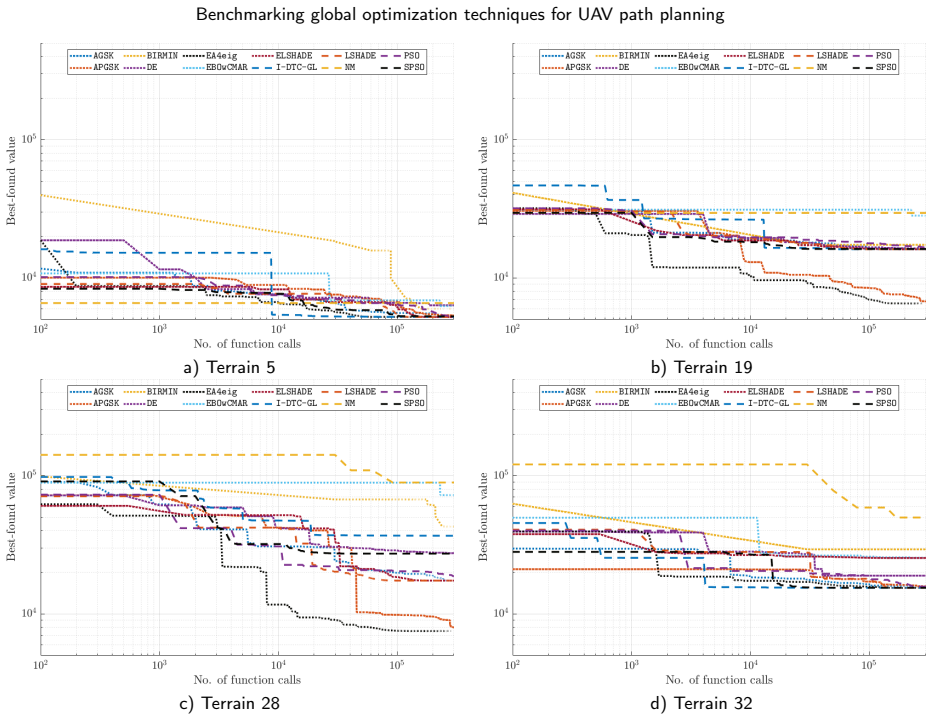
The central object is a problem-instance generator producing 56 UAV path-planning instances: 28 randomly generated terrains, each with 15 or 30 cylindrical threats, combined with a weighted four-criterion cost function (path length, obstacle avoidance, altitude limits, and smoothness) whose decision variables are the waypoint coordinates. The argument is carried by comparing these instances to established benchmark suites through Exploratory Landscape Analysis (ELA) features, and by evaluating twelve solvers with relative error to the best-found solution, number of wins, and Friedman ranks across dimensions 15, 30, 45, 60 and budgets $10^3$, $10^4$, $10^5$ function evaluations.
What would settle it
For a given terrain, construct an instance whose optimal path is known (e.g., place all threats so the straight line from start to goal is feasible and optimal) and check whether the relative-error rankings of EA4eig, APGSK, and ELSHADE against the true optimum reproduce the rankings the paper reports against best-found solutions.
Extended reading notes
Core claim
The central claim is that the generated UAV path-planning problems form a distinct, reusable benchmark family whose landscape characteristics are unlike those of the BBOB, CEC, and ABS suites, and that on these problems the best-performing methods are almost universally the top evolutionary algorithms from recent numerical-optimization competitions. At large computational budgets, EA4eig and APGSK consistently have the lowest Friedman ranks, with statistically significant advantages over most other methods, while ELSHADE, LSHADE, and SPSO also perform well in specific settings; deterministic DIRECT-type methods (BIRMIN, I-DTC-GL) and simple local search (NM) lag behind, especially as dimension and budget grow. The conclusion is stated on the paper's own terms: the UAV instances 'may form an interesting addition to the established benchmark suits.'
Load-bearing premise
The global optima of the 56 instances are unknown, so all relative-error metrics and rankings are computed against the best solution found by any method on each instance; if those best-found solutions are far from the true optima, or if all methods fail similarly on hard instances, the reported rankings may not reflect true performance.
Editorial extensions
If this is right
- The 56 UAV instances are a reusable benchmark family: code and data are publicly released, so other researchers can run the same problems without re-implementing the generator.
- On these instances, method rankings depend on both dimension and computational budget, so benchmarks that test only a single budget or dimension will miss the patterns.
- The variable-dimension view of the problem favors starting at low dimension ($D_V=5$) and refining: in most cases best-found solutions come from the lowest-dimension setting, and higher dimensions rarely compensate for added difficulty.
- For large budgets, the performance gap between many methods narrows, but APGSK and EA4eig remain consistently ahead.
- High-density threat instances are harder and show larger improvements when the budget grows, because methods need more evaluations to escape infeasible or locally optimal corridors.
Reading between the lines
- Because the global optima are unknown, the rankings are relative to the best-found solution; a direct extension would be to construct instances with known optimal paths (e.g., by placing threats so the straight line is optimal) to check whether the reported ordering holds under an absolute reference.
- The variable-dimension finding suggests a practical recipe for UAV path planning: start with few waypoints to find a feasible corridor, then refine with more waypoints; this could be tested as a standalone 'variable-dimension' method and compared against fixed-dimension baselines.
- The landscape-uniqueness result implies that these instances may expose failure modes hidden by artificial benchmarks; a concrete way to check this is to see whether methods tuned on established suites degrade less or more on UAV instances relative to their landscape-similar artificial functions.
- Porting the MATLAB generator to other languages and to established profiling platforms would let the community measure per-run behavior (e.g., anytime curves) rather than only final errors.
Signed reviews
Editorial analysis
A structured set of objections, weighed in public.
Referee Report
Summary. The paper proposes a benchmark suite of 56 UAV path-planning instances generated from 28 hand-picked terrains with two threat densities, and compares 12 global optimization methods (DIRECT-type, classical EC, and recent CEC competition winners) under four dimensionalities (DV=5,10,15,20) and three computational budgets (B=1e3,1e4,1e5). The authors use Exploratory Landscape Analysis (ELA) to argue that the instances are distinct from BBOB, CEC, and ABS benchmark functions, and they report mean relative errors, numbers of best-found solutions, Friedman ranks, and Wilcoxon tests with Holm correction. They find that EA4eig, APGSK, and ELSHADE are the best-performing methods overall, and they discuss the variable-dimension nature of the problem, concluding that solving in lower dimensions is generally more beneficial.
Significance. If the results hold, the proposed UAV instances could serve as a reusable real-world benchmark family, addressing the need for non-artificial test problems in global optimization. The paper provides a public Zenodo repository with code, data, and instance generation routines, which is a valuable asset for reproducibility. The finding that recent CEC-winning evolutionary algorithms outperform DIRECT-type deterministic methods on these discontinuous, constrained landscapes is of interest to both the evolutionary computation and path-planning communities. The variable-dimension investigation is a useful step toward a largely under-studied benchmark scenario. However, the validity of the quantitative conclusions depends on the choice of reference baseline and on the experimental design; these issues are addressed in the major comments.
major comments (3)
- [Section 4, first paragraph; Eq. (2)] The performance metric is defined as the relative error of a method's best-found solution to the best-found solution across all methods in that setting. Because the objective contains the hard infeasibility penalty Jpen=1e4, instances on which no method finds a feasible path (e.g., terrain 32 in Fig. 6d) have an infeasible reference solution with objective value above the cliff. On such instances, the relative errors measure degrees of infeasibility rather than closeness to the unknown optimum, and a method that finds a feasible path would have a negative relative error under the formula given in the text. Since all quantitative conclusions (mean relative error, number of wins, Friedman ranks, Wilcoxon tests) are computed against this baseline, the abstract's claim that the best-ranking methods are 'almost universally' the top CEC evolutionary techniques is not established for hard instances. The authors should report feasibility rates separately, compute relative errors against the best feasible solution found by any method across all settings, and verify whether the qualitative rankings survive this re-analysis.
- [Section 3.2] All methods are run once per instance and setting, starting from an identical random seed. For stochastic global optimizers, a single run provides no information about run-to-run variability, and the Wilcoxon signed-rank tests in Tables 2, 4, and 6 are based on a single paired sample per method, so the reported significance results may not be robust to the choice of seed. The authors should either run multiple independent repetitions (e.g., 10 or more) and report median/mean values with appropriate variance-aware statistical tests, or they should justify the single-run design by, for example, demonstrating low variance on a subset of instances. This is load-bearing because the central ranking claims depend on statistical significance assertions.
- [Section 2.1; Section 2.3] The 56 instances are selected from a pool of 5000 by 'hand-picking twenty-eight terrains that displayed interesting and real-life looking characteristics' without quantitative selection criteria. This makes the instance selection subjective and not independently reproducible, and it may bias the ELA-based novelty analysis toward instances that appear unique by construction. The authors should either specify a quantitative selection procedure (e.g., based on terrain roughness statistics, obstacle coverage, or ELA feature values) or provide the full set of selection criteria so that readers can assess whether the claimed separation from BBOB/CEC/ABS suites is an artifact of hand-picking.
minor comments (5)
- [Throughout] There are several typos: 'AUV path planning' in Section 1 should be 'UAV path planning'; 'threads' appears in place of 'threats' in the discussion of Fig. 7 and in the text near Table 8; 'nad' in Section 2.2.2 should be 'and'; and the statistical test caption says 'Wilcoxon text' instead of 'Wilcoxon test'.
- [Section 4, first paragraph] The term 'relative error' is a misnomer when the reference is a best-found solution rather than a known optimum; consider using 'relative deviation from the best-found solution' or 'performance ratio' to avoid implying ground-truth error.
- [Tables 2, 4, and 6] The text says 'The only two methods for which no statistically significant difference from the best method (EA4eig) was found were APGSK (for DV=5) and LSHADE (for DV={5,15})' for B=1e3, but Table 2 shows LSHADE DV=15 with p*=0.0503, which is exactly the significance level; this borderline result should be reported with caution.
- [Section 4, variable dimension analysis] In Table 7, the best-found solutions for each DV are taken from methods that may have used different budgets and may have been truncated by the three-hour limit for B=1e5; this should be stated more prominently so that the comparison across DV values is interpreted with the appropriate caveats.
- [Section 2.3] The ELA computations use uniform sampling with 250*dim samples in dim=30, which is a relatively small sample for a 30-dimensional discontinuous objective; the authors should discuss whether the ELA features are stable with respect to sample size, especially given the Jpen=1e4 discontinuity.
Circularity Check
No circularity: the UAV benchmark ranking is an empirical result with independent algorithm provenance; self-citations are contextual, not load-bearing.
full rationale
The paper's central claim is an empirical observation: on 56 newly generated UAV instances, certain CEC-winning evolutionary methods rank best. This ranking is not derived from a fitted parameter or from the authors' own prior conclusions. The objective function (Eq. 9) is fixed, the terrain instances are generated from an external tool, and the 12 compared algorithms are independently published methods with CEC provenance. The relative-error metric is computed against the best-found solution across methods because the global optima are unknown (Section 4, first paragraph); this is a comparison baseline, not a fitted prediction, so it does not constitute circularity. The infeasibility cliff (Jpen = 1e4, Eq. 2) and the terrain-32 case where no method finds a feasible path are correctness and robustness concerns about the benchmark, not circular steps. Self-citations appear in the paper: [64] is used to select methods, [34] is cited to motivate real-world benchmark suits, and [56] is the code repository. None of these is the evidence for the headline claim; the ELA-based novelty claim is computed with flacco features and compared against established suites, not assumed from a citation. Thus no step reduces to its own input, and no load-bearing self-citation chain forces the reported result.
Assumptions & free parameters
free parameters (1)
- Objective function weights b1-b4, smoothness penalties beta1-beta2, Jpen=1e4, danger-zone margin S, UAV diameter D =
Adopted from [9,59]; values not re-fit
assumptions (5)
- domain assumption The UAV path-planning cost model of [9,59] (path length, cylindrical threats, altitude bounds, smoothness penalties) adequately represents real UAV path planning.
- domain assumption A single run per method-instance-budget-dimension combination, using an identical random seed, gives a representative performance estimate.
- domain assumption ELA features computed from 250*dim uniform samples in dim=30 capture the relevant landscape differences between the UAV instances and established suites.
- domain assumption The best-found solution across methods is a suitable reference for the unknown global optimum when computing relative errors.
- standard math The Wilcoxon signed-rank test with Holm-Bonferroni correction provides valid inference for the paired comparisons.
Cite this review
Pith. "Pith review of Benchmarking global optimization techniques for unmanned aerial vehicle path planning." pith.science (2026). https://pith.science/paper/DUH2ZAQF
@misc{pith2026250114503,
  author       = {Pith},
  title        = {Pith review of: Benchmarking global optimization techniques for unmanned aerial vehicle path planning},
  year         = {2026},
  howpublished = {\url{https://pith.science/paper/DUH2ZAQF}},
  note         = {Machine review of arXiv:2501.14503}
}
read the original abstract
The Unmanned Aerial Vehicle (UAV) path planning problem is a complex optimization problem in the field of robotics. In this paper, we investigate the possible utilization of this problem in benchmarking global optimization methods. We devise a problem instance generator and pick 56 representative instances, which we compare to established benchmarking suits through Exploratory Landscape Analysis to show their uniqueness. For the computational comparison, we select twelve well-performing global optimization techniques from both subfields of stochastic algorithms (evolutionary computation methods) and deterministic algorithms (Dividing RECTangles, or DIRECT-type methods). The experiments were conducted in settings with varying dimensionality and computational budgets. The results were analyzed through several criteria (number of best-found solutions, mean relative error, Friedman ranks) and utilized established statistical tests. The best-ranking methods for the UAV problems were almost universally the top-performing evolutionary techniques from recent competitions on numerical optimization at the Institute of Electrical and Electronics Engineers Congress on Evolutionary Computation. Lastly, we discussed the variable dimension characteristics of the studied UAV problems that remain still largely under-investigated.
Figures


Figures from the paper (8 more)




Reference graph
Works this paper leans on
-
[1]
Kamate, N
S. Kamate, N. Yilmazer, Application of object detection and tracking techniques for unmanned aerial vehicles, Procedia Computer Science 61 (2015) 436–441
2015
-
[2]
D.Sziroczak,D.Rohacs,J.Rohacs, Reviewofusingsmalluavbasedmeteorologicalmeasurementsforroadweathermanagement, Progress in Aerospace Sciences 134 (2022) 100859
2022
-
[3]
Giordan, A
D. Giordan, A. Manconi, F. Remondino, F. Nex, Use of unmanned aerial vehicles in monitoring application and management of natural hazards, Geomatics, Natural Hazards and Risk 8 (2017) 1–4
2017
-
[4]
T. Yang, Z. Jiang, R. Sun, N. Cheng, H. Feng, Maritime search and rescue based on group mobile computing for unmanned aerial vehicles and unmanned surface vehicles, IEEE transactions on industrial informatics 16 (2020) 7700–7708
2020
-
[5]
A. W. N. Ibrahim, P. W. Ching, G. G. Seet, W. M. Lau, W. Czajewski, Moving objects detection and tracking framework for uav-based surveillance, in: 2010 Fourth Pacific-Rim Symposium on Image and Video Technology, IEEE, 2010, pp. 456–461
2010
-
[6]
J. Kim, S. Kim, C. Ju, H. I. Son, Unmanned aerial vehicles in agriculture: A review of perspective of platform, control, and applications, Ieee Access 7 (2019) 105100–105115
2019
-
[7]
1200–1204
Z.Xiaoning, Analysisofmilitaryapplicationofuavswarmtechnology, in:20203rdInternationalConferenceonUnmannedSystems(ICUS), IEEE, 2020, pp. 1200–1204
2020
-
[8]
A.Ait-Saadi,Y.Meraihi,A.Soukane,A.Ramdane-Cherif,A.B.Gabis, Anovelhybridchaoticaquilaoptimizationalgorithmwithsimulated annealing for unmanned aerial vehicles path planning, Computers and Electrical Engineering 104 (2022) 108461
2022
Show all 108 references
-
[9]
M.D.Phung,Q.P.Ha, Safety-enhanceduavpathplanningwithsphericalvector-basedparticleswarmoptimization, AppliedSoftComputing 107 (2021) 107376
2021
-
[10]
M. D. Phung, T. H. Dinh, Q. P. Ha, et al., System architecture for real-time surface inspection using multiple uavs, IEEE Systems Journal 14 (2019) 2925–2936
2019
-
[11]
L. Lin, M. A. Goodrich, Uav intelligent path planning for wilderness search and rescue, in: 2009 IEEE/RSJ International Conference on Intelligent Robots and Systems, IEEE, 2009, pp. 709–714
2009
-
[12]
M.D.Phung,Q.P.Ha, Motion-encodedparticleswarmoptimizationformovingtargetsearchusinguavs, AppliedSoftComputing97(2020) 106705
2020
-
[13]
C.Yin,Z.Xiao,X.Cao,X.Xi,P.Yang,D.Wu,Offlineandonlinesearch:Uavmultiobjectivepathplanningunderdynamicurbanenvironment, IEEE Internet of Things Journal 5 (2017) 546–558
2017
-
[14]
R. W. Beard, T. W. McLain, M. A. Goodrich, E. P. Anderson, Coordinated target assignment and intercept for unmanned air vehicles, IEEE transactions on robotics and automation 18 (2002) 911–922
2002
-
[15]
Eppstein, Finding the k shortest paths, SIAM Journal on computing 28 (1998) 652–673
D. Eppstein, Finding the k shortest paths, SIAM Journal on computing 28 (1998) 652–673
1998
-
[16]
P. O. Pettersson, P. Doherty, Probabilistic roadmap based path planning for an autonomous unmanned helicopter, Journal of Intelligent & Fuzzy Systems 17 (2006) 395–405
2006
-
[17]
Y. Lin, S. Saripalli, Sampling-based path planning for uav collision avoidance, IEEE Transactions on Intelligent Transportation Systems 18 (2017) 3179–3192
2017
-
[18]
B.Penin,P.R.Giordano,F.Chaumette, Minimum-timetrajectoryplanningunderintermittentmeasurements, IEEERoboticsandAutomation Letters 4 (2018) 153–160
2018
-
[19]
R. J. Szczerba, P. Galkowski, I. S. Glicktein, N. Ternullo, Robust algorithm for real-time route planning, IEEE Transactions on aerospace and electronic systems 36 (2000) 869–878
2000
-
[20]
J. Li, G. Deng, C. Luo, Q. Lin, Q. Yan, Z. Ming, A hybrid path planning method in unmanned air/ground vehicle (uav/ugv) cooperative systems, IEEE Transactions on Vehicular Technology 65 (2016) 9585–9596
2016
-
[21]
J. Kwak, Y. Sung, Autonomous uav flight control for gps-based navigation, IEEE Access 6 (2018) 37947–37955
2018
-
[22]
X. Sun, Y. Liu, W. Yao, N. Qi, Triple-stage path prediction algorithm for real-time mission planning of multi-uav, Electronics Letters 51 (2015) 1490–1492
2015
-
[23]
J.Tang,J.Sun,C.Lu,S.Lao, Optimizedartificialpotentialfieldalgorithmtomulti-unmannedaerialvehiclecoordinatedtrajectoryplanning and collision avoidance in three-dimensional environment, Proceedings of the Institution of Mechanical Engineers, Part G: Journal of Aerospace Engineer...
2019
-
[24]
J. D. Pintér, Global optimization in action: continuous and Lipschitz optimization: algorithms, implementations and applications, volume 6, Springer Science & Business Media, 1995
1995
-
[25]
D. R. Jones, C. D. Perttunen, B. E. Stuckman, Lipschitzian optimization without the lipschitz constant, Journal of optimization Theory and Applications 79 (1993) 157–181
1993
-
[26]
Y. D. Sergeyev, D. E. Kvasov, Global search based on efficient diagonal partitions and a set of lipschitz constants, SIAM Journal on Optimization 16 (2006) 910–937
2006
-
[27]
Molina, J
D. Molina, J. Poyatos, J. D. Ser, S. García, A. Hussain, F. Herrera, Comprehensive taxonomies of nature-and bio-inspired optimization: Inspiration versus algorithmic behavior, critical analysis recommendations, Cognitive Computation 12 (2020) 897–939
2020
-
[28]
X.-S. Yang, Z. Cui, R. Xiao, A. H. Gandomi, M. Karamanoglu, Swarm intelligence and bio-inspired computation: theory and applications, Newnes, 2013. Shehadeh and Kudela: Preprint submitted to Elsevier Page 20 of 23 Benchmarking global optimization techniques for UAV path planning
2013
-
[29]
C. L. Camacho Villalón, T. Stützle, M. Dorigo, Grey wolf, firefly and bat algorithms: Three widespread algorithms that do not contain any novelty, in: International conference on swarm intelligence, Springer, 2020, pp. 121–133
2020
-
[30]
C.L.Camacho-Villalón,M.Dorigo,T.Stützle, Exposingthegreywolf,moth-flame,whale,firefly,bat,andantlionalgorithms:sixmisleading optimization techniques inspired by bestial metaphors, International Transactions in Operational Research 30 (2023) 2945–2971
2023
-
[31]
Aranha, C
C. Aranha, C. L. Camacho Villalón, F. Campelo, M. Dorigo, R. Ruiz, M. Sevaux, K. Sörensen, T. Stützle, Metaphor-based metaheuristics, a call for action: the elephant in the room, Swarm Intelligence 16 (2022) 1–6
2022
-
[32]
Campelo, C
F. Campelo, C. Aranha, Lessons from the evolutionary computation bestiary, Artificial Life 29 (2023) 421–432
2023
-
[33]
stoa: A bio-inspired based optimization algorithm for industrial engineering problems
J. Kudela, Commentary on:“stoa: A bio-inspired based optimization algorithm for industrial engineering problems”[eaai, 82 (2019), 148– 174]and“tunicateswarmalgorithm:Anewbio-inspiredbasedmetaheuristicparadigmforglobaloptimization”[eaai,90(2020),no.103541], Engineering Applicat...
2019
-
[34]
Kudela, A critical problem in benchmarking and analysis of evolutionary computation methods, Nature Machine Intelligence 4 (2022) 1238–1245
J. Kudela, A critical problem in benchmarking and analysis of evolutionary computation methods, Nature Machine Intelligence 4 (2022) 1238–1245
2022
-
[35]
Kudela, The evolutionary computation methods no one should use, arXiv preprint arXiv:2301.01984 (2023)
J. Kudela, The evolutionary computation methods no one should use, arXiv preprint arXiv:2301.01984 (2023)
2023 arXiv
-
[36]
Roberge, M
V. Roberge, M. Tarbouchi, G. Labonté, Comparison of parallel genetic algorithm and particle swarm optimization for real-time uav path planning, IEEE Transactions on industrial informatics 9 (2012) 132–141
2012
-
[37]
C. Xu, H. Duan, F. Liu, Chaotic artificial bee colony approach to uninhabited combat air vehicle (ucav) path planning, Aerospace science and technology 14 (2010) 535–541
2010
-
[38]
Y. Fu, M. Ding, C. Zhou, H. Hu, Route planning for unmanned aerial vehicle (uav) on the sea using hybrid differential evolution and quantum-behaved particle swarm optimization, IEEE Transactions on Systems, Man, and Cybernetics: Systems 43 (2013) 1451–1465
2013
-
[39]
Yu, W.-N
X. Yu, W.-N. Chen, T. Gu, H. Yuan, H. Zhang, J. Zhang, Aco-a*: Ant colony optimization plus a* for 3-d traveling in environments with dense obstacles, IEEE Transactions on Evolutionary Computation 23 (2018) 617–631
2018
-
[40]
H. Chu, J. Yi, F. Yang, Chaos particle swarm optimization enhancement algorithm for uav safe path planning, Applied Sciences 12 (2022) 8977
2022
-
[41]
W. Wang, C. Ye, J. Tian, Sggtso: A spherical vector-based optimization algorithm for 3d uav path planning, Drones 7 (2023) 452
2023
-
[42]
Huang, X
C. Huang, X. Zhou, X. Ran, J. Wang, H. Chen, W. Deng, Adaptive cylinder vector particle swarm optimization with differential evolution for uav path planning, Engineering Applications of Artificial Intelligence 121 (2023) 105942
2023
-
[43]
Z. Yu, Z. Si, X. Li, D. Wang, H. Song, A novel hybrid particle swarm optimization algorithm for path planning of uavs, IEEE Internet of Things Journal 9 (2022) 22547–22558
2022
-
[44]
M.Hellwig,H.-G.Beyer, Benchmarkingevolutionaryalgorithmsforsingleobjectivereal-valuedconstrainedoptimization–acriticalreview, Swarm and evolutionary computation 44 (2019) 927–944
2019
-
[45]
C.García-Martínez,P.D.Gutiérrez,D.Molina,M.Lozano,F.Herrera, Sincecec2005competitiononreal-parameteroptimisation:adecade of research, progress and comparative analysis’s weakness, Soft Computing 21 (2017) 5573–5583
2017
-
[46]
Kudela, R
J. Kudela, R. Matousek, New benchmark functions for single-objective optimization based on a zigzag pattern, IEEE Access 10 (2022) 8262–8278
2022
-
[47]
Hansen, A
N. Hansen, A. Auger, R. Ros, O. Mersmann, T. Tušar, D. Brockhoff, Coco: A platform for comparing continuous optimizers in a black-box setting, Optimization Methods and Software 36 (2021) 114–144
2021
-
[48]
A. P. Piotrowski, Regarding the rankings of optimization heuristics based on artificially-constructed benchmark functions, Information Sciences 297 (2015) 191–201
2015
-
[49]
A.Tzanetos,G.Dounias, Natureinspiredoptimizationalgorithmsorsimplyvariationsofmetaheuristics?, ArtificialIntelligenceReview54 (2021) 1841–1862
2021
-
[50]
A. P. Piotrowski, J. J. Napiorkowski, A. E. Piotrowska, Metaheuristics should be tested on large benchmark set with various numbers of function evaluations, Swarm and Evolutionary Computation 92 (2025) 101807
2025
-
[51]
Mersmann, M
O. Mersmann, M. Preuss, H. Trautmann, Benchmarking evolutionary algorithms: Towards exploratory landscape analysis, in: International Conference on Parallel Problem Solving from Nature, Springer, 2010, pp. 73–82
2010
-
[52]
In press
J.Kudela,M.Juricek,R.Parak,A.Tzanetos,R.Matousek, Benchmarkingderivative-freeglobaloptimizationmethodsonvariabledimension robotics problems, in: IEEE Congress on Evolutionary Computation, IEEE, 2024, p. In press
2024
-
[53]
D. E. Goldberg, B. Korb, K. Deb, Messy genetic algorithms: Motivation, analysis, and first results, Complex systems 3 (1989) 493–530
1989
-
[54]
Karami, A
J. Karami, A. Moghaddam, A. Faridhosseini, A. N. Ziaei, M. Rouholamini, M. Moghbeli, Using fast messy genetic algorithm to optimally schedule pump operation, in: Frontiers in Water-Energy-Nexus—Nature-Based Solutions, Advanced Technologies and Best Practices for EnvironmentalS...
2020
-
[55]
A.Khetan,D.J.Lohan,J.T.Allison, Managingvariable-dimensionstructuraloptimizationproblemsusinggenerativealgorithms, Structural and Multidisciplinary Optimization 52 (2015) 695–715
2015
-
[56]
M. A. Shehadeh, J. Kudela, Zenodo repository: Benchmarking global optimization techniques for uav path planning, 2024. URL:https: //doi.org/10.5281/zenodo.12793991
2024 doi
-
[57]
DOI:https://doi.org/10.1016/j.asoc.2021.107376
M.D.Phung,Q.P.Ha, Safety-enhanceduavpathplanningwithsphericalvector-basedparticleswarmoptimization, AppliedSoftComputing 107 (2021) 107376. DOI:https://doi.org/10.1016/j.asoc.2021.107376
2021
-
[58]
McClure, Automatic terrain generation, matlab central file exchange, 2023
T. McClure, Automatic terrain generation, matlab central file exchange, 2023. URL:https://www.mathworks.com/matlabcentral/ fileexchange/39559-automatic-terrain-generation
2023
-
[59]
Cheng, J
X. Cheng, J. Li, C. Zheng, J. Zhang, M. Zhao, An improved pso-gwo algorithm with chaos and adaptive inertial weight for robot path planning, Frontiers in Neurorobotics 15 (2021). DOI:10.3389/fnbot.2021.770361
2021
-
[60]
com/blockchain-group/DIRECTGOLib, pre-release v2.0
L.Stripinis,J.Kůdela,R.Paulavičius,DIRECTGOLib-DIRECTglobaloptimizationtestproblemslibrary,2023.URL: https://github. com/blockchain-group/DIRECTGOLib, pre-release v2.0. Shehadeh and Kudela: Preprint submitted to Elsevier Page 21 of 23 Benchmarking global optimization technique...
2023
-
[61]
P.Kerschke,H.Trautmann, Comprehensivefeature-basedlandscapeanalysisofcontinuousandconstrainedoptimizationproblemsusingthe r-package flacco, Applications in Statistical Computing: From Music Data Analysis to Industrial Quality Improvement (2019) 93–123
2019
-
[62]
R.P.Prager,H.Trautmann, Nullifyingtheinherentbiasofnon-invariantexploratorylandscapeanalysisfeatures, in:InternationalConference on the Applications of Evolutionary Computation (Part of EvoStar), Springer, 2023, pp. 411–425
2023
-
[63]
U.Škvorc,T.Eftimov,P.Korošec, Understandingtheproblemspaceinsingle-objectivenumericaloptimizationusingexploratorylandscape analysis, Applied Soft Computing 90 (2020) 106138
2020
-
[64]
Stripinis, J
L. Stripinis, J. Kudela, R. Paulavičius, Benchmarking derivative-free global optimization algorithms under limited dimensions and large evaluation budgets, IEEE Transactions on Evolutionary Computation (2024)
2024
-
[65]
LaTorre, D
A. LaTorre, D. Molina, E. Osaba, J. Poyatos, J. Del Ser, F. Herrera, A prescription of methodological guidelines for comparing bio-inspired optimization algorithms, Swarm and Evolutionary Computation 67 (2021) 100973
2021
-
[66]
A.V.Kononova,D.Vermetten,F.Caraffini,M.-A.Mitran,D.Zaharie, Theimportanceofbeingconstrained:Dealingwithinfeasiblesolutions in differential evolution and beyond, Evolutionary Computation (2023) 1–46
2023
-
[67]
T. H. Bäck, A. V. Kononova, B. van Stein, H. Wang, K. A. Antonov, R. T. Kalkreuth, J. de Nobel, D. Vermetten, R. de Winter, F. Ye, Evolutionary algorithms for parameter optimization—thirty years later, Evolutionary Computation 31 (2023) 81–122
2023
-
[68]
J. A. Nelder, R. Mead, A simplex method for function minimization, The computer journal 7 (1965) 308–313
1965
-
[69]
Paulavičius, Y
R. Paulavičius, Y. D. Sergeyev, D. E. Kvasov, J. Žilinskas, Globally-biased birect algorithm with local accelerators for expensive global optimization, Expert Systems with Applications 144 (2020) 113052
2020
-
[70]
Gaviano, D
M. Gaviano, D. E. Kvasov, D. Lera, Y. D. Sergeyev, Algorithm 829: Software for generation of classes of test functions with known local and global minima for global optimization, ACM Transactions on Mathematical Software (TOMS) 29 (2003) 469–480
2003
-
[71]
J.Kudela,M.Juricek, Computationalandexploratorylandscapeanalysisofthegklsgenerator, in:ProceedingsoftheCompanionConference on Genetic and Evolutionary Computation, 2023, pp. 443–446
2023
-
[72]
Stripinis, R
L. Stripinis, R. Paulavičius, An empirical study of various candidate selection and partitioning techniques in the direct framework, Journal of Global Optimization (2022) 1–31
2022
-
[73]
Stripinis, R
L. Stripinis, R. Paulavičius, Directgo: A new direct-type matlab toolbox for derivative-free global optimization, ACM Transactions on Mathematical Software 48 (2022) 1–46
2022
-
[74]
Storn, K
R. Storn, K. Price, Differential evolution–a simple and efficient heuristic for global optimization over continuous spaces, Journal of global optimization 11 (1997) 341–359
1997
-
[75]
M. Pant, H. Zaheer, L. Garcia-Hernandez, A. Abraham, et al., Differential evolution: A review of more than two decades of research, Engineering Applications of Artificial Intelligence 90 (2020) 103479
2020
-
[76]
S. Das, P. N. Suganthan, Differential evolution: A survey of the state-of-the-art, IEEE transactions on evolutionary computation 15 (2010) 4–31
2010
-
[77]
Kudela, R
J. Kudela, R. Matoušek, Combining lipschitz and rbf surrogate models for high-dimensional computationally expensive problems, Information Sciences 619 (2023) 457–477
2023
-
[78]
Bujok, M
P. Bujok, M. Lacko, P. Kolenovsk`y, Differential evolution and engineering problems, Mendel 29 (2023) 45–54
2023
-
[79]
Kennedy, R
J. Kennedy, R. Eberhart, Particle swarm optimization, in: Proceedings of ICNN’95-international conference on neural networks, volume 4, ieee, 1995, pp. 1942–1948
1995
-
[80]
A. P. Piotrowski, J. J. Napiorkowski, A. E. Piotrowska, Particle swarm optimization or differential evolution—a comparison, Engineering Applications of Artificial Intelligence 121 (2023) 106008
2023
-
[81]
D. Wang, D. Tan, L. Liu, Particle swarm optimization algorithm: an overview, Soft computing 22 (2018) 387–408
2018
-
[82]
A. W. Mohamed, A. A. Hadi, A. K. Mohamed, N. H. Awad, Evaluating the performance of adaptive gainingsharing knowledge based algorithm on cec 2020 benchmark problems, in: 2020 IEEE congress on evolutionary computation (CEC), IEEE, 2020, pp. 1–8
2020
-
[83]
A. W. Mohamed, A. A. Hadi, A. K. Mohamed, Gaining-sharing knowledge based algorithm for solving optimization problems: a novel nature-inspired algorithm, International Journal of Machine Learning and Cybernetics 11 (2020) 1501–1529
2020
-
[84]
Kudela, M
J. Kudela, M. Juříček, R. Parák, A collection of robotics problems for benchmarking evolutionary computation methods, in: International Conference on the Applications of Evolutionary Computation (Part of EvoStar), Springer, 2023, pp. 364–379
2023
-
[85]
K. M. Sallam, S. M. Elsayed, R. K. Chakrabortty, M. J. Ryan, Improved multi-operator differential evolution algorithm for solving unconstrained problems, in: 2020 IEEE congress on evolutionary computation (CEC), IEEE, 2020, pp. 1–8
2020
-
[86]
Bujok, P
P. Bujok, P. Kolenovsky, Eigen crossover in cooperative model of evolutionary algorithms applied to cec 2022 single objective numerical optimisation, in: 2022 IEEE Congress on Evolutionary Computation (CEC), IEEE, 2022, pp. 1–8
2022
-
[87]
Hansen, S
N. Hansen, S. D. Müller, P. Koumoutsakos, Reducing the time complexity of the derandomized evolution strategy with covariance matrix adaptation (cma-es), Evolutionary computation 11 (2003) 1–18
2003
-
[88]
Kumar, R
A. Kumar, R. K. Misra, D. Singh, Improving the local search capability of effective butterfly optimizer using covariance matrix adapted retreat phase, in: 2017 IEEE congress on evolutionary computation (CEC), IEEE, 2017, pp. 1835–1842
2017
-
[89]
Tanabe, A
R. Tanabe, A. S. Fukunaga, Improving the search performance of shade using linear population size reduction, in: 2014 IEEE congress on evolutionary computation (CEC), IEEE, 2014, pp. 1658–1665
2014
-
[90]
Mauder, J
T. Mauder, J. Kudela, L. Klimeš, M. Zálešák, P. Charvát, Soft computing methods in the solution of an inverse heat transfer problem with phase change: A comparative study, Engineering Applications of Artificial Intelligence 133 (2024) 108229
2024
-
[91]
Kudela, M
J. Kudela, M. Zálešák, P. Charvát, L. Klimeš, T. Mauder, Assessment of the performance of metaheuristic methods used for the inverse identification of effective heat capacity of phase change materials, Expert Systems with Applications 238 (2024) 122373
2024
-
[92]
Zamuda, J
A. Zamuda, J. D. H. Sosa, Success history applied to expert system for underwater glider path planning using differential evolution, Expert Systems with Applications 119 (2019) 155–170
2019
-
[93]
Matousek, L
R. Matousek, L. Dobrovsky, J. Kudela, How to start a heuristic? utilizing lower bounds for solving the quadratic assignment problem, International Journal of Industrial Engineering Computations 13 (2022) 151–164. Shehadeh and Kudela: Preprint submitted to Elsevier Page 22 of 2...
2022
-
[94]
Holm, A simple sequentially rejective multiple test procedure, Scandinavian journal of statistics (1979) 65–70
S. Holm, A simple sequentially rejective multiple test procedure, Scandinavian journal of statistics (1979) 65–70
1979
-
[95]
Aickin, H
M. Aickin, H. Gensler, Adjusting for multiple testing when reporting research results: the bonferroni vs holm methods., American journal of public health 86 (1996) 726–728
1996
-
[96]
C. Chen, Q. Liu, Y. Jing, M. Zhang, S. Cheng, Y. Li, On the representativeness metric of benchmark problems in numerical optimization, Swarm and Evolutionary Computation 91 (2024) 101716
2024
-
[97]
Doerr, H
C. Doerr, H. Wang, F. Ye, S. Van Rijn, T. Bäck, Iohprofiler: A benchmarking and profiling tool for iterative optimization heuristics, arXiv preprint arXiv:1810.05281 (2018)
2018 arXiv
-
[98]
Kudela, Chance-constrained optimization formulation for ship conceptual design: A comparison of metaheuristic algorithms, Computers 12 (2023)
J. Kudela, Chance-constrained optimization formulation for ship conceptual design: A comparison of metaheuristic algorithms, Computers 12 (2023). DOI:10.3390/computers12110225
2023 doi
-
[99]
DOI:10.1109/TITS.2021.3131473
J.Chen,Y.Zhang,L.Wu,T.You,X.Ning, Anadaptiveclustering-basedalgorithmforautomaticpathplanningofheterogeneousuavs, IEEE Transactions on Intelligent Transportation Systems 23 (2022) 16842 – 16853. DOI:10.1109/TITS.2021.3131473
2022
-
[100]
Z. Yu, Z. Si, X. Li, D. Wang, H. Song, A novel hybrid particle swarm optimization algorithm for path planning of uavs, IEEE Internet of Things Journal 9 (2022) 22547 – 22558. DOI:10.1109/JIOT.2022.3182798
2022
-
[101]
Huang, X
C. Huang, X. Zhou, X. Ran, J. Wang, H. Chen, W. Deng, Adaptive cylinder vector particle swarm optimization with differential evolution for uav path planning, Engineering Applications of Artificial Intelligence 121 (2023). DOI:10.1016/j.engappai.2023.105942
2023
-
[102]
X. Bai, H. Jiang, J. Cui, K. Lu, P. Chen, M. Zhang, Uav path planning based on improved a * and dwa algorithms, International Journal of Aerospace Engineering 2021 (2021). DOI:10.1155/2021/4511252
2021 doi
-
[103]
DOI:10.3390/drones6050126
A.Israr,Z.A.Ali,E.H.Alkhammash,J.J.Jussila, Optimizationmethodsappliedtomotionplanningofunmannedaerialvehicles:Areview, Drones 6 (2022). DOI:10.3390/drones6050126
2022 doi
-
[104]
J. Liu, S. Anavatti, M. Garratt, H. A. Abbass, Modified continuous ant colony optimisation for multiple unmanned ground vehicle path planning, Expert Systems with Applications 196 (2022). DOI:10.1016/j.eswa.2022.116605
2022
-
[105]
DOI:10.1109/ACCESS.2022.3166632
R.Szczepanski,T.Tarczewski,K.Erwinski, Energyefficientlocalpathplanningalgorithmbasedonpredictiveartificialpotentialfield, IEEE Access 10 (2022) 39729 – 39742. DOI:10.1109/ACCESS.2022.3166632
2022
-
[106]
L. Liu, X. Wang, X. Yang, H. Liu, J. Li, P. Wang, Path planning techniques for mobile robots: Review and prospect, Expert Systems with Applications 227 (2023). DOI:10.1016/j.eswa.2023.120254
2023
-
[107]
Ait Saadi, A
A. Ait Saadi, A. Soukane, Y. Meraihi, A. Benmessaoud Gabis, S. Mirjalili, A. Ramdane-Cherif, Uav path planning using optimization approaches: A survey, Archives of Computational Methods in Engineering (2022). DOI:10.1007/s11831-022-09742-7
2022 doi
-
[108]
J. Tang, H. Duan, S. Lao, Swarm intelligence algorithms for multiple unmanned aerial vehicles collaboration: a comprehensive review, Artificial Intelligence Review 56 (2023) 4295 – 4327. DOI:10.1007/s10462-022-10281-7. Shehadeh and Kudela: Preprint submitted to Elsevier Page 2...
2023 doi
Reviewed August 10, 2026 · model on record in the stance chip above.
Discussion (0). Continue with ORCID to comment.