Dynamic Modeling and Control of Multi-Stack Alkaline Water Electrolysis Systems with Shared Gas Separators and Lye Circulation: An Experiment-Based Study
Pith reviewed 2026-05-23 04:47 UTC · model grok-4.3
The pith
A shared 4-in-1 alkaline electrolyzer matches four separate 1-in-1 units within 0.015 MW load error under wind power.
A machine-rendered reading of the paper's core claim, the machinery that carries it, and where it could break.
Core claim
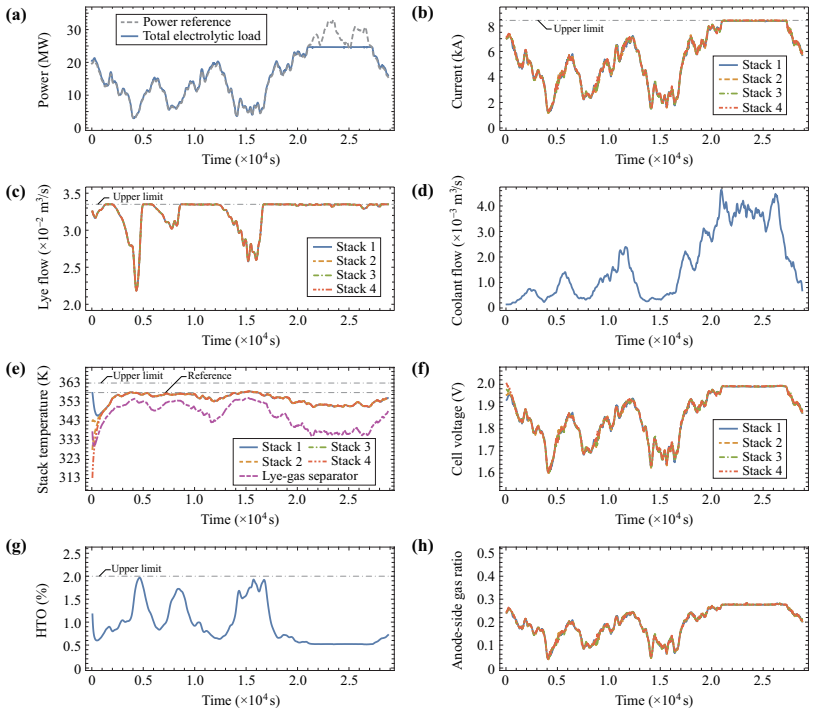
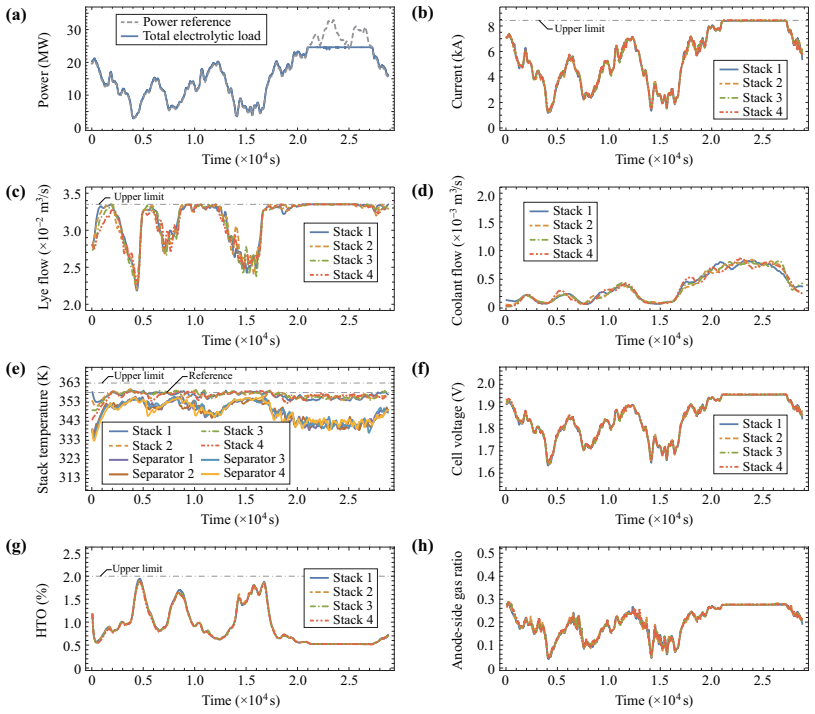
A state-space model of lye circulation, temperature, and hydrogen-to-oxygen dynamics, calibrated on experimental data from a 4-in-1 system, combined with a nonlinear model predictive controller that coordinates inter-stack currents and shared flows, yields load-tracking errors, temperature stabilization, and specific energy consumption that differ from four parallel 1-in-1 systems by at most 0.015 MW, 0.346 K, and 0.001 kWh/Nm³ under wind-power supply.
What carries the argument
The state-space model of shared lye circulation, temperature, and HTO dynamics that supplies the prediction model for the nonlinear MPC coordinating stack currents and common flows.
If this is right
- The shared system can follow wind-power fluctuations with essentially the same accuracy as independent stacks.
- Temperature control remains within 0.346 K of the separate-stack case without extra cooling hardware.
- Specific energy consumption stays within 0.001 kWh/Nm³, preserving the efficiency advantage of the multi-stack layout.
- The NMPC successfully balances load among stacks while respecting shared-separator and circulation constraints.
- The approach supports direct scaling to larger N-in-1 plants for renewable-hydrogen installations.
Where Pith is reading between the lines
- If the small performance gaps persist at industrial scale, shared-separator designs could materially lower the levelized cost of hydrogen.
- The same modeling structure might be reused to compare hybrid plants that mix shared and dedicated stacks within one site.
- Extending the calibration experiments to different stack counts or operating temperatures would test whether the similarity result generalizes.
- Real-time deployment would require confirming that the shared-loop sensors remain accurate enough for the NMPC to keep the reported error bounds.
Load-bearing premise
The model fitted to one physical 4-in-1 rig still correctly describes all cross-stack interactions when the same equations are used to simulate both the shared and the fully separated configurations.
What would settle it
Side-by-side operation of an actual 4-in-1 plant and four separate 1-in-1 plants under identical wind-power traces, checking whether any of the three performance gaps exceeds the stated simulation bounds.
Figures






read the original abstract
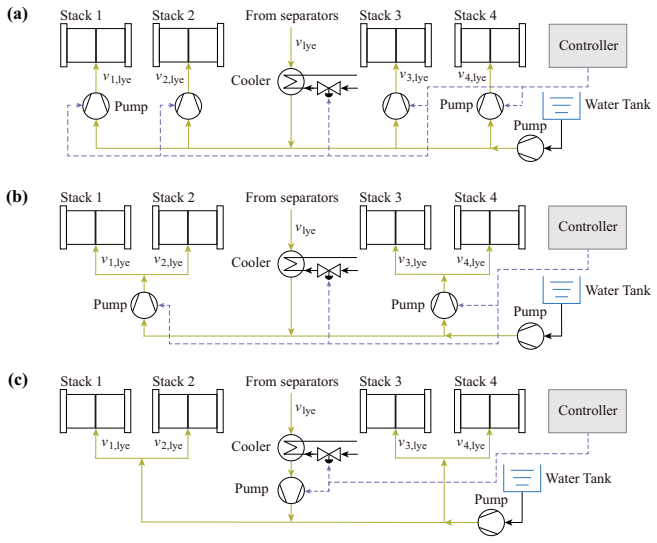
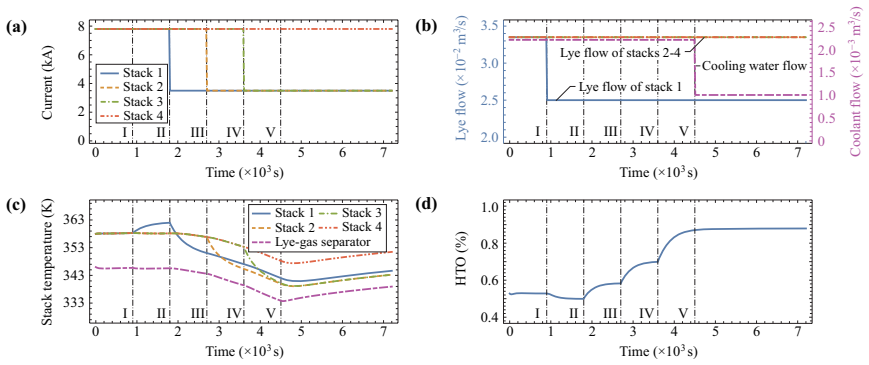
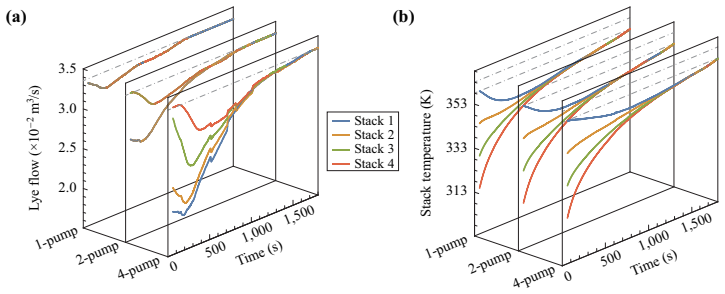
An emerging approach for large-scale renewable hydrogen production is integrating multiple alkaline water electrolysis (AWE) stacks into one balance-of-plant (BoP) system, sharing gas-lye separation and lye circulation components. While this configuration, termed $N$-in-1, reduces cost and complexity, its dynamic performance under fluctuating power remains unclear compared with conventional 1-in-1 systems. This paper develops a state-space model of the multi-stack AWE system, capturing lye circulation, temperature, and hydrogen-to-oxygen (HTO) dynamics, calibrated via experiments on a 4,000 Nm$^3$/h-rated 4-in-1 system. A nonlinear model predictive controller (NMPC) is then designed to coordinate inter-stack current distribution, lye flow, and cooling for load tracking and operational stability. Simulations on the experimental-validated model show that a $4$-in-1 system can achieve very similar performance compared to four parallel 1-in-1 systems. Differences in load-tracking error, temperature stabilization, and specific energy consumption remain below 0.015 MW, 0.346 K, and 0.001 kWh/Nm$^3$ under wind power supply.
Editorial analysis
A structured set of objections, weighed in public.
Referee Report
Summary. The paper develops a state-space model capturing lye circulation, temperature, and HTO dynamics for an N-in-1 alkaline water electrolysis system, calibrated on experimental step-response and steady-state data from a 4000 Nm³/h 4-in-1 rig. It designs an NMPC to coordinate currents, lye flow, and cooling, then uses forward simulations of the tuned model to compare a single 4-in-1 configuration against four independent 1-in-1 systems under wind power, reporting that differences in load-tracking error, temperature stabilization, and specific energy consumption remain below 0.015 MW, 0.346 K, and 0.001 kWh/Nm³.
Significance. If the central comparison is reliable, the work provides evidence that shared balance-of-plant designs can deliver near-equivalent dynamic performance to conventional parallel systems while reducing capital cost and complexity. The experimental calibration on a full-scale rig supplies concrete grounding that is uncommon in this domain; the NMPC formulation for multi-stack coordination is a practical control contribution.
major comments (1)
- [Modeling and simulation sections (model identification and comparative simulations)] The state-space model parameters are identified exclusively from data collected on the physical 4-in-1 rig (shared separators and common lye loop). When the same equations are instantiated four times with independent boundary conditions to represent four 1-in-1 plants, any coupling terms or effective parameters fitted to the shared-flow regime (e.g., lye-flow distribution factors, thermal time constants influenced by common piping) are left unchanged. No separate validation or sensitivity analysis is provided to confirm that these parameters remain valid for the decoupled topology; consequently the headline performance deltas are generated by an unverified model transfer.
minor comments (2)
- [Abstract] The abstract states the performance bounds but supplies no detail on validation metrics (e.g., R², cross-validation splits, or residual statistics) for the calibrated model.
- [Modeling section] Notation for the state-space matrices and the precise definition of the 1-in-1 boundary conditions should be clarified to allow readers to reproduce the decoupled instantiation.
Simulated Author's Rebuttal
We thank the referee for their thorough review and valuable feedback on our manuscript. Below we provide a point-by-point response to the major comment.
read point-by-point responses
-
Referee: [Modeling and simulation sections (model identification and comparative simulations)] The state-space model parameters are identified exclusively from data collected on the physical 4-in-1 rig (shared separators and common lye loop). When the same equations are instantiated four times with independent boundary conditions to represent four 1-in-1 plants, any coupling terms or effective parameters fitted to the shared-flow regime (e.g., lye-flow distribution factors, thermal time constants influenced by common piping) are left unchanged. No separate validation or sensitivity analysis is provided to confirm that these parameters remain valid for the decoupled topology; consequently the headline performance deltas are generated by an unverified model transfer.
Authors: The underlying state-space model is derived from first-principles equations governing mass balances, energy balances, and species transport, which are topology-agnostic. For the 1-in-1 configuration, we instantiate the model with independent boundary conditions and disable the shared-flow coupling terms (e.g., by setting lye distribution factors to independent values and removing common piping effects). The fitted parameters primarily capture stack-level phenomena such as electrochemical kinetics and individual thermal capacities, which should remain consistent across configurations. We recognize that a dedicated sensitivity analysis would further substantiate the transferability. Accordingly, the revised manuscript will include a sensitivity analysis on the key parameters (thermal time constants and flow distribution) to verify that the reported performance differences are insensitive to reasonable variations in these values. revision: partial
Circularity Check
No significant circularity; simulations are forward runs of an experimentally calibrated model.
full rationale
The paper identifies a state-space model from step-response and steady-state experiments on the physical 4-in-1 rig, then performs forward simulation of both the 4-in-1 and four independent 1-in-1 topologies under the same equations. The reported performance deltas are simulation outputs, not algebraic reductions of fitted parameters or self-citations. No load-bearing step equates a claimed result to its own inputs by construction, and the central comparison rests on the model's predictive use rather than tautological renaming or fitted-input prediction.
Axiom & Free-Parameter Ledger
Reference graph
Works this paper leans on
-
[1]
S. E. Hosseini, Hydrogen has found its way to become the fuel of the future, Future Energy 1 (3) (2022) 11–12
work page 2022
-
[2]
International Energy Agency, Global hydrogen review 2024 (Oct. 2024)
work page 2024
-
[3]
A. S. Emam, M. O. Hamdan, B. A. Abu-Nabah, E. Elnajjar, A review on recent trends, challenges, and innovations in alkaline water electrolysis, Int. J. Hydrogen Energy 64 (2024) 599–625
work page 2024
- [4]
-
[5]
D. Niblett, M. Delpisheh, S. Ramakrishnan, M. Mamlouk, Review of next generation hydrogen production from offshore wind using water electrolysis, J. Power Sources 592 (2024) 233904
work page 2024
-
[6]
Y. Chi, J. Lin, P. Li, Z. Yu, S. Mu, X. Li, Y. Song, Elevating the acceptable cost threshold for solid oxide cells: A case study on refinery decarbonization, Appl. Energy 373 (2024) 123829
work page 2024
- [7]
-
[8]
C. Yang, J. Ma, G. Li, et al., Application and practice of many-to-one large-scale alkaline water electrolysis hydrogen production equipment, Solar Energy 5 (2022) 103–114, in Chinese
work page 2022
- [9]
-
[10]
M. Chen, J. Jia, B. Zhang, L. Han, M. Ji, Z. Yu, D. Li, W. Wang, H. Jia, H. Xu, Enhancing the efficiency of multi- electrolyzer clusters with lye mixer: Topology design and control strategy., Energy Eng. 121 (10)
-
[11]
Y. Shi, X. Hu, Z. Zhang, S. Lu, L. Xie, H. Su, Plant-wide modeling, design consideration, and practical hierarchical control strategy considering key variable integral characteristics for an industrial alkaline water electrolyzer plant, Ind. Eng. Chem. Res. 62 (36) (2023) 14441–14455
work page 2023
- [12]
-
[13]
Y. Li, X. Deng, T. Zhang, S. Liu, L. Song, F. Yang, M. Ouyang, X. Shen, Exploration of the configuration and operation rule of the multi-electrolyzers hybrid system of large-scale alkaline water hydrogen production system, Appl. Energy 331 (2023) 120413
work page 2023
-
[14]
X. Meng, A. Gu, J. Zeng, M. Chen, J. Zhou, B. Liu, Z. Mao, Advantages and challenges of China’s participation in international hydrogen trade, Int. J. Hydrogen Energy 52 (2024) 1356–1368
work page 2024
- [15]
-
[16]
Y. Zhai, Y. He, J. Shao, W. Zhang, X. Tong, Z. Wang, W. Weng, Review of hydrogen-driven power-to-x technology and application status in China, Processes 12 (7) (2024) 1518
work page 2024
-
[17]
M. S´ anchez, E. Amores, L. Rodr´ ıguez, C. Clemente-Jul, Semi-empirical model and experimental validation for the perfor- mance evaluation of a 15 kw alkaline water electrolyzer, Int. J. Hydrogen Energy 43 (45) (2018) 20332–20345
work page 2018
- [18]
-
[19]
N. Esfandiari, M. Aliofkhazraei, A. N. Colli, F. C. Walsh, S. Cherevko, L. A. Kibler, M. M. Elnagar, P. D. Lund, D. Zhang, S. Omanovic, et al., Metal-based cathodes for hydrogen production by alkaline water electrolysis: Review of materials, degradation mechanism, and durability tests, Progr. Mat. Sci. (2024) 101254. 32
work page 2024
-
[20]
T. Wang, J. Wang, P. Wang, F. Wang, L. Liu, H. Guo, Non-uniform liquid flow distribution in an alkaline water electrolyzer with concave-convex bipolar plate (CCBP): A numerical study, Int. J. Hydrogen Energy 48 (33) (2023) 12200–12214
work page 2023
- [21]
-
[22]
X. Cao, N. Zhao, S. Zhang, L. Zhou, Y. Hu, J. Yun, Investigation of the hydrogen bubble effect on the overpotential in an alkaline water electrolyzer, Int. J. Hydrogen Energy 49 (2024) 47–57
work page 2024
-
[23]
R. Qi, M. Becker, J. Brauns, T. Turek, J. Lin, Y. Song, Channel design optimization of alkaline electrolysis stacks considering the trade-off between current efficiency and pressure drop, J. Power Sources 579 (2023) 233222
work page 2023
- [24]
- [25]
-
[26]
J. Wang, Z. Ji, Z. Liu, Experimental and numerical investigation on the gas–liquid separation performance of a novel vane separator with grooves, Chem. Eng. Res. Des. 180 (2022) 306–317
work page 2022
-
[27]
X. Zeng, G. Fan, J. Xu, A. Liu, Y. Xu, C. Yan, Experimental study on a new gas–liquid separator for a wide range of gas volume fraction, Chem. Eng. Res. Des. 160 (2020) 561–570
work page 2020
-
[28]
Y. Hu, Z. Yin, C. Han, R. Tong, W. Li, H. Li, Study on gas-liquid separator for separation performance and structural optimization in AEL coupled with renewable energy sources, Int. J. Hydrogen Energy 88 (2024) 369–377
work page 2024
-
[29]
S. Rashidi, N. Karimi, B. Sunden, K. C. Kim, A. G. Olabi, O. Mahian, Progress and challenges on the thermal management of electrochemical energy conversion and storage technologies: Fuel cells, electrolysers, and supercapacitors, Prog. Energy Combust. Sci. 88 (2022) 100966
work page 2022
- [30]
-
[31]
L. Kang, X. Liang, Y. Liu, Optimal design of inter-plant hydrogen networks with intermediate headers of purity and pressure, Int. J. Hydrogen Energy 43 (34) (2018) 16638–16651
work page 2018
-
[32]
Ulleberg, Modeling of advanced alkaline electrolyzers: a system simulation approach, Int
Ø. Ulleberg, Modeling of advanced alkaline electrolyzers: a system simulation approach, Int. J. Hydrogen Energy 28 (1) (2003) 21–33
work page 2003
- [33]
-
[34]
R. Qi, J. Li, J. Lin, Y. Song, J. Wang, Q. Cui, Y. Qiu, M. Tang, J. Wang, Thermal modeling and controller design of an alkaline electrolysis system under dynamic operating conditions, Appl. Energy 332 (2023) 120551
work page 2023
-
[35]
R. Qi, J. Li, J. Lin, Y. Song, J. Wang, Q. Cui, Y. Qiu, M. Tang, J. Wang, Design of the pid temperature controller for an alkaline electrolysis system with time delays, Int. J. Hydrogen Energy 48 (50) (2023) 19008–19021
work page 2023
-
[36]
R. Qi, X. Gao, J. Lin, Y. Song, J. Wang, Y. Qiu, M. Liu, Pressure control strategy to extend the loading range of an alkaline electrolysis system, Int. J. Hydrogen Energy 46 (73) (2021) 35997–36011
work page 2021
- [37]
-
[38]
Y. Li, T. Zhang, X. Deng, B. Liu, J. Ma, F. Yang, M. Ouyang, Active pressure and flow rate control of alkaline water electrolyzer based on wind power prediction and 100% energy utilization in off-grid wind-hydrogen coupling system, Appl. Energy 328 (2022) 120172
work page 2022
-
[39]
Y. Li, T. Zhang, J. Ma, X. Deng, J. Gu, F. Yang, M. Ouyang, Study the effect of lye flow rate, temperature, system pressure and different current density on energy consumption in catalyst test and 500w commercial alkaline water electrolysis, 33 Materials Today Physics 22 (2022) 100606
work page 2022
-
[40]
S. Ding, B. Guo, S. Hu, Z. Tian, J. Gu, T. Zhang, F. Yang, M. Ouyang, Experimental and modeling study on energy flow of 250 kW alkaline water electrolysis system under steady state conditions and cold start process, Fuel 350 (2023) 128799
work page 2023
- [41]
-
[42]
X. Qiu, H. Zhang, Y. Qiu, Y. Zhou, T. Zang, B. Zhou, R. Qi, J. Lin, J. Wang, Dynamic parameter estimation of the alkaline electrolysis system combining Bayesian inference and adaptive polynomial surrogate models, Appl. Energy 348 (2023) 121533
work page 2023
-
[43]
P. Olivier, C. Bourasseau, P. B. Bouamama, Low-temperature electrolysis system modelling: A review, Renew. Sustainable Energy Rev. 78 (2017) 280–300
work page 2017
- [44]
-
[45]
O. A. Aguirre, C. Ocampo-Martinez, O. Camacho, Control strategies for alkaline water electrolyzers: A survey, Int. J. Hydrogen Energy 86 (2024) 1195–1213
work page 2024
-
[46]
Y. Qiu, H. Zhang, Y. Zhou, T. Zang, B. Zhou, G. Chen, Nonlinear model predictive control of alkaline electrolyzers to provide ancillary services, in: 2024 IEEE 7th Int. Electrical Energy Conf. (CIEEC), IEEE, 2024, pp. 2819–2824
work page 2024
-
[47]
X. Li, D. Gao, J. Tang, R. Lin, H. Li, R. Qi, L. Sha, C. Yang, W. Li, Optimization of chemical engineering control for large-scale alkaline electrolysis systems based on renewable energy sources, Int. J. Hydrogen Energy 93 (2024) 193–206
work page 2024
- [48]
- [49]
-
[50]
J. Wang, J. Wen, J. Wang, B. Yang, L. Jiang, Water electrolyzer operation scheduling for green hydrogen production: A review, Renew. Sustainable Energy Rev. 203 (2024) 114779
work page 2024
- [51]
-
[52]
Y. Qiu, B. Zhou, T. Zang, Y. Zhou, S. Chen, R. Qi, J. Li, J. Lin, Extended load flexibility of utility-scale P2H plants: Optimal production scheduling considering dynamic thermal and HTO impurity effects, Renew. Energy 217 (2023) 119198
work page 2023
-
[53]
J. Li, B. Yang, J. Lin, F. Liu, Y. Qiu, Y. Xu, R. Qi, Y. Song, Two-layer energy management strategy for grid-integrated multi-stack power-to-hydrogen station, Applied Energy 367 (2024) 123413
work page 2024
-
[54]
Y. Qiu, Y. Zhou, S. Chen, T. Zang, B. Zhou, Flexibility assessment and aggregation of alkaline electrolyzers considering dynamic process constraints for energy management of renewable power-to-hydrogen systems, Renew. Energy 235 (2024) 121261
work page 2024
- [55]
-
[56]
A. Guan, S. Zhou, W. Gu, Z. Wu, X. Ai, J. Fang, Frequency response coefficient optimal allocation strategy for multi-stacks alkaline water electrolyzer plant, Int. J. Hydrogen Energy 89 (2024) 151–160
work page 2024
-
[57]
Y. Zeng, Y. Qiu, J. Zhu, S. Chen, B. Zhou, J. Li, B. Yang, J. Lin, Scheduling multiple industrial electrolyzers in renewable P2H systems: A coordinated active-reactive power management method, IEEE Trans. Sustainable Energy 16 (1) (2024) 201–214
work page 2024
-
[58]
P. Di´ eguez, A. Urs´ ua, P. Sanchis, C. Sopena, E. Guelbenzu, L. Gand´ ıa, Thermal performance of a commercial alkaline water electrolyzer: Experimental study and mathematical modeling, Int. J. Hydrogen Energy 33 (24) (2008) 7338–7354
work page 2008
- [59]
- [60]
-
[61]
Y. Qiu, J. Lin, F. Liu, N. Dai, Y. Song, Continuous random process modeling of agc signals based on stochastic differential equations, IEEE Trans. Power Syst. 36 (5) (2021) 4575–4587
work page 2021
-
[62]
Y. Qiu, J. Lin, F. Liu, Y. Song, G. Chen, L. Ding, Stochastic online generation control of cascaded run-of-the-river hydropower for mitigating solar power volatility, IEEE Trans. Power Syst. 35 (6) (2020) 4709–4722
work page 2020
-
[63]
C. N. Jones, M. Morari, Polytopic approximation of explicit model predictive controllers, IEEE Trans. Automat. Control 55 (11) (2010) 2542–2553
work page 2010
-
[64]
A. Bemporad, M. Morari, Control of systems integrating logic, dynamics, and constraints, Automatica 35 (3) (1999) 407–427. 35
work page 1999
discussion (0)
Sign in with ORCID, Apple, or X to comment. Anyone can read and Pith papers without signing in.